Japan Natural Feed Additives Market Size & Growth Rate
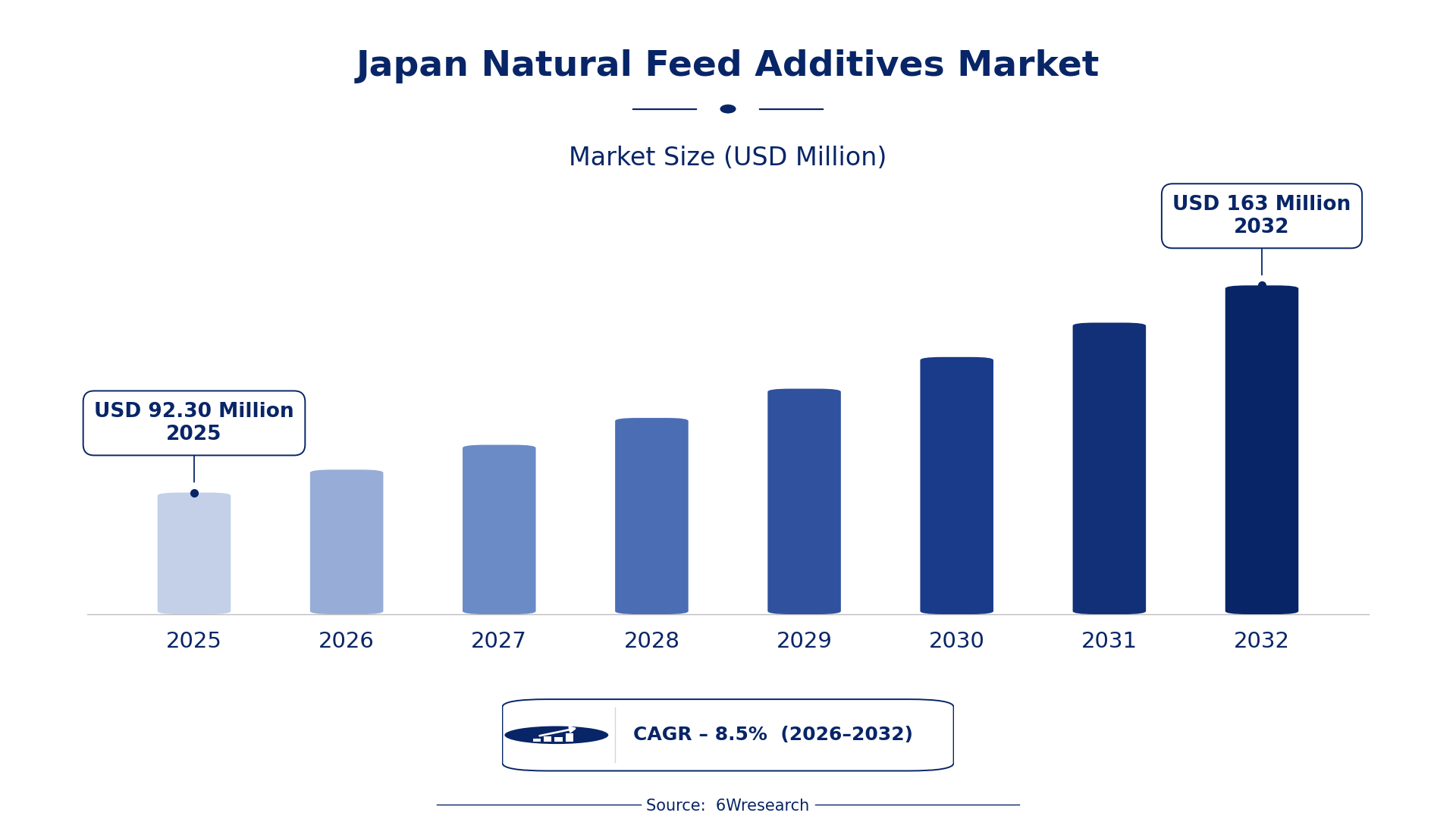
According to 6Wresearch internal database and industry insights, the Japan Natural Feed Additives Market was valued at USD 92.30 Million in 2025 and is projected to reach USD 163 Million by 2032, growing at a CAGR of approximately 8.5% during 2026–2032.
Japan Natural Feed Additives Market Highlights
| Report Metric | Details |
| Report Name | Japan Natural Feed Additives Market (2026-2032) |
| Market Size 2025 | USD 92.30 Million |
| Market Size 2032 | USD 163 Million |
| Absolute Growth 2025–2032 | USD 70.70 Million |
| CAGR 2026–2032 | 8.5% |
| Peak Annual Growth | 9.9% in 2026 |
| Forecast Period | 2026–2032 |
| Historical Data | 2022–2025 |
| Base Year | 2025 |
| Leading Additive Type, 2025 | Probiotics (43% share) |
| Leading Source Material, 2025 | Bacterial Cultures (39% share) |
| Leading Distribution Channel, 2025 | Livestock Suppliers (41% share) |
| Leading End User, 2025 | Poultry & Swine Farms (43% share) |
| Fastest-Growing Additive Type | Phytogenics (12.2% CAGR) |
| Fastest-Growing Source Material | Plant Extracts (11.8% CAGR) |
| Fastest-Growing Distribution Channel | Online Agricultural Stores (10.9% CAGR) |
| Fastest-Growing End User | Aquaculture Farms (11.0% CAGR) |
| Growing Sector | Aquaculture Farms |
| Key End Users | Poultry & Swine Farms, Dairy Farmers, Ruminant Feed Mills, Aquaculture Farms |
Japan Natural Feed Additives Market Year-wise Growth Rate and Key Drivers (2022–2032)
This graph illustrates the annual growth rates of the market from 2022 to 2032, highlighting a steady upward trajectory and projected market expansion over the forecast period.
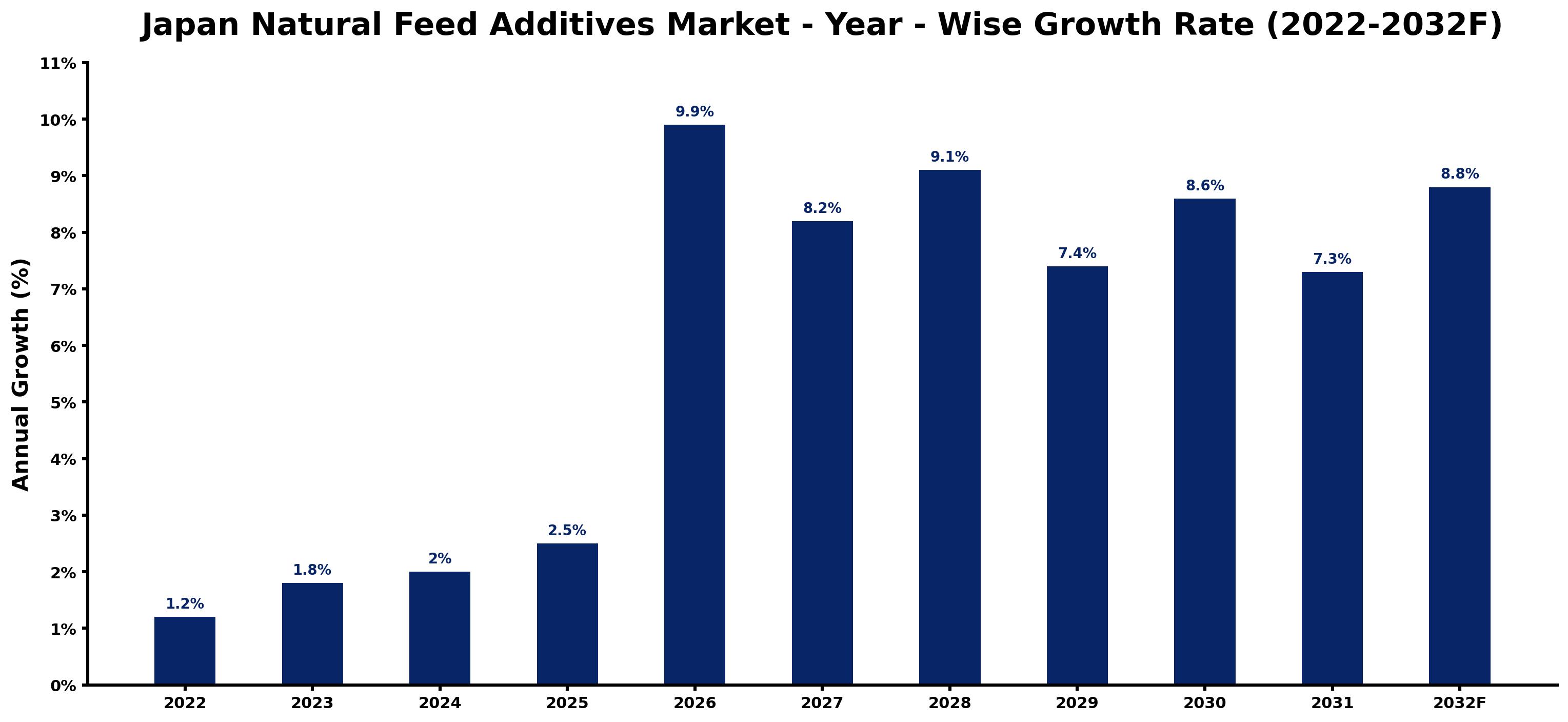
For each year, the table pairs the estimated growth rate with the leading influence on demand, showing how the drivers changed across the period.
| Year | Estimated Annual Growth (%) | Market Rationale |
| 2022 | 1.2 | The market experienced steady growth, driven by increasing health awareness among livestock producers. |
| 2023 | 1.8 | Growth accelerated as poultry farms adopted more natural feed additives for improved animal health. |
| 2024 | 2.0 | The trend continued with rising demand for probiotics in animal feed formulations. |
| 2025 | 2.5 | Growth peaked as the livestock sector expanded, contributing to the economy. |
| 2026 | 9.9 | The market saw a sharp increase due to heightened focus on organic feed under new regulations. |
| 2027 | 8.2 | Growth slowed slightly as the market adjusted to the rapid expansion of the previous year. |
| 2028 | 9.1 | Demand increased again as aquaculture farms began using more feed additives for fish health. |
| 2029 | 7.4 | The market experienced a slowdown as growth stabilised after the previous surge in demand. |
| 2030 | 8.6 | Growth picked up as dairy farmers increasingly relied on additives for milk production. |
| 2031 | 7.3 | A slight slowdown occurred as the market matured and demand stabilised. |
| 2032 | 8.8 | The market is projected to grow as health-conscious practices in livestock continue to rise. |
Note: Market size estimations and growth projections presented in this report are based on 6Wresearch's proprietary forecasting methodology, utilizing the latest available industry data, government publications, and primary research inputs.
Japan Natural Feed Additives Market Synopsis
Natural feed additives are substances derived from natural sources that improve the nutrition and health of livestock. The Japan Natural Feed Additives Market is growing as the poultry population reaches approximately 150 million, and the livestock sector contributes around 1.3 trillion JPY to the economy. Demand is rising due to an emphasis on health and safety, driven by regulations such as the Feed Safety Law, which encourages the use of organic and safe feed ingredients.
Market Dynamics Impact Analysis (2026–2032)
| Factor | Type | Impact | Primary Segment Affected |
| Increased health awareness among livestock producers | Driver | High | Probiotics |
| Rising demand for organic feed due to government initiatives | Driver | High | Organic Acids |
| Growing poultry population creates a need for high-quality feed additives | Opportunity | High | Poultry & Swine Farms |
| Expansion of online agricultural stores facilitates access to feed additives | Opportunity | Medium | Online Agricultural Stores |
| Regulatory compliance costs for feed safety management | Restraint | High | Animal Feed Distributors |
| Limited awareness of natural feed additives among smaller farms | Restraint | Medium | Livestock Suppliers |
| High costs associated with implementing new feed safety standards | Challenge | High | Animal Feed Distributors |
| Competition from synthetic feed additives affecting market share | Challenge | Medium | Probiotics |
Evaluation of Drivers in Japan Natural Feed Additives Market (2026–2032)
Key forces behind demand, with the segment each one moves most, are listed below.
| Drivers | Primary Segment Affected | Why It Matters (Evidence) |
| Growing adoption of probiotics in animal feed formulations | Probiotics | Probiotics are included in 30% of animal feed formulations, enhancing gut health and driving demand from livestock suppliers. |
| Increased focus on organic feed due to consumer preferences | Organic Acids | Organic acids are used in over 40% of poultry feed, responding to consumer demand for healthier meat products. |
| Expansion of the poultry population in Japan | Poultry & Swine Farms | Japan's poultry population is approximately 150 million, leading to higher feed additive consumption among farms. |
| Rising aquaculture feed additive usage | Aquaculture Farms | Aquaculture farms have seen a 20% increase in feed additive usage since 2020, reflecting growing health awareness. |
| Support from the Japan Feed Association for product development | Phytogenics | The association promotes phytogenics, which are increasingly used in 25% of swine feed, enhancing market growth. |
Volumes grow on the back of Japan's expanding poultry population, which is approximately 150 million, creating increased demand for high-quality feed additives. Probiotics are included in 30% of animal feed formulations, improving gut health and driving purchases from livestock suppliers. The focus on organic feed has risen as organic acids are used in over 40% of poultry feed, aligning with consumer preferences for healthier products. Aquaculture farms have seen a 20% increase in feed additive usage since 2020, reflecting a growing awareness of fish health. Support from the Japan Feed Association for product development further boosts the use of phytogenics, which are now in 25% of swine feed formulations.
Evaluation of Restraints in Japan Natural Feed Additives Market
The table below lists the restraints and the evidence behind each.
| Market Restraint | Primary Segment Affected | Why It Matters (Evidence) |
| Regulatory compliance costs for feed safety management | Animal Feed Distributors | Compliance with the Food Sanitation Act increases operational costs for distributors, impacting their profitability. |
| Limited awareness of natural feed additives among smaller farms | Livestock Suppliers | Smaller farms often lack knowledge about the benefits of natural feed additives, restricting their purchasing. |
| High costs associated with implementing new feed safety standards | Animal Feed Distributors | Investments in compliance with the Food Sanitation Act can strain financial resources for distributors. |
| Competition from synthetic feed additives affecting market share | Probiotics | Synthetic alternatives often offer lower prices, making it challenging for natural additives to compete. |
| Market fragmentation leading to inconsistent supply chains | Livestock Suppliers | A fragmented market can disrupt the availability of natural feed additives, affecting farm operations. |
Japan Natural Feed Additives Market Challenges
Japan's poultry population is approximately 150 million, yet compliance with the Organic Agriculture Promotion Act incurs costs exceeding 20 million JPY for smaller producers, limiting their access to organic markets. Increased competition from imported natural feed additives pressures local suppliers, forcing them to lower prices, which can compromise product quality. The rising costs of raw materials, particularly plant extracts, have surged by 15%, squeezing profit margins for producers and leading to higher prices for livestock farms. Supply chain disruptions have delayed shipments by up to six weeks, creating challenges for farms that rely on timely delivery of essential additives.
Trends in the Japan Natural Feed Additives Market
These developments are changing demand patterns in the Japan Natural Feed Additives Market.
- Shift towards Organic Feed in Poultry Farming: Poultry farms in the Tokyo region are increasingly adopting organic feed to address consumer health concerns. Approximately 40% of poultry feed now comprises organic ingredients, reflecting this growing trend.
- Increase in Online Agricultural Stores for Feed Additives: Online agricultural stores are becoming a preferred channel for purchasing feed additives, with a projected growth rate of 10.9%. This trend enables farmers to conveniently access a wider range of products.
- Rising Use of Phytogenics in Swine Feed: Phytogenics are increasingly incorporated in 25% of swine feed in Japan, as farmers seek natural alternatives for improving animal health and performance. This trend illustrates a broader movement towards natural solutions.
- Growth in Aquaculture Feed Additive Usage: Aquaculture farms have recorded a 20% increase in feed additive usage since 2020, driven by a focus on fish health and nutrition. This trend underscores the expanding role of additives in aquaculture.
Investment Opportunities in the Japan Natural Feed Additives Market
Investors looking at the Japan Natural Feed Additives Market should consider the following areas.
- Investment in Organic Feed Production: With the livestock sector projected to grow, a gap exists for organic feed production, estimated at 500 million JPY. Livestock suppliers are seeking organic options to meet rising demand.
- Expansion of Online Sales Channels: The online agricultural store sector is projected to grow by 10.9%, indicating a need for suppliers to invest in e-commerce platforms. This presents an entry point for distributors to reach more farmers.
- Development of Phytogenic Products: Phytogenics are used in 25% of swine feed, highlighting a growing market for these natural additives. Suppliers can collaborate with local farms to develop tailored phytogenic solutions.
- Focus on Aquaculture Health Solutions: Aquaculture feed additive usage has increased by 20% since 2020, creating opportunities for suppliers to provide targeted health solutions. Collaborating with aquaculture farms can facilitate market entry.
Government Initiatives in the Japan Natural Feed Additives Market
The amendment of the Food Sanitation Act in 2018, fully applied in June 2021, made HACCP-based hygiene management mandatory for food businesses, adding a layer of safety for producers and buyers of natural feed additives. This law strengthens the regulatory framework for feed safety, ensuring that all additives meet stringent hygiene standards.
The government allocated 500 million JPY for livestock health initiatives in 2023, administered by the Ministry of Agriculture, Forestry and Fisheries. This funding supports the development and promotion of safe and effective feed additives, benefiting both producers and end-users.
Future Insight of the Japan Natural Feed Additives Market
The government's allocation of 500 million JPY for livestock health initiatives will drive investment in advanced production facilities, prompting suppliers to improve operational efficiency. The ongoing adoption of ISO 22000 will standardise safety management practices, ensuring consistent quality for buyers. A projected increase in the usage of natural feed additives will stimulate innovation among suppliers, as they develop new formulations to meet specific market needs. Support for organic feed initiatives will encourage local producers to diversify their offerings, benefiting both buyers and suppliers.
Market Segmentation Analysis
Japan Natural Feed Additives Market report covers a detailed analysis of the following market segments:
By Additive Type – Probiotics Lead, Phytogenics Expected to Grow Fastest
According to Saurav Kr Singh, Senior Research Analyst at 6Wresearch, with 43% of additive type revenue in 2025, Probiotics was the largest category. Probiotics hold the largest share as they are widely utilised to improve gut health in livestock, particularly in poultry where they feature in 30% of feed formulations. This extensive application creates a robust demand that supports their market dominance. Phytogenics are projected to grow fastest, at a CAGR of 12.2% during 2026–2032. Phytogenics are experiencing rapid growth due to their recognised antimicrobial properties, with notable incorporation in 25% of swine feed. This trend towards natural alternatives is likely to accelerate their adoption rate further. Suppliers should focus on expanding their probiotic offerings while also developing phytogenic products to meet evolving market demands.
By Source Material – Bacterial Cultures Lead, Plant Extracts Expected to Grow Fastest
Bacterial Cultures held 39% of the Japan Natural Feed Additives Market by source material in 2025. Bacterial cultures dominate the market as they are essential for 70% of probiotic formulations used in livestock feed, making them a critical component for ensuring animal health. Their established role in feed formulations solidifies their leading position. The quickest growth will come from Plant Extracts, forecast to expand at a CAGR of 11.8% between 2026 and 2032. Plant extracts are rapidly gaining traction due to their natural flavouring and health benefits, with a current usage in 35% of ruminant feeds. This growth reflects a shift towards more natural ingredients in feed formulations. Buyers may benefit from diversifying their feed sources to include more plant-based materials as demand for natural products rises.
By Distribution Channel – Livestock Suppliers Lead, Online Agricultural Stores Expected to Grow Fastest
In 2025, Livestock Suppliers led the distribution channel split with a 41% share. Livestock suppliers are the primary distributors of feed additives, ensuring essential products reach farms that rely on them for animal health. Their established relationships with these farms create a reliable supply chain, solidifying their leading position. Over 2026–2032, Online Agricultural Stores are expected to post the fastest growth, at a CAGR of 10.9%. Online agricultural stores are emerging as the fastest-growing distribution channel, reflecting farmers' increasing preference for digital platforms to purchase feed additives. This trend indicates a shift towards greater convenience and accessibility in the market. Suppliers must enhance their online strategies to effectively engage with the growing number of buyers opting for digital purchasing.
By End User – Poultry & Swine Farms Lead, Aquaculture Farms Expected to Grow Fastest
Poultry & Swine Farms accounted for 43% of the market by end user in 2025. Poultry and swine farms are the major end-users, driving substantial demand for natural feed additives to enhance livestock health and productivity. The significant poultry population in Japan, approximately 150 million, underscores their vital role in this market. Aquaculture Farms are set to record the highest CAGR in this split, 11.0% over 2026–2032. Aquaculture farms represent the fastest-growing end-user segment, with a 20% increase in feed additive usage since 2020, highlighting a greater emphasis on fish health and sustainable practices. This growth signals a need for comprehensive feed solutions in aquatic farming. Suppliers should develop specialised products tailored for aquaculture to capitalise on this rapidly expanding segment.
Key Attractiveness of the Report
- 10 Years of Market Numbers
- Historical Data Starting from 2022 to 2025
- Base Year 2025
- Forecast Data until 2032
- Key Performance Indicators Impacting the Market
- Major Upcoming Developments and Projects
Key Highlights of the Report:
- Japan Natural Feed Additives Market Outlook
- Market Size of Japan Natural Feed Additives Market, 2025
- Forecast of Japan Natural Feed Additives Market, 2032
- Historical Data and Forecast of Japan Natural Feed Additives Revenues & Volume for the Period 2022-2032F
- Japan Natural Feed Additives Market Trend Evolution
- Japan Natural Feed Additives Market Drivers and Challenges
- Japan Natural Feed Additives Price Trends
- Japan Natural Feed Additives Porter's Five Forces
- Japan Natural Feed Additives Industry Life Cycle
- Historical Data and Forecast of Japan Natural Feed Additives Market Revenues & Volume By Additive Type for the Period 2022-2032F
- Historical Data and Forecast of Japan Natural Feed Additives Market Revenues & Volume By Probiotics for the Period 2022-2032F
- Historical Data and Forecast of Japan Natural Feed Additives Market Revenues & Volume By Enzyme Preparations for the Period 2022-2032F
- Historical Data and Forecast of Japan Natural Feed Additives Market Revenues & Volume By Phytogenics for the Period 2022-2032F
- Historical Data and Forecast of Japan Natural Feed Additives Market Revenues & Volume By Organic Acids for the Period 2022-2032F
- Historical Data and Forecast of Japan Natural Feed Additives Market Revenues & Volume By Source Material for the Period 2022-2032F
- Historical Data and Forecast of Japan Natural Feed Additives Market Revenues & Volume By Bacterial Cultures for the Period 2022-2032F
- Historical Data and Forecast of Japan Natural Feed Additives Market Revenues & Volume By Fungal/Yeast Sources for the Period 2022-2032F
- Historical Data and Forecast of Japan Natural Feed Additives Market Revenues & Volume By Plant Extracts for the Period 2022-2032F
- Historical Data and Forecast of Japan Natural Feed Additives Market Revenues & Volume By Fermentation Products for the Period 2022-2032F
- Historical Data and Forecast of Japan Natural Feed Additives Market Revenues & Volume By Distribution Channel for the Period 2022-2032F
- Historical Data and Forecast of Japan Natural Feed Additives Market Revenues & Volume By Livestock Suppliers for the Period 2022-2032F
- Historical Data and Forecast of Japan Natural Feed Additives Market Revenues & Volume By Animal Feed Distributors for the Period 2022-2032F
- Historical Data and Forecast of Japan Natural Feed Additives Market Revenues & Volume By Online Agricultural Stores for the Period 2022-2032F
- Historical Data and Forecast of Japan Natural Feed Additives Market Revenues & Volume By Direct Sales for the Period 2022-2032F
- Historical Data and Forecast of Japan Natural Feed Additives Market Revenues & Volume By End User for the Period 2022-2032F
- Historical Data and Forecast of Japan Natural Feed Additives Market Revenues & Volume By Poultry & Swine Farms for the Period 2022-2032F
- Historical Data and Forecast of Japan Natural Feed Additives Market Revenues & Volume By Ruminant Feed Mills for the Period 2022-2032F
- Historical Data and Forecast of Japan Natural Feed Additives Market Revenues & Volume By Dairy Farmers for the Period 2022-2032F
- Historical Data and Forecast of Japan Natural Feed Additives Market Revenues & Volume By Aquaculture Farms for the Period 2022-2032F
- Japan Natural Feed Additives Import Export Trade Statistics
- Market Opportunity Assessment By Additive Type
- Market Opportunity Assessment By Source Material
- Market Opportunity Assessment By Distribution Channel
- Market Opportunity Assessment By End User
- Japan Natural Feed Additives Top Companies Market Share
- Japan Natural Feed Additives Competitive Benchmarking By Technical and Operational Parameters
- Japan Natural Feed Additives Company Profiles
- Japan Natural Feed Additives Key Strategic Recommendations
Market Covered
Coverage by segment is as follows.
By Additive Type
- Probiotics
- Enzyme Preparations
- Phytogenics
- Organic Acids
By Source Material
- Bacterial Cultures
- Fungal/Yeast Sources
- Plant Extracts
- Fermentation Products
By Distribution Channel
- Livestock Suppliers
- Animal Feed Distributors
- Online Agricultural Stores
- Direct Sales
By End User
- Poultry & Swine Farms
- Ruminant Feed Mills
- Dairy Farmers
- Aquaculture Farms






































