Japan Neem-Based Pesticides Market Size & Growth Rate
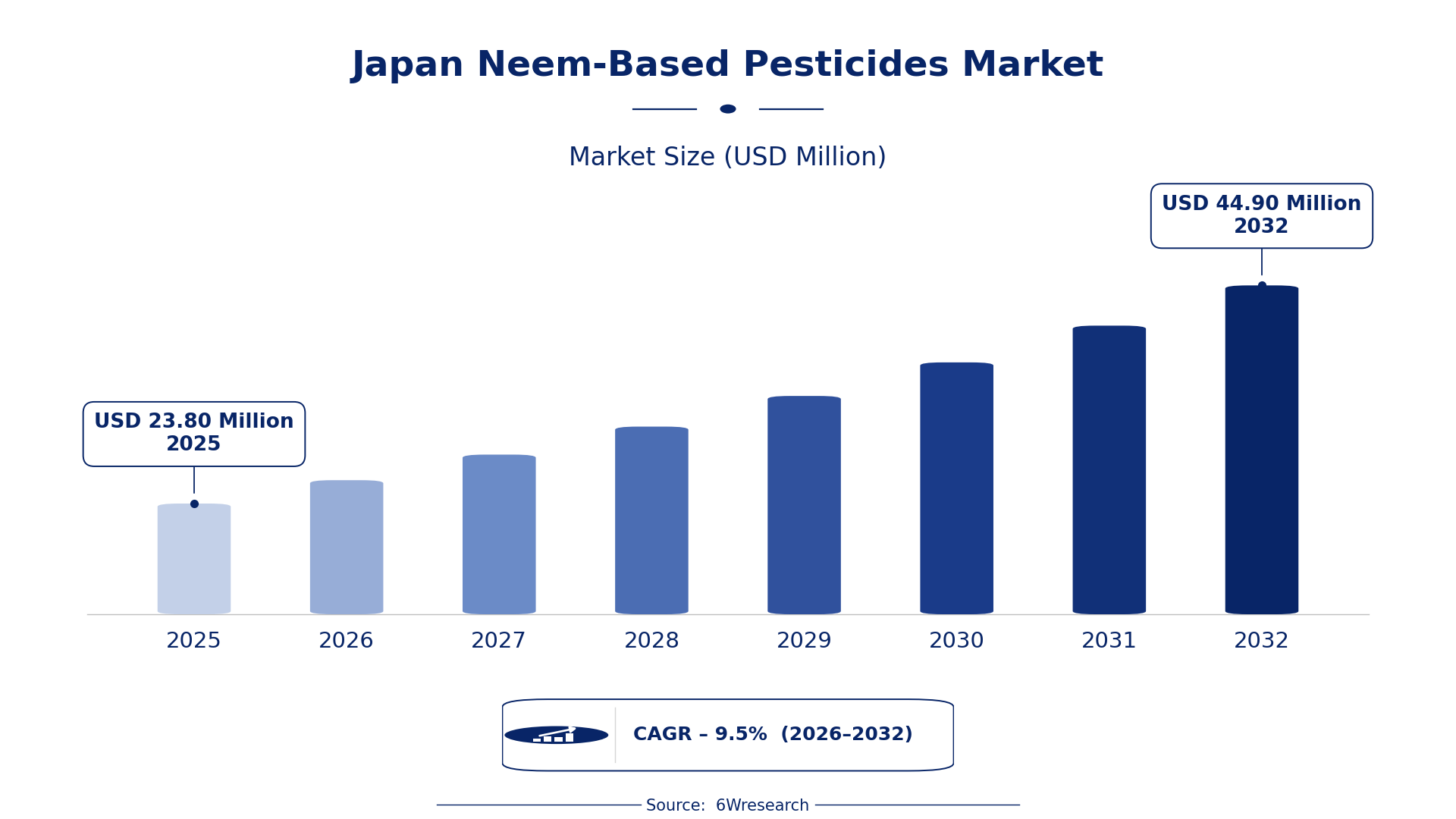
According to 6Wresearch internal database and industry insights, the Japan Neem-Based Pesticides Market was valued at USD 23.80 Million in 2025 and is projected to reach USD 44.90 Million by 2032, growing at a CAGR of approximately 9.5% during 2026–2032.
Japan Neem-Based Pesticides Market Highlights
| Report Metric | Details |
| Report Name | Japan Neem-Based Pesticides Market (2026-2032) |
| Market Size 2025 | USD 23.80 Million |
| Market Size 2032 | USD 44.90 Million |
| Absolute Growth 2025–2032 | USD 21.10 Million |
| CAGR 2026–2032 | 9.5% |
| Peak Annual Growth | 10.7% in 2028 |
| Forecast Period | 2026–2032 |
| Historical Data | 2022–2025 |
| Base Year | 2025 |
| Leading Pesticide Type, 2025 | Azadirachtin Extracts (51% share) |
| Leading Formulation Type, 2025 | Emulsifiable Concentrate (35% share) |
| Leading Distribution Channel, 2025 | Agrochemical Distributors (52% share) |
| Leading End User, 2025 | Crop Farmers (41% share) |
| Fastest-Growing Pesticide Type | Neem Oil Concentrates (12.9% CAGR) |
| Fastest-Growing Formulation Type | Cold-Pressed (13.2% CAGR) |
| Fastest-Growing Distribution Channel | Online Agriculture Stores (11.9% CAGR) |
| Fastest-Growing End User | Horticulturists (12.3% CAGR) |
| Growing Sector | Horticulturists |
| Key End Users | Crop Farmers, Horticulturists, Organic Farms, Soil Health Producers |
Japan Neem-Based Pesticides Market Year-wise Growth Rate and Key Drivers (2022–2032)
This graph illustrates the annual growth rates of the market from 2022 to 2032, highlighting a steady upward trajectory and projected market expansion over the forecast period.
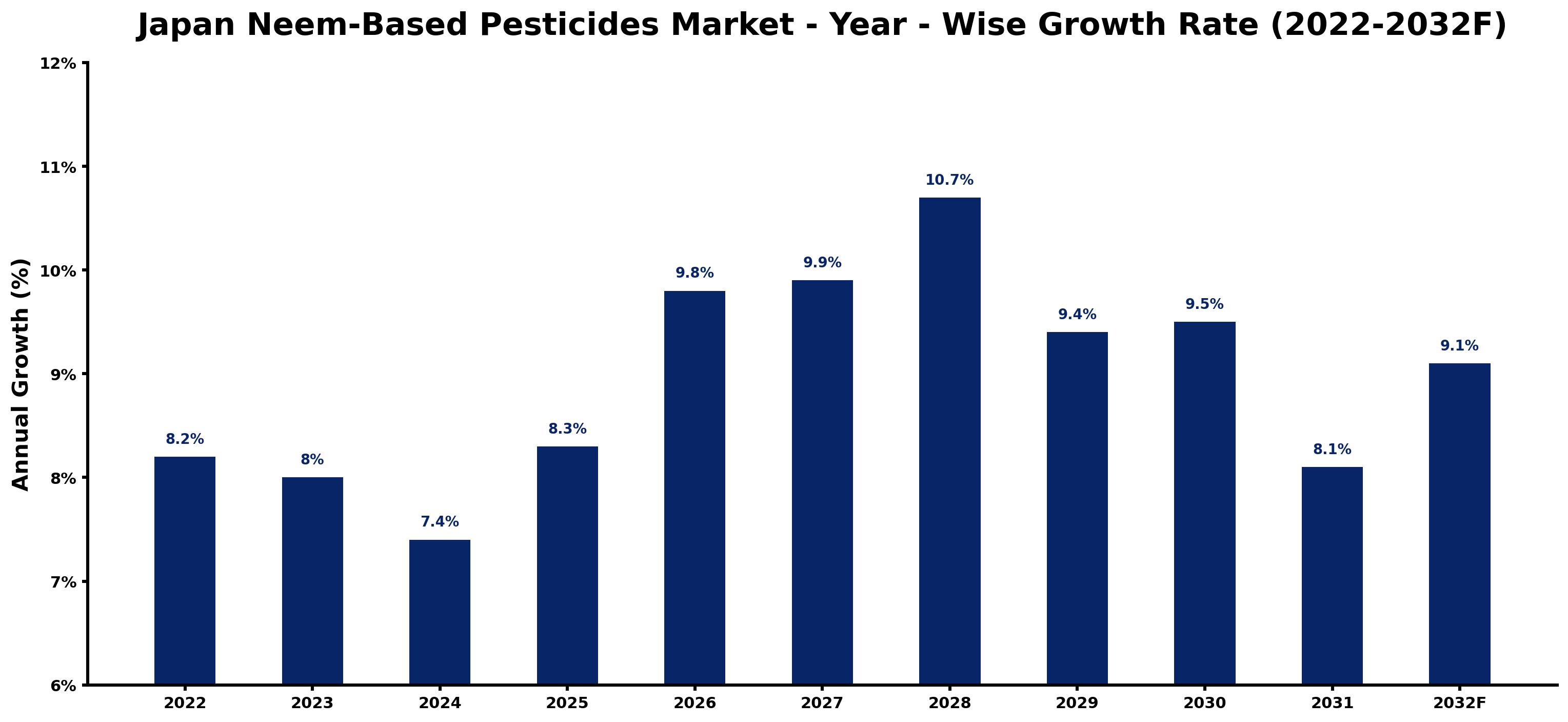
For each year, the table pairs the estimated growth rate with the leading influence on demand, showing how the drivers changed across the period.
| Year | Estimated Annual Growth (%) | Market Rationale |
| 2022 | 8.2 | The market showed steady growth with increasing interest in sustainable farming practices. |
| 2023 | 8.0 | Growth slowed slightly as the market adjusted to previous high levels of demand. |
| 2024 | 7.4 | Demand continued to grow, albeit at a slower pace as market conditions stabilised. |
| 2025 | 8.3 | The market experienced a rebound, driven by rising organic farming activities and demand. |
| 2026 | 9.8 | Growth is expected to accelerate as more farmers adopt neem-based pesticides for sustainable practices. |
| 2027 | 9.9 | The market is projected to maintain momentum with continued investments in organic farming initiatives. |
| 2028 | 10.7 | A peak in growth is anticipated, reflecting heightened awareness of sustainable agriculture. |
| 2029 | 9.4 | Growth is expected to slow as market saturation begins to impact the rate of new customer acquisition. |
| 2030 | 9.5 | Demand will increase again, supported by ongoing government initiatives promoting sustainable practices. |
| 2031 | 8.1 | Growth will moderate as the market adjusts to a more mature phase of development. |
| 2032 | 9.1 | The market is projected to grow steadily as consumer preferences shift towards organic products. |
Note: Market size estimations and growth projections presented in this report are based on 6Wresearch's proprietary forecasting methodology, utilizing the latest available industry data, government publications, and primary research inputs.
Japan Neem-Based Pesticides Market Synopsis
Neem-based pesticides, derived from the neem tree, are essential for pest control in agriculture, especially in organic farming. Their production involves extracting active compounds from neem seeds and leaves, which are effective in managing pests. The Japan Neem-Based Pesticides Market is expanding due to the growth of organic farming, now covering 1.5 million hectares, and government initiatives aimed at increasing organic pesticide use by 20% by 2023. This trend is supported by over 10,000 registered organic farms and the recognition of azadirachtin as a biopesticide under Japanese regulations.
Market Dynamics Impact Analysis (2026–2032)
| Factor | Type | Impact | Primary Segment Affected |
| Increasing adoption of sustainable agricultural practices | Driver | High | Neem Oil Concentrates |
| Growth of the organic farming sector | Driver | High | Azadirachtin Extracts |
| Rising demand for organic pest control solutions | Opportunity | High | Emulsifiable Concentrate |
| Expansion of online agriculture stores for pesticide sales | Opportunity | Medium | Online Agriculture Stores |
| Aging farmer population affecting adoption rates | Restraint | High | Crop Farmers |
| Limited awareness of neem-based products among new farmers | Restraint | Medium | Horticulturists |
| High production costs associated with neem extraction | Challenge | High | Neem Oil Concentrates |
| Competition from synthetic pesticide alternatives | Challenge | Medium | Azadirachtin Extracts |
Evaluation of Drivers in Japan Neem-Based Pesticides Market (2026–2032)
These are the developments adding the most demand over the forecast period.
| Drivers | Primary Segment Affected | Why It Matters (Evidence) |
| Increased organic farming acreage | Neem Oil Concentrates | The organic farming sector in Japan has grown to 1.5 million hectares, driving demand for neem oil. |
| Growing number of registered organic farms | Azadirachtin Extracts | Japan has over 10,000 registered organic farms, increasing the need for effective pest control solutions. |
| Government initiatives promoting organic pesticide use | Emulsifiable Concentrate | A program launched in 2023 aims to increase organic pesticide use by 20%, boosting demand. |
| Rising consumer preference for organic products | Cold-Pressed | As consumers favour organic options, farmers are more likely to purchase neem-based pesticides. |
| Technological advancements in extraction methods | Granular Fertilizer | Innovations in neem extraction are improving product availability and quality for soil health producers. |
Purchasing is picking up as the organic farming sector expands, now covering 1.5 million hectares, leading to increased demand for neem-based pesticides. Over 10,000 registered organic farms in Japan are actively seeking effective pest control solutions, particularly azadirachtin extracts. Consumer preference for organic products continues to rise, encouraging farmers to adopt neem oil concentrates. Advances in extraction methods are improving product quality, making neem-based options more appealing to soil health producers.
Evaluation of Restraints in Japan Neem-Based Pesticides Market
The table below lists the restraints and the evidence behind each.
| Market Restraint | Primary Segment Affected | Why It Matters (Evidence) |
| High production costs for neem extraction | Neem Oil Concentrates | Production costs can exceed 30% of the total price, impacting affordability for farmers. |
| Limited awareness of neem products among new farmers | Horticulturists | Many new farmers lack knowledge about neem-based solutions, hindering adoption rates. |
| Regulatory hurdles for new pesticide approvals | Emulsifiable Concentrate | Stringent regulations delay the entry of new neem-based products into the market. |
| Competition from cheaper synthetic alternatives | Azadirachtin Extracts | Synthetic pesticides often offer lower prices, making them more attractive to cost-sensitive farmers. |
| Inconsistent supply of neem raw materials | Cold-Pressed | Supply chain disruptions can lead to shortages, affecting product availability for producers. |
Japan Neem-Based Pesticides Market Challenges
High costs of neem-based pesticides deter buyers, who often pay 15% more than synthetic alternatives. Limited local supply restricts availability, compelling buyers to import, which can delay deliveries by up to three months. Rising production costs challenge suppliers, with over 1,000 tons of neem oil produced in 2022, yet many struggle to meet the increasing demand. An ageing farmer population, with an average age of 67 years, complicates skills development and adoption of neem products, resulting in lower usage rates among younger farmers entering agriculture.
Trends in the Japan Neem-Based Pesticides Market
The trends below show where the Japan Neem-Based Pesticides Market is heading.
- Shift towards Organic Farming Practices: Since 2022, there has been a notable shift towards organic farming practices in Japan, with over 1.5 million hectares now dedicated to organic agriculture. This expansion is driving demand for neem-based pesticides, as farmers seek sustainable pest control solutions.
- Increased Online Sales Channels: The rise of online agriculture stores has transformed how farmers purchase neem-based pesticides, with this channel growing rapidly. In 2023, online sales accounted for 15% of total pesticide sales, making it a key distribution method.
- Growing Recognition of Biopesticides: In 2023, azadirachtin was officially recognised as a biopesticide under Japanese regulations, enhancing its credibility among farmers. This recognition is expected to boost sales of neem-based products as farmers seek environmentally friendly options.
- Expansion of Government Support Programs: The Japanese government launched a programme in 2023 aimed at increasing organic pesticide use by 20%. This initiative is expected to drive demand for neem-based pesticides, aligning with national sustainability goals.
Investment Opportunities in the Japan Neem-Based Pesticides Market
Investors looking at the Japan Neem-Based Pesticides Market should consider the following areas.
- Tokyo Region: The Tokyo region is a major hub for organic farming, presenting opportunities for suppliers of neem-based pesticides. With over 1,000 tons of neem oil produced in 2022, there is a growing demand for effective pest control solutions.
- Neem Oil Concentrates: Investing in neem oil concentrates is timely, as the organic farming sector expands. Crop farmers are increasingly looking for sustainable pest control options, creating a demand for high-quality neem products.
- Organic Farms: With over 10,000 registered organic farms, there is a significant opportunity to supply neem-based pesticides. Collaborating with local agricultural offices can facilitate market entry and enhance product visibility.
- Current Market Trends: The current push for sustainable agriculture creates a ripe opportunity for neem-based pesticide suppliers. Engaging with the Japan Organic Agriculture Association can help in gaining market insights and certifications.
Government Initiatives in the Japan Neem-Based Pesticides Market
The PRTR Law (1999) mandates businesses to report releases of chemical substances, ensuring transparency in pesticide use. This law complements the Chemical Substances Control Law (1973), which requires evaluation of new chemical substances, promoting safer practices for neem-based pesticide producers.
The Ministry of Agriculture, Forestry and Fisheries oversees the implementation of programmes that support organic farming, including funding for research on neem efficacy. This support helps buyers understand the benefits of neem products and encourages adoption among farmers.
Future Insight of the Japan Neem-Based Pesticides Market
The government's initiative to increase organic pesticide use by 20% will reshape market dynamics, prompting suppliers to innovate. Enhanced research on neem efficacy will build trust among buyers, encouraging broader adoption. New standards from the Japan Organic Agriculture Association will elevate product quality and safety. As organic farming expands across 1.5 million hectares, suppliers must adapt their offerings to meet the rising demand for effective pest control solutions.
Market Segmentation Analysis
Japan Neem-Based Pesticides Market report covers a detailed analysis of the following market segments:
By Pesticide Type – Azadirachtin Extracts Lead, Neem Oil Concentrates Expected to Grow Fastest
According to Saurav Kr Singh, Senior Research Analyst at 6Wresearch, with 51% of pesticide type revenue in 2025, Azadirachtin Extracts was the largest category. Azadirachtin extracts hold the largest share due to their proven effectiveness as the primary active ingredient in neem pesticides, especially in organic farming. The production of over 1,000 tons of neem oil in Japan in 2022 underscores the strong demand for these extracts among farmers. Neem Oil Concentrates are projected to grow fastest, at a CAGR of 12.9% during 2026–2032. Neem oil concentrates are rapidly growing in popularity as they are increasingly used for pest control and improving plant health, particularly following the government's initiative to boost organic pesticide use by 20%. This growth indicates that as farmers become more aware of neem oil's advantages, demand will continue to rise. Suppliers should prioritise the development of neem oil concentrates to meet the increasing market demand.
By Formulation Type – Emulsifiable Concentrate Leads, Cold-Pressed Expected to Grow Fastest
The largest formulation type category in 2025 was Emulsifiable Concentrate, at 35% of revenue. Emulsifiable concentrates dominate the market as they are widely used for their straightforward application process and effectiveness in pest management. Their popularity is bolstered by local agricultural offices promoting their use among farmers in various regions. Cold-Pressed is set to record the highest CAGR in this split, 13.2% over 2026–2032. Cold-pressed formulations are experiencing rapid growth due to their method of extraction that retains neem oil's natural properties, appealing to users focused on sustainability. This trend is expected to continue as more farmers seek environmentally friendly solutions. Suppliers should expand their offerings of cold-pressed formulations to meet the increasing demand for sustainable products.
By Distribution Channel – Agrochemical Distributors Lead, Online Agriculture Stores Expected to Grow Fastest
In 2025, Agrochemical Distributors led the distribution channel split with a 52% share. Agrochemical distributors lead the distribution of neem-based pesticides, serving as the main link between manufacturers and farmers who need these products for effective crop management. Their established relationships within the agricultural sector ensure consistent supply to farmers across Japan. Over 2026–2032, Online Agriculture Stores are expected to post the fastest growth, at a CAGR of 11.9%. Online agriculture stores are the fastest-growing distribution channel, reflecting a shift towards digital purchasing as farmers seek convenience and improved access to products. This trend indicates that suppliers must strengthen their online strategies to capture this evolving market. Suppliers should enhance their online presence to better connect with a growing base of digital-savvy customers.
By End User – Crop Farmers Lead, Horticulturists Expected to Grow Fastest
Crop Farmers held 41% of the Japan Neem-Based Pesticides Market by end user in 2025. Crop farmers are the largest end user group for neem-based pesticides, relying heavily on these products for effective pest control in their agricultural practices. The substantial number of registered organic farms highlights the strong demand from this segment for sustainable pest management solutions. The quickest growth will come from Horticulturists, forecast to expand at a CAGR of 12.3% between 2026 and 2032. Horticulturists represent the fastest-growing end user segment, increasingly utilising neem-based pesticides for pest control in gardens and landscaping. The rising popularity of organic gardening practices is likely to further boost adoption among this group. Suppliers should focus their marketing efforts on horticulturists to capitalise on the growing interest in organic gardening.
Key Attractiveness of the Report
- 10 Years of Market Numbers
- Historical Data Starting from 2022 to 2025
- Base Year 2025
- Forecast Data until 2032
- Key Performance Indicators Impacting the Market
- Major Upcoming Developments and Projects
Key Highlights of the Report:
- Japan Neem-Based Pesticides Market Outlook
- Market Size of Japan Neem-Based Pesticides Market, 2025
- Forecast of Japan Neem-Based Pesticides Market, 2032
- Historical Data and Forecast of Japan Neem-Based Pesticides Revenues & Volume for the Period 2022-2032F
- Japan Neem-Based Pesticides Market Trend Evolution
- Japan Neem-Based Pesticides Market Drivers and Challenges
- Japan Neem-Based Pesticides Price Trends
- Japan Neem-Based Pesticides Porter's Five Forces
- Japan Neem-Based Pesticides Industry Life Cycle
- Historical Data and Forecast of Japan Neem-Based Pesticides Market Revenues & Volume By Pesticide Type for the Period 2022-2032F
- Historical Data and Forecast of Japan Neem-Based Pesticides Market Revenues & Volume By Azadirachtin Extracts for the Period 2022-2032F
- Historical Data and Forecast of Japan Neem-Based Pesticides Market Revenues & Volume By Neem Oil Concentrates for the Period 2022-2032F
- Historical Data and Forecast of Japan Neem-Based Pesticides Market Revenues & Volume By Neem Cake for the Period 2022-2032F
- Historical Data and Forecast of Japan Neem-Based Pesticides Market Revenues & Volume By Neem Compost for the Period 2022-2032F
- Historical Data and Forecast of Japan Neem-Based Pesticides Market Revenues & Volume By Formulation Type for the Period 2022-2032F
- Historical Data and Forecast of Japan Neem-Based Pesticides Market Revenues & Volume By Emulsifiable Concentrate for the Period 2022-2032F
- Historical Data and Forecast of Japan Neem-Based Pesticides Market Revenues & Volume By Cold-Pressed for the Period 2022-2032F
- Historical Data and Forecast of Japan Neem-Based Pesticides Market Revenues & Volume By Granular Fertilizer for the Period 2022-2032F
- Historical Data and Forecast of Japan Neem-Based Pesticides Market Revenues & Volume By Powder Form for the Period 2022-2032F
- Historical Data and Forecast of Japan Neem-Based Pesticides Market Revenues & Volume By Distribution Channel for the Period 2022-2032F
- Historical Data and Forecast of Japan Neem-Based Pesticides Market Revenues & Volume By Agrochemical Distributors for the Period 2022-2032F
- Historical Data and Forecast of Japan Neem-Based Pesticides Market Revenues & Volume By Online Agriculture Stores for the Period 2022-2032F
- Historical Data and Forecast of Japan Neem-Based Pesticides Market Revenues & Volume By Fertilizer Dealers for the Period 2022-2032F
- Historical Data and Forecast of Japan Neem-Based Pesticides Market Revenues & Volume By Direct Sales for the Period 2022-2032F
- Historical Data and Forecast of Japan Neem-Based Pesticides Market Revenues & Volume By End User for the Period 2022-2032F
- Historical Data and Forecast of Japan Neem-Based Pesticides Market Revenues & Volume By Crop Farmers for the Period 2022-2032F
- Historical Data and Forecast of Japan Neem-Based Pesticides Market Revenues & Volume By Horticulturists for the Period 2022-2032F
- Historical Data and Forecast of Japan Neem-Based Pesticides Market Revenues & Volume By Organic Farms for the Period 2022-2032F
- Historical Data and Forecast of Japan Neem-Based Pesticides Market Revenues & Volume By Soil Health Producers for the Period 2022-2032F
- Japan Neem-Based Pesticides Import Export Trade Statistics
- Market Opportunity Assessment By Pesticide Type
- Market Opportunity Assessment By Formulation Type
- Market Opportunity Assessment By Distribution Channel
- Market Opportunity Assessment By End User
- Japan Neem-Based Pesticides Top Companies Market Share
- Japan Neem-Based Pesticides Competitive Benchmarking By Technical and Operational Parameters
- Japan Neem-Based Pesticides Company Profiles
- Japan Neem-Based Pesticides Key Strategic Recommendations
Market Covered
The following segment groups are covered in the report.
By Pesticide Type
- Azadirachtin Extracts
- Neem Oil Concentrates
- Neem Cake
- Neem Compost
By Formulation Type
- Emulsifiable Concentrate
- Cold-Pressed
- Granular Fertilizer
- Powder Form
By Distribution Channel
- Agrochemical Distributors
- Online Agriculture Stores
- Fertilizer Dealers
- Direct Sales
By End User
- Crop Farmers
- Horticulturists
- Organic Farms
- Soil Health Producers






































