Japan Neuropathic Pain Market Size & Growth Rate
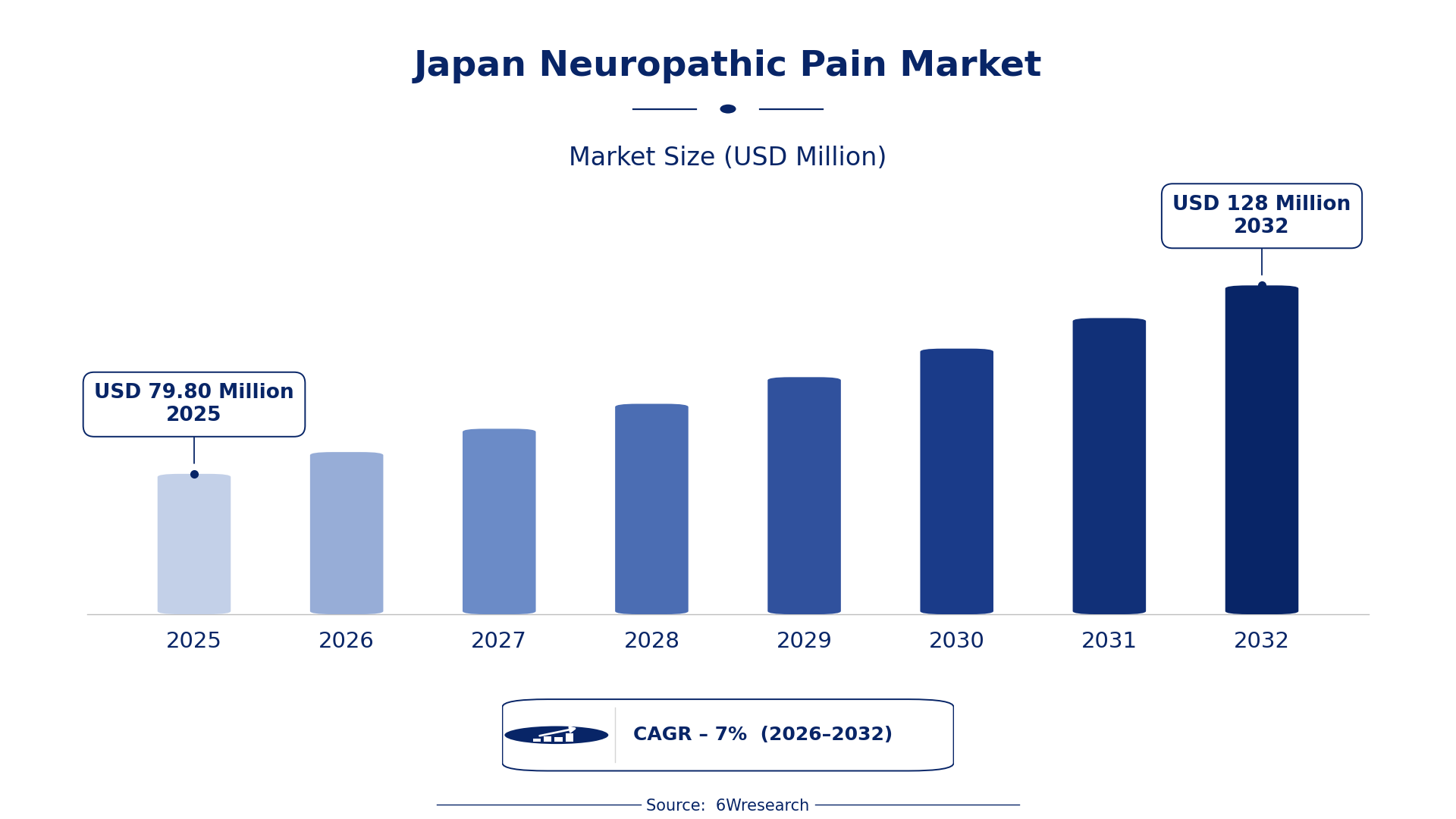
According to 6Wresearch internal database and industry insights, the Japan Neuropathic Pain Market was valued at USD 79.80 Million in 2025 and is projected to reach USD 128 Million by 2032, growing at a CAGR of approximately 7% during 2026–2032.
Japan Neuropathic Pain Market Highlights
| Report Metric | Details |
| Report Name | Japan Neuropathic Pain Market (2026-2032) |
| Market Size 2025 | USD 79.80 Million |
| Market Size 2032 | USD 128 Million |
| Absolute Growth 2025–2032 | USD 48.20 Million |
| CAGR 2026–2032 | 7% |
| Peak Annual Growth | 7.9% in 2026 |
| Forecast Period | 2026–2032 |
| Historical Data | 2022–2025 |
| Base Year | 2025 |
| Leading Type, 2025 | Spinal Cord Stimulation (SCS) Devices (42% share) |
| Leading Product Type, 2025 | Rechargeable and Non-Rechargeable (100% share) |
| Leading Procedure, 2025 | Invasive and Non-Invasive (100% share) |
| Leading Technology, 2025 | Transcutaneous Electrical Nerve Stimulation (53% share) |
| Leading Modality, 2025 | Stationary (59% share) |
| Fastest-Growing Type | External Peripheral Nerve Stimulation (10.0% CAGR) |
| Fastest-Growing Technology | Transcranial Magnetic Stimulation (10.2% CAGR) |
| Fastest-Growing Modality | Portable (9.1% CAGR) |
| Growing Sector | Pain Management |
| Key End Users | Healthcare providers, pain management clinics, patients, medical specialists |
Japan Neuropathic Pain Market Year-wise Growth Rate and Key Drivers (2022–2032)
This graph illustrates the annual growth rates of the market from 2022 to 2032, highlighting a steady upward trajectory and projected market expansion over the forecast period.
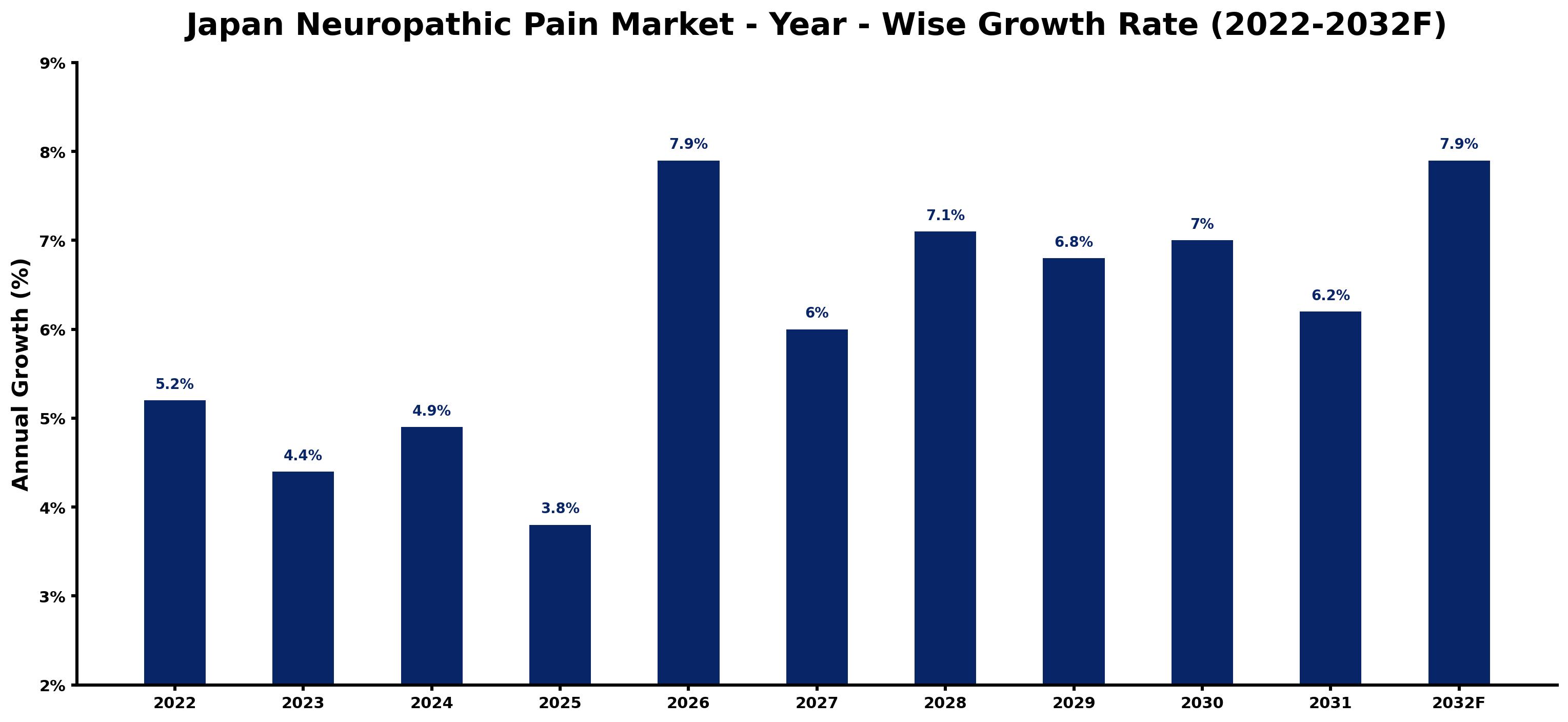
Annual growth estimates for each year appear below with the principal reason behind them, explaining the shifts that set the pace of the market.
| Year | Estimated Annual Growth (%) | Market Rationale |
| 2022 | 5.2 | The market experienced solid growth due to increasing awareness of pain management technologies. |
| 2023 | 4.4 | Growth slowed as the market adjusted to the previous year's rapid expansion. |
| 2024 | 4.9 | A slight recovery occurred as healthcare providers increased investments in pain management solutions. |
| 2025 | 3.8 | Growth decelerated as market saturation began to affect new device sales. |
| 2026 | 7.9 | A surge in demand is expected to emerge with advancements in spinal cord stimulation technologies. |
| 2027 | 6.0 | Growth is projected to slow as competition intensifies among device manufacturers. |
| 2028 | 7.1 | Demand is expected to rise again with increased adoption of portable pain management devices. |
| 2029 | 6.8 | Growth is anticipated to decelerate slightly as market conditions stabilise. |
| 2030 | 7.0 | Demand will increase with new innovations in non-invasive pain relief technologies. |
| 2031 | 6.2 | Growth is expected to slow as regulatory changes impact product approvals. |
| 2032 | 7.9 | A resurgence in demand is projected as new guidelines promote pain management innovations. |
Note: Market size estimations and growth projections presented in this report are based on 6Wresearch's proprietary forecasting methodology, utilizing the latest available industry data, government publications, and primary research inputs.
Japan Neuropathic Pain Market Synopsis
Neuropathic Pain management in Japan utilises various technologies, including spinal cord stimulation and transcutaneous electrical nerve stimulation, to alleviate chronic pain from nerve damage. The Japan Neuropathic Pain Market is expanding due to a growing patient population, with approximately 1.2 million individuals affected. The Tokyo region, hosting 30% of pain management clinics, drives demand. Investment in effective pain relief devices and the increasing number of specialists are key factors contributing to market growth.
Market Dynamics Impact Analysis (2026–2032)
| Factor | Type | Impact | Primary Segment Affected |
| Growing patient population requiring pain management solutions | Driver | High | Spinal Cord Stimulation (SCS) Devices |
| Advancements in pain management technologies enhancing treatment efficacy | Driver | High | Transcutaneous Electrical Nerve Stimulation (Tens) Devices |
| Increase in portable device adoption for home use | Opportunity | High | Portable |
| Expansion of pain management clinics in urban areas | Opportunity | Medium | External Peripheral Nerve Stimulation |
| Regulatory complexities affecting product approvals | Restraint | High | Transcutaneous Electrical Nerve Stimulation (Tens) Devices |
| Limited awareness of newer pain management technologies among healthcare providers | Restraint | Medium | Spinal Cord Stimulation (SCS) Devices |
| High costs associated with invasive procedures | Challenge | High | Invasive and Non-Invasive |
| Capacity constraints in specialized hospitals for invasive procedures | Challenge | Medium | Invasive and Non-Invasive |
Evaluation of Drivers in Japan Neuropathic Pain Market (2026–2032)
Demand rests on the following drivers, each shown with the segment it touches most.
| Drivers | Primary Segment Affected | Why It Matters (Evidence) |
| Increasing number of pain management specialists | Spinal Cord Stimulation (SCS) Devices | In 2023, over 500 specialists were registered, driving demand for advanced pain management solutions. |
| Technological advancements in TENS devices | Transcutaneous Electrical Nerve Stimulation (Tens) Devices | The rise in adoption of TENS devices by 15% in 2023 reflects growing consumer interest. |
| Rising preference for rechargeable devices | Rechargeable and Non-Rechargeable | Seventy percent of patients prefer rechargeable devices for their convenience and usability. |
| Increased focus on non-invasive treatment options | External Peripheral Nerve Stimulation | Providers are prioritising non-invasive methods to reduce patient recovery time. |
| Growing awareness of pain management guidelines | Invasive and Non-Invasive | Guidelines since 2021 have encouraged better treatment practices. |
Much of the new demand traces back to the increasing number of pain management specialists, with over 500 registered in 2023, which drives the need for advanced solutions like spinal cord stimulation. The rise in adoption of transcutaneous electrical nerve stimulation devices by 15% in 2023 reflects growing consumer interest in effective pain relief methods. Seventy percent of patients prefer rechargeable devices, improving their usability and convenience. Providers are focusing on non-invasive methods, as demonstrated by the increasing adoption of external peripheral nerve stimulation technologies. Guidelines since 2021 have prompted better treatment practices, further supporting market growth.
Evaluation of Restraints in Japan Neuropathic Pain Market
The table below lists the restraints and the evidence behind each.
| Market Restraint | Primary Segment Affected | Why It Matters (Evidence) |
| Regulatory complexities affecting product approvals | Transcutaneous Electrical Nerve Stimulation (Tens) Devices | The PMD Act regulates device approvals, causing delays in market entry for new technologies. |
| Limited awareness of newer pain management technologies among healthcare providers | Spinal Cord Stimulation (SCS) Devices | A significant portion of providers remain unaware of the latest advancements, hindering adoption rates. |
| High costs associated with invasive procedures | Invasive and Non-Invasive | Invasive procedures can be prohibitively expensive, limiting access for some patients. |
| Capacity constraints in specialized hospitals for invasive procedures | Invasive and Non-Invasive | Over 200 specialized hospitals are performing these procedures, leading to longer wait times. |
| Market saturation affecting new device sales | Rechargeable and Non-Rechargeable | As the market matures, growth in device sales is becoming increasingly challenging. |
Japan Neuropathic Pain Market Challenges
High regulatory standards under the Pharmaceuticals and Medical Devices Act delay the introduction of new spinal cord stimulation devices, costing clinics approximately six months and limiting treatment options for patients. A shortage of trained pain management specialists affects hospitals' ability to provide adequate care, resulting in longer wait times for 1.2 million patients suffering from neuropathic pain. Supply chain disruptions hinder the availability of transcutaneous electrical nerve stimulation devices, causing clinics to experience stock shortages and patients to face delays in receiving necessary treatments. Rising costs associated with pain management programs, which total around ¥10 billion annually, strain budgets for hospitals and clinics, forcing them to limit services.
Trends in the Japan Neuropathic Pain Market
The trends below show where the Japan Neuropathic Pain Market is heading.
- Shift from Invasive to Non-Invasive Pain Management: Japan is experiencing a shift towards non-invasive pain management solutions, with a growing preference for external peripheral nerve stimulation devices. In 2023, the adoption of these devices increased by 15%, reflecting a broader trend in patient care.
- Transition to Portable Pain Relief Devices: The demand for portable pain relief devices is rising, particularly among home users. In 2023, portable TENS devices saw a 15% increase in adoption, indicating a shift in consumer preferences towards convenience.
- Emergence of Advanced Pain Management Technologies: Recent advancements in pain management technologies are reshaping treatment options. The guidelines since 2021 have driven innovation in device development, improving patient outcomes.
- Growing Focus on Patient-Centric Pain Management: Healthcare providers are increasingly prioritising patient-centric approaches to pain management. The Japan Society of Pain Clinicians' annual conferences highlight advancements in treatment methodologies, promoting a culture of innovation.
Investment Opportunities in the Japan Neuropathic Pain Market
Where to invest in the Japan Neuropathic Pain Market: the main openings are set out below.
- Establish Joint Ventures with Local Manufacturers: With an annual budget of approximately ¥10 billion for pain management programs, establishing joint ventures with local manufacturers can facilitate market entry. Collaborating with pain management clinics in Tokyo can provide access to a large patient base.
- Invest in Portable Device Development: The 15% increase in portable TENS device adoption indicates a market gap for new products. Focusing on portable pain management solutions can attract home users seeking convenience.
- Expand Training Programs for Healthcare Providers: With over 500 registered pain management specialists, expanding training programs can improve awareness of new technologies. Collaborating with the Japan Society of Pain Clinicians can enhance outreach and education.
- Utilise Regulatory Support for New Technologies: The Economic Security Promotion Act supports supply-chain resilience, creating opportunities for new technology development. Engaging with regulatory bodies can streamline the approval process for innovative devices.
Government Initiatives in the Japan Neuropathic Pain Market
The Electrical Appliance and Material Safety Act regulates the safety of electrical appliances, including pain management devices, ensuring that producers meet strict safety standards. Compliance with these regulations is essential for manufacturers to maintain market access and consumer trust.
The PMDA reviews pharmaceuticals and medical devices, including pain management technologies, ensuring they meet safety and efficacy standards. This agency also monitors post-market safety, which is vital for maintaining patient safety and confidence in new products.
Future Insight of the Japan Neuropathic Pain Market
The investment pipeline for pain management technologies will expand by 2032, driven by increasing demand for effective treatments. The adoption of portable TENS devices will see a notable rise as patients seek convenience, contributing to a projected increase in usage. Improved training programmes for pain management specialists will enhance service delivery, addressing the current skills gap. The Ministry of Health, Labour and Welfare's ongoing promotion of pain management guidelines will further standardise practices across hospitals and clinics, improving patient outcomes.
Market Segmentation Analysis
Japan Neuropathic Pain Market report covers a detailed analysis of the following market segments:
By Type – Spinal Cord Stimulation (SCS) Devices Lead, External Peripheral Nerve Stimulation Expected to Grow Fastest
According to Dhaval Chaurasia, Assistant Manager at 6Wresearch, with 42% of type revenue in 2025, Spinal Cord Stimulation (SCS) Devices was the largest category. Spinal Cord Stimulation devices dominate the market because they are widely used for chronic pain management, especially among patients aged 55 and above. Their prevalence is supported by the concentration of pain management clinics in the Tokyo region, catering to a large patient base. Over 2026–2032, External Peripheral Nerve Stimulation is expected to post the fastest growth, at a CAGR of 10.0%. External Peripheral Nerve Stimulation is experiencing rapid growth due to its effectiveness in providing localized pain relief, making it appealing to both healthcare providers and patients. The increasing number of pain management clinics in urban areas is driving higher adoption rates for this technology. Suppliers should focus on increasing the availability and awareness of External Peripheral Nerve Stimulation to leverage its growth potential.
By Product Type – Rechargeable and Non-Rechargeable Leads and Records the Fastest Growth
In 2025, Rechargeable and Non-Rechargeable led the product type split with a 100% share. Rechargeable and Non-Rechargeable devices capture the largest market share as they are essential for the functionality of pain management technologies, catering to diverse patient needs. The preference for rechargeable options is evident, with 70% of patients selecting them for their convenience. Rechargeable and Non-Rechargeable is also forecast to expand faster than any other category, at a CAGR of 7.0% over 2026–2032. The Rechargeable and Non-Rechargeable segment is also the fastest-growing, propelled by rising demand for flexible and user-friendly devices, particularly in outpatient settings. Advancements in battery technology and design are further contributing to this growth. Manufacturers must prioritise user-friendly rechargeable options to remain competitive in this expanding segment.
By Procedure – Invasive and Non-Invasive Leads and Records the Fastest Growth
The largest procedure category in 2025 was Invasive and Non-Invasive, at 100% of revenue. Invasive and Non-Invasive procedures are the most prevalent due to their critical role in addressing a variety of pain management needs across different patient profiles. The existence of over 200 specialised hospitals performing invasive procedures highlights the robust infrastructure supporting this segment. The same category is also set to grow fastest, at a CAGR of 7.0% during 2026–2032. The Invasive and Non-Invasive segment is also the fastest-growing, as healthcare providers increasingly adopt a combined approach to treatment, improving patient outcomes. This trend is reinforced by the Ministry of Health, Labour and Welfare's promotion of comprehensive pain management guidelines. Providers should ensure a balanced offering of both invasive and non-invasive options to meet the evolving preferences of patients.
By Technology – Transcutaneous Electrical Nerve Stimulation Leads, Transcranial Magnetic Stimulation Expected to Grow Fastest
Transcutaneous Electrical Nerve Stimulation took 53% of technology revenue in 2025, more than any other category. Transcutaneous Electrical Nerve Stimulation leads the market, being commonly used for pain management with strong acceptance among patients and clinicians. Its classification under JIS standards reinforces its established position within the regulatory framework. Transcranial Magnetic Stimulation is projected to grow fastest, at a CAGR of 10.2% during 2026–2032. Transcranial Magnetic Stimulation is the fastest-growing technology, despite being less common, as it offers an alternative approach to treating neuropathic pain, attracting interest from researchers and clinicians. The increasing focus on alternative therapies is anticipated to drive its adoption in the future. Suppliers should invest in research and development for emerging technologies like Transcranial Magnetic Stimulation to maintain a competitive edge.
By Modality – Stationary Leads, Portable Expected to Grow Fastest
Stationary held 59% of the Japan Neuropathic Pain Market by modality in 2025. Stationary modalities lead the market, primarily used in clinical settings where comprehensive pain management is delivered. Their established presence in pain management clinics, especially in urban areas, solidifies their leading position. Over 2026–2032, Portable is expected to post the fastest growth, at a CAGR of 9.1%. Portable modalities are the fastest-growing segment, reflecting a shift towards home-based pain management solutions that offer convenience and flexibility for patients. The 15% increase in portable TENS device adoption in 2023 underscores this trend. Manufacturers should focus on developing portable solutions to meet the rising demand for at-home pain management options.
Key Attractiveness of the Report
- 10 Years of Market Numbers
- Historical Data Starting from 2022 to 2025
- Base Year 2025
- Forecast Data until 2032
- Key Performance Indicators Impacting the Market
- Major Upcoming Developments and Projects
Key Highlights of the Report:
- Japan Neuropathic Pain Market Outlook
- Market Size of Japan Neuropathic Pain Market, 2025
- Forecast of Japan Neuropathic Pain Market, 2032
- Historical Data and Forecast of Japan Neuropathic Pain Revenues & Volume for the Period 2022-2032
- Japan Neuropathic Pain Market Trend Evolution
- Japan Neuropathic Pain Market Drivers and Challenges
- Japan Neuropathic Pain Price Trends
- Japan Neuropathic Pain Porter's Five Forces
- Japan Neuropathic Pain Industry Life Cycle
- Historical Data and Forecast of Japan Neuropathic Pain Market Revenues & Volume By Type for the Period 2022-2032
- Historical Data and Forecast of Japan Neuropathic Pain Market Revenues & Volume By Spinal Cord Stimulation (SCS) Devices for the Period 2022-2032
- Historical Data and Forecast of Japan Neuropathic Pain Market Revenues & Volume By External Peripheral Nerve Stimulation for the Period 2022-2032
- Historical Data and Forecast of Japan Neuropathic Pain Market Revenues & Volume By Transcutaneous Electrical Nerve Stimulation (Tens) Devices for the Period 2022-2032
- Historical Data and Forecast of Japan Neuropathic Pain Market Revenues & Volume By Product Type for the Period 2022-2032
- Historical Data and Forecast of Japan Neuropathic Pain Market Revenues & Volume By Rechargeable and Non-Rechargeable for the Period 2022-2032
- Historical Data and Forecast of Japan Neuropathic Pain Market Revenues & Volume By Procedure for the Period 2022-2032
- Historical Data and Forecast of Japan Neuropathic Pain Market Revenues & Volume By Invasive and Non-Invasive for the Period 2022-2032
- Historical Data and Forecast of Japan Neuropathic Pain Market Revenues & Volume By Technology for the Period 2022-2032
- Historical Data and Forecast of Japan Neuropathic Pain Market Revenues & Volume By Transcutaneous Electrical Nerve Stimulation for the Period 2022-2032
- Historical Data and Forecast of Japan Neuropathic Pain Market Revenues & Volume By Transcranial Magnetic Stimulation for the Period 2022-2032
- Historical Data and Forecast of Japan Neuropathic Pain Market Revenues & Volume By Respiratory Electrical Stimulation for the Period 2022-2032
- Historical Data and Forecast of Japan Neuropathic Pain Market Revenues & Volume By Modality for the Period 2022-2032
- Historical Data and Forecast of Japan Neuropathic Pain Market Revenues & Volume By Stationary for the Period 2022-2032
- Historical Data and Forecast of Japan Neuropathic Pain Market Revenues & Volume By Portable for the Period 2022-2032
- Historical Data and Forecast of Japan Neuropathic Pain Market Revenues & Volume By Mode of Purchase for the Period 2022-2032
- Historical Data and Forecast of Japan Neuropathic Pain Market Revenues & Volume By Over-the-Counter Devices for the Period 2022-2032
- Historical Data and Forecast of Japan Neuropathic Pain Market Revenues & Volume By Prescription-Based Devices for the Period 2022-2032
- Historical Data and Forecast of Japan Neuropathic Pain Market Revenues & Volume By Pain Type for the Period 2022-2032
- Historical Data and Forecast of Japan Neuropathic Pain Market Revenues & Volume By Peripheral Neuropathy for the Period 2022-2032
- Historical Data and Forecast of Japan Neuropathic Pain Market Revenues & Volume By Entrapment Neuropathy for the Period 2022-2032
- Historical Data and Forecast of Japan Neuropathic Pain Market Revenues & Volume By Phantom Limb Neuropathy for the Period 2022-2032
- Historical Data and Forecast of Japan Neuropathic Pain Market Revenues & Volume By Trigeminal Neuralgia for the Period 2022-2032
- Historical Data and Forecast of Japan Neuropathic Pain Market Revenues & Volume By Post Herpetic Neuralgia (PHN) for the Period 2022-2032
- Historical Data and Forecast of Japan Neuropathic Pain Market Revenues & Volume By Post Traumatic Neuropathy for the Period 2022-2032
- Historical Data and Forecast of Japan Neuropathic Pain Market Revenues & Volume By Foot Pain for the Period 2022-2032
- Historical Data and Forecast of Japan Neuropathic Pain Market Revenues & Volume By Coccydynia for the Period 2022-2032
- Historical Data and Forecast of Japan Neuropathic Pain Market Revenues & Volume By Indication for the Period 2022-2032
- Historical Data and Forecast of Japan Neuropathic Pain Market Revenues & Volume By Spinal Stenosis for the Period 2022-2032
- Historical Data and Forecast of Japan Neuropathic Pain Market Revenues & Volume By Chemotherapy-Induced Peripheral Neuropathy for the Period 2022-2032
- Historical Data and Forecast of Japan Neuropathic Pain Market Revenues & Volume By Diabetic Neuropathy for the Period 2022-2032
- Historical Data and Forecast of Japan Neuropathic Pain Market Revenues & Volume By Others for the Period 2022-2032
- Japan Neuropathic Pain Import Export Trade Statistics
- Market Opportunity Assessment By Type
- Market Opportunity Assessment By Product Type
- Market Opportunity Assessment By Procedure
- Market Opportunity Assessment By Technology
- Market Opportunity Assessment By Modality
- Market Opportunity Assessment By Mode of Purchase
- Market Opportunity Assessment By Pain Type
- Market Opportunity Assessment By Indication
- Japan Neuropathic Pain Top Companies Market Share
- Japan Neuropathic Pain Competitive Benchmarking By Technical and Operational Parameters
- Japan Neuropathic Pain Company Profiles
- Japan Neuropathic Pain Key Strategic Recommendations
Market Covered
The study includes the following segmentation.
By Type
- Spinal Cord Stimulation (SCS) Devices
- External Peripheral Nerve Stimulation
- Transcutaneous Electrical Nerve Stimulation (Tens) Devices
By Product Type
- Rechargeable and Non-Rechargeable
By Procedure
- Invasive and Non-Invasive
By Technology
- Transcutaneous Electrical Nerve Stimulation
- Transcranial Magnetic Stimulation
- Respiratory Electrical Stimulation
By Modality
- Stationary
- Portable






































