Japan Next-Gen Tractors Market Size & Growth Rate
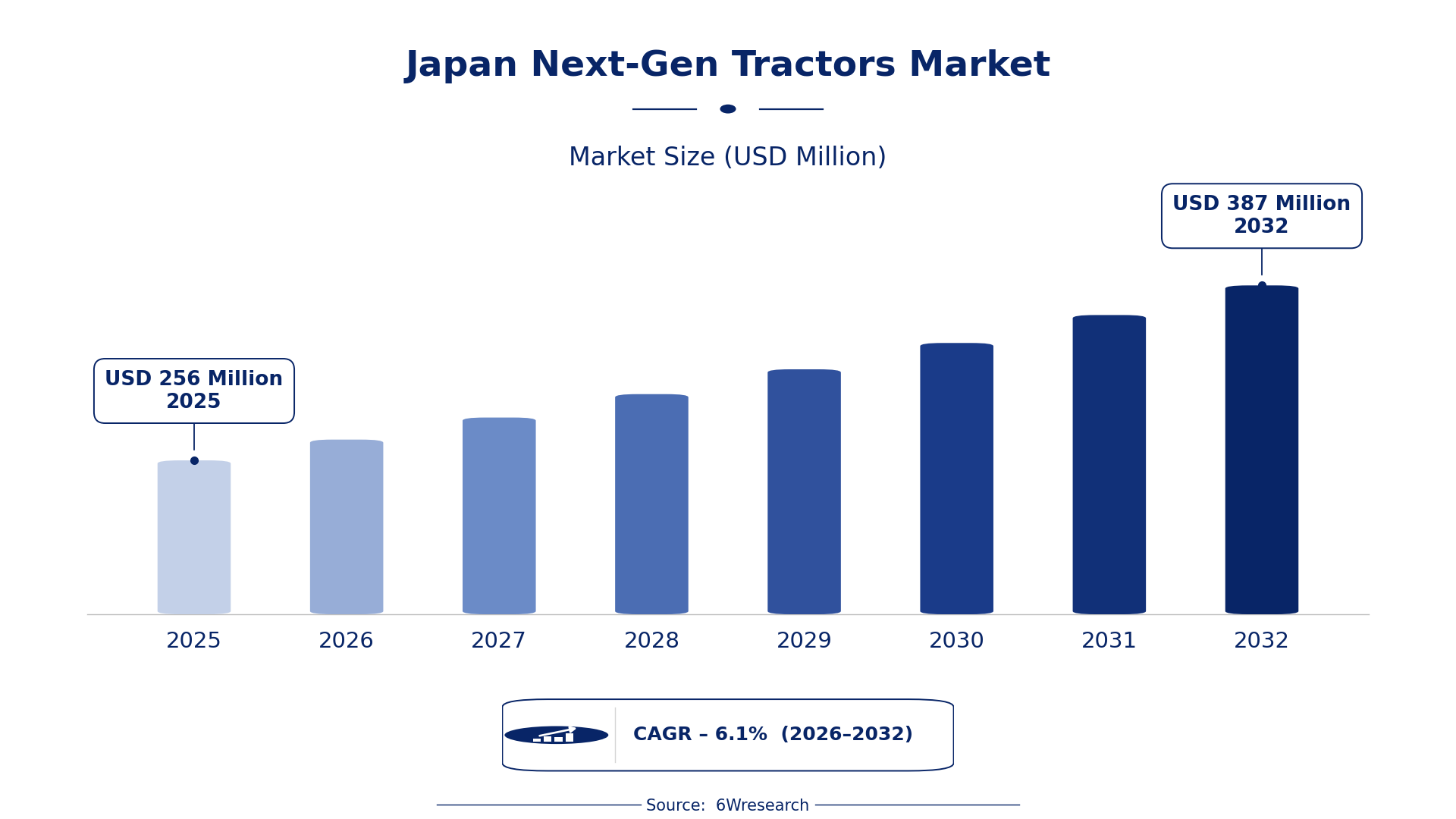
According to 6Wresearch internal database and industry insights, the Japan Next-Gen Tractors Market was valued at USD 256 Million in 2025 and is projected to reach USD 387 Million by 2032, growing at a CAGR of approximately 6.1% during 2026–2032.
Japan Next-Gen Tractors Market Highlights
| Report Metric | Details |
| Report Name | Japan Next-Gen Tractors Market (2026-2032) |
| Market Size 2025 | USD 256 Million |
| Market Size 2032 | USD 387 Million |
| Absolute Growth 2025–2032 | USD 131 Million |
| CAGR 2026–2032 | 6.1% |
| Peak Annual Growth | 6.5% in 2029 |
| Forecast Period | 2026–2032 |
| Historical Data | 2022–2025 |
| Base Year | 2025 |
| Leading Tractor Type, 2025 | Autonomous Tractors (35% share) |
| Leading Technology Innovation, 2025 | GPS + AI Navigation (34% share) |
| Leading Power Source, 2025 | Electric (36% share) |
| Leading End User, 2025 | Large Farms (48% share) |
| Fastest-Growing Tractor Type | Electric Tractors (9.2% CAGR) |
| Fastest-Growing Technology Innovation | IoT Integrated (9.7% CAGR) |
| Fastest-Growing End User | Agro-Tech Firms (8.1% CAGR) |
| Growing Sector | Agriculture |
| Key End Users | Large Farms, Agro-Tech Firms, Agricultural Cooperatives |
Japan Next-Gen Tractors Market Year-wise Growth Rate and Key Drivers (2022–2032)
This graph illustrates the annual growth rates of the market from 2022 to 2032, highlighting a steady upward trajectory and projected market expansion over the forecast period.
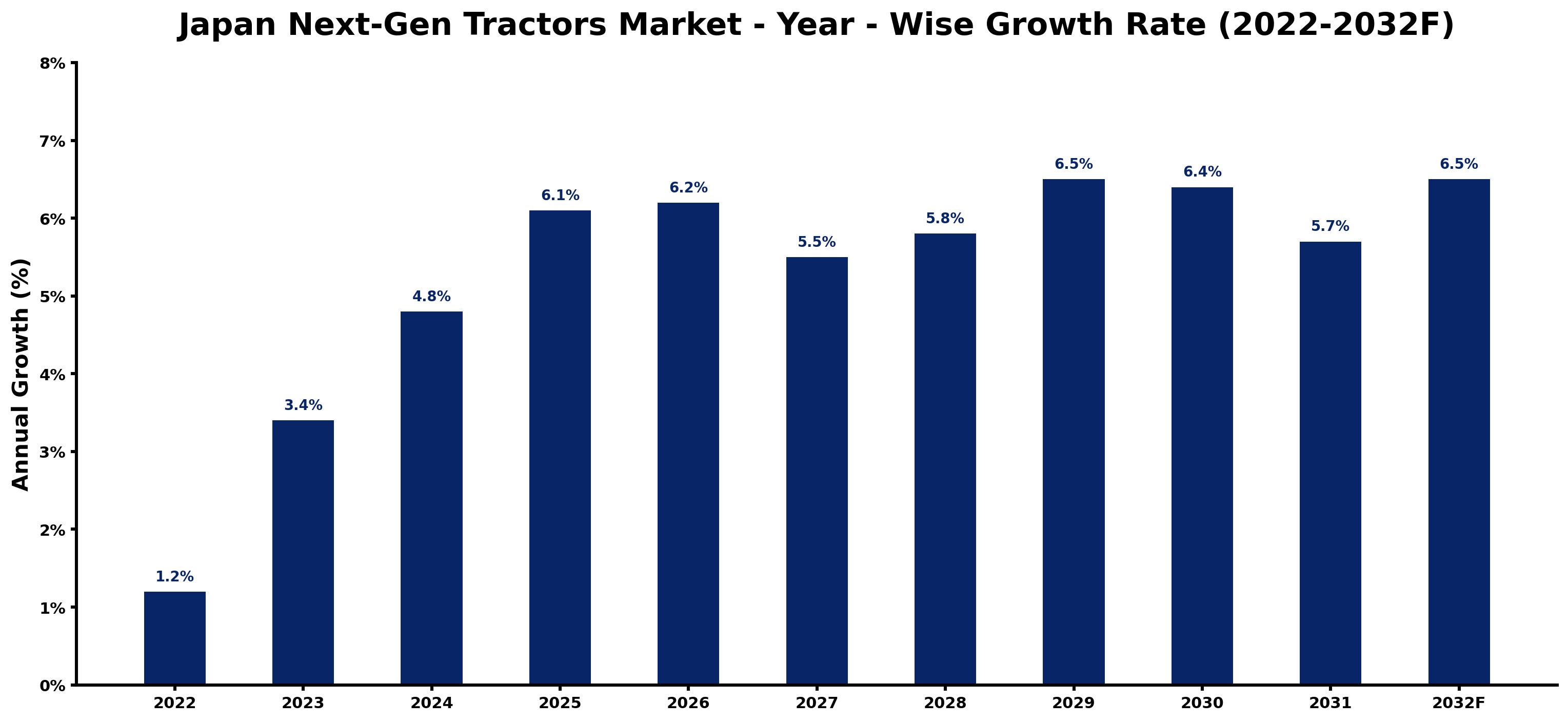
The table below sets out the estimated growth rate for each year and the main factor behind it.
| Year | Estimated Annual Growth (%) | Market Rationale |
| 2022 | 1.2 | The market showed steady growth as farmers began adopting advanced technologies. |
| 2023 | 3.4 | Growth accelerated due to increased investments in smart agriculture technologies. |
| 2024 | 4.8 | Technological advancements in farming practices further boosted market demand. |
| 2025 | 6.1 | The peak growth was driven by a rise in tractor sales across the country. |
| 2026 | 6.2 | Demand remains strong as farmers seek more efficient and sustainable solutions. |
| 2027 | 5.5 | Growth slows slightly as market saturation begins to affect new purchases. |
| 2028 | 5.8 | A resurgence in demand occurs as eco-friendly practices gain traction. |
| 2029 | 6.5 | The market peaks again with a surge in electric tractor adoption. |
| 2030 | 6.4 | Growth is projected to slow as the market stabilises following peak adoption rates. |
| 2031 | 5.7 | Continued interest in advanced tractors maintains a steady growth rate. |
| 2032 | 6.5 | The market is expected to experience renewed growth driven by technological innovations. |
Note: Market size estimations and growth projections presented in this report are based on 6Wresearch's proprietary forecasting methodology, utilizing the latest available industry data, government publications, and primary research inputs.
Japan Next-Gen Tractors Market Synopsis
Next-Gen Tractors represent advanced agricultural machinery that integrates automation and connectivity to improve farming productivity and reduce labour costs. The Japan Next-Gen Tractors Market is expanding due to increasing adoption of technology by farmers, with 30% of farms already utilising some form of technology. The government's push for smart agriculture through initiatives and funding, such as the ¥10 billion allocated in 2023, drives demand for these machines.
Market Dynamics Impact Analysis (2026–2032)
| Factor | Type | Impact | Primary Segment Affected |
| Increasing adoption of electric tractors for eco-friendly operations | Driver | High | Electric Tractors |
| Growing investments in smart agriculture technologies | Driver | High | Smart Tractors |
| Rising demand for precision farming solutions | Opportunity | High | Autonomous Tractors |
| Expansion of agricultural cooperatives facilitating access to advanced machinery | Opportunity | Medium | Agricultural Cooperatives |
| High average age of farmers leading to a labour shortage | Restraint | High | Autonomous Tractors |
| Limited adoption of advanced tractors by small to mid farms due to cost | Restraint | Medium | Small to Mid Farms |
| High initial investment costs for advanced tractor technologies | Challenge | High | Autonomous Tractors |
| Slow pace of technological integration in traditional farming practices | Challenge | Medium | Autonomous Tractors |
Evaluation of Drivers in Japan Next-Gen Tractors Market (2026–2032)
These are the developments adding the most demand over the forecast period.
| Drivers | Primary Segment Affected | Why It Matters (Evidence) |
| Rising adoption of electric tractors | Electric Tractors | Electric tractors are projected to reduce carbon emissions by 30%, encouraging farmers to invest in greener options. |
| Increased investments in smart agriculture | Smart Tractors | Investment in smart agriculture initiatives is expected to lead to higher technology adoption rates among farmers, increasing demand for advanced machinery. |
| Demand for precision farming | Autonomous Tractors | The Tohoku region is leading in agricultural innovation, driving farmers towards precision farming solutions that offer measurable benefits. |
| Popularity of hybrid tractors | Hybrid Tractors | Hybrid tractors are gaining traction due to their versatility in power sources, appealing to diverse farming conditions. |
| Support from agricultural cooperatives | Agricultural Cooperatives | Agricultural cooperatives facilitate access to advanced machinery, increasing adoption among their members. |
Most of the extra volume comes from the increasing adoption of electric tractors, projected to reduce carbon emissions by 30%, prompting farmers to invest in sustainable solutions. In the Tohoku region, a focus on precision farming drives demand for advanced machinery, improving productivity. The popularity of hybrid tractors is also increasing due to their versatility, appealing to various farming conditions. Support from agricultural cooperatives helps facilitate access to advanced machinery, boosting adoption rates among their members.
Evaluation of Restraints in Japan Next-Gen Tractors Market
Several factors work against faster growth; the main ones are summarised below.
| Market Restraint | Primary Segment Affected | Why It Matters (Evidence) |
| High average age of farmers leading to a labour shortage | Autonomous Tractors | With the average age of farmers in Japan at 67 years, a labour shortage is impacting productivity. |
| Limited adoption of advanced tractors by small to mid farms due to cost | Small to Mid Farms | Small to mid farms struggle to adopt advanced tractors due to high costs, restricting market growth. |
| Slow pace of technological integration in traditional farming practices | Autonomous Tractors | Resistance to change among traditional farmers, who constitute a significant portion of the agricultural workforce, hinders the adoption of advanced technologies. |
| High initial investment costs for advanced tractor technologies | Autonomous Tractors | The upfront costs deter many farmers from investing in advanced tractor solutions, limiting their operational capabilities. |
| Concerns over maintenance and repair of advanced technologies | Autonomous Tractors | Farmers worry about the complexity and costs associated with maintaining advanced tractor systems, which can affect their purchasing decisions. |
Japan Next-Gen Tractors Market Challenges
Producers face challenges due to stringent regulations from the Ministry of Agriculture, Forestry and Fisheries, which can delay technology adoption and raise compliance costs, particularly affecting small farms. Limited technological integration, with only 30% of farms employing any form of technology, hampers productivity and puts producers at a competitive disadvantage. Rising costs of advanced machinery strain budgets, especially for approximately 1.5 million farms needing to invest in new equipment to stay competitive. A skills gap exists as the average age of farmers is 67, leading to operational inefficiencies and reduced agricultural output.
Trends in the Japan Next-Gen Tractors Market
The trends below show where the Japan Next-Gen Tractors Market is heading.
- Shift to Electric Tractors: In 2022, 20% of tractors sold were electric models, reflecting a growing trend towards sustainability. This shift is supported by government initiatives promoting eco-friendly farming practices.
- Rise of Smart Agriculture: Since 2023, new initiatives have been launched to support smart agriculture, resulting in increased adoption of technology on farms. This trend is expected to improve productivity as farmers embrace solutions.
- Growth of Hybrid Tractors: Hybrid tractors have gained popularity due to their versatility, with a notable increase in adoption among farmers seeking flexible power sources. This trend aligns with the need for adaptability in varying agricultural conditions.
- Expansion of Agricultural Cooperatives: The Kanto region has seen a rise in agricultural cooperatives, which facilitate access to advanced machinery for local farmers. This trend supports the adoption of Next-Gen Tractors across the region.
Investment Opportunities in the Japan Next-Gen Tractors Market
Investors looking at the Japan Next-Gen Tractors Market should consider the following areas.
- Current demand for eco-friendly solutions: With electric tractors projected to reduce carbon emissions by 30%, there is a strong opportunity for suppliers to invest in electric tractor technology. Large farms are particularly interested in sustainable options.
- Growing market for precision farming tools: The demand for precision farming solutions is increasing, creating opportunities for suppliers to provide autonomous tractors. Agro-tech firms are eager to adopt these technologies to improve operational efficiency.
- Investment in agricultural technology development: Japan allocated ¥10 billion for agricultural technology development in 2023, presenting an opportunity for companies to invest in solutions. Collaborating with agricultural cooperatives can facilitate market entry.
- Expansion of smart agriculture initiatives: The government's push for smart agriculture creates opportunities for investment in smart tractors. Large farms are looking to adopt these technologies to improve productivity and reduce costs.
Government Initiatives in the Japan Next-Gen Tractors Market
The Electrical Appliance and Material Safety Act regulates the safety of electrical appliances and materials sold in Japan, ensuring that Next-Gen Tractors meet safety standards. This law impacts producers, as they must comply with safety regulations to market their products effectively. Additionally, the government allocated ¥10 billion in 2023 to support agricultural technology initiatives, promoting innovation in the sector.
The Ministry of Agriculture, Forestry and Fisheries approves funding for agricultural technology initiatives, including smart farming projects. In 2023, the government allocated ¥10 billion to support these advancements, benefiting producers and buyers alike by encouraging innovation in the sector.
Future Insight of the Japan Next-Gen Tractors Market
Investment in agricultural technology will see a boost, with ¥10 billion allocated for development in 2023, stimulating demand for advanced solutions. The adoption of smart tractors is expected to rise, enhancing operational efficiency as farmers embrace new technologies. Government initiatives supporting IoT in agriculture will enable suppliers to offer more integrated solutions, driving innovation in the sector. As hybrid tractors become more popular, their versatility will support diverse farming practices, benefiting both producers and agriculture.
Market Segmentation Analysis
Japan Next-Gen Tractors Market report covers a detailed analysis of the following market segments:
By Tractor Type – Autonomous Tractors Lead, Electric Tractors Expected to Grow Fastest
According to Saurav Kr Singh, Senior Research Analyst at 6Wresearch, the largest tractor type category in 2025 was Autonomous Tractors, at 35% of revenue. Autonomous Tractors hold the largest share as they are widely adopted by large farms aiming to enhance productivity and reduce labour costs. For instance, the Tohoku region has effectively implemented these machines for precision farming, demonstrating their practical benefits. The quickest growth will come from Electric Tractors, forecast to expand at a CAGR of 9.2% between 2026 and 2032. Electric Tractors are witnessing rapid growth as farmers increasingly prioritise sustainability, with 20% of tractors sold in 2022 being electric models. This trend is likely to accelerate due to government initiatives promoting eco-friendly farming practices. Suppliers should focus on developing electric models to meet the rising demand for sustainable agricultural solutions.
By Technology Innovation – GPS + AI Navigation Leads, IoT Integrated Expected to Grow Fastest
GPS + AI Navigation held 34% of the Japan Next-Gen Tractors Market by technology innovation in 2025. GPS Navigation technology leads this segment as it is essential for the functionality of autonomous tractors, improving their precision and operational efficiency. The Ministry of Agriculture's initiatives promoting smart agriculture further facilitate its widespread adoption among farmers. IoT Integrated is projected to grow fastest, at a CAGR of 9.7% during 2026–2032. IoT Integrated technology is growing swiftly due to its capacity to enhance connectivity among farming equipment, aligning with government efforts to support IoT through subsidies. This trend is crucial for the modernisation of agricultural practices. Buyers should invest in IoT technologies to remain competitive in the advancing agricultural sector.
By Power Source – Electric Leads and Records the Fastest Growth
Electric accounted for 36% of the market by power source in 2025. Electric power sources dominate the market as they are increasingly favoured for their environmentally friendly operations, aligning with Japan's sustainability objectives. The government's support for electric tractors underscores their potential to significantly reduce carbon emissions. The same category is also set to grow fastest, at a CAGR of 9.1% during 2026–2032. Electric power sources are also the fastest-growing segment, reflecting the increasing adoption of electric tractors among farmers seeking sustainable solutions. The dual role of electric tractors as both leader and fastest indicates a strong market trend towards eco-friendliness. Suppliers must concentrate on electric power solutions to capitalise on the growing demand for sustainable agricultural machinery.
By End User – Large Farms Lead, Agro-Tech Firms Expected to Grow Fastest
In 2025, Large Farms led the end user split with a 48% share. Large Farms represent the largest user group for advanced tractors, as they require efficient machinery to manage extensive operations effectively. Their scale allows for substantial investment in high-tech solutions that enhance overall productivity. Over 2026–2032, Agro-Tech Firms are expected to post the fastest growth, at a CAGR of 8.1%. Agro-Tech Firms are the fastest-growing segment as they increasingly integrate advanced technology into their farming solutions, reflecting the trend towards technology-driven agriculture. This shift is supported by government initiatives aimed at modernising farming practices. Suppliers should tailor their products to meet the specific needs of agro-tech firms to leverage growth in this segment.
Key Attractiveness of the Report
- 10 Years of Market Numbers
- Historical Data Starting from 2022 to 2025
- Base Year 2025
- Forecast Data until 2032
- Key Performance Indicators Impacting the Market
- Major Upcoming Developments and Projects
Key Highlights of the Report:
- Japan Next-Gen Tractors Market Outlook
- Market Size of Japan Next-Gen Tractors Market, 2025
- Forecast of Japan Next-Gen Tractors Market, 2032
- Historical Data and Forecast of Japan Next-Gen Tractors Revenues & Volume for the Period 2022-2032F
- Japan Next-Gen Tractors Market Trend Evolution
- Japan Next-Gen Tractors Market Drivers and Challenges
- Japan Next-Gen Tractors Price Trends
- Japan Next-Gen Tractors Porter's Five Forces
- Japan Next-Gen Tractors Industry Life Cycle
- Historical Data and Forecast of Japan Next-Gen Tractors Market Revenues & Volume By Tractor Type for the Period 2022-2032F
- Historical Data and Forecast of Japan Next-Gen Tractors Market Revenues & Volume By Autonomous Tractors for the Period 2022-2032F
- Historical Data and Forecast of Japan Next-Gen Tractors Market Revenues & Volume By Hybrid Tractors for the Period 2022-2032F
- Historical Data and Forecast of Japan Next-Gen Tractors Market Revenues & Volume By Electric Tractors for the Period 2022-2032F
- Historical Data and Forecast of Japan Next-Gen Tractors Market Revenues & Volume By Smart Tractors for the Period 2022-2032F
- Historical Data and Forecast of Japan Next-Gen Tractors Market Revenues & Volume By Connected Tractors for the Period 2022-2032F
- Historical Data and Forecast of Japan Next-Gen Tractors Market Revenues & Volume By Technology Innovation for the Period 2022-2032F
- Historical Data and Forecast of Japan Next-Gen Tractors Market Revenues & Volume By GPS + AI Navigation for the Period 2022-2032F
- Historical Data and Forecast of Japan Next-Gen Tractors Market Revenues & Volume By Semi-Autonomous for the Period 2022-2032F
- Historical Data and Forecast of Japan Next-Gen Tractors Market Revenues & Volume By Battery-powered for the Period 2022-2032F
- Historical Data and Forecast of Japan Next-Gen Tractors Market Revenues & Volume By Sensor-Driven for the Period 2022-2032F
- Historical Data and Forecast of Japan Next-Gen Tractors Market Revenues & Volume By IoT Integrated for the Period 2022-2032F
- Historical Data and Forecast of Japan Next-Gen Tractors Market Revenues & Volume By Power Source for the Period 2022-2032F
- Historical Data and Forecast of Japan Next-Gen Tractors Market Revenues & Volume By Electric for the Period 2022-2032F
- Historical Data and Forecast of Japan Next-Gen Tractors Market Revenues & Volume By Diesel-Electric for the Period 2022-2032F
- Historical Data and Forecast of Japan Next-Gen Tractors Market Revenues & Volume By EV Battery for the Period 2022-2032F
- Historical Data and Forecast of Japan Next-Gen Tractors Market Revenues & Volume By Hybrid for the Period 2022-2032F
- Historical Data and Forecast of Japan Next-Gen Tractors Market Revenues & Volume By Diesel for the Period 2022-2032F
- Historical Data and Forecast of Japan Next-Gen Tractors Market Revenues & Volume By End User for the Period 2022-2032F
- Historical Data and Forecast of Japan Next-Gen Tractors Market Revenues & Volume By Large Farms for the Period 2022-2032F
- Historical Data and Forecast of Japan Next-Gen Tractors Market Revenues & Volume By Agro-Tech Firms for the Period 2022-2032F
- Historical Data and Forecast of Japan Next-Gen Tractors Market Revenues & Volume By Small to Mid Farms for the Period 2022-2032F
- Historical Data and Forecast of Japan Next-Gen Tractors Market Revenues & Volume By Agricultural Cooperatives for the Period 2022-2032F
- Historical Data and Forecast of Japan Next-Gen Tractors Market Revenues & Volume By Agribusiness Enterprises for the Period 2022-2032F
- Japan Next-Gen Tractors Import Export Trade Statistics
- Market Opportunity Assessment By Tractor Type
- Market Opportunity Assessment By Technology Innovation
- Market Opportunity Assessment By Power Source
- Market Opportunity Assessment By End User
- Japan Next-Gen Tractors Top Companies Market Share
- Japan Next-Gen Tractors Competitive Benchmarking By Technical and Operational Parameters
- Japan Next-Gen Tractors Company Profiles
- Japan Next-Gen Tractors Key Strategic Recommendations
Market Covered
The report covers the following segments.
By Tractor Type
- Autonomous Tractors
- Hybrid Tractors
- Electric Tractors
- Smart Tractors
- Connected Tractors
By Technology Innovation
- GPS + AI Navigation
- Semi-Autonomous
- Battery-powered
- Sensor-Driven
- IoT Integrated
By Power Source
- Electric
- Diesel-Electric
- EV Battery
- Hybrid
- Diesel
By End User
- Large Farms
- Agro-Tech Firms
- Small to Mid Farms
- Agricultural Cooperatives
- Agribusiness Enterprises






































