Japan Next generation Computing Market Size & Growth Rate
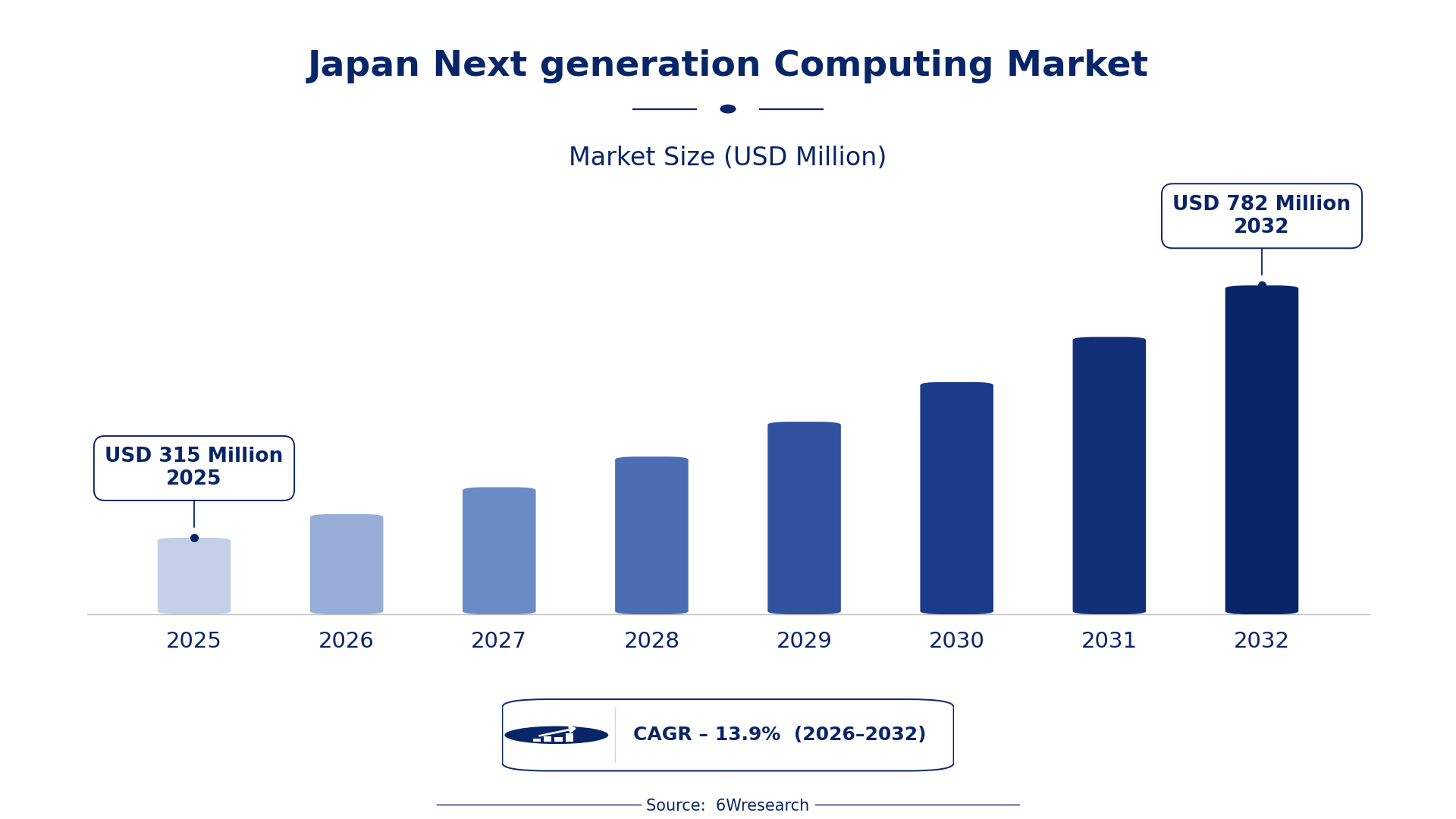
According to 6Wresearch internal database and industry insights, the Japan Next generation Computing Market was valued at USD 315 Million in 2025 and is projected to reach USD 782 Million by 2032, growing at a CAGR of approximately 13.9% during 2026–2032.
Japan Next generation Computing Market Highlights
| Report Metric | Details |
| Report Name | Japan Next generation Computing Market (2026-2032) |
| Market Size 2025 | USD 315 Million |
| Market Size 2032 | USD 782 Million |
| Absolute Growth 2025–2032 | USD 467 Million |
| CAGR 2026–2032 | 13.9% |
| Peak Annual Growth | 15.0% in 2032 |
| Forecast Period | 2026–2032 |
| Historical Data | 2022–2025 |
| Base Year | 2025 |
| Leading Component, 2025 | Hardware (43% share) |
| Leading Computing Type, 2025 | High-Performance Computing (39% share) |
| Leading Deployement, 2025 | Cloud (59% share) |
| Leading End-user, 2025 | Automotive & Transportation (37% share) |
| Fastest-Growing Component | Software (15.7% CAGR) |
| Fastest-Growing Computing Type | Quantum Computing (19.8% CAGR) |
| Fastest-Growing Deployement | On-Premise (18.0% CAGR) |
| Fastest-Growing End-user | Energy & Utilities (18.9% CAGR) |
| Growing Sector | Energy & Utilities |
| Key End Users | Automotive & Transportation, Energy & Utilities, Healthcare, BFSI |
Japan Next generation Computing Market Year-wise Growth Rate and Key Drivers (2022–2032)
This graph illustrates the annual growth rates of the market from 2022 to 2032, highlighting a steady upward trajectory and projected market expansion over the forecast period.
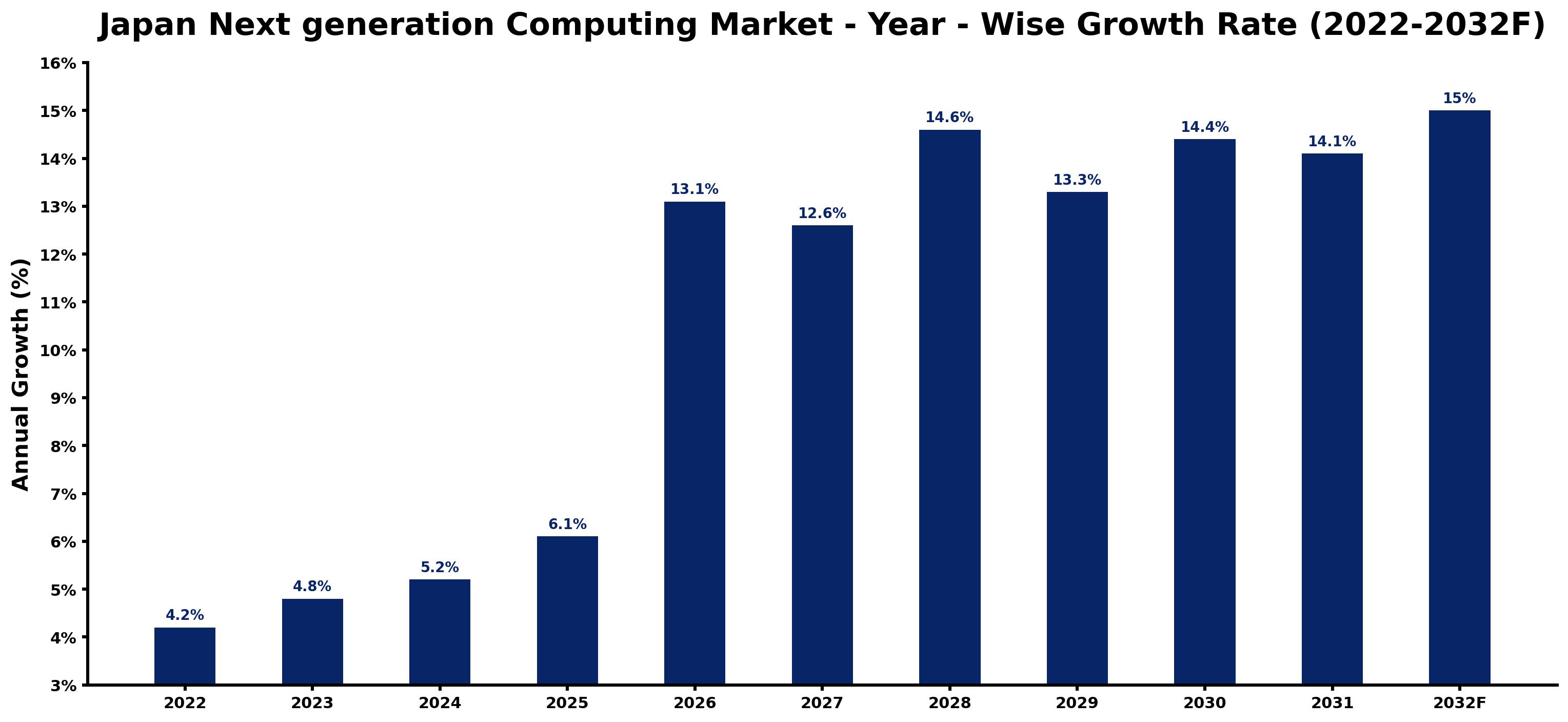
The following figures match every annual growth estimate with the main market development of that year, giving the reasoning behind each rise or slowdown.
| Year | Estimated Annual Growth (%) | Market Rationale |
| 2022 | 4.2 | The market experienced steady growth with increasing interest in advanced computing technologies. |
| 2023 | 4.8 | Demand rose as industries began integrating AI-driven solutions into their operations. |
| 2024 | 5.2 | The automotive sector expanded investments in edge computing for vehicle data processing. |
| 2025 | 6.1 | Healthcare investments in AI tools surged, driving further market growth. |
| 2026 | 13.1 | The market is set to accelerate as high-performance computing becomes essential for research. |
| 2027 | 12.6 | Growth slows slightly as the market adjusts to increased supply and demand balance. |
| 2028 | 14.6 | Demand rises again with advancements in quantum computing research and applications. |
| 2029 | 13.3 | Growth moderates as the market stabilises after rapid technological advancements. |
| 2030 | 14.4 | The introduction of new standards boosts confidence and investment in computing solutions. |
| 2031 | 14.1 | Growth slows as the market matures and competition intensifies among providers. |
| 2032 | 15.0 | The market peaks as demand for next-generation computing reaches unprecedented levels. |
Note: Market size estimations and growth projections presented in this report are based on 6Wresearch's proprietary forecasting methodology, utilizing the latest available industry data, government publications, and primary research inputs.
Japan Next generation Computing Market Synopsis
Next generation computing encompasses advanced technologies such as quantum and edge computing, designed for efficient data processing. These systems play a crucial role in sectors like automotive and healthcare, where real-time data analysis is paramount. The Japan Next Generation Computing Market is growing rapidly due to substantial investments from domestic industries, with the automotive sector expected to invest over ¥1 trillion by 2025. The healthcare industry is increasingly adopting AI-driven data analysis tools, further driving demand for advanced computing solutions.
Market Dynamics Impact Analysis (2026–2032)
| Factor | Type | Impact | Primary Segment Affected |
| Growing investments in AI and machine learning technologies | Driver | High | High-Performance Computing |
| Increased demand for real-time data processing in automotive applications | Driver | High | Edge Computing |
| Emerging opportunities in quantum computing research and applications | Opportunity | Medium | Quantum Computing |
| Rising demand for cloud solutions among businesses | Opportunity | High | Cloud |
| Limited availability of skilled professionals in advanced computing fields | Restraint | High | High-Performance Computing |
| High development costs for next-generation computing technologies | Restraint | Medium | Quantum Computing |
| Competition from international markets affecting local pricing | Challenge | High | Edge Computing |
| Rapid technological changes requiring constant adaptation | Challenge | Medium | High-Performance Computing |
Evaluation of Drivers in Japan Next generation Computing Market (2026–2032)
The table below links each growth driver to the segment it affects and the evidence for it.
| Drivers | Primary Segment Affected | Why It Matters (Evidence) |
| Increased adoption of AI technologies | High-Performance Computing | The healthcare sector's investment in AI-driven data analysis tools is projected to exceed ¥1 trillion by 2025, driving demand for high-performance systems. |
| Growing need for real-time data processing | Edge Computing | The automotive industry is adopting edge computing to improve vehicle data processing, contributing to a projected growth of 15% in this segment. |
| Expanding cloud computing solutions | Cloud | With 59% market share in 2025, cloud solutions are increasingly favoured for their scalability and flexibility in various sectors. |
| Rising interest in quantum computing | Quantum Computing | Research institutions are focusing on quantum computing, which is expected to grow by 19.8% from 2026 to 2032. |
| Investment in smart grid technologies | Energy & Utilities | The energy sector is implementing predictive maintenance solutions, driving the demand for advanced computing technologies. |
Much of the new demand traces back to the automotive and healthcare sectors, both heavily investing in advanced computing technologies. The automotive industry is projected to invest over ¥1 trillion in next-generation computing by 2025, improving real-time data processing capabilities. Healthcare, with over 8 million hospital beds, is increasingly adopting AI-driven data analysis tools to improve patient management. The cloud computing segment is also expanding, as businesses seek scalable solutions. Research institutions are advancing quantum computing, which will grow significantly, further driving demand for advanced computing solutions.
Evaluation of Restraints in Japan Next generation Computing Market
The following restraints limit how fast demand can grow.
| Market Restraint | Primary Segment Affected | Why It Matters (Evidence) |
| Shortage of skilled professionals in advanced computing technologies | High-Performance Computing | The lack of qualified personnel hampers the growth of high-performance computing, limiting project execution across sectors. |
| High costs associated with developing next-generation computing technologies | Quantum Computing | Development expenses restrict smaller firms from entering the quantum computing market, affecting overall growth. |
| Intense competition from international markets | Edge Computing | Local players face pressure from global competitors, resulting in pricing wars and reduced profit margins. |
| Rapid technological advancements necessitating constant adaptation | High-Performance Computing | Companies must continually update their systems, increasing operational costs and resource allocation. |
| Regulatory challenges in data security compliance | Cloud | Compliance with standards like ISO/IEC 27001 requires significant investment, deterring smaller businesses from adopting cloud solutions. |
Japan Next generation Computing Market Challenges
Quantum computing research at institutions like the University of Tokyo faces stringent regulatory requirements, causing delays of up to 18 months for producers. This regulatory burden slows technology development, limiting buyers' access to essential computing solutions. Technological integration issues arise as AI struggles to work with legacy systems, increasing costs for producers by approximately ¥5 billion annually. Supply chain disruptions stem from a lack of local component manufacturers, extending delivery times by three months and hindering buyers' ability to implement next-generation computing systems effectively.
Trends in the Japan Next generation Computing Market
The trends below show where the Japan Next generation Computing Market is heading.
- Shift from On-Premise to Cloud Solutions: In 2023, the trend towards cloud computing accelerated as businesses sought scalable solutions. The Tokyo region, a hub for IT innovations, experienced a 20% increase in cloud adoption, reflecting a broader shift in operational strategies.
- Emergence of Quantum Computing Research: Since 2022, quantum computing has gained traction, particularly in academic institutions. The University of Tokyo leads research efforts, with funding increasing by ¥2 billion, indicating a growing focus on this technology.
- Growing Adoption of Edge Computing in Automotive: The automotive sector has increasingly embraced edge computing since 2022, improving real-time data processing for vehicles. This shift is reflected in a projected 15% growth in edge computing solutions by 2026.
- Increased Investment in AI-Driven Healthcare Solutions: With healthcare investments rising, the sector has adopted AI technologies for data management. In 2023, funding for AI-driven tools reached ¥10 billion, showcasing the demand for advanced computing solutions.
Investment Opportunities in the Japan Next generation Computing Market
The following areas offer the clearest openings for investors and suppliers in the Japan Next generation Computing Market.
- Partnerships with Research Institutions: Collaborating with universities can facilitate access to research in quantum computing, which is expected to expand significantly from 2026 to 2032.
- Targeting the Automotive Sector: The automotive industry is set to invest over ¥1 trillion in next-generation computing by 2025, presenting opportunities for suppliers of advanced computing solutions.
- Developing Cloud Solutions for SMEs: Small and medium enterprises are increasingly seeking cloud solutions for scalability. This trend is supported by a 20% increase in cloud adoption in the Tokyo region.
- Investing in AI-Driven Healthcare Technologies: With the healthcare sector investing heavily in AI tools, suppliers can target this market, which is projected to exceed ¥10 billion in funding for data analysis solutions.
Government Initiatives in the Japan Next generation Computing Market
The Battery Industry Strategy, initiated by METI in August 2022, aims to boost domestic battery manufacturing capacity, indirectly benefiting next-generation computing by creating a reliable supply chain for energy storage solutions. The Green Growth Strategy identifies advanced computing as a critical growth sector, promoting investments and innovations in this area.
The Ministry of Education, Culture, Sports, Science and Technology oversees funding for quantum computing research, approving projects that advance this technology. In 2023, the government allocated ¥10 billion specifically for advanced computing research, supporting initiatives that strengthen Japan's technological capabilities.
Future Insight of the Japan Next generation Computing Market
New advanced computing research initiatives will emerge, supported by government funding and industry collaboration. The automotive sector's projected investment of over ¥1 trillion in next-generation computing by 2025 will accelerate the adoption of real-time data processing technologies. Standards like ISO/IEC 27001 will strengthen data security practices, reassuring buyers about their data management. The rise of tech startups in the Tokyo region will drive ongoing advancements, ensuring a steady flow of cutting-edge solutions for Japan's critical industries.
Market Segmentation Analysis
Japan Next generation Computing Market report covers a detailed analysis of the following market segments:
By Component – Hardware Leads, Software Expected to Grow Fastest
According to Dhaval Chaurasia, Assistant Manager at 6Wresearch, with 43% of component revenue in 2025, Hardware was the largest category. Hardware holds the largest share due to its essential role in constructing computing systems, particularly within Japan's extensive network of over 100 research institutions. These institutions heavily depend on advanced hardware to fulfil their significant computational requirements. The quickest growth will come from Software, forecast to expand at a CAGR of 15.7% between 2026 and 2032. Software is the fastest-growing segment, driven by the healthcare sector's substantial investments in data analysis tools that require effective management of computing resources. This trend reflects a broader shift towards prioritising software solutions across various industries. Suppliers must focus on enhancing their software capabilities to meet the growing demand from multiple sectors.
By Computing Type – High-Performance Computing Leads, Quantum Computing Expected to Grow Fastest
In 2025, High-Performance Computing led the computing type split with a 39% share. High-Performance Computing leads the market because it is vital for executing complex simulations and processing large datasets, widely utilised by research institutions and various industries. The considerable government funding allocated for advanced computing research further reinforces this segment's prominence. Quantum Computing is projected to grow fastest, at a CAGR of 19.8% during 2026–2032. Quantum Computing is witnessing rapid growth, fuelled by robust research initiatives like those from the Ministry of Education, Culture, Sports, Science and Technology. The ongoing developments at institutions such as the University of Tokyo indicate a bright future for this technology. Buyers should prepare for advancements in quantum computing that may transform data processing capabilities in the coming years.
By Deployement – Cloud Leads, On-Premise Expected to Grow Fastest
The largest deployement category in 2025 was Cloud, at 59% of revenue. Cloud deployment dominates the market as it is extensively adopted for scalable computing solutions, allowing organisations to manage their resources effectively. The flexibility provided by cloud solutions caters to the diverse requirements of various sectors in Japan. Over 2026–2032, On-Premise is expected to post the fastest growth, at a CAGR of 18.0%. On-Premise deployment is experiencing swift growth as organisations increasingly prioritise specific data security needs, particularly in sensitive industries. This trend is reflected in the rising number of companies opting for on-premise solutions to safeguard their data. Suppliers must adapt to the increasing demand for on-premise solutions while ensuring they incorporate strong security features.
By End-user – Automotive & Transportation Leads, Energy & Utilities Expected to Grow Fastest
Automotive & Transportation took 37% of end-user revenue in 2025, more than any other category. The Automotive & Transportation sector leads the market, utilising advanced technologies for driver-assistance systems and autonomous vehicles, which are critical for industry innovation. The projected investment of over ¥1 trillion in next-gen computing by this sector underscores its significance. Energy & Utilities are set to record the highest CAGR in this split, 18.9% over 2026–2032. Energy & Utilities is the fastest-growing segment, driven by the need for smart grid management and predictive maintenance solutions. The increasing focus on sustainability and efficiency in this sector is propelling its rapid adoption of next-gen computing technologies. Suppliers should target the energy sector, as its growth presents new opportunities for advanced computing solutions.
Key Attractiveness of the Report
- 10 Years of Market Numbers
- Historical Data Starting from 2022 to 2025
- Base Year 2025
- Forecast Data until 2032
- Key Performance Indicators Impacting the Market
- Major Upcoming Developments and Projects
Key Highlights of the Report:
- Japan Next generation Computing Market Outlook
- Market Size of Japan Next generation Computing Market, 2025
- Forecast of Japan Next generation Computing Market, 2032
- Historical Data and Forecast of Japan Next generation Computing Revenues & Volume for the Period 2022-2032
- Japan Next generation Computing Market Trend Evolution
- Japan Next generation Computing Market Drivers and Challenges
- Japan Next generation Computing Price Trends
- Japan Next generation Computing Porter's Five Forces
- Japan Next generation Computing Industry Life Cycle
- Historical Data and Forecast of Japan Next generation Computing Market Revenues & Volume By Component for the Period 2022-2032
- Historical Data and Forecast of Japan Next generation Computing Market Revenues & Volume By Hardware for the Period 2022-2032
- Historical Data and Forecast of Japan Next generation Computing Market Revenues & Volume By Software for the Period 2022-2032
- Historical Data and Forecast of Japan Next generation Computing Market Revenues & Volume By Services for the Period 2022-2032
- Historical Data and Forecast of Japan Next generation Computing Market Revenues & Volume By Computing Type for the Period 2022-2032
- Historical Data and Forecast of Japan Next generation Computing Market Revenues & Volume By High-Performance Computing for the Period 2022-2032
- Historical Data and Forecast of Japan Next generation Computing Market Revenues & Volume By Quantum Computing for the Period 2022-2032
- Historical Data and Forecast of Japan Next generation Computing Market Revenues & Volume By Optical Computing for the Period 2022-2032
- Historical Data and Forecast of Japan Next generation Computing Market Revenues & Volume By Edge Computing for the Period 2022-2032
- Historical Data and Forecast of Japan Next generation Computing Market Revenues & Volume By Other for the Period 2022-2032
- Historical Data and Forecast of Japan Next generation Computing Market Revenues & Volume By Deployement for the Period 2022-2032
- Historical Data and Forecast of Japan Next generation Computing Market Revenues & Volume By Cloud for the Period 2022-2032
- Historical Data and Forecast of Japan Next generation Computing Market Revenues & Volume By On-Premise for the Period 2022-2032
- Historical Data and Forecast of Japan Next generation Computing Market Revenues & Volume By End-user for the Period 2022-2032
- Historical Data and Forecast of Japan Next generation Computing Market Revenues & Volume By Automotive & Transportation for the Period 2022-2032
- Historical Data and Forecast of Japan Next generation Computing Market Revenues & Volume By Energy & Utilities for the Period 2022-2032
- Historical Data and Forecast of Japan Next generation Computing Market Revenues & Volume By Healthcare for the Period 2022-2032
- Historical Data and Forecast of Japan Next generation Computing Market Revenues & Volume By BFSI for the Period 2022-2032
- Historical Data and Forecast of Japan Next generation Computing Market Revenues & Volume By Aerospace & Defense for the Period 2022-2032
- Historical Data and Forecast of Japan Next generation Computing Market Revenues & Volume By Media & Entertainment for the Period 2022-2032
- Historical Data and Forecast of Japan Next generation Computing Market Revenues & Volume By IT & Telecom for the Period 2022-2032
- Historical Data and Forecast of Japan Next generation Computing Market Revenues & Volume By Other for the Period 2022-2032
- Japan Next generation Computing Import Export Trade Statistics
- Market Opportunity Assessment By Component
- Market Opportunity Assessment By Computing Type
- Market Opportunity Assessment By Deployement
- Market Opportunity Assessment By End-user
- Japan Next generation Computing Top Companies Market Share
- Japan Next generation Computing Competitive Benchmarking By Technical and Operational Parameters
- Japan Next generation Computing Company Profiles
- Japan Next generation Computing Key Strategic Recommendations
Market Covered
This report examines the market across the segments below.
By Component
- Hardware
- Software
- Services
By Computing Type
- High-Performance Computing
- Quantum Computing
- Optical Computing
- Edge Computing
- Other
By Deployement
- Cloud
- On-Premise
By End-user
- Automotive & Transportation
- Energy & Utilities
- Healthcare
- BFSI
- Aerospace & Defense
- Media & Entertainment
- IT & Telecom
- Other































