Japan Nitrogen-Fixing Bacteria Market Size & Growth Rate
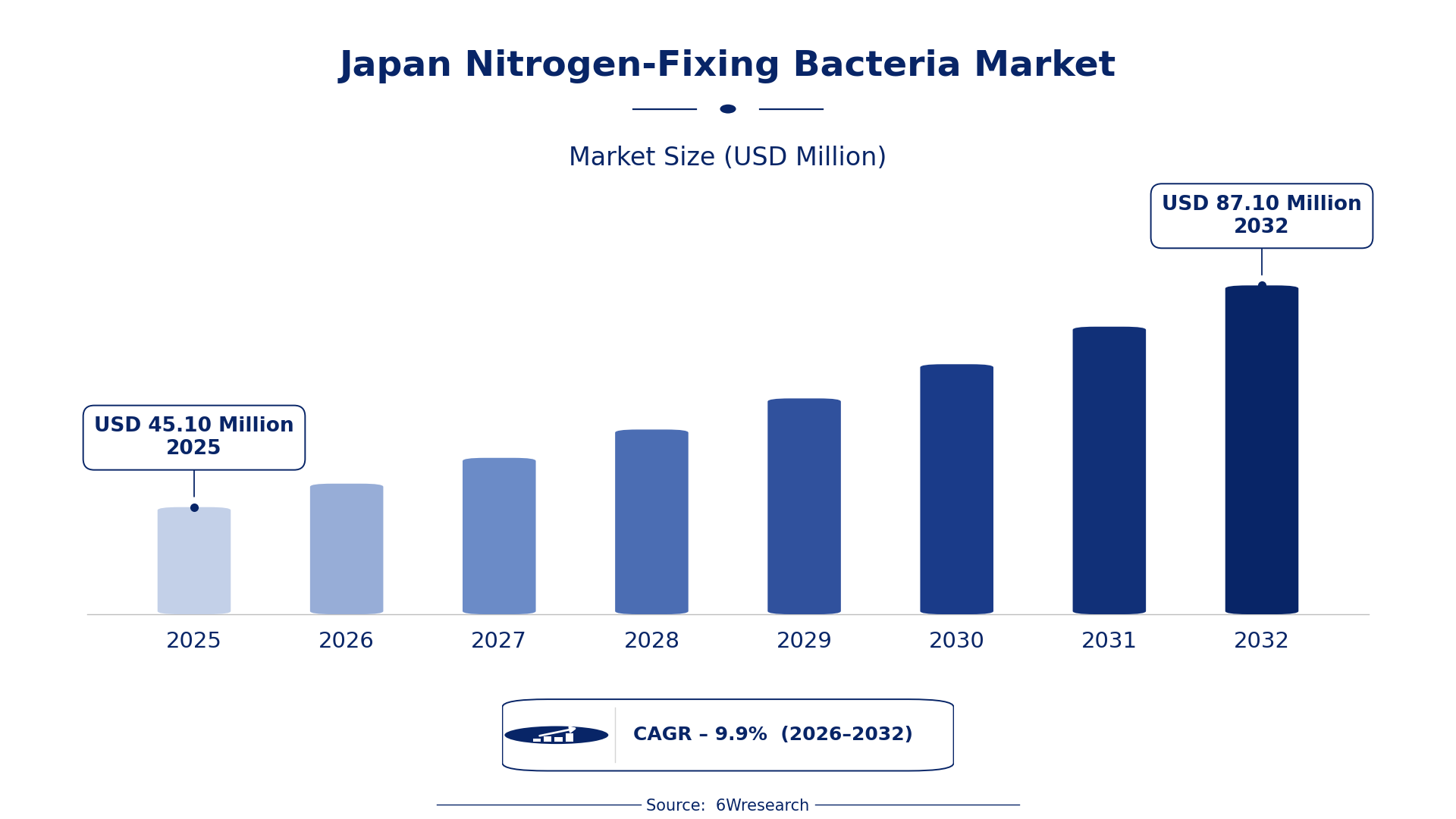
According to 6Wresearch internal database and industry insights, the Japan Nitrogen-Fixing Bacteria Market was valued at USD 45.10 Million in 2025 and is projected to reach USD 87.10 Million by 2032, growing at a CAGR of approximately 9.9% during 2026–2032.
Japan Nitrogen-Fixing Bacteria Market Highlights
| Report Metric | Details |
| Report Name | Japan Nitrogen-Fixing Bacteria Market (2026-2032) |
| Market Size 2025 | USD 45.10 Million |
| Market Size 2032 | USD 87.10 Million |
| Absolute Growth 2025–2032 | USD 42.00 Million |
| CAGR 2026–2032 | 9.9% |
| Peak Annual Growth | 10.8% in 2032 |
| Forecast Period | 2026–2032 |
| Historical Data | 2022–2025 |
| Base Year | 2025 |
| Leading Bacteria Type, 2025 | Rhizobium (47% share) |
| Leading Carrier Medium, 2025 | Peat-based (33% share) |
| Leading Application, 2025 | Seed Inoculants (48% share) |
| Leading End User, 2025 | Legume Farmers (31% share) |
| Fastest-Growing Bacteria Type | Azospirillum (14.1% CAGR) |
| Fastest-Growing Carrier Medium | Liquid Culture (13.1% CAGR) |
| Fastest-Growing Application | Soil Drench (13.5% CAGR) |
| Fastest-Growing End User | Cereal Crop Growers (13.0% CAGR) |
| Growing Sector | Soil Drench |
| Key End Users | Seed Inoculants, Soil Drench, Foliar Spray, Nursery Applications |
Japan Nitrogen-Fixing Bacteria Market Year-wise Growth Rate and Key Drivers (2022–2032)
This graph illustrates the annual growth rates of the market from 2022 to 2032, highlighting a steady upward trajectory and projected market expansion over the forecast period.
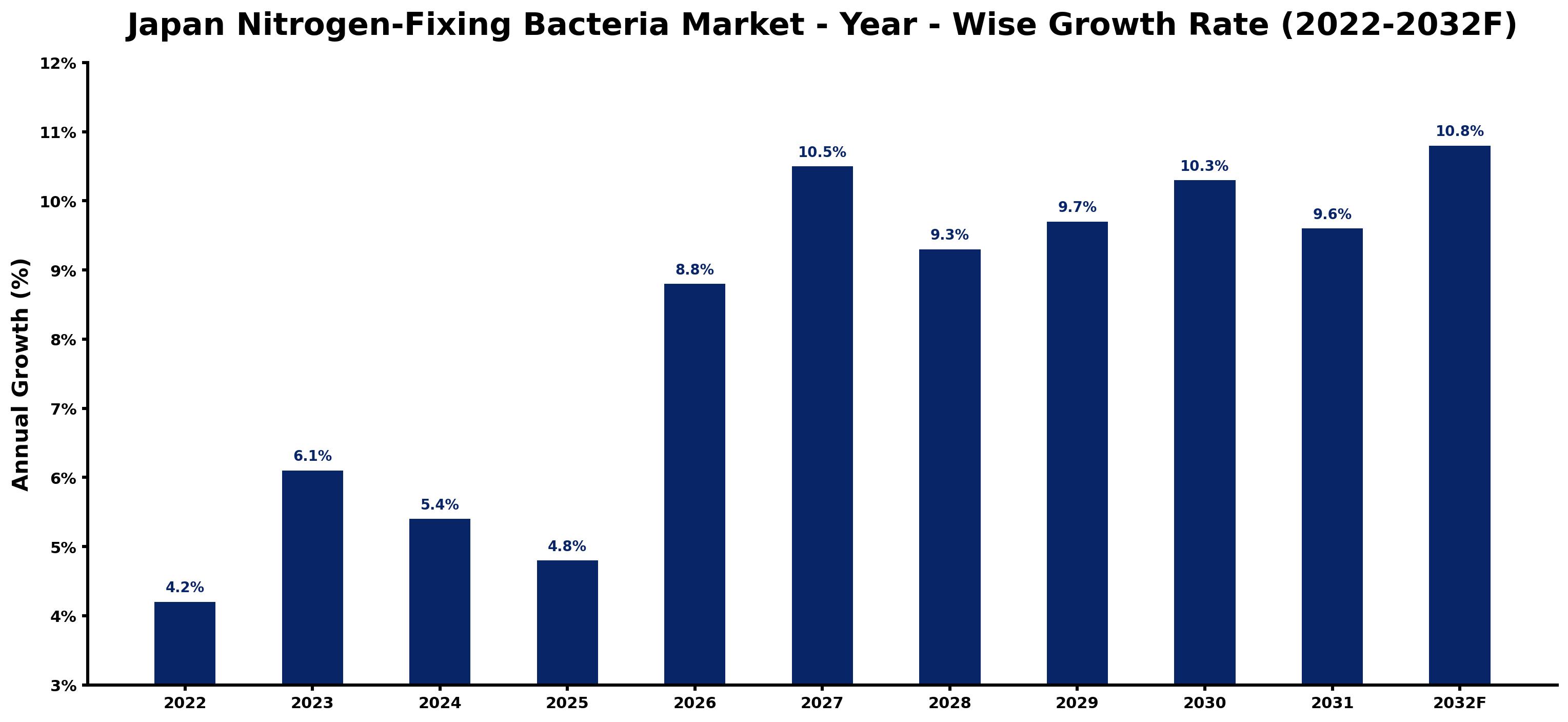
For each year, the table pairs the estimated growth rate with the leading influence on demand, showing how the drivers changed across the period.
| Year | Estimated Annual Growth (%) | Market Rationale |
| 2022 | 4.2 | The market experienced steady growth, driven by increased awareness of sustainable agriculture practices. |
| 2023 | 6.1 | Demand for nitrogen-fixing bacteria surged due to rising adoption among legume farmers across Japan. |
| 2024 | 5.4 | Growth slowed as market saturation began to affect new purchases, particularly in established regions. |
| 2025 | 4.8 | The market continued to grow, albeit at a slower pace, as producers adjusted to changing agricultural practices. |
| 2026 | 8.8 | Growth is expected to accelerate as cereal crop growers in Hokkaido increasingly adopt Azospirillum for yield improvement. |
| 2027 | 10.5 | Demand is projected to rise sharply with the introduction of new sustainable farming initiatives across the country. |
| 2028 | 9.3 | Growth rate is anticipated to slow slightly as the market stabilises after a period of rapid expansion in previous years. |
| 2029 | 9.7 | The market is expected to rebound with renewed interest in nitrogen-fixing applications among vegetable producers. |
| 2030 | 10.3 | Demand is projected to surge again as liquid culture forms become more widely adopted in vegetable production. |
| 2031 | 9.6 | Growth is expected to moderate as the market adjusts to the increased supply of nitrogen-fixing products. |
| 2032 | 10.8 | The market is projected to peak with strong demand driven by ongoing investments in sustainable agricultural practices. |
Note: Market size estimations and growth projections presented in this report are based on 6Wresearch's proprietary forecasting methodology, utilizing the latest available industry data, government publications, and primary research inputs.
Japan Nitrogen-Fixing Bacteria Market Synopsis
Nitrogen-fixing bacteria are microorganisms that convert atmospheric nitrogen into a usable form for plants, primarily produced through fermentation. They improve soil fertility and promote plant growth, with demand primarily from legume farmers and cereal crop growers. The Japan Nitrogen-Fixing Bacteria Market is expanding due to rising adoption of sustainable agricultural practices, with 1.3 million hectares of legume cultivation and government initiatives supporting microbial applications driving increased purchases.
Market Dynamics Impact Analysis (2026–2032)
| Factor | Type | Impact | Primary Segment Affected |
| Increased adoption of Rhizobium among legume farmers | Driver | High | Rhizobium |
| Growing use of Azospirillum by cereal crop growers | Driver | High | Azospirillum |
| Expansion of sustainable agriculture initiatives | Opportunity | High | Legume Farmers |
| Rising interest in aquaponics applications | Opportunity | Medium | Aquaponics |
| Market saturation affecting new purchases | Restraint | High | Seed Inoculants |
| Compliance with ISO 9001 standards for quality | Restraint | Medium | Liquid Culture |
| High production costs for microbial products | Challenge | High | Granular Soil Additive |
| Limited capacity for large-scale production | Challenge | Medium | Azotobacter |
Evaluation of Drivers in Japan Nitrogen-Fixing Bacteria Market (2026–2032)
Below are the drivers that matter most for revenue growth, with supporting evidence.
| Drivers | Primary Segment Affected | Why It Matters (Evidence) |
| Increased adoption of Rhizobium among legume farmers | Rhizobium | With 60% of legume farmers using Rhizobium, this bacteria enhances soil fertility, leading to greater crop yields and increased purchases. |
| Growing use of Azospirillum by cereal crop growers | Azospirillum | Cereal crop growers, particularly in Hokkaido, are increasingly adopting Azospirillum, which improves nutrient uptake and boosts yields, driving demand. |
| Rising popularity of liquid culture forms | Liquid Culture | Liquid culture forms are now adopted in 30% of vegetable production, simplifying application and encouraging more farmers to use nitrogen-fixing bacteria. |
| Demand for granular soil additives in Kanto region | Granular Soil Additive | Granular soil additives are popular in the Kanto region for enhancing soil quality, prompting more purchases among local farmers. |
| Support from the Ministry of Agriculture, Forestry and Fisheries | Rhizobium | The Ministry promotes sustainable practices with nitrogen-fixing bacteria, leading to increased adoption and purchases across the agricultural sector. |
Orders keep climbing as the adoption of nitrogen-fixing bacteria rises among legume farmers, with 60% utilising Rhizobium to improve soil fertility. Cereal crop growers are increasingly turning to Azospirillum, which boosts yields by enhancing nutrient uptake. Rising interest in sustainable practices drives demand for these products, as farmers seek environmentally friendly solutions. Liquid culture forms are now adopted in 30% of vegetable production, making application easier for growers. In the Kanto region, granular soil additives are popular for improving soil quality, further supporting market growth.
Evaluation of Restraints in Japan Nitrogen-Fixing Bacteria Market
Several factors work against faster growth; the main ones are summarised below.
| Market Restraint | Primary Segment Affected | Why It Matters (Evidence) |
| Market saturation affecting new purchases | Seed Inoculants | As the market matures, fewer new farmers are adopting seed inoculants, limiting growth opportunities. |
| Compliance with ISO 9001 standards | Liquid Culture | Producers must invest in quality assurance to meet ISO 9001 standards, increasing operational costs. |
| High production costs for microbial products | Granular Soil Additive | Rising production costs limit profitability for suppliers of granular soil additives, affecting pricing strategies. |
| Limited capacity for large-scale production | Azotobacter | Producers face challenges in scaling up Azotobacter production, restricting supply to meet demand effectively. |
| Dependence on specific soil conditions for effectiveness | Azotobacter | Azotobacter is only effective in certain soil conditions, limiting its broader application in diverse agricultural settings. |
Japan Nitrogen-Fixing Bacteria Market Challenges
Legume farmers in Japan face high production costs due to reliance on peat-based carriers, which 70% of producers use. This dependency raises input expenses, squeezing profit margins for approximately 500,000 farmers. Competition intensifies as alternative soil improvement methods gain traction, forcing producers to lower prices and impacting their revenue. Technology adoption lags, with only 30% of vegetable producers using liquid culture forms, which limits efficiency and crop yield improvements. Supply chain issues arise from restricted access to quality microbial products, causing delays for buyers who require timely deliveries for planting seasons.
Trends in the Japan Nitrogen-Fixing Bacteria Market
The shifts below are changing how Japan Nitrogen-Fixing Bacteria Market products are bought and supplied.
- Cereal Crop Growers Prioritising Azospirillum: Cereal crop growers are increasingly prioritising Azospirillum, with adoption rates rising in Hokkaido. This shift reflects a 14.1% CAGR in the Azospirillum segment, as growers seek improved yields.
- Legume Farmers Shifting to Liquid Culture: Legume farmers are shifting towards liquid culture forms of nitrogen-fixing bacteria, now adopted in 30% of vegetable production. This change improves application efficiency and reflects growing demand for effective solutions.
- Seed Inoculants Gaining Popularity: Seed inoculants have gained popularity among legume farmers, holding a 48% market share in 2025. This trend is driven by the proven benefits of nitrogen-fixing bacteria in improving crop yields.
- Aquaponics Applications Expanding: Aquaponics applications are expanding, with a 15% growth since 2020. This trend highlights the increasing interest in integrated farming systems that utilise nitrogen-fixing bacteria for sustainable practices.
Investment Opportunities in the Japan Nitrogen-Fixing Bacteria Market
The following opportunities in the Japan Nitrogen-Fixing Bacteria Market pair current demand with a clear way in.
- Agricultural Cooperatives: Agricultural cooperatives in Japan are seeking solutions, with an estimated 500,000 farmers. The market gap for nitrogen-fixing bacteria is substantial, as producers can enter through partnerships.
- Kanto Region Soil Enhancement: The Kanto region shows a strong demand for granular soil additives, with a market size of USD 45.10 million. Suppliers can benefit by providing high-quality products to local farmers.
- Hokkaido Cereal Crop Growth: Cereal crop growers in Hokkaido are increasingly adopting nitrogen-fixing bacteria, with a projected growth of 10.5% by 2027. Suppliers should focus on tailored solutions for this region.
- Sustainable Agriculture Initiatives: The Japanese government allocated funds for sustainable agriculture initiatives in 2023, promoting nitrogen-fixing bacteria. Suppliers can engage with local farmers to meet rising demand.
Government Initiatives in the Japan Nitrogen-Fixing Bacteria Market
The Waste Management and Public Cleansing Act (1970; MoE) regulates the treatment and disposal of industrial and municipal waste, ensuring safe practices for producers of nitrogen-fixing bacteria. Compliance with this law requires adherence to waste management protocols, impacting operational costs for manufacturers and suppliers in the sector. The Industrial Standardization Act (1949; amended in 2019) governs JIS product and test standards, ensuring quality and safety in microbial products. Producers must meet these standards to maintain market access and consumer trust.
The Japan Agricultural Cooperatives (JA) plays a crucial role in promoting the use of nitrogen-fixing bacteria among its members, facilitating access to quality products and information. In 2023, the government allocated funds for sustainable agriculture initiatives, supporting farmers in adopting these practices. The Ministry of Agriculture, Forestry and Fisheries endorses the use of nitrogen-fixing bacteria to improve soil health, benefiting both producers and buyers in the agricultural sector.
Future Insight of the Japan Nitrogen-Fixing Bacteria Market
New sustainable agriculture initiatives will emerge by 2032, driving demand for nitrogen-fixing bacteria in modern farming systems. The Ministry of Agriculture, Forestry and Fisheries will support these initiatives, benefiting both buyers and suppliers. The adoption of ISO 9001 standards will ensure higher quality in microbial products, enhancing market trust. Research indicates that nitrogen-fixing bacteria can increase crop yields by 20-30%, encouraging more farmers to integrate them into their practices.
Market Segmentation Analysis
Japan Nitrogen-Fixing Bacteria Market report covers a detailed analysis of the following market segments:
By Bacteria Type – Rhizobium Leads, Azospirillum Expected to Grow Fastest
According to Saurav Kr Singh, Senior Research Analyst at 6Wresearch, with 47% of bacteria type revenue in 2025, Rhizobium was the largest category. Rhizobium holds the largest share as it is extensively used by 60% of legume farmers in Japan, who rely on it for effective nitrogen fixation. This widespread adoption is bolstered by government initiatives that encourage sustainable agricultural practices involving these bacteria. The quickest growth will come from Azospirillum, forecast to expand at a CAGR of 14.1% between 2026 and 2032. Azospirillum is witnessing rapid growth as cereal crop growers, particularly in Hokkaido, increasingly adopt it due to its benefits in enhancing crop yields. The rising demand for efficient nitrogen-fixing solutions in cereal cultivation is driving this sub-segment's expansion. Suppliers should prioritise promoting Azospirillum to cereal crop growers to capitalise on its increasing popularity.
By Carrier Medium – Peat-based Leads, Liquid Culture Expected to Grow Fastest
Peat-based took 33% of carrier medium revenue in 2025, more than any other category. Peat-based carriers dominate the market as they are the most common medium used by 70% of producers for nitrogen-fixing bacteria inoculants. Their effectiveness in maintaining viable microbial populations makes them a preferred choice among agricultural users. Liquid Culture is projected to grow fastest, at a CAGR of 13.1% during 2026–2032. Liquid culture forms are gaining traction due to their ease of application, particularly in vegetable production where 30% of growers have adopted this method. This trend indicates a shift towards more convenient application methods in the industry. Suppliers should consider increasing their offerings of liquid culture products to meet the rising demand for user-friendly application solutions.
By Application – Seed Inoculants Lead, Soil Drench Expected to Grow Fastest
The largest application category in 2025 was Seed Inoculants, at 48% of revenue. Seed inoculants are crucial for legume planting, establishing them as the leading application in the market. Their vital role in ensuring successful legume cultivation drives widespread adoption among farmers across Japan. Over 2026–2032, Soil Drench is expected to post the fastest growth, at a CAGR of 13.5%. Soil drench applications are gaining popularity as they are recognised for their effectiveness in improving soil health. This method's increasing acceptance among farmers indicates a shift towards more comprehensive agricultural practices. Suppliers must broaden their product offerings to include soil drench solutions to meet the evolving preferences of farmers.
By End User – Legume Farmers Lead, Cereal Crop Growers Expected to Grow Fastest
Legume Farmers accounted for 31% of the market by end user in 2025. Legume farmers represent the largest user group of nitrogen-fixing bacteria, with approximately 500,000 farmers employing these products to enhance soil fertility and crop yields. Their reliance on these bacteria for successful legume cultivation solidifies their dominant position in the market. Cereal Crop Growers are set to record the highest CAGR in this split, 13.0% over 2026–2032. Cereal crop growers are increasingly integrating nitrogen-fixing bacteria into their practices to improve yields, reflecting a notable shift in agricultural methodologies. This growing interest suggests significant potential for expansion in this user segment as farmers aim to boost productivity. Suppliers should focus on targeting cereal crop growers to tap into the expanding market for nitrogen-fixing solutions.
Key Attractiveness of the Report
- 10 Years of Market Numbers
- Historical Data Starting from 2022 to 2025
- Base Year 2025
- Forecast Data until 2032
- Key Performance Indicators Impacting the Market
- Major Upcoming Developments and Projects
Key Highlights of the Report:
- Japan Nitrogen-Fixing Bacteria Market Outlook
- Market Size of Japan Nitrogen-Fixing Bacteria Market, 2025
- Forecast of Japan Nitrogen-Fixing Bacteria Market, 2032
- Historical Data and Forecast of Japan Nitrogen-Fixing Bacteria Revenues & Volume for the Period 2022-2032F
- Japan Nitrogen-Fixing Bacteria Market Trend Evolution
- Japan Nitrogen-Fixing Bacteria Market Drivers and Challenges
- Japan Nitrogen-Fixing Bacteria Price Trends
- Japan Nitrogen-Fixing Bacteria Porter's Five Forces
- Japan Nitrogen-Fixing Bacteria Industry Life Cycle
- Historical Data and Forecast of Japan Nitrogen-Fixing Bacteria Market Revenues & Volume By Bacteria Type for the Period 2022-2032F
- Historical Data and Forecast of Japan Nitrogen-Fixing Bacteria Market Revenues & Volume By Rhizobium for the Period 2022-2032F
- Historical Data and Forecast of Japan Nitrogen-Fixing Bacteria Market Revenues & Volume By Azospirillum for the Period 2022-2032F
- Historical Data and Forecast of Japan Nitrogen-Fixing Bacteria Market Revenues & Volume By Azotobacter for the Period 2022-2032F
- Historical Data and Forecast of Japan Nitrogen-Fixing Bacteria Market Revenues & Volume By Frankia spp. for the Period 2022-2032F
- Historical Data and Forecast of Japan Nitrogen-Fixing Bacteria Market Revenues & Volume By Cyanobacteria for the Period 2022-2032F
- Historical Data and Forecast of Japan Nitrogen-Fixing Bacteria Market Revenues & Volume By Carrier Medium for the Period 2022-2032F
- Historical Data and Forecast of Japan Nitrogen-Fixing Bacteria Market Revenues & Volume By Peat-based for the Period 2022-2032F
- Historical Data and Forecast of Japan Nitrogen-Fixing Bacteria Market Revenues & Volume By Liquid Culture for the Period 2022-2032F
- Historical Data and Forecast of Japan Nitrogen-Fixing Bacteria Market Revenues & Volume By Powdered Form for the Period 2022-2032F
- Historical Data and Forecast of Japan Nitrogen-Fixing Bacteria Market Revenues & Volume By Granular Soil Additive for the Period 2022-2032F
- Historical Data and Forecast of Japan Nitrogen-Fixing Bacteria Market Revenues & Volume By Alginate Beads for the Period 2022-2032F
- Historical Data and Forecast of Japan Nitrogen-Fixing Bacteria Market Revenues & Volume By Application for the Period 2022-2032F
- Historical Data and Forecast of Japan Nitrogen-Fixing Bacteria Market Revenues & Volume By Seed Inoculants for the Period 2022-2032F
- Historical Data and Forecast of Japan Nitrogen-Fixing Bacteria Market Revenues & Volume By Soil Drench for the Period 2022-2032F
- Historical Data and Forecast of Japan Nitrogen-Fixing Bacteria Market Revenues & Volume By Foliar Spray for the Period 2022-2032F
- Historical Data and Forecast of Japan Nitrogen-Fixing Bacteria Market Revenues & Volume By Nursery Applications for the Period 2022-2032F
- Historical Data and Forecast of Japan Nitrogen-Fixing Bacteria Market Revenues & Volume By Aquaponics for the Period 2022-2032F
- Historical Data and Forecast of Japan Nitrogen-Fixing Bacteria Market Revenues & Volume By End User for the Period 2022-2032F
- Historical Data and Forecast of Japan Nitrogen-Fixing Bacteria Market Revenues & Volume By Legume Farmers for the Period 2022-2032F
- Historical Data and Forecast of Japan Nitrogen-Fixing Bacteria Market Revenues & Volume By Cereal Crop Growers for the Period 2022-2032F
- Historical Data and Forecast of Japan Nitrogen-Fixing Bacteria Market Revenues & Volume By Vegetable Producers for the Period 2022-2032F
- Historical Data and Forecast of Japan Nitrogen-Fixing Bacteria Market Revenues & Volume By Forestry Nurseries for the Period 2022-2032F
- Historical Data and Forecast of Japan Nitrogen-Fixing Bacteria Market Revenues & Volume By Aquaculture Operations for the Period 2022-2032F
- Japan Nitrogen-Fixing Bacteria Import Export Trade Statistics
- Market Opportunity Assessment By Bacteria Type
- Market Opportunity Assessment By Carrier Medium
- Market Opportunity Assessment By Application
- Market Opportunity Assessment By End User
- Japan Nitrogen-Fixing Bacteria Top Companies Market Share
- Japan Nitrogen-Fixing Bacteria Competitive Benchmarking By Technical and Operational Parameters
- Japan Nitrogen-Fixing Bacteria Company Profiles
- Japan Nitrogen-Fixing Bacteria Key Strategic Recommendations
Market Covered
Coverage by segment is as follows.
By Bacteria Type
- Rhizobium
- Azospirillum
- Azotobacter
- Frankia spp.
- Cyanobacteria
By Carrier Medium
- Peat-based
- Liquid Culture
- Powdered Form
- Granular Soil Additive
- Alginate Beads
By Application
- Seed Inoculants
- Soil Drench
- Foliar Spray
- Nursery Applications
- Aquaponics
By End User
- Legume Farmers
- Cereal Crop Growers
- Vegetable Producers
- Forestry Nurseries
- Aquaculture Operations






































