Japan No-Till Seeding Technology Market Size & Growth Rate
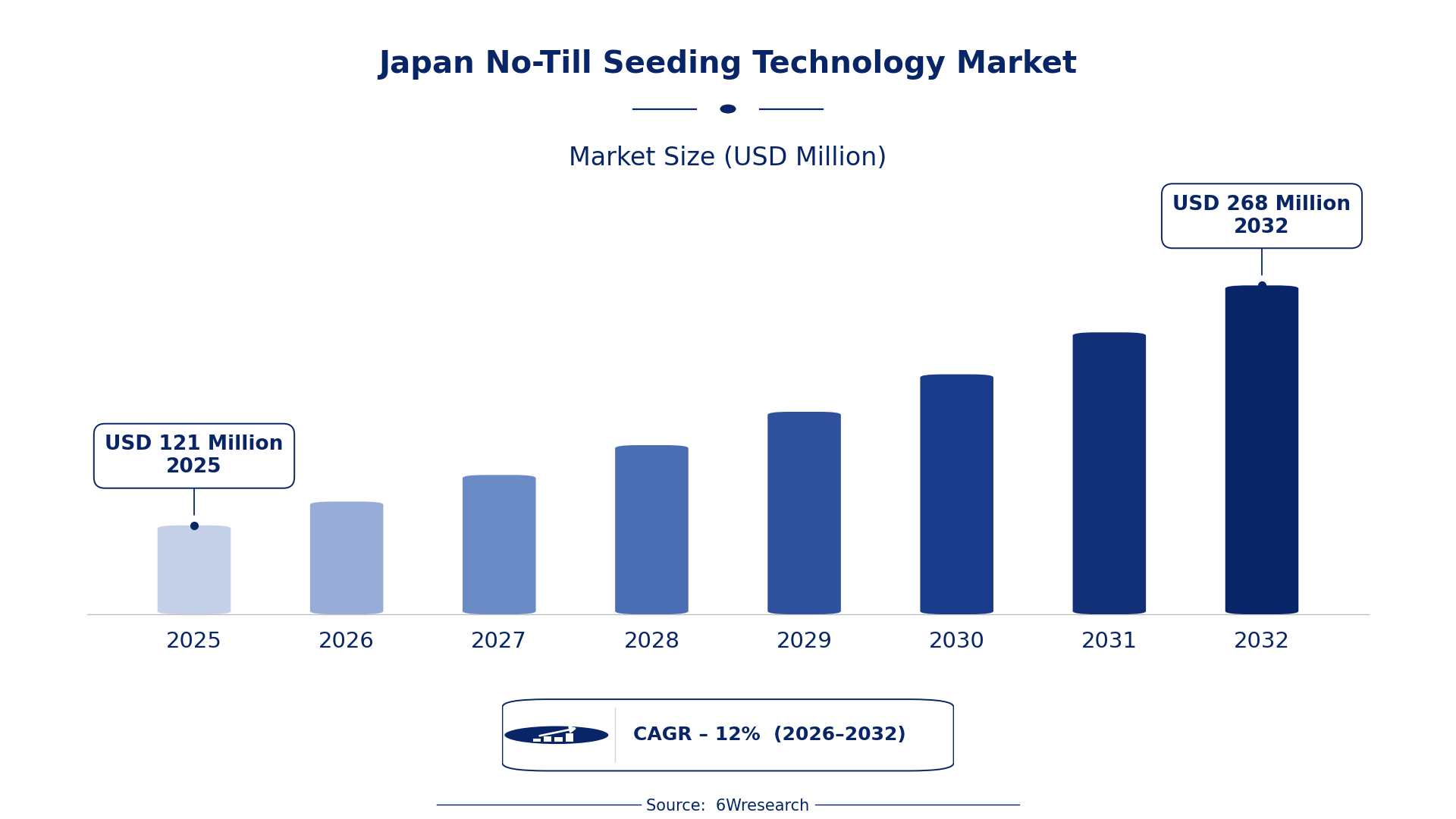
According to 6Wresearch internal database and industry insights, the Japan No-Till Seeding Technology Market was valued at USD 121 Million in 2025 and is projected to reach USD 268 Million by 2032, growing at a CAGR of approximately 12% during 2026–2032.
Japan No-Till Seeding Technology Market Highlights
| Report Metric | Details |
| Report Name | Japan No-Till Seeding Technology Market (2026-2032) |
| Market Size 2025 | USD 121 Million |
| Market Size 2032 | USD 268 Million |
| Absolute Growth 2025–2032 | USD 147 Million |
| CAGR 2026–2032 | 12% |
| Peak Annual Growth | 13.3% in 2032 |
| Forecast Period | 2026–2032 |
| Historical Data | 2022–2025 |
| Base Year | 2025 |
| Leading Equipment Type, 2025 | Disc Seeders (42% share) |
| Leading Mechanism Type, 2025 | Coulter System (33% share) |
| Leading Crop Application, 2025 | Cereal Crops (51% share) |
| Leading Distribution Channel, 2025 | Agricultural Suppliers (48% share) |
| Leading End User Sector, 2025 | Commercial Farming (34% share) |
| Fastest-Growing Equipment Type | Air Seeders (17.6% CAGR) |
| Fastest-Growing Mechanism Type | Pneumatic Delivery (17.4% CAGR) |
| Fastest-Growing Crop Application | Vegetables (16.2% CAGR) |
| Fastest-Growing Distribution Channel | Online Platforms (15.9% CAGR) |
| Fastest-Growing End User Sector | Sustainable Farming (16.4% CAGR) |
| Growing Sector | Vegetables |
| Key End Users | Cereal Crops, Oilseeds, Vegetables, Pulses |
Japan No-Till Seeding Technology Market Year-wise Growth Rate and Key Drivers (2022–2032)
This graph illustrates the annual growth rates of the market from 2022 to 2032, highlighting a steady upward trajectory and projected market expansion over the forecast period.
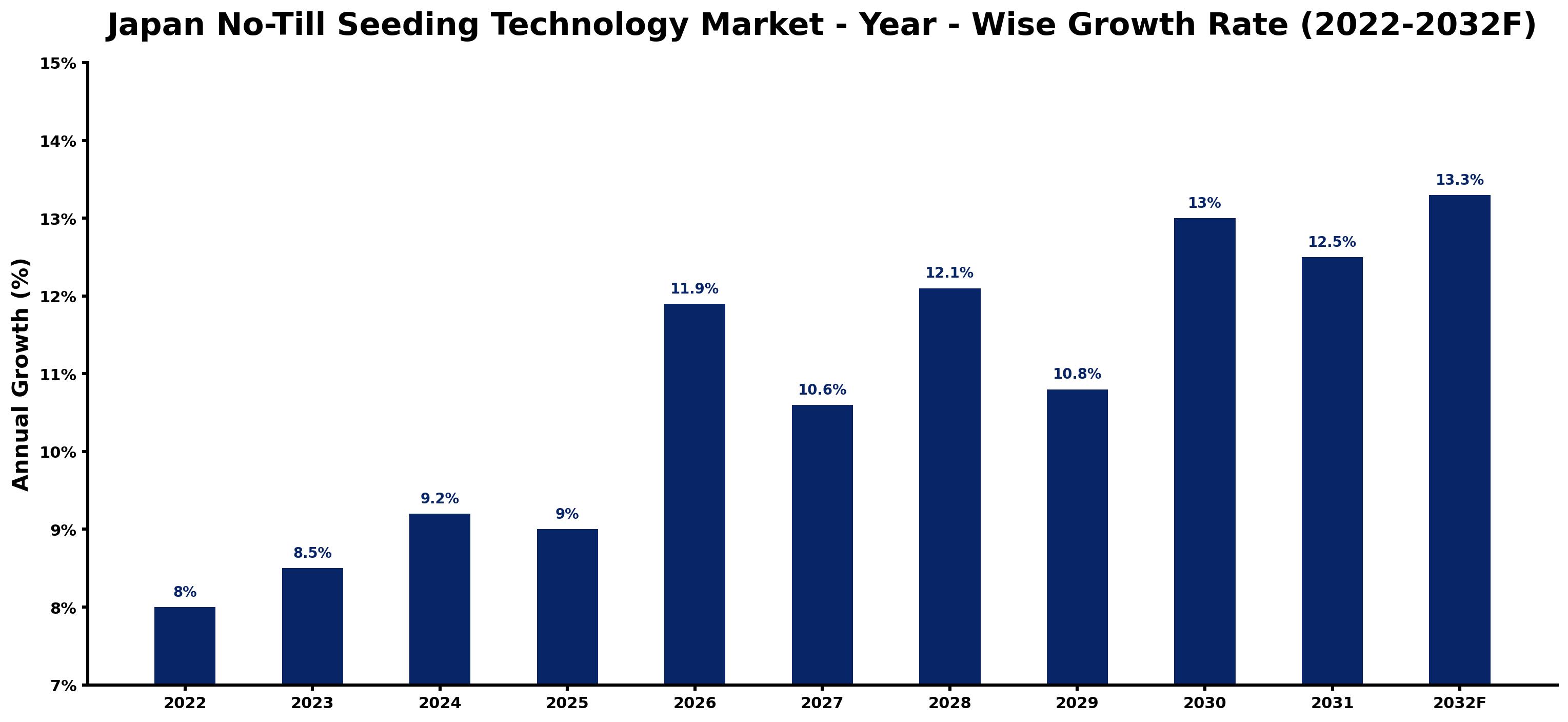
The table below sets out the estimated growth rate for each year and the main factor behind it.
| Year | Estimated Annual Growth (%) | Market Rationale |
| 2022 | 8.0 | The market showed steady growth as farmers adopted sustainable practices. |
| 2023 | 8.5 | Increased awareness of soil health drove higher adoption rates among farmers. |
| 2024 | 9.2 | The introduction of new no-till equipment spurred further market growth. |
| 2025 | 9.0 | Growth slowed slightly as market saturation began to impact new sales. |
| 2026 | 11.9 | The launch of new precision technologies is expected to boost demand for no-till solutions. |
| 2027 | 10.6 | Adoption of no-till practices will continue to rise, driven by environmental concerns. |
| 2028 | 12.1 | Technological advancements in seed placement are projected to lead to increased efficiency. |
| 2029 | 10.8 | Growth is expected to slow as competition intensifies among equipment suppliers. |
| 2030 | 13.0 | The government will set ambitious targets for sustainable farming, driving demand. |
| 2031 | 12.5 | Market growth will slow slightly as farmers evaluate equipment investments. |
| 2032 | 13.3 | The peak growth year is driven by a surge in large-scale farming adoption. |
Note: Market size estimations and growth projections presented in this report are based on 6Wresearch's proprietary forecasting methodology, utilizing the latest available industry data, government publications, and primary research inputs.
Japan No-Till Seeding Technology Market Synopsis
No-Till Seeding Technology is an agricultural practice that minimises soil disturbance during planting, improving soil health and enhancing water retention. The Japan No-Till Seeding Technology Market is growing due to increased adoption of precision agriculture and government initiatives that promote sustainable farming. The Japanese government aims to increase sustainable farming areas by 20% by 2025, driving demand for no-till practices among domestic farmers focused on efficiency and environmentally friendly methods. This transition is further supported by a rising awareness of environmental benefits and advancements in seed placement technology.
Market Dynamics Impact Analysis (2026–2032)
| Factor | Type | Impact | Primary Segment Affected |
| Growing adoption of sustainable farming practices | Driver | High | Cereal Crops |
| Increasing investment in precision agriculture technologies | Driver | High | Precision Planters |
| Rising demand for eco-friendly farming solutions | Opportunity | High | Sustainable Farming |
| Expansion of agricultural suppliers into online sales channels | Opportunity | Medium | Agricultural Suppliers |
| High initial investment costs for no-till equipment | Restraint | High | Disc Seeders |
| Limited awareness of no-till benefits among small farmers | Restraint | Medium | Air Seeders |
| Challenges in transitioning from traditional to no-till methods | Challenge | High | Strip-Till Drills |
| Compliance with updated agricultural standards | Challenge | Medium | Coulter Seed Drills |
Evaluation of Drivers in Japan No-Till Seeding Technology Market (2026–2032)
The following drivers explain most of the expected growth.
| Drivers | Primary Segment Affected | Why It Matters (Evidence) |
| Increased focus on soil health | Cereal Crops | Cereal crops account for about 60% of Japan's total crop production, driving demand for no-till technology and enhancing soil quality. |
| Technological advancements in seed placement | Precision Planters | Adoption of precision planters in regions like Hokkaido has risen, improving planting efficiency and increasing yields. |
| Government initiatives promoting sustainable practices | Sustainable Farming | The Japanese government aims to increase sustainable farming areas by 20% by 2025, encouraging farmers to adopt no-till methods. |
| Growing awareness of environmental benefits | Air Seeders | Air seeders are increasingly popular among large-scale farmers looking to reduce soil erosion and improve crop yields. |
| Rising agricultural productivity demands | Disc Seeders | The average yield for oilseeds in Japan is around 1.2 tons per hectare, necessitating efficient planting solutions. |
Approximately 1.5 million people engage in agriculture, leading to higher demand for efficient planting technologies. The average farm size of 1.5 hectares influences equipment choices, with precision planters gaining traction in regions known for large-scale farming. As awareness of environmental benefits grows, farmers increasingly invest in air seeders to improve productivity and reduce soil erosion. Furthermore, the rising demand for cereal crops drives the need for effective soil management solutions, making no-till technology more appealing.
Evaluation of Restraints in Japan No-Till Seeding Technology Market
Below are the constraints most often cited by buyers and suppliers, with the segment each affects.
| Market Restraint | Primary Segment Affected | Why It Matters (Evidence) |
| High initial costs of no-till equipment | Disc Seeders | The average investment for no-till equipment can be substantial, often exceeding several million yen, deterring small-scale farmers. |
| Limited knowledge about no-till benefits | Air Seeders | Many small farmers lack awareness of the long-term advantages of no-till practices, which can lead to lower adoption rates. |
| Transition challenges from traditional methods | Strip-Till Drills | Farmers face difficulties adapting to new planting techniques, impacting adoption rates and leading to inefficiencies. |
| Compliance with updated agricultural standards | Coulter Seed Drills | New regulations require farmers to meet specific criteria, complicating equipment choices and increasing operational costs. |
| Market saturation in certain regions | Precision Planters | As more farmers adopt no-till practices, competition for market share intensifies, limiting growth opportunities. |
Japan No-Till Seeding Technology Market Challenges
Farmers in the Tohoku region encounter stringent regulations on sustainable practices, which can delay the adoption of no-till technology and reduce crop yields for buyers. Rising costs for specialized equipment, such as air seeders, can increase prices for farmers, limiting their investment in efficient methods. Supply chain disruptions for precision planters can lead to planting delays, negatively affecting production timelines for producers. A shortage of skilled workers in no-till farming techniques restricts effective implementation, resulting in decreased productivity for the 1.5 million agricultural workers in Japan.
Trends in the Japan No-Till Seeding Technology Market
The trends below show where the Japan No-Till Seeding Technology Market is heading.
- Shift in Adoption Towards Precision Agriculture: The Tohoku region is increasingly adopting precision agriculture techniques, with 30% of large-scale farmers using GPS/Auto-Steering technology to improve planting accuracy.
- Growing Popularity of Air Seeders: In Japan, air seeders are gaining traction among large-scale farmers, with adoption rates rising as they improve seed distribution efficiency.
- Increased Focus on Sustainable Practices: The Japanese government has updated regulations to include no-till practices, promoting eco-friendly farming methods among farmers.
- Rise of Online Sales Channels for Agricultural Equipment: Agricultural suppliers are increasingly utilizing online platforms, with a projected growth rate of 15.9% in this distribution channel for the upcoming years.
Investment Opportunities in the Japan No-Till Seeding Technology Market
Below are the investment opportunities with the strongest case in the Japan No-Till Seeding Technology Market.
- Investment in Precision Agriculture: With the average farm size of 1.5 hectares, there is a growing demand for precision agricultural equipment, particularly among large-scale farmers in Hokkaido.
- Expansion into Online Sales Channels: The rise of online platforms offers agricultural suppliers an opportunity to reach a broader audience, especially among tech-savvy farmers.
- Support for Sustainable Farming Initiatives: Government programs that encourage sustainable practices are generating demand for no-till technology, particularly in regions like Tohoku.
- Collaboration with Agricultural Research Institutions: Partnerships with research institutions can support the development of effective no-till solutions, addressing the needs of modern farmers.
Government Initiatives in the Japan No-Till Seeding Technology Market
The Waste Management and Public Cleansing Act regulates waste treatment, impacting producers by requiring compliance with environmental standards. This law ensures that no-till technology aligns with sustainable practices, promoting eco-friendly farming methods among producers. Additionally, the Act encourages farmers to adopt practices that minimise soil disturbance and improve soil health, ultimately benefiting the agricultural sector.
In 2023, a new subsidy programme was launched to support farmers transitioning to no-till methods, administered by the Ministry of Agriculture, Forestry and Fisheries. This programme aims to facilitate the adoption of sustainable practices, with funding allocated to assist farmers in acquiring necessary equipment and training, benefiting approximately 1.5 million people engaged in agriculture.
Future Insight of the Japan No-Till Seeding Technology Market
Precision agriculture technology, particularly through advanced data analytics, will reshape demand for no-till seeding methods by 2032, as farmers pursue improved efficiency. The Japanese government's initiatives to expand sustainable farming areas will drive further adoption of no-till practices. Research initiatives by agricultural experiment stations will improve the effectiveness of no-till methods. By 2025, the average yield for oilseeds is projected to reach 1.5 tons per hectare, benefiting buyers through greater productivity and improved soil health.
Market Segmentation Analysis
Japan No-Till Seeding Technology Market report covers a detailed analysis of the following market segments:
By Equipment Type – Disc Seeders Lead, Air Seeders Expected to Grow Fastest
According to Saurav Kr Singh, Senior Research Analyst at 6Wresearch, the largest equipment type category in 2025 was Disc Seeders, at 42% of revenue. Disc seeders hold the largest share as they are widely used by farmers for planting without disturbing the soil, particularly in the Tohoku region where no-till practices are prevalent. This equipment is essential for maintaining soil health and optimising crop yields across Japan's 4.5 million hectares of arable land. Over 2026–2032, Air Seeders are expected to post the fastest growth, at a CAGR of 17.6%. Air seeders are experiencing rapid growth due to their ability to facilitate efficient seed distribution, which is particularly important for large-scale farmers in Hokkaido. The increasing adoption of air seeders aligns with government initiatives that promote sustainable farming practices, ensuring their relevance in the market. Suppliers should focus on enhancing the availability of air seeders to meet the increasing demand from farmers.
By Mechanism Type – Coulter System Leads, Pneumatic Delivery Expected to Grow Fastest
Coulter System held 33% of the Japan No-Till Seeding Technology Market by mechanism type in 2025. The coulter system is the leading mechanism type because it ensures effective seed placement, which is critical for achieving optimal crop yields. Its dependability has made it a preferred option among commercial farmers throughout Japan. The quickest growth will come from Pneumatic Delivery, forecast to expand at a CAGR of 17.4% between 2026 and 2032. Pneumatic delivery is expanding quickly due to its capacity to improve seed delivery accuracy, which is becoming increasingly vital for farmers focused on precision planting. This trend indicates a shift towards more efficient farming methods. Suppliers need to invest in pneumatic delivery technologies to meet the changing preferences of farmers.
By Crop Application – Cereal Crops Lead, Vegetables Expected to Grow Fastest
In 2025, Cereal Crops led the crop application split with a 51% share. Cereal crops dominate the market as they account for about 60% of Japan's total crop production, making them a primary application for no-till technology. The focus on grain farming in various regions supports the extensive use of no-till practices. Vegetables are projected to grow fastest, at a CAGR of 16.2% during 2026–2032. Vegetables are the fastest-growing application, driven by the high market value of vegetable production, which exceeds 1 trillion yen annually. This trend indicates a shift towards diversifying crop production using no-till methods. Suppliers should consider expanding their product offerings to support the increasing interest in vegetable cultivation.
By Distribution Channel – Agricultural Suppliers Lead, Online Platforms Expected to Grow Fastest
Agricultural Suppliers took 48% of distribution channel revenue in 2025, more than any other category. Agricultural suppliers are the leading distribution channel as they play a vital role in equipment sales, providing essential support to farmers throughout Japan. Their established networks ensure that no-till technology reaches a broad audience, facilitating its adoption across the agricultural sector. Online Platforms are set to record the highest CAGR in this split, 15.9% over 2026–2032. Online platforms are rapidly becoming a preferred distribution channel, reflecting a shift in purchasing behaviours among farmers who seek convenience and accessibility in their buying processes. This trend indicates a broader digital transformation within the agricultural market. Suppliers must enhance their online presence to effectively capture the growing market segment that prefers digital purchasing options.
By End User Sector – Commercial Farming Leads, Sustainable Farming Expected to Grow Fastest
Commercial Farming accounted for 34% of the market by end user sector in 2025. Commercial farming is the largest end user sector, as it represents the major user group of no-till technology, particularly among farmers focused on maximising yields. The scale of operations in this sector necessitates efficient planting practices. Over 2026–2032, Sustainable Farming is expected to post the fastest growth, at a CAGR of 16.4%. Sustainable farming is the fastest-growing sector, aligning with the increasing emphasis on eco-friendly practices and government initiatives promoting sustainable agriculture. This growth reflects a broader societal shift towards sustainability in food production. Suppliers should align their strategies with the sustainable farming trend to meet the needs of this expanding market.
Key Attractiveness of the Report
- 10 Years of Market Numbers
- Historical Data Starting from 2022 to 2025
- Base Year 2025
- Forecast Data until 2032
- Key Performance Indicators Impacting the Market
- Major Upcoming Developments and Projects
Key Highlights of the Report:
- Japan No-Till Seeding Technology Market Outlook
- Market Size of Japan No-Till Seeding Technology Market, 2025
- Forecast of Japan No-Till Seeding Technology Market, 2032
- Historical Data and Forecast of Japan No-Till Seeding Technology Revenues & Volume for the Period 2022-2032F
- Japan No-Till Seeding Technology Market Trend Evolution
- Japan No-Till Seeding Technology Market Drivers and Challenges
- Japan No-Till Seeding Technology Price Trends
- Japan No-Till Seeding Technology Porter's Five Forces
- Japan No-Till Seeding Technology Industry Life Cycle
- Historical Data and Forecast of Japan No-Till Seeding Technology Market Revenues & Volume By Equipment Type for the Period 2022-2032F
- Historical Data and Forecast of Japan No-Till Seeding Technology Market Revenues & Volume By Disc Seeders for the Period 2022-2032F
- Historical Data and Forecast of Japan No-Till Seeding Technology Market Revenues & Volume By Strip-Till Drills for the Period 2022-2032F
- Historical Data and Forecast of Japan No-Till Seeding Technology Market Revenues & Volume By Air Seeders for the Period 2022-2032F
- Historical Data and Forecast of Japan No-Till Seeding Technology Market Revenues & Volume By Precision Planters for the Period 2022-2032F
- Historical Data and Forecast of Japan No-Till Seeding Technology Market Revenues & Volume By Coulter Seed Drills for the Period 2022-2032F
- Historical Data and Forecast of Japan No-Till Seeding Technology Market Revenues & Volume By Mechanism Type for the Period 2022-2032F
- Historical Data and Forecast of Japan No-Till Seeding Technology Market Revenues & Volume By Coulter System for the Period 2022-2032F
- Historical Data and Forecast of Japan No-Till Seeding Technology Market Revenues & Volume By Strip Tillage for the Period 2022-2032F
- Historical Data and Forecast of Japan No-Till Seeding Technology Market Revenues & Volume By Pneumatic Delivery for the Period 2022-2032F
- Historical Data and Forecast of Japan No-Till Seeding Technology Market Revenues & Volume By GPS/Auto-Steering for the Period 2022-2032F
- Historical Data and Forecast of Japan No-Till Seeding Technology Market Revenues & Volume By Blade/Disc System for the Period 2022-2032F
- Historical Data and Forecast of Japan No-Till Seeding Technology Market Revenues & Volume By Crop Application for the Period 2022-2032F
- Historical Data and Forecast of Japan No-Till Seeding Technology Market Revenues & Volume By Cereal Crops for the Period 2022-2032F
- Historical Data and Forecast of Japan No-Till Seeding Technology Market Revenues & Volume By Oilseeds for the Period 2022-2032F
- Historical Data and Forecast of Japan No-Till Seeding Technology Market Revenues & Volume By Pulses for the Period 2022-2032F
- Historical Data and Forecast of Japan No-Till Seeding Technology Market Revenues & Volume By Vegetables for the Period 2022-2032F
- Historical Data and Forecast of Japan No-Till Seeding Technology Market Revenues & Volume By Forage Crops for the Period 2022-2032F
- Historical Data and Forecast of Japan No-Till Seeding Technology Market Revenues & Volume By Distribution Channel for the Period 2022-2032F
- Historical Data and Forecast of Japan No-Till Seeding Technology Market Revenues & Volume By Agricultural Suppliers for the Period 2022-2032F
- Historical Data and Forecast of Japan No-Till Seeding Technology Market Revenues & Volume By Direct OEM Sales for the Period 2022-2032F
- Historical Data and Forecast of Japan No-Till Seeding Technology Market Revenues & Volume By Online Platforms for the Period 2022-2032F
- Historical Data and Forecast of Japan No-Till Seeding Technology Market Revenues & Volume By Specialty Equipment Stores for the Period 2022-2032F
- Historical Data and Forecast of Japan No-Till Seeding Technology Market Revenues & Volume By Distributors for the Period 2022-2032F
- Historical Data and Forecast of Japan No-Till Seeding Technology Market Revenues & Volume By End User Sector for the Period 2022-2032F
- Historical Data and Forecast of Japan No-Till Seeding Technology Market Revenues & Volume By Commercial Farming for the Period 2022-2032F
- Historical Data and Forecast of Japan No-Till Seeding Technology Market Revenues & Volume By Agro Industries for the Period 2022-2032F
- Historical Data and Forecast of Japan No-Till Seeding Technology Market Revenues & Volume By Large-Scale Farmers for the Period 2022-2032F
- Historical Data and Forecast of Japan No-Till Seeding Technology Market Revenues & Volume By Contract Farming for the Period 2022-2032F
- Historical Data and Forecast of Japan No-Till Seeding Technology Market Revenues & Volume By Sustainable Farming for the Period 2022-2032F
- Japan No-Till Seeding Technology Import Export Trade Statistics
- Market Opportunity Assessment By Equipment Type
- Market Opportunity Assessment By Mechanism Type
- Market Opportunity Assessment By Crop Application
- Market Opportunity Assessment By Distribution Channel
- Market Opportunity Assessment By End User Sector
- Japan No-Till Seeding Technology Top Companies Market Share
- Japan No-Till Seeding Technology Competitive Benchmarking By Technical and Operational Parameters
- Japan No-Till Seeding Technology Company Profiles
- Japan No-Till Seeding Technology Key Strategic Recommendations
Market Covered
The report covers the following segments.
By Equipment Type
- Disc Seeders
- Strip-Till Drills
- Air Seeders
- Precision Planters
- Coulter Seed Drills
By Mechanism Type
- Coulter System
- Strip Tillage
- Pneumatic Delivery
- GPS/Auto-Steering
- Blade/Disc System
By Crop Application
- Cereal Crops
- Oilseeds
- Pulses
- Vegetables
- Forage Crops
By Distribution Channel
- Agricultural Suppliers
- Direct OEM Sales
- Online Platforms
- Specialty Equipment Stores
- Distributors
By End User Sector
- Commercial Farming
- Agro Industries
- Large-Scale Farmers
- Contract Farming
- Sustainable Farming






































