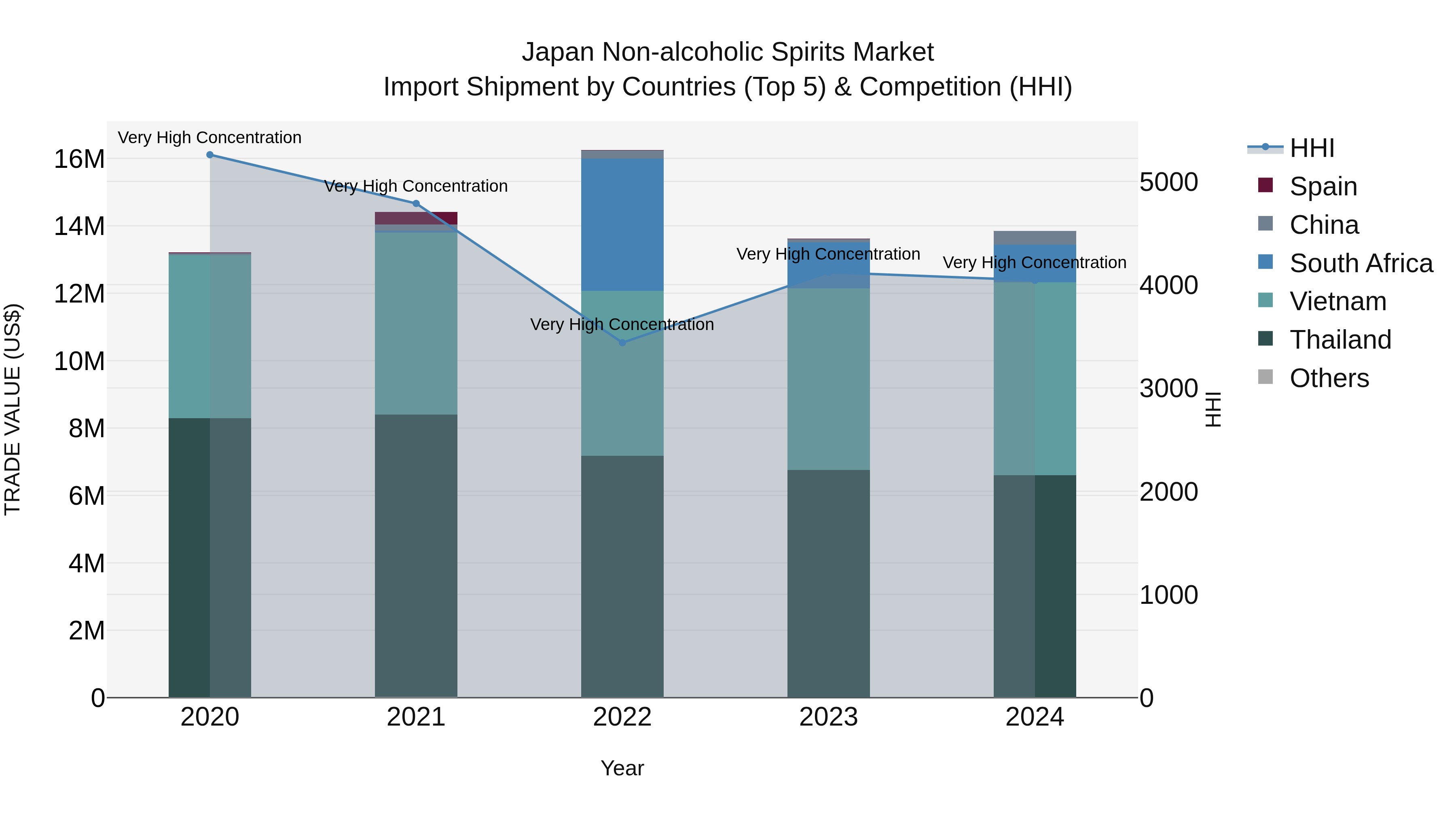
Japan Non-alcoholic Spirits Market Import Shipment by Countries (Top 5) & Competition (HHI)
In 2024, Japan continued to see significant import shipments of non-alcoholic spirits, with top exporters being Thailand, Vietnam, South Africa, China, and Taiwan. The market remained highly concentrated, indicating strong competition among these key players. The compound annual growth rate (CAGR) from 2020 to 2024 was moderate at 1.18%, with a slight acceleration in growth seen from 2023 to 2024 at 1.7%. This data suggests a steady demand for non-alcoholic spirits in Japan, with opportunities for further market expansion and diversification in the coming years.
Key Highlights of the Report:
- Japan Non-Alcoholic Spirits Market Outlook
- Market Size of Japan Non-Alcoholic Spirits Market,2024
- Forecast of Japan Non-Alcoholic Spirits Market, 2031
- Historical Data and Forecast of Japan Non-Alcoholic Spirits Revenues & Volume for the Period 2021-2031
- Japan Non-Alcoholic Spirits Market Trend Evolution
- Japan Non-Alcoholic Spirits Market Drivers and Challenges
- Japan Non-Alcoholic Spirits Price Trends
- Japan Non-Alcoholic Spirits Porter's Five Forces
- Japan Non-Alcoholic Spirits Industry Life Cycle
- Historical Data and Forecast of Japan Non-Alcoholic Spirits Market Revenues & Volume By Type for the Period 2021-2031
- Historical Data and Forecast of Japan Non-Alcoholic Spirits Market Revenues & Volume By Gin Alternative for the Period 2021-2031
- Historical Data and Forecast of Japan Non-Alcoholic Spirits Market Revenues & Volume By Whiskey Alternative for the Period 2021-2031
- Historical Data and Forecast of Japan Non-Alcoholic Spirits Market Revenues & Volume By Rum Alternative for the Period 2021-2031
- Historical Data and Forecast of Japan Non-Alcoholic Spirits Market Revenues & Volume By Vodka Alternative for the Period 2021-2031
- Historical Data and Forecast of Japan Non-Alcoholic Spirits Market Revenues & Volume By Base Ingredient for the Period 2021-2031
- Historical Data and Forecast of Japan Non-Alcoholic Spirits Market Revenues & Volume By Juniper-Based for the Period 2021-2031
- Historical Data and Forecast of Japan Non-Alcoholic Spirits Market Revenues & Volume By Oak-Flavored for the Period 2021-2031
- Historical Data and Forecast of Japan Non-Alcoholic Spirits Market Revenues & Volume By Molasses-Based for the Period 2021-2031
- Historical Data and Forecast of Japan Non-Alcoholic Spirits Market Revenues & Volume By Neutral Base for the Period 2021-2031
- Historical Data and Forecast of Japan Non-Alcoholic Spirits Market Revenues & Volume By Packaging for the Period 2021-2031
- Historical Data and Forecast of Japan Non-Alcoholic Spirits Market Revenues & Volume By Bottles for the Period 2021-2031
- Historical Data and Forecast of Japan Non-Alcoholic Spirits Market Revenues & Volume By Cans for the Period 2021-2031
- Historical Data and Forecast of Japan Non-Alcoholic Spirits Market Revenues & Volume By Cartons for the Period 2021-2031
- Historical Data and Forecast of Japan Non-Alcoholic Spirits Market Revenues & Volume By Kegs for the Period 2021-2031
- Historical Data and Forecast of Japan Non-Alcoholic Spirits Market Revenues & Volume By Distribution Channel for the Period 2021-2031
- Historical Data and Forecast of Japan Non-Alcoholic Spirits Market Revenues & Volume By Supermarkets for the Period 2021-2031
- Historical Data and Forecast of Japan Non-Alcoholic Spirits Market Revenues & Volume By Online Stores for the Period 2021-2031
- Historical Data and Forecast of Japan Non-Alcoholic Spirits Market Revenues & Volume By Restaurants for the Period 2021-2031
- Historical Data and Forecast of Japan Non-Alcoholic Spirits Market Revenues & Volume By Specialty Stores for the Period 2021-2031
- Japan Non-Alcoholic Spirits Import Export Trade Statistics
- Market Opportunity Assessment By Type
- Market Opportunity Assessment By Base Ingredient
- Market Opportunity Assessment By Packaging
- Market Opportunity Assessment By Distribution Channel
- Japan Non-Alcoholic Spirits Top Companies Market Share
- Japan Non-Alcoholic Spirits Competitive Benchmarking By Technical and Operational Parameters
- Japan Non-Alcoholic Spirits Company Profiles
- Japan Non-Alcoholic Spirits Key Strategic Recommendations






































