Japan Non Dormant Alfalfa Seed Market Size & Growth Rate
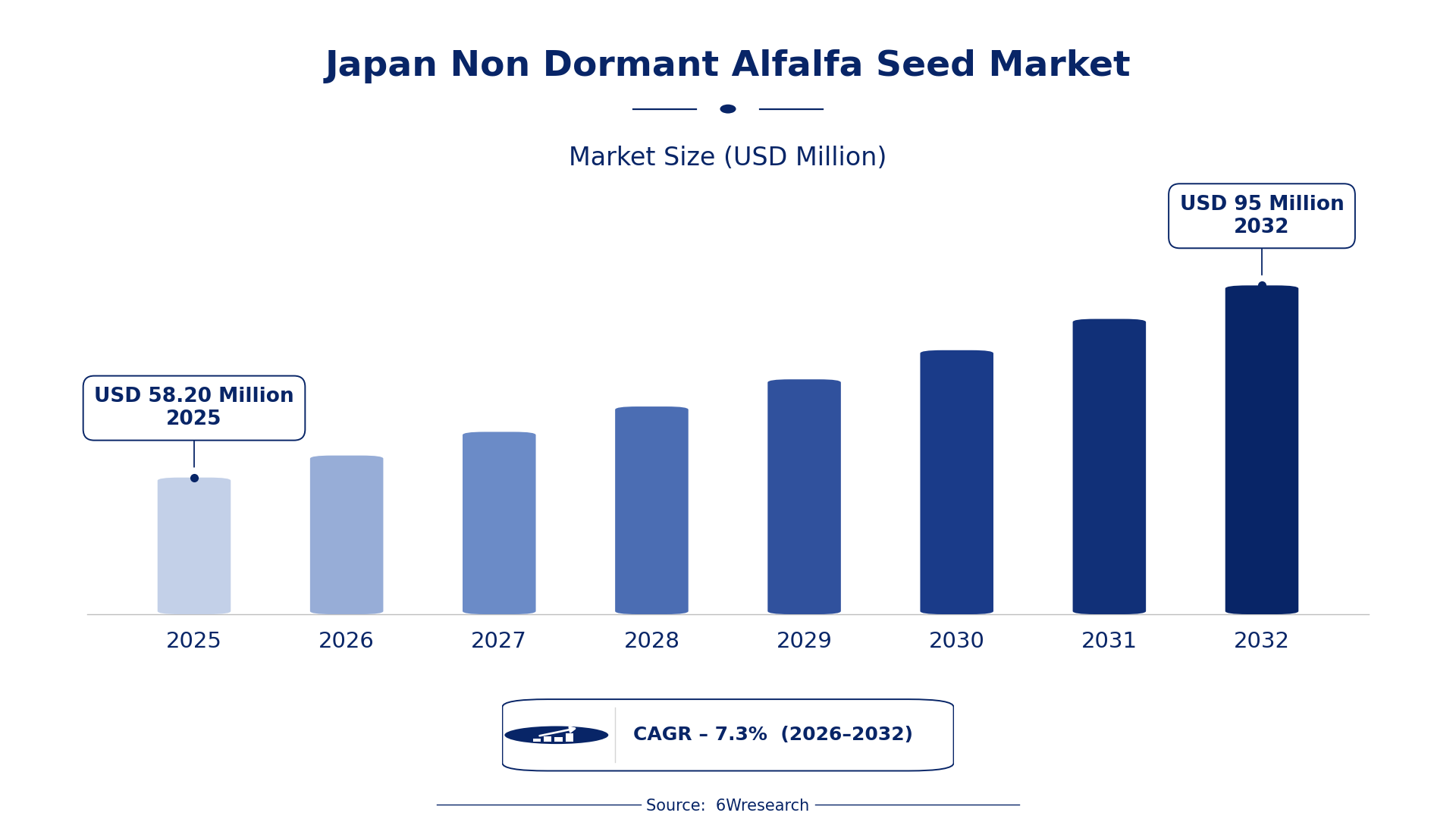
According to 6Wresearch internal database and industry insights, the Japan Non Dormant Alfalfa Seed Market was valued at USD 58.20 Million in 2025 and is projected to reach USD 95 Million by 2032, growing at a CAGR of approximately 7.3% during 2026–2032.
Japan Non Dormant Alfalfa Seed Market Highlights
| Report Metric | Details |
| Report Name | Japan Non Dormant Alfalfa Seed Market (2026-2032) |
| Market Size 2025 | USD 58.20 Million |
| Market Size 2032 | USD 95 Million |
| Absolute Growth 2025–2032 | USD 36.80 Million |
| CAGR 2026–2032 | 7.3% |
| Peak Annual Growth | 8.5% in 2028 |
| Forecast Period | 2026–2032 |
| Historical Data | 2022–2025 |
| Base Year | 2025 |
| Leading Seed Type, 2025 | Non Dormant Seed (46% share) |
| Leading Variety, 2025 | Improved Varieties (46% share) |
| Leading Application Area, 2025 | Forage Production (50% share) |
| Leading Distribution Channel, 2025 | Agri Dealers (39% share) |
| Leading End User, 2025 | Farmers (42% share) |
| Fastest-Growing Seed Type | High-Yield Seed (10.0% CAGR) |
| Fastest-Growing Application Area | Sustainable Farming (9.0% CAGR) |
| Fastest-Growing Distribution Channel | Cooperatives (9.4% CAGR) |
| Fastest-Growing End User | Dairy Farms (9.2% CAGR) |
| Growing Sector | Livestock Feed |
| Key End Users | Farmers, Dairy Farms, Commercial Farms, Agribusinesses |
Japan Non Dormant Alfalfa Seed Market Year-wise Growth Rate and Key Drivers (2022–2032)
This graph illustrates the annual growth rates of the market from 2022 to 2032, highlighting a steady upward trajectory and projected market expansion over the forecast period.
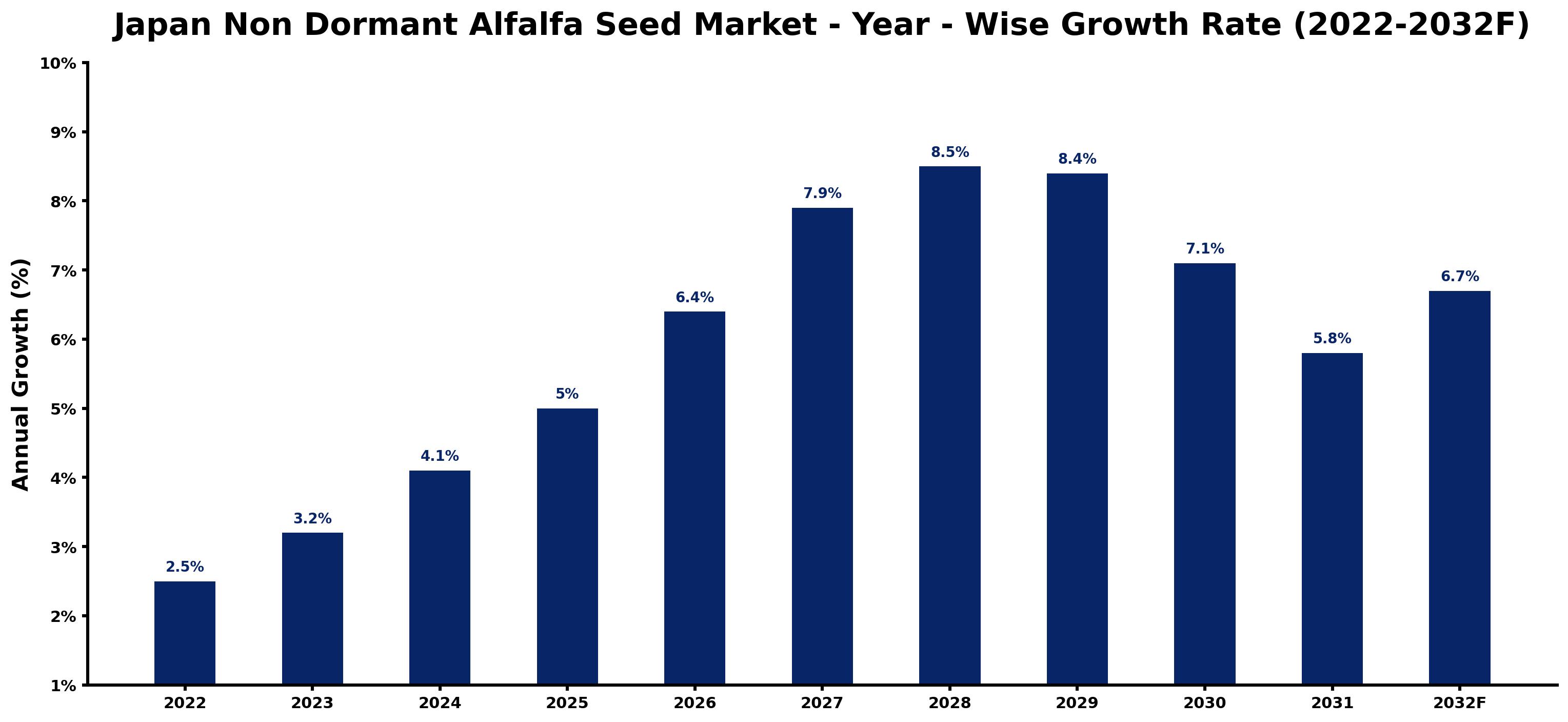
Annual growth estimates for each year appear below with the principal reason behind them, explaining the shifts that set the pace of the market.
| Year | Estimated Annual Growth (%) | Market Rationale |
| 2022 | 2.5 | The demand for forage crops remained stable, driven by livestock needs. |
| 2023 | 3.2 | Growth accelerated as dairy production increased, requiring more forage. |
| 2024 | 4.1 | Demand rose further due to improved farming practices and seed varieties. |
| 2025 | 5.0 | The dairy sector expanded, boosting the need for high-quality forage. |
| 2026 | 6.4 | Growth is expected to continue as farmers adopt more disease-resistant seed types. |
| 2027 | 7.9 | Increased investment in sustainable practices will further stimulate demand. |
| 2028 | 8.5 | The peak growth will be supported by a surge in dairy cow numbers. |
| 2029 | 8.4 | Growth is projected to slow slightly as the market begins to stabilise after peak. |
| 2030 | 7.1 | Demand will remain strong, but growth rates are expected to normalise post-peak. |
| 2031 | 5.8 | The market will continue to grow, albeit at a slower rate than before. |
| 2032 | 6.7 | The forecast indicates renewed growth as new seed varieties gain traction. |
Note: Market size estimations and growth projections presented in this report are based on 6Wresearch's proprietary forecasting methodology, utilizing the latest available industry data, government publications, and primary research inputs.
Japan Non Dormant Alfalfa Seed Market Synopsis
Non Dormant Alfalfa Seed is essential for livestock feed and sustainable farming, primarily produced through selective breeding. The Japan Non Dormant Alfalfa Seed Market is expanding due to rising dairy cow numbers, with over 1.5 million in 2023, and the adoption of advanced farming practices, driven by government initiatives like the Green Food System. Increased demand from domestic farmers and agribusinesses engaged in livestock production further supports this growth, highlighting the importance of high-quality forage in agricultural practices.
Market Dynamics Impact Analysis (2026–2032)
| Factor | Type | Impact | Primary Segment Affected |
| Rising dairy cow population | Driver | High | Dairy Farms |
| Increased adoption of disease-resistant seeds | Driver | High | High-Yield Seed |
| Growing interest in sustainable farming practices | Opportunity | Medium | Sustainable Farming |
| Expansion of cooperative purchasing programs | Opportunity | Medium | Cooperatives |
| Limited average farm size affecting production | Restraint | High | Farmers |
| Dependence on climatic conditions for seed selection | Restraint | Medium | Non Dormant Seed |
| High costs of seed development | Challenge | High | High-Yield Seed |
| Competition from alternative forage crops | Challenge | Medium | Forage Production |
Evaluation of Drivers in Japan Non Dormant Alfalfa Seed Market (2026–2032)
The following drivers explain most of the expected growth.
| Drivers | Primary Segment Affected | Why It Matters (Evidence) |
| Increasing dairy production | Dairy Farms | In 2023, over 1.5 million dairy cows in Japan require substantial forage, driving seed demand. |
| Adoption of disease-resistant seeds | High-Yield Seed | The adoption rate increased by 25% among commercial farms since 2020, enhancing crop resilience. |
| Investment in agricultural innovation | Non Dormant Seed | The government allocated ¥10 billion for agricultural projects, promoting seed development and research. |
| Growing forage crop production | Forage Production | Japan produced 2 million tons of forage crops in 2022, with alfalfa as a key component. |
| Participation in cooperative purchasing programs | Cooperatives | Over 5 million members in agricultural cooperatives facilitate bulk purchasing, reducing costs for farmers. |
Buyers are adding capacity as dairy production increases, with over 1.5 million dairy cows in 2023 driving forage requirements. The adoption of disease-resistant seeds has surged among commercial farms since 2020, improving crop resilience and encouraging investment in high-yield varieties. In 2022, Japan produced 2 million tons of forage crops, with alfalfa as a key contributor.
Evaluation of Restraints in Japan Non Dormant Alfalfa Seed Market
Several factors work against faster growth; the main ones are summarised below.
| Market Restraint | Primary Segment Affected | Why It Matters (Evidence) |
| Limited average farm size | Farmers | The average farm size in Japan is approximately 1.5 hectares, constraining seed purchasing capacity. |
| Dependence on climatic conditions | Non Dormant Seed | Annual rainfall of 1,200 to 2,500 mm affects seed selection and crop yield. |
| High costs of seed development | High-Yield Seed | Developing new seed varieties requires substantial investment, impacting pricing for farmers. |
| Competition from alternative forage crops | Forage Production | Farmers may opt for other forage crops, reducing demand for alfalfa seeds. |
| Market volatility due to climate change | Dairy Farms | Climate change impacts agricultural productivity, creating uncertainty in forage supply. |
Japan Non Dormant Alfalfa Seed Market Challenges
High costs stem from outdated seed technology, limiting yield potential for farmers. In Japan, the average farm size of 1.5 hectares restricts investments in advanced seed varieties, resulting in lower productivity. Compliance with JIS standards incurs additional operational expenses for suppliers, causing delays in seed availability that disrupt farmers' planting schedules. Regulatory requirements for sustainable practices impose extra paperwork, hindering access to new seed varieties for producers. Supply chain disruptions from natural events can lead to shortages, impacting forage availability for over 1.5 million dairy cows in 2023.
Trends in the Japan Non Dormant Alfalfa Seed Market
The trends below show where the Japan Non Dormant Alfalfa Seed Market is heading.
- Shift towards Disease-Resistant Seeds: Farmers are increasingly adopting disease-resistant seeds, with a 25% rise since 2020, reducing losses and improving crop resilience.
- Growing Adoption of Sustainable Practices: The Green Food System initiative has encouraged farmers to implement eco-friendly practices, with a notable increase in participation.
- Transition from Traditional to Improved Varieties: Improved Varieties have gained traction, accounting for 46% market share in 2025, as farmers seek higher adaptability and productivity.
- Increase in Cooperative Purchasing: Cooperatives are expanding their influence, with over 5 million members facilitating bulk purchasing, thus reducing costs for farmers.
Investment Opportunities in the Japan Non Dormant Alfalfa Seed Market
Several openings in the Japan Non Dormant Alfalfa Seed Market merit attention from investors.
- Dairy Farms seeking high-quality forage: With over 1.5 million dairy cows, there is a pressing need for high-quality forage, driving demand for Non Dormant Alfalfa Seed.
- Investment in High-Yield Seed: The adoption of high-yield seeds is increasing, appealing to commercial farms looking to boost productivity.
- Growing interest in Sustainable Farming: The government’s ¥10 billion investment in agricultural innovation creates opportunities for suppliers of sustainable farming solutions.
- Cooperatives expanding services: With over 5 million members, cooperatives are positioned to improve seed distribution, providing a pathway for new suppliers.
Government Initiatives in the Japan Non Dormant Alfalfa Seed Market
The Food Sanitation Act amendment in 2018 mandates HACCP-based hygiene management, impacting producers by ensuring compliance with safety standards. This regulation builds consumer confidence in agricultural products, including Non Dormant Alfalfa Seed, as buyers seek quality assurance. The Economic Security Promotion Act supports supply-chain resilience for critical agricultural products, ensuring that producers can maintain consistent quality and availability, which is essential for farmers in Japan.
The Consumer Affairs Agency oversees the enforcement of laws prohibiting misleading advertising, ensuring that producers adhere to truthful marketing. In 2023, the Ministry of Agriculture, Forestry and Fisheries allocated ¥10 billion to support agricultural innovation projects, including seed development, benefiting producers and improving quality.
Future Insight of the Japan Non Dormant Alfalfa Seed Market
By 2032, a shift towards agricultural innovation will drive suppliers to develop more resilient seed varieties, responding to government initiatives like the Green Food System. This focus will improve crop yields and operational efficiencies among producers. Increased funding for agricultural innovation projects will support research on high-yield varieties, enhancing productivity. As cooperative purchasing programs expand, farmers will gain improved access to quality seeds, which will strengthen food security and agricultural sustainability.
Market Segmentation Analysis
Japan Non Dormant Alfalfa Seed Market report covers a detailed analysis of the following market segments:
By Seed Type – Non Dormant Seed Leads, High-Yield Seed Expected to Grow Fastest
According to Vasu Joshi, Associate Consultant at 6Wresearch, Non Dormant Seed took 46% of seed type revenue in 2025, more than any other category. Non Dormant Seed holds the largest share because it is essential for forage production, particularly in Hokkaido where dairy farming thrives. The substantial demand from local farmers ensures a strong installed base within the agricultural sector. Over 2026–2032, High-Yield Seed is expected to post the fastest growth, at a CAGR of 10.0%. High-Yield Seed is experiencing rapid growth as farmers increasingly strive to maximise forage output, with a reported 25% rise in adoption rates. This trend is reinforced by government initiatives promoting agricultural innovation and the development of superior yield varieties. Suppliers should focus on developing high-yield varieties to meet the increasing demands of farmers.
By Variety – Improved Varieties Lead and Record the Fastest Growth
With 46% of variety revenue in 2025, Improved Varieties was the largest category. Improved Varieties dominate the market due to their capacity to enhance adaptability and productivity, making them the preferred choice among farmers. Their consistent demand underscores their effectiveness in improving forage production outcomes. Its lead should widen, with a projected CAGR of 9.7% during 2026–2032, the highest in this split. Improved Varieties are also the fastest-growing segment, as ongoing research leads to enhancements in seed performance. This growth solidifies their market leadership, as farmers increasingly rely on these varieties for optimal yields. Suppliers must continue investing in research to develop improved varieties that align with agricultural advancements.
By Application Area – Forage Production Leads, Sustainable Farming Expected to Grow Fastest
In 2025, Forage Production led the application area split with a 50% share. Forage Production is the leading application area, primarily due to its direct role in supporting livestock needs, which is crucial for Japan's dairy industry. The large population of dairy cows in the country highlights the importance of this application. The quickest growth will come from Sustainable Farming, forecast to expand at a CAGR of 9.0% between 2026 and 2032. Sustainable Farming is the fastest-growing application area, as more farmers adopt eco-friendly practices encouraged by government initiatives. This shift towards sustainability reflects broader agricultural trends that prioritise environmental responsibility. Suppliers should consider expanding their product lines to include solutions that facilitate sustainable farming practices.
By Distribution Channel – Agri Dealers Lead, Cooperatives Expected to Grow Fastest
Agri Dealers held 39% of the Japan Non Dormant Alfalfa Seed Market by distribution channel in 2025. Agri Dealers are the leading distribution channel, providing essential access to farmers who rely on these dealers for their seed supply. Their established networks and relationships with the farming community ensure effective distribution across the agricultural landscape. Cooperatives are projected to grow fastest, at a CAGR of 9.4% during 2026–2032. Cooperatives are the fastest-growing distribution channel, as they enable farmers to participate in bulk purchasing programs that reduce costs. This trend indicates a growing preference for collaborative purchasing among agricultural producers. Suppliers should enhance partnerships with cooperatives to broaden their market reach and support farmers' purchasing strategies.
By End User – Farmers Lead, Dairy Farms Expected to Grow Fastest
The largest end user category in 2025 was Farmers, at 42% of revenue. Farmers represent the largest end user group, as they are the primary consumers of Non Dormant Alfalfa Seed for their livestock feed needs. The active participation of farmers in the agricultural sector ensures sustained demand for this product. Over 2026–2032, Dairy Farms are expected to post the fastest growth, at a CAGR of 9.2%. Dairy Farms are the fastest-growing end user segment, driven by the increasing number of dairy cows and their substantial forage requirements. This growth indicates a rising need for quality forage to support milk production. Suppliers should tailor their marketing strategies to address the specific needs of dairy farms as a key customer segment.
Key Attractiveness of the Report
- 10 Years of Market Numbers
- Historical Data Starting from 2022 to 2025
- Base Year 2025
- Forecast Data until 2032
- Key Performance Indicators Impacting the Market
- Major Upcoming Developments and Projects
Key Highlights of the Report:
- Japan Non Dormant Alfalfa Seed Market Outlook
- Market Size of Japan Non Dormant Alfalfa Seed Market, 2025
- Forecast of Japan Non Dormant Alfalfa Seed Market, 2032
- Historical Data and Forecast of Japan Non Dormant Alfalfa Seed Market Revenues & Volume for the Period 2022-2032F
- Japan Non Dormant Alfalfa Seed Market Trend Evolution
- Japan Non Dormant Alfalfa Seed Market Drivers and Challenges
- Japan Non Dormant Alfalfa Seed Market Price Trends
- Japan Non Dormant Alfalfa Seed Market Porter's Five Forces
- Japan Non Dormant Alfalfa Seed Market Industry Life Cycle
- Historical Data and Forecast of Japan Non Dormant Alfalfa Seed Market Revenues & Volume By Seed Type for the Period 2022-2032F
- Historical Data and Forecast of Japan Non Dormant Alfalfa Seed Market Revenues & Volume By Non Dormant Seed for the Period 2022-2032F
- Historical Data and Forecast of Japan Non Dormant Alfalfa Seed Market Revenues & Volume By High-Yield Seed for the Period 2022-2032F
- Historical Data and Forecast of Japan Non Dormant Alfalfa Seed Market Revenues & Volume By Disease-Resistant Seed for the Period 2022-2032F
- Historical Data and Forecast of Japan Non Dormant Alfalfa Seed Market Revenues & Volume By Custom Seed Blends for the Period 2022-2032F
- Historical Data and Forecast of Japan Non Dormant Alfalfa Seed Market Revenues & Volume By Variety for the Period 2022-2032F
- Historical Data and Forecast of Japan Non Dormant Alfalfa Seed Market Revenues & Volume By Low Dormancy for the Period 2022-2032F
- Historical Data and Forecast of Japan Non Dormant Alfalfa Seed Market Revenues & Volume By Improved Varieties for the Period 2022-2032F
- Historical Data and Forecast of Japan Non Dormant Alfalfa Seed Market Revenues & Volume By Hybrid for the Period 2022-2032F
- Historical Data and Forecast of Japan Non Dormant Alfalfa Seed Market Revenues & Volume By Region-Specific for the Period 2022-2032F
- Historical Data and Forecast of Japan Non Dormant Alfalfa Seed Market Revenues & Volume By Application Area for the Period 2022-2032F
- Historical Data and Forecast of Japan Non Dormant Alfalfa Seed Market Revenues & Volume By Forage Production for the Period 2022-2032F
- Historical Data and Forecast of Japan Non Dormant Alfalfa Seed Market Revenues & Volume By Livestock Feed for the Period 2022-2032F
- Historical Data and Forecast of Japan Non Dormant Alfalfa Seed Market Revenues & Volume By Sustainable Farming for the Period 2022-2032F
- Historical Data and Forecast of Japan Non Dormant Alfalfa Seed Market Revenues & Volume By Crop Optimization for the Period 2022-2032F
- Historical Data and Forecast of Japan Non Dormant Alfalfa Seed Market Revenues & Volume By Distribution Channel for the Period 2022-2032F
- Historical Data and Forecast of Japan Non Dormant Alfalfa Seed Market Revenues & Volume By Agri Dealers for the Period 2022-2032F
- Historical Data and Forecast of Japan Non Dormant Alfalfa Seed Market Revenues & Volume By Cooperatives for the Period 2022-2032F
- Historical Data and Forecast of Japan Non Dormant Alfalfa Seed Market Revenues & Volume By Direct Sales for the Period 2022-2032F
- Historical Data and Forecast of Japan Non Dormant Alfalfa Seed Market Revenues & Volume By Contract Supply for the Period 2022-2032F
- Historical Data and Forecast of Japan Non Dormant Alfalfa Seed Market Revenues & Volume By End User for the Period 2022-2032F
- Historical Data and Forecast of Japan Non Dormant Alfalfa Seed Market Revenues & Volume By Farmers for the Period 2022-2032F
- Historical Data and Forecast of Japan Non Dormant Alfalfa Seed Market Revenues & Volume By Dairy Farms for the Period 2022-2032F
- Historical Data and Forecast of Japan Non Dormant Alfalfa Seed Market Revenues & Volume By Commercial Farms for the Period 2022-2032F
- Historical Data and Forecast of Japan Non Dormant Alfalfa Seed Market Revenues & Volume By Agribusinesses for the Period 2022-2032F
- Japan Non Dormant Alfalfa Seed Market Import Export Trade Statistics
- Market Opportunity Assessment By Seed Type
- Market Opportunity Assessment By Variety
- Market Opportunity Assessment By Application Area
- Market Opportunity Assessment By Distribution Channel
- Market Opportunity Assessment By End User
- Japan Non Dormant Alfalfa Seed Market Top Companies Market Share
- Japan Non Dormant Alfalfa Seed Market Competitive Benchmarking By Technical and Operational Parameters
- Japan Non Dormant Alfalfa Seed Market Company Profiles
- Japan Non Dormant Alfalfa Seed Market Key Strategic Recommendations
Market Covered
Segments analysed in this report are listed below.
By Seed Type
- Non Dormant Seed
- High-Yield Seed
- Disease-Resistant Seed
- Custom Seed Blends
By Variety
- Low Dormancy
- Improved Varieties
- Hybrid
- Region-Specific
By Application Area
- Forage Production
- Livestock Feed
- Sustainable Farming
- Crop Optimization
By Distribution Channel
- Agri Dealers
- Cooperatives
- Direct Sales
- Contract Supply
By End User
- Farmers
- Dairy Farms
- Commercial Farms
- Agribusinesses






































