Japan Non-GMO Soybean Market Size & Growth Rate
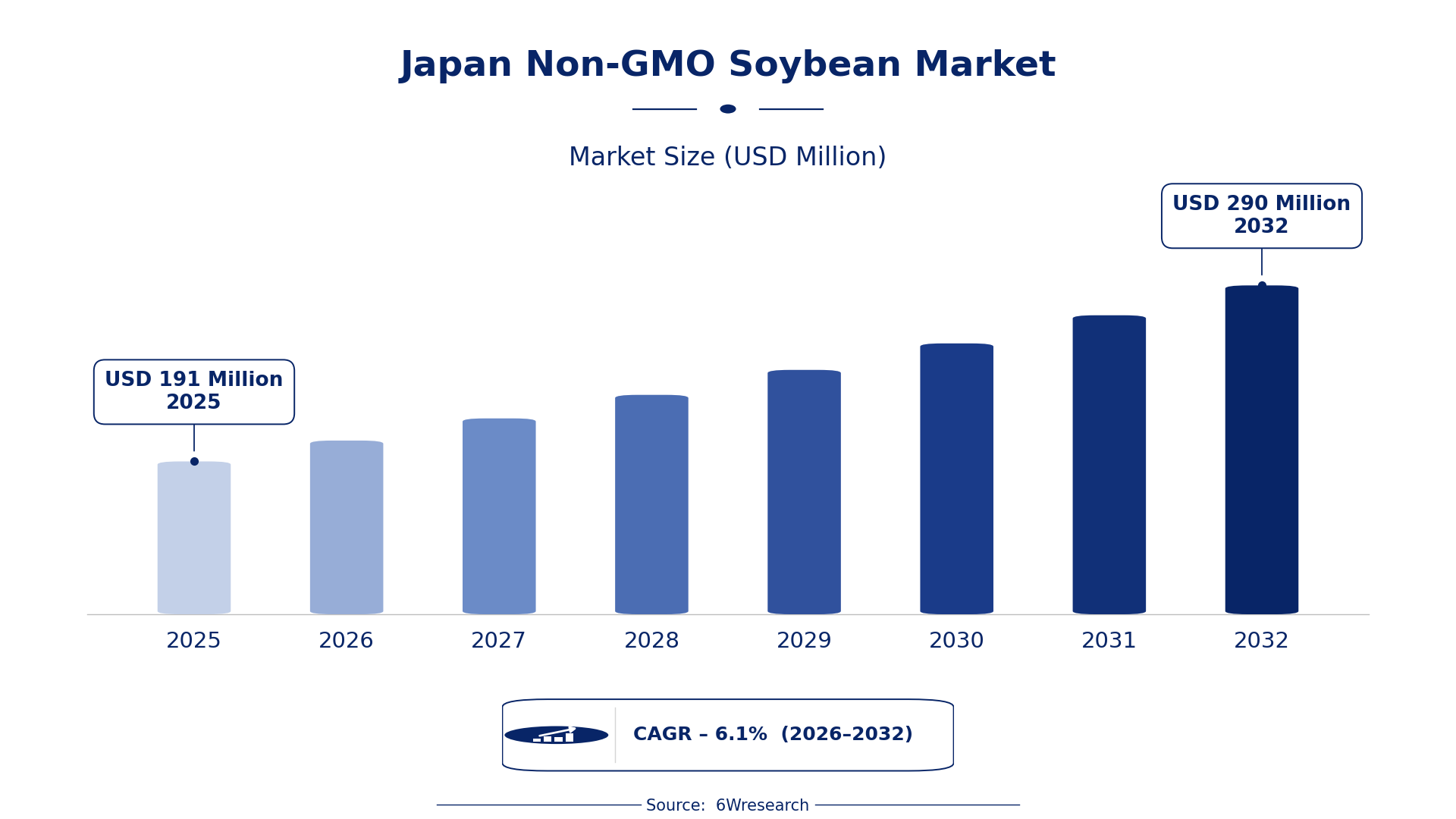
According to 6Wresearch internal database and industry insights, the Japan Non-GMO Soybean Market was valued at USD 191 Million in 2025 and is projected to reach USD 290 Million by 2032, growing at a CAGR of approximately 6.1% during 2026–2032.
Japan Non-GMO Soybean Market Highlights
| Report Metric | Details |
| Report Name | Japan Non-GMO Soybean Market (2026-2032) |
| Market Size 2025 | USD 191 Million |
| Market Size 2032 | USD 290 Million |
| Absolute Growth 2025–2032 | USD 99 Million |
| CAGR 2026–2032 | 6.1% |
| Peak Annual Growth | 7.1% in 2028 |
| Forecast Period | 2026–2032 |
| Historical Data | 2022–2025 |
| Base Year | 2025 |
| Leading Product Type, 2025 | Soybean Oil (47% share) |
| Leading Source, 2025 | Organic (44% share) |
| Leading Application Area, 2025 | Food Processing (40% share) |
| Leading Distribution Channel, 2025 | Direct Sales (46% share) |
| Leading End User, 2025 | Food Manufacturers (52% share) |
| Fastest-Growing Product Type | Soy Protein (8.4% CAGR) |
| Fastest-Growing Source | Non-GMO (8.5% CAGR) |
| Fastest-Growing Application Area | Nutrition & Supplements (7.4% CAGR) |
| Fastest-Growing Distribution Channel | Online Platforms (7.9% CAGR) |
| Fastest-Growing End User | Nutraceutical Companies (7.7% CAGR) |
| Growing Sector | Food Processing |
| Key End Users | Food Manufacturers, Nutraceutical Companies, Livestock Farms, Bakery Sector |
Japan Non-GMO Soybean Market Year-wise Growth Rate and Key Drivers (2022–2032)
This graph illustrates the annual growth rates of the market from 2022 to 2032, highlighting a steady upward trajectory and projected market expansion over the forecast period.
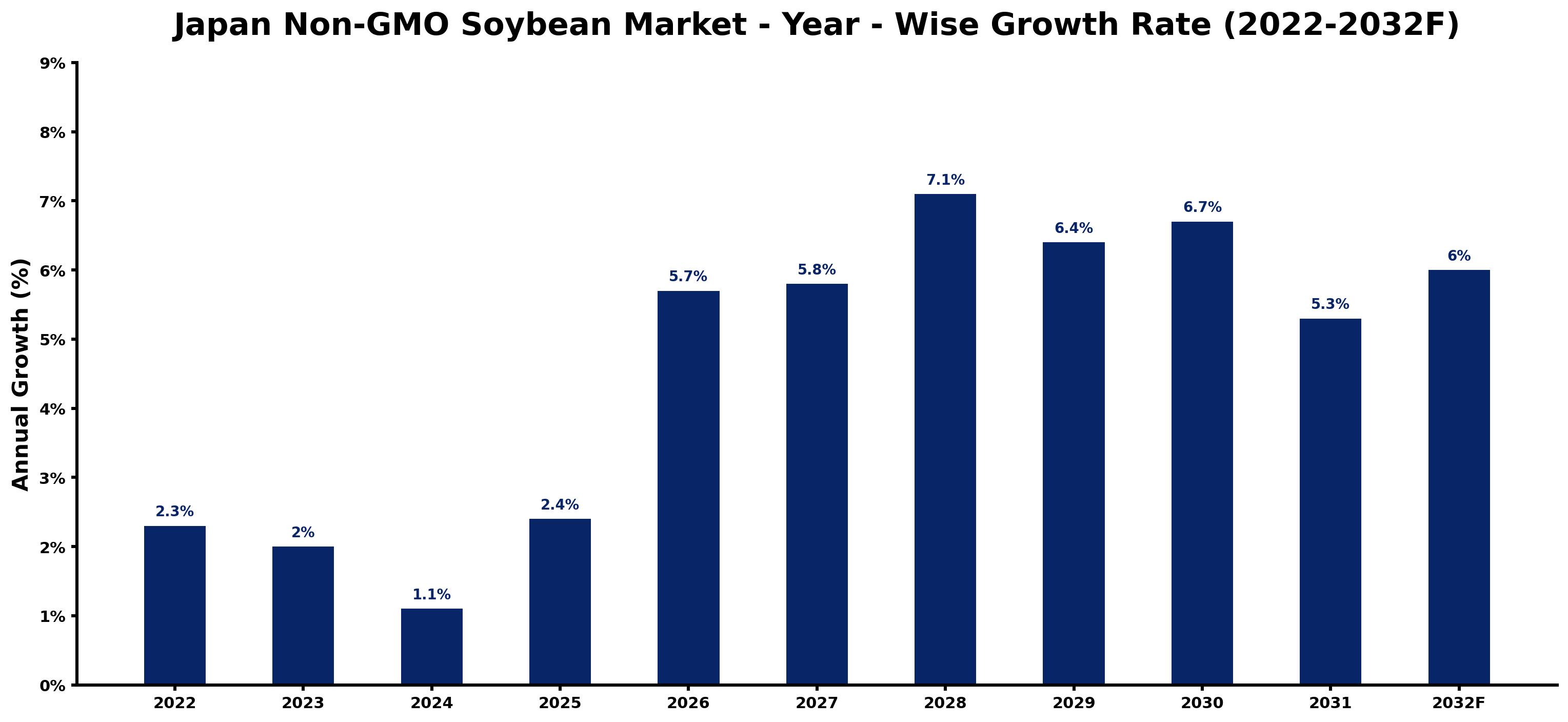
Year by year, the estimates below pair each growth rate with the development that shaped it.
| Year | Estimated Annual Growth (%) | Market Rationale |
| 2022 | 2.3 | The demand for non-GMO soybeans was strong due to health trends among consumers. |
| 2023 | 2.0 | Growth slowed as market saturation began to affect new orders for soybeans. |
| 2024 | 1.1 | Demand growth slowed as competition increased in the soybean market. |
| 2025 | 2.4 | Demand surged as food manufacturers focused on non-GMO ingredients for health-conscious consumers. |
| 2026 | 5.7 | Growth is expected to accelerate with rising interest in plant-based diets and soy protein products. |
| 2027 | 5.8 | Continued demand for non-GMO soybeans is projected to support higher growth rates in the market. |
| 2028 | 7.1 | The market is expected to peak as health campaigns promote non-GMO products widely among consumers. |
| 2029 | 6.4 | Growth is projected to slow slightly as the market matures and competition intensifies. |
| 2030 | 6.7 | Demand is expected to increase again as food manufacturers expand their non-GMO product lines. |
| 2031 | 5.3 | Growth is projected to moderate as market conditions stabilise and consumer preferences evolve. |
| 2032 | 6.0 | The market is expected to grow steadily as health trends continue to influence purchasing. |
Note: Market size estimations and growth projections presented in this report are based on 6Wresearch's proprietary forecasting methodology, utilizing the latest available industry data, government publications, and primary research inputs.
Japan Non-GMO Soybean Market Synopsis
Non-GMO soybeans are cultivated using traditional farming methods and are primarily used in food products, animal feed, and nutritional supplements. The Japan Non-GMO Soybean Market is growing as health-conscious consumers and food manufacturers prioritise natural ingredients. The Tokyo region serves as a major hub for food processing, driving demand for non-GMO soy products, with the industry valued at over 200 trillion yen.
Market Dynamics Impact Analysis (2026–2032)
| Factor | Type | Impact | Primary Segment Affected |
| Rising health consciousness among consumers | Driver | High | Non-GMO |
| Increased sourcing of non-GMO soybeans by local food manufacturers | Driver | High | Food Processing |
| Growing demand for plant-based proteins in the food industry | Opportunity | High | Soy Protein |
| Expansion of the bakery sector focusing on non-GMO ingredients | Opportunity | Medium | Soy Flour |
| Competition from genetically modified soybean products | Restraint | High | Non-GMO |
| Limited awareness of non-GMO benefits among some consumer segments | Restraint | Medium | Food Manufacturers |
| High production costs for non-GMO soybeans | Challenge | High | Soybean Oil |
| Dependence on traditional farming methods limits scalability | Challenge | Medium | Whole Soybeans |
Evaluation of Drivers in Japan Non-GMO Soybean Market (2026–2032)
Key forces behind demand, with the segment each one moves most, are listed below.
| Drivers | Primary Segment Affected | Why It Matters (Evidence) |
| Health trends driving consumer preference for non-GMO products | Non-GMO | The Japanese population's growing interest in health foods increases demand for non-GMO soybeans, with local food manufacturers sourcing more. |
| Rising use of soy protein in plant-based products | Soy Protein | In 2022, the Japanese food industry, valued at over 200 trillion yen, is increasingly incorporating soy protein into various products, reflecting a shift towards plant-based diets. |
| Expansion of the bakery sector using non-GMO soy flour | Soy Flour | The bakery sector's focus on natural ingredients boosts demand for non-GMO soy flour, particularly in health-oriented products. |
| Increased production of non-GMO soybeans by local farmers | Whole Soybeans | Local farmers are responding to market demand by increasing their cultivation of non-GMO soybeans. |
| Growing awareness of health benefits associated with non-GMO foods | Food Processing | Health campaigns promoting non-GMO products are encouraging food processors to adopt these ingredients. |
Behind the steady rise in orders sits a shift in consumer preferences towards non-GMO products, with the Japanese population increasingly interested in health foods. Approximately 1.5 million tons of soybeans were produced in Japan in 2022, with local food manufacturers sourcing more non-GMO soybeans to meet demand. The food industry is integrating soy protein into a variety of plant-based products, reflecting ongoing trends. The bakery sector is expanding its use of non-GMO soy flour, driven by health trends. This combination of factors is leading to a sustained increase in demand for non-GMO soybeans across various applications.
Evaluation of Restraints in Japan Non-GMO Soybean Market
Several factors work against faster growth; the main ones are summarised below.
| Market Restraint | Primary Segment Affected | Why It Matters (Evidence) |
| High production costs associated with non-GMO farming methods | Non-GMO | Producers face higher costs compared to genetically modified crops, impacting pricing strategies. |
| Limited consumer awareness of non-GMO benefits | Food Manufacturers | Some segments of the population remain unaware of the advantages of non-GMO products, hindering market growth. |
| Competition from cheaper genetically modified soybean products | Soybean Oil | Genetically modified soybeans are often less expensive, affecting the market share of non-GMO products. |
| Supply chain complexities in sourcing non-GMO soybeans | Whole Soybeans | Challenges in maintaining non-GMO certification throughout the supply chain can deter buyers. |
| Limited availability of non-GMO seeds for farmers | Soy Protein | The restricted supply of non-GMO seeds can limit production capacity for local farmers. |
Japan Non-GMO Soybean Market Challenges
High production costs for non-GMO soybeans burden local farmers, as traditional methods yield only 1.5 million tons annually, limiting their profitability. Technological limitations in cultivation hinder efficiency, delaying supply to food manufacturers who face rising demand for healthier options. Competition from cheaper genetically modified soybeans forces domestic producers to lower prices, squeezing margins and reducing market share. Buyers experience confusion due to inconsistent JIS standards, which can deter purchases and ultimately reduce sales for local food manufacturers.
Trends in the Japan Non-GMO Soybean Market
The shifts below are changing how Japan Non-GMO Soybean Market products are bought and supplied.
- Shift towards Plant-Based Ingredients: The Japanese food industry is increasingly adopting plant-based ingredients, with soy protein gaining traction in various products. In 2022, the market for plant-based foods reached approximately 500 billion yen, reflecting changing consumer preferences.
- Transition from Conventional to Non-GMO Soybeans: Since 2023, there has been a marked shift towards non-GMO soybeans among food manufacturers. This transition is driven by health campaigns that promote the benefits of non-GMO products, resulting in increased demand.
- Emergence of Online Platforms for Soybean Sales: The rise of online platforms for food sales has transformed distribution channels for non-GMO soybeans. In 2023, online sales grew by 25%, providing new opportunities for suppliers to reach health-conscious consumers.
- Prioritisation of Quality Standards in Soybean Production: The implementation of JIS standards in soybean quality is becoming more prevalent. In 2022, over 70% of soybean producers adhered to these standards, ensuring higher quality and safety in non-GMO products.
Investment Opportunities in the Japan Non-GMO Soybean Market
Investors looking at the Japan Non-GMO Soybean Market should consider the following areas.
- Timing for Investment in Non-GMO Soybean Production: With the increasing demand for non-GMO soybeans, now is an ideal time to invest in production facilities. Local food manufacturers are seeking reliable suppliers, particularly in the Tokyo region, where demand is high.
- Entry into the Nutraceutical Market: Investing in the nutraceutical sector presents an opportunity due to the expected market growth to 1 trillion yen by 2025. Collaborating with nutraceutical companies can facilitate entry into this expanding market.
- Expansion of Direct Sales Channels: The growing preference for direct sales among consumers provides an opportunity for suppliers to establish partnerships. Focusing on specialty stores in urban areas can enhance market reach.
- Investment in Online Sales Infrastructure: Now is the time to invest in online sales platforms, which are projected to grow by 7.9% annually. Establishing a strong online presence can attract health-conscious consumers seeking non-GMO products.
Government Initiatives in the Japan Non-GMO Soybean Market
The Waste Management and Public Cleansing Act of 1970 establishes regulations for the treatment and disposal of waste, impacting producers by ensuring proper waste management practices in soybean cultivation. The Food Recycling Law of 2000 mandates food businesses to reduce waste, promoting the recycling of food products into feed and fertiliser, which benefits soybean producers by creating a sustainable supply chain.
In 2023, the government launched a programme to promote organic farming, including soybeans, with funding of 5 billion yen aimed at supporting farmers transitioning to organic methods. The Ministry of Agriculture, Forestry and Fisheries oversees these initiatives, ensuring compliance with regulations and supporting sustainable agricultural practices.
Future Insight of the Japan Non-GMO Soybean Market
Innovations in farming technology will reshape demand for non-GMO soybeans by 2032, driven by government support for organic practices. Stricter JIS standards will improve product quality, benefiting buyers and suppliers. The trend towards plant-based diets will increase the need for soy products, with the nutraceutical market projected to reach 1 trillion yen by 2025. Enhanced food safety measures under ISO 22000 will build consumer trust in these products, driving market growth.
Market Segmentation Analysis
Japan Non-GMO Soybean Market report covers a detailed analysis of the following market segments:
By Product Type – Soybean Oil Leads, Soy Protein Expected to Grow Fastest
According to Vasu Joshi, Associate Consultant at 6Wresearch, Soybean Oil accounted for 47% of the market by product type in 2025. Soybean oil holds the largest share as it is extensively used in cooking and food production, integral to many traditional dishes. Its consistent demand is driven by both consumers and food manufacturers who rely on it for quality and versatility. Soy Protein is projected to grow fastest, at a CAGR of 8.4% during 2026–2032. Soy protein is rapidly gaining popularity, particularly in health supplements and plant-based food products, as consumers increasingly prioritise nutrition. This shift towards healthier eating habits is expected to further accelerate its demand in the coming years. Suppliers should prioritise the production of soy protein to cater to the expanding health-conscious market.
By Source – Organic Leads, Non-GMO Expected to Grow Fastest
With 44% of source revenue in 2025, Organic was the largest category. Organic soybeans are becoming more popular, yet non-GMO soybeans remain the preferred choice for health-conscious consumers. This preference is reflected in local food manufacturers increasingly sourcing non-GMO soybeans to meet the demand for natural ingredients. The quickest growth will come from Non-GMO, forecast to expand at a CAGR of 8.5% between 2026 and 2032. Non-GMO soybeans are experiencing the fastest growth due to rising health trends that influence consumer preferences towards natural products. The government's recent programme promoting organic farming indirectly supports this trend, solidifying the demand for non-GMO options. Buyers should focus on sourcing non-GMO soybeans to align with the increasing consumer preference for healthier food options.
By Application Area – Food Processing Leads, Nutrition & Supplements Expected to Grow Fastest
Food Processing held 40% of the Japan Non-GMO Soybean Market by application area in 2025. Food processing is the leading application area, utilising soybeans in a wide range of food products. The substantial size of this sector ensures a steady demand for soybeans across various categories, reinforcing its market position. Nutrition & Supplements are set to record the highest CAGR in this split, 7.4% over 2026–2032. The nutrition and supplements segment is growing rapidly, driven by increasing consumer awareness of health benefits. This expansion is expected to create new opportunities for suppliers as the market for health products continues to rise. Suppliers should explore opportunities in the nutrition and supplements market to capitalise on emerging health trends.
By Distribution Channel – Direct Sales Leads, Online Platforms Expected to Grow Fastest
Direct Sales took 46% of distribution channel revenue in 2025, more than any other category. Direct sales dominate the distribution channel, effectively reaching food manufacturers and other buyers. This method facilitates strong relationship management and customer service, ensuring a reliable supply chain. Over 2026–2032, Online Platforms are expected to post the fastest growth, at a CAGR of 7.9%. Online platforms are rapidly emerging as the fastest-growing sales channel, reflecting a shift towards digital purchasing behaviours. The convenience and accessibility of online shopping are key factors driving this growth, indicating a need for suppliers to adapt. Suppliers must enhance their online presence to capture the increasing demand through digital channels.
By End User – Food Manufacturers Lead, Nutraceutical Companies Expected to Grow Fastest
In 2025, Food Manufacturers led the end user split with a 52% share. Food manufacturers represent the largest user group of non-GMO soybeans, incorporating them into various products to satisfy consumer demands. Their established operations contribute significantly to the overall market size, ensuring consistent demand. Nutraceutical Companies are projected to grow fastest, at a CAGR of 7.7% during 2026–2032. Nutraceutical companies are experiencing the fastest growth as they cater to the rising demand for health-focused products. This sector's expansion reflects broader health trends among consumers, indicating a shift towards wellness-oriented offerings in the market. Suppliers should target nutraceutical companies to leverage the growing interest in health and wellness products.
Key Attractiveness of the Report
- 10 Years of Market Numbers
- Historical Data Starting from 2022 to 2025
- Base Year 2025
- Forecast Data until 2032
- Key Performance Indicators Impacting the Market
- Major Upcoming Developments and Projects
Key Highlights of the Report:
- Japan Non-GMO Soybean Market Outlook
- Market Size of Japan Non-GMO Soybean Market, 2025
- Forecast of Japan Non-GMO Soybean Market, 2032
- Historical Data and Forecast of Japan Non-GMO Soybean Market Revenues & Volume for the Period 2022-2032F
- Japan Non-GMO Soybean Market Trend Evolution
- Japan Non-GMO Soybean Market Drivers and Challenges
- Japan Non-GMO Soybean Market Price Trends
- Japan Non-GMO Soybean Market Porter's Five Forces
- Japan Non-GMO Soybean Market Industry Life Cycle
- Historical Data and Forecast of Japan Non-GMO Soybean Market Revenues & Volume By Product Type for the Period 2022-2032F
- Historical Data and Forecast of Japan Non-GMO Soybean Market Revenues & Volume By Soybean Oil for the Period 2022-2032F
- Historical Data and Forecast of Japan Non-GMO Soybean Market Revenues & Volume By Soy Protein for the Period 2022-2032F
- Historical Data and Forecast of Japan Non-GMO Soybean Market Revenues & Volume By Soy Flour for the Period 2022-2032F
- Historical Data and Forecast of Japan Non-GMO Soybean Market Revenues & Volume By Whole Soybeans for the Period 2022-2032F
- Historical Data and Forecast of Japan Non-GMO Soybean Market Revenues & Volume By Source for the Period 2022-2032F
- Historical Data and Forecast of Japan Non-GMO Soybean Market Revenues & Volume By Organic for the Period 2022-2032F
- Historical Data and Forecast of Japan Non-GMO Soybean Market Revenues & Volume By Non-GMO for the Period 2022-2032F
- Historical Data and Forecast of Japan Non-GMO Soybean Market Revenues & Volume By Non-GMO for the Period 2022-2032F
- Historical Data and Forecast of Japan Non-GMO Soybean Market Revenues & Volume By Certified Non-GMO for the Period 2022-2032F
- Historical Data and Forecast of Japan Non-GMO Soybean Market Revenues & Volume By Application Area for the Period 2022-2032F
- Historical Data and Forecast of Japan Non-GMO Soybean Market Revenues & Volume By Food Processing for the Period 2022-2032F
- Historical Data and Forecast of Japan Non-GMO Soybean Market Revenues & Volume By Nutrition & Supplements for the Period 2022-2032F
- Historical Data and Forecast of Japan Non-GMO Soybean Market Revenues & Volume By Bakery & Snacks for the Period 2022-2032F
- Historical Data and Forecast of Japan Non-GMO Soybean Market Revenues & Volume By Animal Feed for the Period 2022-2032F
- Historical Data and Forecast of Japan Non-GMO Soybean Market Revenues & Volume By Distribution Channel for the Period 2022-2032F
- Historical Data and Forecast of Japan Non-GMO Soybean Market Revenues & Volume By Direct Sales for the Period 2022-2032F
- Historical Data and Forecast of Japan Non-GMO Soybean Market Revenues & Volume By Online Platforms for the Period 2022-2032F
- Historical Data and Forecast of Japan Non-GMO Soybean Market Revenues & Volume By Specialty Stores for the Period 2022-2032F
- Historical Data and Forecast of Japan Non-GMO Soybean Market Revenues & Volume By Industrial Suppliers for the Period 2022-2032F
- Historical Data and Forecast of Japan Non-GMO Soybean Market Revenues & Volume By End User for the Period 2022-2032F
- Historical Data and Forecast of Japan Non-GMO Soybean Market Revenues & Volume By Food Manufacturers for the Period 2022-2032F
- Historical Data and Forecast of Japan Non-GMO Soybean Market Revenues & Volume By Nutraceutical Companies for the Period 2022-2032F
- Historical Data and Forecast of Japan Non-GMO Soybean Market Revenues & Volume By Food Industry for the Period 2022-2032F
- Historical Data and Forecast of Japan Non-GMO Soybean Market Revenues & Volume By Livestock Farms for the Period 2022-2032F
- Japan Non-GMO Soybean Market Import Export Trade Statistics
- Market Opportunity Assessment By Product Type
- Market Opportunity Assessment By Source
- Market Opportunity Assessment By Application Area
- Market Opportunity Assessment By Distribution Channel
- Market Opportunity Assessment By End User
- Japan Non-GMO Soybean Market Top Companies Market Share
- Japan Non-GMO Soybean Market Competitive Benchmarking By Technical and Operational Parameters
- Japan Non-GMO Soybean Market Company Profiles
- Japan Non-GMO Soybean Market Key Strategic Recommendations
Market Covered
Segments analysed in this report are listed below.
By Product Type
- Soybean Oil
- Soy Protein
- Soy Flour
- Whole Soybeans
By Source
- Organic
- Non-GMO
- Certified Non-GMO
By Application Area
- Food Processing
- Nutrition & Supplements
- Bakery & Snacks
- Animal Feed
By Distribution Channel
- Direct Sales
- Online Platforms
- Specialty Stores
- Industrial Suppliers
By End User
- Food Manufacturers
- Nutraceutical Companies
- Food Industry
- Livestock Farms






































