Japan Non-Toxic Pest Management Market Size & Growth Rate
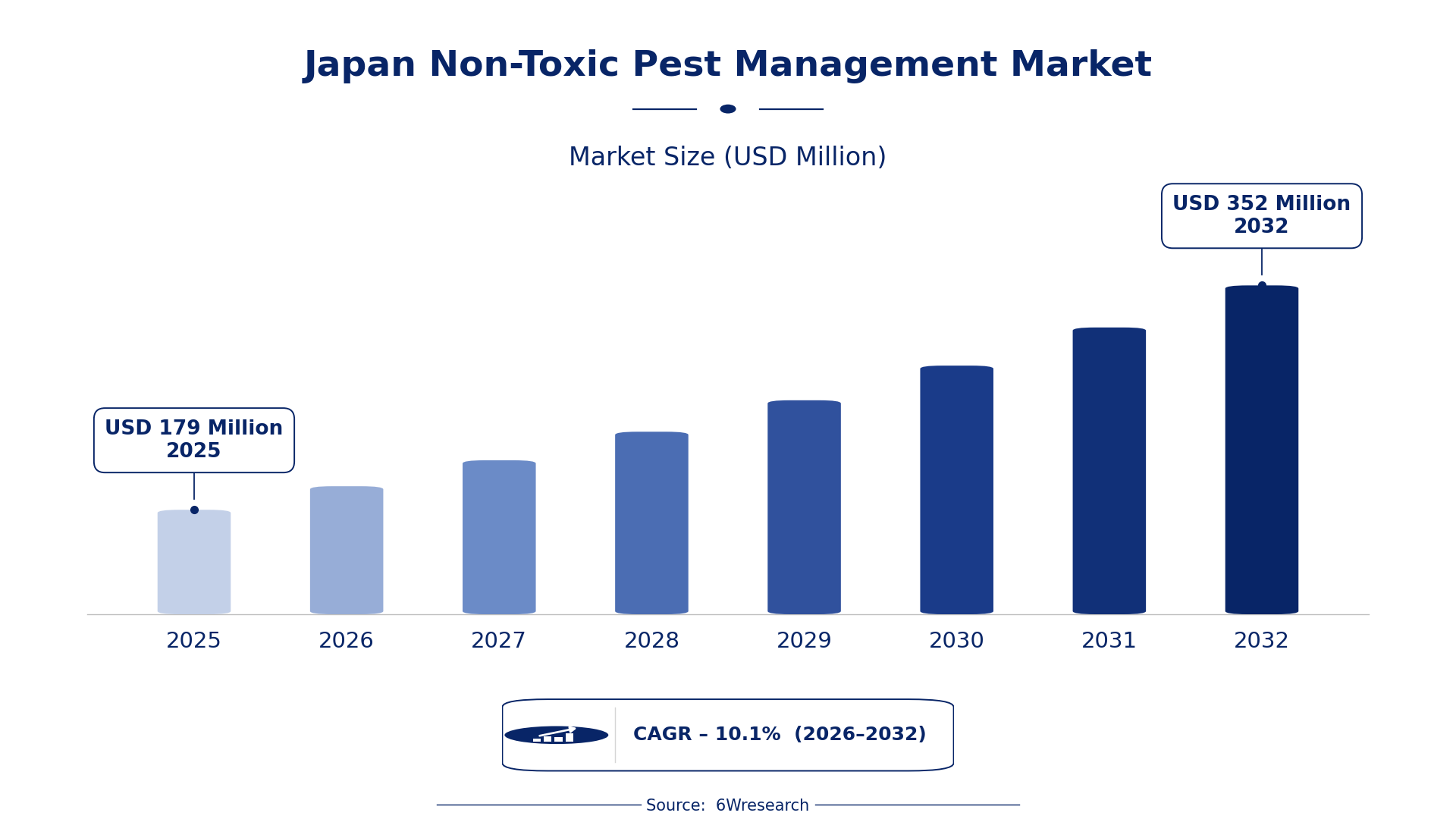
According to 6Wresearch internal database and industry insights, the Japan Non-Toxic Pest Management Market was valued at USD 179 Million in 2025 and is projected to reach USD 352 Million by 2032, growing at a CAGR of approximately 10.1% during 2026–2032.
Japan Non-Toxic Pest Management Market Highlights
| Report Metric | Details |
| Report Name | Japan Non-Toxic Pest Management Market (2026-2032) |
| Market Size 2025 | USD 179 Million |
| Market Size 2032 | USD 352 Million |
| Absolute Growth 2025–2032 | USD 173 Million |
| CAGR 2026–2032 | 10.1% |
| Peak Annual Growth | 10.9% in 2030 |
| Forecast Period | 2026–2032 |
| Historical Data | 2022–2025 |
| Base Year | 2025 |
| Leading Solution Type, 2025 | Botanical Sprays (39% share) |
| Leading Active Ingredient, 2025 | Neem Oil (41% share) |
| Leading Pest Targeted, 2025 | Insects & Mites (32% share) |
| Leading Distribution Channel, 2025 | Organic Stores (34% share) |
| Leading End User Sector, 2025 | Agriculture (36% share) |
| Fastest-Growing Solution Type | Biological Control (14.9% CAGR) |
| Fastest-Growing Active Ingredient | Nematodes (13.4% CAGR) |
| Fastest-Growing Pest Targeted | Bedbugs (13.9% CAGR) |
| Fastest-Growing Distribution Channel | Online Retailers (13.1% CAGR) |
| Fastest-Growing End User Sector | Residential Consumers (13.3% CAGR) |
| Growing Sector | Agriculture |
| Key End Users | Agriculture, Residential Consumers, Food Storage Facilities, Crop Growers |
Japan Non-Toxic Pest Management Market Year-wise Growth Rate and Key Drivers (2022–2032)
This graph illustrates the annual growth rates of the market from 2022 to 2032, highlighting a steady upward trajectory and projected market expansion over the forecast period.
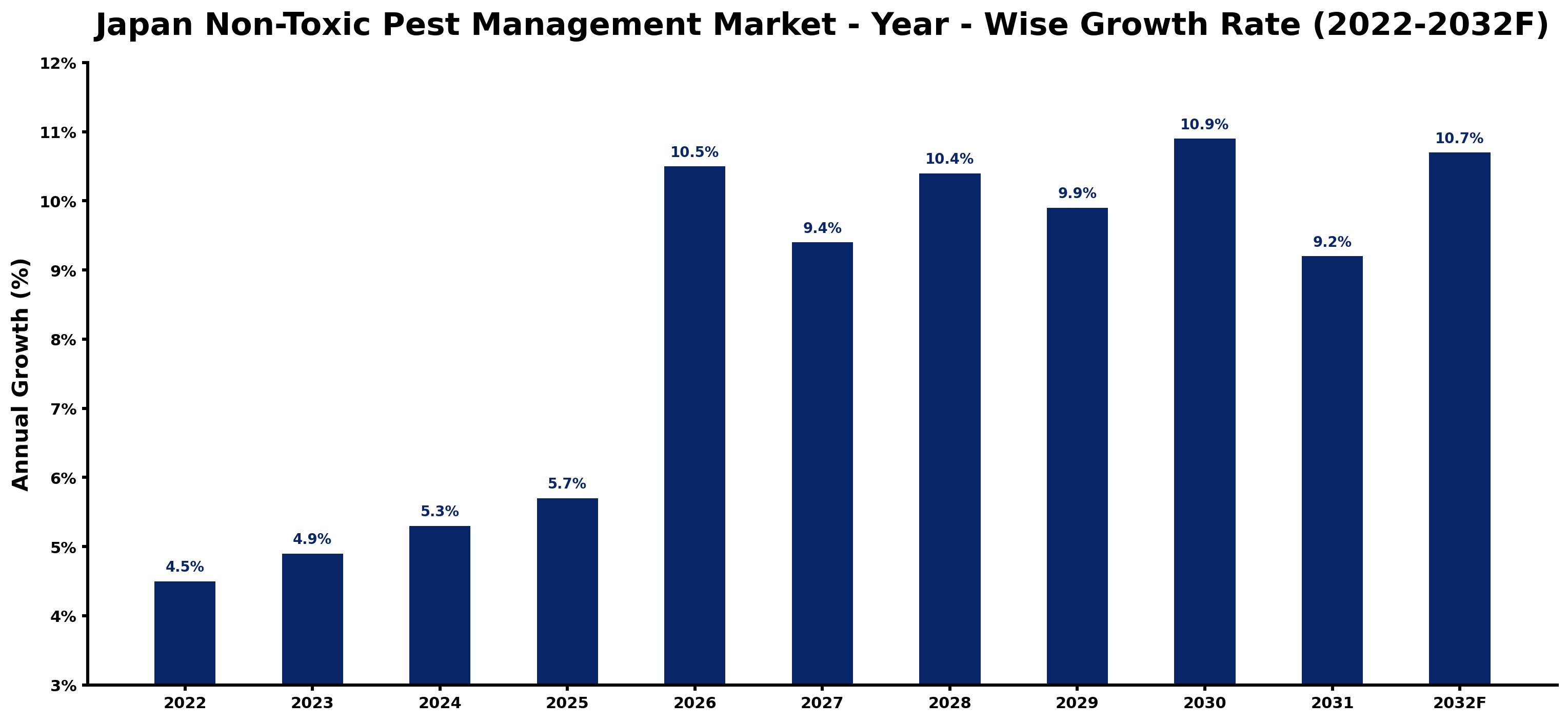
Year by year, the estimates below pair each growth rate with the development that shaped it.
| Year | Estimated Annual Growth (%) | Market Rationale |
| 2022 | 4.5 | The market showed steady growth, reflecting ongoing interest in sustainable pest solutions. |
| 2023 | 4.9 | Demand increased due to heightened awareness of non-toxic alternatives among consumers. |
| 2024 | 5.3 | The rise in organic farming practices contributed to further market expansion. |
| 2025 | 5.7 | The market reached a historical peak as more users adopted eco-friendly pest management. |
| 2026 | 10.5 | Growth is expected to accelerate as urban populations increase, driving pest management needs. |
| 2027 | 9.4 | A slowdown in growth is expected as market saturation begins in some areas. |
| 2028 | 10.4 | Demand is projected to surge again, supported by innovations in biological pest control methods. |
| 2029 | 9.9 | Growth is expected to slow slightly as competition intensifies among suppliers. |
| 2030 | 10.9 | The market is projected to peak again, driven by strong consumer preference for non-toxic solutions. |
| 2031 | 9.2 | A slowdown in growth is expected as the market stabilises after rapid expansion. |
| 2032 | 10.7 | Growth is projected to rebound as new pest management technologies gain traction. |
Note: Market size estimations and growth projections presented in this report are based on 6Wresearch's proprietary forecasting methodology, utilizing the latest available industry data, government publications, and primary research inputs.
Japan Non-Toxic Pest Management Market Synopsis
Non-toxic pest management products utilise natural ingredients to control pests without harmful chemicals. The organic farming sector in Japan is valued at approximately 1.5 billion USD, driving demand for sustainable pest management solutions. Key factors include the rising adoption of biological control methods and the increasing urban population, which heightens the need for effective pest management in residential areas and food storage facilities.
Market Dynamics Impact Analysis (2026–2032)
| Factor | Type | Impact | Primary Segment Affected |
| Increased adoption of biological control methods is driving demand for sustainable pest solutions. | Driver | High | Biological Control |
| The rise in organic farming practices is creating opportunities for non-toxic pest management products. | Driver | High | Neem Oil |
| Growing urban populations are leading to heightened demand for pest management solutions in residential areas. | Opportunity | High | Residential Consumers |
| The increasing focus on sustainable practices in agriculture presents a significant opportunity for suppliers. | Opportunity | High | Agriculture |
| Market saturation in urban areas is limiting growth potential for some pest management products. | Restraint | Medium | Ultrasonic Devices |
| Competition among suppliers is driving prices down, affecting profit margins. | Restraint | Medium | Biological Control |
| Limited consumer awareness of non-toxic options can hinder market growth. | Challenge | Medium | Diatomaceous Earth |
| Regulatory compliance costs can be burdensome for small producers. | Challenge | Medium | Pheromone Traps |
Evaluation of Drivers in Japan Non-Toxic Pest Management Market (2026–2032)
The table below links each growth driver to the segment it affects and the evidence for it.
| Drivers | Primary Segment Affected | Why It Matters (Evidence) |
| Increased organic farming practices are driving demand for non-toxic pest management solutions. | Neem Oil | The use of neem oil has increased by 30% among organic farmers, reflecting a shift towards sustainable practices. |
| Urban population growth is creating a larger market for pest management solutions. | Food Storage Facilities | Urban areas, with around 37 million people, are expanding the need for effective pest management solutions. |
| Online sales of non-toxic pest management products have surged, expanding market access. | Online Retailers | Online sales rose by 25% in the last year, making products more accessible to consumers. |
| The increasing concern over food safety is driving demand for effective pest management in food storage. | Food Storage Facilities | Food safety regulations heighten the need for pest management solutions in storage facilities. |
| Local agricultural cooperatives are promoting biological control methods, boosting adoption rates. | Biological Control | The Ministry of Agriculture, Forestry and Fisheries encourages farmers to transition away from harmful chemicals. |
Much of the new demand traces back to the increasing organic farming practices in Japan, with the organic farming sector valued at approximately 1.5 billion USD in 2023. The use of neem oil has surged by 30% among organic farmers, reflecting a shift towards sustainable pest management solutions. Urban population growth, with around 37 million people in urban areas, is creating a larger market for pest management solutions. Local agricultural cooperatives promote biological control methods, encouraging farmers to transition away from harmful chemicals. Online sales of non-toxic products have risen by 25%, improving access for consumers seeking eco-friendly options.
Evaluation of Restraints in Japan Non-Toxic Pest Management Market
The table below lists the restraints and the evidence behind each.
| Market Restraint | Primary Segment Affected | Why It Matters (Evidence) |
| Market saturation in urban areas limits growth potential for pest management products. | Ultrasonic Devices | As urban areas become saturated, demand for ultrasonic devices is plateauing, affecting sales. |
| Intense competition among suppliers is driving prices down, impacting profit margins. | Biological Control | Increased competition leads to price reductions, which can squeeze profit margins for suppliers. |
| Limited consumer awareness of non-toxic pest management options can hinder market growth. | Diatomaceous Earth | Many consumers remain unaware of the benefits of non-toxic solutions, limiting market expansion. |
| Regulatory compliance costs can be burdensome for smaller producers in the market. | Pheromone Traps | Smaller producers face high costs to meet regulatory standards, which can limit their competitiveness. |
| The reliance on traditional pest control methods can slow the adoption of non-toxic solutions. | Biological Control | Many farmers continue to use conventional methods, hindering the transition to non-toxic alternatives. |
Japan Non-Toxic Pest Management Market Challenges
Producers in the organic farming sector face rising supply costs due to limited availability of non-toxic pest management products, which can increase operational expenses by up to 15%. Importers encounter high costs associated with sourcing natural ingredients, leading to a 20% increase in procurement expenses for pest management solutions. Urban homeowners experience delays in pest control services, particularly for bedbug treatments, as demand surges in metropolitan areas, causing wait times to extend by an average of two weeks. Regulatory complexities surrounding the JIS Z 2801 standard increase compliance costs for suppliers, potentially raising product prices by 10%.
Trends in the Japan Non-Toxic Pest Management Market
Four trends stand out in the Japan Non-Toxic Pest Management Market.
- Shift towards Biological Control Methods: The Kinki region is leading a shift towards biological control methods in agriculture, with local cooperatives promoting these practices. Over 1,000 certified organic farms are utilising non-toxic pest management.
- Rising Online Sales of Non-Toxic Products: Online retailers are experiencing a surge in sales of non-toxic pest management products, with a 25% increase in the last year. This trend reflects changing consumer preferences for eco-friendly solutions.
- Increased Focus on Food Safety: Food storage facilities are increasingly adopting non-toxic pest management solutions to comply with food safety regulations. The Food Sanitation Act amendment mandates stricter hygiene management, driving demand for effective pest control.
- Urban Areas Driving Pest Management Demand: Urban areas, with a population of around 37 million, are seeing increased demand for pest management solutions. This growth is particularly notable in residential settings, where pest concerns are rising.
Investment Opportunities in the Japan Non-Toxic Pest Management Market
The following areas offer the clearest openings for investors and suppliers in the Japan Non-Toxic Pest Management Market.
- Partnerships with Agricultural Cooperatives: Now is a prime time to partner with agricultural cooperatives promoting biological pest control methods. With over 1,000 certified organic farms, there is a strong market for non-toxic solutions.
- Investing in Online Retail Channels: With online sales of non-toxic products rising by 25%, investing in e-commerce platforms presents a significant opportunity. Suppliers can reach a broader consumer base through digital channels.
- Expanding Product Offerings in Urban Markets: The urban population of approximately 37 million creates a gap for innovative pest management solutions. Suppliers should focus on developing products tailored for urban residential consumers.
- Certification for Organic Products: Obtaining organic certification can open doors to new markets, particularly among environmentally conscious consumers. The Japan Organic Agriculture Association supports the use of non-toxic pest management.
Government Initiatives in the Japan Non-Toxic Pest Management Market
The Waste Management and Public Cleansing Act (1970) regulates waste treatment and disposal, impacting pest management producers by necessitating compliance with waste disposal standards. This law ensures that pest management products do not contribute to environmental harm, promoting sustainable practices. The government has allocated funds for research into natural pest control methods in 2023, supporting innovation in the sector.
The Food Sanitation Act amendment (2018) mandates HACCP-based hygiene management for food businesses, guiding buyers in implementing effective pest control measures. This regulation encourages the adoption of non-toxic pest management solutions, enhancing food safety and compliance among producers.
Future Insight of the Japan Non-Toxic Pest Management Market
A shift towards sustainable pest management will prompt suppliers to invest in innovative biological control methods. Government funding for research into natural pest solutions will drive the development of effective alternatives. Urban areas will increasingly adopt ultrasonic devices as a non-chemical pest control strategy, supported by environmental agency promotions. The annual pest control market in Japan is estimated at 1.2 billion USD, indicating expanding opportunities for buyers seeking eco-friendly pest management solutions.
Market Segmentation Analysis
Japan Non-Toxic Pest Management Market report covers a detailed analysis of the following market segments:
By Solution Type – Botanical Sprays Lead, Biological Control Expected to Grow Fastest
According to Saurav Kr Singh, Senior Research Analyst at 6Wresearch, Botanical Sprays held 39% of the Japan Non-Toxic Pest Management Market by solution type in 2025. Botanical sprays dominate the market as they are widely used for immediate pest control in various settings, including agriculture and residential areas. Their strong presence is evident in the organic farming sector, which is valued at approximately 1.5 billion USD in 2023, attracting eco-conscious users. Biological Control is set to record the highest CAGR in this split, 14.9% over 2026–2032. Biological control is experiencing rapid growth due to its reliance on natural predators, appealing to organic farmers who prioritise sustainable practices. The government's allocation of funds for research into these methods in 2023 is expected to further boost their adoption in the market. Suppliers should focus on developing biological control products to meet the increasing demand for sustainable pest management solutions.
By Active Ingredient – Neem Oil Leads, Nematodes Expected to Grow Fastest
The largest active ingredient category in 2025 was Neem Oil, at 41% of revenue. Neem oil holds the largest share as it is extensively used by organic farmers in Japan for its effectiveness as a natural insect repellent. Its popularity is underscored by a 30% increase in usage among organic farmers in recent years. Nematodes are projected to grow fastest, at a CAGR of 13.4% during 2026–2032. Nematodes are seeing the fastest growth as effective biological control agents for soil pests, particularly in organic farming practices. Their rising adoption is supported by local agricultural cooperatives advocating for sustainable pest management. Buyers should consider integrating nematodes into their pest management strategies for improved effectiveness.
By Pest Targeted – Insects & Mites Lead, Bedbugs Expected to Grow Fastest
With 32% of pest targeted revenue in 2025, Insects & Mites was the largest category. Insects and mites are the primary targets for pest control solutions, presenting significant challenges in both agricultural and urban environments. Their prevalence necessitates the implementation of various pest management strategies to effectively manage these common pests. Over 2026–2032, Bedbugs are expected to post the fastest growth, at a CAGR of 13.9%. Bedbugs are emerging as the fastest-growing concern, particularly in urban areas where their prevalence has increased notably. The rising number of bedbug treatments in the Tokyo metropolitan area underscores the urgent need for effective pest management solutions. Suppliers must create specialised products and strategies to address the growing bedbug issue in urban settings.
By Distribution Channel – Organic Stores Lead, Online Retailers Expected to Grow Fastest
In 2025, Organic Stores led the distribution channel split with a 34% share. Organic stores are the leading distribution channel for non-toxic pest management products, catering to the increasing consumer preference for eco-friendly solutions. Their importance is underscored by the growing number of certified organic farms in Japan that rely on these products for pest control. The quickest growth will come from Online Retailers, forecast to expand at a CAGR of 13.1% between 2026 and 2032. Online retailers are rapidly becoming the fastest-growing distribution channel, evidenced by a 25% increase in online sales of non-toxic pest management products in the past year. This shift indicates a change in consumer behaviour towards more convenient purchasing options. Suppliers should enhance their online sales strategies to capitalise on the growing trend of e-commerce in pest management solutions.
By End User Sector – Agriculture Leads, Residential Consumers Expected to Grow Fastest
Agriculture took 36% of end user sector revenue in 2025, more than any other category. The agriculture sector is the largest end user of pest management solutions, driven by the need for effective pest control in crop production. This sector's continued activity, with a strong focus on sustainable practices, sustains its dominance. Residential Consumers are set to record the highest CAGR in this split, 13.3% over 2026–2032. Residential consumers represent the fastest-growing segment as urban populations increase, leading to heightened demand for home pest control solutions. The average household's annual spending on pest management underscores this trend. Suppliers should tailor their products to meet the specific needs of residential consumers as this market expands.
Key Attractiveness of the Report
- 10 Years of Market Numbers
- Historical Data Starting from 2022 to 2025
- Base Year 2025
- Forecast Data until 2032
- Key Performance Indicators Impacting the Market
- Major Upcoming Developments and Projects
Key Highlights of the Report:
- Japan Non-Toxic Pest Management Market Outlook
- Market Size of Japan Non-Toxic Pest Management Market, 2025
- Forecast of Japan Non-Toxic Pest Management Market, 2032
- Historical Data and Forecast of Japan Non-Toxic Pest Management Revenues & Volume for the Period 2022-2032F
- Japan Non-Toxic Pest Management Market Trend Evolution
- Japan Non-Toxic Pest Management Market Drivers and Challenges
- Japan Non-Toxic Pest Management Price Trends
- Japan Non-Toxic Pest Management Porter's Five Forces
- Japan Non-Toxic Pest Management Industry Life Cycle
- Historical Data and Forecast of Japan Non-Toxic Pest Management Market Revenues & Volume By Solution Type for the Period 2022-2032F
- Historical Data and Forecast of Japan Non-Toxic Pest Management Market Revenues & Volume By Botanical Sprays for the Period 2022-2032F
- Historical Data and Forecast of Japan Non-Toxic Pest Management Market Revenues & Volume By Diatomaceous Earth for the Period 2022-2032F
- Historical Data and Forecast of Japan Non-Toxic Pest Management Market Revenues & Volume By Pheromone Traps for the Period 2022-2032F
- Historical Data and Forecast of Japan Non-Toxic Pest Management Market Revenues & Volume By Biological Control for the Period 2022-2032F
- Historical Data and Forecast of Japan Non-Toxic Pest Management Market Revenues & Volume By Ultrasonic Devices for the Period 2022-2032F
- Historical Data and Forecast of Japan Non-Toxic Pest Management Market Revenues & Volume By Active Ingredient for the Period 2022-2032F
- Historical Data and Forecast of Japan Non-Toxic Pest Management Market Revenues & Volume By Neem Oil for the Period 2022-2032F
- Historical Data and Forecast of Japan Non-Toxic Pest Management Market Revenues & Volume By Silica-Based for the Period 2022-2032F
- Historical Data and Forecast of Japan Non-Toxic Pest Management Market Revenues & Volume By Natural Attractants for the Period 2022-2032F
- Historical Data and Forecast of Japan Non-Toxic Pest Management Market Revenues & Volume By Nematodes, Fungi for the Period 2022-2032F
- Historical Data and Forecast of Japan Non-Toxic Pest Management Market Revenues & Volume By Sound Technology for the Period 2022-2032F
- Historical Data and Forecast of Japan Non-Toxic Pest Management Market Revenues & Volume By Pest Targeted for the Period 2022-2032F
- Historical Data and Forecast of Japan Non-Toxic Pest Management Market Revenues & Volume By Insects & Mites for the Period 2022-2032F
- Historical Data and Forecast of Japan Non-Toxic Pest Management Market Revenues & Volume By Ants, Bedbugs, Fleas for the Period 2022-2032F
- Historical Data and Forecast of Japan Non-Toxic Pest Management Market Revenues & Volume By Moths, Beetles for the Period 2022-2032F
- Historical Data and Forecast of Japan Non-Toxic Pest Management Market Revenues & Volume By Soil-Borne Pests for the Period 2022-2032F
- Historical Data and Forecast of Japan Non-Toxic Pest Management Market Revenues & Volume By Rodents & Insects for the Period 2022-2032F
- Historical Data and Forecast of Japan Non-Toxic Pest Management Market Revenues & Volume By Distribution Channel for the Period 2022-2032F
- Historical Data and Forecast of Japan Non-Toxic Pest Management Market Revenues & Volume By Organic Stores for the Period 2022-2032F
- Historical Data and Forecast of Japan Non-Toxic Pest Management Market Revenues & Volume By Online Retailers for the Period 2022-2032F
- Historical Data and Forecast of Japan Non-Toxic Pest Management Market Revenues & Volume By Farming Co-ops for the Period 2022-2032F
- Historical Data and Forecast of Japan Non-Toxic Pest Management Market Revenues & Volume By Agri Input Suppliers for the Period 2022-2032F
- Historical Data and Forecast of Japan Non-Toxic Pest Management Market Revenues & Volume By Hardware Stores for the Period 2022-2032F
- Historical Data and Forecast of Japan Non-Toxic Pest Management Market Revenues & Volume By End User Sector for the Period 2022-2032F
- Historical Data and Forecast of Japan Non-Toxic Pest Management Market Revenues & Volume By Agriculture for the Period 2022-2032F
- Historical Data and Forecast of Japan Non-Toxic Pest Management Market Revenues & Volume By Residential Consumers for the Period 2022-2032F
- Historical Data and Forecast of Japan Non-Toxic Pest Management Market Revenues & Volume By Food Storage Facilities for the Period 2022-2032F
- Historical Data and Forecast of Japan Non-Toxic Pest Management Market Revenues & Volume By Crop Growers for the Period 2022-2032F
- Historical Data and Forecast of Japan Non-Toxic Pest Management Market Revenues & Volume By Homeowners for the Period 2022-2032F
- Japan Non-Toxic Pest Management Import Export Trade Statistics
- Market Opportunity Assessment By Solution Type
- Market Opportunity Assessment By Active Ingredient
- Market Opportunity Assessment By Pest Targeted
- Market Opportunity Assessment By Distribution Channel
- Market Opportunity Assessment By End User Sector
- Japan Non-Toxic Pest Management Top Companies Market Share
- Japan Non-Toxic Pest Management Competitive Benchmarking By Technical and Operational Parameters
- Japan Non-Toxic Pest Management Company Profiles
- Japan Non-Toxic Pest Management Key Strategic Recommendations
Market Covered
The report covers the following segments.
By Solution Type
- Botanical Sprays
- Diatomaceous Earth
- Pheromone Traps
- Biological Control
- Ultrasonic Devices
By Active Ingredient
- Neem Oil
- Silica-Based
- Natural Attractants
- Nematodes
- Fungi
- Sound Technology
By Pest Targeted
- Insects & Mites
- Ants
- Bedbugs
- Fleas
- Moths
- Beetles
- Soil-Borne Pests
- Rodents & Insects
By Distribution Channel
- Organic Stores
- Online Retailers
- Farming Co-ops
- Agri Input Suppliers
- Hardware Stores
By End User Sector
- Agriculture
- Residential Consumers
- Food Storage Facilities
- Crop Growers
- Homeowners






































