Japan Nursing Homes and Long-Term Care Facilities Market Size & Growth Rate
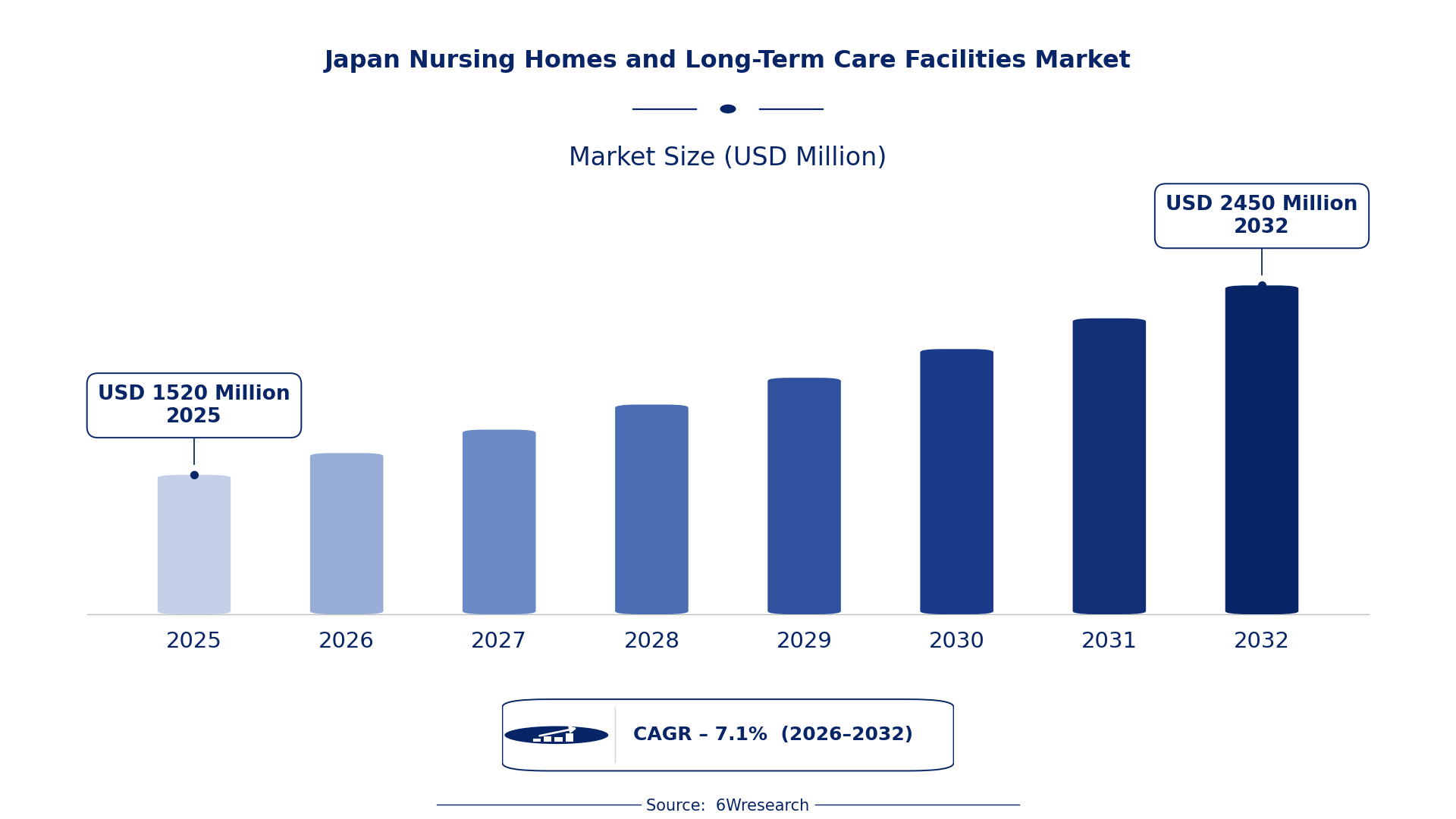
According to 6Wresearch internal database and industry insights, the Japan Nursing Homes and Long-Term Care Facilities Market was valued at USD 1,520 Million in 2025 and is projected to reach USD 2,450 Million by 2032, growing at a CAGR of approximately 7.1% during 2026–2032.
Japan Nursing Homes and Long-Term Care Facilities Market Highlights
| Report Metric | Details |
| Report Name | Japan Nursing Homes and Long-Term Care Facilities Market (2026-2032) |
| Market Size 2025 | USD 1,520 Million |
| Market Size 2032 | USD 2,450 Million |
| Absolute Growth 2025–2032 | USD 930 Million |
| CAGR 2026–2032 | 7.1% |
| Peak Annual Growth | 8.3% in 2027 |
| Forecast Period | 2026–2032 |
| Historical Data | 2022–2025 |
| Base Year | 2025 |
| Leading Product, 2025 | EHR (59% share) |
| Leading Mode of Delivery, 2025 | Web-Based (44% share) |
| Fastest-Growing Product | eMAR (9.4% CAGR) |
| Fastest-Growing Mode of Delivery | On-Premises (8.9% CAGR) |
| Growing Sector | On-Premises |
| Key End Users | Web-Based, On-Premises, Cloud-Based |
Japan Nursing Homes and Long-Term Care Facilities Market Year-wise Growth Rate and Key Drivers (2022–2032)
This graph illustrates the annual growth rates of the market from 2022 to 2032, highlighting a steady upward trajectory and projected market expansion over the forecast period.
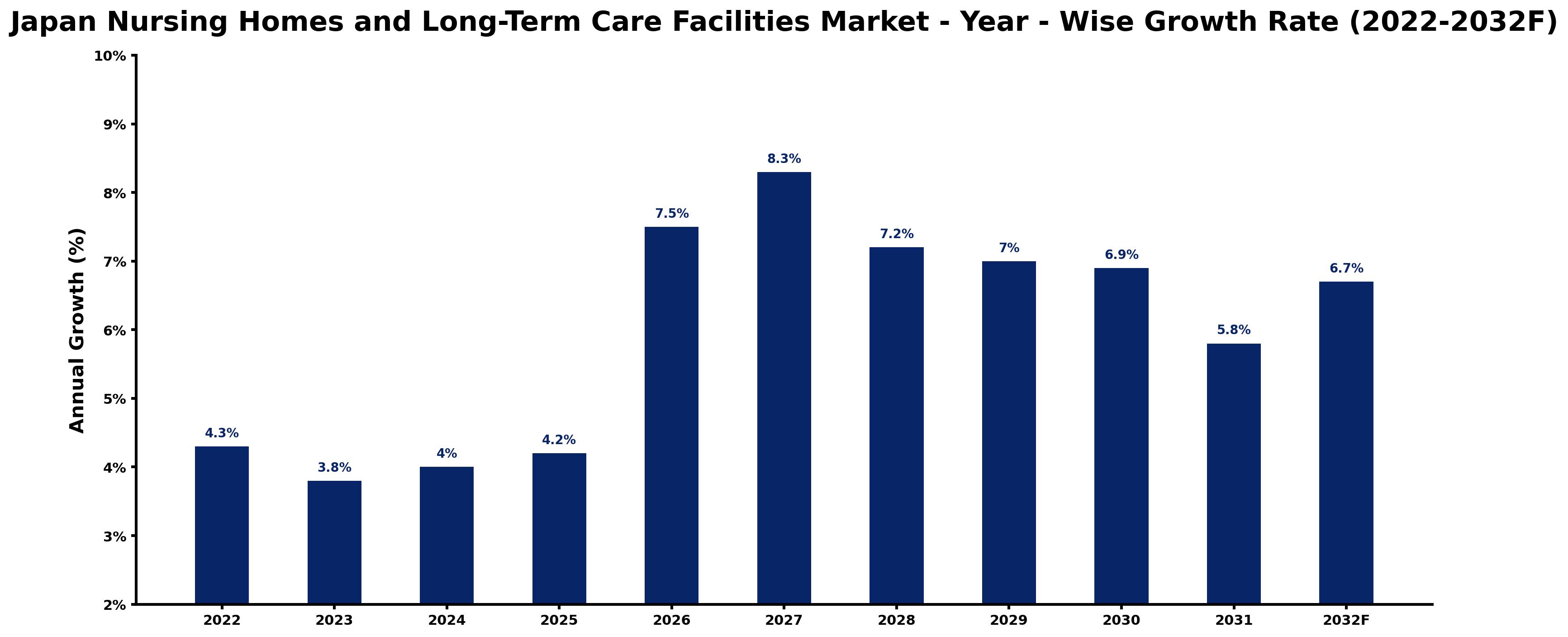
The table below sets out the estimated growth rate for each year and the main factor behind it.
| Year | Estimated Annual Growth (%) | Market Rationale |
| 2022 | 4.3 | The market experienced steady growth due to rising demand for elderly care services. |
| 2023 | 3.8 | Growth slowed slightly as facilities adjusted to increased operational costs. |
| 2024 | 4.0 | Demand accelerated as more elderly individuals required long-term care services. |
| 2025 | 4.2 | Growth continued as the aging population increased the need for nursing homes. |
| 2026 | 7.5 | Demand is expected to surge with the introduction of new care programs. |
| 2027 | 8.3 | The market is projected to peak as facilities expand to accommodate rising patient numbers. |
| 2028 | 7.2 | Growth is expected to slow as market saturation begins to take effect. |
| 2029 | 7.0 | Demand will remain steady, supported by ongoing investments in care quality. |
| 2030 | 6.9 | Growth is projected to continue slowing as the market stabilises after rapid expansion. |
| 2031 | 5.8 | The market will grow at a slower pace due to increased competition among facilities. |
| 2032 | 6.7 | Demand is expected to rise again as new standards improve care quality. |
Note: Market size estimations and growth projections presented in this report are based on 6Wresearch's proprietary forecasting methodology, utilizing the latest available industry data, government publications, and primary research inputs.
Japan Nursing Homes and Long-Term Care Facilities Market Synopsis
Nursing homes and long-term care facilities in Japan provide residential care for the elderly and individuals with disabilities. In 2023, over 8 million elderly individuals required care, underscoring the growing demand for these services. Factors driving the Japan Nursing Homes and Long-Term Care Facilities Market include an aging population, with 29.3% of the population aged 65 or older, and the Long-Term Care Insurance System, which covers a large portion of care costs, ensuring accessibility and affordability for families.
Market Dynamics Impact Analysis (2026–2032)
| Factor | Type | Impact | Primary Segment Affected |
| Aging population increases demand for long-term care services. | Driver | High | EHR |
| Rising healthcare expenditures support facility expansion and upgrades. | Driver | High | EHR |
| Investment in cloud-based solutions enhances operational efficiency. | Opportunity | Medium | Cloud-Based |
| Growing emphasis on quality care creates demand for certified staff. | Opportunity | Medium | EHR |
| High operational costs can limit facility profitability. | Restraint | High | EHR |
| Regulatory compliance requirements can burden smaller facilities. | Restraint | Medium | EHR |
| Cost pressures from rising wages affect facility budgets. | Challenge | High | EHR |
| Capacity constraints limit the ability to expand services. | Challenge | Medium | EHR |
Evaluation of Drivers in Japan Nursing Homes and Long-Term Care Facilities Market (2026–2032)
Demand rests on the following drivers, each shown with the segment it touches most.
| Drivers | Primary Segment Affected | Why It Matters (Evidence) |
| Aging population drives demand for nursing homes. | EHR | In 2023, over 8 million elderly individuals required care, prompting facilities to expand services. |
| Healthcare expenditure growth supports facility upgrades. | EHR | Japan's national medical care expenditure was about JPY 46.7 trillion in fiscal 2022, enabling investments in care quality. |
| Cloud-based solutions improve operational efficiency. | Cloud-Based | As of 2023, 40% of facilities adopted cloud-based solutions, improving accessibility and staff management. |
| Long-Term Care Insurance System facilitates care access. | EHR | This system covers a large portion of care costs, making services more affordable for families. |
| Quality standards drive certification demand. | EHR | Many facilities pursue ISO 9001 certification for quality assurance, reflecting a commitment to high service standards. |
Purchasing is picking up as 29.3% of Japan's population was aged 65 or older in September 2024, leading to increased demand for nursing homes. This demographic shift compels facilities to expand services, as over 8 million elderly individuals required care in 2023. Japan's national medical care expenditure reached about JPY 46.7 trillion in fiscal 2022, enabling targeted investments in long-term care. The introduction of quality standards, such as ISO 9001, motivates facilities to improve their service offerings, ensuring better support for residents. Additionally, the adoption of cloud-based solutions by 40% of facilities boosts operational efficiency, allowing for better staff management and patient care.
Evaluation of Restraints in Japan Nursing Homes and Long-Term Care Facilities Market
Several factors work against faster growth; the main ones are summarised below.
| Market Restraint | Primary Segment Affected | Why It Matters (Evidence) |
| Outdated technology hampers operational efficiency. | EHR | Many facilities struggle with legacy systems, increasing operational costs and affecting service delivery. |
| Frequent regulatory changes create compliance burdens. | EHR | Facilities face challenges in keeping up with evolving regulations, delaying service delivery and impacting care quality. |
| Intense competition leads to price wars. | EHR | Price competition among nursing homes reduces profitability, limiting resources for service improvements. |
| Supply chain disruptions affect essential medical supplies. | EHR | Delays in obtaining medical supplies can compromise the quality of care provided to residents. |
| Limited availability of certified care staff. | EHR | The government aims to increase certified staff by 20% by 2025, but shortages remain a concern. |
Japan Nursing Homes and Long-Term Care Facilities Market Challenges
Many facilities struggle with outdated technology, which raises operational costs for producers and limits care efficiency. Frequent regulatory changes create compliance challenges that delay service delivery for nursing homes, ultimately affecting care quality for over 8 million elderly individuals. Intense competition among long-term care providers leads to price wars, squeezing margins for operators and restricting funds for improvements. Disruptions in the supply chain for essential medical supplies can cause delays, impacting care quality and raising costs for facilities.
Trends in the Japan Nursing Homes and Long-Term Care Facilities Market
Below are the shifts with the largest effect on the Japan Nursing Homes and Long-Term Care Facilities Market.
- Shift from Traditional to Cloud-Based Solutions: Healthcare facilities are increasingly adopting cloud-based solutions for better accessibility and management. As of 2023, 40% of nursing homes have implemented these systems, enhancing operational efficiency and service delivery.
- Transition to Enhanced Quality Standards: The push for ISO 9001 certification among facilities began in 2023, reflecting a growing commitment to quality assurance. This trend is expected to improve service quality across the sector.
- Emergence of New Rehabilitation Centres: The development of new rehabilitation centres started in 2023, aiming to improve service offerings for the elderly. This initiative aligns with the government's goal to enhance care quality.
- Prioritisation of Long-Term Care Insurance: The Long-Term Care Insurance System has gained importance since its introduction, covering a significant portion of care costs. This shift ensures better access to services for families in need.
Investment Opportunities in the Japan Nursing Homes and Long-Term Care Facilities Market
Several openings in the Japan Nursing Homes and Long-Term Care Facilities Market merit attention from investors.
- Investment in Cloud-Based Solutions: Investing in cloud-based solutions is timely as 40% of facilities have adopted these systems. This trend supports operational efficiency and accessibility, appealing to nursing homes seeking modernisation.
- Expansion of Rehabilitation Centres: The demand for new rehabilitation centres is increasing, driven by the aging population. Facilities in urban areas like Tokyo can benefit from partnerships to meet this growing need.
- Focus on Quality Certification: With many facilities pursuing ISO 9001 certification, there is an opportunity for suppliers of quality assurance services. Collaborating with nursing homes can enhance their service standards.
- Enhancement of Long-Term Care Services: The Long-Term Care Insurance System presents an opportunity for investment in services that cater to the elderly. Facilities can partner with local governments to improve care offerings.
Government Initiatives in the Japan Nursing Homes and Long-Term Care Facilities Market
The Long-Term Care Insurance Act, enacted in 1997 and in force since 2000, funds nursing care and support services for older people, ensuring that facilities meet regulatory standards. The Medical Care Act of 1948 sets essential standards for hospitals and clinics, including staffing and facility requirements, contributing to the overall quality of care.
In 2023, the Tokyo Metropolitan Government allocated JPY 2 billion to improve care quality through various initiatives. The Ministry of Health, Labour and Welfare oversees these regulations, ensuring compliance and funding for necessary upgrades.
Future Insight of the Japan Nursing Homes and Long-Term Care Facilities Market
The introduction of new rehabilitation centres will transform care capabilities by 2032, benefiting both buyers and suppliers. The initiative to increase certified care staff by 20% will improve service quality across facilities. Adoption of JIS standards will ensure higher safety and quality assurance in care.
Market Segmentation Analysis
Japan Nursing Homes and Long-Term Care Facilities Market report covers a detailed analysis of the following market segments:
By Product – EHR Leads, eMAR Expected to Grow Fastest
According to Shubham Padhi, Research Analyst at 6Wresearch, with 59% of product revenue in 2025, EHR was the largest category. Electronic Health Records represent the largest share due to their essential role in managing patient records and care plans, ensuring compliance in nursing homes. The extensive network of over 30,000 licensed facilities in Japan relies on EHR systems to maintain efficient operations and deliver quality care. The quickest growth will come from eMAR, forecast to expand at a CAGR of 9.4% between 2026 and 2032. The eMAR segment is experiencing rapid growth as it is crucial for medication administration and safety, especially with the rising number of elderly individuals needing care. The demand for sophisticated medication management solutions is increasing significantly, driven by the care needs of over 8 million elderly individuals. This suggests that suppliers should focus on advancing EHR and eMAR technologies to meet the growing demands of nursing homes.
By Mode of Delivery – Web-Based Leads, On-Premises Expected to Grow Fastest
Web-Based took 44% of mode of delivery revenue in 2025, more than any other category. Web-Based delivery leads the market as it offers accessibility and ease of use for staff, facilitating better communication and coordination of care. The high concentration of nursing homes in urban areas like Tokyo further supports the preference for web-based solutions. On-Premises are set to record the highest CAGR in this split, 8.9% over 2026–2032. On-Premises delivery is growing faster despite being less common, as some facilities prefer this model for control over data security and system performance. The push for improved care quality in response to regulatory standards is driving this trend. Buyers may consider a mix of delivery methods to balance accessibility with security and control.
Key Attractiveness of the Report
- 10 Years of Market Numbers
- Historical Data Starting from 2022 to 2025
- Base Year 2025
- Forecast Data until 2032
- Key Performance Indicators Impacting the Market
- Major Upcoming Developments and Projects
Key Highlights of the Report:
- Japan Nursing Homes and Long-Term Care Facilities Market Outlook
- Market Size of Japan Nursing Homes and Long-Term Care Facilities Market, 2025
- Forecast of Japan Nursing Homes and Long-Term Care Facilities Market, 2032
- Historical Data and Forecast of Japan Nursing Homes and Long-Term Care Facilities Revenues & Volume for the Period 2022-2032
- Japan Nursing Homes and Long-Term Care Facilities Market Trend Evolution
- Japan Nursing Homes and Long-Term Care Facilities Market Drivers and Challenges
- Japan Nursing Homes and Long-Term Care Facilities Price Trends
- Japan Nursing Homes and Long-Term Care Facilities Porter's Five Forces
- Japan Nursing Homes and Long-Term Care Facilities Industry Life Cycle
- Historical Data and Forecast of Japan Nursing Homes and Long-Term Care Facilities Market Revenues & Volume By Product for the Period 2022-2032
- Historical Data and Forecast of Japan Nursing Homes and Long-Term Care Facilities Market Revenues & Volume By EHR for the Period 2022-2032
- Historical Data and Forecast of Japan Nursing Homes and Long-Term Care Facilities Market Revenues & Volume By eMAR for the Period 2022-2032
- Historical Data and Forecast of Japan Nursing Homes and Long-Term Care Facilities Market Revenues & Volume By Payroll Management for the Period 2022-2032
- Historical Data and Forecast of Japan Nursing Homes and Long-Term Care Facilities Market Revenues & Volume By Mode of Delivery for the Period 2022-2032
- Historical Data and Forecast of Japan Nursing Homes and Long-Term Care Facilities Market Revenues & Volume By Web-Based for the Period 2022-2032
- Historical Data and Forecast of Japan Nursing Homes and Long-Term Care Facilities Market Revenues & Volume By On-Premises for the Period 2022-2032
- Historical Data and Forecast of Japan Nursing Homes and Long-Term Care Facilities Market Revenues & Volume By Cloud-Based for the Period 2022-2032
- Japan Nursing Homes and Long-Term Care Facilities Import Export Trade Statistics
- Market Opportunity Assessment By Product
- Market Opportunity Assessment By Mode of Delivery
- Japan Nursing Homes and Long-Term Care Facilities Top Companies Market Share
- Japan Nursing Homes and Long-Term Care Facilities Competitive Benchmarking By Technical and Operational Parameters
- Japan Nursing Homes and Long-Term Care Facilities Company Profiles
- Japan Nursing Homes and Long-Term Care Facilities Key Strategic Recommendations
Market Covered
The report covers the following segments.
By Product
- EHR
- eMAR
- Payroll Management
By Mode of Delivery
- Web-Based
- On-Premises
- Cloud-Based






































