Japan Nutritional Supplements for Aquaculture Market Size & Growth Rate
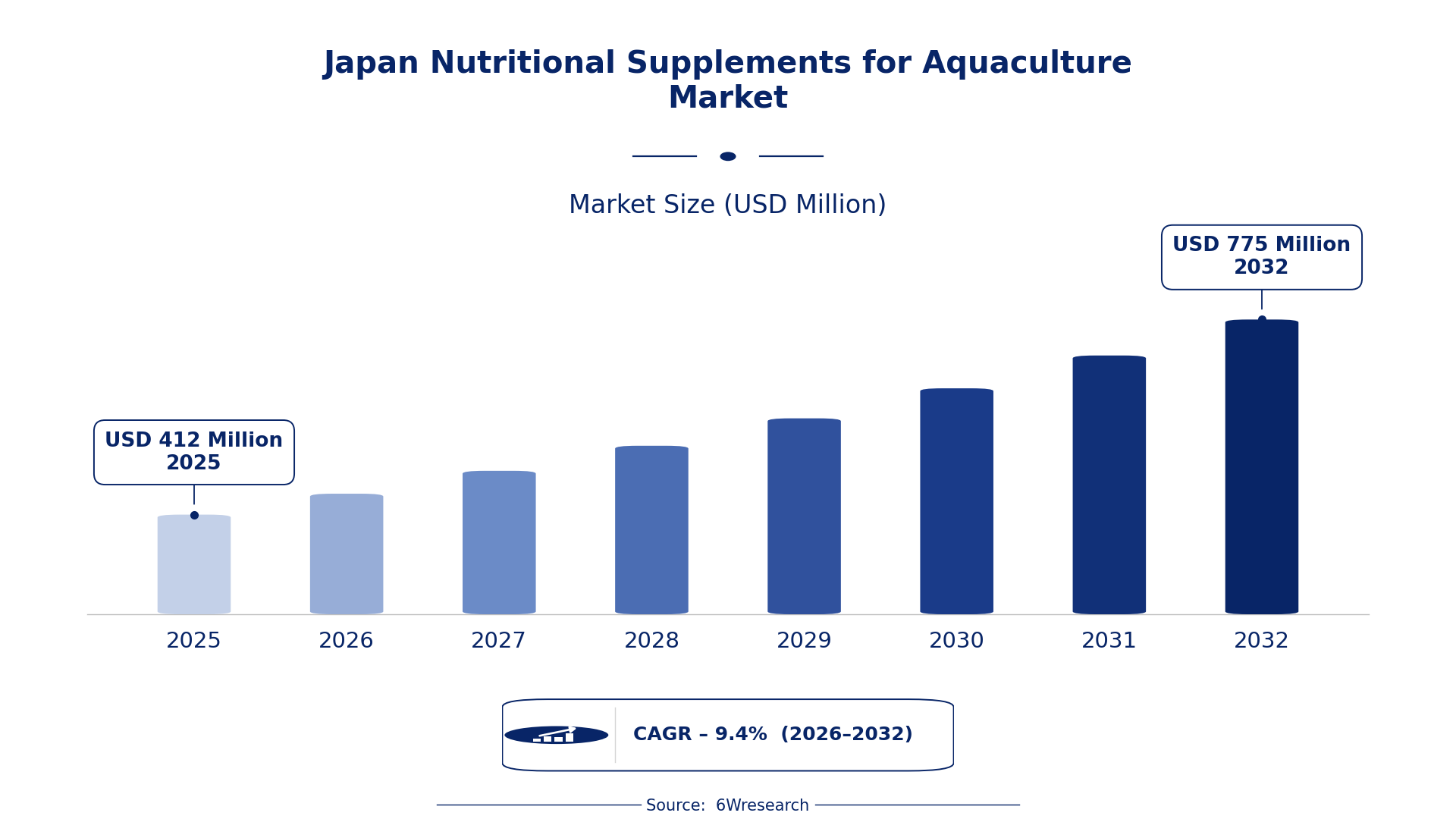
According to 6Wresearch internal database and industry insights, the Japan Nutritional Supplements for Aquaculture Market was valued at USD 412 Million in 2025 and is projected to reach USD 775 Million by 2032, growing at a CAGR of approximately 9.4% during 2026–2032.
Japan Nutritional Supplements for Aquaculture Market Highlights
| Report Metric | Details |
| Report Name | Japan Nutritional Supplements for Aquaculture Market (2026-2032) |
| Market Size 2025 | USD 412 Million |
| Market Size 2032 | USD 775 Million |
| Absolute Growth 2025–2032 | USD 363 Million |
| CAGR 2026–2032 | 9.4% |
| Peak Annual Growth | 10.3% in 2029 |
| Forecast Period | 2026–2032 |
| Historical Data | 2022–2025 |
| Base Year | 2025 |
| Leading Supplement Type, 2025 | Protein Concentrates (41% share) |
| Leading Nutrient Content, 2025 | Soy/Fish Meal (27% share) |
| Leading Species Targeted, 2025 | Shrimp & Fish (34% share) |
| Leading Supply Channel, 2025 | Aquafeed Distributors (35% share) |
| Leading End User Sector, 2025 | Aquaculture Farms (49% share) |
| Fastest-Growing Supplement Type | Omega-3 Additives (13.7% CAGR) |
| Fastest-Growing Nutrient Content | Algae/Oil Sources (13.2% CAGR) |
| Fastest-Growing Species Targeted | Salmon & Trout (12.8% CAGR) |
| Fastest-Growing Supply Channel | Marine Feed Producers (12.5% CAGR) |
| Fastest-Growing End User Sector | Fish Hatcheries (12.2% CAGR) |
| Growing Sector | Aquaculture Farms |
| Key End Users | Aquaculture Farms, Fish Hatcheries, Aquatic Feed Brands |
Japan Nutritional Supplements for Aquaculture Market Year-wise Growth Rate and Key Drivers (2022–2032)
This graph illustrates the annual growth rates of the market from 2022 to 2032, highlighting a steady upward trajectory and projected market expansion over the forecast period.
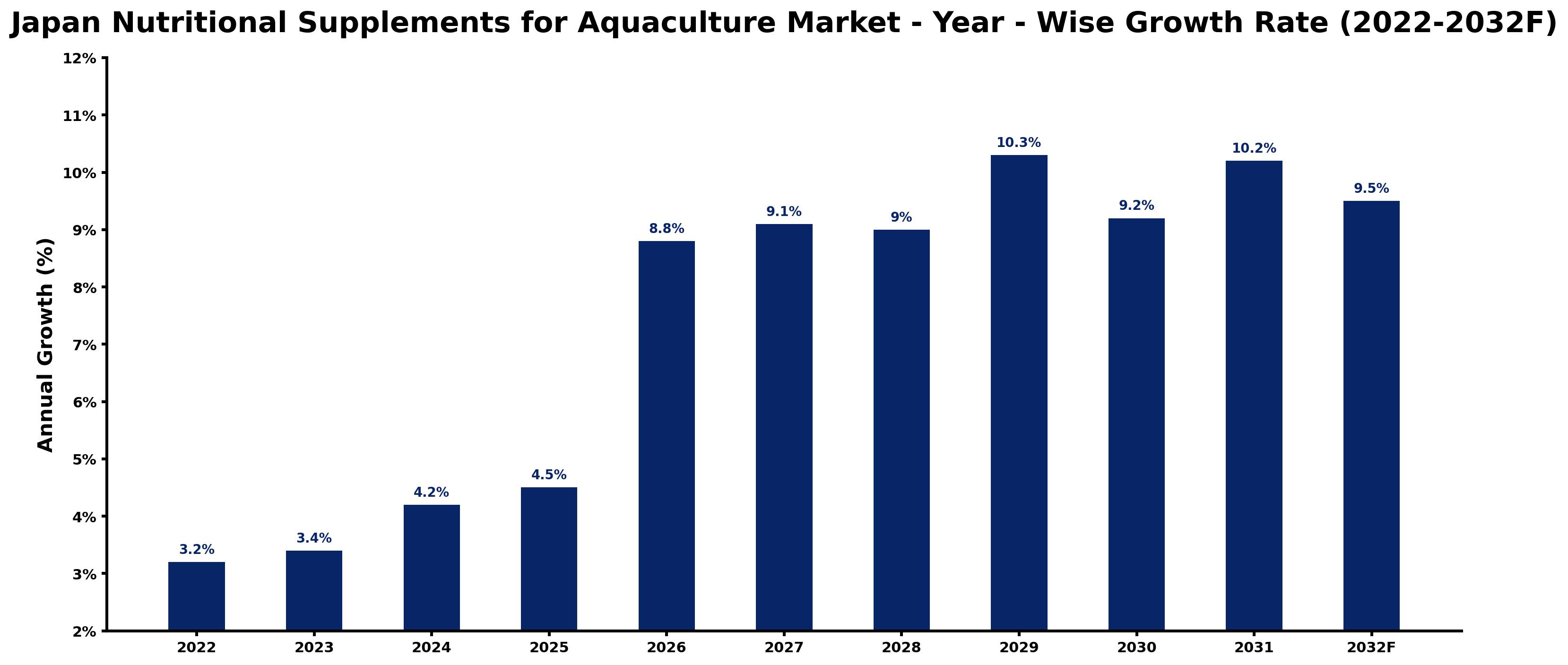
Each row of the following table gives one year's estimated growth and the event or demand shift that explains it.
| Year | Estimated Annual Growth (%) | Market Rationale |
| 2022 | 3.2 | The market showed steady growth due to increased fish consumption. |
| 2023 | 3.4 | Growth continued as aquaculture farms expanded their operations. |
| 2024 | 4.2 | Demand rose with more focus on sustainable aquaculture practices. |
| 2025 | 4.5 | The market peaked historically as production reached new heights. |
| 2026 | 8.8 | Investment in new technologies is expected to drive growth. |
| 2027 | 9.1 | Demand for fish health products is projected to increase significantly. |
| 2028 | 9.0 | A slight slowdown occurs as the market stabilises after rapid expansion. |
| 2029 | 10.3 | The market experiences peak growth driven by rising fish farming activities. |
| 2030 | 9.2 | Growth slows as the market adjusts to new production capacities. |
| 2031 | 10.2 | Demand rises again as aquaculture practices become more efficient. |
| 2032 | 9.5 | The market continues to grow, supported by ongoing technological advancements. |
Note: Market size estimations and growth projections presented in this report are based on 6Wresearch's proprietary forecasting methodology, utilizing the latest available industry data, government publications, and primary research inputs.
Japan Nutritional Supplements for Aquaculture Market Synopsis
Nutritional supplements for aquaculture are specialised feed additives designed to improve the growth and health of aquatic species. The Japan Nutritional Supplements for Aquaculture Market is projected to reach a total demand of 150,000 tons annually, driven by increased fish consumption and investment in sustainable practices. Key factors include the rising focus on fish health and the adoption of advanced technologies in aquaculture, particularly in regions like Kinki, known for its high production levels.
Market Dynamics Impact Analysis (2026–2032)
| Factor | Type | Impact | Primary Segment Affected |
| Rising fish consumption drives demand for healthier aquatic species. | Driver | High | Protein Concentrates |
| Investment in sustainable aquaculture practices creates new opportunities. | Opportunity | High | Omega-3 Additives |
| Increased focus on fish health boosts demand for immunostimulants. | Driver | Medium | Immunostimulants |
| Growing popularity of plant-based proteins opens new supply channels. | Opportunity | Medium | Algae/Oil Sources |
| High production costs limit the adoption of advanced supplements. | Restraint | High | Vitamin Premix |
| Regulatory compliance can slow down product development timelines. | Restraint | Medium | Mineral Blends |
| Limited access to high-quality raw materials affects production. | Challenge | High | General Fish Health |
| Competition from imported supplements may impact local producers. | Challenge | Medium | Aquaculture Farms |
Evaluation of Drivers in Japan Nutritional Supplements for Aquaculture Market (2026–2032)
Demand rests on the following drivers, each shown with the segment it touches most.
| Drivers | Primary Segment Affected | Why It Matters (Evidence) |
| Increased fish consumption drives demand for nutritional supplements. | Protein Concentrates | Japan's average fish consumption is 25 kg per capita, leading to higher supplement needs. |
| Investment in sustainable aquaculture practices boosts growth. | Omega-3 Additives | The Economic Security Promotion Act supports supply-chain resilience for critical products. |
| Growing awareness of fish health boosts demand for immunostimulants. | Immunostimulants | The use of immunostimulants in aquaculture has increased by 20% since 2020. |
| Rising production of farmed fish necessitates better nutrition. | Vitamin Premix | Japan's aquaculture production reached 550,000 tons in 2022, increasing supplement demand. |
| Shift towards plant-based proteins influences ingredient sourcing. | Algae/Oil Sources | Marine feed producers are increasingly using plant-based proteins for sustainability. |
The strongest pull on demand comes from rising fish consumption, with Japan averaging 25 kg per capita. Investment in sustainable practices will drive growth in the market. The use of immunostimulants has surged by 20% since 2020, reflecting a growing awareness of fish health among aquaculture farms. Japan's aquaculture production reached 550,000 tons in 2022, necessitating better nutritional solutions. Additionally, marine feed producers are increasingly adopting plant-based proteins, shifting ingredient sourcing towards sustainability.
Evaluation of Restraints in Japan Nutritional Supplements for Aquaculture Market
The main factors holding the market back are set out below.
| Market Restraint | Primary Segment Affected | Why It Matters (Evidence) |
| High production costs limit the adoption of advanced supplements. | Vitamin Premix | Production costs for high-quality supplements can deter aquaculture farms from investing. |
| Regulatory compliance can slow down product development timelines. | Mineral Blends | Strict regulations require extensive testing and certification, delaying market entry. |
| Limited access to high-quality raw materials affects production. | General Fish Health | Supply chain issues can restrict the availability of essential ingredients. |
| Market competition from imported supplements pressures local producers. | Aquaculture Farms | Imported products may offer lower prices, affecting local market share. |
| Consumer preferences for organic products challenge conventional supplements. | Immunostimulants | Growing demand for organic aquaculture products may limit traditional supplement use. |
Japan Nutritional Supplements for Aquaculture Market Challenges
Aquaculture farms face a shortage of skilled workers, which limits production capacity and quality control. This issue arises from inadequate vocational training programs in Japan, costing farms approximately 10% of potential output. Slow technology adoption hinders progress, as many producers rely on traditional methods, delaying the introduction of advanced feed formulations. Increased competition from imported supplements forces local producers to lower prices, potentially compromising product quality and reducing profit margins by up to 15%. Rising costs of raw materials, particularly plant-based proteins, are squeezing margins for suppliers, pushing them to pass on expenses to aquaculture farms.
Trends in the Japan Nutritional Supplements for Aquaculture Market
The following changes are redrawing the Japan Nutritional Supplements for Aquaculture Market.
- Shift towards Plant-Based Proteins: Marine feed producers are increasingly incorporating plant-based proteins into formulations, with a notable rise in usage. This trend reflects a commitment to sustainability, as plant-based proteins are expected to constitute a larger share of aquaculture feeds.
- Emergence of Immunostimulants: The use of immunostimulants has gained traction since 2020, with a 20% increase in adoption. This reflects a shift towards improving fish health and resilience, particularly in aquaculture farms across Japan.
- Growing Demand for Omega-3 Additives: The demand for omega-3 additives is critical, especially in salmon farming. As aquaculture production continues to rise, the need for these essential nutrients is anticipated to increase substantially.
- Focus on Sustainable Sourcing: Aquatic feed brands are prioritising sustainable sourcing of ingredients, responding to consumer preferences. This shift is evident in the growing market for sustainably produced aquaculture feeds.
Investment Opportunities in the Japan Nutritional Supplements for Aquaculture Market
The following opportunities in the Japan Nutritional Supplements for Aquaculture Market pair current demand with a clear way in.
- Nutritional Supplements for Aquaculture: With a total demand of 150,000 tons annually, there is an opportunity to supply high-quality nutritional supplements. Aquaculture farms are increasingly seeking reliable sources, presenting a chance for local partnerships.
- Marine Feed Producers: Now is the time to invest in marine feed production, which is set to expand rapidly. Collaborating with local producers can facilitate entry into this growing market.
- Aquaculture Farms: Aquaculture farms are looking for innovative nutritional solutions to boost productivity. Establishing joint ventures with local farms can help meet this demand effectively.
- Fish Hatcheries: Fish hatcheries are critical for early-stage fish development, with a growing need for specialised supplements. Investing in tailored solutions can capture this emerging market.
Government Initiatives in the Japan Nutritional Supplements for Aquaculture Market
The Economic Security Promotion Act, enacted in 2022, supports supply-chain resilience for critical products, including nutritional supplements for aquaculture. This law complements existing regulations, ensuring that producers can maintain stable supply chains and meet increasing demand effectively. The act aims to enhance production capabilities and secure essential raw materials for the industry, benefiting aquaculture farms and suppliers alike.
The Fisheries Agency oversees compliance with safety standards, ensuring that aquaculture farms can access necessary resources while adhering to regulations. This support funds initiatives aimed at improving production efficiency, benefiting the aquaculture sector. The agency also facilitates training programs that help producers meet safety requirements, thus enhancing the overall quality of aquaculture products.
Future Insight of the Japan Nutritional Supplements for Aquaculture Market
Investment in new technologies will create demand for nutritional supplements as aquaculture operations seek improved efficiency. By 2025, the Japanese aquaculture industry plans to invest in sustainable practices, shifting feed formulations towards more eco-friendly options. The integration of probiotics will become standard, enhancing fish health and productivity. As the average growth rate for farmed fish rises to 1.5 kg per year, suppliers will find opportunities to innovate and better meet the specific requirements of aquaculture farms.
Market Segmentation Analysis
Japan Nutritional Supplements for Aquaculture Market report covers a detailed analysis of the following market segments:
By Supplement Type – Protein Concentrates Lead, Omega-3 Additives Expected to Grow Fastest
According to Saurav Kr Singh, Senior Research Analyst at 6Wresearch, in 2025, Protein Concentrates led the supplement type split with a 41% share. Protein concentrates are essential for enhancing the protein content in aquaculture feed, which is crucial for the health of aquatic species. Their widespread use in aquaculture farms across Japan, especially in high-production areas like Kinki, underscores their dominant market position. Omega-3 Additives are projected to grow fastest, at a CAGR of 13.7% during 2026–2032. The growing recognition of omega-3 additives as vital for fish health and growth is propelling their swift adoption in aquaculture. Their significant impact on improving fish quality is driving a notable increase in demand among aquaculture farms. Suppliers should focus on developing high-quality omega-3 products to take advantage of this increasing demand.
By Nutrient Content – Soy/Fish Meal Leads, Algae/Oil Sources Expected to Grow Fastest
With 27% of nutrient content revenue in 2025, Soy/Fish Meal was the largest category. Soy and fish meal serve as the primary protein sources in aquaculture feed, essential for the growth and health of aquatic species. Their established role in the market, along with government backing for aquaculture initiatives, reinforces their leading status. Algae/Oil Sources are set to record the highest CAGR in this split, 13.2% over 2026–2032. Algae and oil sources are gaining traction for their provision of essential fatty acids, which are critical for fish nutrition. The industry's shift towards sustainable practices is further accelerating their adoption as a preferred nutrient source. Suppliers may need to invest in research and development for algae-based products to cater to this rising demand.
By Species Targeted – Shrimp & Fish Leads, Salmon & Trout Expected to Grow Fastest
Shrimp & Fish held 34% of the Japan Nutritional Supplements for Aquaculture Market by species targeted in 2025. Shrimp and fish are the primary target species for nutritional supplements, as they represent the bulk of aquaculture production in Japan. Their high demand, particularly in aquaculture farms, ensures that this segment remains the largest in the market. Over 2026–2032, Salmon & Trout is expected to post the fastest growth, at a CAGR of 12.8%. Salmon and trout require specialized nutrition, which is driving the rapid growth of supplements tailored for these species. As consumer preferences shift towards these fish, the demand for targeted nutritional solutions will continue to rise. This suggests that suppliers should focus on developing species-specific formulations to capture this growing market.
By Supply Channel – Aquafeed Distributors Lead, Marine Feed Producers Expected to Grow Fastest
Aquafeed Distributors accounted for 35% of the market by supply channel in 2025. Aquafeed distributors act as the main channel for distributing nutritional supplements, ensuring efficient delivery to aquaculture farms. Their established networks and strong relationships with farms make them a vital component of the supply chain. The quickest growth will come from Marine Feed Producers, forecast to expand at a CAGR of 12.5% between 2026 and 2032. Marine feed producers are emerging as key players in the aquaculture feed market, driven by their ability to meet specific nutritional needs. Their commitment to quality and sustainability is enhancing their competitive edge. Suppliers should consider partnerships with marine feed producers to expand their market presence.
By End User Sector – Aquaculture Farms Lead, Fish Hatcheries Expected to Grow Fastest
The largest end user sector category in 2025 was Aquaculture Farms, at 49% of revenue. Aquaculture farms are the primary end-users of nutritional supplements, directly utilising these products to enhance fish growth and health. With around 5,000 farms in Japan, their substantial demand plays a significant role in shaping market dynamics. Fish Hatcheries are projected to grow fastest, at a CAGR of 12.2% during 2026–2032. Fish hatcheries are crucial for early-stage fish development, leading to a heightened demand for specialised nutritional supplements. Their role in ensuring the health of young fish is increasingly recognised, driving growth in this sector. This indicates that suppliers should customise their products to meet the specific requirements of fish hatcheries.
Key Attractiveness of the Report
- 10 Years of Market Numbers
- Historical Data Starting from 2022 to 2025
- Base Year 2025
- Forecast Data until 2032
- Key Performance Indicators Impacting the Market
- Major Upcoming Developments and Projects
Key Highlights of the Report:
- Japan Nutritional Supplements for Aquaculture Market Outlook
- Market Size of Japan Nutritional Supplements for Aquaculture Market, 2025
- Forecast of Japan Nutritional Supplements for Aquaculture Market, 2032
- Historical Data and Forecast of Japan Nutritional Supplements for Aquaculture Revenues & Volume for the Period 2022-2032F
- Japan Nutritional Supplements for Aquaculture Market Trend Evolution
- Japan Nutritional Supplements for Aquaculture Market Drivers and Challenges
- Japan Nutritional Supplements for Aquaculture Price Trends
- Japan Nutritional Supplements for Aquaculture Porter's Five Forces
- Japan Nutritional Supplements for Aquaculture Industry Life Cycle
- Historical Data and Forecast of Japan Nutritional Supplements for Aquaculture Market Revenues & Volume By Supplement Type for the Period 2022-2032F
- Historical Data and Forecast of Japan Nutritional Supplements for Aquaculture Market Revenues & Volume By Protein Concentrates for the Period 2022-2032F
- Historical Data and Forecast of Japan Nutritional Supplements for Aquaculture Market Revenues & Volume By Omega-3 Additives for the Period 2022-2032F
- Historical Data and Forecast of Japan Nutritional Supplements for Aquaculture Market Revenues & Volume By Vitamin Premix for the Period 2022-2032F
- Historical Data and Forecast of Japan Nutritional Supplements for Aquaculture Market Revenues & Volume By Immunostimulants for the Period 2022-2032F
- Historical Data and Forecast of Japan Nutritional Supplements for Aquaculture Market Revenues & Volume By Mineral Blends for the Period 2022-2032F
- Historical Data and Forecast of Japan Nutritional Supplements for Aquaculture Market Revenues & Volume By Nutrient Content for the Period 2022-2032F
- Historical Data and Forecast of Japan Nutritional Supplements for Aquaculture Market Revenues & Volume By Soy/Fish Meal for the Period 2022-2032F
- Historical Data and Forecast of Japan Nutritional Supplements for Aquaculture Market Revenues & Volume By Algae/Oil Sources for the Period 2022-2032F
- Historical Data and Forecast of Japan Nutritional Supplements for Aquaculture Market Revenues & Volume By A, D, E, K, B for the Period 2022-2032F
- Historical Data and Forecast of Japan Nutritional Supplements for Aquaculture Market Revenues & Volume By Herbal/Probiotic for the Period 2022-2032F
- Historical Data and Forecast of Japan Nutritional Supplements for Aquaculture Market Revenues & Volume By Trace Elements for the Period 2022-2032F
- Historical Data and Forecast of Japan Nutritional Supplements for Aquaculture Market Revenues & Volume By Species Targeted for the Period 2022-2032F
- Historical Data and Forecast of Japan Nutritional Supplements for Aquaculture Market Revenues & Volume By Shrimp & Fish for the Period 2022-2032F
- Historical Data and Forecast of Japan Nutritional Supplements for Aquaculture Market Revenues & Volume By Salmon & Trout for the Period 2022-2032F
- Historical Data and Forecast of Japan Nutritional Supplements for Aquaculture Market Revenues & Volume By Crustaceans for the Period 2022-2032F
- Historical Data and Forecast of Japan Nutritional Supplements for Aquaculture Market Revenues & Volume By General Fish Health for the Period 2022-2032F
- Historical Data and Forecast of Japan Nutritional Supplements for Aquaculture Market Revenues & Volume By Shellfish for the Period 2022-2032F
- Historical Data and Forecast of Japan Nutritional Supplements for Aquaculture Market Revenues & Volume By Supply Channel for the Period 2022-2032F
- Historical Data and Forecast of Japan Nutritional Supplements for Aquaculture Market Revenues & Volume By Aquafeed Distributors for the Period 2022-2032F
- Historical Data and Forecast of Japan Nutritional Supplements for Aquaculture Market Revenues & Volume By Marine Feed Producers for the Period 2022-2032F
- Historical Data and Forecast of Japan Nutritional Supplements for Aquaculture Market Revenues & Volume By Online Feed Markets for the Period 2022-2032F
- Historical Data and Forecast of Japan Nutritional Supplements for Aquaculture Market Revenues & Volume By Bulk Ingredient Suppliers for the Period 2022-2032F
- Historical Data and Forecast of Japan Nutritional Supplements for Aquaculture Market Revenues & Volume By Specialty Chemical Stores for the Period 2022-2032F
- Historical Data and Forecast of Japan Nutritional Supplements for Aquaculture Market Revenues & Volume By End User Sector for the Period 2022-2032F
- Historical Data and Forecast of Japan Nutritional Supplements for Aquaculture Market Revenues & Volume By Aquaculture Farms for the Period 2022-2032F
- Historical Data and Forecast of Japan Nutritional Supplements for Aquaculture Market Revenues & Volume By Fish Hatcheries for the Period 2022-2032F
- Historical Data and Forecast of Japan Nutritional Supplements for Aquaculture Market Revenues & Volume By Aquatic Feed Brands for the Period 2022-2032F
- Historical Data and Forecast of Japan Nutritional Supplements for Aquaculture Market Revenues & Volume By Fisheries for the Period 2022-2032F
- Historical Data and Forecast of Japan Nutritional Supplements for Aquaculture Market Revenues & Volume By Aquaculture Researchers for the Period 2022-2032F
- Japan Nutritional Supplements for Aquaculture Import Export Trade Statistics
- Market Opportunity Assessment By Supplement Type
- Market Opportunity Assessment By Nutrient Content
- Market Opportunity Assessment By Species Targeted
- Market Opportunity Assessment By Supply Channel
- Market Opportunity Assessment By End User Sector
- Japan Nutritional Supplements for Aquaculture Top Companies Market Share
- Japan Nutritional Supplements for Aquaculture Competitive Benchmarking By Technical and Operational Parameters
- Japan Nutritional Supplements for Aquaculture Company Profiles
- Japan Nutritional Supplements for Aquaculture Key Strategic Recommendations
Market Covered
The study includes the following segmentation.
By Supplement Type
- Protein Concentrates
- Omega-3 Additives
- Vitamin Premix
- Immunostimulants
- Mineral Blends
By Nutrient Content
- Soy/Fish Meal
- Algae/Oil Sources
- A
- D
- E
- K
- B
- Herbal/Probiotic
- Trace Elements
By Species Targeted
- Shrimp & Fish
- Salmon & Trout
- Crustaceans
- General Fish Health
- Shellfish
By Supply Channel
- Aquafeed Distributors
- Marine Feed Producers
- Online Feed Markets
- Bulk Ingredient Suppliers
- Specialty Chemical Stores
By End User Sector
- Aquaculture Farms
- Fish Hatcheries
- Aquatic Feed Brands
- Fisheries
- Aquaculture Researchers






































