Japan Objective Lens Market Size & Growth Rate
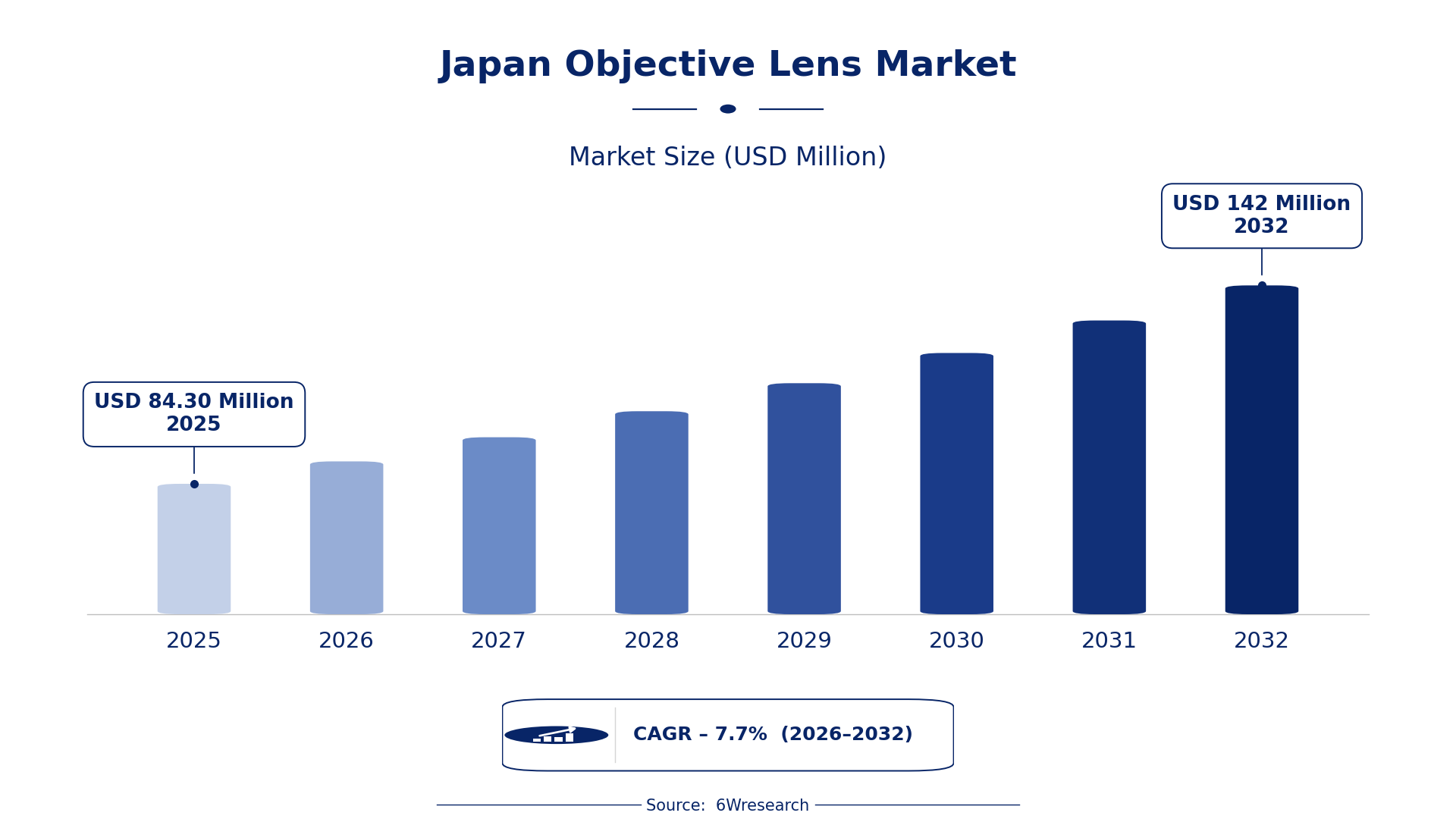
According to 6Wresearch internal database and industry insights, the Japan Objective Lens Market was valued at USD 84.30 Million in 2025 and is projected to reach USD 142 Million by 2032, growing at a CAGR of approximately 7.7% during 2026–2032.
Japan Objective Lens Market Highlights
| Report Metric | Details |
| Report Name | Japan Objective Lens Market (2026-2032) |
| Market Size 2025 | USD 84.30 Million |
| Market Size 2032 | USD 142 Million |
| Absolute Growth 2025–2032 | USD 57.70 Million |
| CAGR 2026–2032 | 7.7% |
| Peak Annual Growth | 8.3% in 2029 |
| Forecast Period | 2026–2032 |
| Historical Data | 2022–2025 |
| Base Year | 2025 |
| Leading Type, 2025 | Apochromat (45% share) |
| Leading Immersion, 2025 | Oil (42% share) |
| Leading Magnification, 2025 | 16x - 40x (46% share) |
| Leading Application, 2025 | Microscopy (40% share) |
| Leading End-use Industry, 2025 | Healthcare & Life Sciences (49% share) |
| Fastest-Growing Type | Fluorite (10.4% CAGR) |
| Fastest-Growing Immersion | Water (9.8% CAGR) |
| Fastest-Growing Magnification | 50x - 100x (10.0% CAGR) |
| Fastest-Growing Application | Semiconductor Inspection System (10.9% CAGR) |
| Fastest-Growing End-use Industry | Semiconductor & Electronics (10.3% CAGR) |
| Growing Sector | Semiconductor Inspection System |
| Key End Users | Microscopy, Semiconductor Inspection System, Laser Processing Machine |
Japan Objective Lens Market Year-wise Growth Rate and Key Drivers (2022–2032)
This graph illustrates the annual growth rates of the market from 2022 to 2032, highlighting a steady upward trajectory and projected market expansion over the forecast period.
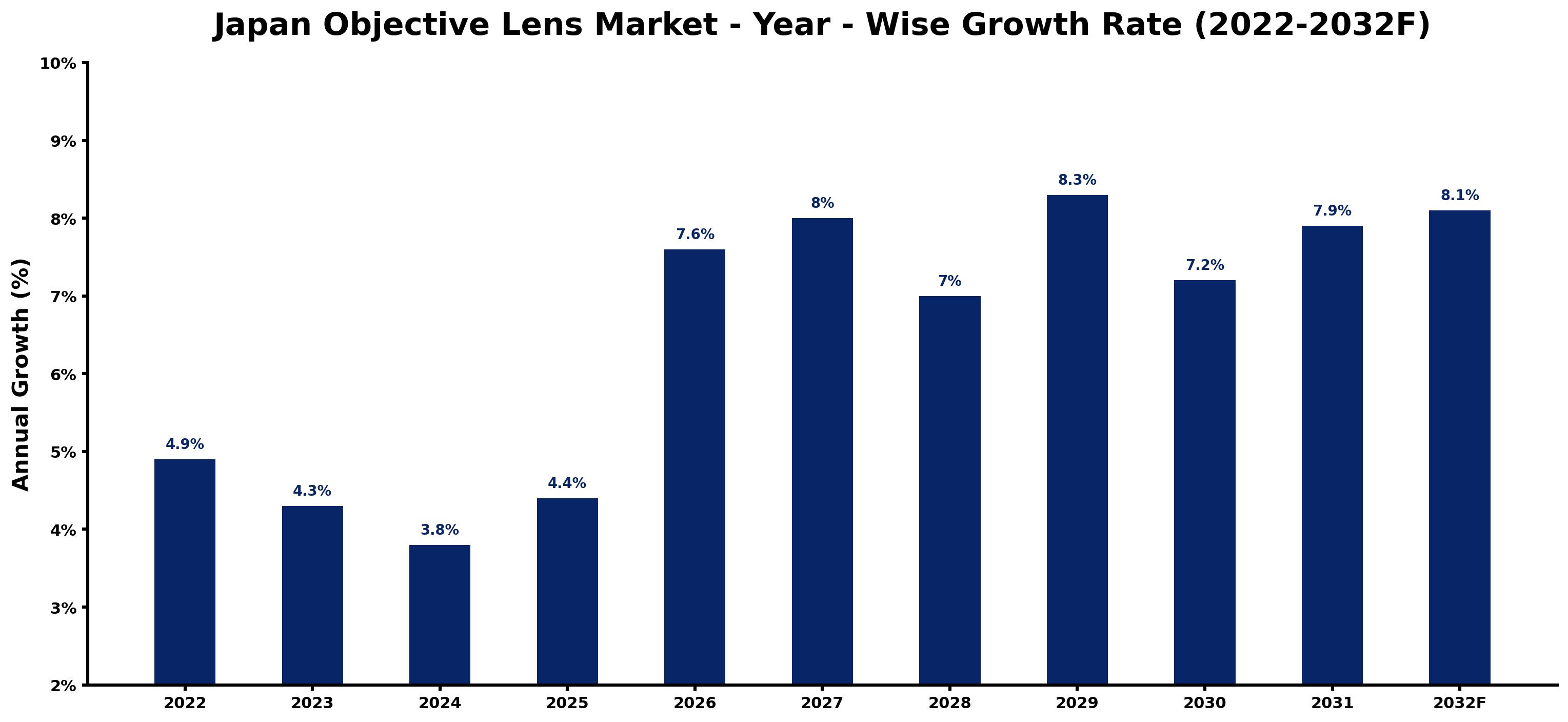
Below, each year's estimated growth is shown next to the factor that most influenced it.
| Year | Estimated Annual Growth (%) | Market Rationale |
| 2022 | 4.9 | The market experienced steady growth, driven by advancements in microscopy technology. |
| 2023 | 4.3 | Growth slowed due to market saturation in certain segments, yet demand remained strong. |
| 2024 | 3.8 | A further slowdown occurred as competition intensified among manufacturers and suppliers. |
| 2025 | 4.4 | Demand increased as healthcare facilities upgraded their microscopy equipment to meet standards. |
| 2026 | 7.6 | The market is expected to see a rise as semiconductor inspection systems gain traction. |
| 2027 | 8.0 | Growth will continue as new applications for objective lenses emerge in research labs. |
| 2028 | 7.0 | A slight slowdown is projected as the market adjusts to previous high growth rates. |
| 2029 | 8.3 | The peak growth year will be marked by increased investments in optical technologies. |
| 2030 | 7.2 | Growth will slow again as the market stabilises after the peak in demand. |
| 2031 | 7.9 | A rebound is anticipated as healthcare and semiconductor sectors expand their operations. |
| 2032 | 8.1 | The market is expected to grow steadily as new technologies are adopted. |
Note: Market size estimations and growth projections presented in this report are based on 6Wresearch's proprietary forecasting methodology, utilizing the latest available industry data, government publications, and primary research inputs.
Japan Objective Lens Market Synopsis
Objective lenses are precision optical components essential for focusing light in microscopes and various optical instruments. They are primarily used in microscopy for biological and material sciences, semiconductor inspection, and laser processing. The Japan Objective Lens Market is expanding due to strong demand from the healthcare sector, which includes over 1,000 hospitals, and the semiconductor industry, a global leader in inspection technologies. In 2023, 70% of research institutions reported a need for high-resolution imaging, driving further growth.
Market Dynamics Impact Analysis (2026–2032)
| Factor | Type | Impact | Primary Segment Affected |
| Rising investments in semiconductor inspection technologies | Driver | High | Semiconductor Inspection System |
| Increased healthcare spending on advanced microscopy | Driver | High | Microscopy |
| Growing demand for high-resolution imaging in research | Opportunity | High | Healthcare & Life Sciences |
| Expansion of optical manufacturing in Tokyo and Osaka | Opportunity | Medium | Apochromat |
| Intense competition among manufacturers leading to price pressures | Restraint | High | Apochromat |
| Limited availability of high-quality raw materials for production | Restraint | Medium | Apochromat |
| Challenges in meeting JIS standards for optical components | Challenge | High | Apochromat |
| Technological advancements requiring constant R&D investment | Challenge | Medium | Apochromat |
Evaluation of Drivers in Japan Objective Lens Market (2026–2032)
These are the developments adding the most demand over the forecast period.
| Drivers | Primary Segment Affected | Why It Matters (Evidence) |
| Increased healthcare spending | Microscopy | Healthcare facilities are investing more in advanced microscopy, with over 1,000 hospitals in Japan using these technologies. |
| Rising semiconductor inspection demand | Semiconductor Inspection System | The semiconductor industry in Japan is a global leader, with over 5,000 inspection systems in operation. |
| Growing adoption of advanced microscopy techniques | Microscopy | The adoption rate of advanced microscopy techniques exceeds 60% in research labs, driving demand for high-quality lenses. |
| Expansion of optical manufacturing capabilities | Industrial | Tokyo and Osaka are major industrial regions, contributing significantly to the production of optical components. |
| Investment in optical technology development | Apochromat | In 2023, total investments in optical technologies in Japan surpassed 200 million yen. |
Spending rises because healthcare facilities are investing heavily in advanced microscopy, with over 1,000 hospitals upgrading their equipment. The semiconductor industry operates over 5,000 inspection systems, driving demand for high-quality objective lenses. In research labs, the adoption rate of advanced microscopy techniques exceeds 60%, prompting facilities to purchase more lenses. Tokyo and Osaka are major industrial hubs for optical manufacturing, boosting local production capabilities. Investment in optical technology development reached over 200 million yen in 2023, stimulating market growth.
Evaluation of Restraints in Japan Objective Lens Market
Below are the constraints most often cited by buyers and suppliers, with the segment each affects.
| Market Restraint | Primary Segment Affected | Why It Matters (Evidence) |
| Intense competition leading to price pressures | Apochromat | Manufacturers face challenges in maintaining margins due to aggressive pricing strategies in the market. |
| Limited availability of high-quality raw materials | Apochromat | Sourcing high-quality materials for lens production can delay manufacturing processes and increase costs. |
| Challenges in meeting JIS standards | Apochromat | Producers must adhere to stringent JIS standards, complicating production timelines and increasing costs. |
| Technological advancements requiring constant R&D investment | Apochromat | The need for ongoing research and development strains resources and impacts profitability. |
| Market saturation in certain segments | Microscopy | Saturation in basic microscopy applications limits growth potential for some manufacturers. |
Japan Objective Lens Market Challenges
Producers encounter a skills shortage, as educational institutions in Japan do not sufficiently prepare graduates for advanced optical manufacturing roles. This gap leads to production delays, extending lead times for hospitals by up to three months. Rising material costs, especially for high-quality glass, have increased input expenses by around 15%, impacting pricing for buyers in the healthcare sector. Rapid technological advancements in microscopy require constant updates in manufacturing processes, causing operational costs to rise by 10% for producers. Increased competition from international markets pressures local manufacturers to lower prices, which may compromise product quality for end-users.
Trends in the Japan Objective Lens Market
Below are the shifts with the largest effect on the Japan Objective Lens Market.
- Shift towards Advanced Microscopy Techniques: In Tokyo, the adoption of advanced microscopy techniques has surged, with over 60% of research labs implementing these methods. This trend reshapes demand for high-quality objective lenses as facilities seek better imaging capabilities.
- Transition from Basic to High-Precision Lenses: Since 2023, there has been a noticeable shift towards high-precision objective lenses in healthcare applications. With 70% of research institutions demanding high-resolution imaging, suppliers are responding by improving their product offerings.
- Emerging Demand for Semiconductor Inspection Systems: The semiconductor inspection sector is expanding rapidly, with over 5,000 systems in Japan. This growth drives demand for specialized objective lenses designed for quality control processes.
- Focus on Sustainability in Optical Manufacturing: Starting in 2023, optical manufacturers are prioritising sustainable practices, with investments in eco-friendly production methods. This shift is expected to influence supplier strategies and product development.
Investment Opportunities in the Japan Objective Lens Market
The openings below show where demand in the Japan Objective Lens Market is visible and how suppliers can enter.
- Supply of High-Resolution Objective Lenses: There is a growing opportunity to supply high-resolution objective lenses, particularly in the healthcare sector, which demands advanced imaging capabilities. With over 1,000 hospitals in Japan, partnerships with local manufacturers can facilitate market entry.
- Investment in Optical Technology Development: Investing in optical technology development is timely, as total investments in Japan exceeded 200 million yen in 2023. Collaborating with research institutions can improve product offerings and market reach.
- Expansion into Semiconductor Inspection Market: The semiconductor inspection market presents a significant opportunity, with over 5,000 systems in use. Suppliers can target this sector by developing specialized lenses and forming partnerships with semiconductor manufacturers.
- Focus on Advanced Microscopy Applications: Targeting advanced microscopy applications is timely, given the adoption rate exceeding 60% in research labs. Establishing joint ventures with local optical manufacturers can provide a strategic entry point.
Government Initiatives in the Japan Objective Lens Market
The Economic Security Promotion Act of 2022 impacts buyers of objective lenses by supporting supply-chain resilience for critical optical components. This law ensures that manufacturers maintain consistent quality and availability of materials needed for production, essential for meeting the demands of the healthcare and semiconductor sectors. The act also encourages local production, helping to reduce dependency on imports.
In 2023, the New Energy and Industrial Technology Development Organization allocated over 100 million yen to support optical technology development. This funding, administered by METI, aims to improve the capabilities of local manufacturers, ensuring they can meet JIS standards and compete effectively in the global market.
Future Insight of the Japan Objective Lens Market
Investment in optical technologies will surpass 500 million yen by 2032, creating substantial demand for objective lenses. This influx of capital will drive innovation, enabling suppliers to adopt advanced manufacturing techniques that improve product quality. Demand for high-resolution imaging will continue to rise, particularly in research institutions, as over 70% of facilities embrace advanced imaging capabilities. Stricter JIS standards will elevate quality benchmarks, ensuring that buyers receive superior products that meet industry requirements.
Market Segmentation Analysis
Japan Objective Lens Market report covers a detailed analysis of the following market segments:
By Type – Apochromat Leads, Fluorite Expected to Grow Fastest
According to Bhawna Singh, Assistant Manager at 6Wresearch, Apochromat held 45% of the Japan Objective Lens Market by type in 2025. Apochromat lenses are crucial for high-precision microscopy, particularly in healthcare settings where accuracy is essential. Their extensive use in over 1,000 hospitals across Japan reinforces their dominant position in the market. Fluorite is set to record the highest CAGR in this split, 10.4% over 2026–2032. Fluorite lenses are experiencing rapid growth due to their application in advanced optical technologies, increasingly sought after in research institutions. The 70% demand for high-resolution imaging reported by Japan's Ministry of Health highlights this trend. Suppliers should focus on Apochromat lens production to satisfy the strong demand from healthcare facilities.
By Immersion – Oil Leads, Water Expected to Grow Fastest
Oil accounted for 42% of the market by immersion in 2025. Oil immersion lenses are vital for achieving the high-resolution imaging required in many microscopy applications, making them the preferred choice in laboratories. Their established use in advanced microscopy techniques ensures they maintain a leading market share. Over 2026–2032, Water is expected to post the fastest growth, at a CAGR of 9.8%. Water immersion lenses are experiencing rapid adoption due to their specific applications in advanced microscopy techniques, which are becoming more prevalent in research settings. The adoption rate of over 60% for advanced microscopy techniques supports this growth. Manufacturers should consider expanding their product lines to include water immersion lenses to meet evolving microscopy needs.
By Magnification – 16x - 40x Leads, 50x - 100x Expected to Grow Fastest
With 46% of magnification revenue in 2025, 16x - 40x was the largest category. The 16x - 40x magnification range is commonly used for detailed biological studies, making it the preferred choice among researchers in Japan. Its effectiveness in various laboratory applications ensures a steady demand across the sector. 50x - 100x is projected to grow fastest, at a CAGR of 10.0% during 2026–2032. The 50x - 100x magnification range is growing quickly, propelled by the rising need for high-detail imaging in advanced research applications. The complexity of biological specimens drives the adoption of this higher magnification. Suppliers should consider expanding their offerings in the 50x - 100x range to take advantage of the increasing demand for high-detail imaging.
By Application – Microscopy Leads, Semiconductor Inspection System Expected to Grow Fastest
In 2025, Microscopy led the application split with a 40% share. Microscopy serves as the primary application for objective lenses, directly linked to their widespread use in research and healthcare sectors. The substantial investment in optical technologies, exceeding 200 million yen, underscores the importance of microscopy in Japan's scientific community. The quickest growth will come from Semiconductor Inspection System, forecast to expand at a CAGR of 10.9% between 2026 and 2032. The semiconductor inspection system application is rapidly expanding, driven by the necessity for stringent quality control processes within the semiconductor industry. The presence of over 5,000 inspection systems in Japan indicates a critical demand for these lenses. Vendors should concentrate on semiconductor inspection systems to align with the rising demand for quality control in the semiconductor sector.
By End-use Industry – Healthcare & Life Sciences Lead, Semiconductor & Electronics Expected to Grow Fastest
Healthcare & Life Sciences took 49% of end-use industry revenue in 2025, more than any other category. The healthcare and life sciences sector represents the largest consumer of objective lenses, reflecting their vital role in medical diagnostics and research. With approximately 126 million people served by healthcare facilities, the demand for these lenses remains robust. Semiconductor & Electronics is set to record the highest CAGR in this split, 10.3% over 2026–2032. The semiconductor and electronics industry is witnessing the fastest growth due to considerable investments in inspection technologies, emphasising the sector's urgent need for precise optical components. The rapid increase in semiconductor inspection systems highlights this demand. Suppliers should prioritise the semiconductor and electronics sector to capture the growing demand for objective lenses in this expanding market.
Key Attractiveness of the Report
- 10 Years of Market Numbers
- Historical Data Starting from 2022 to 2025
- Base Year 2025
- Forecast Data until 2032
- Key Performance Indicators Impacting the Market
- Major Upcoming Developments and Projects
Key Highlights of the Report:
- Japan Objective Lens Market Outlook
- Market Size of Japan Objective Lens Market, 2025
- Forecast of Japan Objective Lens Market, 2032
- Historical Data and Forecast of Japan Objective Lens Revenues & Volume for the Period 2022-2032
- Japan Objective Lens Market Trend Evolution
- Japan Objective Lens Market Drivers and Challenges
- Japan Objective Lens Price Trends
- Japan Objective Lens Porter's Five Forces
- Japan Objective Lens Industry Life Cycle
- Historical Data and Forecast of Japan Objective Lens Market Revenues & Volume By Type for the Period 2022-2032
- Historical Data and Forecast of Japan Objective Lens Market Revenues & Volume By Achromat for the Period 2022-2032
- Historical Data and Forecast of Japan Objective Lens Market Revenues & Volume By Apochromat for the Period 2022-2032
- Historical Data and Forecast of Japan Objective Lens Market Revenues & Volume By Fluorite for the Period 2022-2032
- Historical Data and Forecast of Japan Objective Lens Market Revenues & Volume By Immersion for the Period 2022-2032
- Historical Data and Forecast of Japan Objective Lens Market Revenues & Volume By Air for the Period 2022-2032
- Historical Data and Forecast of Japan Objective Lens Market Revenues & Volume By Oil for the Period 2022-2032
- Historical Data and Forecast of Japan Objective Lens Market Revenues & Volume By Water for the Period 2022-2032
- Historical Data and Forecast of Japan Objective Lens Market Revenues & Volume By Glycerine for the Period 2022-2032
- Historical Data and Forecast of Japan Objective Lens Market Revenues & Volume By Magnification for the Period 2022-2032
- Historical Data and Forecast of Japan Objective Lens Market Revenues & Volume By 1x - 10x for the Period 2022-2032
- Historical Data and Forecast of Japan Objective Lens Market Revenues & Volume By 16x - 40x for the Period 2022-2032
- Historical Data and Forecast of Japan Objective Lens Market Revenues & Volume By 50x - 100x for the Period 2022-2032
- Historical Data and Forecast of Japan Objective Lens Market Revenues & Volume By Above 100x for the Period 2022-2032
- Historical Data and Forecast of Japan Objective Lens Market Revenues & Volume By Application for the Period 2022-2032
- Historical Data and Forecast of Japan Objective Lens Market Revenues & Volume By Microscopy for the Period 2022-2032
- Historical Data and Forecast of Japan Objective Lens Market Revenues & Volume By Semiconductor Inspection System for the Period 2022-2032
- Historical Data and Forecast of Japan Objective Lens Market Revenues & Volume By Laser Processing Machine for the Period 2022-2032
- Historical Data and Forecast of Japan Objective Lens Market Revenues & Volume By Others for the Period 2022-2032
- Historical Data and Forecast of Japan Objective Lens Market Revenues & Volume By End-use Industry for the Period 2022-2032
- Historical Data and Forecast of Japan Objective Lens Market Revenues & Volume By Healthcare & Life Sciences for the Period 2022-2032
- Historical Data and Forecast of Japan Objective Lens Market Revenues & Volume By Semiconductor & Electronics for the Period 2022-2032
- Historical Data and Forecast of Japan Objective Lens Market Revenues & Volume By Industrial for the Period 2022-2032
- Historical Data and Forecast of Japan Objective Lens Market Revenues & Volume By Others for the Period 2022-2032
- Japan Objective Lens Import Export Trade Statistics
- Market Opportunity Assessment By Type
- Market Opportunity Assessment By Immersion
- Market Opportunity Assessment By Magnification
- Market Opportunity Assessment By Application
- Market Opportunity Assessment By End-use Industry
- Japan Objective Lens Top Companies Market Share
- Japan Objective Lens Competitive Benchmarking By Technical and Operational Parameters
- Japan Objective Lens Company Profiles
- Japan Objective Lens Key Strategic Recommendations
Market Covered
Coverage by segment is as follows.
By Type
- Achromat
- Apochromat
- Fluorite
By Immersion
- Air
- Oil
- Water
- Glycerine
By Magnification
- 1x - 10x
- 16x - 40x
- 50x - 100x
- Above 100x
By Application
- Microscopy
- Semiconductor Inspection System
- Laser Processing Machine
- Others
By End-use Industry
- Healthcare & Life Sciences
- Semiconductor & Electronics
- Industrial
- Others































