Japan Oil-Based Adjuvants Market Size & Growth Rate
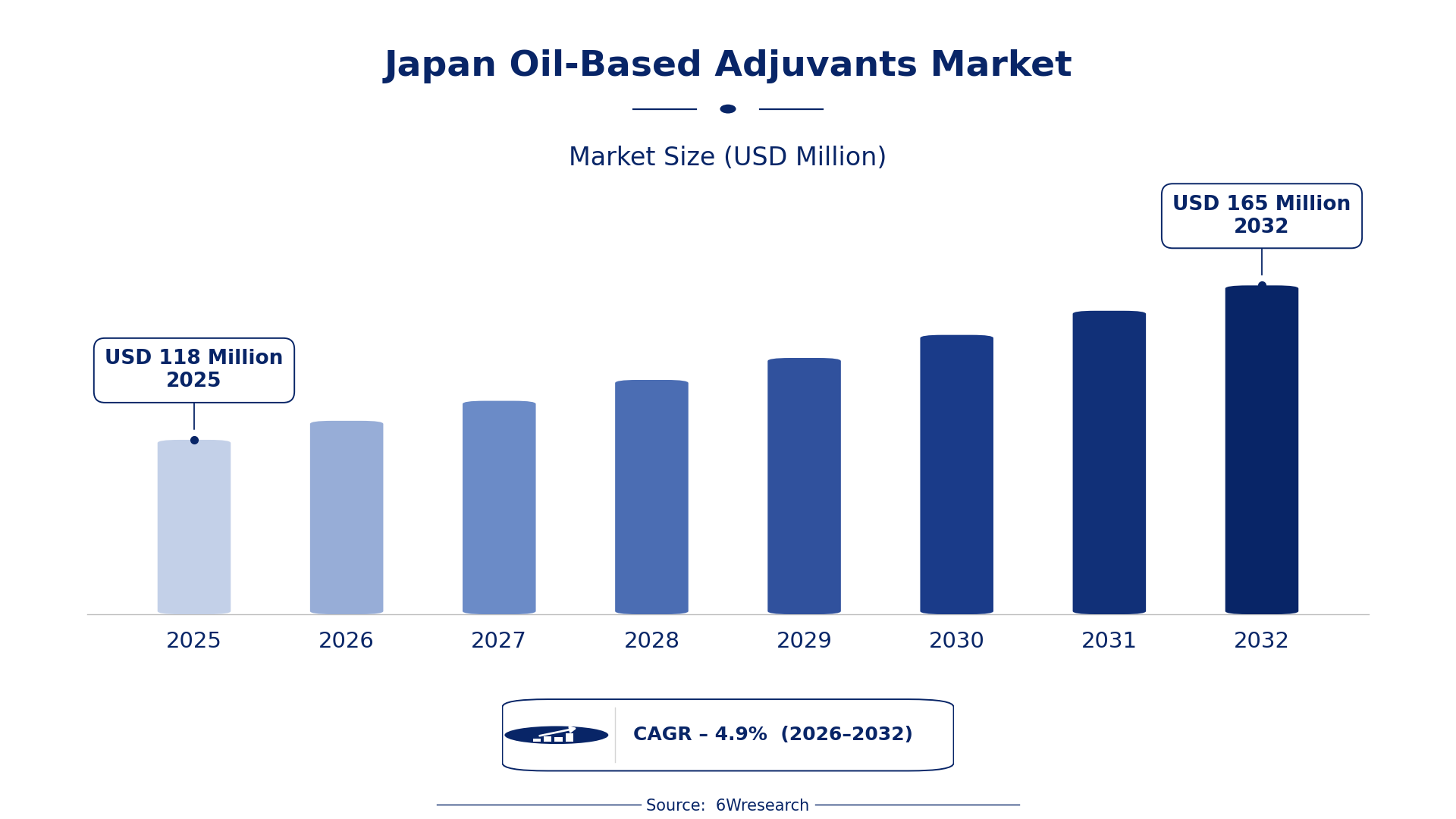
According to 6Wresearch internal database and industry insights, the Japan Oil-Based Adjuvants Market was valued at USD 118 Million in 2025 and is projected to reach USD 165 Million by 2032, growing at a CAGR of approximately 4.9% during 2026–2032.
Japan Oil-Based Adjuvants Market Highlights
| Report Metric | Details |
| Report Name | Japan Oil-Based Adjuvants Market (2026-2032) |
| Market Size 2025 | USD 118 Million |
| Market Size 2032 | USD 165 Million |
| Absolute Growth 2025–2032 | USD 47 Million |
| CAGR 2026–2032 | 4.9% |
| Peak Annual Growth | 5.3% in 2032 |
| Forecast Period | 2026–2032 |
| Historical Data | 2022–2025 |
| Base Year | 2025 |
| Leading Segment Type, 2025 | Vegetable Oil Adjuvants (44% share) |
| Leading Oil Base Type, 2025 | Soybean/Corn Oil (48% share) |
| Leading Application Area, 2025 | Agricultural Spraying (39% share) |
| Leading Distribution Channel, 2025 | Agrochemical Distributors (36% share) |
| Leading End User Sector, 2025 | Crop Protection Companies (35% share) |
| Fastest-Growing Segment Type | Petroleum Oil Adjuvants (7.0% CAGR) |
| Fastest-Growing Oil Base Type | Paraffinic Oil (7.1% CAGR) |
| Fastest-Growing Application Area | Herbicide Carriers (6.1% CAGR) |
| Fastest-Growing Distribution Channel | Farm Supply Stores (6.5% CAGR) |
| Fastest-Growing End User Sector | Large-Scale Farmers (6.4% CAGR) |
| Growing Sector | Agricultural sector |
| Key End Users | Crop protection companies, large-scale farmers, commercial agri operators, agrochemical firms |
Japan Oil-Based Adjuvants Market Year-wise Growth Rate and Key Drivers (2022–2032)
This graph illustrates the annual growth rates of the market from 2022 to 2032, highlighting a steady upward trajectory and projected market expansion over the forecast period.
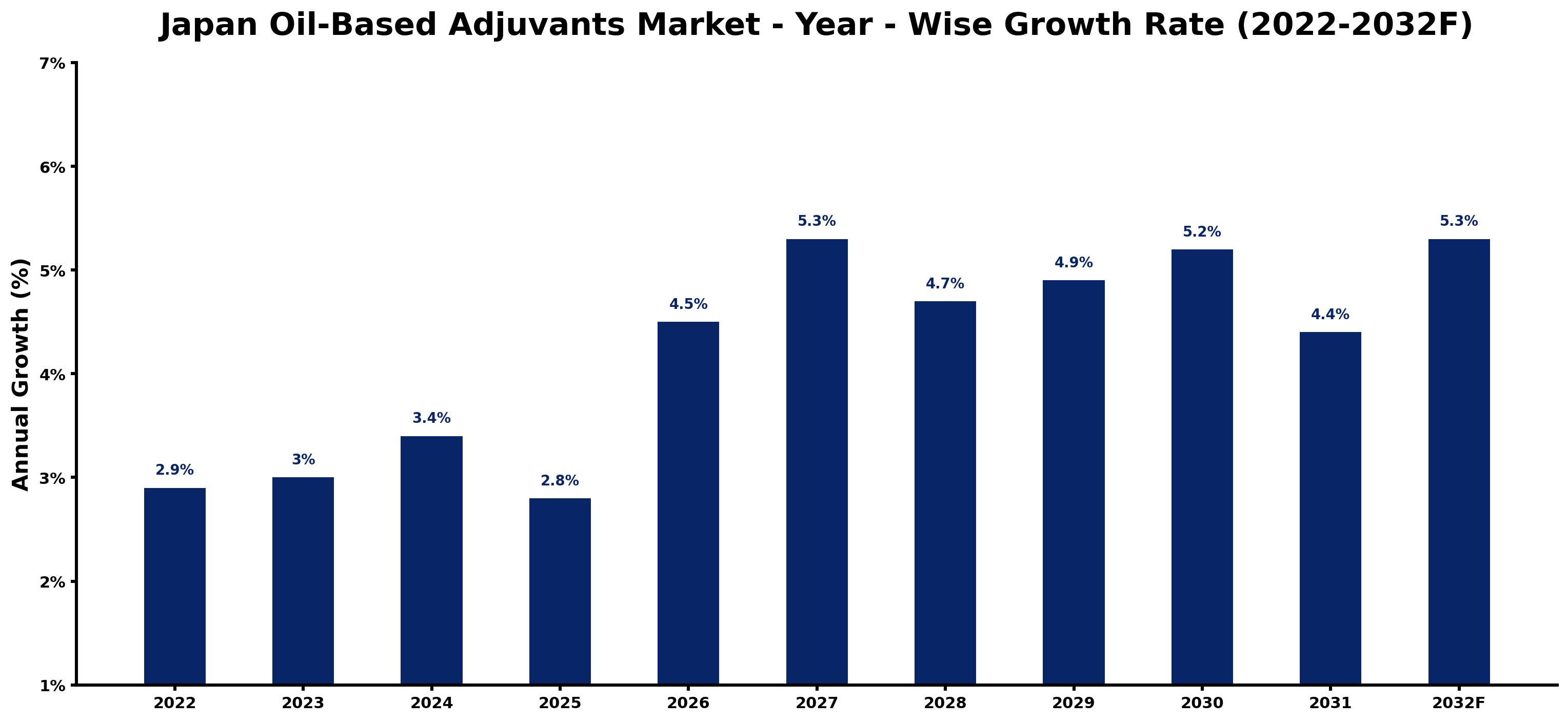
The yearly estimates that follow link every growth rate to its principal driver, so readers can see why the pace changed in each period.
| Year | Estimated Annual Growth (%) | Market Rationale |
| 2022 | 2.9 | The market showed steady growth, reflecting ongoing agricultural practices. |
| 2023 | 3.0 | Growth continued as farmers increased their use of effective adjuvants. |
| 2024 | 3.4 | Demand rose due to improved crop protection strategies among farmers. |
| 2025 | 2.8 | Growth slowed slightly as market conditions stabilised after previous gains. |
| 2026 | 4.5 | The market is expected to rebound as adoption of new technologies increases. |
| 2027 | 5.3 | Demand is projected to surge with rising investments in agricultural efficiency. |
| 2028 | 4.7 | Growth is expected to moderate as the market adjusts to new supply conditions. |
| 2029 | 4.9 | Increased demand from large-scale farmers will drive market expansion. |
| 2030 | 5.2 | The market is projected to continue growing as sustainable practices gain traction. |
| 2031 | 4.4 | Growth is expected to decelerate as market saturation begins to take effect. |
| 2032 | 5.3 | The market is projected to peak with high demand for advanced adjuvant formulations. |
Note: Market size estimations and growth projections presented in this report are based on 6Wresearch's proprietary forecasting methodology, utilizing the latest available industry data, government publications, and primary research inputs.
Japan Oil-Based Adjuvants Market Synopsis
Oil-based adjuvants are chemical formulations used to improve the effectiveness of agricultural sprays, primarily created by blending oils with surfactants and emulsifiers. The Japan Oil-Based Adjuvants Market is growing due to increasing demand from domestic farmers and agrochemical firms focused on crop protection.
Market Dynamics Impact Analysis (2026–2032)
| Factor | Type | Impact | Primary Segment Affected |
| Increasing adoption of precision agriculture technologies | Driver | High | Vegetable Oil Adjuvants |
| Rising demand for effective pest control solutions | Driver | High | Petroleum Oil Adjuvants |
| Growing interest in multi-function adjuvants | Opportunity | Medium | Blend Adjuvants |
| Expansion of online agro platforms for distribution | Opportunity | Medium | Agrochemical Distributors |
| Regulatory pressures on pesticide use | Restraint | High | Mineral Oil Adjuvants |
| Aging farmer population affecting adoption rates | Restraint | Medium | Soybean/Corn Oil |
| High competition among suppliers impacting pricing | Challenge | High | Methylated Seed Oils |
| Supply chain disruptions affecting availability | Challenge | Medium | Agricultural Spraying |
Evaluation of Drivers in Japan Oil-Based Adjuvants Market (2026–2032)
The table below links each growth driver to the segment it affects and the evidence for it.
| Drivers | Primary Segment Affected | Why It Matters (Evidence) |
| Increased investments in precision agriculture | Vegetable Oil Adjuvants | The adoption of precision agriculture technologies among large-scale farmers is rising, resulting in more effective use of oil-based adjuvants. |
| Growing focus on sustainable farming practices | Petroleum Oil Adjuvants | The push for sustainable agriculture is driving demand for adjuvants that improve pesticide performance, emphasising eco-friendly solutions. |
| Rising need for effective weed management solutions | Herbicide Carriers | The increasing use of herbicide carriers in Japan is boosting purchases of oil-based adjuvants, essential for effective weed control. |
| Expansion of agrochemical distribution channels | Agrochemical Distributors | Agrochemical distributors are vital in the supply chain, facilitating the availability of oil-based adjuvants to farmers. |
| Increased awareness of crop protection efficacy | Blend Adjuvants | Farmers are becoming more aware of the benefits of multi-function adjuvants, which is boosting their demand. |
Most of the extra volume comes from the increasing adoption of precision agriculture technologies, which is rising among large-scale farmers, resulting in more effective use of oil-based adjuvants. The growing focus on sustainable farming practices drives demand, as producers seek solutions that improve pesticide performance. The rising need for effective weed management solutions is prompting higher purchases of oil-based adjuvants, while agrochemical distributors are essential in ensuring product availability. Farmers are increasingly aware of the benefits of multi-function adjuvants, further boosting their demand for these products.
Evaluation of Restraints in Japan Oil-Based Adjuvants Market
The following restraints limit how fast demand can grow.
| Market Restraint | Primary Segment Affected | Why It Matters (Evidence) |
| Regulatory pressures on pesticide use | Mineral Oil Adjuvants | Strict regulations enforced by the Environmental Protection Agency limit the types of pesticides that can be used, affecting adjuvant demand. |
| Aging farmer population affecting adoption rates | Soybean/Corn Oil | The average age of farmers in Japan is around 67 years, impacting their willingness to adopt new products. |
| High competition among suppliers impacting pricing | Methylated Seed Oils | Intense competition among suppliers results in pricing pressures, affecting profitability for producers. |
| Supply chain disruptions affecting availability | Agricultural Spraying | Disruptions in the supply chain can delay the availability of essential adjuvants, impacting farmers' operations. |
| Limited awareness of adjuvant benefits among small-scale farmers | Blend Adjuvants | Small-scale farmers may lack knowledge about the advantages of using oil-based adjuvants, limiting market growth. |
Japan Oil-Based Adjuvants Market Challenges
A major obstacle in Japan's oil-based adjuvants market is the skills shortage, with the average age of farmers around 67 years, limiting the adoption of modern agricultural practices and reducing productivity for producers. High production costs stem from strict regulations enforced by the Environmental Protection Agency, leading to delays and increased expenses for buyers, who face higher prices for effective pest management solutions. Competition from alternative pest management strategies pressures producers to innovate, compelling buyers to seek more affordable options. Price volatility of raw materials disrupts budgeting for agrochemical firms, resulting in unpredictable operational costs.
Trends in the Japan Oil-Based Adjuvants Market
The trends below show where the Japan Oil-Based Adjuvants Market is heading.
- Shift towards Sustainable Agricultural Practices: In 2023, Japan implemented a new subsidy program for sustainable agriculture practices, aiming to reduce greenhouse gas emissions by 46%. This initiative encourages farmers to adopt eco-friendly methods, increasing the demand for oil-based adjuvants.
- Growth of Online Agro Platforms: Farm Supply Stores are increasingly adopting online platforms for sales, with a projected growth rate of 6.5%. This shift allows farmers easier access to oil-based adjuvants, expanding market reach.
- Rising Use of Multi-Function Adjuvants: The agricultural sector is seeing a growing trend towards multi-function adjuvants, which serve various agricultural needs. This trend is driven by the need for efficiency in pest control, with increased adoption among commercial agri operators.
- Increased Focus on Integrated Pest Management: The Japanese government promotes integrated pest management strategies, encouraging the use of oil-based adjuvants. This focus is essential for effective weed management, driving demand for herbicide carriers.
Investment Opportunities in the Japan Oil-Based Adjuvants Market
Below are the investment opportunities with the strongest case in the Japan Oil-Based Adjuvants Market.
- Partnerships with Local Distributors: Establishing partnerships with local agrochemical distributors is timely, as they play a key role in the supply chain. Collaborating can improve market access and distribution efficiency.
- Investment in Precision Agriculture Technologies: Investing in precision agriculture technologies can yield returns, with large-scale farmers increasingly adopting these methods. The Tohoku region is a key area for agricultural production, presenting opportunities for suppliers.
- Expansion into Online Sales Channels: The growing trend of online agro platforms presents an opportunity for suppliers to reach a broader audience. With a projected growth rate of 6.5%, tapping into this channel can boost sales.
- Development of Eco-Friendly Adjuvants: With Japan targeting a 46% cut in greenhouse-gas emissions by 2030, there is a demand for eco-friendly adjuvants. Suppliers can innovate in this area to meet the needs of environmentally conscious farmers.
Government Initiatives in the Japan Oil-Based Adjuvants Market
The GX Basic Policy, adopted in 2023, aims for about JPY 150 trillion of public-private decarbonisation investment over 10 years. This measure encourages producers to invest in sustainable practices, impacting the formulation of oil-based adjuvants. The Industrial Standardization Act governs JIS product standards, ensuring quality in agricultural chemicals, which affects buyers' purchasing decisions.
The Ministry of Agriculture, Forestry and Fisheries oversees agricultural standards and funds various programs to support sustainable practices. This agency approves initiatives that promote the use of oil-based adjuvants, ensuring compliance with national standards and improving product quality.
Future Insight of the Japan Oil-Based Adjuvants Market
Adoption of precision agriculture technologies will transform demand for oil-based adjuvants by 2032, as farmers increasingly utilise data-driven methods to improve crop yields. The new subsidy program for sustainable agriculture practices will promote the use of eco-friendly formulations, supporting Japan's goal of a 46% reduction in greenhouse-gas emissions by fiscal 2030. By 2032, the rise in multi-function formulations will improve efficiency in pest control. Expansion of cultivated land to approximately 4.5 million hectares will further drive the need for effective solutions, ensuring comprehensive crop protection strategies.
Market Segmentation Analysis
Japan Oil-Based Adjuvants Market report covers a detailed analysis of the following market segments:
By Segment Type – Vegetable Oil Adjuvants Lead, Petroleum Oil Adjuvants Expected to Grow Fastest
According to Saurav Kr Singh, Senior Research Analyst at 6Wresearch, the largest segment type category in 2025 was Vegetable Oil Adjuvants, at 44% of revenue. Vegetable oil adjuvants hold the largest share as they are widely utilised by farmers to improve pesticide application effectiveness. Their importance is particularly evident in the Tohoku region, a key agricultural production area in Japan. Over 2026–2032, Petroleum Oil Adjuvants are expected to post the fastest growth, at a CAGR of 7.0%. Petroleum oil adjuvants are rapidly gaining popularity due to their ability to significantly enhance pesticide performance, making them highly sought after by farmers. The recent introduction of subsidy programmes for sustainable agriculture practices is further accelerating their adoption. Suppliers should focus on developing petroleum oil adjuvants to meet the increasing demand.
By Oil Base Type – Soybean/Corn Oil Leads, Paraffinic Oil Expected to Grow Fastest
In 2025, Soybean/Corn Oil led the oil base type split with a 48% share. Soybean and corn oil are the predominant bases for adjuvants, preferred by farmers for their proven effectiveness in enhancing spray quality. This preference is evident across Japan's extensive network of over 1.3 million farms. The quickest growth will come from Paraffinic Oil, forecast to expand at a CAGR of 7.1% between 2026 and 2032. Paraffinic oil is experiencing the fastest growth because of its low volatility, which is advantageous for various agricultural applications. The rising adoption of precision agriculture technologies among farmers is also propelling its demand. Buyers should consider paraffinic oil options to enhance their agricultural practices.
By Application Area – Agricultural Spraying Leads, Herbicide Carriers Expected to Grow Fastest
With 39% of application area revenue in 2025, Agricultural Spraying was the largest category. Agricultural spraying is the primary application area for oil-based adjuvants, crucial for crop yield and pest management. This is particularly significant in Japan, where the average yield of rice is around 5.2 tons per hectare. Herbicide Carriers are set to record the highest CAGR in this split, 6.1% over 2026–2032. Herbicide carriers are witnessing the fastest growth as they are essential for effectively delivering active ingredients for weed control. The Japanese government's promotion of integrated pest management strategies is also contributing to this increase. Suppliers should prioritise the development of herbicide carriers to align with market needs.
By Distribution Channel – Agrochemical Distributors Lead, Farm Supply Stores Expected to Grow Fastest
Agrochemical Distributors took 36% of distribution channel revenue in 2025, more than any other category. Agrochemical distributors are the leading distribution channel for oil-based adjuvants, serving as the primary link between manufacturers and farmers. Their established networks are vital for ensuring product availability across Japan's agricultural sector. Farm Supply Stores are projected to grow fastest, at a CAGR of 6.5% during 2026–2032. Farm supply stores are emerging as the fastest-growing channel, providing direct access to farmers in need of adjuvants. The convenience of local sourcing is driving this shift in purchasing behaviour. Suppliers should strengthen partnerships with farm supply stores to enhance their market presence.
By End User Sector – Crop Protection Companies Lead, Large-Scale Farmers Expected to Grow Fastest
Crop Protection Companies held 35% of the Japan Oil-Based Adjuvants Market by end user sector in 2025. Crop protection companies are the largest consumers of oil-based adjuvants, relying on these products to enhance the effectiveness of their pesticide formulations. Their significant role in the agricultural supply chain underscores the importance of adjuvants in crop protection. Over 2026–2032, Large-Scale Farmers are expected to post the fastest growth, at a CAGR of 6.4%. Large-scale farmers are increasingly adopting oil-based adjuvants to optimise crop yields and effectively manage pests. This trend is supported by the substantial agricultural budget, which exceeds 1 trillion yen annually. Suppliers should tailor their products to meet the specific needs of large-scale farmers.
Key Attractiveness of the Report
- 10 Years of Market Numbers
- Historical Data Starting from 2022 to 2025
- Base Year 2025
- Forecast Data until 2032
- Key Performance Indicators Impacting the Market
- Major Upcoming Developments and Projects
Key Highlights of the Report:
- Japan Oil-Based Adjuvants Market Outlook
- Market Size of Japan Oil-Based Adjuvants Market, 2025
- Forecast of Japan Oil-Based Adjuvants Market, 2032
- Historical Data and Forecast of Japan Oil-Based Adjuvants Revenues & Volume for the Period 2022-2032F
- Japan Oil-Based Adjuvants Market Trend Evolution
- Japan Oil-Based Adjuvants Market Drivers and Challenges
- Japan Oil-Based Adjuvants Price Trends
- Japan Oil-Based Adjuvants Porter's Five Forces
- Japan Oil-Based Adjuvants Industry Life Cycle
- Historical Data and Forecast of Japan Oil-Based Adjuvants Market Revenues & Volume By Segment Type for the Period 2022-2032F
- Historical Data and Forecast of Japan Oil-Based Adjuvants Market Revenues & Volume By Vegetable Oil Adjuvants for the Period 2022-2032F
- Historical Data and Forecast of Japan Oil-Based Adjuvants Market Revenues & Volume By Petroleum Oil Adjuvants for the Period 2022-2032F
- Historical Data and Forecast of Japan Oil-Based Adjuvants Market Revenues & Volume By Methylated Seed Oils for the Period 2022-2032F
- Historical Data and Forecast of Japan Oil-Based Adjuvants Market Revenues & Volume By Mineral Oil Adjuvants for the Period 2022-2032F
- Historical Data and Forecast of Japan Oil-Based Adjuvants Market Revenues & Volume By Blend Adjuvants for the Period 2022-2032F
- Historical Data and Forecast of Japan Oil-Based Adjuvants Market Revenues & Volume By Oil Base Type for the Period 2022-2032F
- Historical Data and Forecast of Japan Oil-Based Adjuvants Market Revenues & Volume By Soybean/Corn Oil for the Period 2022-2032F
- Historical Data and Forecast of Japan Oil-Based Adjuvants Market Revenues & Volume By Paraffinic Oil for the Period 2022-2032F
- Historical Data and Forecast of Japan Oil-Based Adjuvants Market Revenues & Volume By Modified Natural Oils for the Period 2022-2032F
- Historical Data and Forecast of Japan Oil-Based Adjuvants Market Revenues & Volume By Refined Oils for the Period 2022-2032F
- Historical Data and Forecast of Japan Oil-Based Adjuvants Market Revenues & Volume By Mixed Oil Compositions for the Period 2022-2032F
- Historical Data and Forecast of Japan Oil-Based Adjuvants Market Revenues & Volume By Application Area for the Period 2022-2032F
- Historical Data and Forecast of Japan Oil-Based Adjuvants Market Revenues & Volume By Agricultural Spraying for the Period 2022-2032F
- Historical Data and Forecast of Japan Oil-Based Adjuvants Market Revenues & Volume By Herbicide Carriers for the Period 2022-2032F
- Historical Data and Forecast of Japan Oil-Based Adjuvants Market Revenues & Volume By Fungicide/Pesticide Boosters for the Period 2022-2032F
- Historical Data and Forecast of Japan Oil-Based Adjuvants Market Revenues & Volume By Insecticide Compatibility for the Period 2022-2032F
- Historical Data and Forecast of Japan Oil-Based Adjuvants Market Revenues & Volume By Multi-Function Use for the Period 2022-2032F
- Historical Data and Forecast of Japan Oil-Based Adjuvants Market Revenues & Volume By Distribution Channel for the Period 2022-2032F
- Historical Data and Forecast of Japan Oil-Based Adjuvants Market Revenues & Volume By Agrochemical Distributors for the Period 2022-2032F
- Historical Data and Forecast of Japan Oil-Based Adjuvants Market Revenues & Volume By Farm Supply Stores for the Period 2022-2032F
- Historical Data and Forecast of Japan Oil-Based Adjuvants Market Revenues & Volume By Online Agro Platforms for the Period 2022-2032F
- Historical Data and Forecast of Japan Oil-Based Adjuvants Market Revenues & Volume By Agri-Chem Retailers for the Period 2022-2032F
- Historical Data and Forecast of Japan Oil-Based Adjuvants Market Revenues & Volume By Direct Sales for the Period 2022-2032F
- Historical Data and Forecast of Japan Oil-Based Adjuvants Market Revenues & Volume By End User Sector for the Period 2022-2032F
- Historical Data and Forecast of Japan Oil-Based Adjuvants Market Revenues & Volume By Crop Protection Companies for the Period 2022-2032F
- Historical Data and Forecast of Japan Oil-Based Adjuvants Market Revenues & Volume By Large-Scale Farmers for the Period 2022-2032F
- Historical Data and Forecast of Japan Oil-Based Adjuvants Market Revenues & Volume By Commercial Agri Operators for the Period 2022-2032F
- Historical Data and Forecast of Japan Oil-Based Adjuvants Market Revenues & Volume By Horticultural Farms for the Period 2022-2032F
- Historical Data and Forecast of Japan Oil-Based Adjuvants Market Revenues & Volume By Agrochemical Firms for the Period 2022-2032F
- Japan Oil-Based Adjuvants Import Export Trade Statistics
- Market Opportunity Assessment By Segment Type
- Market Opportunity Assessment By Oil Base Type
- Market Opportunity Assessment By Application Area
- Market Opportunity Assessment By Distribution Channel
- Market Opportunity Assessment By End User Sector
- Japan Oil-Based Adjuvants Top Companies Market Share
- Japan Oil-Based Adjuvants Competitive Benchmarking By Technical and Operational Parameters
- Japan Oil-Based Adjuvants Company Profiles
- Japan Oil-Based Adjuvants Key Strategic Recommendations
Market Covered
The following segment groups are covered in the report.
By Segment Type
- Vegetable Oil Adjuvants
- Petroleum Oil Adjuvants
- Methylated Seed Oils
- Mineral Oil Adjuvants
- Blend Adjuvants
By Oil Base Type
- Soybean/Corn Oil
- Paraffinic Oil
- Modified Natural Oils
- Refined Oils
- Mixed Oil Compositions
By Application Area
- Agricultural Spraying
- Herbicide Carriers
- Fungicide/Pesticide Boosters
- Insecticide Compatibility
- Multi-Function Use
By Distribution Channel
- Agrochemical Distributors
- Farm Supply Stores
- Online Agro Platforms
- Agri-Chem Retailers
- Direct Sales
By End User Sector
- Crop Protection Companies
- Large-Scale Farmers
- Commercial Agri Operators
- Horticultural Farms
- Agrochemical Firms






































