Japan Oleochemicals Market Size & Growth Rate
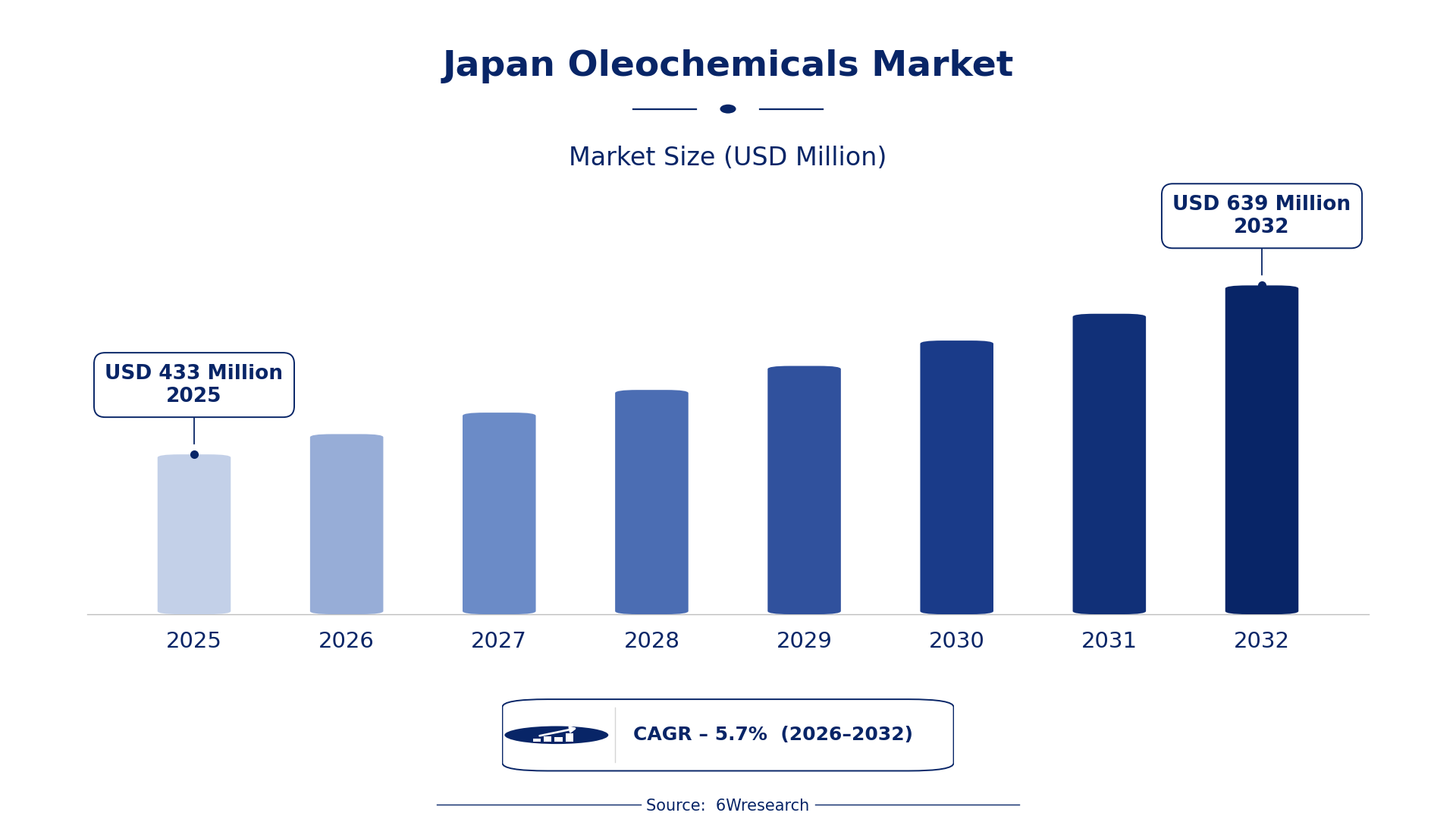
According to 6Wresearch internal database and industry insights, the Japan Oleochemicals Market was valued at USD 433 Million in 2025 and is projected to reach USD 639 Million by 2032, growing at a CAGR of approximately 5.7% during 2026–2032.
Japan Oleochemicals Market Highlights
| Report Metric | Details |
| Report Name | Japan Oleochemicals Market (2026-2032) |
| Market Size 2025 | USD 433 Million |
| Market Size 2032 | USD 639 Million |
| Absolute Growth 2025–2032 | USD 206 Million |
| CAGR 2026–2032 | 5.7% |
| Peak Annual Growth | 6.2% in 2027 |
| Forecast Period | 2026–2032 |
| Historical Data | 2022–2025 |
| Base Year | 2025 |
| Leading Type, 2025 | Fatty Acid (37% share) |
| Leading Application, 2025 | Pharmaceutical & personal care (41% share) |
| Fastest-Growing Type | Fatty Alcohol (7.8% CAGR) |
| Fastest-Growing Application | Food & beverages (8.0% CAGR) |
| Growing Sector | Personal care |
| Key End Users | Pharmaceuticals, food processing, personal care, detergents |
Japan Oleochemicals Market Year-wise Growth Rate and Key Drivers (2022–2032)
This graph illustrates the annual growth rates of the market from 2022 to 2032, highlighting a steady upward trajectory and projected market expansion over the forecast period.
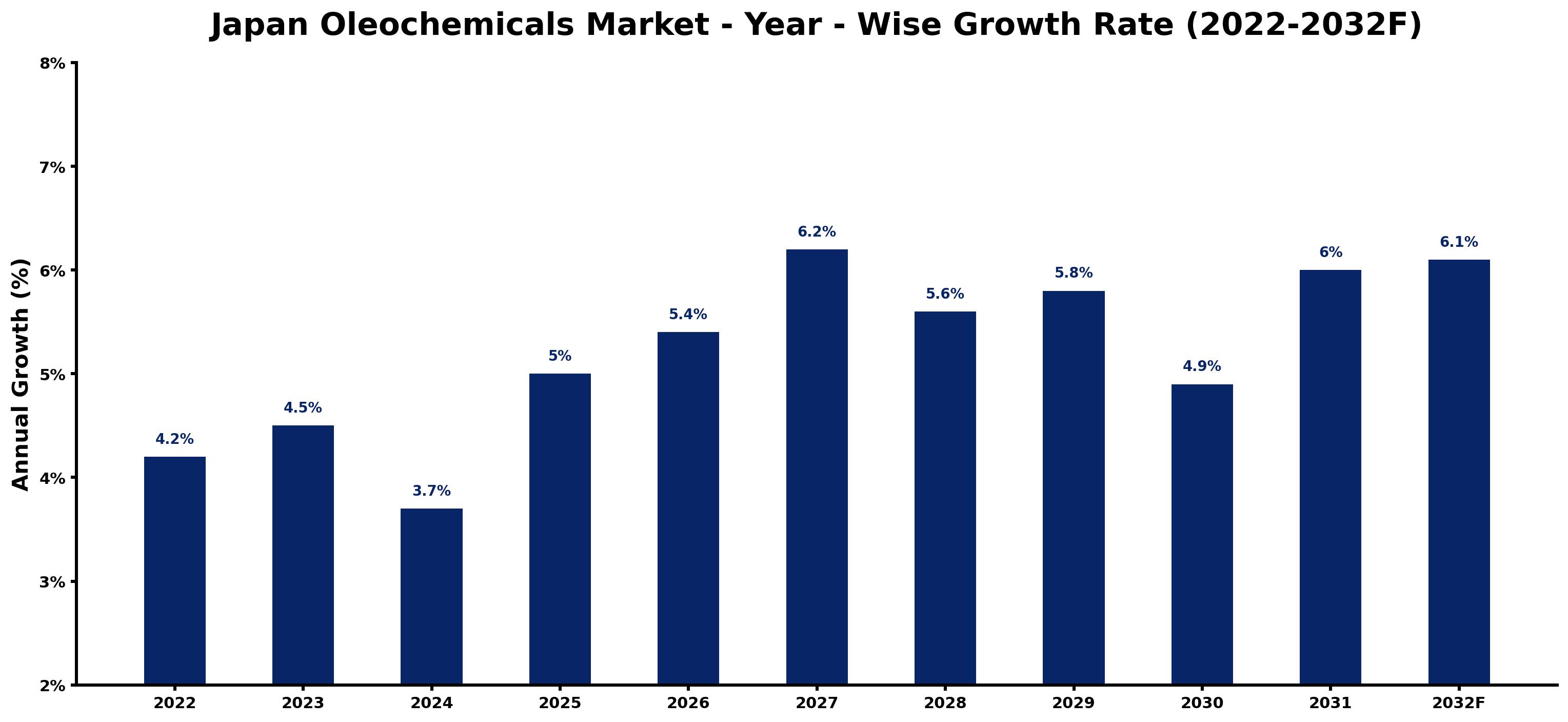
Year by year, the estimates below pair each growth rate with the development that shaped it.
| Year | Estimated Annual Growth (%) | Market Rationale |
| 2022 | 4.2 | The market showed steady growth due to stable demand from domestic users. |
| 2023 | 4.5 | Demand increased as the personal care sector expanded, driving higher orders. |
| 2024 | 3.7 | Growth slowed as some manufacturers faced production capacity constraints. |
| 2025 | 5.0 | The market rebounded with increased investments in sustainable production methods. |
| 2026 | 5.4 | Rising demand for fatty alcohols is projected to boost growth in personal care formulations. |
| 2027 | 6.2 | The peak growth will be driven by heightened demand for eco-friendly products. |
| 2028 | 5.6 | Growth is expected to slow as market saturation in certain applications begins to appear. |
| 2029 | 5.8 | Demand for glycerin surged due to its extensive use in pharmaceuticals. |
| 2030 | 4.9 | Growth is projected to moderate as the market adjusts to changing consumer preferences. |
| 2031 | 6.0 | Increased focus on sustainability will lead to higher orders for oleochemical products. |
| 2032 | 6.1 | Continued investments in green technologies will support sustained growth. |
Note: Market size estimations and growth projections presented in this report are based on 6Wresearch's proprietary forecasting methodology, utilizing the latest available industry data, government publications, and primary research inputs.
Japan Oleochemicals Market Synopsis
Oleochemicals are derived from natural fats and oils through processes such as hydrolysis and transesterification. The Japan Oleochemicals Market is expanding due to increased demand from the pharmaceutical and food processing sectors. With the personal care market valued at approximately $10 billion, investments in sustainable production methods are driving this growth. The government's Green Growth Strategy aims for JPY 150 trillion in decarbonisation investments, creating opportunities for oleochemical producers.
Market Dynamics Impact Analysis (2026–2032)
| Factor | Type | Impact | Primary Segment Affected |
| Growing demand for sustainable products | Driver | High | Fatty Alcohol |
| Rising personal care market value | Driver | High | Pharmaceutical & personal care |
| Increased investment in sustainable production | Opportunity | High | Fatty Acid |
| Expansion of the food and beverage sector | Opportunity | High | Food & beverages |
| Production capacity constraints in the sector | Restraint | Medium | Glycerin |
| Compliance with stringent regulations | Restraint | Medium | Fatty Acid |
| Fluctuating raw material prices | Challenge | High | Fatty Alcohol |
| Challenges in meeting JIS standards | Challenge | Medium | Pharmaceutical & personal care |
Evaluation of Drivers in Japan Oleochemicals Market (2026–2032)
The main growth drivers and the segments they affect most are set out below.
| Drivers | Primary Segment Affected | Why It Matters (Evidence) |
| Increased demand for personal care products | Fatty Alcohol | The personal care market in Japan is valued at approximately $10 billion, leading to higher orders for fatty alcohols used in surfactants. |
| Growth in pharmaceutical formulations | Glycerin | Glycerin is utilized in over 50% of pharmaceutical formulations in Japan, driving demand for this oleochemical. |
| Expansion of the food processing sector | Fatty Acid | The food and beverage sector accounts for 20% of total oleochemical consumption, increasing the need for fatty acids. |
| Investment in sustainable production methods | Fatty Acid | Japan's GX Basic Policy targets JPY 150 trillion in decarbonisation investments, promoting sustainable oleochemical production. |
| Rising consumer preference for eco-friendly products | Pharmaceutical & personal care | The personal care industry is expected to grow by 5% annually through 2026, boosting demand for sustainable formulations. |
Behind the steady rise in orders sits a marked increase in the personal care market, valued at approximately $10 billion. The expansion of the food processing sector, which accounts for 20% of total oleochemical consumption, drives demand for fatty acids. Glycerin, utilized in over 50% of pharmaceutical formulations, sees heightened orders as the pharmaceutical sector grows. Japan's decarbonisation investment targets promote sustainable production methods, further boosting demand. The personal care industry is projected to grow by 5% annually through 2026, creating more opportunities for eco-friendly formulations.
Evaluation of Restraints in Japan Oleochemicals Market
Several factors work against faster growth; the main ones are summarised below.
| Market Restraint | Primary Segment Affected | Why It Matters (Evidence) |
| Production capacity constraints due to limited facilities | Fatty Acid | Adhering to JIS standards requires substantial investment, impacting profitability for manufacturers. |
| Fluctuating raw material prices affecting profitability | Pharmaceutical & personal care | Stringent compliance requirements can delay product launches and increase operational costs. |
| Market saturation in certain applications | Fatty Alcohol | As the market matures, growth in traditional applications may slow, affecting overall demand. |
| Limited innovation in product development | Glycerin | As competition increases, manufacturers may struggle to differentiate products, impacting sales. |
| Dependency on imports for raw materials | Fatty Acid | Relying on imports can lead to supply chain disruptions, affecting production schedules. |
Japan Oleochemicals Market Challenges
High competition among buyers forces suppliers to lower prices, resulting from a saturated market with numerous local producers. This environment exists due to the influx of imports, which can reduce profit margins by 15% for manufacturers. Suppliers struggle with the need for advanced technology, as adapting to new production methods often requires substantial investment, causing delays of up to six months for product launches. Increased operational costs related to sustainability initiatives can raise expenses by 10% for producers, while a shortage of skilled workers in advanced processing can decrease output efficiency by 20% for some suppliers.
Trends in the Japan Oleochemicals Market
The following changes are redrawing the Japan Oleochemicals Market.
- Shift towards sustainable production methods: In 2023, a government program was launched to promote sustainable oleochemical production, expected to drive investments in eco-friendly practices, aligning with global sustainability trends.
- Transition from traditional to bio-based feedstocks: Since 2022, there has been a marked shift towards using bio-based feedstocks in oleochemical production. This change is driven by consumer demand for greener products, with the fatty alcohol market projected to reach 300,000 tons by 2025.
- Emergence of new applications in personal care: The personal care sector is increasingly incorporating oleochemicals in formulations, with a projected annual growth rate of 5% through 2026. This trend underscores the expanding role of oleochemicals in product development.
- Growth in glycerin usage in pharmaceuticals: Glycerin's application in pharmaceuticals has surged, with over 50% of formulations utilizing it. This trend reflects the growing reliance on glycerin for effective drug delivery systems.
Investment Opportunities in the Japan Oleochemicals Market
Investors looking at the Japan Oleochemicals Market should consider the following areas.
- Timing aligns with sustainability goals: With Japan targeting a 46% reduction in greenhouse-gas emissions by 2030, oleochemical producers have the chance to invest in sustainable practices and technologies.
- Food processing sector expanding rapidly: The food and beverage sector, accounting for 20% of oleochemical consumption, offers opportunities for suppliers to develop tailored solutions for food additives and processing.
- Growing demand from the pharmaceutical sector: As the pharmaceutical market expands, oleochemical manufacturers can supply glycerin and other derivatives for new formulations.
- Investment in eco-friendly product development: With the personal care industry projected to grow by 5% annually, manufacturers can focus on developing sustainable oleochemical products to meet evolving consumer preferences.
Government Initiatives in the Japan Oleochemicals Market
The PRTR Law, enacted in 1999, mandates businesses to report chemical substance releases, impacting oleochemical producers by requiring transparency in environmental practices. Compliance with this law is essential for maintaining market access and consumer trust, as over 1,000 businesses are affected annually.
The Chemical Substances Control Law, established in 1973, requires evaluation and control of chemical substances in manufacturing. This law ensures that oleochemical producers adhere to safety standards, influencing product formulations and marketability, with over 500 substances regulated.
Future Insight of the Japan Oleochemicals Market
Technological advancements in sustainable production will reshape demand by 2032, as buyers will seek eco-friendly options. The government's decarbonisation investment programme will drive innovation in oleochemical processes, improving production capabilities. By 2025, the fatty alcohol market is projected to reach 300,000 tons, reflecting changing consumer preferences. Growth in the personal care sector, projected to be 5% annually through 2026, will further boost the demand for high-quality oleochemicals.
Market Segmentation Analysis
Japan Oleochemicals Market report covers a detailed analysis of the following market segments:
By Type – Fatty Acid Leads, Fatty Alcohol Expected to Grow Fastest
According to Ravi Bhandari, Research Head at 6Wresearch, Fatty Acid held 37% of the Japan Oleochemicals Market by type in 2025. Fatty acids dominate the market due to their essential role in soap and detergent production, which is vital for both domestic and commercial cleaning applications. The concentration of the soap and detergent industry in the Kanto region further amplifies the demand for fatty acids. Fatty Alcohol is projected to grow fastest, at a CAGR of 7.8% during 2026–2032. The fatty alcohol segment is experiencing rapid growth as it is integral to surfactants in personal care products, which are anticipated to expand by 5% annually through 2026. This increasing demand for personal care items will likely maintain fatty acids' leading position in the market. Suppliers should focus on fatty acid and fatty alcohol offerings to meet the growing demands of the personal care and cleaning sectors.
By Application – Pharmaceutical & personal care Leads, Food & beverages Expected to Grow Fastest
Pharmaceutical & personal care took 41% of application revenue in 2025, more than any other category. Pharmaceutical and personal care applications lead the market due to the extensive use of oleochemicals in formulations, with glycerin featured in over 50% of pharmaceutical products. This reliance on oleochemicals for health-related applications significantly boosts its market share. Food & beverages are set to record the highest CAGR in this split, 8.0% over 2026–2032. The food and beverages segment is the fastest-growing application, representing 20% of total oleochemical consumption, driven by a rising preference for natural ingredients in food processing. This trend towards sustainable practices in food production is expected to further accelerate growth in the oleochemical market. Buyers in the food and beverage sector should increase their use of oleochemicals to align with the rising trend towards sustainability and natural ingredients.
Key Attractiveness of the Report
- 10 Years of Market Numbers
- Historical Data Starting from 2022 to 2025
- Base Year 2025
- Forecast Data until 2032
- Key Performance Indicators Impacting the Market
- Major Upcoming Developments and Projects
Key Highlights of the Report:
- Japan Oleochemicals Market Outlook
- Market Size of Japan Oleochemicals Market, 2025
- Forecast of Japan Oleochemicals Market, 2032
- Historical Data and Forecast of Japan Oleochemicals Revenues & Volume for the Period 2022-2032
- Japan Oleochemicals Market Trend Evolution
- Japan Oleochemicals Market Drivers and Challenges
- Japan Oleochemicals Price Trends
- Japan Oleochemicals Porter's Five Forces
- Japan Oleochemicals Industry Life Cycle
- Historical Data and Forecast of Japan Oleochemicals Market Revenues & Volume By Type for the Period 2022-2032
- Historical Data and Forecast of Japan Oleochemicals Market Revenues & Volume By Fatty Acid for the Period 2022-2032
- Historical Data and Forecast of Japan Oleochemicals Market Revenues & Volume By Fatty Alcohol for the Period 2022-2032
- Historical Data and Forecast of Japan Oleochemicals Market Revenues & Volume By Glycerin for the Period 2022-2032
- Historical Data and Forecast of Japan Oleochemicals Market Revenues & Volume By Others for the Period 2022-2032
- Historical Data and Forecast of Japan Oleochemicals Market Revenues & Volume By Application for the Period 2022-2032
- Historical Data and Forecast of Japan Oleochemicals Market Revenues & Volume By Pharmaceutical & personal care for the Period 2022-2032
- Historical Data and Forecast of Japan Oleochemicals Market Revenues & Volume By Food & beverages for the Period 2022-2032
- Historical Data and Forecast of Japan Oleochemicals Market Revenues & Volume By Soaps & detergents for the Period 2022-2032
- Historical Data and Forecast of Japan Oleochemicals Market Revenues & Volume By Polymers for the Period 2022-2032
- Historical Data and Forecast of Japan Oleochemicals Market Revenues & Volume By Others for the Period 2022-2032
- Japan Oleochemicals Import Export Trade Statistics
- Market Opportunity Assessment By Type
- Market Opportunity Assessment By Application
- Japan Oleochemicals Top Companies Market Share
- Japan Oleochemicals Competitive Benchmarking By Technical and Operational Parameters
- Japan Oleochemicals Company Profiles
- Japan Oleochemicals Key Strategic Recommendations
Market Covered
The study includes the following segmentation.
By Type
- Fatty Acid
- Fatty Alcohol
- Glycerin
- Others
By Application
- Pharmaceutical & personal care
- Food & beverages
- Soaps & detergents
- Polymers
- Others































