Japan Ophthalmology Drugs and Devices Market Size & Growth Rate
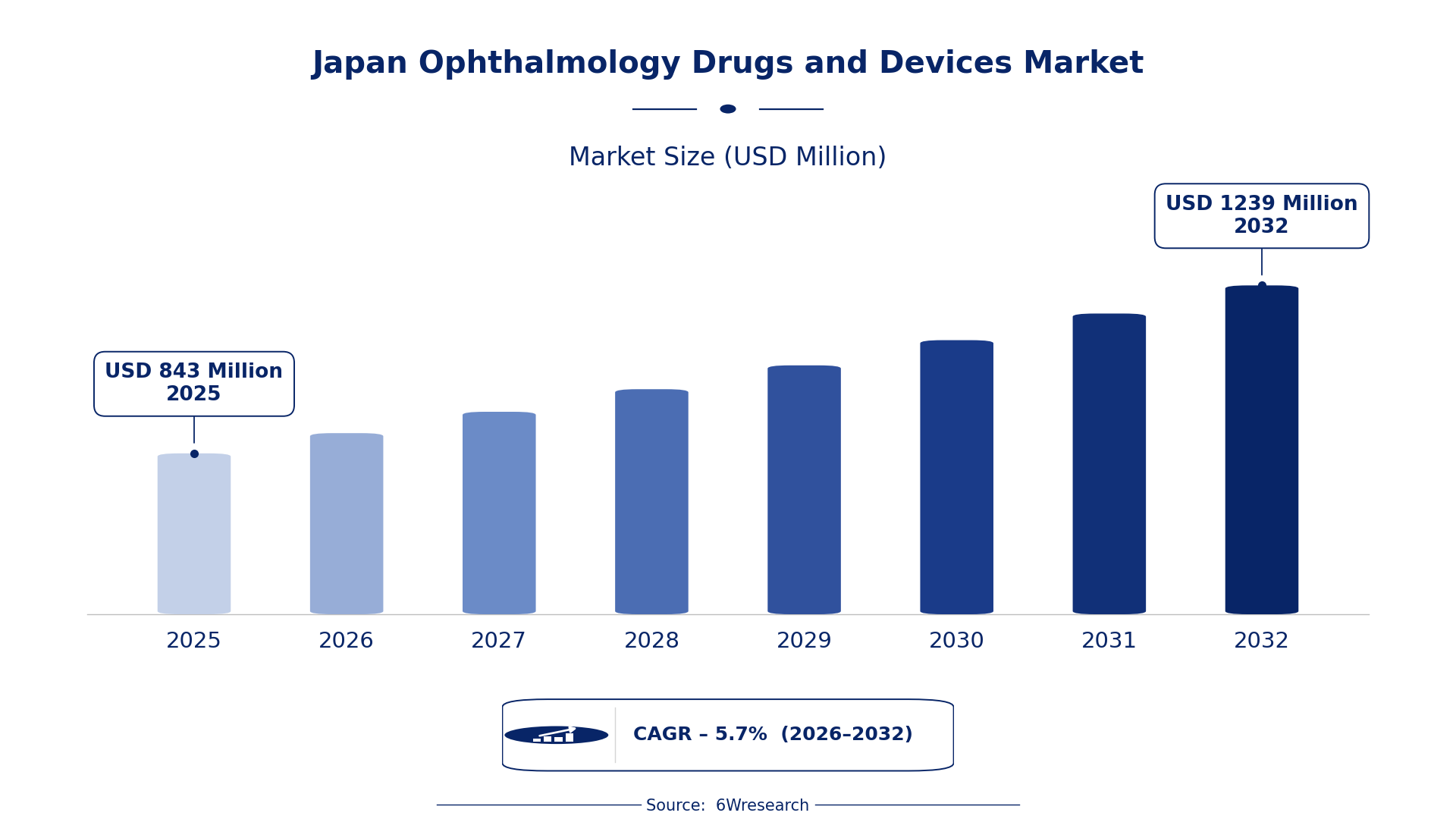
According to 6Wresearch internal database and industry insights, the Japan Ophthalmology Drugs and Devices Market was valued at USD 843 Million in 2025 and is projected to reach USD 1,239 Million by 2032, growing at a CAGR of approximately 5.7% during 2026–2032.
Japan Ophthalmology Drugs and Devices Market Highlights
| Report Metric | Details |
| Report Name | Japan Ophthalmology Drugs and Devices Market (2026-2032) |
| Market Size 2025 | USD 843 Million |
| Market Size 2032 | USD 1,239 Million |
| Absolute Growth 2025–2032 | USD 396 Million |
| CAGR 2026–2032 | 5.7% |
| Peak Annual Growth | 6.9% in 2028 |
| Forecast Period | 2026–2032 |
| Historical Data | 2022–2025 |
| Base Year | 2025 |
| Leading Products, 2025 | Diagnostic and Monitoring Devices (35% share) |
| Leading Indication, 2025 | Glaucoma (43% share) |
| Leading End Use, 2025 | Hospitals (44% share) |
| Fastest-Growing Products | Surgical Devices (7.8% CAGR) |
| Fastest-Growing Indication | Retinal disorders (7.6% CAGR) |
| Fastest-Growing End Use | Clinics (6.8% CAGR) |
| Growing Sector | Hospitals |
| Key End Users | Healthcare providers, clinics, hospitals, patients |
Japan Ophthalmology Drugs and Devices Market Year-wise Growth Rate and Key Drivers (2022–2032)
This graph illustrates the annual growth rates of the market from 2022 to 2032, highlighting a steady upward trajectory and projected market expansion over the forecast period.
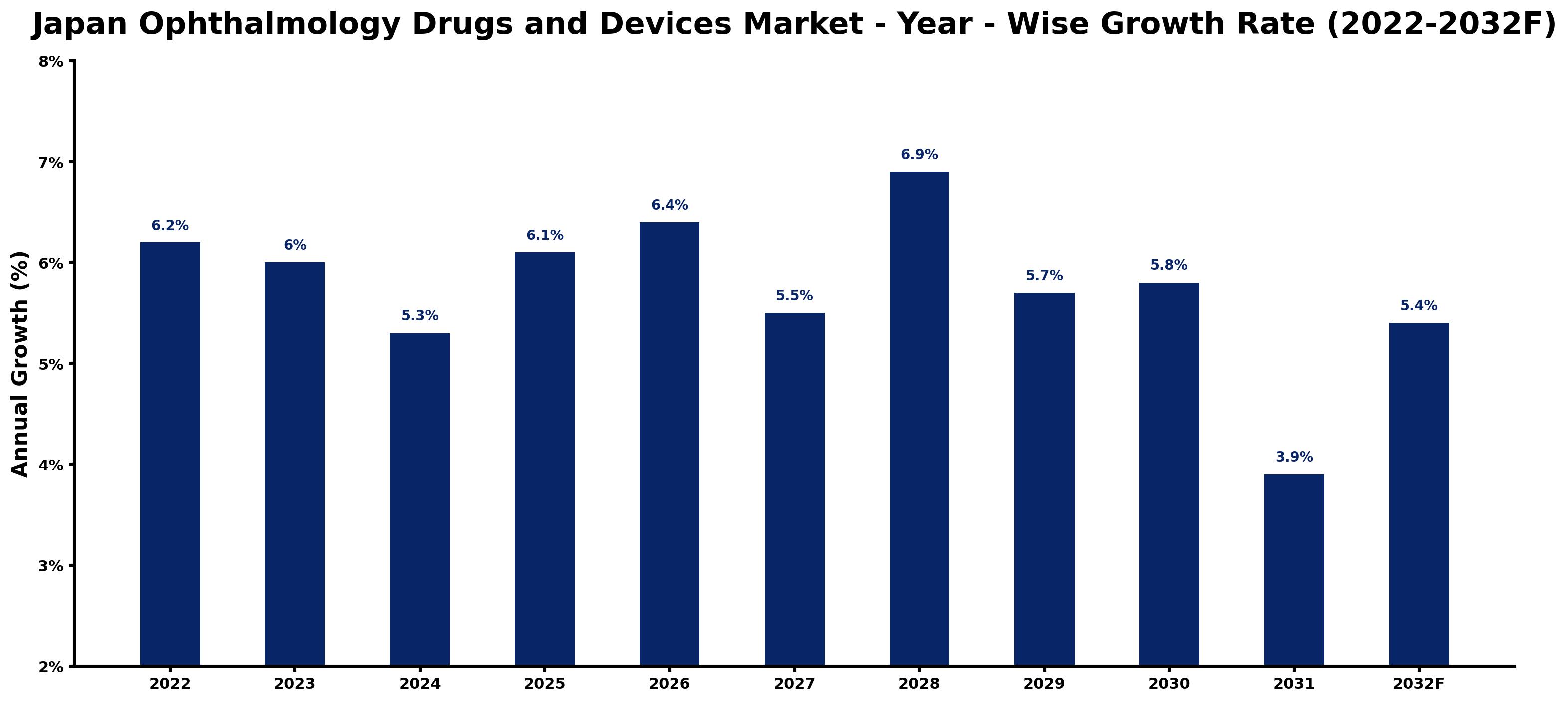
Each row of the following table gives one year's estimated growth and the event or demand shift that explains it.
| Year | Estimated Annual Growth (%) | Market Rationale |
| 2022 | 6.2 | The market experienced strong demand due to an aging population and increased healthcare spending. |
| 2023 | 6.0 | Growth slowed slightly as the market adjusted to previous high levels of investment. |
| 2024 | 5.3 | A continued focus on technological advancements contributed to a further slowdown in growth. |
| 2025 | 6.1 | Demand for surgical devices increased as hospitals expanded their ophthalmology services. |
| 2026 | 6.4 | Investment in diagnostic devices is expected to rise, driving higher demand for eye care solutions. |
| 2027 | 5.5 | Growth is projected to slow as market saturation begins to affect new product introductions. |
| 2028 | 6.9 | A peak in growth is expected as new treatments for glaucoma gain traction. |
| 2029 | 5.7 | The market is projected to slow as competition intensifies among device manufacturers. |
| 2030 | 5.8 | Demand for vision care products will rise steadily with an aging population. |
| 2031 | 3.9 | Growth is expected to slow as regulatory changes introduce more stringent approval processes. |
| 2032 | 5.4 | A renewed focus on rural healthcare access is projected to drive growth. |
Note: Market size estimations and growth projections presented in this report are based on 6Wresearch's proprietary forecasting methodology, utilizing the latest available industry data, government publications, and primary research inputs.
Japan Ophthalmology Drugs and Devices Market Synopsis
Ophthalmology drugs and devices include pharmaceuticals and equipment for diagnosing and treating eye conditions, such as glaucoma management and vision correction. The Japan Ophthalmology Drugs and Devices Market is expanding due to a rapidly aging population, with 29.3% of citizens aged 65 or older as of September 2024. Increased healthcare expenditure, projected at JPY 46.7 trillion in fiscal 2022, and advancements in medical technology further stimulate demand. Over 100 specialized hospitals and ongoing government programs improve access to eye care services, driving market growth.
Market Dynamics Impact Analysis (2026–2032)
| Factor | Type | Impact | Primary Segment Affected |
| Aging population increasing demand for eye care services. | Driver | High | Vision Care |
| Technological advancements in surgical devices enhancing treatment options. | Driver | High | Surgical Devices |
| Investment in rural healthcare facilities creating new market opportunities. | Opportunity | High | Hospitals |
| Growing prevalence of dry eye syndrome leading to increased product demand. | Opportunity | Medium | Drugs |
| Regulatory hurdles delaying the approval of new ophthalmology devices. | Restraint | High | Diagnostic and Monitoring Devices |
| High costs associated with advanced surgical devices limiting accessibility. | Restraint | Medium | Surgical Devices |
| Intense competition among manufacturers affecting pricing strategies. | Challenge | High | Vision Care |
| Rapid technological changes requiring continuous investment in R&D. | Challenge | Medium | Drugs |
Evaluation of Drivers in Japan Ophthalmology Drugs and Devices Market (2026–2032)
These are the developments adding the most demand over the forecast period.
| Drivers | Primary Segment Affected | Why It Matters (Evidence) |
| Increasing healthcare expenditure on ophthalmology services. | Vision Care | Japan's national medical care expenditure reached about JPY 46.7 trillion in fiscal 2022, prompting more spending on eye care. |
| Advancements in surgical techniques and devices. | Surgical Devices | Investment in surgical devices is projected to rise as hospitals adopt new technologies, enhancing treatment options. |
| Rising incidence of glaucoma among the aging population. | Drugs | With an estimated 1.5 million people suffering from glaucoma, demand for effective treatments is growing. |
| Expansion of specialized ophthalmology hospitals. | Diagnostic and Monitoring Devices | Japan has over 100 hospitals specializing in ophthalmology, increasing the need for diagnostic tools. |
| Growing patient awareness about eye health. | Vision Care | An increasing number of patients treated for dry eye syndrome, approximately 5 million annually, drives demand for vision care products. |
What keeps demand rising is the increase in healthcare expenditure, which reached approximately JPY 46.7 trillion in fiscal 2022. This spending has led to greater investment in surgical devices, particularly as hospitals embrace new technologies. The prevalence of glaucoma, affecting about 1.5 million individuals, fuels the need for effective drug treatments. The rising awareness of eye health, reflected by 5 million annual treatments for dry eye syndrome, boosts purchases of vision care products.
Evaluation of Restraints in Japan Ophthalmology Drugs and Devices Market
Below are the constraints most often cited by buyers and suppliers, with the segment each affects.
| Market Restraint | Primary Segment Affected | Why It Matters (Evidence) |
| Regulatory approval processes delaying market entry for new devices. | Diagnostic and Monitoring Devices | The PMDA's stringent review processes can extend the time to market for new ophthalmic devices, impacting supply. |
| High costs of advanced surgical devices limiting access for some healthcare providers. | Surgical Devices | The high price of sophisticated surgical devices can restrict their adoption in smaller hospitals. |
| Limited reimbursement for certain ophthalmology drugs affecting market growth. | Drugs | The NHI drug price standard can restrict the financial viability of some treatments, affecting availability. |
| Market saturation in certain device categories leading to intense competition. | Vision Care | An influx of similar products has created a competitive environment, impacting profitability. |
| Shortage of skilled professionals in ophthalmology affecting service delivery. | Diagnostic and Monitoring Devices | The increasing demand for eye care services is not matched by the availability of trained personnel. |
Japan Ophthalmology Drugs and Devices Market Challenges
High costs of ophthalmology drugs burden buyers, as Japan's healthcare expenditure on these drugs reached approximately 100 billion yen in 2023. Suppliers encounter technological hurdles due to stringent standards set by the Japanese Ophthalmological Society and ISO 13485, resulting in product launch delays that can extend for several months. A shortage of skilled professionals in ophthalmology affects hospitals, as the increasing average age of patients necessitates experienced practitioners. Accessibility issues remain for buyers in rural areas, where many still struggle to locate local vision care services despite recent government initiatives to improve access.
Trends in the Japan Ophthalmology Drugs and Devices Market
Below are the shifts with the largest effect on the Japan Ophthalmology Drugs and Devices Market.
- Shift towards Advanced Diagnostic Technologies: In 2023, Japan saw a rise in the adoption of advanced diagnostic devices, with over 100 specialised hospitals implementing new technologies. This shift is set to improve patient outcomes and streamline treatment processes.
- Transition from Traditional to Digital Eye Care Solutions: Tokyo is experiencing a transition to digital solutions in eye care, with telemedicine becoming more prevalent. Approximately 20% of consultations are now conducted online, enhancing accessibility for patients.
- Rising Focus on Preventative Eye Care: Clinics are increasingly prioritising preventative care, with a notable rise in screenings for eye diseases. This trend is driven by the Japanese Ophthalmological Society's updated clinical guidelines.
- Emergence of Integrated Eye Care Facilities: In Osaka, integrated eye care facilities are becoming more common, combining various services under one roof. This model is expected to improve patient convenience and care efficiency.
Investment Opportunities in the Japan Ophthalmology Drugs and Devices Market
The openings below show where demand in the Japan Ophthalmology Drugs and Devices Market is visible and how suppliers can enter.
- Joint Ventures for Device Development: Partnering with local hospitals for joint ventures can support device development, particularly in Tokyo, where demand is high. The market gap for new devices is substantial, with an estimated 100 billion yen spent on ophthalmology drugs in 2023.
- Investment in Rural Healthcare Facilities: Establishing partnerships with rural healthcare providers can meet the growing demand for eye care services. With 29.3% of the population aged 65 or older, there is a pressing need for improved access.
- Expansion of Vision Care Product Lines: Clinics are seeking new vision care products to address rising patient needs. With approximately 5 million patients treated for dry eye annually, there is a clear opportunity for new product introductions.
- Development of Telemedicine Solutions: Investing in telemedicine platforms can meet the rising demand for remote consultations. The trend towards digital healthcare is growing, especially in urban areas.
Government Initiatives in the Japan Ophthalmology Drugs and Devices Market
The NHI drug price standard, revised regularly, sets reimbursement prices for ophthalmology drugs, ensuring that these treatments remain accessible to patients. The PMD Act regulates the approval and quality of these drugs and devices, impacting their market presence and availability.
The Pharmaceuticals and Medical Devices Agency (PMDA) reviews and approves ophthalmology products, ensuring safety and efficacy. The Japan Agency for Medical Research and Development (AMED) funds research projects aimed at advancing ophthalmic technologies, supporting innovation in this sector.
Future Insight of the Japan Ophthalmology Drugs and Devices Market
Investment in new ophthalmology facilities will create opportunities for suppliers and expand treatment options for buyers. The government program aimed at improving access to vision care in rural areas will drive demand for ophthalmology services. Training initiatives for medical professionals will close skill gaps, ensuring a more capable workforce. With 1.5 million individuals suffering from glaucoma, the demand for effective treatments will spur innovation and prompt suppliers to develop advanced solutions.
Market Segmentation Analysis
Japan Ophthalmology Drugs and Devices Market report covers a detailed analysis of the following market segments:
By Products – Diagnostic and Monitoring Devices Lead, Surgical Devices Expected to Grow Fastest
According to Shubham Padhi, Research Analyst at 6Wresearch, the largest products category in 2025 was Diagnostic and Monitoring Devices, at 35% of revenue. Diagnostic and Monitoring Devices hold the largest share due to their essential role in diagnosing eye conditions, with over 100 specialised ophthalmology hospitals in Japan relying on these tools. Their critical function in patient care across major regions like Tokyo and Osaka reinforces their dominance in the market. Surgical Devices are set to record the highest CAGR in this split, 7.8% over 2026–2032. Surgical Devices are experiencing rapid growth as investment in surgical procedures increases, with a notable rise in ophthalmic surgeries expected in the coming years. The expansion of this segment is further supported by updated clinical guidelines for retinal disorders, which enhance treatment capabilities. Suppliers should focus on advancing surgical devices to align with the growing demand from healthcare providers.
By Indication – Glaucoma Leads, Retinal disorders Expected to Grow Fastest
Glaucoma held 43% of the Japan Ophthalmology Drugs and Devices Market by indication in 2025. Glaucoma leads the indications as it affects approximately 1.5 million individuals in Japan, making it a critical focus area within ophthalmology. The high prevalence of this condition ensures a steady demand for related drugs and devices among healthcare providers. Over 2026–2032, Retinal disorders are expected to post the fastest growth, at a CAGR of 7.6%. Retinal disorders represent the fastest-growing indication, with a significant emphasis on treatment highlighted by updated clinical guidelines released in 2023. This growth is likely to continue as the ageing population increases the incidence of such disorders. Buyers should prepare for an influx of new treatments targeting retinal disorders as the market continues to expand.
By End Use – Hospitals Lead, Clinics Expected to Grow Fastest
With 44% of end use revenue in 2025, Hospitals was the largest category. Hospitals dominate the end-use segment as they serve as the primary setting for advanced eye care, with around 8,100 hospitals available in Japan. The concentration of specialised services in hospitals ensures a high demand for ophthalmology drugs and devices. Clinics are projected to grow fastest, at a CAGR of 6.8% during 2026–2032. Clinics are the fastest-growing end-use segment, driven by the increasing number of routine eye examinations and treatments performed outside hospital settings. This trend reflects a shift towards more accessible eye care options for patients. Suppliers should consider strategies to engage with clinics to meet the rising demand for ophthalmology services.
Key Attractiveness of the Report
- 10 Years of Market Numbers
- Historical Data Starting from 2022 to 2025
- Base Year 2025
- Forecast Data until 2032
- Key Performance Indicators Impacting the Market
- Major Upcoming Developments and Projects
Key Highlights of the Report:
- Japan Ophthalmology Drugs and Devices Market Outlook
- Market Size of Japan Ophthalmology Drugs and Devices Market, 2025
- Forecast of Japan Ophthalmology Drugs and Devices Market, 2032
- Historical Data and Forecast of Japan Ophthalmology Drugs and Devices Revenues & Volume for the Period 2022-2032
- Japan Ophthalmology Drugs and Devices Market Trend Evolution
- Japan Ophthalmology Drugs and Devices Market Drivers and Challenges
- Japan Ophthalmology Drugs and Devices Price Trends
- Japan Ophthalmology Drugs and Devices Porter's Five Forces
- Japan Ophthalmology Drugs and Devices Industry Life Cycle
- Historical Data and Forecast of Japan Ophthalmology Drugs and Devices Market Revenues & Volume By Products for the Period 2022-2032
- Historical Data and Forecast of Japan Ophthalmology Drugs and Devices Market Revenues & Volume By Diagnostic and Monitoring Devices for the Period 2022-2032
- Historical Data and Forecast of Japan Ophthalmology Drugs and Devices Market Revenues & Volume By Surgical Devices for the Period 2022-2032
- Historical Data and Forecast of Japan Ophthalmology Drugs and Devices Market Revenues & Volume By Vision Care for the Period 2022-2032
- Historical Data and Forecast of Japan Ophthalmology Drugs and Devices Market Revenues & Volume By Drugs for the Period 2022-2032
- Historical Data and Forecast of Japan Ophthalmology Drugs and Devices Market Revenues & Volume By Indication for the Period 2022-2032
- Historical Data and Forecast of Japan Ophthalmology Drugs and Devices Market Revenues & Volume By Glaucoma for the Period 2022-2032
- Historical Data and Forecast of Japan Ophthalmology Drugs and Devices Market Revenues & Volume By Retinal disorders for the Period 2022-2032
- Historical Data and Forecast of Japan Ophthalmology Drugs and Devices Market Revenues & Volume By Dry eye for the Period 2022-2032
- Historical Data and Forecast of Japan Ophthalmology Drugs and Devices Market Revenues & Volume By Allergy/Inflammation/Conjunctivitis for the Period 2022-2032
- Historical Data and Forecast of Japan Ophthalmology Drugs and Devices Market Revenues & Volume By End Use for the Period 2022-2032
- Historical Data and Forecast of Japan Ophthalmology Drugs and Devices Market Revenues & Volume By Hospitals for the Period 2022-2032
- Historical Data and Forecast of Japan Ophthalmology Drugs and Devices Market Revenues & Volume By Clinics for the Period 2022-2032
- Historical Data and Forecast of Japan Ophthalmology Drugs and Devices Market Revenues & Volume By Others for the Period 2022-2032
- Japan Ophthalmology Drugs and Devices Import Export Trade Statistics
- Market Opportunity Assessment By Products
- Market Opportunity Assessment By Indication
- Market Opportunity Assessment By End Use
- Japan Ophthalmology Drugs and Devices Top Companies Market Share
- Japan Ophthalmology Drugs and Devices Competitive Benchmarking By Technical and Operational Parameters
- Japan Ophthalmology Drugs and Devices Company Profiles
- Japan Ophthalmology Drugs and Devices Key Strategic Recommendations
Market Covered
Segments analysed in this report are listed below.
By Products
- Diagnostic and Monitoring Devices
- Surgical Devices
- Vision Care
- Drugs
By Indication
- Glaucoma
- Retinal disorders
- Dry eye
- Allergy/Inflammation/Conjunctivitis
By End Use
- Hospitals
- Clinics
- Others































