Japan Organic Acaricides Market Size & Growth Rate
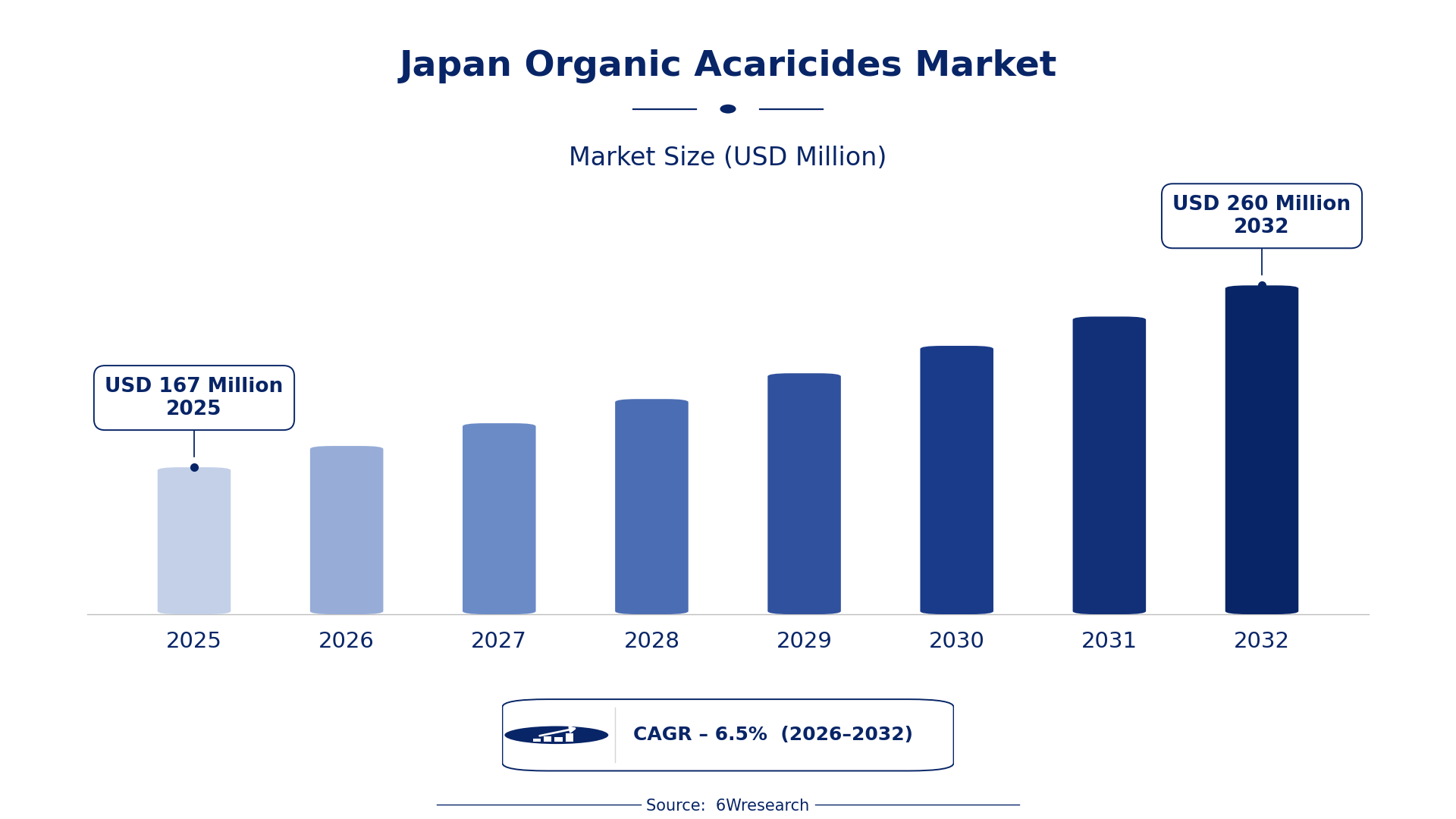
According to 6Wresearch internal database and industry insights, the Japan Organic Acaricides Market was valued at USD 167 Million in 2025 and is projected to reach USD 260 Million by 2032, growing at a CAGR of approximately 6.5% during 2026–2032.
Japan Organic Acaricides Market Highlights
| Report Metric | Details |
| Report Name | Japan Organic Acaricides Market (2026-2032) |
| Market Size 2025 | USD 167 Million |
| Market Size 2032 | USD 260 Million |
| Absolute Growth 2025–2032 | USD 93 Million |
| CAGR 2026–2032 | 6.5% |
| Peak Annual Growth | 7.5% in 2032 |
| Forecast Period | 2026–2032 |
| Historical Data | 2022–2025 |
| Base Year | 2025 |
| Leading Organic Acaricides Market, 2025 | Plant-Based Acaricides (39% share) |
| Leading Product Type, 2025 | Neem Oil (35% share) |
| Leading Formulation Type, 2025 | Liquid Concentrate (44% share) |
| Leading Distribution Channel, 2025 | Agricultural Stores (43% share) |
| Leading End User, 2025 | Organic Farmers (38% share) |
| Fastest-Growing Organic Acaricides Market | Biological Acaricides (8.6% CAGR) |
| Fastest-Growing Product Type | Garlic (9.4% CAGR) |
| Fastest-Growing Formulation Type | Spray & Powder Form (9.3% CAGR) |
| Fastest-Growing Distribution Channel | Online Platforms (8.3% CAGR) |
| Fastest-Growing End User | Pest Control Firms (8.7% CAGR) |
| Growing Sector | Organic Agriculture |
| Key End Users | Organic Farmers, Home Gardeners, Greenhouse Growers |
Japan Organic Acaricides Market Year-wise Growth Rate and Key Drivers (2022–2032)
This graph illustrates the annual growth rates of the market from 2022 to 2032, highlighting a steady upward trajectory and projected market expansion over the forecast period.
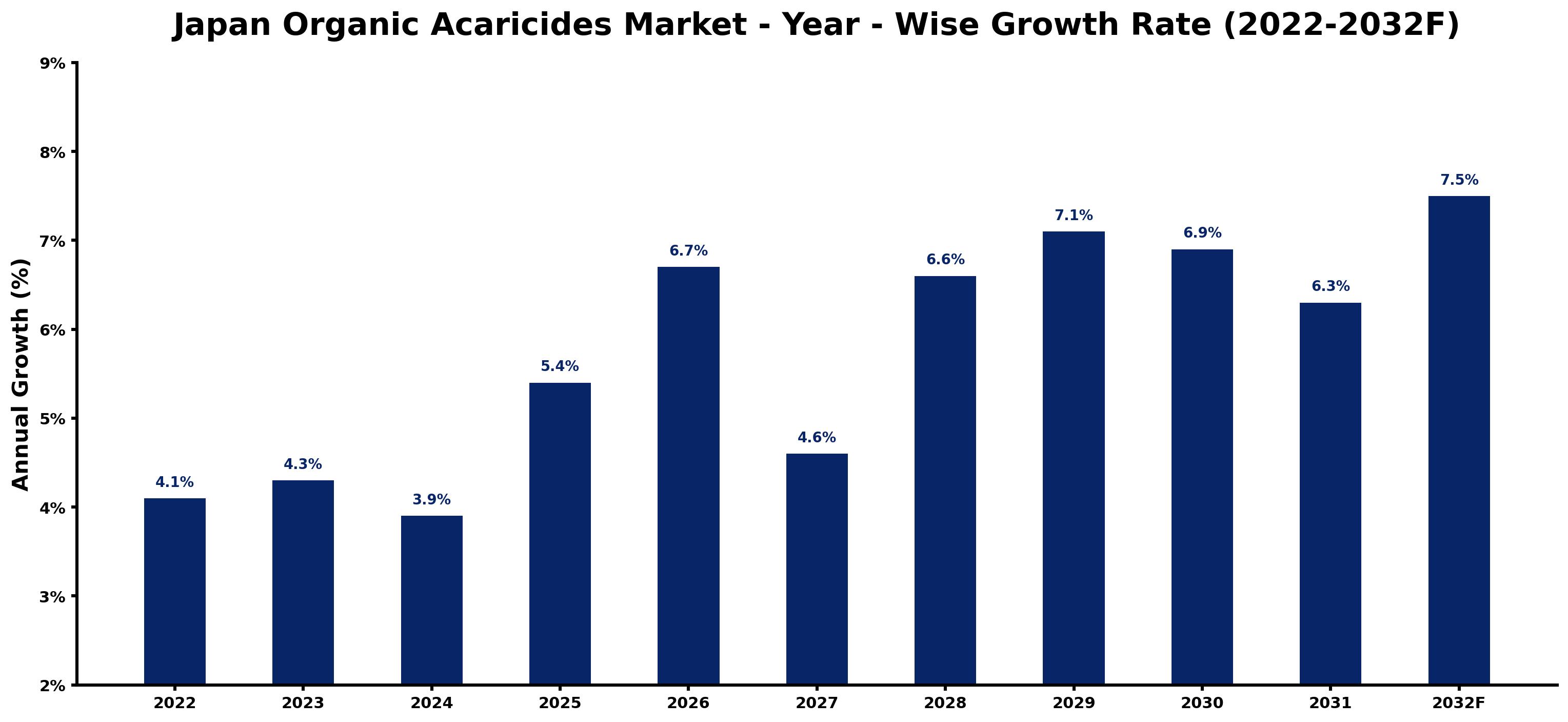
The table below sets out the estimated growth rate for each year and the main factor behind it.
| Year | Estimated Annual Growth (%) | Market Rationale |
| 2022 | 4.1 | The market showed steady growth, driven by increased interest in organic farming practices. |
| 2023 | 4.3 | Demand for organic pest control products continued to rise, reflecting consumer preferences for sustainable solutions. |
| 2024 | 3.9 | Growth slowed slightly as market adjustments occurred, but organic farming remained a priority for many. |
| 2025 | 5.4 | The market experienced an uptick, supported by government initiatives promoting organic agriculture. |
| 2026 | 6.7 | Demand is expected to surge as organic farming practices gain traction, leading to increased purchases of acaricides. |
| 2027 | 4.6 | Growth will slow as market saturation begins to influence purchasing patterns among consumers. |
| 2028 | 6.6 | The market is projected to rebound with renewed interest in organic gardening, boosting acaricide sales once again. |
| 2029 | 7.1 | Demand is expected to accelerate as urban gardening initiatives expand, increasing the need for effective pest control. |
| 2030 | 6.9 | Growth will slow slightly as the market stabilises, reflecting a mature phase of organic pest management. |
| 2031 | 6.3 | The market will continue to grow, driven by ongoing consumer interest in organic solutions for pest control. |
| 2032 | 7.5 | Demand is projected to peak as organic farming becomes mainstream, significantly increasing acaricide purchases. |
Note: Market size estimations and growth projections presented in this report are based on 6Wresearch's proprietary forecasting methodology, utilizing the latest available industry data, government publications, and primary research inputs.
Japan Organic Acaricides Market Synopsis
Organic acaricides are derived from natural sources and are key to controlling mite populations in agriculture. These products find their primary application in organic farming and home gardening, focusing on sustainable practices. The Japan Organic Acaricides Market is growing due to the increase in organic farming, which spans 400,000 hectares and includes around 60,000 certified organic farmers. Government support through various initiatives and rising consumer interest among home gardeners, estimated at 15% annually, are primary drivers of this market's growth.
Market Dynamics Impact Analysis (2026–2032)
| Factor | Type | Impact | Primary Segment Affected |
| Increasing organic farming area | Driver | High | Plant-Based Acaricides |
| Rising consumer interest in sustainable pest control | Driver | High | Biological Acaricides |
| Growing demand for organic solutions among urban gardeners | Opportunity | High | Essential Oil Acaricides |
| Expansion of online sales channels for organic products | Opportunity | Medium | Sulfur-Based Acaricides |
| Limited awareness among conventional farmers | Restraint | Medium | Plant-Based Acaricides |
| Higher costs associated with organic certification | Restraint | High | Biological Acaricides |
| Supply chain disruptions affecting product availability | Challenge | High | Essential Oil Acaricides |
| Competition from synthetic pest control products | Challenge | Medium | Sulfur-Based Acaricides |
Evaluation of Drivers in Japan Organic Acaricides Market (2026–2032)
These are the developments adding the most demand over the forecast period.
| Drivers | Primary Segment Affected | Why It Matters (Evidence) |
| Increase in organic farming area to 400,000 hectares | Plant-Based Acaricides | This expansion drives demand for effective pest management solutions among organic farmers. |
| Growing number of certified organic farmers at approximately 60,000 | Biological Acaricides | More farmers adopting organic practices increases the need for natural pest control options. |
| Rising consumer interest in sustainable gardening practices | Essential Oil Acaricides | Home gardeners are increasingly seeking organic solutions, boosting demand for effective acaricides. |
| Government support through various initiatives, including subsidies | Sulfur-Based Acaricides | This initiative encourages organic farming, leading to higher demand for organic pest control products. |
| Urban gardening initiatives in the Tokyo Metropolitan area | Micronized Sulfur | These initiatives promote the use of organic solutions, increasing the need for effective acaricides. |
Behind the steady rise in orders sits the increase in organic farming area, which reached 400,000 hectares in 2022, driving demand for effective pest management solutions. The growing number of certified organic farmers, approximately 60,000, leads to increased adoption of organic solutions for pest control. Consumer interest in sustainable gardening practices has spurred home gardeners to seek organic products, boosting the demand for effective acaricides.
Evaluation of Restraints in Japan Organic Acaricides Market
These are the pressures that could keep growth below its potential.
| Market Restraint | Primary Segment Affected | Why It Matters (Evidence) |
| Limited awareness among conventional farmers about organic acaricides | Plant-Based Acaricides | This lack of knowledge restricts market growth as conventional farmers may not consider organic options. |
| Higher costs associated with organic certification processes | Biological Acaricides | These costs deter some farmers from transitioning to organic practices, limiting the customer base. |
| Supply chain disruptions affecting product availability | Essential Oil Acaricides | Such disruptions can lead to delays in product delivery, impacting sales and customer satisfaction. |
| Competition from synthetic pest control products | Sulfur-Based Acaricides | Synthetic options often have lower prices, making them more attractive to some farmers. |
| Regulatory hurdles for new organic product approvals | Micronized Sulfur | These hurdles can slow down the introduction of new products into the market. |
Japan Organic Acaricides Market Challenges
Certification processes for acaricides are subject to stringent regulations, causing delays of up to six months for producers. Technology gaps hinder the development of effective pest control solutions, resulting in a 15% annual increase in pest damage for farmers. Rising production costs, compounded by a ¥1 billion government subsidy in 2023, strain budgets for organic farmers, compelling them to reconsider pest management strategies. Limited expertise in organic farming practices restricts growers' ability to utilise available products effectively, reducing yields and profitability for producers in the sector.
Trends in the Japan Organic Acaricides Market
The shifts below are changing how Japan Organic Acaricides Market products are bought and supplied.
- Shift towards Urban Organic Gardening: Urban gardeners are increasingly adopting organic practices, particularly in the Tokyo Metropolitan area, where local initiatives support sustainable gardening. This trend is reflected in the rising demand for organic acaricides, projected to grow by 15% annually.
- Growing Popularity of Essential Oil Acaricides: Essential oil acaricides are gaining traction among greenhouse growers in urban areas, driven by their natural pest management properties. This segment is expected to expand as more growers seek sustainable solutions.
- Increase in Online Sales Channels: The rise of online platforms for purchasing organic products is transforming distribution methods. With a projected growth rate of 8.3%, online sales are becoming a preferred channel for consumers seeking organic acaricides.
- Expansion of Organic Farming Initiatives: Government programs promoting organic farming are shaping market trends. The allocation of ¥1 billion for organic farming subsidies in 2023 is anticipated to improve the availability of organic acaricides.
Investment Opportunities in the Japan Organic Acaricides Market
Where to invest in the Japan Organic Acaricides Market: the main openings are set out below.
- Urban Gardening Initiatives: Urban gardening in the Tokyo Metropolitan area is creating demand for organic acaricides, with a projected growth rate of 15%. Suppliers should consider partnerships with local gardening associations to tap into this market.
- Online Sales Expansion: The growth of online platforms offers a timely opportunity to reach consumers seeking organic solutions. Collaborating with e-commerce platforms can facilitate access to a broader audience of home gardeners.
- Support for Organic Farming Programs: The Japanese government's allocation of ¥1 billion for organic farming subsidies presents an opportunity for suppliers to engage with organic farmers. Establishing partnerships with agricultural cooperatives can improve market penetration.
- Rising Demand from Greenhouse Growers: Greenhouse growers are increasingly utilising organic acaricides, particularly essential oils, to manage pests. Investing in targeted marketing strategies can help suppliers reach this growing segment effectively.
Government Initiatives in the Japan Organic Acaricides Market
The Waste Management and Public Cleansing Act ensures proper treatment and disposal of waste, supporting organic farmers by promoting environmentally friendly practices and compliance with safety standards. The JAS standards also contribute to certifying organic products, ensuring quality and safety for consumers.
The Ministry of Agriculture, Forestry and Fisheries oversees the implementation of organic farming initiatives and allocates funding for related projects. This agency is responsible for approving subsidies, which can greatly benefit organic farmers and acaricide producers.
Future Insight of the Japan Organic Acaricides Market
Government initiatives will bolster support for organic farming, prompting suppliers to innovate in product offerings. The organic farming area is projected to reach 600,000 hectares, creating opportunities for advanced formulations tailored to urban gardening. Urban gardening programs will encourage suppliers to develop targeted solutions that meet specific consumer needs. Training programs will enhance farmers' skills, ensuring effective application of acaricides and boosting agricultural productivity.
Market Segmentation Analysis
Japan Organic Acaricides Market report covers a detailed analysis of the following market segments:
By Organic Acaricides Market – Plant-Based Acaricides Lead, Biological Acaricides Expected to Grow Fastest
According to Aarti Yadav, Research Associate at 6Wresearch, Plant-Based Acaricides took 39% of organic acaricides market revenue in 2025, more than any other category. Plant-Based Acaricides dominate due to their widespread adoption among organic farmers, who rely on these products for effective pest control. For instance, the Kanto region, known for its agricultural activities, sees extensive use of these acaricides. Biological Acaricides are projected to grow fastest, at a CAGR of 8.6% during 2026–2032. Biological Acaricides are experiencing rapid growth as urban greenhouse growers increasingly seek natural pest management solutions. The popularity of these products is further supported by the government's initiatives promoting organic farming. Suppliers should focus on expanding their offerings in biological options to meet the rising demand from urban growers.
By Product Type – Neem Oil Leads, Garlic Expected to Grow Fastest
Neem Oil held 35% of the Japan Organic Acaricides Market by product type in 2025. Neem Oil commands the largest share due to its established reputation for effective insect control, making it a staple for organic farmers. Its widespread use in various agricultural practices solidifies its position as the preferred organic acaricide. The quickest growth will come from Garlic, forecast to expand at a CAGR of 9.4% between 2026 and 2032. Garlic is rapidly gaining popularity as a natural repellent, particularly among urban gardeners looking for eco-friendly solutions. This trend is supported by a growing consumer preference for organic products, which is driving its market growth. Buyers should consider incorporating a variety of organic acaricides to optimise their pest management approaches.
By Formulation Type – Liquid Concentrate Leads, Spray & Powder Form Expected to Grow Fastest
The largest formulation type category in 2025 was Liquid Concentrate, at 44% of revenue. Liquid Concentrate is the preferred formulation due to its ease of application, making it a favourite among farmers. This convenience has led to a substantial installed base in the market. Over 2026–2032, Spray & Powder Form is expected to post the fastest growth, at a CAGR of 9.3%. Spray & Powder Form is rapidly gaining popularity for its versatility, allowing users to adapt their pest control methods according to specific needs. The flexibility of this formulation type is appealing to a broad range of users. Suppliers should consider developing more versatile formulations to cater to the changing preferences of users.
By Distribution Channel – Agricultural Stores Lead, Online Platforms Expected to Grow Fastest
In 2025, Agricultural Stores led the distribution channel split with a 43% share. Agricultural Stores hold the largest share as they serve as the primary source for organic acaricides, directly catering to farmers' needs. Their established networks and relationships within the agricultural community ensure consistent access to these products. Online Platforms are set to record the highest CAGR in this split, 8.3% over 2026–2032. Online Platforms are experiencing rapid growth due to the rising preference for convenient purchasing options among home gardeners. This trend reflects a shift in consumer behaviour towards digital channels for acquiring agricultural products. Suppliers need to focus on strengthening their online sales strategies to capture the growing consumer interest in digital purchasing.
By End User – Organic Farmers Lead, Pest Control Firms Expected to Grow Fastest
Organic Farmers accounted for 38% of the market by end user in 2025. Organic Farmers constitute the largest user group of organic acaricides, relying on these products for sustainable pest management in their agricultural practices. Their dedication to organic farming ensures a steady demand for effective pest control solutions. Pest Control Firms are projected to grow fastest, at a CAGR of 8.7% during 2026–2032. Pest Control Firms are rapidly adopting organic acaricides as part of their service offerings, reflecting a growing trend towards environmentally responsible pest management. The rising consumer awareness of organic practices is driving this growth in demand. Suppliers should focus on developing tailored solutions that meet the evolving needs of pest control firms as they expand their organic service capabilities.
Key Attractiveness of the Report
- 10 Years of Market Numbers
- Historical Data Starting from 2022 to 2025
- Base Year 2025
- Forecast Data until 2032
- Key Performance Indicators Impacting the Market
- Major Upcoming Developments and Projects
Key Highlights of the Report:
- Japan Organic Acaricides Market Outlook
- Market Size of Japan Organic Acaricides Market, 2025
- Forecast of Japan Organic Acaricides Market, 2032
- Historical Data and Forecast of Japan Organic Acaricides Revenues & Volume for the Period 2022-2032F
- Japan Organic Acaricides Market Trend Evolution
- Japan Organic Acaricides Market Drivers and Challenges
- Japan Organic Acaricides Price Trends
- Japan Organic Acaricides Porter's Five Forces
- Japan Organic Acaricides Industry Life Cycle
- Historical Data and Forecast of Japan Organic Acaricides Market Revenues & Volume By Organic Acaricides Market for the Period 2022-2032F
- Historical Data and Forecast of Japan Organic Acaricides Market Revenues & Volume By Plant-Based Acaricides for the Period 2022-2032F
- Historical Data and Forecast of Japan Organic Acaricides Market Revenues & Volume By Biological Acaricides for the Period 2022-2032F
- Historical Data and Forecast of Japan Organic Acaricides Market Revenues & Volume By Essential Oil Acaricides for the Period 2022-2032F
- Historical Data and Forecast of Japan Organic Acaricides Market Revenues & Volume By Sulfur-Based Acaricides for the Period 2022-2032F
- Historical Data and Forecast of Japan Organic Acaricides Market Revenues & Volume By Product Type for the Period 2022-2032F
- Historical Data and Forecast of Japan Organic Acaricides Market Revenues & Volume By Neem Oil, Garlic for the Period 2022-2032F
- Historical Data and Forecast of Japan Organic Acaricides Market Revenues & Volume By Fungal/Bacterial for the Period 2022-2032F
- Historical Data and Forecast of Japan Organic Acaricides Market Revenues & Volume By Eucalyptus, Clove for the Period 2022-2032F
- Historical Data and Forecast of Japan Organic Acaricides Market Revenues & Volume By Micronized Sulfur for the Period 2022-2032F
- Historical Data and Forecast of Japan Organic Acaricides Market Revenues & Volume By Formulation Type for the Period 2022-2032F
- Historical Data and Forecast of Japan Organic Acaricides Market Revenues & Volume By Liquid Concentrate for the Period 2022-2032F
- Historical Data and Forecast of Japan Organic Acaricides Market Revenues & Volume By Spray & Powder Form for the Period 2022-2032F
- Historical Data and Forecast of Japan Organic Acaricides Market Revenues & Volume By Emulsifiable Concentrate for the Period 2022-2032F
- Historical Data and Forecast of Japan Organic Acaricides Market Revenues & Volume By Dust/Wettable Powder for the Period 2022-2032F
- Historical Data and Forecast of Japan Organic Acaricides Market Revenues & Volume By Distribution Channel for the Period 2022-2032F
- Historical Data and Forecast of Japan Organic Acaricides Market Revenues & Volume By Agricultural Stores for the Period 2022-2032F
- Historical Data and Forecast of Japan Organic Acaricides Market Revenues & Volume By Online Platforms for the Period 2022-2032F
- Historical Data and Forecast of Japan Organic Acaricides Market Revenues & Volume By Retail Outlets for the Period 2022-2032F
- Historical Data and Forecast of Japan Organic Acaricides Market Revenues & Volume By Co-op Distributors for the Period 2022-2032F
- Historical Data and Forecast of Japan Organic Acaricides Market Revenues & Volume By End User for the Period 2022-2032F
- Historical Data and Forecast of Japan Organic Acaricides Market Revenues & Volume By Organic Farmers for the Period 2022-2032F
- Historical Data and Forecast of Japan Organic Acaricides Market Revenues & Volume By Pest Control Firms for the Period 2022-2032F
- Historical Data and Forecast of Japan Organic Acaricides Market Revenues & Volume By Home Gardeners for the Period 2022-2032F
- Historical Data and Forecast of Japan Organic Acaricides Market Revenues & Volume By Greenhouse Growers for the Period 2022-2032F
- Japan Organic Acaricides Import Export Trade Statistics
- Market Opportunity Assessment By Organic Acaricides Market
- Market Opportunity Assessment By Product Type
- Market Opportunity Assessment By Formulation Type
- Market Opportunity Assessment By Distribution Channel
- Market Opportunity Assessment By End User
- Japan Organic Acaricides Top Companies Market Share
- Japan Organic Acaricides Competitive Benchmarking By Technical and Operational Parameters
- Japan Organic Acaricides Company Profiles
- Japan Organic Acaricides Key Strategic Recommendations
Market Covered
The following segment groups are covered in the report.
By Organic Acaricides Market
- Plant-Based Acaricides
- Biological Acaricides
- Essential Oil Acaricides
- Sulfur-Based Acaricides
By Product Type
- Neem Oil
- Garlic
- Fungal/Bacterial
- Eucalyptus
- Clove
- Micronized Sulfur
By Formulation Type
- Liquid Concentrate
- Spray & Powder Form
- Emulsifiable Concentrate
- Dust/Wettable Powder
By Distribution Channel
- Agricultural Stores
- Online Platforms
- Retail Outlets
- Co-op Distributors
By End User
- Organic Farmers
- Pest Control Firms
- Home Gardeners
- Greenhouse Growers






































