Japan Organic Acids in Feed Market Size & Growth Rate
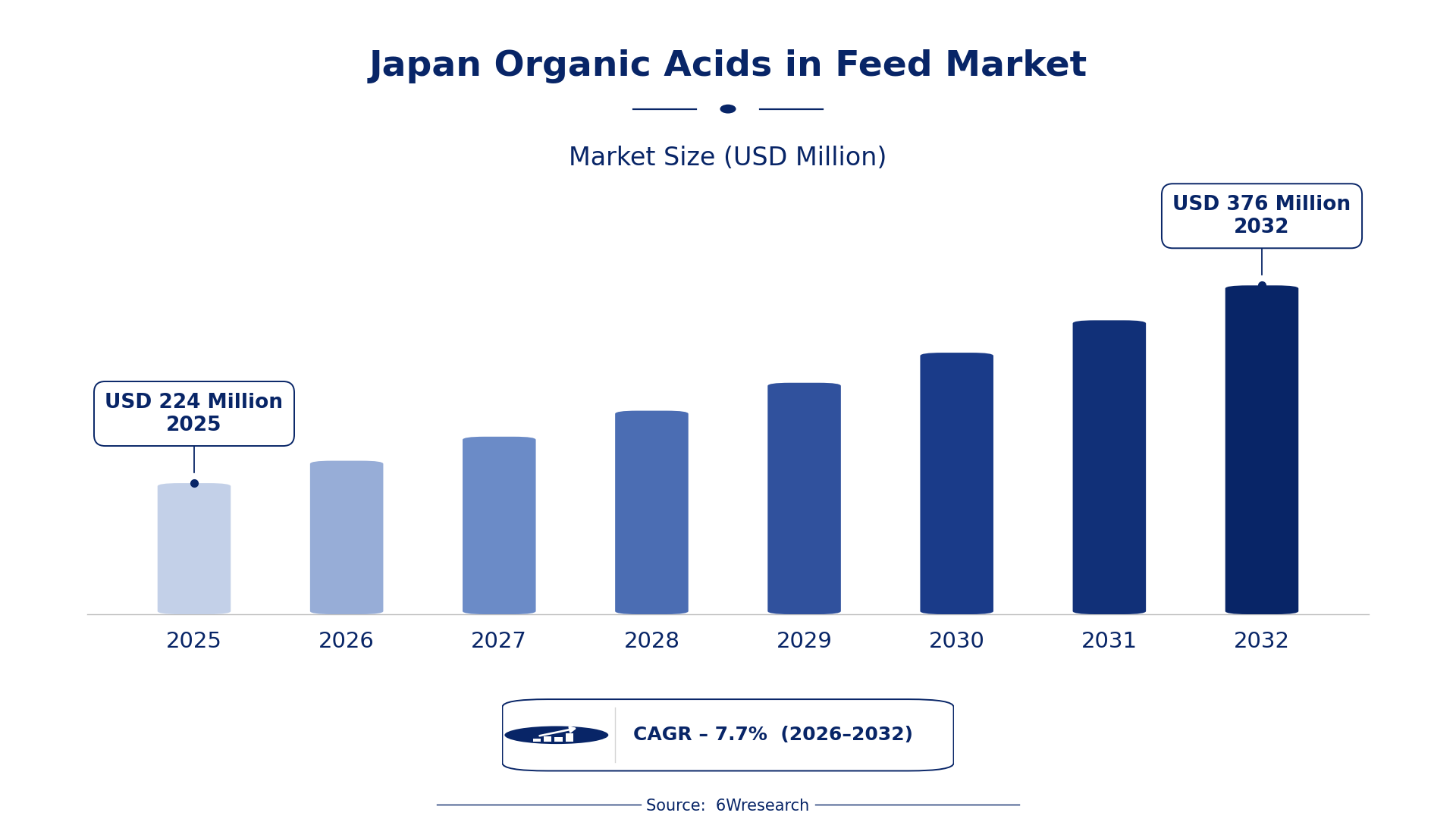
According to 6Wresearch internal database and industry insights, the Japan Organic Acids in Feed Market was valued at USD 224 Million in 2025 and is projected to reach USD 376 Million by 2032, growing at a CAGR of approximately 7.7% during 2026–2032.
Japan Organic Acids in Feed Market Highlights
| Report Metric | Details |
| Report Name | Japan Organic Acids in Feed Market (2026-2032) |
| Market Size 2025 | USD 224 Million |
| Market Size 2032 | USD 376 Million |
| Absolute Growth 2025–2032 | USD 152 Million |
| CAGR 2026–2032 | 7.7% |
| Peak Annual Growth | 8.5% in 2027 |
| Forecast Period | 2026–2032 |
| Historical Data | 2022–2025 |
| Base Year | 2025 |
| Leading Organic Acids in Feed Market, 2025 | Formic Acid (47% share) |
| Leading Acid Type, 2025 | Antibacterial (41% share) |
| Leading Application Type, 2025 | Poultry Feed (38% share) |
| Leading Distribution Channel, 2025 | Bulk Suppliers (38% share) |
| Leading End User, 2025 | Poultry Farmers (44% share) |
| Fastest-Growing Organic Acids in Feed Market | Propionic Acid (9.9% CAGR) |
| Fastest-Growing Acid Type | Digestive Aid (10.7% CAGR) |
| Fastest-Growing Application Type | Cattle Feed (10.2% CAGR) |
| Fastest-Growing Distribution Channel | Agrochemical Dealers (10.0% CAGR) |
| Fastest-Growing End User | Dairy Industry (10.1% CAGR) |
| Growing Sector | Poultry Feed |
| Key End Users | Poultry Farmers, Dairy Industry, Swine Breeders |
Japan Organic Acids in Feed Market Year-wise Growth Rate and Key Drivers (2022–2032)
This graph illustrates the annual growth rates of the market from 2022 to 2032, highlighting a steady upward trajectory and projected market expansion over the forecast period.
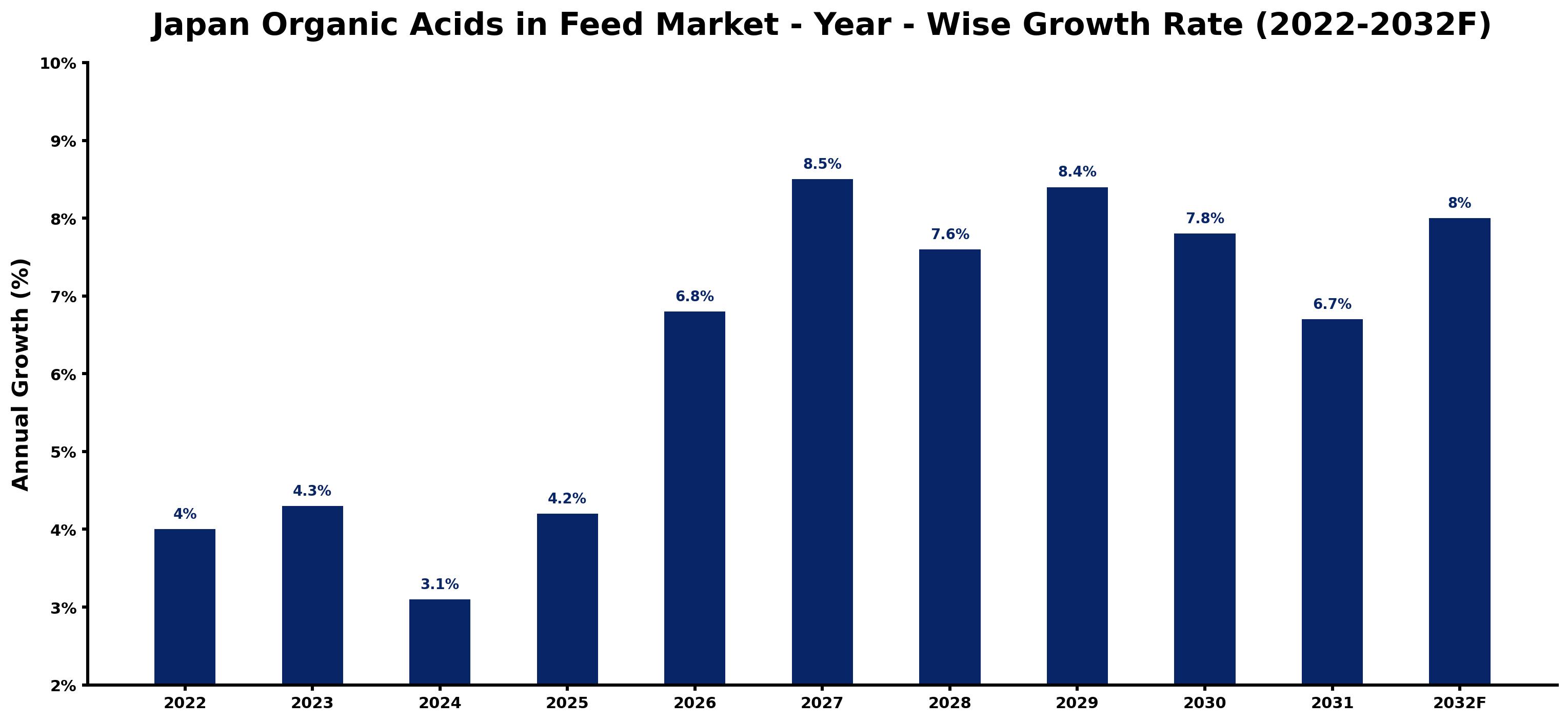
Year by year, the estimates below pair each growth rate with the development that shaped it.
| Year | Estimated Annual Growth (%) | Market Rationale |
| 2022 | 4.0 | The market showed steady growth as poultry populations remained stable and demand for feed additives increased. |
| 2023 | 4.3 | Demand for organic acids rose due to improved awareness of animal health and nutrition among farmers. |
| 2024 | 3.1 | Growth slowed as feed prices increased, prompting farmers to reassess their feed formulations. |
| 2025 | 4.2 | Demand accelerated again as the dairy industry expanded, requiring more efficient feed solutions. |
| 2026 | 6.8 | The market is expected to experience a surge as poultry feed formulations increasingly incorporate organic acids. |
| 2027 | 8.5 | Peak growth will be driven by heightened focus on animal health and performance in livestock. |
| 2028 | 7.6 | Growth is projected to moderate as the market adjusts to previous peaks in demand and production capacity. |
| 2029 | 8.4 | Demand will increase again as farmers seek effective solutions to improve livestock health. |
| 2030 | 7.8 | Growth is expected to slow as market saturation occurs in certain segments, particularly poultry feed. |
| 2031 | 6.7 | The market will continue to grow, albeit at a slower rate, as new applications emerge. |
| 2032 | 8.0 | Demand is projected to surge again as innovations in feed formulations attract more buyers. |
Note: Market size estimations and growth projections presented in this report are based on 6Wresearch's proprietary forecasting methodology, utilizing the latest available industry data, government publications, and primary research inputs.
Japan Organic Acids in Feed Market Synopsis
Organic acids in feed are chemical compounds used to enhance animal health and performance, produced through fermentation or chemical synthesis. The Japan Organic Acids in Feed Market is growing, supported by a poultry population of approximately 150 million and a dairy industry producing around 8 million tons of milk annually. Increased awareness of animal health, the need for effective preservation, and improved nutrient absorption are driving demand for these additives in livestock nutrition.
Market Dynamics Impact Analysis (2026–2032)
| Factor | Type | Impact | Primary Segment Affected |
| Increased focus on animal health and nutrition | Driver | High | Poultry Feed |
| Rising demand for feed preservation solutions | Driver | High | Formic Acid |
| Expanding dairy industry requiring efficient feed solutions | Opportunity | High | Dairy Industry |
| Growing interest in sustainable livestock practices | Opportunity | High | Cattle Feed |
| Fluctuating feed prices impacting purchasing decisions | Restraint | Medium | Pig Feed |
| Limited awareness of organic acids among smaller farmers | Restraint | Medium | Aquaculture Feed |
| High production costs for organic acids | Challenge | High | Formic Acid |
| Dependence on specific feed formulations limiting flexibility | Challenge | Medium | Poultry Feed |
Evaluation of Drivers in Japan Organic Acids in Feed Market (2026–2032)
Key forces behind demand, with the segment each one moves most, are listed below.
| Drivers | Primary Segment Affected | Why It Matters (Evidence) |
| Growing poultry population driving feed demand | Poultry Feed | Japan's poultry population is approximately 150 million, increasing the need for effective feed additives. |
| Demand for effective preservatives in feed formulations | Formic Acid | Formic acid is used in about 30% of poultry feed formulations, maintaining shelf life and quality. |
| Expansion of the dairy sector requiring improved feed | Dairy Industry | The dairy industry produces around 8 million tons of milk annually, necessitating better feed solutions. |
| Rising awareness of gut health in livestock | Lactic Acid | Lactic acid is commonly used to improve digestion and nutrient absorption in cattle feed. |
| Increasing focus on sustainable livestock practices | Cattle Feed | Farmers are adopting organic acids to improve feed efficiency and reduce waste. |
Buyers are adding capacity as the poultry population in Japan reaches approximately 150 million, driving the need for effective feed additives. The dairy industry, producing around 8 million tons of milk annually, is increasingly demanding improved feed solutions, particularly organic acids. The rising focus on sustainable livestock practices encourages farmers to adopt organic acids for better feed efficiency and waste reduction. The growing awareness of gut health among livestock producers is leading to higher demand for lactic acid, which aids digestion and nutrient absorption in cattle feed. This upward trend in the organic acids market reflects producers' efforts to meet evolving livestock nutrition needs.
Evaluation of Restraints in Japan Organic Acids in Feed Market
Several factors work against faster growth; the main ones are summarised below.
| Market Restraint | Primary Segment Affected | Why It Matters (Evidence) |
| High production costs for organic acids | Formic Acid | Production costs for organic acids can be substantial, impacting overall pricing for farmers. |
| Limited awareness of organic acids among smaller farmers | Aquaculture Feed | Many smaller farmers lack knowledge about the benefits of organic acids, limiting their adoption. |
| Fluctuating feed prices impacting purchasing decisions | Pig Feed | Rising feed prices can lead farmers to reconsider their feed formulations and ingredient choices. |
| Dependence on specific feed formulations limiting flexibility | Poultry Feed | Farmers may find it challenging to switch formulations due to established practices and supplier contracts. |
| Regulatory compliance costs for feed additives | Dairy Industry | Compliance with safety regulations can increase costs for producers, affecting pricing strategies. |
Japan Organic Acids in Feed Market Challenges
Producers face escalating logistics costs, with transportation expenses increasing by 15% over the past year, which raises overall feed prices for livestock. Poultry farmers encounter a 10% price rise for organic acids due to limited domestic production capacity, straining their budgets. A lack of qualified nutritionists hampers feed formulation, with 20% of producers unable to find skilled professionals, resulting in delays in product innovation. Stringent testing requirements under the Feed Additives Registration Program cost producers about 5% of their operational budget, limiting their ability to invest in new technologies.
Trends in the Japan Organic Acids in Feed Market
Four trends stand out in the Japan Organic Acids in Feed Market.
- Shift towards Sustainable Livestock Practices: Japan is increasingly adopting sustainable livestock practices, with the dairy industry at the forefront. Approximately 8 million tons of milk produced annually is driving demand for organic acids to improve feed efficiency and reduce waste.
- Increase in Poultry Feed Formulations: The use of organic acids in poultry feed formulations has risen, with formic acid utilised in about 30% of these products. This trend reflects a growing emphasis on animal health and performance.
- Rising Demand for Digestive Aids: Digestive aids are becoming more prevalent in livestock feed, particularly lactic acid, which improves nutrient absorption. This trend is clear as farmers increasingly focus on gut health in their livestock.
- Expansion of the Dairy Sector: The dairy sector in Japan is expanding, producing around 8 million tons of milk annually. This growth is driving demand for organic acids to improve feed quality and livestock health.
Investment Opportunities in the Japan Organic Acids in Feed Market
Below are the investment opportunities with the strongest case in the Japan Organic Acids in Feed Market.
- Organic Acids for Poultry Nutrition: There is a growing opportunity to supply organic acids for poultry nutrition, supported by a poultry population of approximately 150 million. Collaborating with poultry farmers can broaden product reach.
- Entry into the Dairy Sector: Investing in organic acids for the dairy sector presents an opportunity, as the industry produces around 8 million tons of milk annually. Establishing partnerships with dairy producers can facilitate market entry.
- Supply of Digestive Aids: The demand for digestive aids in livestock feed is rising, particularly for cattle. Focusing on this segment can attract dairy farmers looking to improve feed efficiency.
- Distribution through Bulk Suppliers: Bulk suppliers remain a primary distribution channel for organic acids, holding a significant market share. Forming partnerships with these distributors can streamline market access.
Government Initiatives in the Japan Organic Acids in Feed Market
The framework governing organic acids in feed is shaped by several laws, including the Chemical Substances Control Law, which mandates evaluation of chemical substances, and the PRTR Law, which requires businesses to report chemical releases. These regulations create a structured environment for organic acid producers and buyers, ensuring compliance and safety in feed formulations. The Act against Unjustifiable Premiums and Misleading Representations prohibits misleading labelling and advertising of goods, further protecting consumers.
The Japan Animal Feed Manufacturers Association (JAFMA) oversees the approval and funding of feed additives, including organic acids. The Ministry of Agriculture, Forestry and Fisheries (MAFF) promotes safe feed ingredients and supports compliance with industry standards. These agencies play an important role in ensuring that organic acids meet safety requirements and are effectively integrated into livestock feed.
Future Insight of the Japan Organic Acids in Feed Market
Advancements in fermentation technology will transform organic acid production, improving efficiency in feed formulations. By 2032, the integration of smart farming technologies will optimise livestock management, enhancing animal health outcomes. Implementation of ISO 9001 standards will strengthen quality assurance in feed production, benefiting suppliers and buyers alike. The Japanese aquaculture market, valued at approximately 1.5 billion USD, will see expanded niche applications for organic acids, creating new opportunities for producers.
Market Segmentation Analysis
Japan Organic Acids in Feed Market report covers a detailed analysis of the following market segments:
By Organic Acids in Feed Market – Formic Acid Leads, Propionic Acid Expected to Grow Fastest
According to Aarti Yadav, Research Associate at 6Wresearch, the largest organic acids in feed market category in 2025 was Formic Acid, at 47% of revenue. Formic acid commands the largest share due to its prevalent use as a preservative in animal feed, particularly in poultry formulations. Its incorporation in approximately 30% of poultry feed formulations underscores its critical role in ensuring feed quality and safety. Propionic Acid is projected to grow fastest, at a CAGR of 9.9% during 2026–2032. Propionic acid is witnessing rapid growth as it effectively prevents mold growth in feed, a vital concern for producers. The rising emphasis on maintaining feed safety and quality propels this increasing demand. Suppliers should prioritise the availability of propionic acid to address the expanding market requirements.
By Acid Type – Antibacterial Leads, Digestive Aid Expected to Grow Fastest
Antibacterial took 41% of acid type revenue in 2025, more than any other category. Antibacterial organic acids lead the market as they are crucial for controlling bacterial growth in feed, thereby safeguarding animal health. Their extensive application across various livestock sectors reinforces their dominant status. The quickest growth will come from Digestive Aid, forecast to expand at a CAGR of 10.7% between 2026 and 2032. The digestive aid segment is experiencing swift growth, driven by the necessity to enhance nutrient absorption in livestock, which is vital for boosting overall productivity. This trend indicates a heightened focus on animal performance and health. Buyers should seek to acquire more digestive aids to optimise livestock efficiency.
By Application Type – Poultry Feed Leads, Cattle Feed Expected to Grow Fastest
In 2025, Poultry Feed led the application type split with a 38% share. Poultry feed is the foremost application type due to the considerable poultry population in Japan, estimated at around 150 million. This substantial demand for poultry nutrition directly supports the utilisation of organic acids. Over 2026–2032, Cattle Feed is expected to post the fastest growth, at a CAGR of 10.2%. Cattle feed is growing at the fastest rate as producers increasingly adopt organic acids to improve digestion in cattle, reflecting the dairy industry's significant output of approximately 8 million tons of milk annually. Suppliers may need to broaden their product lines in cattle feed to capitalise on this growth opportunity.
By Distribution Channel – Bulk Suppliers Lead, Agrochemical Dealers Expected to Grow Fastest
Bulk Suppliers held 38% of the Japan Organic Acids in Feed Market by distribution channel in 2025. Bulk suppliers lead the market as they serve as the primary distribution channel for large quantities of organic acids, catering to the high-volume needs of the livestock industry. Their established networks ensure consistent supply to major producers. Agrochemical Dealers are set to record the highest CAGR in this split, 10.0% over 2026–2032. Agrochemical dealers are growing rapidly as they cater to smaller quantity needs, allowing more flexible purchasing options for farmers. This trend is driven by the increasing number of smaller farms seeking quality feed additives. Suppliers should consider partnerships with agrochemical dealers to reach a broader customer base.
By End User – Poultry Farmers Lead, Dairy Industry Expected to Grow Fastest
With 44% of end user revenue in 2025, Poultry Farmers was the largest category. Poultry farmers represent the largest end user group of organic acids in feed, motivated by the extensive poultry population and the necessity for effective feed solutions. Their dependence on organic acids for maintaining animal health solidifies their leading position. Dairy Industry is projected to grow fastest, at a CAGR of 10.1% during 2026–2032. The dairy industry is the fastest-growing end user, employing organic acids to enhance cattle feed and boost milk production. The industry's robust output necessitates effective feed solutions to support its growth. Suppliers should customise their offerings to meet the specific demands of the dairy industry.
Key Attractiveness of the Report
- 10 Years of Market Numbers
- Historical Data Starting from 2022 to 2025
- Base Year 2025
- Forecast Data until 2032
- Key Performance Indicators Impacting the Market
- Major Upcoming Developments and Projects
Key Highlights of the Report:
- Japan Organic Acids in Feed Market Outlook
- Market Size of Japan Organic Acids in Feed Market, 2025
- Forecast of Japan Organic Acids in Feed Market, 2032
- Historical Data and Forecast of Japan Organic Acids in Feed Revenues & Volume for the Period 2022-2032F
- Japan Organic Acids in Feed Market Trend Evolution
- Japan Organic Acids in Feed Market Drivers and Challenges
- Japan Organic Acids in Feed Price Trends
- Japan Organic Acids in Feed Porter's Five Forces
- Japan Organic Acids in Feed Industry Life Cycle
- Historical Data and Forecast of Japan Organic Acids in Feed Market Revenues & Volume By Organic Acids in Feed Market for the Period 2022-2032F
- Historical Data and Forecast of Japan Organic Acids in Feed Market Revenues & Volume By Formic Acid for the Period 2022-2032F
- Historical Data and Forecast of Japan Organic Acids in Feed Market Revenues & Volume By Propionic Acid for the Period 2022-2032F
- Historical Data and Forecast of Japan Organic Acids in Feed Market Revenues & Volume By Lactic Acid for the Period 2022-2032F
- Historical Data and Forecast of Japan Organic Acids in Feed Market Revenues & Volume By Citric Acid for the Period 2022-2032F
- Historical Data and Forecast of Japan Organic Acids in Feed Market Revenues & Volume By Acid Type for the Period 2022-2032F
- Historical Data and Forecast of Japan Organic Acids in Feed Market Revenues & Volume By Antibacterial for the Period 2022-2032F
- Historical Data and Forecast of Japan Organic Acids in Feed Market Revenues & Volume By Mold Inhibitor for the Period 2022-2032F
- Historical Data and Forecast of Japan Organic Acids in Feed Market Revenues & Volume By Digestive Aid for the Period 2022-2032F
- Historical Data and Forecast of Japan Organic Acids in Feed Market Revenues & Volume By Growth Enhancer for the Period 2022-2032F
- Historical Data and Forecast of Japan Organic Acids in Feed Market Revenues & Volume By Application Type for the Period 2022-2032F
- Historical Data and Forecast of Japan Organic Acids in Feed Market Revenues & Volume By Poultry Feed for the Period 2022-2032F
- Historical Data and Forecast of Japan Organic Acids in Feed Market Revenues & Volume By Cattle Feed for the Period 2022-2032F
- Historical Data and Forecast of Japan Organic Acids in Feed Market Revenues & Volume By Pig Feed for the Period 2022-2032F
- Historical Data and Forecast of Japan Organic Acids in Feed Market Revenues & Volume By Aquaculture Feed for the Period 2022-2032F
- Historical Data and Forecast of Japan Organic Acids in Feed Market Revenues & Volume By Distribution Channel for the Period 2022-2032F
- Historical Data and Forecast of Japan Organic Acids in Feed Market Revenues & Volume By Bulk Suppliers for the Period 2022-2032F
- Historical Data and Forecast of Japan Organic Acids in Feed Market Revenues & Volume By Agrochemical Dealers for the Period 2022-2032F
- Historical Data and Forecast of Japan Organic Acids in Feed Market Revenues & Volume By Online Retail for the Period 2022-2032F
- Historical Data and Forecast of Japan Organic Acids in Feed Market Revenues & Volume By Animal Nutrition Brands for the Period 2022-2032F
- Historical Data and Forecast of Japan Organic Acids in Feed Market Revenues & Volume By End User for the Period 2022-2032F
- Historical Data and Forecast of Japan Organic Acids in Feed Market Revenues & Volume By Poultry Farmers for the Period 2022-2032F
- Historical Data and Forecast of Japan Organic Acids in Feed Market Revenues & Volume By Dairy Industry for the Period 2022-2032F
- Historical Data and Forecast of Japan Organic Acids in Feed Market Revenues & Volume By Swine Breeders for the Period 2022-2032F
- Historical Data and Forecast of Japan Organic Acids in Feed Market Revenues & Volume By Fish Farms for the Period 2022-2032F
- Japan Organic Acids in Feed Import Export Trade Statistics
- Market Opportunity Assessment By Organic Acids in Feed Market
- Market Opportunity Assessment By Acid Type
- Market Opportunity Assessment By Application Type
- Market Opportunity Assessment By Distribution Channel
- Market Opportunity Assessment By End User
- Japan Organic Acids in Feed Top Companies Market Share
- Japan Organic Acids in Feed Competitive Benchmarking By Technical and Operational Parameters
- Japan Organic Acids in Feed Company Profiles
- Japan Organic Acids in Feed Key Strategic Recommendations
Market Covered
Segments analysed in this report are listed below.
By Organic Acids in Feed Market
- Formic Acid
- Propionic Acid
- Lactic Acid
- Citric Acid
By Acid Type
- Antibacterial
- Mold Inhibitor
- Digestive Aid
- Growth Enhancer
By Application Type
- Poultry Feed
- Cattle Feed
- Pig Feed
- Aquaculture Feed
By Distribution Channel
- Bulk Suppliers
- Agrochemical Dealers
- Online Retail
- Animal Nutrition Brands
By End User
- Poultry Farmers
- Dairy Industry
- Swine Breeders
- Fish Farms






































