Japan Organic Beans Market Size & Growth Rate
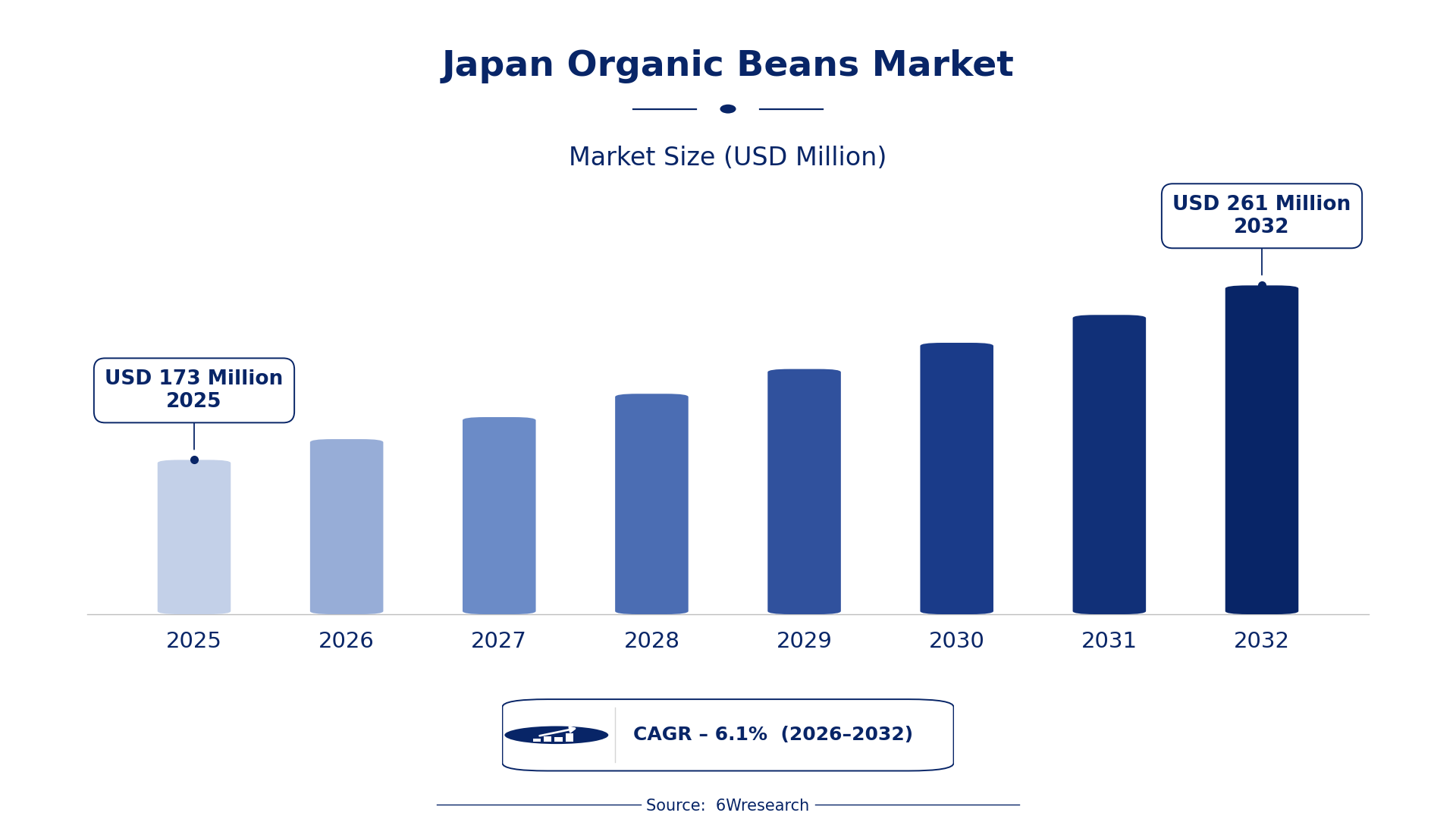
According to 6Wresearch internal database and industry insights, the Japan Organic Beans Market was valued at USD 173 Million in 2025 and is projected to reach USD 261 Million by 2032, growing at a CAGR of approximately 6.1% during 2026–2032.
Japan Organic Beans Market Highlights
| Report Metric | Details |
| Report Name | Japan Organic Beans Market (2026-2032) |
| Market Size 2025 | USD 173 Million |
| Market Size 2032 | USD 261 Million |
| Absolute Growth 2025–2032 | USD 88 Million |
| CAGR 2026–2032 | 6.1% |
| Peak Annual Growth | 7.4% in 2032 |
| Forecast Period | 2026–2032 |
| Historical Data | 2022–2025 |
| Base Year | 2025 |
| Leading Organic Beans Market, 2025 | Organic Soybeans (43% share) |
| Leading Bean Type, 2025 | Dried (48% share) |
| Leading Processing Type, 2025 | Washed & Packed (41% share) |
| Leading Distribution Channel, 2025 | Online Grocery (38% share) |
| Leading End User, 2025 | Health-Focused Shoppers (38% share) |
| Fastest-Growing Organic Beans Market | Organic Lentils (8.4% CAGR) |
| Fastest-Growing Bean Type | Canned (9.3% CAGR) |
| Fastest-Growing Distribution Channel | Wholesale Stores (8.2% CAGR) |
| Fastest-Growing End User | Vegan Households (8.3% CAGR) |
| Growing Sector | Vegan Households |
| Key End Users | Health-Focused Shoppers, Vegan Households, Restaurants & Cafes, Tofu & Soy Milk Producers |
Japan Organic Beans Market Year-wise Growth Rate and Key Drivers (2022–2032)
This graph illustrates the annual growth rates of the market from 2022 to 2032, highlighting a steady upward trajectory and projected market expansion over the forecast period.
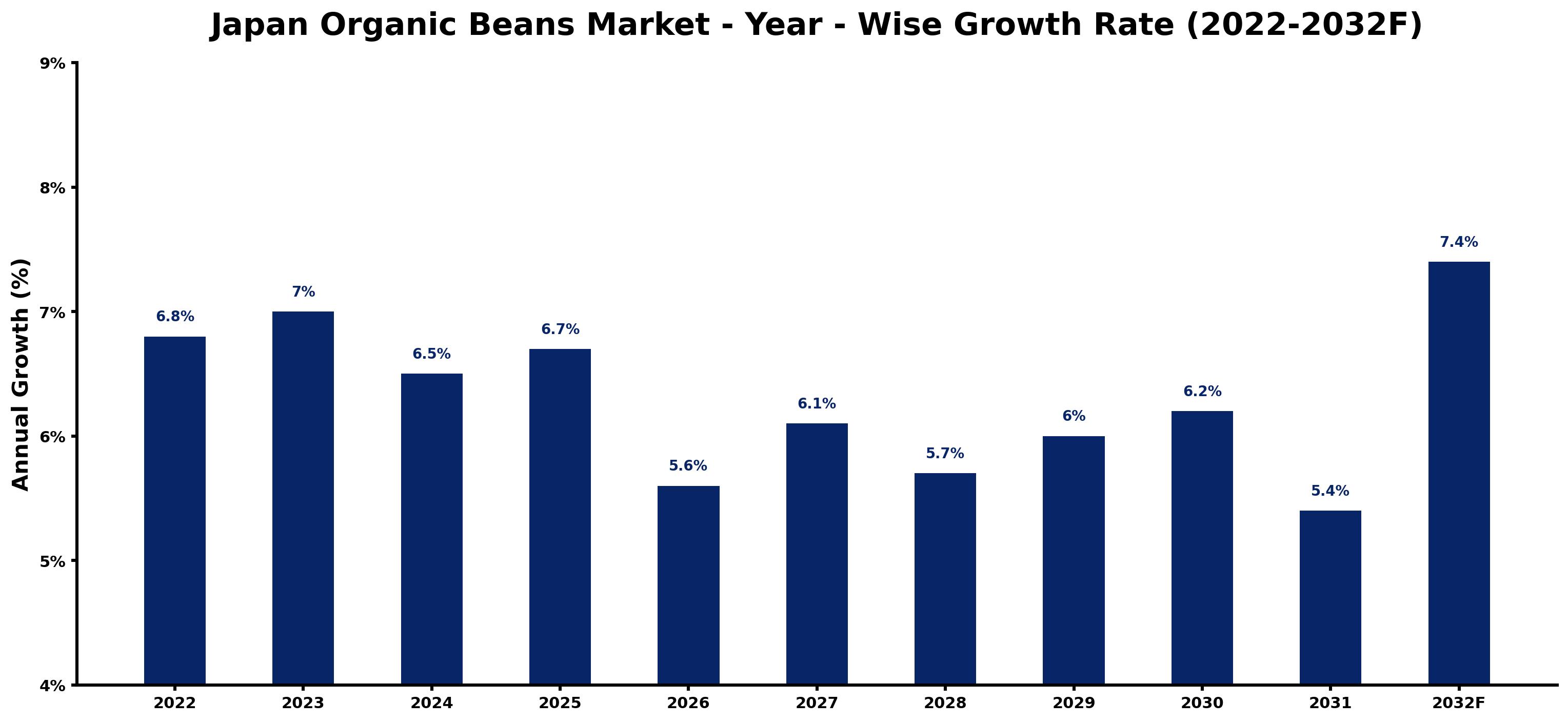
The table below sets out the estimated growth rate for each year and the main factor behind it.
| Year | Estimated Annual Growth (%) | Market Rationale |
| 2022 | 6.8 | The market experienced steady growth due to rising health consciousness among consumers. |
| 2023 | 7.0 | Demand surged as more health-focused restaurants incorporated organic beans into their menus. |
| 2024 | 6.5 | Growth slowed slightly as competition increased among suppliers of organic beans. |
| 2025 | 6.7 | Sales picked up again, driven by an increase in vegan households across the country. |
| 2026 | 5.6 | Growth is expected to decelerate as market saturation begins to affect new customer acquisition. |
| 2027 | 6.1 | Demand is projected to increase again as organic products gain popularity among mainstream consumers. |
| 2028 | 5.7 | Growth is expected to slow due to a temporary dip in consumer spending on premium products. |
| 2029 | 6.0 | Sales will rise as health-focused shoppers continue to expand their organic purchases. |
| 2030 | 6.2 | Demand is projected to grow as more food manufacturers seek organic ingredients for their products. |
| 2031 | 5.4 | Growth is expected to slow again as the market reaches a more mature phase. |
| 2032 | 7.4 | The market is projected to peak, driven by heightened awareness of health benefits associated with organic foods. |
Note: Market size estimations and growth projections presented in this report are based on 6Wresearch's proprietary forecasting methodology, utilizing the latest available industry data, government publications, and primary research inputs.
Japan Organic Beans Market Synopsis
Organic beans are cultivated without synthetic fertilizers or pesticides, primarily through sustainable farming practices. The Japan Organic Beans Market, valued at approximately 100 billion yen, is experiencing growth driven by health-conscious households and the increasing number of vegan consumers. Factors such as the popularity of organic black beans in health-focused restaurants and a 30% increase in online grocery sales in 2023 contribute to this upward trend.
Market Dynamics Impact Analysis (2026–2032)
| Factor | Type | Impact | Primary Segment Affected |
| Growing health consciousness among consumers | Driver | High | Organic Soybeans |
| Increase in vegan households | Driver | High | Organic Lentils |
| Expansion of online grocery sales | Opportunity | High | Dried |
| Rising demand for plant-based products | Opportunity | High | Canned |
| Higher prices compared to conventional beans | Restraint | Medium | Organic Black Beans |
| Limited supply from domestic sources | Restraint | Medium | Organic Soybeans |
| Competition from conventional bean suppliers | Challenge | High | Organic Lentils |
| Market saturation affecting growth potential | Challenge | Medium | Dried |
Evaluation of Drivers in Japan Organic Beans Market (2026–2032)
The main growth drivers and the segments they affect most are set out below.
| Drivers | Primary Segment Affected | Why It Matters (Evidence) |
| Increase in health-focused dining options | Organic Black Beans | Health-conscious restaurants are increasingly offering organic black beans, leading to higher demand. |
| Rise in veganism among consumers | Organic Lentils | The number of vegan households has surpassed 1 million, boosting demand for organic lentils. |
| Growth of online grocery shopping | Dried | Online grocery sales of organic products surged by 30% in 2023, expanding consumer access. |
| Increased awareness of health benefits | Organic Soybeans | More consumers are seeking organic soybeans for their nutritional value, driving purchases. |
| Support from local organic farming initiatives | Canned | Government programs promoting organic farming increase the availability of canned organic beans. |
What keeps demand rising is the expansion of health-focused dining options, with organic black beans increasingly featured in menus. In 2023, online grocery sales of organic products surged by 30%, making them more accessible to consumers. The rise in vegan households, now exceeding 1 million, has boosted demand for organic lentils. Growing awareness of health benefits associated with organic products drives purchases among health-conscious shoppers.
Evaluation of Restraints in Japan Organic Beans Market
These are the pressures that could keep growth below its potential.
| Market Restraint | Primary Segment Affected | Why It Matters (Evidence) |
| Higher average prices compared to conventional beans | Organic Black Beans | Organic beans are priced 20% higher than conventional options, limiting some consumers' purchasing power. |
| Limited domestic supply sources | Organic Soybeans | The majority of organic soybeans are sourced from Hokkaido, constraining overall supply. |
| Competition from conventional bean suppliers | Organic Lentils | Conventional beans are often cheaper, making it challenging for organic varieties to compete. |
| Market saturation affecting new customer acquisition | Dried | As the market matures, attracting new customers becomes increasingly difficult. |
| Consumer price sensitivity during economic downturns | Canned | Economic fluctuations can lead consumers to opt for cheaper alternatives. |
Japan Organic Beans Market Challenges
Producers incur increased operational costs due to stringent JAS regulations, raising expenses by 15% and reducing profitability. Supply chain issues in sourcing organic soybeans from Hokkaido lead to delays, costing producers potential sales during peak seasons. Competition from conventional bean suppliers offering lower prices pressures organic bean sellers to lower their margins, affecting their market share among cost-conscious consumers. Limited adoption of advanced farming technologies restricts yield improvements, making it difficult for growers to meet the rising demand from health-focused shoppers.
Trends in the Japan Organic Beans Market
The trends below show where the Japan Organic Beans Market is heading.
- Shift towards Online Grocery Shopping: The Tokyo Metropolitan Government supports initiatives for organic food, resulting in a 30% increase in online grocery sales of organic products in 2023. This trend enables consumers to access a wider variety of organic beans conveniently.
- Growing Popularity of Vegan Products: The number of vegan households in Japan has surpassed 1 million, impacting the demand for organic beans. This trend is reshaping menus in restaurants and cafes, driving suppliers to adapt their offerings.
- Increased Focus on Health Benefits: Health-focused shoppers now make up 25% of the organic beans market, reflecting a shift towards healthier eating. This trend encourages food manufacturers to incorporate organic beans into their products.
- Rise of Sustainable Farming Practices: The Japanese Organic Farmers Association promotes sustainable farming, contributing to the growth of organic beans. This initiative aligns with consumer preferences for environmentally friendly products.
Investment Opportunities in the Japan Organic Beans Market
Below are the investment opportunities with the strongest case in the Japan Organic Beans Market.
- Current Demand for Organic Beans: With the organic beans market valued at approximately 100 billion yen, there is a strong opportunity to supply organic black beans to health-focused restaurants, which are increasingly incorporating them into their menus.
- Expanding Online Grocery Sales: The 30% increase in online grocery sales in 2023 presents an opportunity to invest in e-commerce platforms for organic beans, targeting health-conscious consumers seeking convenient shopping options.
- Growing Vegan Market: With over 1 million vegan households, there is a significant opportunity to supply organic lentils to food manufacturers creating plant-based products, catering to this expanding consumer base.
- Support for Organic Farming Initiatives: Government programs promoting organic farming create opportunities for partnerships with local growers, enhancing the supply chain for organic beans and meeting rising consumer demand.
Government Initiatives in the Japan Organic Beans Market
The Food Sanitation Act amendment of 2018, fully applied in June 2021, mandates HACCP-based hygiene management for food businesses, impacting organic bean producers by requiring rigorous safety protocols. The Plastic Resource Circulation Act, enacted in 2021, encourages the reduction and recycling of plastics, compelling producers to adopt sustainable packaging solutions. These regulations aim to enhance food safety and environmental sustainability, ultimately benefiting consumers by ensuring safer and more eco-friendly products.
In 2023, the Japanese government launched a program to promote organic farming, with an investment of 5 billion yen aimed at supporting organic bean growers. The Ministry of Agriculture, Forestry and Fisheries oversees this initiative, providing funding for training and resources to enhance organic farming practices. This support is crucial for increasing the production capacity of organic beans, enabling producers to meet rising consumer demand.
Future Insight of the Japan Organic Beans Market
A policy-driven shift towards sustainable agriculture will reshape the market by 2032, encouraging suppliers to implement eco-friendly practices. Enhanced agricultural standards will elevate product quality, appealing to buyers prioritising health. Investment in precision farming technology will improve yields and reduce costs for producers. With over 1 million vegan households, demand for organic beans will surge, driving a significant increase in online sales of organic products.
Market Segmentation Analysis
Japan Organic Beans Market report covers a detailed analysis of the following market segments:
By Organic Beans Market – Organic Soybeans Lead, Organic Lentils Expected to Grow Fastest
According to Aarti Yadav, Research Associate at 6Wresearch, Organic Soybeans held 43% of the Japan Organic Beans Market by organic beans market in 2025. Organic soybeans play a vital role in tofu and soy milk production, integral to the Japanese diet. The consistent quality from the Hokkaido region supports their dominance in the market. Over 2026–2032, Organic Lentils are expected to post the fastest growth, at a CAGR of 8.4%. Organic lentils are becoming increasingly popular among health-conscious consumers, reflecting a shift towards plant-based diets. The rise of over 1 million vegan households in Japan significantly boosts the demand for nutritious ingredients like lentils. Suppliers must focus on expanding their organic lentil offerings to meet the growing health-conscious consumer base.
By Bean Type – Dried Leads, Canned Expected to Grow Fastest
Dried took 48% of bean type revenue in 2025, more than any other category. Dried beans are prevalent in the market as they are commonly used for home cooking, resonating with traditional culinary practices in Japan. Their adaptability in various dishes solidifies their strong market position. Canned is projected to grow fastest, at a CAGR of 9.3% during 2026–2032. Canned beans are experiencing the fastest growth due to their convenience for quick meal preparation, appealing to the busy lifestyles of contemporary consumers. The shift towards ready-to-eat meals is further propelling this trend. Retailers ought to expand their canned bean selections to meet the increasing consumer demand for convenient meal solutions.
By Processing Type – Washed & Packed Leads and Records the Fastest Growth
In 2025, Washed & Packed led the processing type split with a 41% share. Washed and packed beans are the leading processing type as they are the standard for retail distribution, ensuring that consumers receive clean and ready-to-use products. This method aligns with consumer expectations for quality and convenience. Its lead should widen, with a projected CAGR of 8.9% during 2026–2032, the highest in this split. The washed and packed segment is also the fastest-growing, as it meets the increasing demand for ready-to-eat products in the organic market. As consumer preferences shift towards convenience, this processing method will continue to thrive. Manufacturers should maintain high standards in washed and packed processing to meet consumer expectations and drive sales.
By Distribution Channel – Online Grocery Leads, Wholesale Stores Expected to Grow Fastest
Online Grocery accounted for 38% of the market by distribution channel in 2025. Online grocery sales have become the leading distribution channel, driven by the growing trend of e-commerce and the convenience it offers to consumers. The 30% increase in online sales of organic products in 2023 reflects this shift. The quickest growth will come from Wholesale Stores, forecast to expand at a CAGR of 8.2% between 2026 and 2032. Wholesale stores are the fastest-growing channel, serving as a primary distribution point for bulk purchases of organic beans. The increasing number of health-focused shoppers seeking bulk options is propelling this growth. Suppliers should strengthen their partnerships with wholesale distributors to maximise reach and sales.
By End User – Health-Focused Shoppers Lead, Vegan Households Expected to Grow Fastest
With 38% of end user revenue in 2025, Health-Focused Shoppers was the largest category. Health-focused shoppers represent the largest end-user segment, accounting for 25% of the organic beans market, as they prioritise organic products for their health benefits. This demographic's commitment to healthier eating drives demand. Over 2026–2032, Vegan Households are expected to post the fastest growth, at a CAGR of 8.3%. Vegan households are the fastest-growing end-user segment, reflecting the rising interest in plant-based diets among consumers. The growth in this segment is likely to accelerate as more households adopt vegan lifestyles. Marketers should tailor their strategies to target vegan households to capitalise on this expanding market segment.
Key Attractiveness of the Report
- 10 Years of Market Numbers
- Historical Data Starting from 2022 to 2025
- Base Year 2025
- Forecast Data until 2032
- Key Performance Indicators Impacting the Market
- Major Upcoming Developments and Projects
Key Highlights of the Report:
- Japan Organic Beans Market Outlook
- Market Size of Japan Organic Beans Market, 2025
- Forecast of Japan Organic Beans Market, 2032
- Historical Data and Forecast of Japan Organic Beans Revenues & Volume for the Period 2022-2032F
- Japan Organic Beans Market Trend Evolution
- Japan Organic Beans Market Drivers and Challenges
- Japan Organic Beans Price Trends
- Japan Organic Beans Porter's Five Forces
- Japan Organic Beans Industry Life Cycle
- Historical Data and Forecast of Japan Organic Beans Market Revenues & Volume By Organic Beans Market for the Period 2022-2032F
- Historical Data and Forecast of Japan Organic Beans Market Revenues & Volume By Organic Black Beans for the Period 2022-2032F
- Historical Data and Forecast of Japan Organic Beans Market Revenues & Volume By Organic Kidney Beans for the Period 2022-2032F
- Historical Data and Forecast of Japan Organic Beans Market Revenues & Volume By Organic Soybeans for the Period 2022-2032F
- Historical Data and Forecast of Japan Organic Beans Market Revenues & Volume By Organic Lentils for the Period 2022-2032F
- Historical Data and Forecast of Japan Organic Beans Market Revenues & Volume By Bean Type for the Period 2022-2032F
- Historical Data and Forecast of Japan Organic Beans Market Revenues & Volume By Dried for the Period 2022-2032F
- Historical Data and Forecast of Japan Organic Beans Market Revenues & Volume By Canned for the Period 2022-2032F
- Historical Data and Forecast of Japan Organic Beans Market Revenues & Volume By Raw & Fermented for the Period 2022-2032F
- Historical Data and Forecast of Japan Organic Beans Market Revenues & Volume By Red/Green Varieties for the Period 2022-2032F
- Historical Data and Forecast of Japan Organic Beans Market Revenues & Volume By Processing Type for the Period 2022-2032F
- Historical Data and Forecast of Japan Organic Beans Market Revenues & Volume By Washed & Packed for the Period 2022-2032F
- Historical Data and Forecast of Japan Organic Beans Market Revenues & Volume By Steam Cooked for the Period 2022-2032F
- Historical Data and Forecast of Japan Organic Beans Market Revenues & Volume By Dehulled for the Period 2022-2032F
- Historical Data and Forecast of Japan Organic Beans Market Revenues & Volume By Whole/Split for the Period 2022-2032F
- Historical Data and Forecast of Japan Organic Beans Market Revenues & Volume By Distribution Channel for the Period 2022-2032F
- Historical Data and Forecast of Japan Organic Beans Market Revenues & Volume By Wholesale Stores for the Period 2022-2032F
- Historical Data and Forecast of Japan Organic Beans Market Revenues & Volume By Online Grocery for the Period 2022-2032F
- Historical Data and Forecast of Japan Organic Beans Market Revenues & Volume By Food Manufacturers for the Period 2022-2032F
- Historical Data and Forecast of Japan Organic Beans Market Revenues & Volume By Organic Retailers for the Period 2022-2032F
- Historical Data and Forecast of Japan Organic Beans Market Revenues & Volume By End User for the Period 2022-2032F
- Historical Data and Forecast of Japan Organic Beans Market Revenues & Volume By Restaurants & Cafes for the Period 2022-2032F
- Historical Data and Forecast of Japan Organic Beans Market Revenues & Volume By Vegan Households for the Period 2022-2032F
- Historical Data and Forecast of Japan Organic Beans Market Revenues & Volume By Tofu & Soy Milk Producers for the Period 2022-2032F
- Historical Data and Forecast of Japan Organic Beans Market Revenues & Volume By Health-Focused Shoppers for the Period 2022-2032F
- Japan Organic Beans Import Export Trade Statistics
- Market Opportunity Assessment By Organic Beans Market
- Market Opportunity Assessment By Bean Type
- Market Opportunity Assessment By Processing Type
- Market Opportunity Assessment By Distribution Channel
- Market Opportunity Assessment By End User
- Japan Organic Beans Top Companies Market Share
- Japan Organic Beans Competitive Benchmarking By Technical and Operational Parameters
- Japan Organic Beans Company Profiles
- Japan Organic Beans Key Strategic Recommendations
Market Covered
Coverage by segment is as follows.
By Organic Beans Market
- Organic Black Beans
- Organic Kidney Beans
- Organic Soybeans
- Organic Lentils
By Bean Type
- Dried
- Canned
- Raw & Fermented
- Red/Green Varieties
By Processing Type
- Washed & Packed
- Steam Cooked
- Dehulled
- Whole/Split
By Distribution Channel
- Wholesale Stores
- Online Grocery
- Food Manufacturers
- Organic Retailers
By End User
- Restaurants & Cafes
- Vegan Households
- Tofu & Soy Milk Producers
- Health-Focused Shoppers






































