Japan Organic Crop Boosters Market Size & Growth Rate
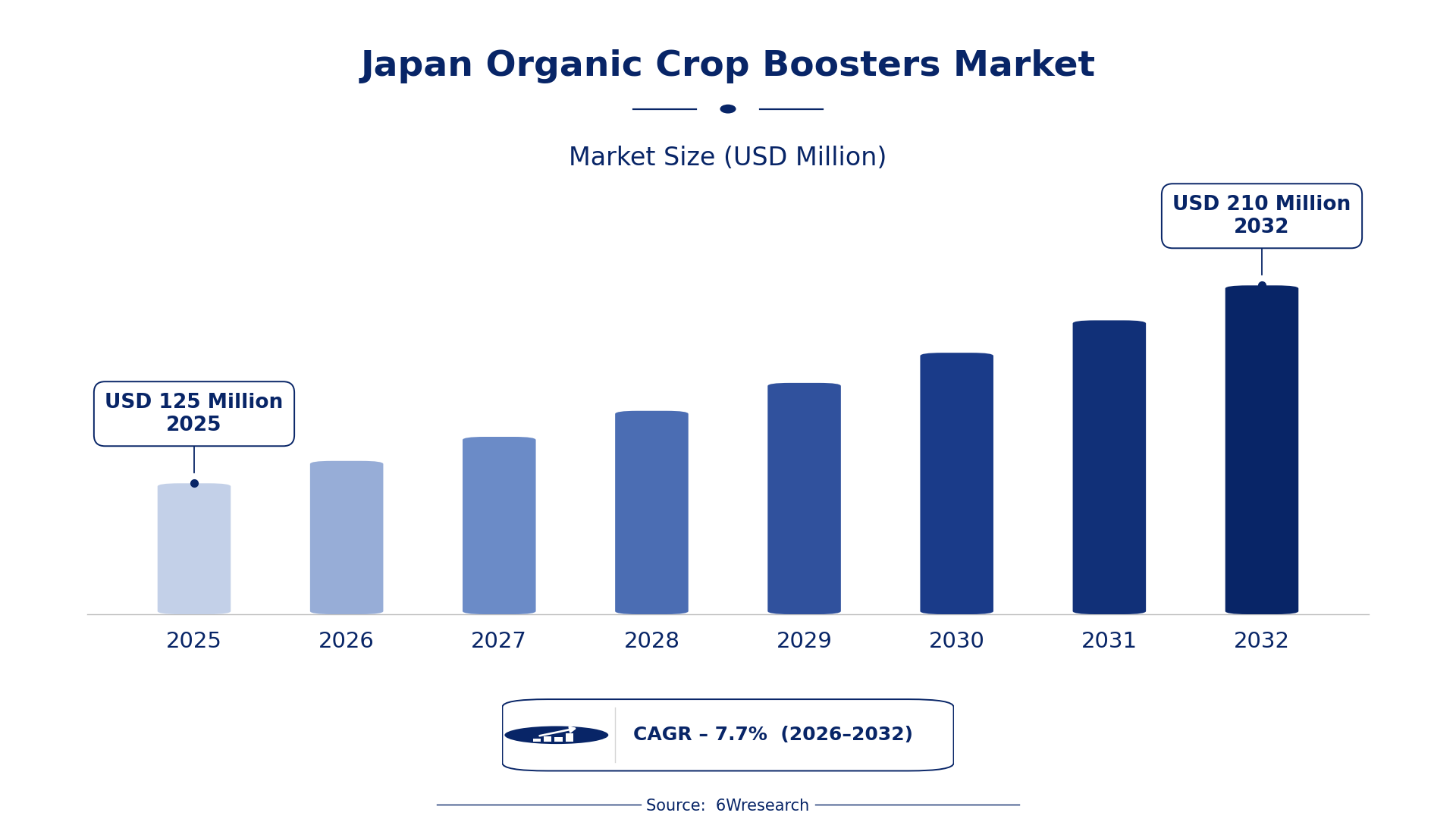
According to 6Wresearch internal database and industry insights, the Japan Organic Crop Boosters Market was valued at USD 125 Million in 2025 and is projected to reach USD 210 Million by 2032, growing at a CAGR of approximately 7.7% during 2026–2032.
Japan Organic Crop Boosters Market Highlights
| Report Metric | Details |
| Report Name | Japan Organic Crop Boosters Market (2026-2032) |
| Market Size 2025 | USD 125 Million |
| Market Size 2032 | USD 210 Million |
| Absolute Growth 2025–2032 | USD 85 Million |
| CAGR 2026–2032 | 7.7% |
| Peak Annual Growth | 8.6% in 2029 |
| Forecast Period | 2026–2032 |
| Historical Data | 2022–2025 |
| Base Year | 2025 |
| Leading Organic Crop Boosters Market, 2025 | Microbial Boosters (39% share) |
| Leading Booster Type, 2025 | Rhizobacteria (52% share) |
| Leading Application Method, 2025 | Soil Spraying (44% share) |
| Leading Distribution Channel, 2025 | Agricultural Retailers (51% share) |
| Leading End User, 2025 | Organic Farmers (38% share) |
| Fastest-Growing Organic Crop Boosters Market | Bioenzymes (10.4% CAGR) |
| Fastest-Growing Booster Type | Natural Compounds (11.2% CAGR) |
| Fastest-Growing Application Method | Foliar Spray (10.2% CAGR) |
| Fastest-Growing Distribution Channel | Online Agri-Stores (9.9% CAGR) |
| Fastest-Growing End User | Horticulture Farms (10.1% CAGR) |
| Growing Sector | Organic Farming |
| Key End Users | Organic Farmers, Horticulture Farms, Crop Producers, Fruit & Vegetable Growers |
Japan Organic Crop Boosters Market Year-wise Growth Rate and Key Drivers (2022–2032)
This graph illustrates the annual growth rates of the market from 2022 to 2032, highlighting a steady upward trajectory and projected market expansion over the forecast period.
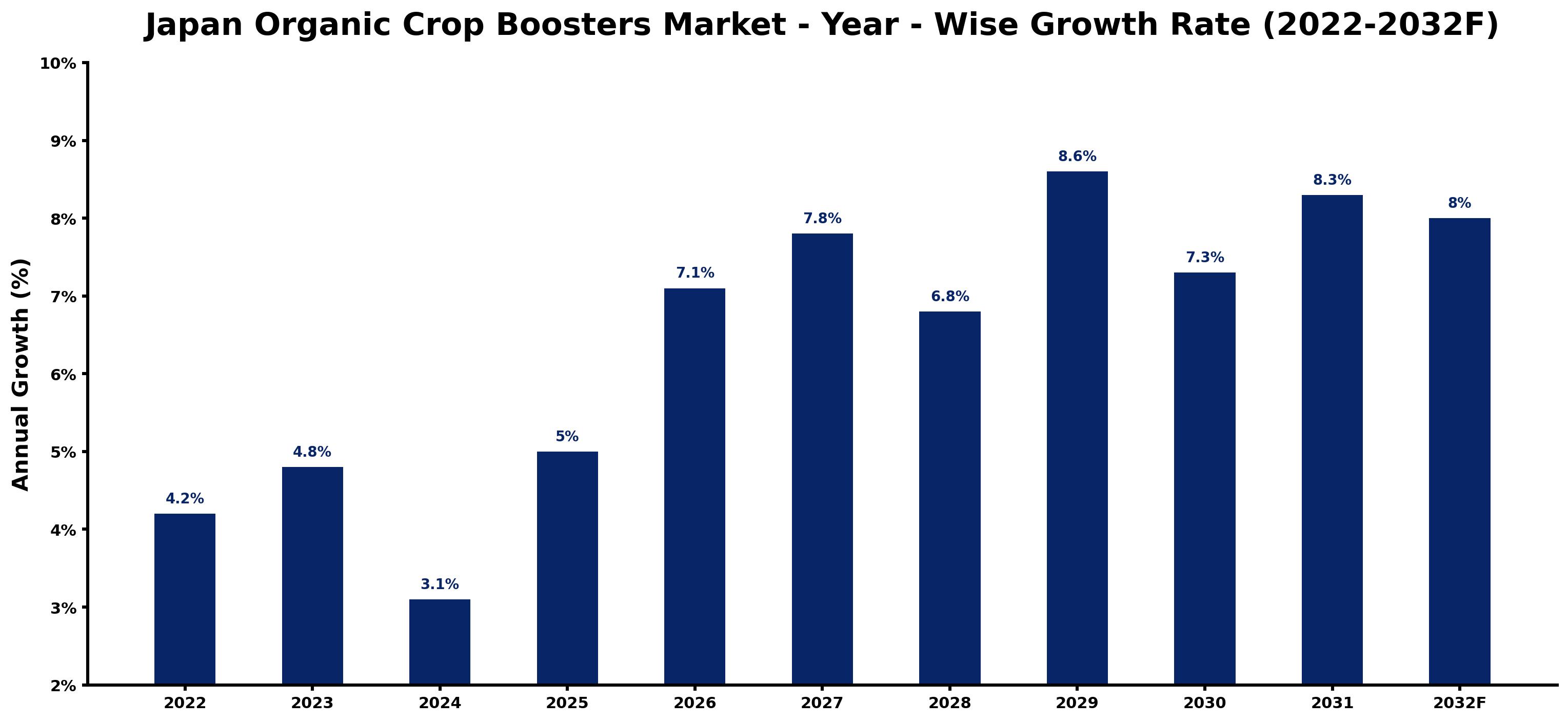
The following figures match every annual growth estimate with the main market development of that year, giving the reasoning behind each rise or slowdown.
| Year | Estimated Annual Growth (%) | Market Rationale |
| 2022 | 4.2 | The market showed steady growth due to increasing organic farming practices. |
| 2023 | 4.8 | Growth accelerated as more farmers adopted organic methods and products. |
| 2024 | 3.1 | The growth rate slowed as market saturation began to impact new orders. |
| 2025 | 5.0 | Demand surged as organic crop area expanded across regions. |
| 2026 | 7.1 | The market is expected to continue rising with increased investment in organic farming. |
| 2027 | 7.8 | Growth is projected to remain strong as consumer preferences shift towards organic products. |
| 2028 | 6.8 | A slowdown is anticipated as competition intensifies among organic suppliers. |
| 2029 | 8.6 | The peak growth year will be driven by heightened awareness of sustainable agriculture. |
| 2030 | 7.3 | Growth is expected to slow as the market stabilises following rapid expansion. |
| 2031 | 8.3 | Demand will increase again as organic farming initiatives gain momentum. |
| 2032 | 8.0 | The market growth rate is projected to stabilise as organic practices become mainstream. |
Note: Market size estimations and growth projections presented in this report are based on 6Wresearch's proprietary forecasting methodology, utilizing the latest available industry data, government publications, and primary research inputs.
Japan Organic Crop Boosters Market Synopsis
Organic crop boosters are natural substances that improve plant growth and health, made from materials like microbes and seaweed. The Japan Organic Crop Boosters Market is growing as organic farming areas expand, with approximately 80,000 hectares cultivated in 2022. Government support, rising consumer demand for organic produce, and the adoption of sustainable farming practices are propelling this growth, with the market valued at around ¥300 billion as of 2022.
Market Dynamics Impact Analysis (2026–2032)
| Factor | Type | Impact | Primary Segment Affected |
| Increasing organic farming area | Driver | High | Microbial Boosters |
| Government support for organic agriculture | Driver | High | Seaweed Extracts |
| Growing consumer demand for organic produce | Opportunity | High | Bioenzymes |
| Expansion of agricultural retailers | Opportunity | Medium | Humic Acid Boosters |
| Competition from synthetic alternatives | Restraint | High | Rhizobacteria |
| Limited awareness among conventional farmers | Restraint | Medium | Liquid Extract |
| High initial investment costs for organic practices | Challenge | High | Natural Compounds |
| Supply chain disruptions affecting product availability | Challenge | Medium | Biochemical Enhancer |
Evaluation of Drivers in Japan Organic Crop Boosters Market (2026–2032)
Below are the drivers that matter most for revenue growth, with supporting evidence.
| Drivers | Primary Segment Affected | Why It Matters (Evidence) |
| Expansion of organic farmland | Microbial Boosters | Japan's organic farming area reached 80,000 hectares in 2022, increasing demand for microbial boosters. |
| Government initiatives promoting organic farming | Seaweed Extracts | The Ministry of Agriculture, Forestry and Fisheries promotes organic farming, boosting seaweed extract usage. |
| Rising consumer preference for organic products | Bioenzymes | The organic market in Japan is valued at approximately ¥300 billion, driving bioenzyme adoption. |
| Increased availability of agricultural retailers | Humic Acid Boosters | Agricultural retailers accounted for a large share of organic booster distribution, improving access. |
| Support from the Japan Organic Agriculture Association | Rhizobacteria | The association promotes organic practices, leading to higher demand for rhizobacteria. |
Behind the steady rise in orders is the expansion of organic farmland, which reached 80,000 hectares in 2022, driving demand for microbial boosters. The organic market, valued at approximately ¥300 billion, reflects increasing consumer preference for organic products, particularly bioenzymes. Improved distribution networks have facilitated access to humic acid boosters, as agricultural retailers play a crucial role in this sector. The Japan Organic Agriculture Association's support is boosting demand for rhizobacteria as more farmers adopt these practices.
Evaluation of Restraints in Japan Organic Crop Boosters Market
Below are the constraints most often cited by buyers and suppliers, with the segment each affects.
| Market Restraint | Primary Segment Affected | Why It Matters (Evidence) |
| Competition from cheaper synthetic alternatives | Rhizobacteria | Synthetic products often offer lower prices, making it challenging for organic boosters to compete. |
| Limited awareness among conventional farmers | Liquid Extract | Many conventional farmers lack knowledge about the benefits of organic boosters, hindering adoption. |
| High initial investment costs for organic practices | Natural Compounds | Organic farming requires substantial upfront investment, deterring some potential users from switching. |
| Supply chain disruptions affecting product availability | Biochemical Enhancer | Logistical issues can delay the delivery of organic boosters, impacting supply to farmers. |
| Regulatory hurdles for certification | Microbial Boosters | Obtaining organic certification can be a lengthy process, limiting market entry for new products. |
Japan Organic Crop Boosters Market Challenges
Japan's organic farmers face challenges due to a lack of skilled labour, which hampers their ability to implement effective farming methods and reduces overall productivity. Buyers encounter inflated prices from limited access to organic crop boosters, with costs rising by 20% over the past year as demand outstrips supply. Many producers rely on outdated technology, with only 30% utilising modern organic practices, leading to diminished crop yields. Local competition intensifies as imported products enter the market, forcing domestic producers to lower prices and cutting their profit margins by approximately 15%.
Trends in the Japan Organic Crop Boosters Market
The following changes are redrawing the Japan Organic Crop Boosters Market.
- Horticulture Farms Adopting Advanced Techniques: Horticulture farms in Hokkaido are increasingly adopting advanced farming techniques, with a 15% rise in organic practices since 2023. This shift responds to consumer demand for high-quality produce.
- Increased Adoption of Soil Spraying Methods: Since 2025, the use of soil spraying techniques has grown, with 44% of organic farmers employing this method. This change improves nutrient delivery directly to the soil.
- Growth of Online Agricultural Retail Channels: The rise of online agricultural stores has transformed purchasing habits, with a 25% increase in sales through this channel in 2023. This shift allows farmers easier access to organic crop boosters.
- Organic Farmers Embracing New Technologies: Organic farmers are increasingly adopting precision agriculture technologies to improve crop yields. In 2022, approximately 30% of organic farms in Tokyo implemented these technologies, improving efficiency.
Investment Opportunities in the Japan Organic Crop Boosters Market
Several openings in the Japan Organic Crop Boosters Market merit attention from investors.
- Tokyo's Agricultural Retailers Expanding Offerings: Tokyo's agricultural retailers are expanding their offerings of organic crop boosters, with a projected growth of 20% in 2023. This expansion creates opportunities for suppliers to enter the market.
- Growing Demand for Bioenzymes: The demand for bioenzymes is increasing, with the market projected to grow by 10% in 2024. Suppliers can target organic farmers looking to improve soil health and crop yield.
- Investment in Organic Fertilizer Subsidy Programmes: The government allocated ¥1 billion for organic agriculture support programs in 2023, creating strong opportunities for investment in organic fertilizers and boosters.
- Hokkaido's Horticulture Farms Seeking Quality Inputs: Horticulture farms in Hokkaido are actively seeking high-quality organic crop boosters, driven by consumer demand for premium produce. Suppliers can enter this market through partnerships with local distributors.
Government Initiatives in the Japan Organic Crop Boosters Market
The GX Promotion Act, introduced in 2023, establishes a framework for promoting organic agriculture. This act builds on previous laws, aiming to support organic farming practices and increase organic farmland to 3% by 2030, benefiting the market for organic crop boosters.
Organic farmers benefit from the new subsidy program launched in 2023, which provides financial assistance for organic fertilizer use. The Ministry of Agriculture, Forestry and Fisheries oversees this program, ensuring that farmers can access necessary resources to improve their crop production.
Future Insight of the Japan Organic Crop Boosters Market
Organic farmers will gain access to new technologies by 2032, driven by government initiatives and subsidy programmes aimed at improving productivity. The introduction of updated organic certification standards will facilitate market access for local suppliers, boosting their competitiveness. Japan's commitment to increasing organic farmland to 3% by 2030 will expand the market significantly. With the government allocating ¥1 billion for organic agriculture support in 2023, suppliers will need to adapt to meet the rising consumer demand for sustainable farming practices.
Market Segmentation Analysis
Japan Organic Crop Boosters Market report covers a detailed analysis of the following market segments:
By Organic Crop Boosters Market – Microbial Boosters Lead, Bioenzymes Expected to Grow Fastest
According to Aarti Yadav, Research Associate at 6Wresearch, Microbial Boosters accounted for 39% of the market by organic crop boosters market in 2025. Microbial boosters are essential for enhancing soil health and plant growth, making them a top choice for organic farmers in key regions like Tokyo and Hokkaido. Their popularity is bolstered by government initiatives that actively promote organic agriculture and its benefits. Bioenzymes are projected to grow fastest, at a CAGR of 10.4% during 2026–2032. Bioenzymes are experiencing rapid growth as they effectively promote soil microbial activity and plant metabolism, aligning with the increasing focus on sustainable farming practices. The recent launch of a government subsidy program for organic fertilizers is further accelerating their adoption. Suppliers should prioritise bioenzymes to align with the growing demand for sustainable agricultural solutions.
By Booster Type – Rhizobacteria Leads, Natural Compounds Expected to Grow Fastest
In 2025, Rhizobacteria led the booster type split with a 52% share. Rhizobacteria play a crucial role in enhancing nutrient uptake in plants, making them a preferred choice among organic farmers across Japan. Their extensive application across various crops ensures a solid installed base within the organic farming sector. Over 2026–2032, Natural Compounds are expected to post the fastest growth, at a CAGR of 11.2%. Natural compounds are witnessing rapid growth as they appeal to farmers seeking environmentally friendly solutions derived from natural sources. The rising awareness of organic practices among growers is further driving their adoption. Buyers will increasingly seek natural compound options, encouraging suppliers to diversify their product offerings.
By Application Method – Soil Spraying Leads, Foliar Spray Expected to Grow Fastest
The largest application method category in 2025 was Soil Spraying, at 44% of revenue. Soil spraying is the predominant application method, allowing for direct application of organic boosters to the soil, which is essential for nutrient absorption. This method is widely utilised by organic farmers throughout Japan, especially in key agricultural regions. Foliar Spray is set to record the highest CAGR in this split, 10.2% over 2026–2032. Foliar spray is gaining popularity due to its efficiency in delivering nutrients directly to plant leaves, resulting in quicker improvements in crop health. The trend towards precision farming is accelerating its adoption among farmers. Suppliers should consider promoting foliar spray solutions to cater to the changing preferences of farmers.
By Distribution Channel – Agricultural Retailers Lead, Online Agri-Stores Expected to Grow Fastest
Agricultural Retailers took 51% of distribution channel revenue in 2025, more than any other category. Agricultural retailers are the primary source for farmers to obtain organic boosters, providing a reliable and accessible purchasing channel. Their established networks and relationships with local farmers strengthen their market position and facilitate product distribution. The quickest growth will come from Online Agri-Stores, forecast to expand at a CAGR of 9.9% between 2026 and 2032. Online agri-stores are experiencing the fastest growth, offering convenience and a broader selection of organic products that appeal to tech-savvy farmers. The shift towards digital purchasing is transforming the distribution landscape and expanding market reach. Suppliers must enhance their online presence to effectively reach the growing segment of digital shoppers.
By End User – Organic Farmers Lead, Horticulture Farms Expected to Grow Fastest
With 38% of end user revenue in 2025, Organic Farmers was the largest category. Organic farmers are the main users of organic crop boosters, relying on these products to comply with regulations such as JAS. The increasing number of organic farmers in Japan ensures a robust and consistent demand for these solutions. Horticulture Farms are projected to grow fastest, at a CAGR of 10.1% during 2026–2032. Horticulture farms are rapidly adopting organic crop boosters due to their critical role in fruit and vegetable production, increasingly focused on organic methods. The rising consumer demand for organic produce is further driving this growth in the sector. Suppliers should tailor their products to meet the specific needs of horticulture farms to capitalise on this expanding market.
Key Attractiveness of the Report
- 10 Years of Market Numbers
- Historical Data Starting from 2022 to 2025
- Base Year 2025
- Forecast Data until 2032
- Key Performance Indicators Impacting the Market
- Major Upcoming Developments and Projects
Key Highlights of the Report:
- Japan Organic Crop Boosters Market Outlook
- Market Size of Japan Organic Crop Boosters Market, 2025
- Forecast of Japan Organic Crop Boosters Market, 2032
- Historical Data and Forecast of Japan Organic Crop Boosters Revenues & Volume for the Period 2022-2032F
- Japan Organic Crop Boosters Market Trend Evolution
- Japan Organic Crop Boosters Market Drivers and Challenges
- Japan Organic Crop Boosters Price Trends
- Japan Organic Crop Boosters Porter's Five Forces
- Japan Organic Crop Boosters Industry Life Cycle
- Historical Data and Forecast of Japan Organic Crop Boosters Market Revenues & Volume By Organic Crop Boosters Market for the Period 2022-2032F
- Historical Data and Forecast of Japan Organic Crop Boosters Market Revenues & Volume By Microbial Boosters for the Period 2022-2032F
- Historical Data and Forecast of Japan Organic Crop Boosters Market Revenues & Volume By Seaweed Extracts for the Period 2022-2032F
- Historical Data and Forecast of Japan Organic Crop Boosters Market Revenues & Volume By Humic Acid Boosters for the Period 2022-2032F
- Historical Data and Forecast of Japan Organic Crop Boosters Market Revenues & Volume By Bioenzymes for the Period 2022-2032F
- Historical Data and Forecast of Japan Organic Crop Boosters Market Revenues & Volume By Booster Type for the Period 2022-2032F
- Historical Data and Forecast of Japan Organic Crop Boosters Market Revenues & Volume By Rhizobacteria for the Period 2022-2032F
- Historical Data and Forecast of Japan Organic Crop Boosters Market Revenues & Volume By Liquid Extract for the Period 2022-2032F
- Historical Data and Forecast of Japan Organic Crop Boosters Market Revenues & Volume By Natural Compounds for the Period 2022-2032F
- Historical Data and Forecast of Japan Organic Crop Boosters Market Revenues & Volume By Biochemical Enhancer for the Period 2022-2032F
- Historical Data and Forecast of Japan Organic Crop Boosters Market Revenues & Volume By Application Method for the Period 2022-2032F
- Historical Data and Forecast of Japan Organic Crop Boosters Market Revenues & Volume By Soil Spraying for the Period 2022-2032F
- Historical Data and Forecast of Japan Organic Crop Boosters Market Revenues & Volume By Foliar Spray for the Period 2022-2032F
- Historical Data and Forecast of Japan Organic Crop Boosters Market Revenues & Volume By Soil Amendment for the Period 2022-2032F
- Historical Data and Forecast of Japan Organic Crop Boosters Market Revenues & Volume By Drip Irrigation for the Period 2022-2032F
- Historical Data and Forecast of Japan Organic Crop Boosters Market Revenues & Volume By Distribution Channel for the Period 2022-2032F
- Historical Data and Forecast of Japan Organic Crop Boosters Market Revenues & Volume By Agricultural Retailers for the Period 2022-2032F
- Historical Data and Forecast of Japan Organic Crop Boosters Market Revenues & Volume By Online Agri-Stores for the Period 2022-2032F
- Historical Data and Forecast of Japan Organic Crop Boosters Market Revenues & Volume By Agro-Dealers for the Period 2022-2032F
- Historical Data and Forecast of Japan Organic Crop Boosters Market Revenues & Volume By Input Suppliers for the Period 2022-2032F
- Historical Data and Forecast of Japan Organic Crop Boosters Market Revenues & Volume By End User for the Period 2022-2032F
- Historical Data and Forecast of Japan Organic Crop Boosters Market Revenues & Volume By Organic Farmers for the Period 2022-2032F
- Historical Data and Forecast of Japan Organic Crop Boosters Market Revenues & Volume By Horticulture Farms for the Period 2022-2032F
- Historical Data and Forecast of Japan Organic Crop Boosters Market Revenues & Volume By Crop Producers for the Period 2022-2032F
- Historical Data and Forecast of Japan Organic Crop Boosters Market Revenues & Volume By Fruit & Vegetable Growers for the Period 2022-2032F
- Japan Organic Crop Boosters Import Export Trade Statistics
- Market Opportunity Assessment By Organic Crop Boosters Market
- Market Opportunity Assessment By Booster Type
- Market Opportunity Assessment By Application Method
- Market Opportunity Assessment By Distribution Channel
- Market Opportunity Assessment By End User
- Japan Organic Crop Boosters Top Companies Market Share
- Japan Organic Crop Boosters Competitive Benchmarking By Technical and Operational Parameters
- Japan Organic Crop Boosters Company Profiles
- Japan Organic Crop Boosters Key Strategic Recommendations
Market Covered
This report examines the market across the segments below.
By Organic Crop Boosters Market
- Microbial Boosters
- Seaweed Extracts
- Humic Acid Boosters
- Bioenzymes
By Booster Type
- Rhizobacteria
- Liquid Extract
- Natural Compounds
- Biochemical Enhancer
By Application Method
- Soil Spraying
- Foliar Spray
- Soil Amendment
- Drip Irrigation
By Distribution Channel
- Agricultural Retailers
- Online Agri-Stores
- Agro-Dealers
- Input Suppliers
By End User
- Organic Farmers
- Horticulture Farms
- Crop Producers
- Fruit & Vegetable Growers






































