Japan Organic Crop Cover Market Size & Growth Rate
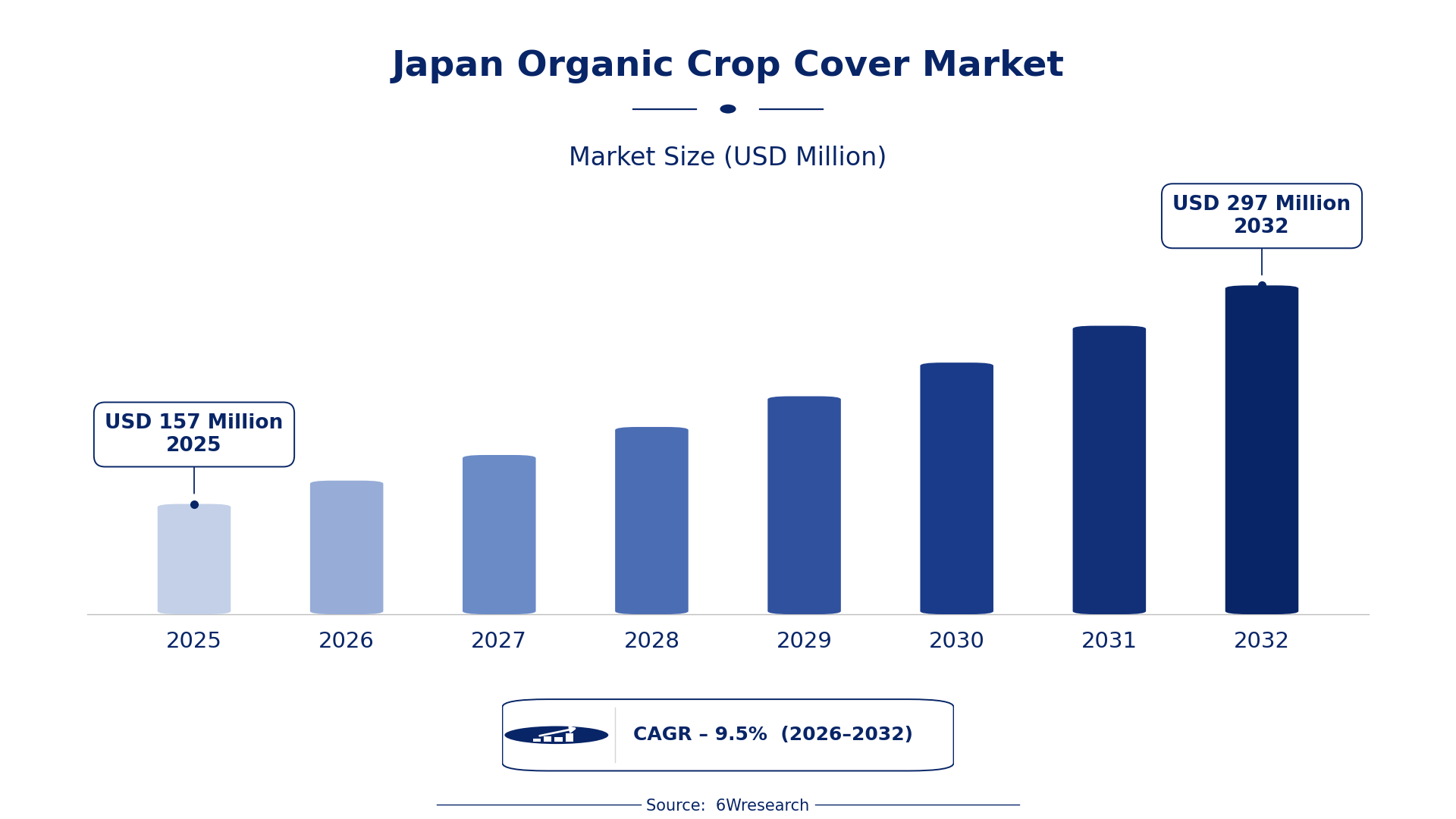
According to 6Wresearch internal database and industry insights, the Japan Organic Crop Cover Market was valued at USD 157 Million in 2025 and is projected to reach USD 297 Million by 2032, growing at a CAGR of approximately 9.5% during 2026–2032.
Japan Organic Crop Cover Market Highlights
| Report Metric | Details |
| Report Name | Japan Organic Crop Cover Market (2026-2032) |
| Market Size 2025 | USD 157 Million |
| Market Size 2032 | USD 297 Million |
| Absolute Growth 2025–2032 | USD 140 Million |
| CAGR 2026–2032 | 9.5% |
| Peak Annual Growth | 10.3% in 2029 |
| Forecast Period | 2026–2032 |
| Historical Data | 2022–2025 |
| Base Year | 2025 |
| Leading Organic Crop Cover Market, 2025 | Mulching Films (46% share) |
| Leading Cover Type, 2025 | Biodegradable (36% share) |
| Leading Material Type, 2025 | Corn Starch-Based (45% share) |
| Leading Distribution Channel, 2025 | Agri Input Retailers (48% share) |
| Leading End User, 2025 | Organic Farmers (50% share) |
| Fastest-Growing Organic Crop Cover Market | Cover Crops (12.1% CAGR) |
| Fastest-Growing Cover Type | Legumes (13.9% CAGR) |
| Fastest-Growing Material Type | Living Biomass (13.4% CAGR) |
| Fastest-Growing Distribution Channel | Seed Distributors (11.7% CAGR) |
| Fastest-Growing End User | Sustainable Farms (12.4% CAGR) |
| Growing Sector | Organic Agriculture |
| Key End Users | Organic Farmers, Sustainable Farms, Vegetable Growers |
Japan Organic Crop Cover Market Year-wise Growth Rate and Key Drivers (2022–2032)
This graph illustrates the annual growth rates of the market from 2022 to 2032, highlighting a steady upward trajectory and projected market expansion over the forecast period.
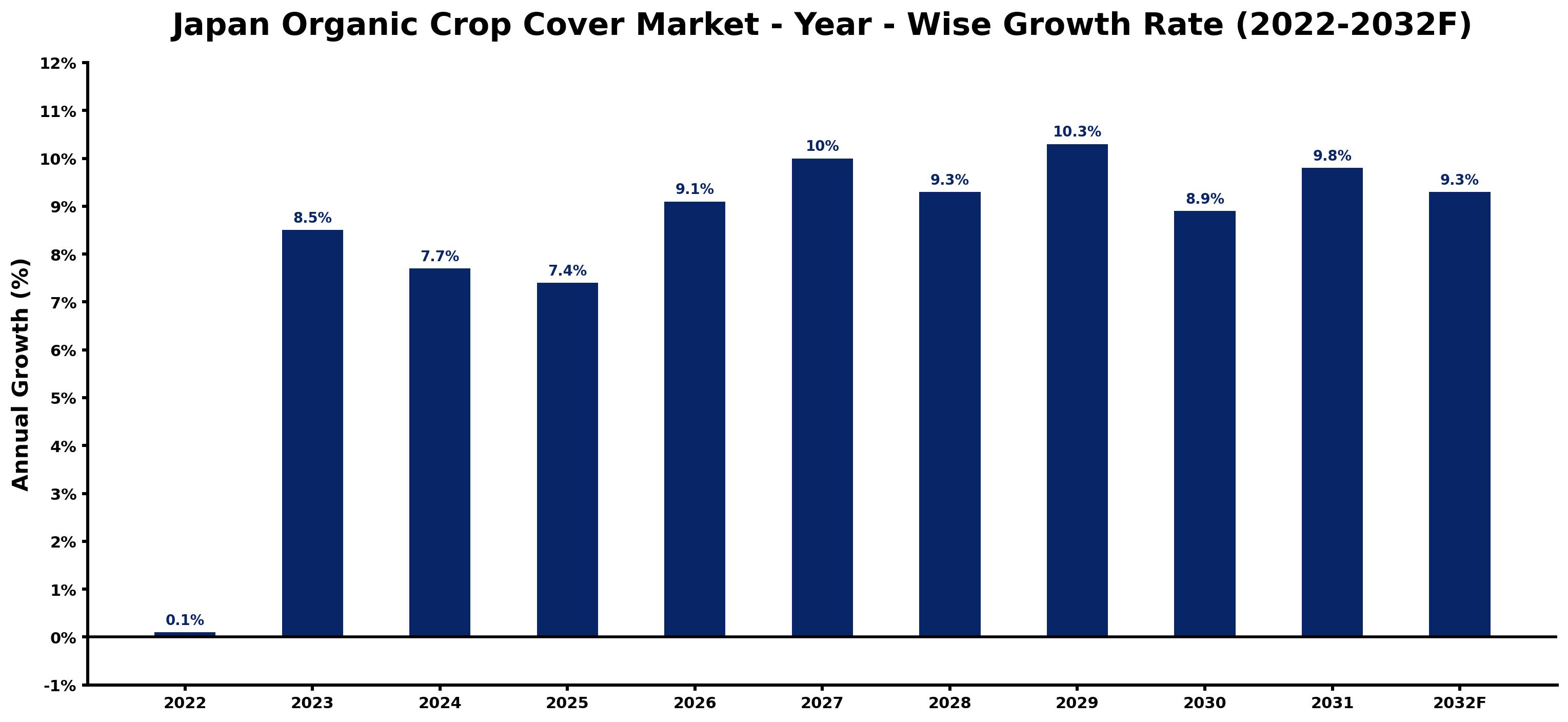
Annual growth estimates for each year appear below with the principal reason behind them, explaining the shifts that set the pace of the market.
| Year | Estimated Annual Growth (%) | Market Rationale |
| 2022 | 0.1 | Organic crop cover usage was minimal, reflecting early adoption stages among farmers. |
| 2023 | 8.5 | The market experienced growth as organic farming gained traction in Japan. |
| 2024 | 7.7 | Growth slowed as farmers adjusted to new practices and materials in organic agriculture. |
| 2025 | 7.4 | Continued adoption of organic methods led to further but slower growth in crop cover usage. |
| 2026 | 9.1 | Increased investment in organic farming technologies is expected to spur renewed growth in crop cover demand. |
| 2027 | 10.0 | Demand is projected to surge as more farmers recognise the benefits of biodegradable materials. |
| 2028 | 9.3 | Growth is anticipated to moderate as the market begins to stabilise after rapid expansion in previous years. |
| 2029 | 10.3 | The market is expected to peak as new products and practices attract additional buyers and users. |
| 2030 | 8.9 | Growth is projected to slow again as market saturation begins to take effect in certain regions. |
| 2031 | 9.8 | Demand is expected to rise as organic consumer awareness and preferences continue to expand. |
| 2032 | 9.3 | The market is projected to stabilise with consistent demand from established organic farming practices. |
Note: Market size estimations and growth projections presented in this report are based on 6Wresearch's proprietary forecasting methodology, utilizing the latest available industry data, government publications, and primary research inputs.
Japan Organic Crop Cover Market Synopsis
Organic crop covers are biodegradable materials designed to protect soil and crops, made from natural substances such as corn starch and legumes. Their primary uses include soil moisture retention and weed suppression, while improving soil health. The Japan Organic Crop Cover Market is expanding due to the increase in organic farming areas, with approximately 200,000 hectares in 2023, and a rise in the number of organic farmers, estimated at 80,000. Government support through subsidies and the Organic Farming Promotion Act is driving demand for these sustainable agricultural practices.
Market Dynamics Impact Analysis (2026–2032)
| Factor | Type | Impact | Primary Segment Affected |
| Growing organic farming area | Driver | High | Mulching Films |
| Increased consumer demand for organic produce | Driver | High | Compost Blankets |
| Rising awareness of sustainable agriculture | Opportunity | High | Cover Crops |
| Government subsidies for organic farming | Opportunity | Medium | Biodegradable |
| Limited awareness among traditional farmers | Restraint | Medium | Straw Covers |
| Higher initial costs of organic materials | Restraint | High | Corn Starch-Based |
| Aging farmer population | Challenge | High | Organic Farmers |
| Need for compliance with organic standards | Challenge | Medium | Sustainable Farms |
Evaluation of Drivers in Japan Organic Crop Cover Market (2026–2032)
The table below links each growth driver to the segment it affects and the evidence for it.
| Drivers | Primary Segment Affected | Why It Matters (Evidence) |
| Expansion of organic farming practices | Compost Blankets | The organic farming area reached 200,000 hectares in 2023, encouraging the use of compost blankets for soil health. |
| Consumer interest in sustainability | Biodegradable | With 10 million organic consumers in Japan, demand for biodegradable covers is rising as consumers seek eco-friendly products. |
| Support through subsidies | Cover Crops | The Ministry of Agriculture allocated ¥1 billion for organic initiatives in 2023, boosting cover crop adoption among farmers. |
| Training and resources from associations | Mulching Films | Support from the Organic Agriculture Association of Japan increases the use of mulching films among farmers, improving soil health. |
| Awareness of environmental impacts | Straw Covers | Organic vegetable growers are increasingly adopting straw covers to suppress weeds and retain moisture, improving crop yields. |
Much of the new demand stems from the expansion of organic farming practices, with Japan's organic farming area reaching 200,000 hectares in 2023. This growth encourages the use of compost blankets, which improve soil health and fertility. The presence of approximately 10 million organic consumers fuels demand for biodegradable crop covers, as these consumers seek eco-friendly products. Increased awareness of environmental impacts leads organic vegetable growers to adopt straw covers for moisture retention and weed suppression, improving overall crop yields.
Evaluation of Restraints in Japan Organic Crop Cover Market
The table below lists the restraints and the evidence behind each.
| Market Restraint | Primary Segment Affected | Why It Matters (Evidence) |
| Limited awareness among traditional farmers | Straw Covers | Many traditional farmers remain unaware of the benefits of straw covers, limiting their adoption and hindering market growth. |
| Higher initial costs of organic materials | Corn Starch-Based | The higher costs associated with corn starch-based covers deter some farmers from switching to organic options, affecting overall demand. |
| Aging farmer population | Organic Farmers | With an average age of 57, the aging population of organic farmers poses a challenge for market growth by limiting new entrants. |
| Need for compliance with organic standards | Sustainable Farms | Sustainable farms must navigate complex compliance requirements, which can delay the adoption of new materials and practices. |
| Limited distribution networks in rural areas | Biodegradable | Local suppliers face challenges in reaching remote farming communities, hindering the spread of biodegradable options and affecting availability. |
Japan Organic Crop Cover Market Challenges
Organic vegetable growers in Japan face challenges with outdated technology, as many rely on traditional methods that limit efficiency, costing them up to 30% in potential yield gains. Local suppliers contend with intense competition from imported alternatives, resulting in a 20% drop in sales for domestic distributors. Inconsistent availability of organic crop covers, especially in rural areas, delays planting schedules by weeks for farmers. Rising demand has led to a 15% increase in prices for organic crop covers over the past year, squeezing profit margins for buyers.
Trends in the Japan Organic Crop Cover Market
The shifts below are changing how Japan Organic Crop Cover Market products are bought and supplied.
- Shift from Traditional to Biodegradable Covers: The trend towards biodegradable crop covers has gained momentum, particularly among organic farmers. In 2023, organic crop cover usage increased by 15%, reflecting a growing preference for sustainable materials.
- Growing Adoption of Compost Blankets: Sustainable farms are increasingly adopting compost blankets to improve soil health. This shift is evidenced by rising interest in composting practices, with growth noted in Hokkaido's organic farming region.
- Increase in Organic Farming Initiatives: The government has ramped up support for organic farming, allocating ¥1 billion in 2023 for initiatives. This funding is expected to improve organic farming practices across Japan, leading to greater crop cover usage.
- Rising Consumer Demand for Organic Produce: Consumer awareness of organic produce is increasing, with an estimated 10 million organic consumers in Japan. This trend is driving demand for organic crop covers, particularly among vegetable growers.
Investment Opportunities in the Japan Organic Crop Cover Market
The following opportunities in the Japan Organic Crop Cover Market pair current demand with a clear way in.
- Timing for Sustainable Practices: With the government's target to increase organic farmland to 300,000 hectares by 2025, there is an opportunity for suppliers of biodegradable covers to meet demand for sustainable materials.
- Entry through Local Partnerships: Local suppliers can partner with organic farmers to distribute biodegradable crop covers effectively, tapping into the growing need for eco-friendly products.
- Growing Need among Organic Farmers: Organic farmers are increasingly seeking new crop cover solutions, presenting an opportunity for manufacturers to introduce biodegradable products that meet their needs.
- Gap in Distribution Channels: With local suppliers essential for distributing organic crop covers, there is a gap in rural areas that can be addressed by establishing cooperative stores to improve access.
Government Initiatives in the Japan Organic Crop Cover Market
The GX Promotion Act of 2023 reinforces existing support for organic farming by providing a legal framework for sustainable practices. This act complements the Chemical Substances Control Law of 1973, which requires evaluation and control of chemical substances in agriculture, ensuring safer practices for organic crop cover producers and users.
Organic farmers benefit from the Organic Agriculture Promotion Program, which provides financial assistance for adopting new practices. This program, supported by the Ministry of Agriculture, helps farmers access funding for biodegradable crop covers, improving their ability to invest in sustainable solutions.
Future Insight of the Japan Organic Crop Cover Market
By 2032, organic farmers will transition towards advanced biodegradable materials, driven by government initiatives and growing consumer interest in sustainable agriculture. The government aims to expand organic farmland to 300,000 hectares by 2025, creating new opportunities for suppliers. Enhanced training and resources from agricultural associations will improve farmer capabilities, facilitating better adoption of crop covers. With 1,500 tons of organic produce exported in 2022, the market for crop covers will likely grow, driving innovation in production methods.
Market Segmentation Analysis
Japan Organic Crop Cover Market report covers a detailed analysis of the following market segments:
By Organic Crop Cover Market – Mulching Films Lead, Cover Crops Expected to Grow Fastest
According to Aarti Yadav, Research Associate at 6Wresearch, Mulching Films held 46% of the Japan Organic Crop Cover Market by organic crop cover market in 2025. Mulching films are widely employed by organic farmers in Japan, particularly in Hokkaido, for their efficiency in retaining soil moisture and suppressing weeds. The substantial number of organic farmers, estimated at 80,000, reinforces the strong demand for this sub-segment. Cover Crops are set to record the highest CAGR in this split, 12.1% over 2026–2032. Cover crops are rapidly being adopted by sustainable farms as they enhance soil quality and prevent erosion, aligning with government initiatives to promote organic practices. The recent 15% increase in organic crop cover usage highlights the growing interest in these solutions. Suppliers should prioritise cover crops to cater to the increasing demand from sustainable farming practices.
By Cover Type – Biodegradable Leads, Legumes Expected to Grow Fastest
Biodegradable accounted for 36% of the market by cover type in 2025. Biodegradable covers are preferred in Japan as they meet environmental goals by significantly reducing plastic waste in agriculture. The government's support for organic farming initiatives further encourages the adoption of biodegradable materials among farmers. Legumes are projected to grow fastest, at a CAGR of 13.9% during 2026–2032. Legumes are becoming increasingly popular due to their nitrogen-fixing ability and contribution to soil fertility, which are essential for organic farming. The Ministry of Agriculture, Forestry and Fisheries promotes practices that enhance soil health, driving this segment's growth. Buyers should focus on biodegradable options to adhere to sustainability standards and government regulations.
By Material Type – Corn Starch-Based Leads, Living Biomass Expected to Grow Fastest
With 45% of material type revenue in 2025, Corn Starch-Based was the largest category. Corn starch-based covers are the leading choice due to their biodegradable nature, making them suitable for organic farming practices. Their popularity is reinforced by the growing organic farming area, which reached 200,000 hectares in 2023. The quickest growth will come from Living Biomass, forecast to expand at a CAGR of 13.4% between 2026 and 2032. Living biomass is emerging as a fast-growing material type because it provides essential nutrients and protects soil, appealing to organic farmers. The increasing focus on soil health in Japan's organic farming sector is propelling this trend. Suppliers must consider expanding their offerings to include living biomass materials to cater to evolving farmer preferences.
By Distribution Channel – Agri Input Retailers Lead, Seed Distributors Expected to Grow Fastest
In 2025, Agri Input Retailers led the distribution channel split with a 48% share. Agri input retailers dominate the distribution of organic crop covers, acting as a crucial link between suppliers and farmers. Their established networks are essential for reaching the growing number of organic farmers across Japan. Over 2026–2032, Seed Distributors are expected to post the fastest growth, at a CAGR of 11.7%. Seed distributors are swiftly gaining importance as they provide seeds alongside crop covers, offering a convenient solution for farmers. This synergy is particularly appealing as the organic farming sector continues to expand. Suppliers should enhance collaborations with seed distributors to improve market access and customer convenience.
By End User – Organic Farmers Lead, Sustainable Farms Expected to Grow Fastest
The largest end user category in 2025 was Organic Farmers, at 50% of revenue. Organic farmers represent the largest user group for organic crop covers, motivated by their dedication to sustainable agricultural practices. With approximately 80,000 organic farmers in Japan, this segment is pivotal for market growth. Sustainable Farms are set to record the highest CAGR in this split, 12.4% over 2026–2032. Sustainable farms are increasingly incorporating organic crop covers to align with eco-friendly farming practices, reflecting a broader trend towards sustainability. This transition is supported by government initiatives promoting organic agriculture. Suppliers should customise their products to meet the unique requirements of sustainable farms to leverage this expanding segment.
Key Attractiveness of the Report
- 10 Years of Market Numbers
- Historical Data Starting from 2022 to 2025
- Base Year 2025
- Forecast Data until 2032
- Key Performance Indicators Impacting the Market
- Major Upcoming Developments and Projects
Key Highlights of the Report:
- Japan Organic Crop Cover Market Outlook
- Market Size of Japan Organic Crop Cover Market, 2025
- Forecast of Japan Organic Crop Cover Market, 2032
- Historical Data and Forecast of Japan Organic Crop Cover Revenues & Volume for the Period 2022-2032F
- Japan Organic Crop Cover Market Trend Evolution
- Japan Organic Crop Cover Market Drivers and Challenges
- Japan Organic Crop Cover Price Trends
- Japan Organic Crop Cover Porter's Five Forces
- Japan Organic Crop Cover Industry Life Cycle
- Historical Data and Forecast of Japan Organic Crop Cover Market Revenues & Volume By Organic Crop Cover Market for the Period 2022-2032F
- Historical Data and Forecast of Japan Organic Crop Cover Market Revenues & Volume By Mulching Films for the Period 2022-2032F
- Historical Data and Forecast of Japan Organic Crop Cover Market Revenues & Volume By Cover Crops for the Period 2022-2032F
- Historical Data and Forecast of Japan Organic Crop Cover Market Revenues & Volume By Straw Covers for the Period 2022-2032F
- Historical Data and Forecast of Japan Organic Crop Cover Market Revenues & Volume By Compost Blankets for the Period 2022-2032F
- Historical Data and Forecast of Japan Organic Crop Cover Market Revenues & Volume By Cover Type for the Period 2022-2032F
- Historical Data and Forecast of Japan Organic Crop Cover Market Revenues & Volume By Biodegradable for the Period 2022-2032F
- Historical Data and Forecast of Japan Organic Crop Cover Market Revenues & Volume By Legumes, Grasses for the Period 2022-2032F
- Historical Data and Forecast of Japan Organic Crop Cover Market Revenues & Volume By Natural Mulch for the Period 2022-2032F
- Historical Data and Forecast of Japan Organic Crop Cover Market Revenues & Volume By Organic Waste for the Period 2022-2032F
- Historical Data and Forecast of Japan Organic Crop Cover Market Revenues & Volume By Material Type for the Period 2022-2032F
- Historical Data and Forecast of Japan Organic Crop Cover Market Revenues & Volume By Corn Starch-Based for the Period 2022-2032F
- Historical Data and Forecast of Japan Organic Crop Cover Market Revenues & Volume By Living Biomass for the Period 2022-2032F
- Historical Data and Forecast of Japan Organic Crop Cover Market Revenues & Volume By Wheat Straw for the Period 2022-2032F
- Historical Data and Forecast of Japan Organic Crop Cover Market Revenues & Volume By Compost Material for the Period 2022-2032F
- Historical Data and Forecast of Japan Organic Crop Cover Market Revenues & Volume By Distribution Channel for the Period 2022-2032F
- Historical Data and Forecast of Japan Organic Crop Cover Market Revenues & Volume By Agri Input Retailers for the Period 2022-2032F
- Historical Data and Forecast of Japan Organic Crop Cover Market Revenues & Volume By Seed Distributors for the Period 2022-2032F
- Historical Data and Forecast of Japan Organic Crop Cover Market Revenues & Volume By Local Suppliers for the Period 2022-2032F
- Historical Data and Forecast of Japan Organic Crop Cover Market Revenues & Volume By Cooperative Stores for the Period 2022-2032F
- Historical Data and Forecast of Japan Organic Crop Cover Market Revenues & Volume By End User for the Period 2022-2032F
- Historical Data and Forecast of Japan Organic Crop Cover Market Revenues & Volume By Organic Farmers for the Period 2022-2032F
- Historical Data and Forecast of Japan Organic Crop Cover Market Revenues & Volume By Sustainable Farms for the Period 2022-2032F
- Historical Data and Forecast of Japan Organic Crop Cover Market Revenues & Volume By Vegetable Growers for the Period 2022-2032F
- Historical Data and Forecast of Japan Organic Crop Cover Market Revenues & Volume By Large Farms for the Period 2022-2032F
- Japan Organic Crop Cover Import Export Trade Statistics
- Market Opportunity Assessment By Organic Crop Cover Market
- Market Opportunity Assessment By Cover Type
- Market Opportunity Assessment By Material Type
- Market Opportunity Assessment By Distribution Channel
- Market Opportunity Assessment By End User
- Japan Organic Crop Cover Top Companies Market Share
- Japan Organic Crop Cover Competitive Benchmarking By Technical and Operational Parameters
- Japan Organic Crop Cover Company Profiles
- Japan Organic Crop Cover Key Strategic Recommendations
Market Covered
The study includes the following segmentation.
By Organic Crop Cover Market
- Mulching Films
- Cover Crops
- Straw Covers
- Compost Blankets
By Cover Type
- Biodegradable
- Legumes
- Grasses
- Natural Mulch
- Organic Waste
By Material Type
- Corn Starch-Based
- Living Biomass
- Wheat Straw
- Compost Material
By Distribution Channel
- Agri Input Retailers
- Seed Distributors
- Local Suppliers
- Cooperative Stores
By End User
- Organic Farmers
- Sustainable Farms
- Vegetable Growers
- Large Farms






































