Japan Organic Crop Nutrition Market Size & Growth Rate
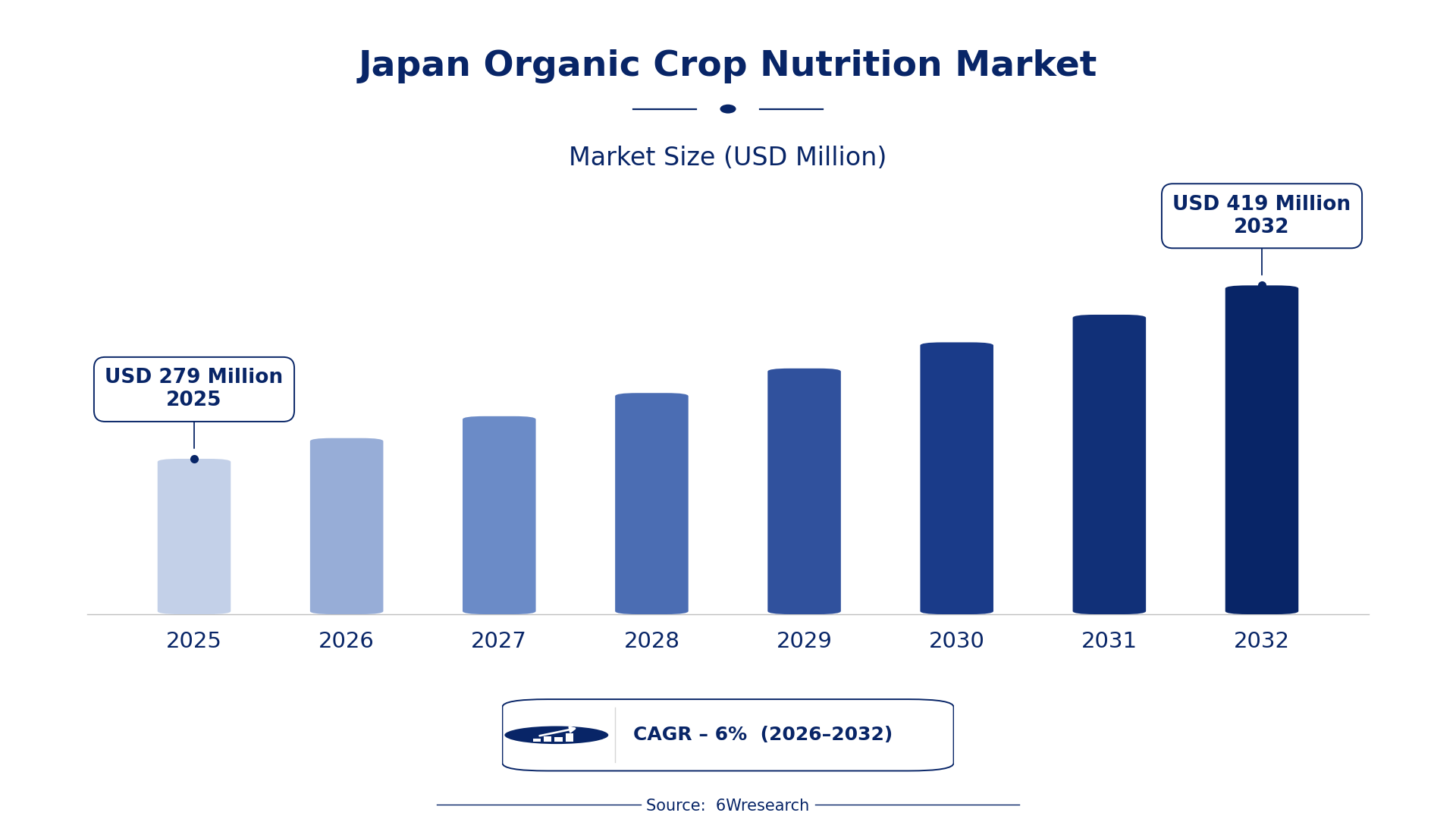
According to 6Wresearch internal database and industry insights, the Japan Organic Crop Nutrition Market was valued at USD 279 Million in 2025 and is projected to reach USD 419 Million by 2032, growing at a CAGR of approximately 6% during 2026–2032.
Japan Organic Crop Nutrition Market Highlights
| Report Metric | Details |
| Report Name | Japan Organic Crop Nutrition Market (2026-2032) |
| Market Size 2025 | USD 279 Million |
| Market Size 2032 | USD 419 Million |
| Absolute Growth 2025–2032 | USD 140 Million |
| CAGR 2026–2032 | 6% |
| Peak Annual Growth | 6.9% in 2026 |
| Forecast Period | 2026–2032 |
| Historical Data | 2022–2025 |
| Base Year | 2025 |
| Leading Organic Crop Nutrition Market, 2025 | Biofertilizers (39% share) |
| Leading Product Type, 2025 | Liquid Nutrients (45% share) |
| Leading Nutrient Content, 2025 | NPK Balanced (49% share) |
| Leading Distribution Channel, 2025 | Agri Input Stores (48% share) |
| Leading End User, 2025 | Grain Farmers (45% share) |
| Fastest-Growing Organic Crop Nutrition Market | Organic Foliar Sprays (7.8% CAGR) |
| Fastest-Growing Nutrient Content | Micronutrients (8.1% CAGR) |
| Fastest-Growing Distribution Channel | Online Agri Platforms (7.5% CAGR) |
| Fastest-Growing End User | Home Gardeners (7.6% CAGR) |
| Growing Sector | Home Gardeners |
| Key End Users | Grain Farmers, Fruit Growers, Plantation Owners, Home Gardeners |
Japan Organic Crop Nutrition Market Year-wise Growth Rate and Key Drivers (2022–2032)
This graph illustrates the annual growth rates of the market from 2022 to 2032, highlighting a steady upward trajectory and projected market expansion over the forecast period.
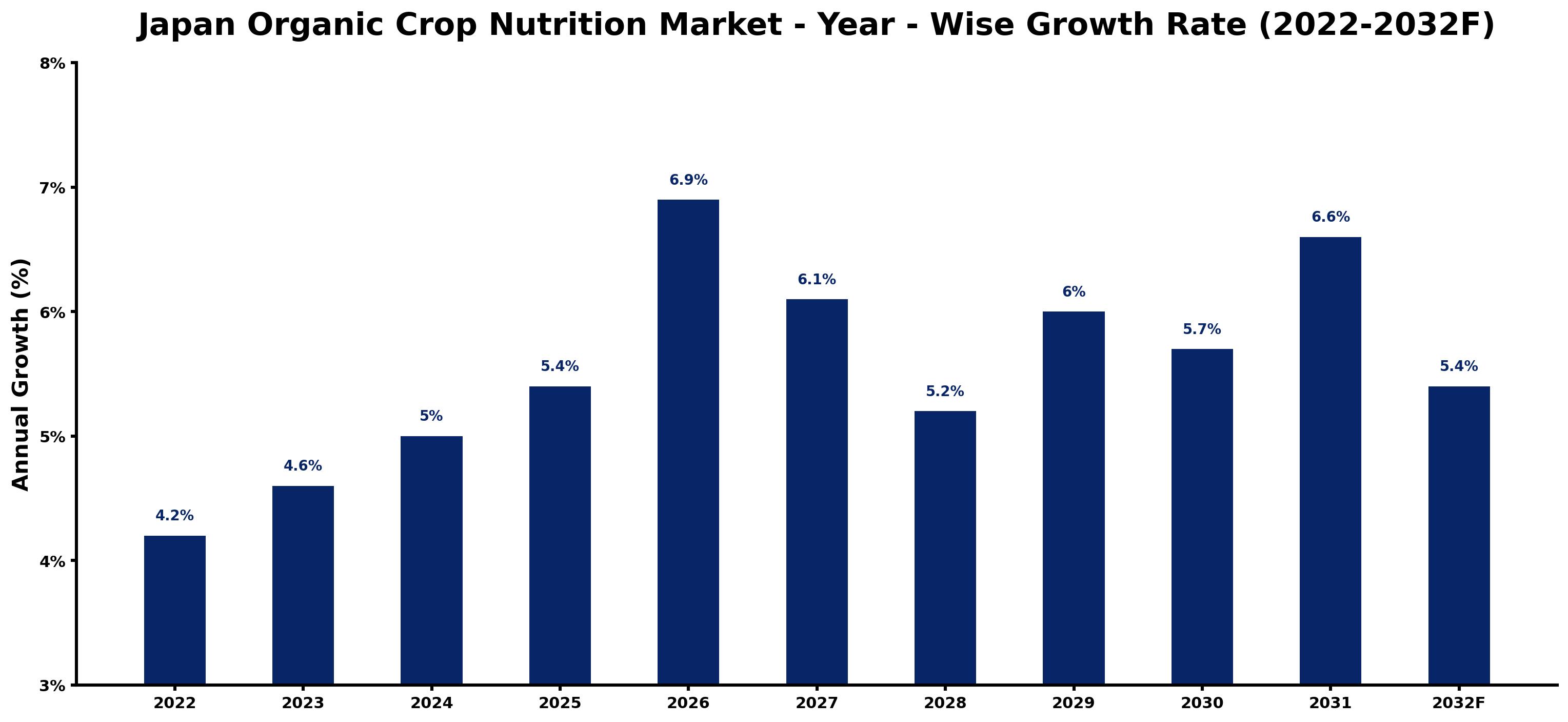
Each row of the following table gives one year's estimated growth and the event or demand shift that explains it.
| Year | Estimated Annual Growth (%) | Market Rationale |
| 2022 | 4.2 | The market showed steady growth, reflecting ongoing interest in organic farming practices. |
| 2023 | 4.6 | Demand increased as more farmers adopted organic methods, improving soil fertility and crop yields. |
| 2024 | 5.0 | The rise in organic farming area contributed to higher consumption of organic crop nutrition products. |
| 2025 | 5.4 | Growth continued as government initiatives spurred investment in organic farming. |
| 2026 | 6.9 | The peak growth year is driven by a surge in organic product sales through digital platforms. |
| 2027 | 6.1 | Growth slowed slightly as the market adjusted to increased supply and demand. |
| 2028 | 5.2 | The market continued to grow, supported by rising awareness of sustainable farming practices. |
| 2029 | 6.0 | Demand picked up again as urban gardening initiatives gained popularity among home gardeners. |
| 2030 | 5.7 | Growth slowed as the market stabilised, reflecting a mature organic farming sector. |
| 2031 | 6.6 | The market experienced renewed interest due to increased government support for organic initiatives. |
| 2032 | 5.4 | Growth slowed as the market reached a more stable phase, reflecting established consumer habits. |
Note: Market size estimations and growth projections presented in this report are based on 6Wresearch's proprietary forecasting methodology, utilizing the latest available industry data, government publications, and primary research inputs.
Japan Organic Crop Nutrition Market Synopsis
Organic Crop Nutrition consists of bio-based fertilizers and soil amendments that improve soil fertility and plant growth. Produced through natural processes such as composting and fermentation, it primarily supports sustainable agriculture practices. The Japan Organic Crop Nutrition Market is expanding due to rising consumer demand for organic products, an increase in certified organic farmers, and government initiatives that promote organic farming. With Japan's organic farming area reaching 300,000 hectares in 2022, the market is projected to continue its growth in the coming years.
Market Dynamics Impact Analysis (2026–2032)
| Factor | Type | Impact | Primary Segment Affected |
| Increasing adoption of organic farming practices | Driver | High | Biofertilizers |
| Growing demand for sustainable agriculture solutions | Driver | High | Organic Foliar Sprays |
| Rising interest in urban gardening initiatives | Opportunity | Medium | Compost & Manure |
| Expansion of online agri platforms for organic products | Opportunity | High | Liquid Nutrients |
| Aging farmer demographics leading to workforce challenges | Restraint | High | Vermicompost |
| Compliance with JAS standards for organic fertilizers | Restraint | Medium | NPK Balanced |
| High production costs affecting pricing strategies | Challenge | High | Organic Matter |
| Limited access to organic inputs in rural areas | Challenge | Medium | Earthworm Castings |
Evaluation of Drivers in Japan Organic Crop Nutrition Market (2026–2032)
Demand rests on the following drivers, each shown with the segment it touches most.
| Drivers | Primary Segment Affected | Why It Matters (Evidence) |
| Rising organic farming area | Biofertilizers | The organic farming area in Japan reached 300,000 hectares in 2022, increasing the demand for organic crop nutrition products among farmers. |
| Government subsidies for organic practices | Biofertilizers | In 2023, Japan allocated ¥1 billion for organic farming subsidies, encouraging farmers to adopt bio-based fertilizers and enhance soil fertility. |
| Growing popularity of urban gardening | Organic Foliar Sprays | Urban gardening initiatives have led to a 20% increase in the use of organic foliar sprays among home gardeners, boosting market demand. |
| Increase in certified organic farmers | Vermicompost | The number of certified organic farmers in Japan is approximately 30,000, driving the demand for effective soil health solutions like vermicompost. |
| Expansion of online agri platforms | Liquid Nutrients | Online agri platforms reported a 25% increase in organic product sales in 2023, facilitating greater access to liquid nutrients for farmers. |
Buyers are adding capacity as Japan's organic farming area reached 300,000 hectares in 2022, driving demand for biofertilizers. The popularity of organic foliar sprays surged by 20% in urban areas, increasing sales among home gardeners. Online agri platforms reported a 25% increase in organic product sales in 2023, boosting liquid nutrient purchases.
Evaluation of Restraints in Japan Organic Crop Nutrition Market
The following restraints limit how fast demand can grow.
| Market Restraint | Primary Segment Affected | Why It Matters (Evidence) |
| High production costs for organic inputs | Vermicompost | Production costs for organic inputs are high, limiting price competitiveness for vermicompost products. |
| Strict compliance requirements for organic certification | NPK Balanced | Compliance with JAS standards for organic fertilizers can delay product availability for farmers. |
| Aging farmer population affecting workforce availability | Organic Matter | The average age of organic farmers in Japan is 60 years, creating workforce challenges in organic farming. |
| Limited distribution channels in rural areas | Earthworm Castings | Access to organic inputs is restricted in rural areas, affecting the availability of earthworm castings. |
| Market saturation in urban gardening supplies | Liquid Nutrients | The growing number of suppliers in urban gardening has led to market saturation for liquid nutrients. |
Japan Organic Crop Nutrition Market Challenges
Strict JAS standards for fertilizers impose compliance burdens on producers, resulting in product launch delays and increased costs of up to 20%. An aging farmer demographic, with an average age of 60, limits the adoption of new techniques, leading to stagnant productivity for buyers. Limited technological advancements in crop nutrition restrict producers' ability to improve soil health, resulting in a 15% lower yield increase compared to conventional methods for farmers. Supply chain inefficiencies in rural areas complicate access to inputs, forcing buyers to rely on local vendors and face potential delays in crop cycles.
Trends in the Japan Organic Crop Nutrition Market
Buyers and suppliers in the Japan Organic Crop Nutrition Market are adjusting to the following trends.
- Shift towards Urban Gardening: Tokyo is experiencing a shift towards urban gardening, with more home gardeners adopting organic practices. In 2023, organic foliar sprays gained traction among urban gardeners, reflecting a growing trend in sustainable living.
- Increase in Online Purchases: Online agri platforms are witnessing a notable increase in organic product sales, with a reported 25% growth in 2023. This trend indicates a shift in purchasing behaviour among farmers and gardeners towards digital channels.
- Growing Demand for Vermicompost: The demand for vermicompost is rising as its effectiveness in improving soil health becomes more recognised. This trend is apparent in various regions, where farmers are increasingly integrating vermicompost into their practices.
- Focus on Sustainable Practices: There is a heightened focus on sustainable farming practices across Japan, driven by consumer demand for organic products. The Japanese government aims to double organic farmland by 2025, supporting this trend.
Investment Opportunities in the Japan Organic Crop Nutrition Market
Where to invest in the Japan Organic Crop Nutrition Market: the main openings are set out below.
- Partnerships with Local Vendors: Now is a prime time to partner with local vendors, as the organic crop nutrition market expands. With 300,000 hectares of organic farming area, collaboration can improve distribution effectiveness.
- Investment in Online Platforms: The 25% increase in online sales in 2023 underscores the need for investment in digital platforms. Suppliers can effectively reach urban gardeners and farmers through these channels.
- Focus on Urban Gardening Initiatives: Urban gardeners are increasingly adopting organic practices, creating a demand for tailored products. Suppliers can target this segment by developing specific organic crop nutrition solutions.
- Expansion into Rural Areas: With limited access to organic inputs in rural areas, there is a substantial opportunity to expand distribution. Establishing partnerships with local cooperatives can enhance market penetration.
Government Initiatives in the Japan Organic Crop Nutrition Market
The Organic Agriculture Promotion Act enacted in 2000 supports organic farming by providing guidelines and incentives for producers. This policy framework encourages the adoption of organic practices and ensures compliance with JAS standards, which are crucial for market access. The Japanese government aims to double organic farmland by 2025, reflecting its commitment to sustainable agriculture and increasing the availability of organic products for consumers.
In 2023, Japan allocated ¥1 billion for organic farming subsidies, administered by the Ministry of Agriculture, Forestry and Fisheries (MAFF). This funding supports farmers transitioning to organic practices and enhances the overall growth of the organic crop nutrition market. MAFF oversees organic certification, ensuring that products meet established standards, thereby boosting consumer confidence.
Future Insight of the Japan Organic Crop Nutrition Market
Japan's policy-driven shift aims to double organic farmland by 2025, prompting suppliers to innovate in their product offerings. Urban gardening initiatives will create new opportunities for crop nutrition products, driving demand among buyers. Online platforms will improve access to inputs, streamlining distribution for producers. The introduction of advanced farming technologies will further enhance soil health, potentially increasing yields by 10% across various crops, benefiting both farmers and consumers.
Market Segmentation Analysis
Japan Organic Crop Nutrition Market report covers a detailed analysis of the following market segments:
By Organic Crop Nutrition Market – Biofertilizers Lead, Organic Foliar Sprays Expected to Grow Fastest
According to Aarti Yadav, Research Associate at 6Wresearch, in 2025, Biofertilizers led the organic crop nutrition market split with a 39% share. Biofertilizers dominate the market as they are crucial for enhancing soil fertility and crop yield, especially in regions like Tokyo where organic farming is prevalent. The substantial number of certified organic farmers, approximately 30,000, relies heavily on these products for successful cultivation. The quickest growth will come from Organic Foliar Sprays, forecast to expand at a CAGR of 7.8% between 2026 and 2032. The rapid growth of organic foliar sprays is driven by their effectiveness in nutrient absorption, particularly appealing to urban gardeners who seek efficient gardening solutions. This segment's popularity is surging as home gardening initiatives expand, reflecting changing consumer preferences. Suppliers must focus on developing biofertilizers to meet the rising demand in urban gardening.
By Product Type – Liquid Nutrients Lead and Record the Fastest Growth
The largest product type category in 2025 was Liquid Nutrients, at 45% of revenue. Liquid nutrients lead the market as they provide nutrients in a readily absorbable form, making them essential for farmers seeking immediate results in crop production. Their effectiveness in various applications contributes to their dominant share in the organic crop nutrition sector. The same category are also set to grow fastest, at a CAGR of 8.4% during 2026–2032. The growth of liquid nutrients is sustained by their versatility and ease of application, appealing to both large-scale farmers and home gardeners. As the trend towards organic farming continues, the demand for these products is expected to rise further. Suppliers must ensure a steady supply of liquid nutrients to capitalise on the increasing interest in organic farming.
By Nutrient Content – NPK Balanced Leads, Micronutrients Expected to Grow Fastest
NPK Balanced took 49% of nutrient content revenue in 2025, more than any other category. NPK balanced fertilizers lead the market as they provide essential nutrients vital for crop growth, particularly benefiting grain farmers who rely on them for optimal yields. Their extensive use in regions like Hokkaido underscores their importance in the agricultural sector. Micronutrients are projected to grow fastest, at a CAGR of 8.1% during 2026–2032. The increasing demand for micronutrients is propelled by their essential role in various plant physiological functions, crucial for enhancing crop quality and yield. As awareness of their benefits grows, farmers are integrating these nutrients into their practices more frequently. Suppliers should broaden their offerings to include micronutrients, addressing the evolving needs of farmers.
By Distribution Channel – Agri Input Stores Lead, Online Agri Platforms Expected to Grow Fastest
With 48% of distribution channel revenue in 2025, Agri Input Stores was the largest category. Agri input stores are the primary distribution channel for farmers, providing direct access to necessary organic crop nutrition products. Their established presence in rural areas ensures farmers can easily procure the inputs required for effective farming. Online Agri Platforms are set to record the highest CAGR in this split, 7.5% over 2026–2032. Online agri platforms are experiencing rapid growth, evidenced by a 25% increase in organic product sales in 2023, highlighting a shift towards digital purchasing. This trend indicates a growing preference for convenience among consumers, particularly in urban settings. Suppliers should enhance their online presence to capture the expanding market of digital consumers.
By End User – Grain Farmers Lead, Home Gardeners Expected to Grow Fastest
Grain Farmers accounted for 45% of the market by end user in 2025. Grain farmers constitute the largest segment of end users for organic crop nutrition products, utilising these inputs to boost crop yields and maintain soil health. Their pivotal role in the agricultural landscape emphasises their significance to the overall market. The quickest growth will come from Home Gardeners, forecast to expand at a CAGR of 7.6% between 2026 and 2032. Home gardeners are increasingly adopting organic practices, indicating a shift towards sustainable gardening methods. This segment's growth reflects a broader trend of organic consumption gaining traction in urban areas, presenting a notable market opportunity. Suppliers should customise their products to cater to the specific needs of home gardeners to capitalise on this growing market.
Key Attractiveness of the Report
- 10 Years of Market Numbers
- Historical Data Starting from 2022 to 2025
- Base Year 2025
- Forecast Data until 2032
- Key Performance Indicators Impacting the Market
- Major Upcoming Developments and Projects
Key Highlights of the Report:
- Japan Organic Crop Nutrition Market Outlook
- Market Size of Japan Organic Crop Nutrition Market, 2025
- Forecast of Japan Organic Crop Nutrition Market, 2032
- Historical Data and Forecast of Japan Organic Crop Nutrition Revenues & Volume for the Period 2022-2032F
- Japan Organic Crop Nutrition Market Trend Evolution
- Japan Organic Crop Nutrition Market Drivers and Challenges
- Japan Organic Crop Nutrition Price Trends
- Japan Organic Crop Nutrition Porter's Five Forces
- Japan Organic Crop Nutrition Industry Life Cycle
- Historical Data and Forecast of Japan Organic Crop Nutrition Market Revenues & Volume By Organic Crop Nutrition Market for the Period 2022-2032F
- Historical Data and Forecast of Japan Organic Crop Nutrition Market Revenues & Volume By Biofertilizers for the Period 2022-2032F
- Historical Data and Forecast of Japan Organic Crop Nutrition Market Revenues & Volume By Organic Foliar Sprays for the Period 2022-2032F
- Historical Data and Forecast of Japan Organic Crop Nutrition Market Revenues & Volume By Compost & Manure for the Period 2022-2032F
- Historical Data and Forecast of Japan Organic Crop Nutrition Market Revenues & Volume By Vermicompost for the Period 2022-2032F
- Historical Data and Forecast of Japan Organic Crop Nutrition Market Revenues & Volume By Product Type for the Period 2022-2032F
- Historical Data and Forecast of Japan Organic Crop Nutrition Market Revenues & Volume By Nitrogen Fixers for the Period 2022-2032F
- Historical Data and Forecast of Japan Organic Crop Nutrition Market Revenues & Volume By Liquid Nutrients for the Period 2022-2032F
- Historical Data and Forecast of Japan Organic Crop Nutrition Market Revenues & Volume By Organic Matter for the Period 2022-2032F
- Historical Data and Forecast of Japan Organic Crop Nutrition Market Revenues & Volume By Earthworm Castings for the Period 2022-2032F
- Historical Data and Forecast of Japan Organic Crop Nutrition Market Revenues & Volume By Nutrient Content for the Period 2022-2032F
- Historical Data and Forecast of Japan Organic Crop Nutrition Market Revenues & Volume By Azotobacter, Rhizobium for the Period 2022-2032F
- Historical Data and Forecast of Japan Organic Crop Nutrition Market Revenues & Volume By Micronutrients for the Period 2022-2032F
- Historical Data and Forecast of Japan Organic Crop Nutrition Market Revenues & Volume By NPK Balanced for the Period 2022-2032F
- Historical Data and Forecast of Japan Organic Crop Nutrition Market Revenues & Volume By Rich Organic Carbon for the Period 2022-2032F
- Historical Data and Forecast of Japan Organic Crop Nutrition Market Revenues & Volume By Distribution Channel for the Period 2022-2032F
- Historical Data and Forecast of Japan Organic Crop Nutrition Market Revenues & Volume By Agri Input Stores for the Period 2022-2032F
- Historical Data and Forecast of Japan Organic Crop Nutrition Market Revenues & Volume By Online Agri Platforms for the Period 2022-2032F
- Historical Data and Forecast of Japan Organic Crop Nutrition Market Revenues & Volume By Local Vendors for the Period 2022-2032F
- Historical Data and Forecast of Japan Organic Crop Nutrition Market Revenues & Volume By Farmer Cooperatives for the Period 2022-2032F
- Historical Data and Forecast of Japan Organic Crop Nutrition Market Revenues & Volume By End User for the Period 2022-2032F
- Historical Data and Forecast of Japan Organic Crop Nutrition Market Revenues & Volume By Grain Farmers for the Period 2022-2032F
- Historical Data and Forecast of Japan Organic Crop Nutrition Market Revenues & Volume By Fruit Growers for the Period 2022-2032F
- Historical Data and Forecast of Japan Organic Crop Nutrition Market Revenues & Volume By Home Gardeners for the Period 2022-2032F
- Historical Data and Forecast of Japan Organic Crop Nutrition Market Revenues & Volume By Plantation Owners for the Period 2022-2032F
- Japan Organic Crop Nutrition Import Export Trade Statistics
- Market Opportunity Assessment By Organic Crop Nutrition Market
- Market Opportunity Assessment By Product Type
- Market Opportunity Assessment By Nutrient Content
- Market Opportunity Assessment By Distribution Channel
- Market Opportunity Assessment By End User
- Japan Organic Crop Nutrition Top Companies Market Share
- Japan Organic Crop Nutrition Competitive Benchmarking By Technical and Operational Parameters
- Japan Organic Crop Nutrition Company Profiles
- Japan Organic Crop Nutrition Key Strategic Recommendations
Market Covered
This report examines the market across the segments below.
By Organic Crop Nutrition Market
- Biofertilizers
- Organic Foliar Sprays
- Compost & Manure
- Vermicompost
By Product Type
- Nitrogen Fixers
- Liquid Nutrients
- Organic Matter
- Earthworm Castings
By Nutrient Content
- Azotobacter
- Rhizobium
- Micronutrients
- NPK Balanced
- Rich Organic Carbon
By Distribution Channel
- Agri Input Stores
- Online Agri Platforms
- Local Vendors
- Farmer Cooperatives
By End User
- Grain Farmers
- Fruit Growers
- Home Gardeners
- Plantation Owners






































