Japan Organic Crop Protection Market Size & Growth Rate
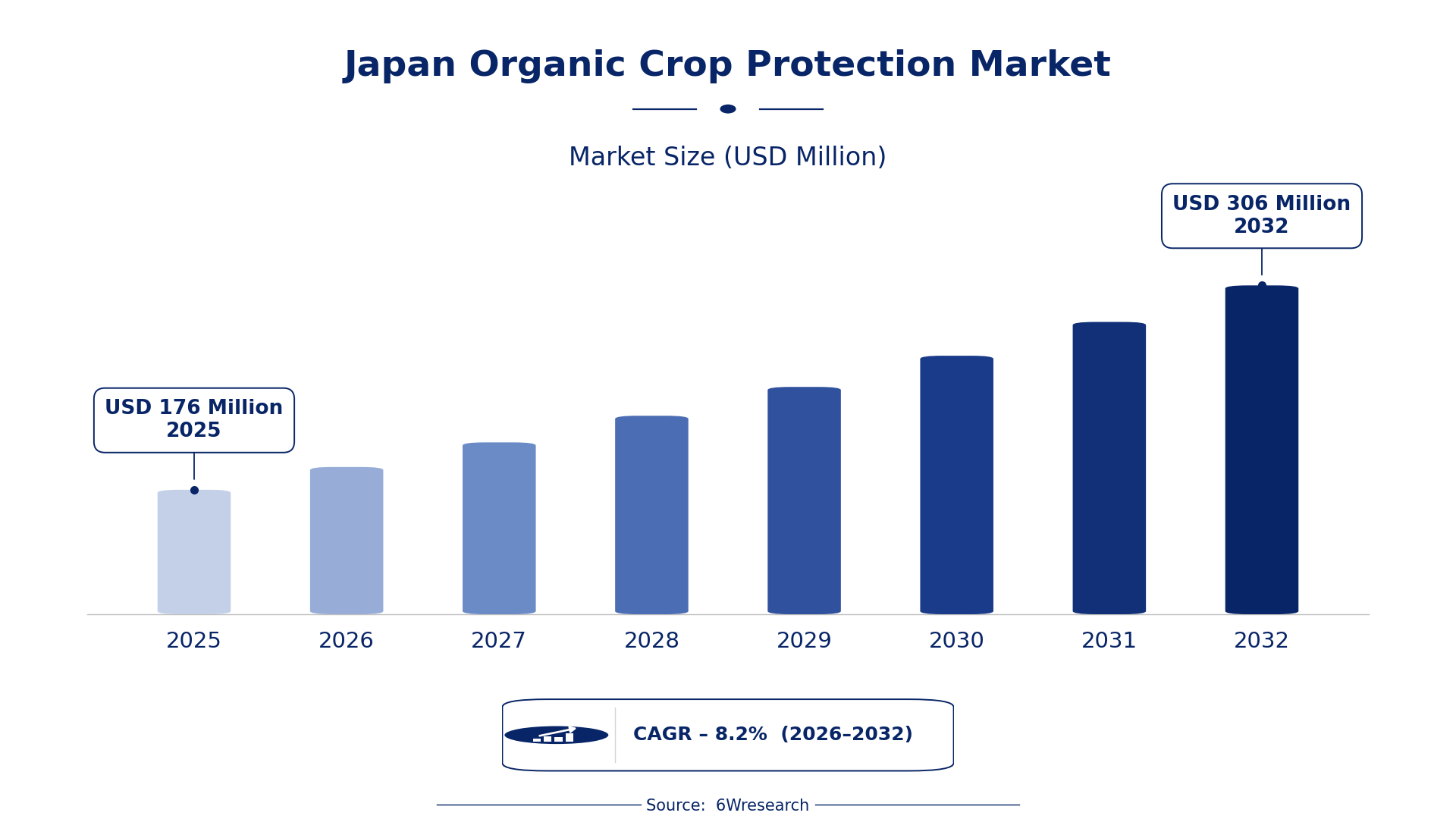
According to 6Wresearch internal database and industry insights, the Japan Organic Crop Protection Market was valued at USD 176 Million in 2025 and is projected to reach USD 306 Million by 2032, growing at a CAGR of approximately 8.2% during 2026–2032.
Japan Organic Crop Protection Market Highlights
| Report Metric | Details |
| Report Name | Japan Organic Crop Protection Market (2026-2032) |
| Market Size 2025 | USD 176 Million |
| Market Size 2032 | USD 306 Million |
| Absolute Growth 2025–2032 | USD 130 Million |
| CAGR 2026–2032 | 8.2% |
| Peak Annual Growth | 9.8% in 2032 |
| Forecast Period | 2026–2032 |
| Historical Data | 2022–2025 |
| Base Year | 2025 |
| Leading Organic Crop Protection Market, 2025 | Biopesticides (38% share) |
| Leading Product Type, 2025 | Neem (45% share) |
| Leading Target Pest Type, 2025 | Insects (47% share) |
| Leading Distribution Channel, 2025 | Agricultural Retailers (40% share) |
| Leading End User, 2025 | Organic Vegetable Farmers (39% share) |
| Fastest-Growing Organic Crop Protection Market | Botanical Pesticides (11.1% CAGR) |
| Fastest-Growing Target Pest Type | Caterpillars (11.8% CAGR) |
| Fastest-Growing Distribution Channel | Online Agri Stores (10.9% CAGR) |
| Fastest-Growing End User | Horticulture Growers (11.0% CAGR) |
| Growing Sector | Organic Vegetable Farming |
| Key End Users | Organic Vegetable Farmers, Horticulture Growers, Cereal Crop Producers |
Japan Organic Crop Protection Market Year-wise Growth Rate and Key Drivers (2022–2032)
This graph illustrates the annual growth rates of the market from 2022 to 2032, highlighting a steady upward trajectory and projected market expansion over the forecast period.
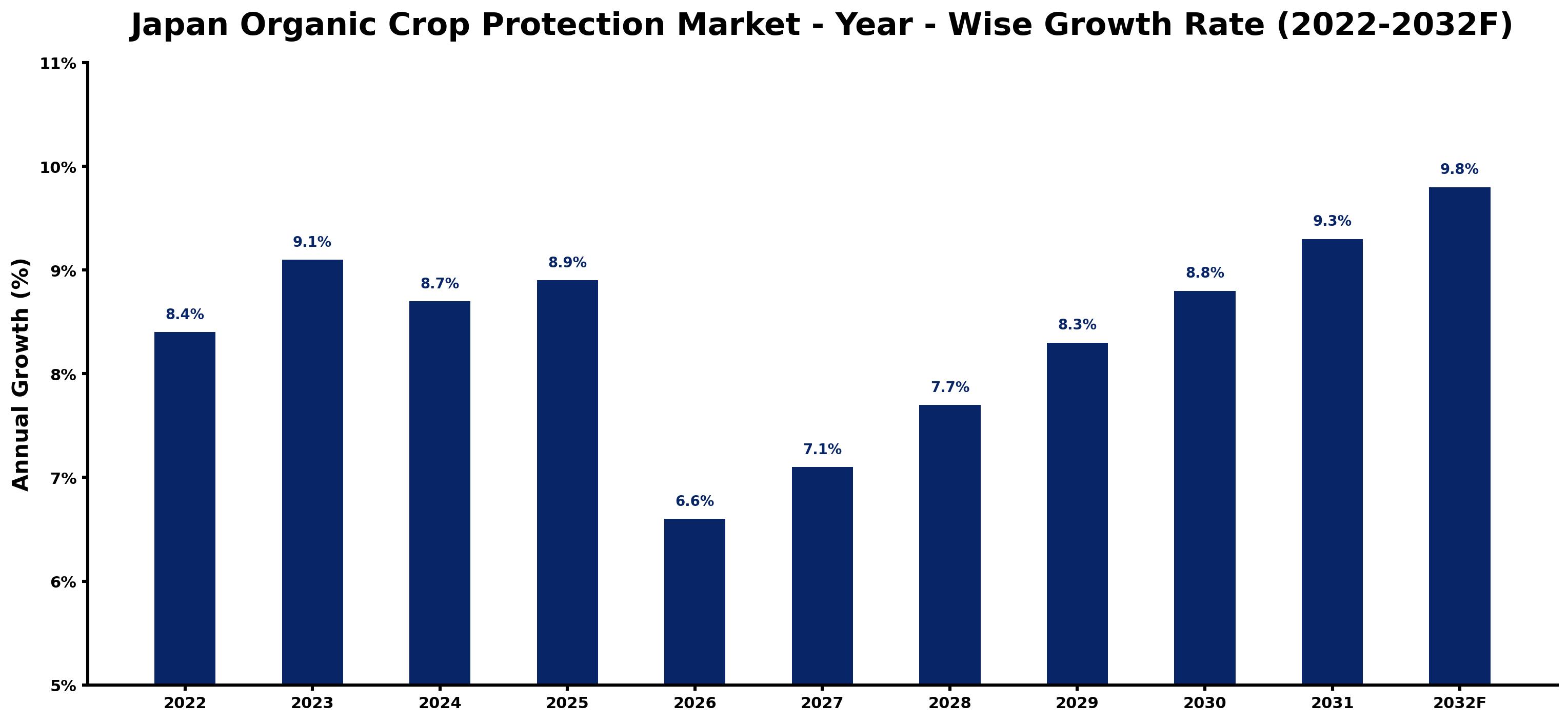
Each row of the following table gives one year's estimated growth and the event or demand shift that explains it.
| Year | Estimated Annual Growth (%) | Market Rationale |
| 2022 | 8.4 | Organic farming practices were increasingly adopted by farmers across Japan. |
| 2023 | 9.1 | The launch of new organic pest management programs stimulated market growth. |
| 2024 | 8.7 | Adoption of biopesticides slowed as farmers adjusted to new practices. |
| 2025 | 8.9 | Increased consumer demand for organic produce drove higher purchases of crop protection products. |
| 2026 | 6.6 | Market growth is projected to moderate as farmers face challenges in sourcing organic materials. |
| 2027 | 7.1 | Investment in organic farming technologies will encourage more farmers to adopt organic methods. |
| 2028 | 7.7 | Growing awareness of sustainable practices will lead to higher demand for organic solutions. |
| 2029 | 8.3 | The expansion of organic farmland is expected to contribute to rising sales of crop protection products. |
| 2030 | 8.8 | Increased exports of organic vegetables will boost the domestic market for organic solutions. |
| 2031 | 9.3 | Consumer preference for organic products will continue to rise, supporting market growth. |
| 2032 | 9.8 | The government’s target to double organic farmland will spur significant investments. |
Note: Market size estimations and growth projections presented in this report are based on 6Wresearch's proprietary forecasting methodology, utilizing the latest available industry data, government publications, and primary research inputs.
Japan Organic Crop Protection Market Synopsis
Organic crop protection involves using natural substances to manage pests and diseases in agriculture, primarily derived from plant extracts and microorganisms. The market is growing due to rising domestic demand from organic vegetable farmers and increased exports, particularly in horticulture. Government initiatives, such as the Organic JAS certification program launched in 2023, support this growth, while the biopesticide market is gaining traction among farmers seeking sustainable pest management solutions. Approximately 1.5 million hectares of organic farmland exist, reflecting the sector's growth potential and the increasing focus on sustainable agricultural practices.
Market Dynamics Impact Analysis (2026–2032)
| Factor | Type | Impact | Primary Segment Affected |
| Growing consumer preference for organic produce | Driver | High | Biopesticides |
| Increasing adoption of organic farming practices | Driver | High | Botanical Pesticides |
| Expansion of organic farmland to meet government targets | Opportunity | Medium | Fungal Pathogen Controllers |
| Rising exports of organic vegetables to international markets | Opportunity | Medium | Natural Repellents |
| Limited availability of certified organic inputs | Restraint | High | Biopesticides |
| Higher production costs for organic farming | Restraint | Medium | Botanical Pesticides |
| Challenges in sourcing organic materials | Challenge | High | Fungal Pathogen Controllers |
| Competition from conventional pesticides | Challenge | Medium | Natural Repellents |
Evaluation of Drivers in Japan Organic Crop Protection Market (2026–2032)
The main growth drivers and the segments they affect most are set out below.
| Drivers | Primary Segment Affected | Why It Matters (Evidence) |
| Rising consumer demand for organic products | Biopesticides | This trend drives farmers to adopt biopesticides, with the organic vegetable market valued at around 500 billion yen annually. |
| Government initiatives promoting organic farming | Botanical Pesticides | The Organic JAS certification program encourages farmers to use botanical pesticides, ensuring compliance with organic standards. |
| Increased investment in organic farming technologies | Fungal Pathogen Controllers | Investment in technologies is expected to improve pest management, increasing adoption among horticulture growers by enhancing efficiency. |
| Growing awareness of sustainable agricultural practices | Natural Repellents | As awareness rises, more farmers are utilizing natural repellents, particularly in fruit orchards, to improve pest control effectiveness. |
| Expansion of organic farmland | Biopesticides | The government aims to increase organic farmland to 3 million hectares by 2030, boosting biopesticide demand significantly. |
A wider customer base explains much of the growth, as rising consumer demand for organic products drives farmers to adopt biopesticides. Investment in organic farming technologies will improve pest management, particularly among horticulture growers in regions like Hokkaido. Increased awareness of sustainable agricultural practices leads to more farmers using natural repellents, especially in fruit orchards.
Evaluation of Restraints in Japan Organic Crop Protection Market
The following restraints limit how fast demand can grow.
| Market Restraint | Primary Segment Affected | Why It Matters (Evidence) |
| Limited availability of certified organic inputs | Biopesticides | This scarcity restricts farmers' ability to source necessary organic materials, affecting production capabilities and leading to delays in pest management. |
| Higher production costs for organic farming | Botanical Pesticides | The increased costs associated with organic practices deter some farmers from fully transitioning to organic methods, impacting their profitability. |
| Regulatory hurdles for new organic products | Fungal Pathogen Controllers | Stringent regulations can slow the approval process for new organic crop protection products, delaying market entry for suppliers. |
| Competition from conventional pesticides | Natural Repellents | The effectiveness and lower costs of conventional pesticides can discourage farmers from using organic alternatives, limiting market growth. |
| Challenges in sourcing organic materials | Biopesticides | Farmers face difficulties in obtaining organic inputs, which can delay pest management strategies and affect crop yields. |
Japan Organic Crop Protection Market Challenges
Organic vegetable farmers face a skills shortage in Japan, as many lack training in effective pest management techniques, which can reduce yields by up to 15%. Rising costs of organic inputs, such as plant extracts, can increase production expenses by 20%, straining farmers' budgets. Regulatory hurdles from the Agricultural Chemicals Control Law complicate the approval process for new products, delaying market entry for suppliers by several months. Increased competition from conventional farming methods forces organic producers to lower prices, risking profit margins and threatening the viability of their operations.
Trends in the Japan Organic Crop Protection Market
The following changes are redrawing the Japan Organic Crop Protection Market.
- Shift from Conventional to Organic Farming: Since 2023, organic vegetable farming has gained traction, particularly in regions like Hokkaido. Approximately 1.5 million hectares are now dedicated to organic farming, reflecting a growing preference for sustainable practices.
- Emergence of Online Distribution Channels: In 2023, online agri stores began to play a more prominent role in distributing organic crop protection products. This shift is anticipated to grow at a CAGR of 10.9%.
- Increased Adoption of Biopesticides: The trend towards biopesticides has accelerated since 2022, with horticulture growers increasingly utilizing neem and pyrethrum for pest control, reflecting a shift towards sustainable solutions.
- Growing Popularity of Natural Repellents: Natural repellents have gained popularity among fruit orchard growers since 2022, with garlic extract being frequently used for its pest-repelling properties.
Investment Opportunities in the Japan Organic Crop Protection Market
Several openings in the Japan Organic Crop Protection Market merit attention from investors.
- Supply of Biopesticides: With the organic vegetable market valued at approximately 500 billion yen, there is an opportunity to supply biopesticides to farmers. Collaborating with agricultural retailers can facilitate market entry.
- Distribution of Natural Repellents: Natural repellents are increasingly sought after, particularly among fruit orchard growers. Establishing partnerships with local agro shops can improve distribution capabilities.
- Investment in Organic Farming Technologies: The government aims to increase organic farmland to 3 million hectares by 2030, creating a demand for advanced organic farming technologies. Engaging in joint ventures with local firms can be advantageous.
- Expansion of Online Sales Channels: The rise of online agri stores presents a timely opportunity to supply organic crop protection products. Investing in e-commerce platforms can help reach a broader customer base.
Government Initiatives in the Japan Organic Crop Protection Market
The Organic JAS certification program, launched in 2023, strengthens the framework established by earlier regulations. This program provides guidelines for organic farming practices, ensuring that producers meet specific standards for crop protection products, thus maintaining market integrity and consumer trust. The government aims to support farmers by increasing the area of organic farmland to 3 million hectares by 2030, which will help sustain the growth of the organic sector.
The Ministry of Agriculture plays a critical role in approving organic pest management practices. It funds initiatives that support farmers transitioning to organic methods, with a target of increasing organic farmland to 3 million hectares by 2030. This support is vital for enhancing the availability and accessibility of organic crop protection products for farmers.
Future Insight of the Japan Organic Crop Protection Market
Investment in organic farming will surge, driven by government initiatives to increase organic farmland to 3 million hectares by 2030. This expansion will create robust demand for crop protection products, particularly natural pest management solutions. Training programs will prepare around 100,000 farmers with improved pest management skills, enhancing productivity across the sector. The launch of the Organic Crop Protection program will support sustainable practices, ensuring compliance and promoting growth in the organic sector.
Market Segmentation Analysis
Japan Organic Crop Protection Market report covers a detailed analysis of the following market segments:
By Organic Crop Protection Market – Biopesticides Lead, Botanical Pesticides Expected to Grow Fastest
According to Aarti Yadav, Research Associate at 6Wresearch, Biopesticides accounted for 38% of the market by organic crop protection market in 2025. Biopesticides hold the largest share due to their effectiveness against specific pests and diseases, essential for organic farming. Their adoption is particularly notable in regions like Hokkaido, where farmers rely on these solutions for pest management. Botanical Pesticides are projected to grow fastest, at a CAGR of 11.1% during 2026–2032. Botanical Pesticides are growing rapidly as they are increasingly recognised for their natural pest control capabilities. The rising focus on sustainable agricultural practices among organic farmers significantly boosts demand for these eco-friendly options. Suppliers need to ensure a steady supply of biopesticides and provide education to meet the increasing demand in the market.
By Product Type – Neem Leads and Records the Fastest Growth
Neem took 45% of product type revenue in 2025, more than any other category. Neem is the leading product type due to its widespread use for its insecticidal properties, making it a preferred choice among organic farmers. Its effectiveness in controlling a variety of pests contributes to its dominant market position. Its lead should widen, with a projected CAGR of 9.7% during 2026–2032, the highest in this split. The growth of Neem is expected to continue as its popularity among farmers increases due to its natural origin and effectiveness. This sustained demand will likely widen its lead in the market as more farmers adopt organic practices. Buyers will benefit from increased availability and potentially lower costs as Neem becomes more mainstream in the organic market.
By Target Pest Type – Insects Lead, Caterpillars Expected to Grow Fastest
The largest target pest type category in 2025 was Insects, at 47% of revenue. Insects are the primary target for organic pesticides, which explains their leading share in the market. The prevalence of insect-related issues in organic farming necessitates effective pest management solutions focused on this category. Over 2026–2032, Caterpillars are expected to post the fastest growth, at a CAGR of 11.8%. Caterpillars are seeing the fastest growth as a target pest type due to their specific threat to crops, prompting farmers to seek effective biopesticide solutions. This targeted approach will likely lead to increased investments in caterpillar control methods. Suppliers should tailor their product offerings to address the specific needs of farmers dealing with caterpillar infestations.
By Distribution Channel – Agricultural Retailers Lead, Online Agri Stores Expected to Grow Fastest
With 40% of distribution channel revenue in 2025, Agricultural Retailers was the largest category. Agricultural Retailers dominate the distribution channel as they serve as the primary access point for farmers seeking organic crop protection products. Their established relationships with farmers facilitate the effective distribution of these products across regions. Online Agri Stores are set to record the highest CAGR in this split, 10.9% over 2026–2032. Online Agri Stores are rapidly gaining traction as a distribution channel, providing farmers with convenient access to organic products. The shift towards digital platforms is driven by the increasing need for efficient purchasing options in the agricultural sector. Suppliers must invest in online platforms to reach a broader audience and cater to the evolving purchasing preferences of farmers.
By End User – Organic Vegetable Farmers Lead, Horticulture Growers Expected to Grow Fastest
Organic Vegetable Farmers held 39% of the Japan Organic Crop Protection Market by end user in 2025. Organic Vegetable Farmers represent the largest user group of organic pesticides, driven by the strong demand for organic vegetables in Japan. Their commitment to sustainable farming necessitates effective crop protection to ensure high quality and yield. Horticulture Growers are projected to grow fastest, at a CAGR of 11.0% during 2026–2032. Horticulture Growers are the fastest-growing segment as they adopt organic crop protection methods to enhance production efficiency. This trend aligns with a broader movement towards sustainability in agriculture. Suppliers should focus their marketing efforts on horticulture growers to effectively meet their specific crop protection needs.
Key Attractiveness of the Report
- 10 Years of Market Numbers
- Historical Data Starting from 2022 to 2025
- Base Year 2025
- Forecast Data until 2032
- Key Performance Indicators Impacting the Market
- Major Upcoming Developments and Projects
Key Highlights of the Report:
- Japan Organic Crop Protection Market Outlook
- Market Size of Japan Organic Crop Protection Market, 2025
- Forecast of Japan Organic Crop Protection Market, 2032
- Historical Data and Forecast of Japan Organic Crop Protection Revenues & Volume for the Period 2022-2032F
- Japan Organic Crop Protection Market Trend Evolution
- Japan Organic Crop Protection Market Drivers and Challenges
- Japan Organic Crop Protection Price Trends
- Japan Organic Crop Protection Porter's Five Forces
- Japan Organic Crop Protection Industry Life Cycle
- Historical Data and Forecast of Japan Organic Crop Protection Market Revenues & Volume By Organic Crop Protection Market for the Period 2022-2032F
- Historical Data and Forecast of Japan Organic Crop Protection Market Revenues & Volume By Botanical Pesticides for the Period 2022-2032F
- Historical Data and Forecast of Japan Organic Crop Protection Market Revenues & Volume By Biopesticides for the Period 2022-2032F
- Historical Data and Forecast of Japan Organic Crop Protection Market Revenues & Volume By Fungal Pathogen Controllers for the Period 2022-2032F
- Historical Data and Forecast of Japan Organic Crop Protection Market Revenues & Volume By Natural Repellents for the Period 2022-2032F
- Historical Data and Forecast of Japan Organic Crop Protection Market Revenues & Volume By Product Type for the Period 2022-2032F
- Historical Data and Forecast of Japan Organic Crop Protection Market Revenues & Volume By Neem, Pyrethrum for the Period 2022-2032F
- Historical Data and Forecast of Japan Organic Crop Protection Market Revenues & Volume By Bacillus thuringiensis for the Period 2022-2032F
- Historical Data and Forecast of Japan Organic Crop Protection Market Revenues & Volume By Trichoderma spp. for the Period 2022-2032F
- Historical Data and Forecast of Japan Organic Crop Protection Market Revenues & Volume By Garlic Extract, Chili for the Period 2022-2032F
- Historical Data and Forecast of Japan Organic Crop Protection Market Revenues & Volume By Target Pest Type for the Period 2022-2032F
- Historical Data and Forecast of Japan Organic Crop Protection Market Revenues & Volume By Insects for the Period 2022-2032F
- Historical Data and Forecast of Japan Organic Crop Protection Market Revenues & Volume By Caterpillars for the Period 2022-2032F
- Historical Data and Forecast of Japan Organic Crop Protection Market Revenues & Volume By Soil Fungi for the Period 2022-2032F
- Historical Data and Forecast of Japan Organic Crop Protection Market Revenues & Volume By Rodents, Birds for the Period 2022-2032F
- Historical Data and Forecast of Japan Organic Crop Protection Market Revenues & Volume By Distribution Channel for the Period 2022-2032F
- Historical Data and Forecast of Japan Organic Crop Protection Market Revenues & Volume By Agricultural Retailers for the Period 2022-2032F
- Historical Data and Forecast of Japan Organic Crop Protection Market Revenues & Volume By Agri Wholesalers for the Period 2022-2032F
- Historical Data and Forecast of Japan Organic Crop Protection Market Revenues & Volume By Online Agri Stores for the Period 2022-2032F
- Historical Data and Forecast of Japan Organic Crop Protection Market Revenues & Volume By Local Agro Shops for the Period 2022-2032F
- Historical Data and Forecast of Japan Organic Crop Protection Market Revenues & Volume By End User for the Period 2022-2032F
- Historical Data and Forecast of Japan Organic Crop Protection Market Revenues & Volume By Organic Vegetable Farmers for the Period 2022-2032F
- Historical Data and Forecast of Japan Organic Crop Protection Market Revenues & Volume By Cereal Crop Producers for the Period 2022-2032F
- Historical Data and Forecast of Japan Organic Crop Protection Market Revenues & Volume By Horticulture Growers for the Period 2022-2032F
- Historical Data and Forecast of Japan Organic Crop Protection Market Revenues & Volume By Fruit Orchards for the Period 2022-2032F
- Japan Organic Crop Protection Import Export Trade Statistics
- Market Opportunity Assessment By Organic Crop Protection Market
- Market Opportunity Assessment By Product Type
- Market Opportunity Assessment By Target Pest Type
- Market Opportunity Assessment By Distribution Channel
- Market Opportunity Assessment By End User
- Japan Organic Crop Protection Top Companies Market Share
- Japan Organic Crop Protection Competitive Benchmarking By Technical and Operational Parameters
- Japan Organic Crop Protection Company Profiles
- Japan Organic Crop Protection Key Strategic Recommendations
Market Covered
The report covers the following segments.
By Organic Crop Protection Market
- Botanical Pesticides
- Biopesticides
- Fungal Pathogen Controllers
- Natural Repellents
By Product Type
- Neem
- Pyrethrum
- Bacillus thuringiensis
- Trichoderma spp.
- Garlic Extract
- Chili
By Target Pest Type
- Insects
- Caterpillars
- Soil Fungi
- Rodents
- Birds
By Distribution Channel
- Agricultural Retailers
- Agri Wholesalers
- Online Agri Stores
- Local Agro Shops
By End User
- Organic Vegetable Farmers
- Cereal Crop Producers
- Horticulture Growers
- Fruit Orchards






































