Japan Organic Feed Additives Market Size & Growth Rate
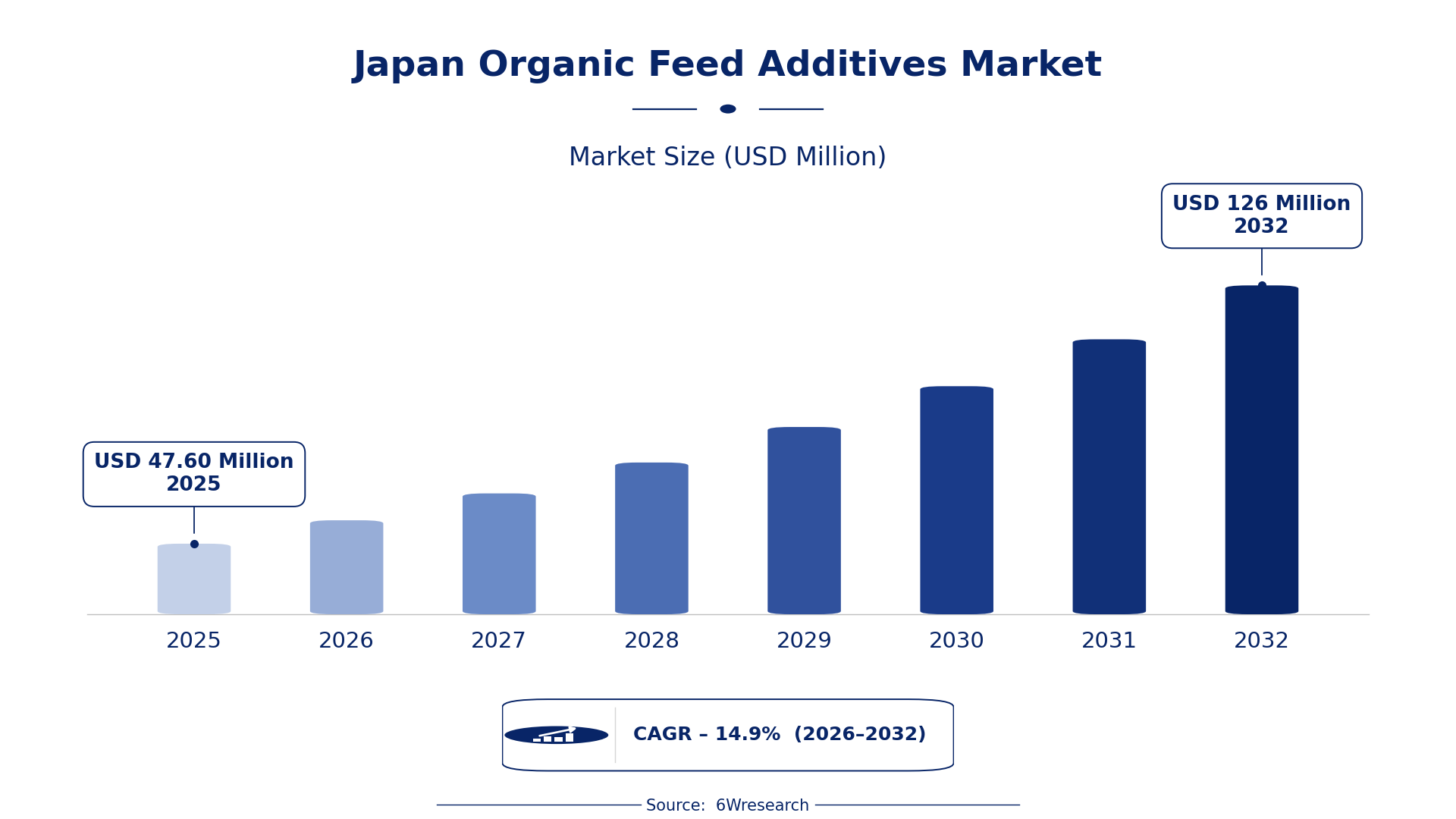
According to 6Wresearch internal database and industry insights, the Japan Organic Feed Additives Market was valued at USD 47.60 Million in 2025 and is projected to reach USD 126 Million by 2032, growing at a CAGR of approximately 14.9% during 2026–2032.
Japan Organic Feed Additives Market Highlights
| Report Metric | Details |
| Report Name | Japan Organic Feed Additives Market (2026-2032) |
| Market Size 2025 | USD 47.60 Million |
| Market Size 2032 | USD 126 Million |
| Absolute Growth 2025–2032 | USD 78.40 Million |
| CAGR 2026–2032 | 14.9% |
| Peak Annual Growth | 15.9% in 2027 |
| Forecast Period | 2026–2032 |
| Historical Data | 2022–2025 |
| Base Year | 2025 |
| Leading Organic Feed Additives Market, 2025 | Probiotics (50% share) |
| Leading Additive Type, 2025 | Lactobacillus spp. (43% share) |
| Leading Ingredient Source, 2025 | Fermented Cultures (46% share) |
| Leading Distribution Channel, 2025 | Livestock Suppliers (40% share) |
| Leading End User, 2025 | Poultry Farms (40% share) |
| Fastest-Growing Organic Feed Additives Market | Herbal Feed Additives (19.6% CAGR) |
| Fastest-Growing Additive Type | Garlic (17.4% CAGR) |
| Fastest-Growing Ingredient Source | Plant Extracts (20.8% CAGR) |
| Fastest-Growing Distribution Channel | Veterinary Stores (19.7% CAGR) |
| Fastest-Growing End User | Dairy Cattle Farms (19.5% CAGR) |
| Growing Sector | Poultry |
| Key End Users | Poultry Farms, Dairy Cattle Farms, Aquaculture Industries |
Japan Organic Feed Additives Market Year-wise Growth Rate and Key Drivers (2022–2032)
This graph illustrates the annual growth rates of the market from 2022 to 2032, highlighting a steady upward trajectory and projected market expansion over the forecast period.
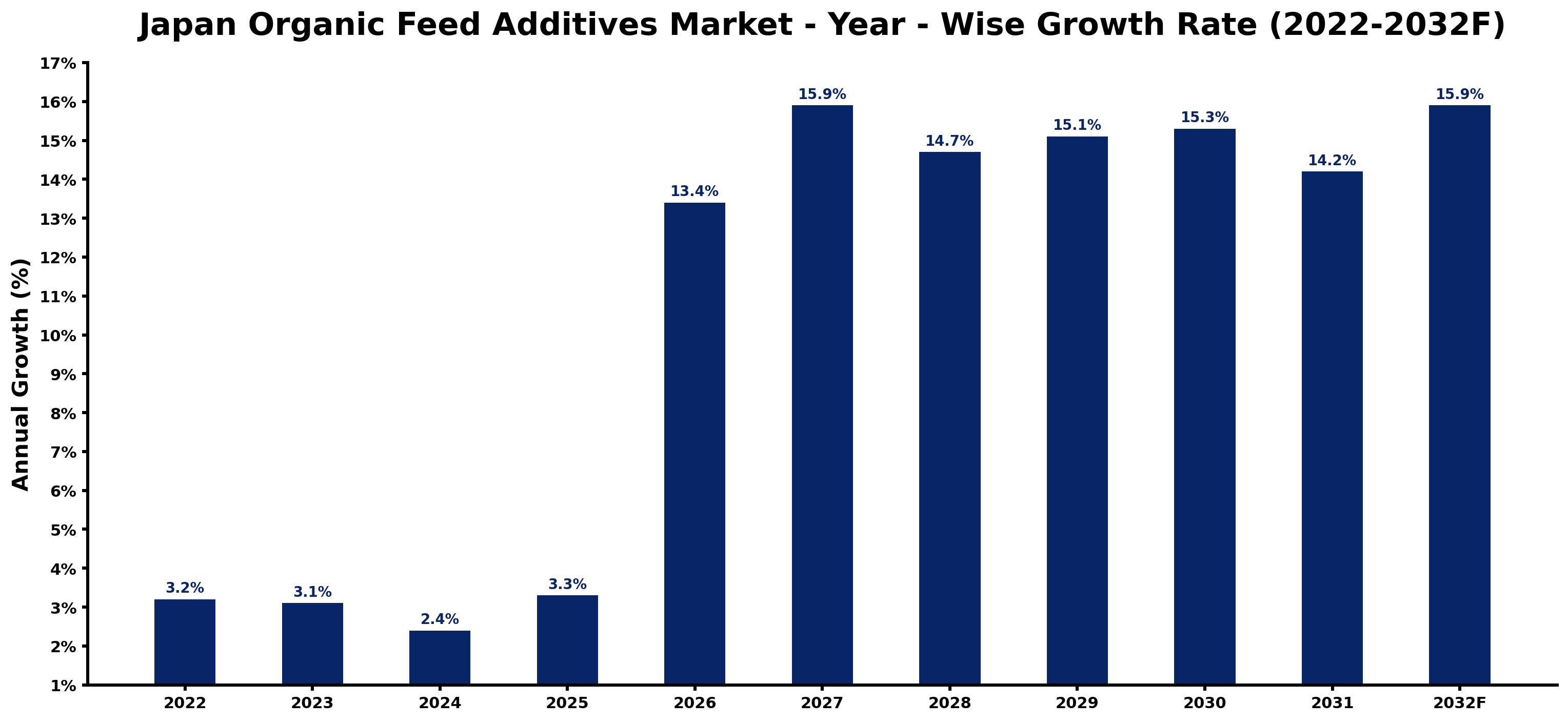
The yearly estimates that follow link every growth rate to its principal driver, so readers can see why the pace changed in each period.
| Year | Estimated Annual Growth (%) | Market Rationale |
| 2022 | 3.2 | The market experienced steady growth, reflecting strong interest in organic products. |
| 2023 | 3.1 | Growth slowed slightly due to market saturation and increased competition among suppliers. |
| 2024 | 2.4 | A further slowdown occurred as buyers became more selective in their purchases. |
| 2025 | 3.3 | Demand increased as poultry farms sought to improve feed quality and health benefits. |
| 2026 | 13.4 | A rise in growth is expected to be driven by heightened awareness of organic farming benefits. |
| 2027 | 15.9 | The peak growth year will see a surge in demand from dairy cattle farms for organic additives. |
| 2028 | 14.7 | Growth is projected to slow slightly as the market begins to stabilise after rapid expansion. |
| 2029 | 15.1 | Demand is expected to pick up again as aquaculture industries expand their use of organic feed. |
| 2030 | 15.3 | Continued growth will be supported by rising consumer preference for organic livestock products. |
| 2031 | 14.2 | Growth is anticipated to slow as the market matures and competition intensifies among suppliers. |
| 2032 | 15.9 | Demand is projected to surge again as new technologies improve the efficiency of organic feed additives. |
Note: Market size estimations and growth projections presented in this report are based on 6Wresearch's proprietary forecasting methodology, utilizing the latest available industry data, government publications, and primary research inputs.
Japan Organic Feed Additives Market Synopsis
Organic feed additives are natural substances added to animal feed to improve livestock health and productivity. They are produced through fermentation, extraction, or synthesis from natural sources, improving digestion and nutrient absorption. The Japan Organic Feed Additives Market is growing due to rising consumer demand for organic products, particularly in the poultry and dairy sectors. The aquaculture industry's expansion further drives this growth, with local farms and veterinary practices adopting these additives to improve livestock health and productivity.
Market Dynamics Impact Analysis (2026–2032)
| Factor | Type | Impact | Primary Segment Affected |
| Rising consumer demand for organic products drives the need for organic feed additives, particularly in the poultry sector, leading to increased purchases by local farms. | Driver | High | Probiotics |
| Technological advancements in production processes enhance the efficiency of organic feed additives, encouraging livestock producers to adopt these innovations for better productivity. | Driver | High | Amino Acid Supplements |
| The growing aquaculture industry presents opportunities for suppliers to introduce organic feed additives tailored for fish health, expanding market reach. | Opportunity | High | Aquaculture Industries |
| Increased funding for research on probiotics creates opportunities for developing new organic feed solutions, attracting investments from local farms. | Opportunity | High | Dairy Cattle Farms |
| Strict regulations related to feed safety and quality compliance create barriers for suppliers, limiting their ability to enter the market effectively. | Restraint | High | Herbal Feed Additives |
| High production costs associated with organic feed additives can deter smaller producers from entering the market, restricting competition. | Restraint | Medium | Enzyme Additives |
| Workforce shortages in the agricultural sector hinder the ability of producers to scale operations, impacting supply capabilities for organic feed additives. | Challenge | High | Probiotics |
| Intense competition among livestock producers leads to price wars, affecting profit margins and forcing suppliers to adjust pricing strategies. | Challenge | Medium | Probiotics |
Evaluation of Drivers in Japan Organic Feed Additives Market (2026–2032)
The main growth drivers and the segments they affect most are set out below.
| Drivers | Primary Segment Affected | Why It Matters (Evidence) |
| Growing awareness of health benefits associated with organic feed. | Probiotics | This trend leads to increased purchases by poultry farms looking to improve gut health, with the poultry sector consuming a significant amount of organic additives. |
| Expansion of the aquaculture industry in Japan. | Amino Acid Supplements | The industry's growth, valued at approximately 1.5 billion USD, drives demand for organic additives to improve fish health and productivity. |
| Government initiatives promoting organic farming practices. | Enzyme Additives | The 2023 initiative encourages local farms to adopt organic practices, leading to increased purchases of organic feed additives. |
| Rising consumer demand for organic products. | Herbal Feed Additives | This demand influences dairy cattle farms to seek organic solutions, boosting their purchases of these additives. |
| Increased focus on animal welfare and sustainable practices. | Fermented Cultures | As livestock suppliers aim to meet consumer expectations, they invest more in organic feed additives. |
A wider customer base explains much of the growth, as the poultry sector's consumption of organic feed additives is substantial, supported by approximately 125 million people in Japan. The aquaculture industry, valued at around 1.5 billion USD, is increasingly adopting organic solutions to enhance fish health. Consumer demand for organic products is influencing dairy cattle farms to seek these solutions, resulting in increased purchases across the sector.
Evaluation of Restraints in Japan Organic Feed Additives Market
Several factors work against faster growth; the main ones are summarised below.
| Market Restraint | Primary Segment Affected | Why It Matters (Evidence) |
| Regulatory compliance with JIS standards can delay product launches. | Enzyme Additives | Producers must ensure their products meet strict safety and quality standards, which can slow down market entry. |
| High production costs for organic feed additives limit profit margins. | Herbal Feed Additives | The costs associated with sourcing organic materials can make it challenging for suppliers to remain competitive. |
| Limited awareness among smaller farms about the benefits of organic additives. | Amino Acid Supplements | This lack of knowledge can restrict the market's growth potential as these farms may opt for conventional feed. |
| Competition from synthetic feed additives impacts market share. | Lactobacillus spp. | Synthetic alternatives often come at a lower price, making them more appealing to cost-sensitive buyers. |
| Supply chain disruptions can affect availability of organic ingredients. | Fermented Cultures | These disruptions can lead to inconsistent supply, impacting the ability of producers to meet demand. |
Japan Organic Feed Additives Market Challenges
Intense rivalry among livestock producers leads to price reductions, which pressures suppliers to lower their margins. This situation arises from Japan's approximately 125 million population, resulting in a saturated market that diminishes profitability for producers. Strict regulations create supply chain disruptions, delaying product availability for local farms. Compliance with JIS standards incurs additional costs for suppliers, raising prices for end users like veterinary practices. Workforce skills shortages limit innovation, restricting growth opportunities for producers in the organic feed additives sector.
Trends in the Japan Organic Feed Additives Market
Below are the shifts with the largest effect on the Japan Organic Feed Additives Market.
- Shift towards Sustainable Practices: Japan's livestock industry is increasingly embracing sustainable practices, fuelled by consumer demand for organic products. In 2023, a government initiative aimed to promote organic farming practices, encouraging farms to transition to organic feed additives.
- Emergence of Plant-Based Additives: The use of plant extracts in organic feed is gaining momentum, with a projected CAGR of 20.8% for the next few years. This trend is evident in the rising popularity of plant-based feed among dairy cattle farms.
- Increased Adoption of Probiotics: Probiotics are becoming crucial in livestock nutrition, particularly in poultry farms. The average size of poultry farms in Japan is around 10,000 birds, resulting in a substantial demand for these additives.
- Regulatory Focus on Feed Safety: The Food Sanitation Act amendment ensures compliance with safety standards for feed additives. This regulation, overseen by the Ministry of Agriculture, Forestry and Fisheries, plays a key role in maintaining product quality in the market.
Investment Opportunities in the Japan Organic Feed Additives Market
Investors looking at the Japan Organic Feed Additives Market should consider the following areas.
- Gap in Organic Feed Supply: With the organic feed additives market projected to reach USD 126 million by 2032, suppliers have the opportunity to address the gap in organic feed supply for livestock farms.
- Timing for Investment in Dairy Sector: Now is a prime time to invest in organic feed additives for dairy cattle farms, which are expected to grow significantly through 2032, driven by increasing consumer demand for organic dairy products.
- Focus on Veterinary Stores: Veterinary stores are becoming increasingly important distribution channels for organic feed additives. Investing in partnerships with these stores can improve market reach and visibility.
- Entry through Local Partnerships: Establishing joint ventures with local suppliers can facilitate entry into the organic feed additives market, particularly in regions with a strong agricultural presence.
Government Initiatives in the Japan Organic Feed Additives Market
The Food Sanitation Act amendment, fully implemented in June 2021, mandates HACCP-based hygiene management for food businesses. This regulation impacts producers of organic feed additives by requiring adherence to strict hygiene standards, ensuring the safety and quality of their products. The amendment aims to enhance food safety across the industry, benefiting both producers and consumers.
Various funding programs overseen by the Ministry of Agriculture, Forestry and Fisheries support research on probiotics for livestock. These initiatives provide buyers with access to effective organic feed solutions that improve livestock health and productivity, focusing on enhancing the overall quality of organic feed additives in the market.
Future Insight of the Japan Organic Feed Additives Market
Technological advancements in production techniques will transform the organic feed additives market by 2032, improving efficiency for buyers and suppliers. A government initiative to promote organic farming practices will stimulate demand, encouraging more farms to adopt these methods. Increased research funding will lead to new products that improve livestock health, benefiting both buyers and suppliers. As consumer interest in organic products rises, suppliers must adapt their strategies to meet evolving market demands.
Market Segmentation Analysis
Japan Organic Feed Additives Market report covers a detailed analysis of the following market segments:
By Organic Feed Additives Market – Probiotics Lead, Herbal Feed Additives Expected to Grow Fastest
According to Aarti Yadav, Research Associate at 6Wresearch, with 50% of organic feed additives market revenue in 2025, Probiotics was the largest category. Probiotics hold a substantial share as they are essential for enhancing gut health in livestock, particularly within the poultry sector, which is a major consumer. The integration of probiotics aligns with the increasing demand for organic products among local farms. The quickest growth will come from Herbal Feed Additives, forecast to expand at a CAGR of 19.6% between 2026 and 2032. Herbal Feed Additives are experiencing rapid growth as farmers seek natural alternatives to improve livestock health, driven by consumer preferences for organic farming. This trend is expected to continue as awareness of the benefits of natural solutions expands. Suppliers should focus on expanding their offerings of herbal feed additives to meet the growing demand in the market.
By Additive Type – Lactobacillus spp. Leads, Garlic Expected to Grow Fastest
Lactobacillus spp. accounted for 43% of the market by additive type in 2025. Lactobacillus spp. dominates the market due to its critical role in improving gut health in livestock, particularly in poultry farms where digestive efficiency is vital. This widespread application reinforces its leading position in the organic feed additives market. Garlic is projected to grow fastest, at a CAGR of 17.4% during 2026–2032. Garlic is rapidly gaining popularity due to its natural antimicrobial properties, which are increasingly valued by farmers seeking effective and safe feed solutions. This growth reflects a broader trend towards natural ingredients in animal nutrition. Buyers may benefit from exploring garlic-based products as a cost-effective and natural alternative to traditional feed additives.
By Ingredient Source – Fermented Cultures Lead, Plant Extracts Expected to Grow Fastest
Fermented Cultures took 46% of ingredient source revenue in 2025, more than any other category. Fermented Cultures are the leading ingredient source as they significantly enhance feed efficiency and health, making them essential in livestock nutrition. Their established use in poultry and dairy sectors solidifies their dominant position in the market. Plant Extracts are set to record the highest CAGR in this split, 20.8% over 2026–2032. Plant Extracts are witnessing the fastest growth as more producers recognise their natural health benefits, particularly in improving overall livestock well-being. This shift towards plant-based solutions aligns with consumer trends favouring organic products. Suppliers should consider increasing their range of plant extract options to capitalise on this growing trend.
By Distribution Channel – Livestock Suppliers Lead, Veterinary Stores Expected to Grow Fastest
The largest distribution channel category in 2025 was Livestock Suppliers, at 40% of revenue. Livestock Suppliers are the primary distribution channel, providing essential access to organic feed additives for farmers across Japan. Their established relationships with livestock producers ensure a steady demand for these products. Over 2026–2032, Veterinary Stores are expected to post the fastest growth, at a CAGR of 19.7%. Veterinary Stores are rapidly becoming the fastest-growing channel as they offer direct access to feed additives, supported by increasing veterinary recommendations for organic solutions. This trend indicates a shift towards more specialised retail environments for livestock nutrition. Suppliers should strengthen partnerships with veterinary stores to enhance market reach and accessibility.
By End User – Poultry Farms Lead, Dairy Cattle Farms Expected to Grow Fastest
In 2025, Poultry Farms led the end user split with a 40% share. Poultry Farms are the largest consumers of organic feed additives, driven by their need for effective solutions to enhance growth and productivity in a competitive market. This high demand solidifies their leading position in the organic feed additives sector. The quickest growth will come from Dairy Cattle Farms, forecast to expand at a CAGR of 19.5% between 2026 and 2032. Dairy Cattle Farms are experiencing the fastest growth in organic feed additive usage as producers aim to improve milk quality and yield through natural solutions. This trend is likely to expand as dairy farming practices evolve towards sustainability. Suppliers should tailor their products to meet the specific needs of dairy cattle farms to capture this growing segment.
Key Attractiveness of the Report
- 10 Years of Market Numbers
- Historical Data Starting from 2022 to 2025
- Base Year 2025
- Forecast Data until 2032
- Key Performance Indicators Impacting the Market
- Major Upcoming Developments and Projects
Key Highlights of the Report:
- Japan Organic Feed Additives Market Outlook
- Market Size of Japan Organic Feed Additives Market, 2025
- Forecast of Japan Organic Feed Additives Market, 2032
- Historical Data and Forecast of Japan Organic Feed Additives Revenues & Volume for the Period 2022-2032F
- Japan Organic Feed Additives Market Trend Evolution
- Japan Organic Feed Additives Market Drivers and Challenges
- Japan Organic Feed Additives Price Trends
- Japan Organic Feed Additives Porter's Five Forces
- Japan Organic Feed Additives Industry Life Cycle
- Historical Data and Forecast of Japan Organic Feed Additives Market Revenues & Volume By Organic Feed Additives Market for the Period 2022-2032F
- Historical Data and Forecast of Japan Organic Feed Additives Market Revenues & Volume By Probiotics for the Period 2022-2032F
- Historical Data and Forecast of Japan Organic Feed Additives Market Revenues & Volume By Herbal Feed Additives for the Period 2022-2032F
- Historical Data and Forecast of Japan Organic Feed Additives Market Revenues & Volume By Amino Acid Supplements for the Period 2022-2032F
- Historical Data and Forecast of Japan Organic Feed Additives Market Revenues & Volume By Enzyme Additives for the Period 2022-2032F
- Historical Data and Forecast of Japan Organic Feed Additives Market Revenues & Volume By Additive Type for the Period 2022-2032F
- Historical Data and Forecast of Japan Organic Feed Additives Market Revenues & Volume By Lactobacillus spp. for the Period 2022-2032F
- Historical Data and Forecast of Japan Organic Feed Additives Market Revenues & Volume By Garlic, Fenugreek for the Period 2022-2032F
- Historical Data and Forecast of Japan Organic Feed Additives Market Revenues & Volume By Methionine, Lysine for the Period 2022-2032F
- Historical Data and Forecast of Japan Organic Feed Additives Market Revenues & Volume By Phytase, Xylanase for the Period 2022-2032F
- Historical Data and Forecast of Japan Organic Feed Additives Market Revenues & Volume By Ingredient Source for the Period 2022-2032F
- Historical Data and Forecast of Japan Organic Feed Additives Market Revenues & Volume By Fermented Cultures for the Period 2022-2032F
- Historical Data and Forecast of Japan Organic Feed Additives Market Revenues & Volume By Plant Extracts for the Period 2022-2032F
- Historical Data and Forecast of Japan Organic Feed Additives Market Revenues & Volume By Natural Protein for the Period 2022-2032F
- Historical Data and Forecast of Japan Organic Feed Additives Market Revenues & Volume By Microbial Sources for the Period 2022-2032F
- Historical Data and Forecast of Japan Organic Feed Additives Market Revenues & Volume By Distribution Channel for the Period 2022-2032F
- Historical Data and Forecast of Japan Organic Feed Additives Market Revenues & Volume By Livestock Suppliers for the Period 2022-2032F
- Historical Data and Forecast of Japan Organic Feed Additives Market Revenues & Volume By Veterinary Stores for the Period 2022-2032F
- Historical Data and Forecast of Japan Organic Feed Additives Market Revenues & Volume By Feed Distributors for the Period 2022-2032F
- Historical Data and Forecast of Japan Organic Feed Additives Market Revenues & Volume By Online Agri Retailers for the Period 2022-2032F
- Historical Data and Forecast of Japan Organic Feed Additives Market Revenues & Volume By End User for the Period 2022-2032F
- Historical Data and Forecast of Japan Organic Feed Additives Market Revenues & Volume By Poultry Farms for the Period 2022-2032F
- Historical Data and Forecast of Japan Organic Feed Additives Market Revenues & Volume By Dairy Cattle Farms for the Period 2022-2032F
- Historical Data and Forecast of Japan Organic Feed Additives Market Revenues & Volume By Pig & Swine Producers for the Period 2022-2032F
- Historical Data and Forecast of Japan Organic Feed Additives Market Revenues & Volume By Aquaculture Industries for the Period 2022-2032F
- Japan Organic Feed Additives Import Export Trade Statistics
- Market Opportunity Assessment By Organic Feed Additives Market
- Market Opportunity Assessment By Additive Type
- Market Opportunity Assessment By Ingredient Source
- Market Opportunity Assessment By Distribution Channel
- Market Opportunity Assessment By End User
- Japan Organic Feed Additives Top Companies Market Share
- Japan Organic Feed Additives Competitive Benchmarking By Technical and Operational Parameters
- Japan Organic Feed Additives Company Profiles
- Japan Organic Feed Additives Key Strategic Recommendations
Market Covered
The study includes the following segmentation.
By Organic Feed Additives Market
- Probiotics
- Herbal Feed Additives
- Amino Acid Supplements
- Enzyme Additives
By Additive Type
- Lactobacillus spp.
- Garlic
- Fenugreek
- Methionine
- Lysine
- Phytase
- Xylanase
By Ingredient Source
- Fermented Cultures
- Plant Extracts
- Natural Protein
- Microbial Sources
By Distribution Channel
- Livestock Suppliers
- Veterinary Stores
- Feed Distributors
- Online Agri Retailers
By End User
- Poultry Farms
- Dairy Cattle Farms
- Pig & Swine Producers
- Aquaculture Industries






































