Japan Organic Fungicides Market Size & Growth Rate
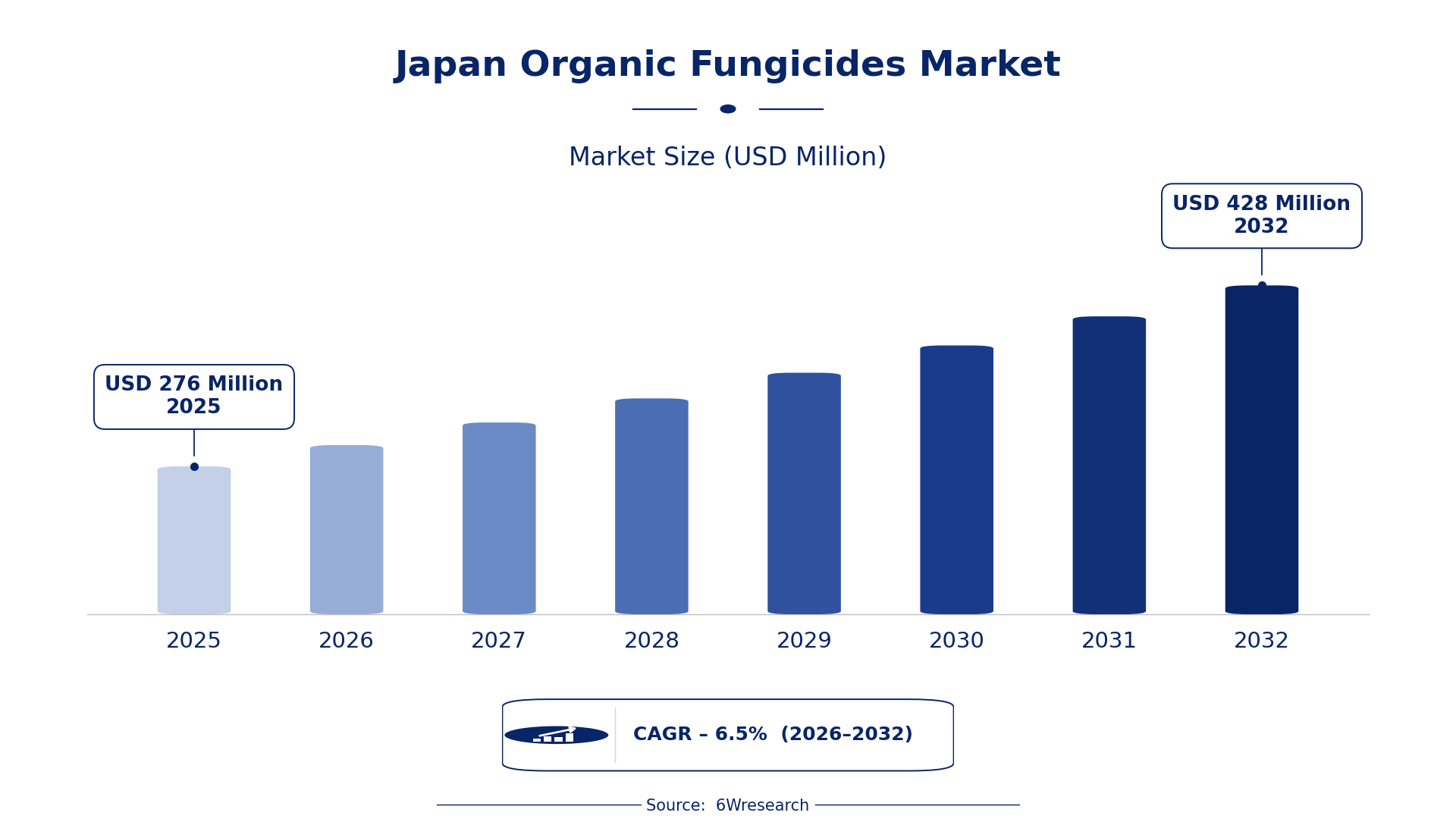
According to 6Wresearch internal database and industry insights, the Japan Organic Fungicides Market was valued at USD 276 Million in 2025 and is projected to reach USD 428 Million by 2032, growing at a CAGR of approximately 6.5% during 2026–2032.
Japan Organic Fungicides Market Highlights
| Report Metric | Details |
| Report Name | Japan Organic Fungicides Market (2026-2032) |
| Market Size 2025 | USD 276 Million |
| Market Size 2032 | USD 428 Million |
| Absolute Growth 2025–2032 | USD 152 Million |
| CAGR 2026–2032 | 6.5% |
| Peak Annual Growth | 7.3% in 2028 |
| Forecast Period | 2026–2032 |
| Historical Data | 2022–2025 |
| Base Year | 2025 |
| Leading Product Type, 2025 | Biofungicides (37% share) |
| Leading Form Type, 2025 | Liquid Form (46% share) |
| Leading Distribution Channel, 2025 | Industrial Suppliers (51% share) |
| Leading End User Sector, 2025 | Agriculture Sector (53% share) |
| Fastest-Growing Form Type | Microbial (9.1% CAGR) |
| Fastest-Growing Distribution Channel | Online Platforms (8.6% CAGR) |
| Fastest-Growing End User Sector | Organic Farming (8.7% CAGR) |
| Growing Sector | Organic Farming |
| Key End Users | Farmers, agricultural cooperatives, horticulturists, organic product distributors |
Japan Organic Fungicides Market Year-wise Growth Rate and Key Drivers (2022–2032)
This graph illustrates the annual growth rates of the market from 2022 to 2032, highlighting a steady upward trajectory and projected market expansion over the forecast period.
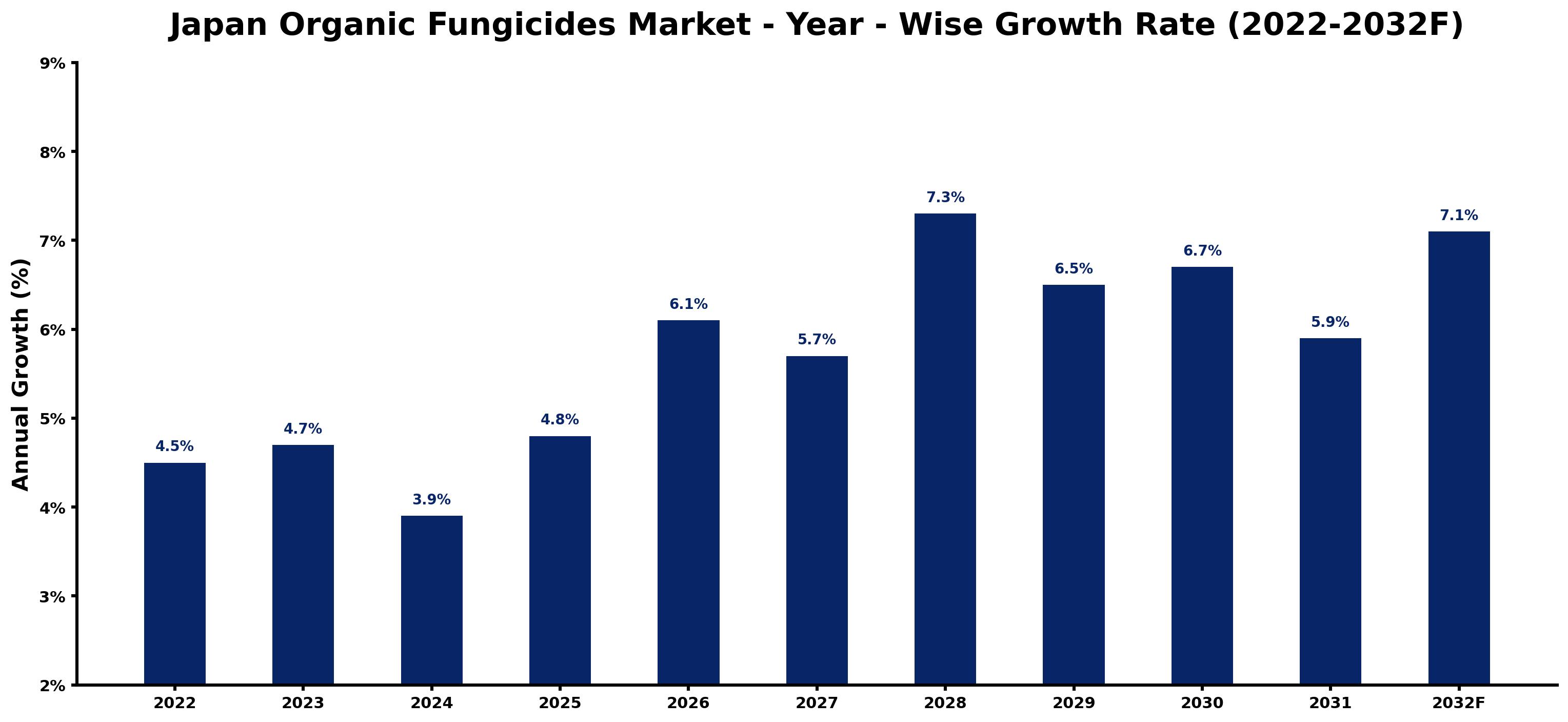
Annual growth estimates for each year appear below with the principal reason behind them, explaining the shifts that set the pace of the market.
| Year | Estimated Annual Growth (%) | Market Rationale |
| 2022 | 4.5 | The market showed steady growth supported by rising organic farming practices. |
| 2023 | 4.7 | Growth accelerated as more farmers adopted organic fungicides for crop protection. |
| 2024 | 3.9 | The growth rate slowed slightly due to market saturation in some regions. |
| 2025 | 4.8 | Demand increased as the government promoted organic farming initiatives. |
| 2026 | 6.1 | The market is anticipated to experience faster growth due to rising adoption of eco-friendly alternatives. |
| 2027 | 5.7 | Growth is projected to slow as competition intensifies among fungicide producers. |
| 2028 | 7.3 | The peak growth rate will be achieved due to heightened awareness of sustainable agricultural practices. |
| 2029 | 6.5 | Growth is expected to slow as the market matures and demand stabilises. |
| 2030 | 6.7 | Demand will increase again as new organic farming methods gain popularity. |
| 2031 | 5.9 | The growth rate is projected to slow as the market reaches a saturation point. |
| 2032 | 7.1 | Demand is expected to rise due to government targets for expanding organic farmland. |
Note: Market size estimations and growth projections presented in this report are based on 6Wresearch's proprietary forecasting methodology, utilizing the latest available industry data, government publications, and primary research inputs.
Japan Organic Fungicides Market Synopsis
Organic fungicides are biopesticides derived from natural sources, primarily used to control fungal diseases in crops. The Japan Organic Fungicides Market is growing due to increased adoption of organic practices, government support for sustainable agriculture, and a rising number of certified organic farmers. In 2023, Japan's organic farming area reached 500,000 hectares, reflecting the growing interest in eco-friendly solutions. This expansion is driven by the increasing demand for organic products and the government's initiatives to promote sustainable farming methods.
Market Dynamics Impact Analysis (2026–2032)
| Factor | Type | Impact | Primary Segment Affected |
| Increased adoption of organic farming practices | Driver | High | Biofungicides |
| Government support for organic farming initiatives | Driver | High | Copper-Based Fungicides |
| Growing demand for sustainable agricultural solutions | Opportunity | High | Biofungicides |
| Expansion of organic farmland under government targets | Opportunity | High | Organic Farming |
| Competition from synthetic fungicides | Restraint | Medium | Copper-Based Fungicides |
| Limited awareness of organic fungicides among farmers | Restraint | Medium | Sulfur-Based Fungicides |
| Aging farmer population affecting production capacity | Challenge | High | Agriculture Sector |
| Challenges in scaling production of biofungicides | Challenge | Medium | Biofungicides |
Evaluation of Drivers in Japan Organic Fungicides Market (2026–2032)
Demand rests on the following drivers, each shown with the segment it touches most.
| Drivers | Primary Segment Affected | Why It Matters (Evidence) |
| Increasing organic farming area | Biofungicides | The organic farming area in Japan reached 500,000 hectares in 2022, leading to higher purchases of biofungicides by farmers. |
| Government support for organic agriculture | Copper-Based Fungicides | The Ministry of Agriculture, Forestry and Fisheries promotes organic practices, boosting demand for copper-based fungicides. |
| Consumer preference for organic products | Biofungicides | Organic farming contributes 1.5% to total agricultural output, driving demand for biofungicides among consumers. |
| Growth in certified organic farmers | Sulfur-Based Fungicides | Japan had over 30,000 certified organic farmers in 2023, increasing the use of sulfur-based fungicides. |
| Focus on sustainable agricultural solutions | Biofungicides | The GX Promotion Act encourages the adoption of eco-friendly practices, boosting the market for biofungicides. |
Volumes grow on the back of expanding organic farming areas, which reached 500,000 hectares in 2022, prompting farmers to increase their purchases of eco-friendly fungicides. The rising consumer preference for organic products has led to organic farming contributing 1.5% to total agricultural output, driving further demand for sustainable solutions. The number of certified organic farmers exceeded 30,000 in 2023, which has boosted the use of alternative fungicides.
Evaluation of Restraints in Japan Organic Fungicides Market
Below are the constraints most often cited by buyers and suppliers, with the segment each affects.
| Market Restraint | Primary Segment Affected | Why It Matters (Evidence) |
| Competition from synthetic fungicides | Copper-Based Fungicides | Synthetic fungicides dominate the market, making it challenging for organic options to gain traction. |
| Limited awareness of organic fungicides among farmers | Sulfur-Based Fungicides | Many farmers lack knowledge about the benefits of organic fungicides, limiting their adoption. |
| High production costs of biofungicides | Biofungicides | The production of biofungicides can be more expensive, deterring some farmers from switching. |
| Regulatory hurdles for new products | Biofungicides | Obtaining approval for new organic fungicides can be a lengthy process, slowing market entry. |
| Aging farmer population affecting production capacity | Agriculture Sector | The average age of organic farmers is 57 years, impacting the workforce and production capabilities. |
Japan Organic Fungicides Market Challenges
In 2023, biofungicides accounted for only 15% of the total fungicide market, limiting competition for producers of organic fungicides. This low market share exists due to farmers' limited awareness of organic options, resulting in slower adoption rates and reduced sales opportunities for suppliers. The average annual consumption of fungicides in Japan is approximately 10,000 tons, constraining the supply of organic alternatives for buyers. Regulatory complexities can delay product approvals, causing producers to miss market opportunities and impacting farmers' pest management strategies.
Trends in the Japan Organic Fungicides Market
The trends below show where the Japan Organic Fungicides Market is heading.
- Shift from Conventional to Organic Farming: Since 2022, the agriculture sector has seen a shift towards organic practices, particularly in the Tokyo region, where the concentration of organic farms is highest. This change is reflected in the increasing organic farming area, projected to reach 1 million hectares by 2025.
- Rise of Biofungicides in Crop Protection: The use of biofungicides has gained traction since 2023, particularly among certified organic farmers. With biofungicides accounting for 15% of the total fungicide market, this trend reflects a growing preference for sustainable solutions.
- Growing Popularity of Sulfur-Based Fungicides: Since 2023, sulfur-based fungicides have become increasingly popular, especially in grape cultivation. This trend is supported by their effectiveness against powdery mildew, making them a preferred choice among grape growers.
- Expansion of Online Sales Channels: In 2023, online platforms began gaining traction as a sales channel for organic fungicides. This shift is evidenced by an 8.6% CAGR in online sales, catering to the convenience needs of farmers.
Investment Opportunities in the Japan Organic Fungicides Market
Several openings in the Japan Organic Fungicides Market merit attention from investors.
- Investment in Biofungicide Production Facilities: The Tokyo region presents an opportunity for investment in biofungicide production facilities, as demand is expected to rise. With biofungicides accounting for 15% of the market, this is a timely investment.
- Expansion of Organic Farming Area: With the government's target to increase organic farmland to 1 million hectares by 2025, there is an opportunity for suppliers of organic fungicides to meet this demand.
- Collaboration with Agricultural Cooperatives: Partnering with agricultural cooperatives in the Kanto region can facilitate market entry for new organic fungicide products, tapping into existing networks of farmers.
- Development of Targeted Marketing Strategies: As the average age of organic farmers is 57 years, developing targeted marketing strategies to reach younger farmers can improve market penetration and growth.
Government Initiatives in the Japan Organic Fungicides Market
The Organic JAS certification, established in 2001, mandates that organic products meet specific standards, ensuring quality and safety for consumers. The GX Promotion Act, enacted in 2023, further supports organic agriculture by providing a framework for sustainable practices and increasing organic farmland.
In 2023, the government allocated USD 10 million for organic farming initiatives, administered by the Ministry of Agriculture, Forestry and Fisheries, to support farmers transitioning to organic practices and to strengthen the organic agriculture sector.
Future Insight of the Japan Organic Fungicides Market
The introduction of the Organic Agriculture Promotion Program will support farmers transitioning to organic practices and increase the number of certified farms. By 2025, the government aims to expand organic farmland to 1 million hectares, providing greater opportunities for suppliers. Rising interest in microbial fungicides will stimulate advancements in product development. Research from the National Institute of Agrobiological Sciences on biofungicides will likely improve efficacy, resulting in better pest management solutions for farmers.
Market Segmentation Analysis
Japan Organic Fungicides Market report covers a detailed analysis of the following market segments:
By Product Type – Biofungicides Lead and Record the Fastest Growth
According to Aarti Yadav, Research Associate at 6Wresearch, with 37% of product type revenue in 2025, Biofungicides was the largest category. Biofungicides dominate the market as they are extensively used in organic farming, which is actively promoted by government initiatives. The Organic Agriculture Promotion Program initiated in 2022 has incentivised farmers to adopt these natural solutions for crop protection. Its lead should widen, with a projected CAGR of 9.4% during 2026–2032, the highest in this split. The increasing preference for biofungicides is fuelled by a rising awareness of sustainable farming methods, with the government targeting a substantial increase in organic farmland. This focus will likely reinforce the leading position of biofungicides in the market. Suppliers should prioritise biofungicides to align with the growing demand for sustainable agricultural solutions.
By Form Type – Liquid Form Leads, Microbial Expected to Grow Fastest
Liquid Form took 46% of form type revenue in 2025, more than any other category. Liquid form products dominate the market as they are commonly used for foliar applications, making them essential for effective crop protection. Their versatility in application methods contributes to their leading position. Microbial is projected to grow fastest, at a CAGR of 9.1% during 2026–2032. Microbial formulations are rapidly gaining traction due to their eco-friendly properties, appealing to a growing segment of environmentally conscious farmers. This shift towards microbial options indicates a potential for increased market share in the near future. Suppliers should invest in developing and marketing microbial formulations to capture the emerging demand.
By Distribution Channel – Industrial Suppliers Lead, Online Platforms Expected to Grow Fastest
In 2025, Industrial Suppliers led the distribution channel split with a 51% share. Industrial suppliers are the primary source for bulk fungicide purchases, catering to large-scale agricultural operations that require consistent product availability. Their well-established networks facilitate efficient distribution to farmers across various regions, ensuring they meet the high demand for organic fungicides. Online Platforms are set to record the highest CAGR in this split, 8.6% over 2026–2032. Online platforms are experiencing rapid growth as farmers increasingly seek the convenience and variety that digital purchasing provides. This trend suggests that suppliers need to enhance their online presence to meet the evolving preferences of their customers. Suppliers must focus on developing robust online distribution strategies to align with the changing purchasing habits of farmers.
By End User Sector – Agriculture Sector Leads, Organic Farming Expected to Grow Fastest
The largest end user sector category in 2025 was Agriculture Sector, at 53% of revenue. The agriculture sector is the largest user of fungicides, utilising them extensively for crop protection across various farming practices. This high demand from traditional agriculture underpins its leading position in the market. The quickest growth will come from Organic Farming, forecast to expand at a CAGR of 8.7% between 2026 and 2032. Organic farming is the fastest growing sector as it increasingly adopts organic fungicides to meet consumer demand for sustainable produce. The growth in organic farming will further amplify the need for organic fungicides in the future. Suppliers should target organic farming initiatives to capitalise on the sector's growth potential.
Key Attractiveness of the Report
- 10 Years of Market Numbers
- Historical Data Starting from 2022 to 2025
- Base Year 2025
- Forecast Data until 2032
- Key Performance Indicators Impacting the Market
- Major Upcoming Developments and Projects
Key Highlights of the Report:
- Japan Organic Fungicides Market Outlook
- Market Size of Japan Organic Fungicides Market, 2025
- Forecast of Japan Organic Fungicides Market, 2032
- Historical Data and Forecast of Japan Organic Fungicides Revenues & Volume for the Period 2022-2032F
- Japan Organic Fungicides Market Trend Evolution
- Japan Organic Fungicides Market Drivers and Challenges
- Japan Organic Fungicides Price Trends
- Japan Organic Fungicides Porter's Five Forces
- Japan Organic Fungicides Industry Life Cycle
- Historical Data and Forecast of Japan Organic Fungicides Market Revenues & Volume By Product Type for the Period 2022-2032F
- Historical Data and Forecast of Japan Organic Fungicides Market Revenues & Volume By Copper-Based Fungicides for the Period 2022-2032F
- Historical Data and Forecast of Japan Organic Fungicides Market Revenues & Volume By Sulfur-Based Fungicides for the Period 2022-2032F
- Historical Data and Forecast of Japan Organic Fungicides Market Revenues & Volume By Biofungicides for the Period 2022-2032F
- Historical Data and Forecast of Japan Organic Fungicides Market Revenues & Volume By Essential Oil Fungicides for the Period 2022-2032F
- Historical Data and Forecast of Japan Organic Fungicides Market Revenues & Volume By Form Type for the Period 2022-2032F
- Historical Data and Forecast of Japan Organic Fungicides Market Revenues & Volume By Powder Form for the Period 2022-2032F
- Historical Data and Forecast of Japan Organic Fungicides Market Revenues & Volume By Liquid Form for the Period 2022-2032F
- Historical Data and Forecast of Japan Organic Fungicides Market Revenues & Volume By Microbial for the Period 2022-2032F
- Historical Data and Forecast of Japan Organic Fungicides Market Revenues & Volume By Oil-Based for the Period 2022-2032F
- Historical Data and Forecast of Japan Organic Fungicides Market Revenues & Volume By Distribution Channel for the Period 2022-2032F
- Historical Data and Forecast of Japan Organic Fungicides Market Revenues & Volume By Industrial Suppliers for the Period 2022-2032F
- Historical Data and Forecast of Japan Organic Fungicides Market Revenues & Volume By Direct Sales for the Period 2022-2032F
- Historical Data and Forecast of Japan Organic Fungicides Market Revenues & Volume By Online Platforms for the Period 2022-2032F
- Historical Data and Forecast of Japan Organic Fungicides Market Revenues & Volume By Specialty Retailers for the Period 2022-2032F
- Historical Data and Forecast of Japan Organic Fungicides Market Revenues & Volume By End User Sector for the Period 2022-2032F
- Historical Data and Forecast of Japan Organic Fungicides Market Revenues & Volume By Agriculture Sector for the Period 2022-2032F
- Historical Data and Forecast of Japan Organic Fungicides Market Revenues & Volume By Horticulture for the Period 2022-2032F
- Historical Data and Forecast of Japan Organic Fungicides Market Revenues & Volume By Organic Farming for the Period 2022-2032F
- Historical Data and Forecast of Japan Organic Fungicides Market Revenues & Volume By Nursery & Landscaping for the Period 2022-2032F
- Japan Organic Fungicides Import Export Trade Statistics
- Market Opportunity Assessment By Product Type
- Market Opportunity Assessment By Form Type
- Market Opportunity Assessment By Distribution Channel
- Market Opportunity Assessment By End User Sector
- Japan Organic Fungicides Top Companies Market Share
- Japan Organic Fungicides Competitive Benchmarking By Technical and Operational Parameters
- Japan Organic Fungicides Company Profiles
- Japan Organic Fungicides Key Strategic Recommendations
Market Covered
This report examines the market across the segments below.
By Product Type
- Copper-Based Fungicides
- Sulfur-Based Fungicides
- Biofungicides
- Essential Oil Fungicides
By Form Type
- Powder Form
- Liquid Form
- Microbial
- Oil-Based
By Distribution Channel
- Industrial Suppliers
- Direct Sales
- Online Platforms
- Specialty Retailers
By End User Sector
- Agriculture Sector
- Horticulture
- Organic Farming
- Nursery & Landscaping






































