Japan Organic Herbicides Market Size & Growth Rate
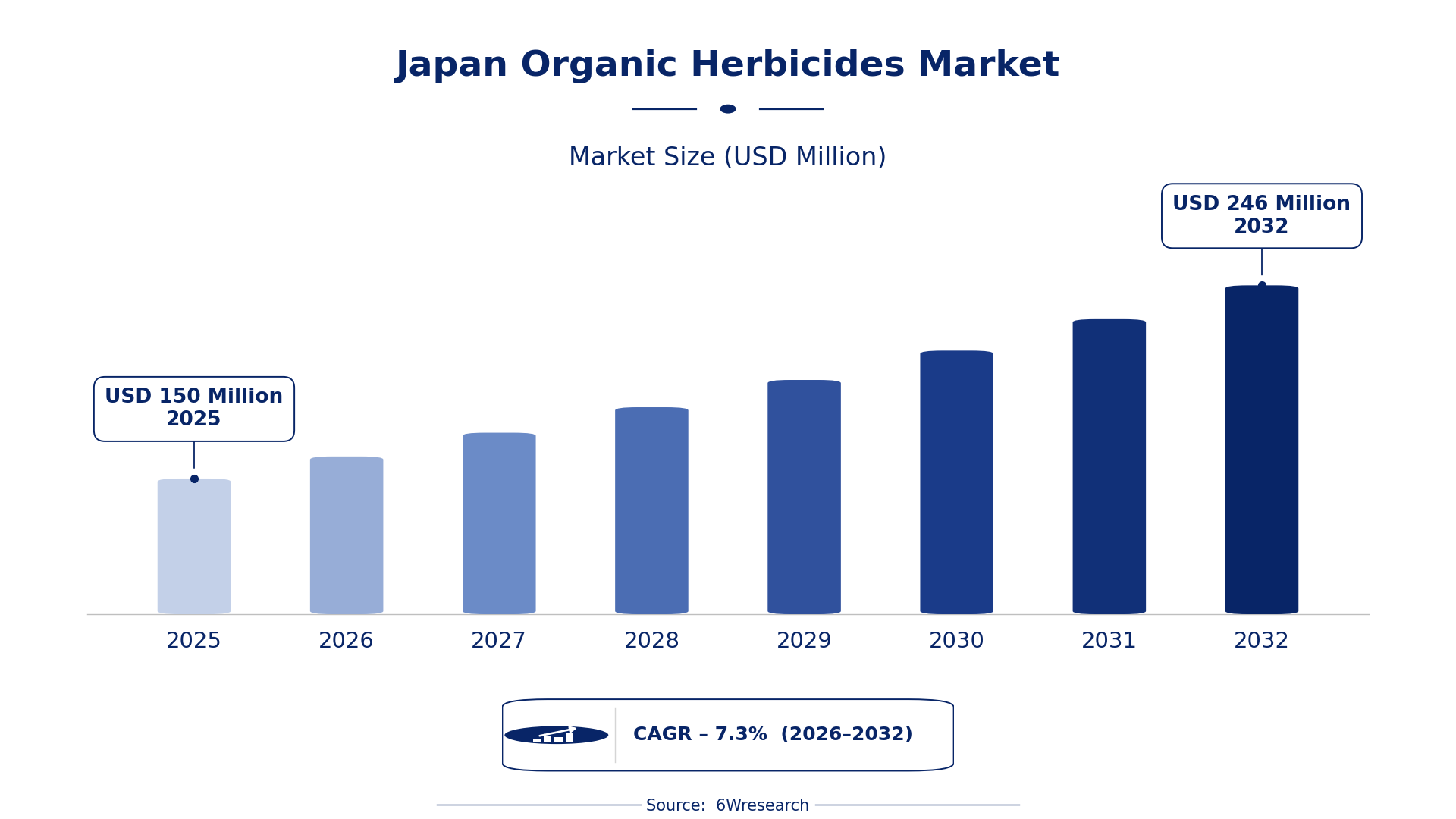
According to 6Wresearch internal database and industry insights, the Japan Organic Herbicides Market was valued at USD 150 Million in 2025 and is projected to reach USD 246 Million by 2032, growing at a CAGR of approximately 7.3% during 2026–2032.
Japan Organic Herbicides Market Highlights
| Report Metric | Details |
| Report Name | Japan Organic Herbicides Market (2026-2032) |
| Market Size 2025 | USD 150 Million |
| Market Size 2032 | USD 246 Million |
| Absolute Growth 2025–2032 | USD 96 Million |
| CAGR 2026–2032 | 7.3% |
| Peak Annual Growth | 8.2% in 2032 |
| Forecast Period | 2026–2032 |
| Historical Data | 2022–2025 |
| Base Year | 2025 |
| Leading Product Type, 2025 | Vinegar-Based (37% share) |
| Leading Composition Type, 2025 | Acetic Acid Base (45% share) |
| Leading Distribution Channel, 2025 | Direct Sales (56% share) |
| Leading End User Sector, 2025 | Organic Farms (42% share) |
| Fastest-Growing Product Type | Salt-Based (10.2% CAGR) |
| Fastest-Growing Composition Type | Mineral Base (10.4% CAGR) |
| Fastest-Growing Distribution Channel | Online Platforms (9.7% CAGR) |
| Fastest-Growing End User Sector | Landscaping Companies (9.5% CAGR) |
| Growing Sector | Organic Farming |
| Key End Users | Organic Farms, Landscaping Companies, Small Scale Farmers, Horticulture |
Japan Organic Herbicides Market Year-wise Growth Rate and Key Drivers (2022–2032)
This graph illustrates the annual growth rates of the market from 2022 to 2032, highlighting a steady upward trajectory and projected market expansion over the forecast period.
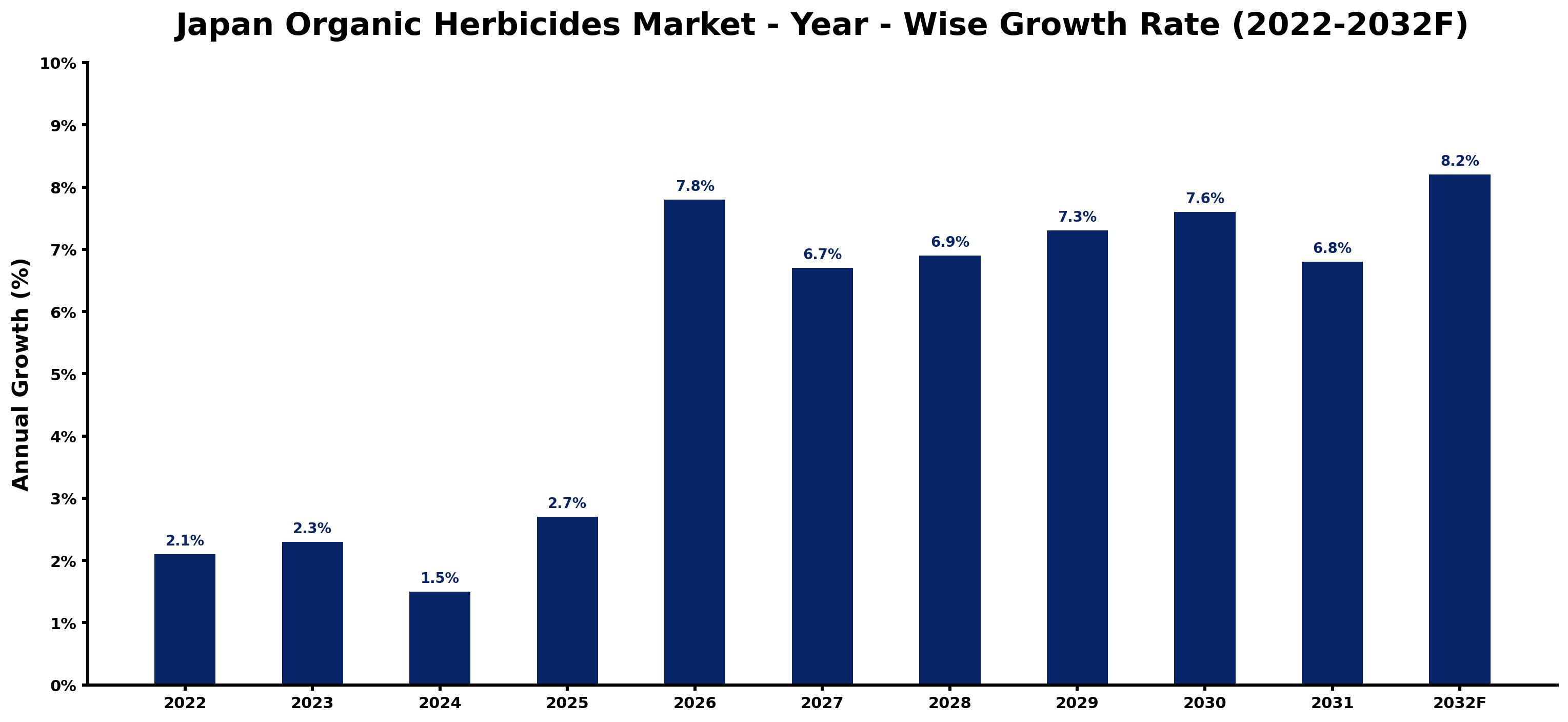
Below, each year's estimated growth is shown next to the factor that most influenced it.
| Year | Estimated Annual Growth (%) | Market Rationale |
| 2022 | 2.1 | The market showed steady growth, reflecting increased interest in organic farming practices. |
| 2023 | 2.3 | Growth was faster than the previous year, driven by rising demand for organic produce. |
| 2024 | 1.5 | Growth slowed as market saturation began to affect new purchases. |
| 2025 | 2.7 | Growth accelerated again, supported by government initiatives promoting organic farming. |
| 2026 | 7.8 | Demand is expected to surge as consumer preferences shift towards eco-friendly products. |
| 2027 | 6.7 | Growth is projected to slow slightly due to intensified competition among suppliers. |
| 2028 | 6.9 | Demand is expected to increase again, spurred by new organic farming practices. |
| 2029 | 7.3 | Growth will continue as small-scale farmers adopt organic herbicides more widely. |
| 2030 | 7.6 | Demand is projected to rise further, driven by urban landscaping projects using organic options. |
| 2031 | 6.8 | Growth will slow as market maturity begins to set in. |
| 2032 | 8.2 | Demand is expected to peak, driven by a strong push for sustainable agricultural practices. |
Note: Market size estimations and growth projections presented in this report are based on 6Wresearch's proprietary forecasting methodology, utilizing the latest available industry data, government publications, and primary research inputs.
Japan Organic Herbicides Market Synopsis
Organic herbicides are derived from natural sources, including vinegar and essential oils, and are used to control weeds in agriculture and landscaping. The Japan Organic Herbicides Market is growing due to the expansion of organic farming areas, which reached 80,000 hectares in 2022, alongside rising consumer demand for sustainable products. Support from the Ministry of Agriculture, Forestry and Fisheries through subsidies further fuels this growth, creating opportunities for suppliers in this segment.
Market Dynamics Impact Analysis (2026–2032)
| Factor | Type | Impact | Primary Segment Affected |
| Growing organic farming area | Driver | High | Vinegar-Based |
| Increased consumer demand for sustainable products | Driver | High | Essential Oil-Based |
| Expansion of organic farms | Opportunity | High | Organic Farms |
| Rising online sales channels | Opportunity | Medium | Online Platforms |
| Regulatory compliance costs | Restraint | High | Salt-Based |
| Limited awareness among small-scale farmers | Restraint | Medium | Fatty Acid Herbicide |
| High competition among suppliers | Challenge | High | Essential Oil-Based |
| Supply chain disruptions | Challenge | Medium | Vinegar-Based |
Evaluation of Drivers in Japan Organic Herbicides Market (2026–2032)
The table below links each growth driver to the segment it affects and the evidence for it.
| Drivers | Primary Segment Affected | Why It Matters (Evidence) |
| Increase in organic farming practices | Vinegar-Based | Japan's organic farming area reached 80,000 hectares in 2022, boosting demand for effective weed control. |
| Government subsidies for organic farming | Essential Oil-Based | Subsidies from the Ministry of Agriculture, Forestry and Fisheries encourage farmers to adopt eco-friendly practices, increasing herbicide use. |
| Rising consumer preference for eco-friendly products | Salt-Based | The organic produce market was valued at approximately ¥300 billion in 2023, driving demand for organic herbicides. |
| Growth of urban landscaping projects | Fatty Acid Herbicide | Vinegar-based herbicides are commonly used in urban landscaping, increasing demand among landscaping companies. |
| Popularity of essential oil-based herbicides | Botanical Oils | Essential oil-based herbicides are gaining traction among small-scale farmers, boosting their purchasing. |
What keeps demand rising is the increasing area of organic farming, which reached 80,000 hectares in 2022, leading to greater purchases of organic herbicides. The support for organic farming, valued at approximately ¥300 billion in 2023, encourages farmers to adopt eco-friendly practices. Urban landscaping projects frequently utilise vinegar-based solutions, boosting demand from landscaping companies. Essential oil-based herbicides are gaining traction among small-scale farmers, further driving sales. The growing consumer preference for sustainable products influences purchasing decisions, with more buyers opting for organic solutions.
Evaluation of Restraints in Japan Organic Herbicides Market
Several factors work against faster growth; the main ones are summarised below.
| Market Restraint | Primary Segment Affected | Why It Matters (Evidence) |
| High costs associated with regulatory compliance | Salt-Based | Compliance with JAS standards can increase costs for producers, affecting their competitiveness. |
| Limited awareness of organic herbicides among farmers | Fatty Acid Herbicide | Many small-scale farmers remain unaware of the benefits of organic herbicides, hindering market growth. |
| Supply chain disruptions affecting availability | Essential Oil-Based | Recent supply chain issues have impacted product availability, affecting purchasing decisions. |
| Intense competition leading to price wars | Vinegar-Based | High competition among suppliers can reduce profit margins and create market instability. |
| Seasonal fluctuations in demand | Botanical Oils | Demand for organic herbicides can vary seasonally, affecting sales consistency. |
Japan Organic Herbicides Market Challenges
In 2022, Japan's organic farming area reached 80,000 hectares, but many buyers struggle to find sufficient organic herbicides due to limited domestic production. This shortage delays planting schedules for producers, potentially reducing crop yields by up to 20%. Strict JAS standards for organic products complicate the approval process for new herbicides, causing technology adoption to lag and preventing suppliers from meeting increasing demand. Skills gaps in the application of these products diminish their effectiveness, leading to wasted resources for farmers who depend on them.
Trends in the Japan Organic Herbicides Market
The following changes are redrawing the Japan Organic Herbicides Market.
- Shift Towards Essential Oil-Based Herbicides: Small-scale farmers are increasingly adopting essential oil-based herbicides for their natural properties, with a notable rise in popularity observed in 2023, reflecting a shift in farming practices.
- Growing Use of Vinegar-Based Solutions in Urban Areas: Urban landscaping projects have increasingly utilised vinegar-based herbicides since 2022, reflecting a shift towards eco-friendly practices in city planning, particularly in metropolitan areas.
- Increase in Online Sales Channels: The rise of online platforms for purchasing organic herbicides has been notable, with a 15% increase in online sales recorded last year, indicating a shift in consumer purchasing behaviour.
- Focus on Sustainable Agriculture Initiatives: The Japanese government has included organic herbicides in its sustainable agriculture initiatives, promoting eco-friendly practices across the country, which is expected to support market growth.
Investment Opportunities in the Japan Organic Herbicides Market
Investors looking at the Japan Organic Herbicides Market should consider the following areas.
- Gap in Organic Herbicide Awareness: With over 30,000 certified organic farms in Japan, there is an opportunity to educate farmers about organic herbicides, improving market penetration and sales potential.
- Chiba Prefecture as a Hub for Organic Production: Chiba Prefecture, known for its organic vegetable production, presents opportunities for suppliers to establish partnerships with local farmers, strengthening distribution channels.
- Entry through Local Partnerships: Investing in local partnerships can facilitate market entry for suppliers looking to provide organic herbicides in Japan's growing market, especially in rural areas.
- Supply of Eco-Friendly Herbicides: The increasing demand for sustainable herbicides offers a chance for suppliers to develop and market organic herbicide solutions, catering to environmentally conscious consumers.
Government Initiatives in the Japan Organic Herbicides Market
The Waste Management and Public Cleansing Act (1970) regulates the treatment of waste, ensuring that producers adhere to strict environmental standards. This law supports sustainable practices in the organic herbicide sector, promoting eco-friendly production methods. The Chemical Substances Control Law (1973) requires evaluation and oversight of chemical substances, impacting the production of organic herbicides.
In 2023, the government allocated ¥5 billion for training programs to support organic farming practices, administered by the Ministry of Agriculture, Forestry and Fisheries. This funding aims to improve the skills of farmers in using organic herbicides effectively.
Future Insight of the Japan Organic Herbicides Market
By 2032, buyers will see a rise in the number of certified organic farms, exceeding 30,000, as government training programs improve farming practices. The Tokyo region is expected to experience a 25% increase in organic farmland by 2025, allowing for greater access to diverse herbicide options. Urban landscaping projects will increasingly incorporate vinegar-based solutions, showcasing a commitment to eco-friendly practices. The push for sustainable agriculture will stimulate innovation and broaden the market for organic herbicides, benefiting both buyers and suppliers.
Market Segmentation Analysis
Japan Organic Herbicides Market report covers a detailed analysis of the following market segments:
By Product Type – Vinegar-Based Leads, Salt-Based Expected to Grow Fastest
According to Aarti Yadav, Research Associate at 6Wresearch, in 2025, Vinegar-Based led the product type split with a 37% share. Vinegar-based herbicides hold the largest market share due to their effectiveness in controlling weeds without harmful chemicals, making them a preferred solution among organic farmers. Their use is particularly prominent in urban landscaping projects, where eco-friendly practices are increasingly demanded. Salt-Based is set to record the highest CAGR in this split, 10.2% over 2026–2032. Salt-based herbicides are experiencing rapid growth because they are effectively utilised for their desiccating properties on unwanted vegetation, especially in coastal agricultural areas. This trend is further propelled by the rising demand for efficient and environmentally safe weed control methods. Suppliers should prioritise expanding their vinegar-based product lines while also exploring salt-based options to leverage emerging market opportunities.
By Composition Type – Acetic Acid Base Leads, Mineral Base Expected to Grow Fastest
Acetic Acid Base took 45% of composition type revenue in 2025, more than any other category. The acetic acid base leads the market as it is widely adopted as a natural herbicide, appealing to organic farmers who seek effective weed management solutions. Its acceptance is underscored by the growth of organic farming in Japan, which reached 80,000 hectares in 2022. Over 2026–2032, Mineral Base is expected to post the fastest growth, at a CAGR of 10.4%. Mineral base herbicides are witnessing the fastest growth, albeit from a smaller base, due to their specific properties that cater to niche agricultural needs. This growth is supported by government initiatives that promote organic farming practices and training. Buyers should consider diversifying their herbicide options by incorporating both acetic acid and mineral base products to address varying agricultural requirements.
By Distribution Channel – Direct Sales Leads, Online Platforms Expected to Grow Fastest
The largest distribution channel category in 2025 was Direct Sales, at 56% of revenue. Direct sales dominate the market as they provide an effective link to farmers, ensuring that organic herbicides reach primary users efficiently. This method aligns with the increasing trend of organic farming, bolstered by government subsidies and training programmes. Online Platforms are projected to grow fastest, at a CAGR of 9.7% during 2026–2032. Online platforms are rapidly emerging as a preferred distribution channel, reflecting a shift in consumer purchasing behaviour towards organic products. The 15% increase in online sales over the last year indicates a significant trend towards digital purchasing in the agricultural sector. Suppliers should enhance their online presence to effectively engage with the growing segment of buyers who prefer purchasing organic herbicides through digital channels.
By End User Sector – Organic Farms Lead, Landscaping Companies Expected to Grow Fastest
Organic Farms held 42% of the Japan Organic Herbicides Market by end user sector in 2025. Organic farms represent the largest user group of organic herbicides, as they are the primary consumers seeking effective and environmentally friendly weed control solutions. The increase in certified organic farms, which exceeded 30,000 in 2023, further solidifies this segment's dominance. The quickest growth will come from Landscaping Companies, forecast to expand at a CAGR of 9.5% between 2026 and 2032. Landscaping companies are the fastest-growing end user sector, utilising organic options to provide eco-friendly services that cater to environmentally conscious consumers. This trend is expected to continue as urban areas increasingly adopt sustainable landscaping practices. Suppliers should tailor their marketing strategies to target landscaping companies, as this sector presents a growing opportunity for organic herbicide sales.
Key Attractiveness of the Report
- 10 Years of Market Numbers
- Historical Data Starting from 2022 to 2025
- Base Year 2025
- Forecast Data until 2032
- Key Performance Indicators Impacting the Market
- Major Upcoming Developments and Projects
Key Highlights of the Report:
- Japan Organic Herbicides Market Outlook
- Market Size of Japan Organic Herbicides Market, 2025
- Forecast of Japan Organic Herbicides Market, 2032
- Historical Data and Forecast of Japan Organic Herbicides Revenues & Volume for the Period 2022-2032F
- Japan Organic Herbicides Market Trend Evolution
- Japan Organic Herbicides Market Drivers and Challenges
- Japan Organic Herbicides Price Trends
- Japan Organic Herbicides Porter's Five Forces
- Japan Organic Herbicides Industry Life Cycle
- Historical Data and Forecast of Japan Organic Herbicides Market Revenues & Volume By Product Type for the Period 2022-2032F
- Historical Data and Forecast of Japan Organic Herbicides Market Revenues & Volume By Vinegar-Based for the Period 2022-2032F
- Historical Data and Forecast of Japan Organic Herbicides Market Revenues & Volume By Salt-Based for the Period 2022-2032F
- Historical Data and Forecast of Japan Organic Herbicides Market Revenues & Volume By Essential Oil-Based for the Period 2022-2032F
- Historical Data and Forecast of Japan Organic Herbicides Market Revenues & Volume By Fatty Acid Herbicide for the Period 2022-2032F
- Historical Data and Forecast of Japan Organic Herbicides Market Revenues & Volume By Composition Type for the Period 2022-2032F
- Historical Data and Forecast of Japan Organic Herbicides Market Revenues & Volume By Acetic Acid Base for the Period 2022-2032F
- Historical Data and Forecast of Japan Organic Herbicides Market Revenues & Volume By Mineral Base for the Period 2022-2032F
- Historical Data and Forecast of Japan Organic Herbicides Market Revenues & Volume By Botanical Oils for the Period 2022-2032F
- Historical Data and Forecast of Japan Organic Herbicides Market Revenues & Volume By Soap-Based for the Period 2022-2032F
- Historical Data and Forecast of Japan Organic Herbicides Market Revenues & Volume By Distribution Channel for the Period 2022-2032F
- Historical Data and Forecast of Japan Organic Herbicides Market Revenues & Volume By Direct Sales for the Period 2022-2032F
- Historical Data and Forecast of Japan Organic Herbicides Market Revenues & Volume By Online Platforms for the Period 2022-2032F
- Historical Data and Forecast of Japan Organic Herbicides Market Revenues & Volume By Agricultural Supply for the Period 2022-2032F
- Historical Data and Forecast of Japan Organic Herbicides Market Revenues & Volume By Specialty Retailers for the Period 2022-2032F
- Historical Data and Forecast of Japan Organic Herbicides Market Revenues & Volume By End User Sector for the Period 2022-2032F
- Historical Data and Forecast of Japan Organic Herbicides Market Revenues & Volume By Organic Farms for the Period 2022-2032F
- Historical Data and Forecast of Japan Organic Herbicides Market Revenues & Volume By Landscaping Companies for the Period 2022-2032F
- Historical Data and Forecast of Japan Organic Herbicides Market Revenues & Volume By Horticulture for the Period 2022-2032F
- Historical Data and Forecast of Japan Organic Herbicides Market Revenues & Volume By Small Scale Farmers for the Period 2022-2032F
- Japan Organic Herbicides Import Export Trade Statistics
- Market Opportunity Assessment By Product Type
- Market Opportunity Assessment By Composition Type
- Market Opportunity Assessment By Distribution Channel
- Market Opportunity Assessment By End User Sector
- Japan Organic Herbicides Top Companies Market Share
- Japan Organic Herbicides Competitive Benchmarking By Technical and Operational Parameters
- Japan Organic Herbicides Company Profiles
- Japan Organic Herbicides Key Strategic Recommendations
Market Covered
This report examines the market across the segments below.
By Product Type
- Vinegar-Based
- Salt-Based
- Essential Oil-Based
- Fatty Acid Herbicide
By Composition Type
- Acetic Acid Base
- Mineral Base
- Botanical Oils
- Soap-Based
By Distribution Channel
- Direct Sales
- Online Platforms
- Agricultural Supply
- Specialty Retailers
By End User Sector
- Organic Farms
- Landscaping Companies
- Horticulture
- Small Scale Farmers






































