Japan Organic Insecticides Market Size & Growth Rate
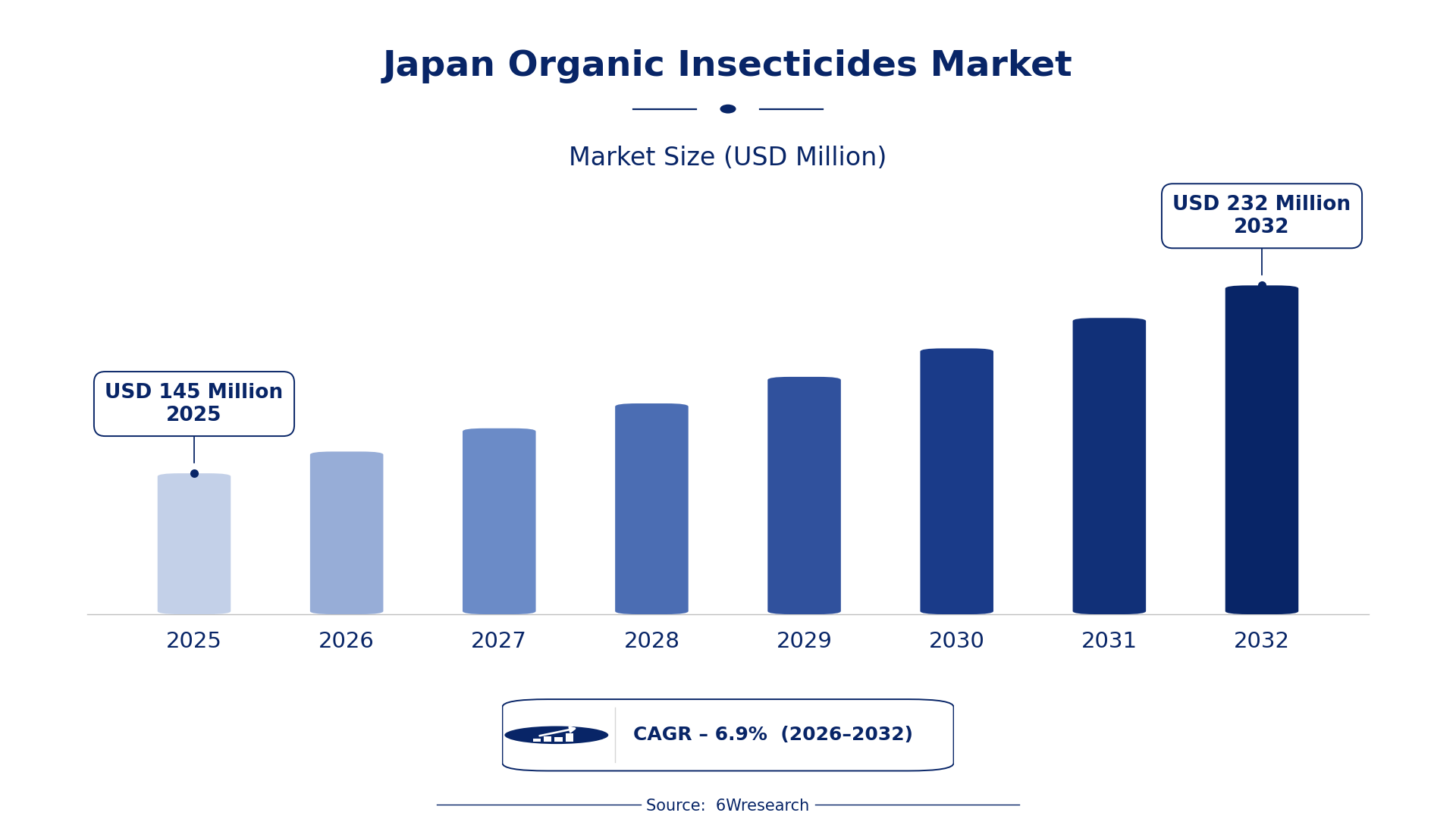
According to 6Wresearch internal database and industry insights, the Japan Organic Insecticides Market was valued at USD 145 Million in 2025 and is projected to reach USD 232 Million by 2032, growing at a CAGR of approximately 6.9% during 2026–2032.
Japan Organic Insecticides Market Highlights
| Report Metric | Details |
| Report Name | Japan Organic Insecticides Market (2026-2032) |
| Market Size 2025 | USD 145 Million |
| Market Size 2032 | USD 232 Million |
| Absolute Growth 2025–2032 | USD 87 Million |
| CAGR 2026–2032 | 6.9% |
| Peak Annual Growth | 8.0% in 2028 |
| Forecast Period | 2026–2032 |
| Historical Data | 2022–2025 |
| Base Year | 2025 |
| Leading Product Type, 2025 | Neem-Based Insecticide (48% share) |
| Leading Active Ingredient, 2025 | Neem Extract (46% share) |
| Leading Distribution Channel, 2025 | Agricultural Suppliers (42% share) |
| Leading End User Sector, 2025 | Organic Farming (41% share) |
| Fastest-Growing Product Type | Garlic-Based Insecticide (9.6% CAGR) |
| Fastest-Growing Active Ingredient | Natural Sulfur (8.9% CAGR) |
| Fastest-Growing Distribution Channel | Online Platforms (9.1% CAGR) |
| Fastest-Growing End User Sector | Horticulture (9.2% CAGR) |
| Growing Sector | Organic Farming |
| Key End Users | Organic farmers, horticulturists, greenhouse operators, agricultural suppliers |
Japan Organic Insecticides Market Year-wise Growth Rate and Key Drivers (2022–2032)
This graph illustrates the annual growth rates of the market from 2022 to 2032, highlighting a steady upward trajectory and projected market expansion over the forecast period.
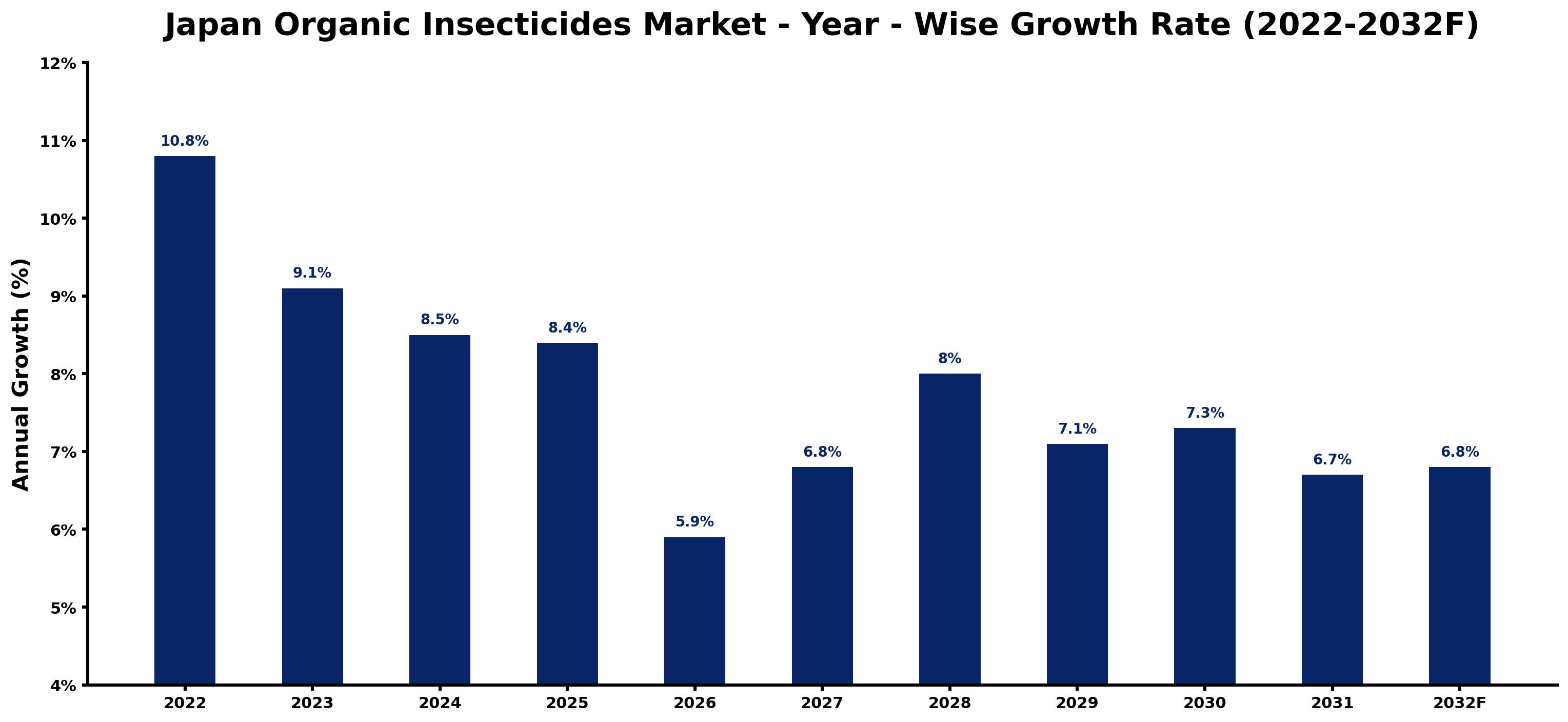
Annual growth estimates for each year appear below with the principal reason behind them, explaining the shifts that set the pace of the market.
| Year | Estimated Annual Growth (%) | Market Rationale |
| 2022 | 10.8 | The market experienced strong growth due to increased organic farming activities and consumer demand for sustainable products. |
| 2023 | 9.1 | Growth slowed as the market adjusted to previous highs, but demand for organic insecticides remained strong. |
| 2024 | 8.5 | Market expansion continued, albeit at a slower pace, as organic pest control methods gained traction among farmers. |
| 2025 | 8.4 | The market maintained steady growth as more farmers adopted organic pest control solutions to meet consumer preferences. |
| 2026 | 5.9 | Growth is expected to slow further as the market begins to stabilise after rapid expansion in previous years. |
| 2027 | 6.8 | Demand will rise again as awareness of sustainable farming practices increases among consumers and farmers. |
| 2028 | 8.0 | The market is projected to peak with heightened interest in environmentally friendly agricultural practices and organic solutions. |
| 2029 | 7.1 | Growth is expected to slow as the market adjusts to the peak, but interest in organic insecticides will persist. |
| 2030 | 7.3 | Demand will increase again as new organic farming initiatives are launched across the country, expanding the market. |
| 2031 | 6.7 | Growth is projected to moderate as the market stabilises, reflecting a more mature organic farming sector. |
| 2032 | 6.8 | Demand is expected to rise as innovative organic solutions are introduced to the market. |
Note: Market size estimations and growth projections presented in this report are based on 6Wresearch's proprietary forecasting methodology, utilizing the latest available industry data, government publications, and primary research inputs.
Japan Organic Insecticides Market Synopsis
Organic insecticides, derived from natural sources, are essential for pest management in organic farming and horticulture. The Japan Organic Insecticides Market is expanding due to a notable increase in organic farming areas, reaching 2.5 million hectares in 2022, and a growing number of organic farms, approximately 30,000 as of 2023. Government initiatives, including a ¥2 billion allocation in 2023 to support organic farming, are driving demand for these products from domestic users and the agricultural sector.
Market Dynamics Impact Analysis (2026–2032)
| Factor | Type | Impact | Primary Segment Affected |
| Growing organic farming area | Driver | High | Neem-Based Insecticide |
| Increasing consumer preference for organic products | Driver | High | Pyrethrin-Based |
| Rising number of organic farms | Opportunity | High | Garlic-Based Insecticide |
| Expansion of online purchasing channels | Opportunity | High | Online Platforms |
| Regulatory compliance costs | Restraint | Medium | Natural Sulfur |
| Limited awareness of organic insecticides | Restraint | Medium | Citrus Oil Insecticide |
| Supply chain disruptions | Challenge | High | Agricultural Suppliers |
| Competition from synthetic alternatives | Challenge | High | Organic Farming |
Evaluation of Drivers in Japan Organic Insecticides Market (2026–2032)
Below are the drivers that matter most for revenue growth, with supporting evidence.
| Drivers | Primary Segment Affected | Why It Matters (Evidence) |
| Expansion of organic farming practices | Organic Farming | The organic farming area reached 2.5 million hectares in 2022, increasing the demand for organic insecticides among farmers. |
| Growth of online purchasing platforms | Online Platforms | The rise of online platforms simplifies access to organic insecticides, encouraging more consumers to purchase these products. |
| Awareness of health benefits of organic products | Horticulture | Growing consumer awareness of health benefits drives demand for natural insecticides in the horticulture sector. |
| Government support for organic farming initiatives | Organic Farming | The Japanese government allocated ¥2 billion in 2023 to promote organic farming, boosting demand for organic insecticides. |
| Popularity of pyrethrin-based insecticides in greenhouses | Pyrethrin-Based | Pyrethrin-based insecticides are widely used in the greenhouse industry for effective pest control, increasing their market share. |
What keeps demand rising is the expansion of organic farming practices, with Japan's organic farming area reaching 2.5 million hectares in 2022. This growth has spurred purchases of organic insecticides, particularly effective solutions as farmers seek alternatives to synthetic options. The rise of online purchasing platforms has simplified access to organic insecticides for consumers, broadening the market reach. Awareness of health benefits associated with organic products also contributes to higher demand for natural insecticides, especially in the horticulture sector.
Evaluation of Restraints in Japan Organic Insecticides Market
These are the pressures that could keep growth below its potential.
| Market Restraint | Primary Segment Affected | Why It Matters (Evidence) |
| High costs associated with regulatory compliance | Natural Sulfur | Producers face high costs to meet regulations, impacting pricing and market entry for organic insecticides. |
| Limited consumer awareness of organic insecticides | Citrus Oil Insecticide | Many consumers lack awareness of organic insecticides, limiting market growth and adoption rates. |
| Supply chain disruptions affecting availability | Agricultural Suppliers | Disruptions in supply chains can lead to shortages of organic insecticides, impacting sales and product availability. |
| Competition from synthetic insecticides | Organic Farming | Synthetic alternatives often offer lower prices, challenging the competitiveness of organic insecticides in the market. |
| Seasonal demand fluctuations | Garlic-Based Insecticide | Demand for certain organic insecticides can vary seasonally, complicating inventory management for suppliers. |
Japan Organic Insecticides Market Challenges
Japan's organic farming area reached 2.5 million hectares in 2022, escalating competition among producers and pushing prices down, which reduces profit margins for suppliers. A lack of skilled labour in organic agriculture leads to operational inefficiencies, causing delays in product availability for farmers. Supply chain disruptions arise from dependence on specific natural ingredients, increasing production costs for producers and raising prices for buyers. Stringent regulations under the JAS can prolong product approval timelines, resulting in lost sales opportunities for suppliers as they navigate complex compliance processes.
Trends in the Japan Organic Insecticides Market
The shifts below are changing how Japan Organic Insecticides Market products are bought and supplied.
- Shift from Conventional to Organic Farming Practices: Since 2023, organic farming practices have gained traction, driven by consumer demand for sustainable products. The number of organic farms in Japan has increased to approximately 30,000, reflecting this trend.
- Emergence of Online Platforms for Organic Products: In 2023, online platforms have become a key channel for purchasing organic insecticides, growing at a rate of 9.1%. This shift is enabling greater access for consumers and farmers alike.
- Increased Adoption of Neem-Based Solutions: Starting in 2022, Neem-Based insecticides have seen heightened adoption among organic farmers due to their effectiveness. This trend is supported by the growing organic farming area, reaching 2.5 million hectares.
- Focus on Sustainable Pest Management Standards: The JAS (Japanese Agricultural Standards) has been important since 2023 in regulating organic insecticides, ensuring safety and quality. This regulatory framework supports the growth of organic farming practices.
Investment Opportunities in the Japan Organic Insecticides Market
Below are the investment opportunities with the strongest case in the Japan Organic Insecticides Market.
- Organic Farmers Seeking Effective Solutions: Organic farmers in Japan are increasingly looking for effective pest control solutions, with the organic farming area reaching 2.5 million hectares in 2022. Investing in Neem-Based insecticides can meet this demand through local partnerships.
- Growing Demand for Online Purchases: With online sales of organic products rising, there is a gap in the market for suppliers. The online platform sector is expected to grow at 9.1%, creating opportunities for new entrants.
- Investment in Organic Farming Support: The Japanese government allocated ¥2 billion in 2023 to support organic farming initiatives. This funding presents opportunities for suppliers to collaborate with local farmers and provide organic insecticides.
- Increasing Interest in Sustainable Practices: As awareness of sustainable practices rises, there is a growing need for organic insecticides. Suppliers can enter the market by forming partnerships with agricultural suppliers.
Government Initiatives in the Japan Organic Insecticides Market
The Waste Management and Public Cleansing Act of 1970 regulates the treatment and disposal of waste, impacting producers of organic insecticides by ensuring safe practices. Compliance with these regulations is essential for market participation and consumer safety. The act has led to improved waste management practices among producers, creating a safer environment for organic farming. Additionally, the Japanese government has implemented various initiatives to support organic farming, including funding for training and resources.
The Digital Agency, established in September 2021, leads government digital transformation efforts and approves initiatives that support the agricultural sector's efficiency. This agency's backing for digital tools is essential for advancements in organic farming, facilitating better access to information and resources for organic insecticide producers. The agency has also funded projects aimed at improving the supply chain for organic products, enhancing overall market accessibility.
Future Insight of the Japan Organic Insecticides Market
A programme to promote organic farming will increase the number of organic farms by 10% by 2032, driving demand for organic insecticides. Facilities focused on producing pest control solutions will emerge, improving product availability for buyers. Advances in pest management technology will improve efficacy and safety standards, benefiting both suppliers and end-users. Recognition of natural sulfur under ISO 22000 will simplify compliance, facilitating easier market entry for producers.
Market Segmentation Analysis
Japan Organic Insecticides Market report covers a detailed analysis of the following market segments:
By Product Type – Neem-Based Insecticide Leads, Garlic-Based Insecticide Expected to Grow Fastest
According to Aarti Yadav, Research Associate at 6Wresearch, in 2025, Neem-Based Insecticide led the product type split with a 48% share. Neem-based insecticides hold the largest share due to their widespread use in organic farming for effective pest control. They are particularly favoured by farmers in the Tokyo region, which has the highest concentration of organic farms in Japan. Garlic-Based Insecticide is projected to grow fastest, at a CAGR of 9.6% during 2026–2032. The garlic-based insecticide segment is growing rapidly as it addresses specific pest issues in home gardening and small-scale farming. This rise is supported by an increasing interest in sustainable gardening practices among urban dwellers. Suppliers should focus on expanding their offerings of garlic-based products to capture the growing market segment.
By Active Ingredient – Neem Extract Leads, Natural Sulfur Expected to Grow Fastest
Neem Extract held 46% of the Japan Organic Insecticides Market by active ingredient in 2025. Neem extract is the leading active ingredient because it is a popular choice among organic insecticides for its efficacy and safety in pest management. Its acceptance under the JAS standards further solidifies its position in the market. Natural Sulfur is set to record the highest CAGR in this split, 8.9% over 2026–2032. Natural sulfur is experiencing the fastest growth as it is increasingly recognised for its applications in specific pest control scenarios, particularly in organic horticulture. This trend is likely to continue as more growers seek compliant solutions for pest management. Buyers may benefit from diversifying their pest control strategies by incorporating natural sulfur into their practices.
By Distribution Channel – Agricultural Suppliers Lead, Online Platforms Expected to Grow Fastest
Agricultural Suppliers accounted for 42% of the market by distribution channel in 2025. Agricultural suppliers hold the largest share in distributing organic insecticides as they are the primary source for farmers requiring effective pest control solutions. Their established relationships with the agricultural community and understanding of local needs solidify their position in the market. Over 2026–2032, Online Platforms are expected to post the fastest growth, at a CAGR of 9.1%. Online platforms are experiencing rapid growth as a distribution channel due to the convenience they offer consumers looking for organic products. The increasing trend of e-commerce in Japan is making organic insecticides more accessible to a broader audience. Suppliers must invest in online marketing strategies to reach the growing number of consumers preferring digital purchasing options.
By End User Sector – Organic Farming Leads, Horticulture Expected to Grow Fastest
Organic Farming took 41% of end user sector revenue in 2025, more than any other category. Organic farming leads the market for organic insecticides due to the extensive area dedicated to organic practices, which reached 2.5 million hectares in 2022. This sector's commitment to environmentally friendly methods ensures a steady demand for organic pest control solutions. The quickest growth will come from Horticulture, forecast to expand at a CAGR of 9.2% between 2026 and 2032. Horticulture is experiencing rapid growth in the use of organic insecticides, driven by its crucial role in managing pests across various crops. The increasing share of organic horticulture, accounting for 15% of total production, is a key factor in this growth. Suppliers must tailor their offerings to meet the specific needs of the horticultural sector, ensuring effective pest management solutions.
Key Attractiveness of the Report
- 10 Years of Market Numbers
- Historical Data Starting from 2022 to 2025
- Base Year 2025
- Forecast Data until 2032
- Key Performance Indicators Impacting the Market
- Major Upcoming Developments and Projects
Key Highlights of the Report:
- Japan Organic Insecticides Market Outlook
- Market Size of Japan Organic Insecticides Market, 2025
- Forecast of Japan Organic Insecticides Market, 2032
- Historical Data and Forecast of Japan Organic Insecticides Revenues & Volume for the Period 2022-2032F
- Japan Organic Insecticides Market Trend Evolution
- Japan Organic Insecticides Market Drivers and Challenges
- Japan Organic Insecticides Price Trends
- Japan Organic Insecticides Porter's Five Forces
- Japan Organic Insecticides Industry Life Cycle
- Historical Data and Forecast of Japan Organic Insecticides Market Revenues & Volume By Product Type for the Period 2022-2032F
- Historical Data and Forecast of Japan Organic Insecticides Market Revenues & Volume By Neem-Based Insecticide for the Period 2022-2032F
- Historical Data and Forecast of Japan Organic Insecticides Market Revenues & Volume By Garlic-Based Insecticide for the Period 2022-2032F
- Historical Data and Forecast of Japan Organic Insecticides Market Revenues & Volume By Pyrethrin-Based for the Period 2022-2032F
- Historical Data and Forecast of Japan Organic Insecticides Market Revenues & Volume By Citrus Oil Insecticide for the Period 2022-2032F
- Historical Data and Forecast of Japan Organic Insecticides Market Revenues & Volume By Active Ingredient for the Period 2022-2032F
- Historical Data and Forecast of Japan Organic Insecticides Market Revenues & Volume By Neem Extract for the Period 2022-2032F
- Historical Data and Forecast of Japan Organic Insecticides Market Revenues & Volume By Natural Sulfur for the Period 2022-2032F
- Historical Data and Forecast of Japan Organic Insecticides Market Revenues & Volume By Chrysanthemum Oil for the Period 2022-2032F
- Historical Data and Forecast of Japan Organic Insecticides Market Revenues & Volume By Citrus Extracts for the Period 2022-2032F
- Historical Data and Forecast of Japan Organic Insecticides Market Revenues & Volume By Distribution Channel for the Period 2022-2032F
- Historical Data and Forecast of Japan Organic Insecticides Market Revenues & Volume By Agricultural Suppliers for the Period 2022-2032F
- Historical Data and Forecast of Japan Organic Insecticides Market Revenues & Volume By Online Platforms for the Period 2022-2032F
- Historical Data and Forecast of Japan Organic Insecticides Market Revenues & Volume By Direct Sales for the Period 2022-2032F
- Historical Data and Forecast of Japan Organic Insecticides Market Revenues & Volume By Specialty Stores for the Period 2022-2032F
- Historical Data and Forecast of Japan Organic Insecticides Market Revenues & Volume By End User Sector for the Period 2022-2032F
- Historical Data and Forecast of Japan Organic Insecticides Market Revenues & Volume By Organic Farming for the Period 2022-2032F
- Historical Data and Forecast of Japan Organic Insecticides Market Revenues & Volume By Horticulture for the Period 2022-2032F
- Historical Data and Forecast of Japan Organic Insecticides Market Revenues & Volume By Greenhouse Industry for the Period 2022-2032F
- Historical Data and Forecast of Japan Organic Insecticides Market Revenues & Volume By Small Garden Owners for the Period 2022-2032F
- Japan Organic Insecticides Import Export Trade Statistics
- Market Opportunity Assessment By Product Type
- Market Opportunity Assessment By Active Ingredient
- Market Opportunity Assessment By Distribution Channel
- Market Opportunity Assessment By End User Sector
- Japan Organic Insecticides Top Companies Market Share
- Japan Organic Insecticides Competitive Benchmarking By Technical and Operational Parameters
- Japan Organic Insecticides Company Profiles
- Japan Organic Insecticides Key Strategic Recommendations
Market Covered
Segments analysed in this report are listed below.
By Product Type
- Neem-Based Insecticide
- Garlic-Based Insecticide
- Pyrethrin-Based
- Citrus Oil Insecticide
By Active Ingredient
- Neem Extract
- Natural Sulfur
- Chrysanthemum Oil
- Citrus Extracts
By Distribution Channel
- Agricultural Suppliers
- Online Platforms
- Direct Sales
- Specialty Stores
By End User Sector
- Organic Farming
- Horticulture
- Greenhouse Industry
- Small Garden Owners






































