Japan Pattern Recognition Market Size & Growth Rate
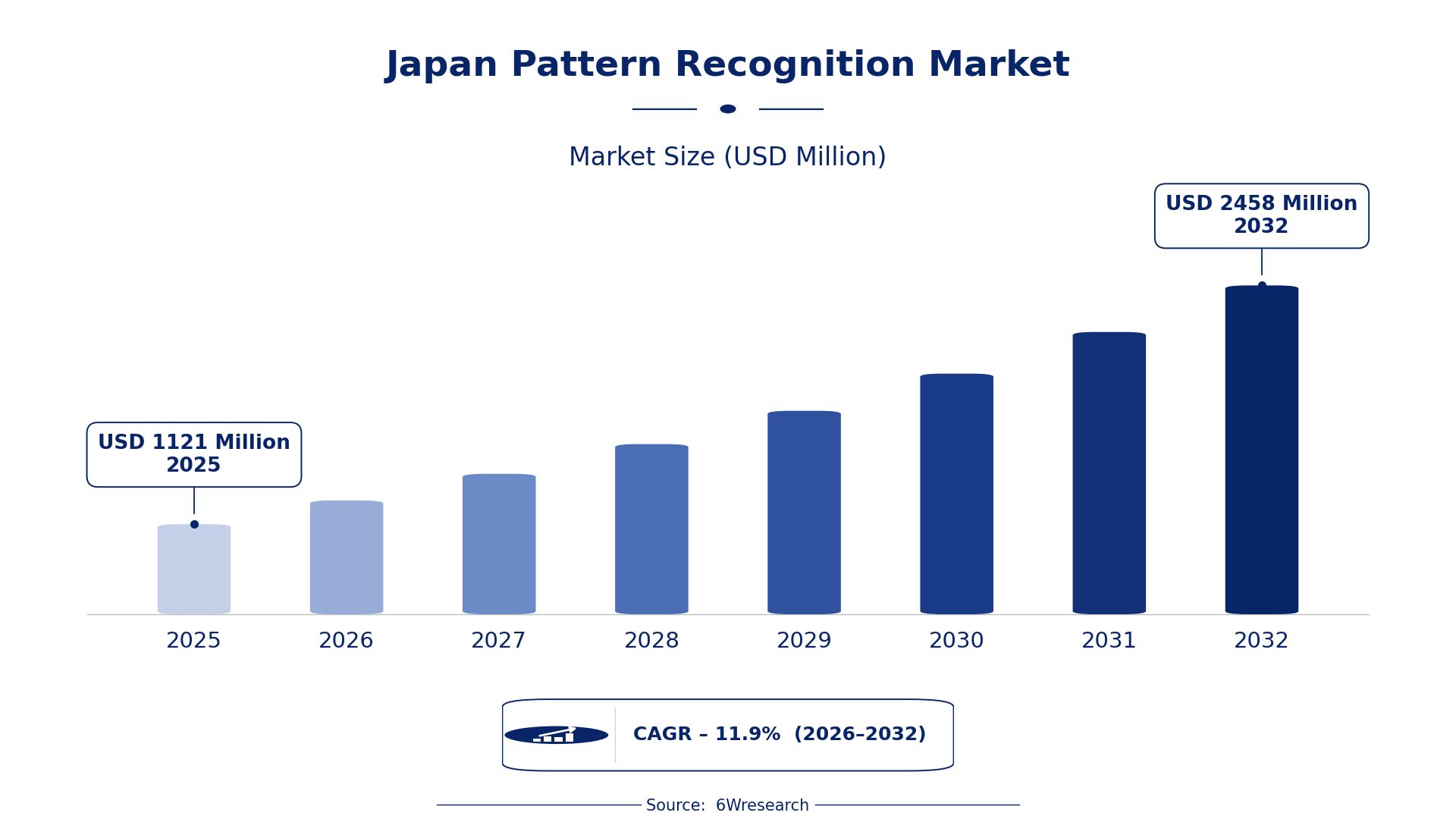
According to 6Wresearch internal database and industry insights, the Japan Pattern Recognition Market was valued at USD 1,121 Million in 2025 and is projected to reach USD 2,458 Million by 2032, growing at a CAGR of approximately 11.9% during 2026–2032.
Japan Pattern Recognition Market Highlights
| Report Metric | Details |
| Report Name | Japan Pattern Recognition Market (2026-2032) |
| Market Size 2025 | USD 1,121 Million |
| Market Size 2032 | USD 2,458 Million |
| Absolute Growth 2025–2032 | USD 1,337 Million |
| CAGR 2026–2032 | 11.9% |
| Peak Annual Growth | 12.8% in 2032 |
| Forecast Period | 2026–2032 |
| Historical Data | 2022–2025 |
| Base Year | 2025 |
| Leading Type, 2025 | Automatic Medical Diagnosis (48% share) |
| Leading Component, 2025 | Software (41% share) |
| Leading Deployment, 2025 | Cloud (56% share) |
| Leading Application, 2025 | Image Processing and Segmentation (44% share) |
| Leading Industry Vertical, 2025 | Healthcare (31% share) |
| Fastest-Growing Component | Service (17.0% CAGR) |
| Fastest-Growing Deployment | On-Premises (13.7% CAGR) |
| Fastest-Growing Application | Speech Recognition (18.0% CAGR) |
| Fastest-Growing Industry Vertical | IT & Telecom (16.6% CAGR) |
| Growing Sector | Healthcare |
| Key End Users | Healthcare providers, IT & Telecom companies, diagnostic tool manufacturers |
Japan Pattern Recognition Market Year-wise Growth Rate and Key Drivers (2022–2032)
This graph illustrates the annual growth rates of the market from 2022 to 2032, highlighting a steady upward trajectory and projected market expansion over the forecast period.
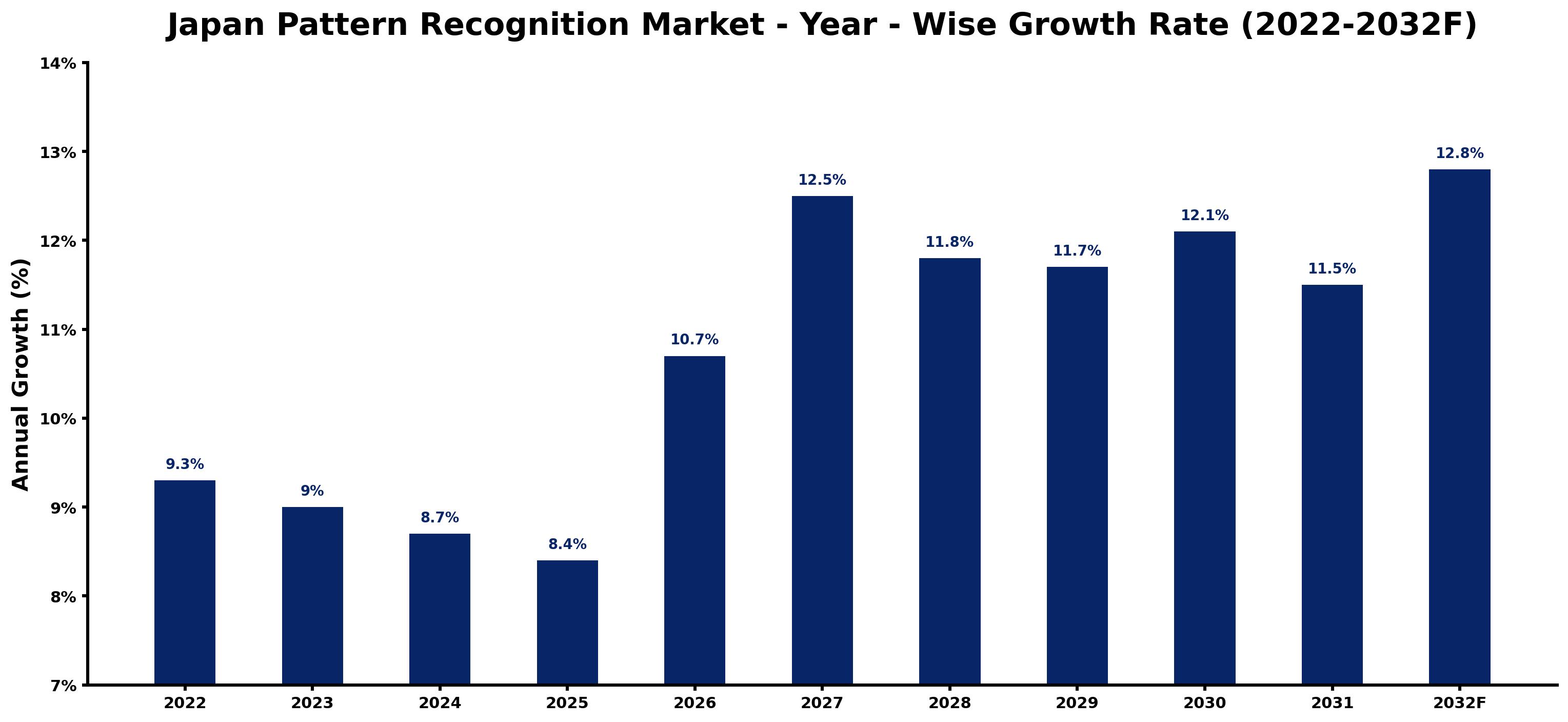
Below, each year's estimated growth is shown next to the factor that most influenced it.
| Year | Estimated Annual Growth (%) | Market Rationale |
| 2022 | 9.3 | The market experienced solid growth due to increased healthcare technology adoption. |
| 2023 | 9.0 | Growth slowed slightly as the market adjusted to previous expansions and investments. |
| 2024 | 8.7 | Continued investment in AI technologies contributed to further growth, albeit at a slower pace. |
| 2025 | 8.4 | Market growth decelerated as saturation in early adopters began to appear. |
| 2026 | 10.7 | Demand surged as healthcare facilities increasingly integrated AI diagnostics into their operations. |
| 2027 | 12.5 | The market accelerated as advancements in machine learning drove new applications. |
| 2028 | 11.8 | Growth slowed as competition intensified among existing technology providers. |
| 2029 | 11.7 | Market expansion continued but at a reduced rate due to emerging alternatives. |
| 2030 | 12.1 | Demand increased as healthcare systems adopted more advanced AI solutions. |
| 2031 | 11.5 | Growth moderated as market maturity began to set in with established players. |
| 2032 | 12.8 | The market peaked with significant investments in healthcare AI technologies. |
Note: Market size estimations and growth projections presented in this report are based on 6Wresearch's proprietary forecasting methodology, utilizing the latest available industry data, government publications, and primary research inputs.
Japan Pattern Recognition Market Synopsis
Pattern recognition is a technology that identifies patterns in data through algorithms and machine learning. It finds applications in speech recognition, image processing, and automatic medical diagnosis. The Japan Pattern Recognition Market is expanding as the healthcare sector increasingly adopts these technologies, with 30% of diagnostic tools utilising pattern recognition in 2023. The IT sector is also investing heavily in AI technologies, which drives demand for solutions in urban planning and management, as demonstrated by the Smart City initiative.
Market Dynamics Impact Analysis (2026–2032)
| Factor | Type | Impact | Primary Segment Affected |
| Growing adoption of AI in healthcare diagnostics | Driver | High | Automatic Medical Diagnosis |
| Increasing investment in IT and telecom sectors | Driver | High | Speech Recognition |
| Rising demand for advanced diagnostic tools | Opportunity | High | Healthcare |
| Expansion of AI applications in urban management | Opportunity | Medium | IT & Telecom |
| High costs associated with implementing AI solutions | Restraint | High | Healthcare |
| Limited skilled workforce in AI technologies | Restraint | Medium | IT & Telecom |
| Compliance with stringent data security regulations | Challenge | High | Healthcare |
| Capacity constraints in scaling AI solutions | Challenge | Medium | IT & Telecom |
Evaluation of Drivers in Japan Pattern Recognition Market (2026–2032)
The main growth drivers and the segments they affect most are set out below.
| Drivers | Primary Segment Affected | Why It Matters (Evidence) |
| Increased integration of AI in healthcare diagnostics | Automatic Medical Diagnosis | In 2023, 500,000 patients utilized AI for diagnostics in hospitals, driving demand for advanced tools. |
| Growing use of voice-activated systems | Speech Recognition | The need for efficient document handling in healthcare facilities boosts demand for multimedia document recognition solutions. |
| Expansion of digital document management systems | Multimedia Document Recognition (MDR) | The demand for efficient document handling in healthcare facilities drives the need for MDR solutions. |
| Rising patient numbers requiring diagnostics | Automatic Medical Diagnosis | Japan's average life expectancy of 84 years increases the need for new healthcare technologies. |
| Investment in AI technologies by IT & Telecom | IT & Telecom | The sector is heavily investing in AI, improving data management and security capabilities. |
Purchasing is picking up as the healthcare sector increasingly adopts AI technologies, with 30% of diagnostic tools incorporating pattern recognition in 2023. The average life expectancy in Japan, currently at 84 years, drives demand for advanced healthcare solutions. In 2023, 500,000 patients utilized AI for diagnostics, pushing hospitals to invest in advanced tools. The IT & Telecom sector is investing heavily in AI technologies, improving data management and security capabilities.
Evaluation of Restraints in Japan Pattern Recognition Market
The table below lists the restraints and the evidence behind each.
| Market Restraint | Primary Segment Affected | Why It Matters (Evidence) |
| High costs of implementing AI technologies | Healthcare | The average investment for AI systems can exceed millions, limiting adoption among smaller facilities. |
| Shortage of skilled professionals in AI | IT & Telecom | The lack of qualified personnel hampers the implementation and scaling of AI solutions. |
| Compliance with data security regulations | Healthcare | Adhering to ISO/IEC 27001 standards requires substantial investment and operational adjustments. |
| Limited infrastructure for AI deployment | IT & Telecom | Many regions lack the necessary infrastructure to support advanced AI applications. |
| Resistance to change within traditional sectors | Healthcare | Established practices in healthcare can slow the adoption of new AI technologies. |
Japan Pattern Recognition Market Challenges
In Japan, only 30% of diagnostic tools in the healthcare sector utilise pattern recognition, as strict data security regulations impede technology adoption among hospitals. Intense competition among IT suppliers lowers prices, which in turn reduces profit margins and limits funding for research and development. Rising costs associated with developing advanced algorithms place financial pressure on suppliers, compelling them to raise prices for buyers, who then face increased expenses. With only 500,000 patients currently using AI for diagnostics in hospitals, buyers encounter delays in accessing the full benefits of this technology in patient care.
Trends in the Japan Pattern Recognition Market
Buyers and suppliers in the Japan Pattern Recognition Market are adjusting to the following trends.
- Shift in Healthcare Towards AI-Driven Diagnostics: Healthcare providers are increasingly adopting AI-driven diagnostics, with 30% of diagnostic tools using pattern recognition in 2023. This trend is reshaping patient care and operational efficiency.
- Growing Preference for Cloud-Based Solutions: Cloud deployment is becoming the preferred choice for pattern recognition applications, holding a 56% share in 2025. This shift allows for greater scalability and flexibility in IT operations.
- Increased Focus on Data Security Standards: The adoption of ISO/IEC 27001 is rising among healthcare providers to ensure data security in AI applications. This standard is critical for maintaining patient confidentiality and trust.
- Expansion of AI in Urban Development: The Smart City initiative is promoting the integration of AI in urban planning, with significant investments aimed at enhancing city management. This trend is expected to grow as cities modernise.
Investment Opportunities in the Japan Pattern Recognition Market
The following opportunities in the Japan Pattern Recognition Market pair current demand with a clear way in.
- Supply of Advanced Diagnostic Tools: With 30% of diagnostic tools using pattern recognition, there is a significant opportunity to supply advanced diagnostic technologies. Healthcare facilities are actively seeking innovative solutions to improve patient outcomes.
- Investment in AI Training Programs: Now is the time to invest in AI training programs, addressing the skills gap in the workforce. Collaborating with educational institutions can help bridge this gap and enhance capabilities.
- Development of Scalable Cloud Solutions: The growing preference for cloud solutions presents an opportunity to develop scalable AI applications. IT & Telecom sectors are looking for partners to enhance their service offerings.
- Expansion into Public Safety Applications: The Ministry of Internal Affairs and Communications promotes AI for public safety, creating opportunities for technology providers to supply innovative solutions in this sector.
Government Initiatives in the Japan Pattern Recognition Market
The 'Healthcare AI Strategy' programme, initiated by the Japanese government, aims to enhance the adoption of AI technologies in healthcare. This initiative builds on previous efforts to modernise healthcare systems and improve patient outcomes, targeting a significant increase in AI integration by 2025.
The Digital Agency, established in 2021, is responsible for approving and funding projects that enhance digital transformation across sectors. This agency supports initiatives that promote the use of AI technologies, with a focus on improving public services and urban management.
Future Insight of the Japan Pattern Recognition Market
Pattern recognition technology will reshape demand by 2032, driven by the Digital Agency's initiatives to promote digital transformation across sectors. The installed base of healthcare AI systems is projected to reach 1 million by 2025, allowing hospitals to improve diagnostic accuracy. The Smart City initiative will incorporate AI into urban planning, creating new avenues for pattern recognition applications. As Japan's population ages, the need for healthcare innovations will intensify, prompting suppliers to develop more sophisticated solutions to address this growing demand.
Market Segmentation Analysis
Japan Pattern Recognition Market report covers a detailed analysis of the following market segments:
By Type – Automatic Medical Diagnosis Leads and Records the Fastest Growth
According to Summon Dutta, Assistant Manager at 6Wresearch, Automatic Medical Diagnosis accounted for 48% of the market by type in 2025. Automatic Medical Diagnosis holds the largest share due to its essential role in improving diagnostic accuracy within Japan's healthcare sector. The technology's application in 30% of diagnostic tools exemplifies its importance in modern medical practices. Its lead should widen, with a projected CAGR of 14.2% during 2026–2032, the highest in this split. The growth of Automatic Medical Diagnosis will continue to accelerate as the installed base of healthcare systems is projected to reach 1 million by 2025. This ongoing adoption reflects a strong commitment to enhancing patient outcomes, ensuring the segment's lead will widen. Suppliers must focus on developing robust solutions that cater to the increasing demand for this technology in healthcare.
By Component – Software Leads, Service Expected to Grow Fastest
With 41% of component revenue in 2025, Software was the largest category. Software is the leading component as it serves as the core for all pattern recognition applications, enabling essential functionalities across various sectors. Its integral role in healthcare diagnostics exemplifies its importance in the market, showcasing its widespread use. Service is projected to grow fastest, at a CAGR of 17.0% during 2026–2032. Service is experiencing rapid growth due to the increasing need for implementation support in complex systems. As organisations seek to optimise their use of software, the demand for professional services will rise correspondingly, driving this segment's expansion. Buyers should consider investing in comprehensive service packages to maximise the effectiveness of their software solutions.
By Deployment – Cloud Leads, On-Premises Expected to Grow Fastest
In 2025, Cloud led the deployment split with a 56% share. Cloud deployment leads the market because it offers scalability and flexibility, which are crucial for handling large datasets in pattern recognition applications. The growing preference for cloud solutions among healthcare providers illustrates this trend, highlighting its significance. On-Premises are set to record the highest CAGR in this split, 13.7% over 2026–2032. On-Premises deployment is growing quickly as many legacy systems still rely on traditional infrastructures for data processing. This segment's growth reflects a need for stability and control in environments where data security is paramount, indicating a shift in deployment preferences. Suppliers should ensure their solutions are compatible with both cloud and on-premises environments to meet diverse customer needs.
By Application – Image Processing and Segmentation Leads, Speech Recognition Expected to Grow Fastest
The largest application category in 2025 was Image Processing and Segmentation, at 44% of revenue. Image Processing and Segmentation is the dominant application due to its critical role in various healthcare functionalities, particularly in diagnostics. This application is essential for accurately interpreting medical images, which is vital for patient care and operational efficiency. Over 2026–2032, Speech Recognition is expected to post the fastest growth, at a CAGR of 18.0%. Speech Recognition is rapidly expanding as it becomes increasingly integrated into voice-activated systems, enhancing user interaction across applications. The rising number of patients using AI for diagnostics further fuels this growth, indicating a shift in application focus. Suppliers must innovate to keep pace with the growing demand for applications that enhance user experience and operational efficiency.
By Industry Vertical – Healthcare Leads, IT & Telecom Expected to Grow Fastest
Healthcare held 31% of the Japan Pattern Recognition Market by industry vertical in 2025. Healthcare is the leading industry vertical as it directly benefits from improved diagnostic accuracy through pattern recognition technologies. The substantial investment in healthcare systems underscores the sector's commitment to leveraging technology for better patient outcomes, solidifying its position. The quickest growth will come from IT & Telecom, forecast to expand at a CAGR of 16.6% between 2026 and 2032. IT & Telecom is witnessing the fastest growth, driven by the urgent need for effective data management and security solutions. The ongoing digital transformation initiatives in Japan highlight the sector's critical role in adopting new technologies, propelling this segment forward. Buyers in IT & Telecom should prioritise solutions that enhance data security and management capabilities to stay competitive.
Key Attractiveness of the Report
- 10 Years of Market Numbers
- Historical Data Starting from 2022 to 2025
- Base Year 2025
- Forecast Data until 2032
- Key Performance Indicators Impacting the Market
- Major Upcoming Developments and Projects
Key Highlights of the Report:
- Japan Pattern Recognition Market Outlook
- Market Size of Japan Pattern Recognition Market, 2025
- Forecast of Japan Pattern Recognition Market, 2032
- Historical Data and Forecast of Japan Pattern Recognition Revenues & Volume for the Period 2022-2032
- Japan Pattern Recognition Market Trend Evolution
- Japan Pattern Recognition Market Drivers and Challenges
- Japan Pattern Recognition Price Trends
- Japan Pattern Recognition Porter's Five Forces
- Japan Pattern Recognition Industry Life Cycle
- Historical Data and Forecast of Japan Pattern Recognition Market Revenues & Volume By Type for the Period 2022-2032
- Historical Data and Forecast of Japan Pattern Recognition Market Revenues & Volume By Speech Recognition for the Period 2022-2032
- Historical Data and Forecast of Japan Pattern Recognition Market Revenues & Volume By Speaker Identification for the Period 2022-2032
- Historical Data and Forecast of Japan Pattern Recognition Market Revenues & Volume By Multimedia Document Recognition (MDR) for the Period 2022-2032
- Historical Data and Forecast of Japan Pattern Recognition Market Revenues & Volume By Automatic Medical Diagnosis for the Period 2022-2032
- Historical Data and Forecast of Japan Pattern Recognition Market Revenues & Volume By Component for the Period 2022-2032
- Historical Data and Forecast of Japan Pattern Recognition Market Revenues & Volume By Hardware for the Period 2022-2032
- Historical Data and Forecast of Japan Pattern Recognition Market Revenues & Volume By Software for the Period 2022-2032
- Historical Data and Forecast of Japan Pattern Recognition Market Revenues & Volume By Service for the Period 2022-2032
- Historical Data and Forecast of Japan Pattern Recognition Market Revenues & Volume By Deployment for the Period 2022-2032
- Historical Data and Forecast of Japan Pattern Recognition Market Revenues & Volume By Cloud for the Period 2022-2032
- Historical Data and Forecast of Japan Pattern Recognition Market Revenues & Volume By On-Premises for the Period 2022-2032
- Historical Data and Forecast of Japan Pattern Recognition Market Revenues & Volume By Application for the Period 2022-2032
- Historical Data and Forecast of Japan Pattern Recognition Market Revenues & Volume By Image Processing and Segmentation for the Period 2022-2032
- Historical Data and Forecast of Japan Pattern Recognition Market Revenues & Volume By Analysis for the Period 2022-2032
- Historical Data and Forecast of Japan Pattern Recognition Market Revenues & Volume By Computer Vision for the Period 2022-2032
- Historical Data and Forecast of Japan Pattern Recognition Market Revenues & Volume By Seismic Analysis for the Period 2022-2032
- Historical Data and Forecast of Japan Pattern Recognition Market Revenues & Volume By Radar Signal Classification/Analysis for the Period 2022-2032
- Historical Data and Forecast of Japan Pattern Recognition Market Revenues & Volume By Speech Recognition for the Period 2022-2032
- Historical Data and Forecast of Japan Pattern Recognition Market Revenues & Volume By Finger Print Identification for the Period 2022-2032
- Historical Data and Forecast of Japan Pattern Recognition Market Revenues & Volume By Industry Vertical for the Period 2022-2032
- Historical Data and Forecast of Japan Pattern Recognition Market Revenues & Volume By Retail and E-Commerce for the Period 2022-2032
- Historical Data and Forecast of Japan Pattern Recognition Market Revenues & Volume By Media and Entertainment for the Period 2022-2032
- Historical Data and Forecast of Japan Pattern Recognition Market Revenues & Volume By BFSI for the Period 2022-2032
- Historical Data and Forecast of Japan Pattern Recognition Market Revenues & Volume By Automobile and Transportation for the Period 2022-2032
- Historical Data and Forecast of Japan Pattern Recognition Market Revenues & Volume By IT & Telecom for the Period 2022-2032
- Historical Data and Forecast of Japan Pattern Recognition Market Revenues & Volume By Government for the Period 2022-2032
- Historical Data and Forecast of Japan Pattern Recognition Market Revenues & Volume By Healthcare for the Period 2022-2032
- Historical Data and Forecast of Japan Pattern Recognition Market Revenues & Volume By Others for the Period 2022-2032
- Japan Pattern Recognition Import Export Trade Statistics
- Market Opportunity Assessment By Type
- Market Opportunity Assessment By Component
- Market Opportunity Assessment By Deployment
- Market Opportunity Assessment By Application
- Market Opportunity Assessment By Industry Vertical
- Japan Pattern Recognition Top Companies Market Share
- Japan Pattern Recognition Competitive Benchmarking By Technical and Operational Parameters
- Japan Pattern Recognition Company Profiles
- Japan Pattern Recognition Key Strategic Recommendations
Market Covered
The study includes the following segmentation.
By Type
- Speech Recognition
- Speaker Identification
- Multimedia Document Recognition (MDR)
- Automatic Medical Diagnosis
By Component
- Hardware
- Software
- Service
By Deployment
- Cloud
- On-Premises
By Application
- Image Processing and Segmentation
- Analysis
- Computer Vision
- Seismic Analysis
- Radar Signal Classification/Analysis
- Speech Recognition
- Finger Print Identification
By Industry Vertical
- Retail and E-Commerce
- Media and Entertainment
- BFSI
- Automobile and Transportation
- IT & Telecom
- Government
- Healthcare
- Others































