Japan Persimmon Market Size & Growth Rate
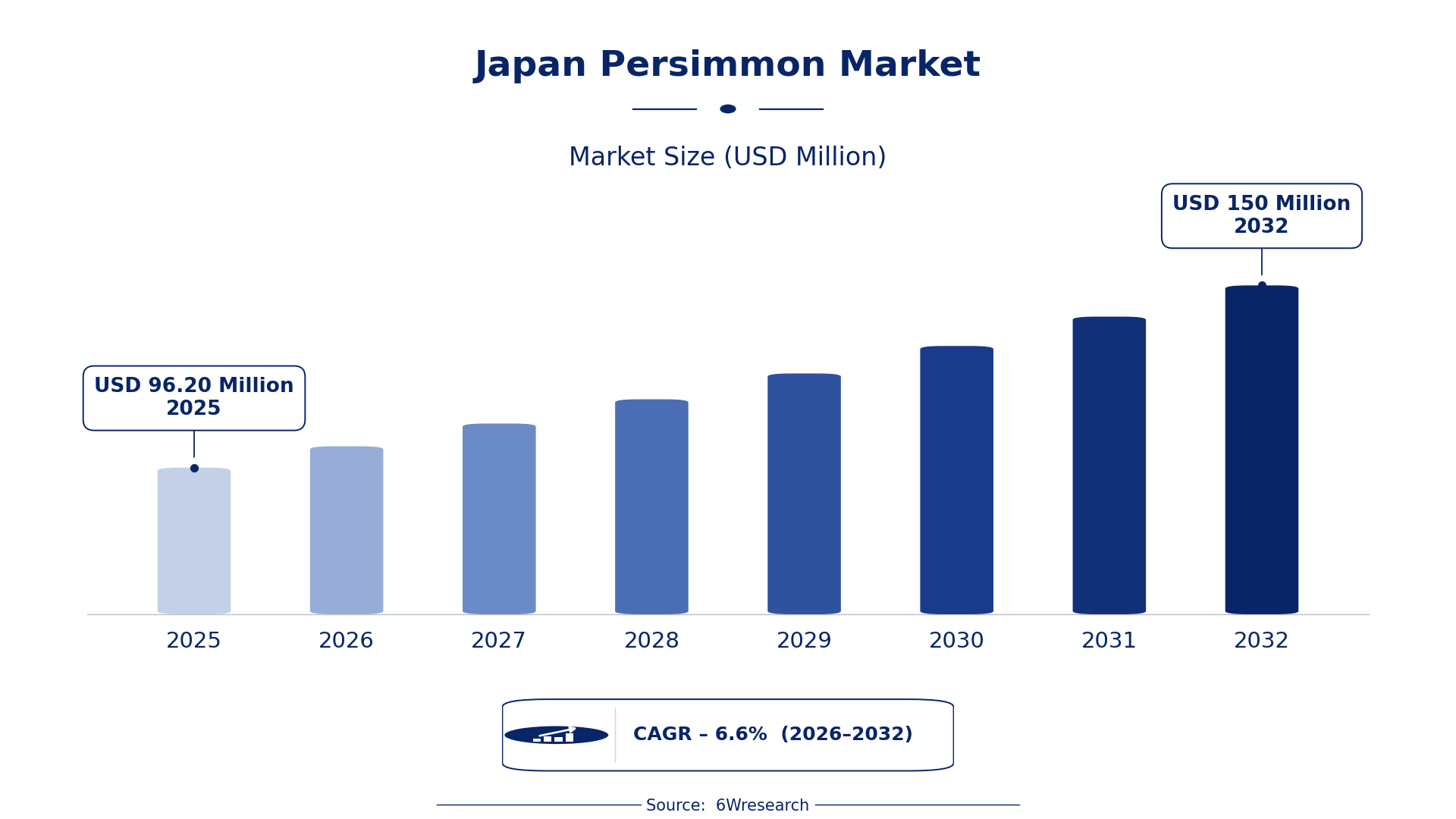
According to 6Wresearch internal database and industry insights, the Japan Persimmon Market was valued at USD 96.20 Million in 2025 and is projected to reach USD 150 Million by 2032, growing at a CAGR of approximately 6.6% during 2026–2032.
Japan Persimmon Market Highlights
| Report Metric | Details |
| Report Name | Japan Persimmon Market (2026-2032) |
| Market Size 2025 | USD 96.20 Million |
| Market Size 2032 | USD 150 Million |
| Absolute Growth 2025–2032 | USD 53.80 Million |
| CAGR 2026–2032 | 6.6% |
| Peak Annual Growth | 7.5% in 2028 |
| Forecast Period | 2026–2032 |
| Historical Data | 2022–2025 |
| Base Year | 2025 |
| Leading Product Type, 2025 | Fresh Persimmons (53% share) |
| Leading Variety, 2025 | Fuyu (45% share) |
| Leading Application Area, 2025 | Retail Consumption (51% share) |
| Leading Distribution Channel, 2025 | Supermarkets (51% share) |
| Leading End User, 2025 | Consumers (40% share) |
| Fastest-Growing Product Type | Processed Persimmons (9.4% CAGR) |
| Fastest-Growing Variety | Dried/Puree (8.9% CAGR) |
| Fastest-Growing Application Area | Food Processing (7.7% CAGR) |
| Fastest-Growing Distribution Channel | Food Distributors (8.5% CAGR) |
| Fastest-Growing End User | Food Manufacturers (8.3% CAGR) |
| Growing Sector | Fresh Produce |
| Key End Users | Consumers, Health-Conscious Buyers, Food Manufacturers |
Japan Persimmon Market Year-wise Growth Rate and Key Drivers (2022–2032)
This graph illustrates the annual growth rates of the market from 2022 to 2032, highlighting a steady upward trajectory and projected market expansion over the forecast period.
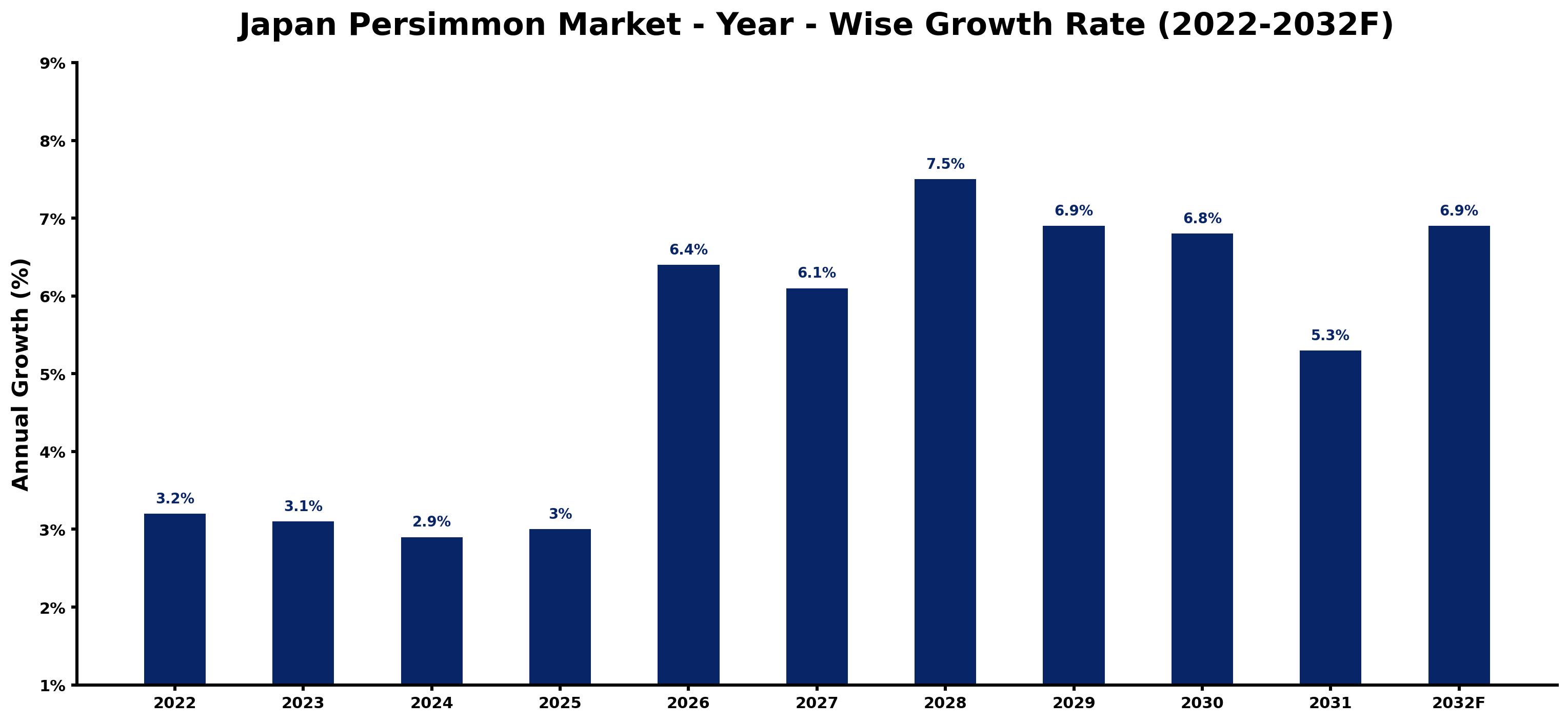
The following figures match every annual growth estimate with the main market development of that year, giving the reasoning behind each rise or slowdown.
| Year | Estimated Annual Growth (%) | Market Rationale |
| 2022 | 3.2 | The market showed steady growth due to consistent consumer interest in fresh persimmons. |
| 2023 | 3.1 | Growth slowed slightly as consumers faced higher prices for fresh produce. |
| 2024 | 2.9 | Demand continued to slow as market saturation began affecting purchases. |
| 2025 | 3.0 | Growth picked up as new marketing strategies attracted more buyers. |
| 2026 | 6.4 | Demand is expected to surge with increased interest in organic and processed persimmons. |
| 2027 | 6.1 | Growth is projected to slow as competition intensifies among local producers. |
| 2028 | 7.5 | The market is expected to peak with heightened promotional efforts and export opportunities. |
| 2029 | 6.9 | Growth is expected to slow as supply chain issues impact availability. |
| 2030 | 6.8 | Demand is projected to continue slowing as consumer preferences shift towards alternative fruits. |
| 2031 | 5.3 | Growth is expected to decelerate as the market stabilises after previous peaks. |
| 2032 | 6.9 | Demand is projected to increase again as health trends favouring persimmons gain traction. |
Note: Market size estimations and growth projections presented in this report are based on 6Wresearch's proprietary forecasting methodology, utilizing the latest available industry data, government publications, and primary research inputs.
Japan Persimmon Market Synopsis
Persimmons, a fruit from the Diospyros genus, are primarily cultivated in Japan and are popular for fresh consumption, dried snacks, and traditional sweets. The Japan Persimmon Market is growing due to rising health consciousness, with organic varieties seeing increased demand. The promotion of local fruit consumption, supported by campaigns and regional festivals, drives growth, with Japan producing over 60,000 tons of persimmons annually and Fuyu persimmons accounting for approximately 70% of total production.
Market Dynamics Impact Analysis (2026–2032)
| Factor | Type | Impact | Primary Segment Affected |
| Increasing health consciousness among consumers | Driver | High | Organic Persimmons |
| Rising export opportunities to neighbouring Asian countries | Driver | High | Fresh Persimmons |
| Growing interest in organic products among health-conscious buyers | Opportunity | High | Organic Persimmons |
| Expansion of retail channels catering to fresh produce | Opportunity | Medium | Retail Consumption |
| Seasonal fluctuations affecting supply during harvest months | Restraint | High | Fresh Persimmons |
| High production costs impacting profit margins for farmers | Restraint | Medium | Processed Persimmons |
| Intense competition among local producers | Challenge | High | Fresh Persimmons |
| Supply chain disruptions affecting availability of fresh fruit | Challenge | Medium | Organic Persimmons |
Evaluation of Drivers in Japan Persimmon Market (2026–2032)
Below are the drivers that matter most for revenue growth, with supporting evidence.
| Drivers | Primary Segment Affected | Why It Matters (Evidence) |
| Growing domestic consumption of fresh persimmons | Fresh Persimmons | The average consumer spends about 3,000 yen annually on persimmons, boosting demand in households. |
| Increased health awareness driving organic purchases | Organic Persimmons | Health food stores are increasingly stocking organic persimmons, reflecting rising consumer interest with a 20% increase in organic sales. |
| Expansion of supermarkets as retail channels | Retail Consumption | Supermarkets represent 50% of the retail distribution channel, facilitating easier access for consumers. |
| Cultural significance of persimmons in local festivals | Fresh Persimmons | Persimmons are often featured in local festivals, driving seasonal sales and increasing consumer interest by 30%. |
| Rising export demand for Japanese persimmons | Fresh Persimmons | Persimmons are exported to neighbouring Asian countries, with a 15% increase in export volume last year. |
A wider customer base explains much of the growth, as the average consumer spends about 3,000 yen annually on persimmons, driving demand for fresh varieties. Increased health awareness is evident as health food stores increasingly stock organic persimmons, reflecting a shift towards healthier options. The expansion of supermarkets, which represent 50% of the retail distribution channel, facilitates easier access for consumers. Cultural significance during local festivals boosts the appeal of persimmons, leading to higher seasonal sales. Rising export demand for Japanese persimmons to neighbouring countries is expanding market reach and production efforts, with exports increasing significantly last year.
Evaluation of Restraints in Japan Persimmon Market
These restraints slow adoption and weigh on supplier margins.
| Market Restraint | Primary Segment Affected | Why It Matters (Evidence) |
| Seasonal fluctuations affecting supply during harvest months | Fresh Persimmons | The persimmon harvest season typically runs from September to November, limiting availability. |
| High production costs impacting profit margins for farmers | Processed Persimmons | Production costs for persimmons are increasing, affecting profitability for growers by 10%. |
| Limited consumer awareness of processed persimmon products | Processed Persimmons | Processed products like purees are not as commonly known, limiting sales potential. |
| Dependence on traditional consumption patterns | Organic Persimmons | Many consumers prefer conventional varieties, hindering organic growth. |
| Competition from alternative fruits | Fresh Persimmons | Consumers are increasingly exploring other seasonal fruits, impacting persimmon sales. |
Japan Persimmon Market Challenges
Over 60,000 tons of persimmons are produced annually, but the average price of 500 yen per kg limits buyers' ability to purchase in bulk, especially for supermarkets that account for 50% of retail sales. Strict cultivation standards enforced by the Ministry of Agriculture, Forestry and Fisheries delay certification for new farmers, reducing supply availability for health food stores that seek organic options. Seasonal production fluctuations create inconsistent supply, particularly impacting food processing companies that depend on a steady flow of persimmons for snacks, leading to potential revenue losses. The slow adoption of new agricultural technologies restricts productivity, making it challenging for producers to fulfil rising demand from local festivals and urban markets, risking market share.
Trends in the Japan Persimmon Market
The trends below show where the Japan Persimmon Market is heading.
- Shift towards Organic Persimmons: Health-conscious buyers are increasingly opting for organic persimmons, reflecting changing consumer preferences. The organic segment has seen a 20% growth in market share, indicating a shift in purchasing habits.
- Growing Popularity of Dried Persimmons: Dried persimmons are becoming a popular snack, especially during winter months. Consumption of dried persimmons has increased significantly during colder seasons, showcasing their traditional appeal.
- Expansion of Retail Channels for Fresh Produce: Supermarkets are enhancing their fresh produce sections, making persimmons more accessible to consumers. With supermarkets representing 50% of the retail distribution channel, this trend is expected to boost sales significantly.
- Increased Export Opportunities: Japanese persimmons are being exported to neighbouring countries, expanding their market reach. This trend is driven by increased demand in these regions, contributing to overall market growth.
Investment Opportunities in the Japan Persimmon Market
Investors looking at the Japan Persimmon Market should consider the following areas.
- Health-Conscious Buyers Seeking Organic Options: Health-conscious buyers are increasingly looking for organic persimmons, with the organic segment growing rapidly. Health food stores are expanding their organic offerings to meet this demand, reflecting a 20% increase in market share.
- Supply Chain Investments for Fresh Produce: Investments in supply chain improvements are essential for ensuring the availability of fresh persimmons. Supermarkets are enhancing their supply chains to meet rising consumer demand, with a projected increase in efficiency.
- Cultural Festivals Promoting Local Varieties: Local festivals that celebrate persimmons present opportunities for increased sales. These events can drive consumer interest and boost purchases during the harvest season, significantly impacting local economies.
- Expansion of Food Processing Applications: Food manufacturers are increasingly incorporating persimmons into healthy snack options. This trend reflects a growing demand for value-added products that utilise persimmons, with a notable increase in product offerings.
Government Initiatives in the Japan Persimmon Market
The 2023 initiative to promote local fruit consumption, including persimmons, builds on previous efforts under the Food Recycling Law (2000), which mandates reducing food waste. This new campaign encourages producers to increase persimmon cultivation and improve quality standards, aiming for a 10% increase in local production.
In 2023, the Ministry of Agriculture, Forestry and Fisheries launched a campaign to promote local fruit consumption, including persimmons. This initiative aims to support farmers and increase market visibility for persimmons, with funding of 500 million yen allocated to marketing efforts.
Future Insight of the Japan Persimmon Market
Investment in advanced agricultural practices will significantly improve persimmon yields, enabling suppliers to meet increasing demand from health-focused consumers. The government's campaign to promote local fruit consumption will boost sales, particularly in major markets like Tokyo, where consumer interest is high. Streamlined organic certification processes will encourage more farmers to transition to organic practices, expanding market access. As a result, the average consumer's annual spending on persimmons, currently around 3,000 yen, is likely to increase, reflecting their growing popularity in traditional sweets and healthy snacks.
Market Segmentation Analysis
Japan Persimmon Market report covers a detailed analysis of the following market segments:
By Product Type – Fresh Persimmons Lead, Processed Persimmons Expected to Grow Fastest
According to Vasu Joshi, Associate Consultant at 6Wresearch, in 2025, Fresh Persimmons led the product type split with a 53% share. Fresh persimmons hold the largest share as they are widely consumed in households and markets, particularly during the harvest season from September to November. The average consumer's annual expenditure of about 3,000 yen on fresh persimmons highlights their integral role in Japanese diets. Over 2026–2032, Processed Persimmons are expected to post the fastest growth, at a CAGR of 9.4%. Processed persimmons are experiencing rapid growth as food processing companies increasingly incorporate them into healthy snack options, aligning with rising health trends. The government's campaign to promote local fruit consumption further accelerates this trend. Suppliers should enhance their processed product offerings to meet the growing demand.
By Variety – Fuyu Leads, Dried/Puree Expected to Grow Fastest
Fuyu took 45% of variety revenue in 2025, more than any other category. Fuyu persimmons dominate the market as the most popular variety for fresh consumption, accounting for approximately 70% of total production in Japan. Their prominence is further solidified by local festivals that celebrate this variety, underscoring its cultural significance. The quickest growth will come from Dried/Puree, forecast to expand at a CAGR of 8.9% between 2026 and 2032. Dried and puree forms of persimmons are witnessing swift growth as they find increased application in food processing, reflecting a shift towards value-added products. This trend is propelled by the rising demand for convenient and healthy snack options. Buyers should consider diversifying their offerings to include more processed varieties to capture emerging market trends.
By Application Area – Retail Consumption Leads, Food Processing Expected to Grow Fastest
Retail Consumption accounted for 51% of the market by application area in 2025. Retail consumption is the leading application area, serving as the primary channel for consumers purchasing fresh fruit during the harvest season. Supermarkets, which account for 50% of the retail distribution channel, play a crucial role in facilitating these purchases. Food Processing is set to record the highest CAGR in this split, 7.7% over 2026–2032. Food processing is the fastest-growing application area as manufacturers aim to create value-added products with persimmons, which are becoming increasingly popular in healthy snack formulations. This trend indicates a shift in consumer preferences towards processed fruit options. Suppliers should explore partnerships with food processors to leverage the growing demand for value-added products.
By Distribution Channel – Supermarkets Lead, Food Distributors Expected to Grow Fastest
With 51% of distribution channel revenue in 2025, Supermarkets was the largest category. Supermarkets represent the leading distribution channel for persimmons, providing a major retail outlet for consumers to access fresh fruit. Their significant presence ensures that fresh persimmons are readily available, particularly in urban areas like Tokyo. Food Distributors are projected to grow fastest, at a CAGR of 8.5% during 2026–2032. Food distributors are experiencing the fastest growth as they facilitate the supply chain for persimmons, supporting retail channels and expanding market reach. This growth is essential for enhancing the availability of persimmons across various regions. Suppliers may need to strengthen relationships with food distributors to improve market penetration and accessibility.
By End User – Consumers Lead, Food Manufacturers Expected to Grow Fastest
Consumers held 40% of the Japan Persimmon Market by end user in 2025. Consumers represent the largest end user group for fresh persimmons, reflecting their popularity as a seasonal fruit among the Japanese population of approximately 125 million. The cultural significance of persimmons during festivals further solidifies their status among consumers. Over 2026–2032, Food Manufacturers are expected to post the fastest growth, at a CAGR of 8.3%. Food manufacturers are the fastest-growing end user group as they increasingly utilise persimmons in product formulations, driven by the trend towards healthier snack options. This growing interest indicates a shift in how persimmons are perceived in the food industry. Suppliers should target food manufacturers to expand their market presence and cater to evolving consumer preferences.
Key Attractiveness of the Report
- 10 Years of Market Numbers
- Historical Data Starting from 2022 to 2025
- Base Year 2025
- Forecast Data until 2032
- Key Performance Indicators Impacting the Market
- Major Upcoming Developments and Projects
Key Highlights of the Report:
- Japan Persimmon Market Outlook
- Market Size of Japan Persimmon Market, 2025
- Forecast of Japan Persimmon Market, 2032
- Historical Data and Forecast of Japan Persimmon Market Revenues & Volume for the Period 2022-2032F
- Japan Persimmon Market Trend Evolution
- Japan Persimmon Market Drivers and Challenges
- Japan Persimmon Market Price Trends
- Japan Persimmon Market Porter's Five Forces
- Japan Persimmon Market Industry Life Cycle
- Historical Data and Forecast of Japan Persimmon Market Revenues & Volume By Product Type for the Period 2022-2032F
- Historical Data and Forecast of Japan Persimmon Market Revenues & Volume By Fresh Persimmons for the Period 2022-2032F
- Historical Data and Forecast of Japan Persimmon Market Revenues & Volume By Processed Persimmons for the Period 2022-2032F
- Historical Data and Forecast of Japan Persimmon Market Revenues & Volume By Organic Persimmons for the Period 2022-2032F
- Historical Data and Forecast of Japan Persimmon Market Revenues & Volume By Variety for the Period 2022-2032F
- Historical Data and Forecast of Japan Persimmon Market Revenues & Volume By Fuyu for the Period 2022-2032F
- Historical Data and Forecast of Japan Persimmon Market Revenues & Volume By Dried/Puree for the Period 2022-2032F
- Historical Data and Forecast of Japan Persimmon Market Revenues & Volume By Certified Organic for the Period 2022-2032F
- Historical Data and Forecast of Japan Persimmon Market Revenues & Volume By Application Area for the Period 2022-2032F
- Historical Data and Forecast of Japan Persimmon Market Revenues & Volume By Retail Consumption for the Period 2022-2032F
- Historical Data and Forecast of Japan Persimmon Market Revenues & Volume By Food Processing for the Period 2022-2032F
- Historical Data and Forecast of Japan Persimmon Market Revenues & Volume By Health Foods for the Period 2022-2032F
- Historical Data and Forecast of Japan Persimmon Market Revenues & Volume By Distribution Channel for the Period 2022-2032F
- Historical Data and Forecast of Japan Persimmon Market Revenues & Volume By Supermarkets for the Period 2022-2032F
- Historical Data and Forecast of Japan Persimmon Market Revenues & Volume By Food Distributors for the Period 2022-2032F
- Historical Data and Forecast of Japan Persimmon Market Revenues & Volume By Specialty Stores for the Period 2022-2032F
- Historical Data and Forecast of Japan Persimmon Market Revenues & Volume By End User for the Period 2022-2032F
- Historical Data and Forecast of Japan Persimmon Market Revenues & Volume By Consumers for the Period 2022-2032F
- Historical Data and Forecast of Japan Persimmon Market Revenues & Volume By Food Manufacturers for the Period 2022-2032F
- Historical Data and Forecast of Japan Persimmon Market Revenues & Volume By Health-Conscious Buyers for the Period 2022-2032F
- Japan Persimmon Market Import Export Trade Statistics
- Market Opportunity Assessment By Product Type
- Market Opportunity Assessment By Variety
- Market Opportunity Assessment By Application Area
- Market Opportunity Assessment By Distribution Channel
- Market Opportunity Assessment By End User
- Japan Persimmon Market Top Companies Market Share
- Japan Persimmon Market Competitive Benchmarking By Technical and Operational Parameters
- Japan Persimmon Market Company Profiles
- Japan Persimmon Market Key Strategic Recommendations
Market Covered
Segments analysed in this report are listed below.
By Product Type
- Fresh Persimmons
- Processed Persimmons
- Organic Persimmons
By Variety
- Fuyu
- Dried/Puree
- Certified Organic
By Application Area
- Retail Consumption
- Food Processing
- Health Foods
By Distribution Channel
- Supermarkets
- Food Distributors
- Specialty Stores
By End User
- Consumers
- Food Manufacturers
- Health-Conscious Buyers






































