Japan Pesticide Additives Market Size & Growth Rate
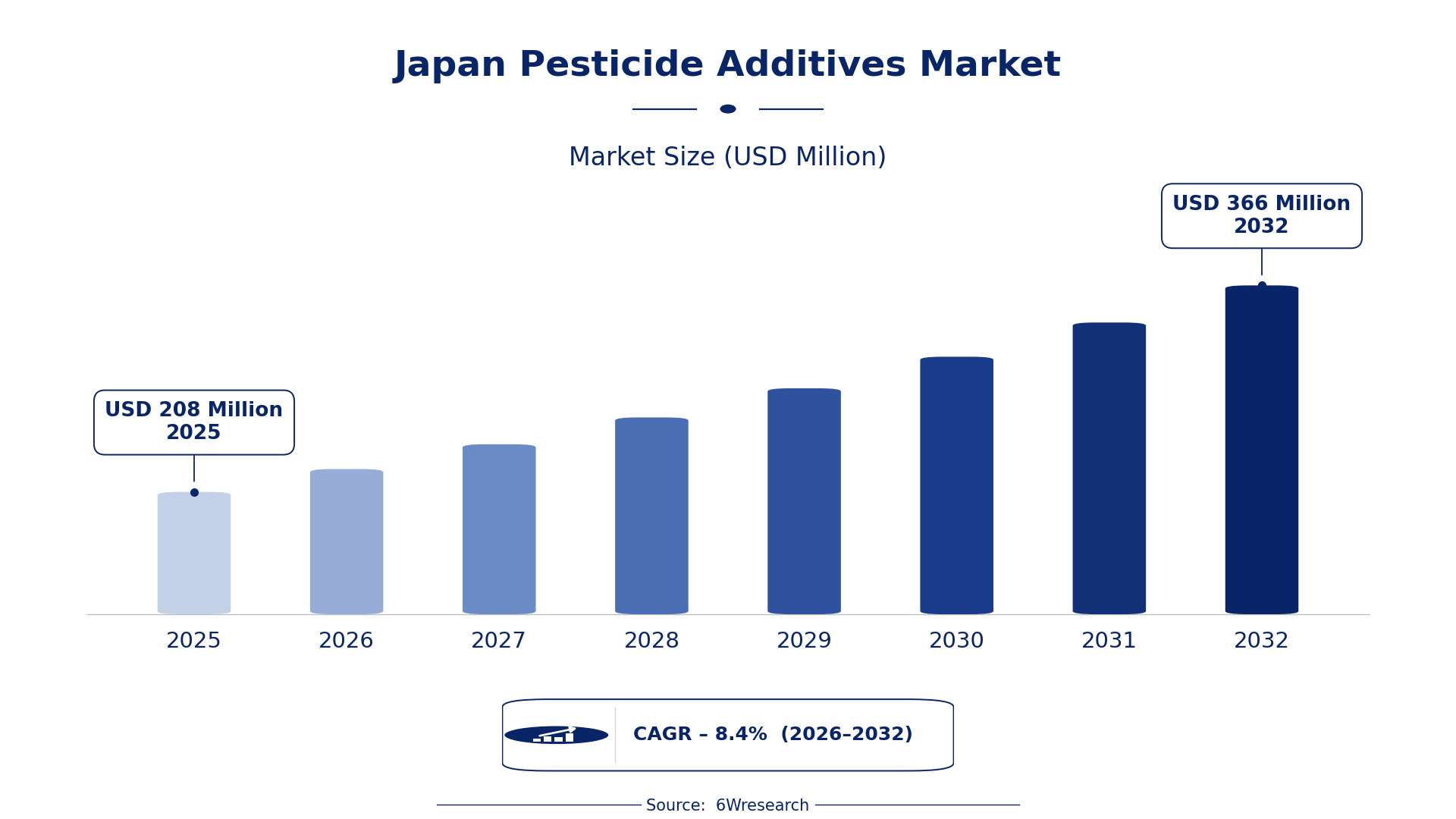
According to 6Wresearch internal database and industry insights, the Japan Pesticide Additives Market was valued at USD 208 Million in 2025 and is projected to reach USD 366 Million by 2032, growing at a CAGR of approximately 8.4% during 2026–2032.
Japan Pesticide Additives Market Highlights
| Report Metric | Details |
| Report Name | Japan Pesticide Additives Market (2026-2032) |
| Market Size 2025 | USD 208 Million |
| Market Size 2032 | USD 366 Million |
| Absolute Growth 2025–2032 | USD 158 Million |
| CAGR 2026–2032 | 8.4% |
| Peak Annual Growth | 9.2% in 2028 |
| Forecast Period | 2026–2032 |
| Historical Data | 2022–2025 |
| Base Year | 2025 |
| Leading Additive Type, 2025 | Surfactants (36% share) |
| Leading Function Type, 2025 | Wetting Agent (45% share) |
| Leading Distribution Channel, 2025 | Agro Distributors (37% share) |
| Leading End User, 2025 | Pesticide Manufacturers (54% share) |
| Fastest-Growing Additive Type | Stickers (11.6% CAGR) |
| Fastest-Growing Function Type | Adhesion Enhancer (11.9% CAGR) |
| Fastest-Growing Distribution Channel | Direct Sales (10.8% CAGR) |
| Fastest-Growing End User | Farmers (10.6% CAGR) |
| Growing Sector | Farmers |
| Key End Users | Pesticide Manufacturers, Farmers, Sprayer Companies, Crop Consultants |
Japan Pesticide Additives Market Year-wise Growth Rate and Key Drivers (2022–2032)
This graph illustrates the annual growth rates of the market from 2022 to 2032, highlighting a steady upward trajectory and projected market expansion over the forecast period.
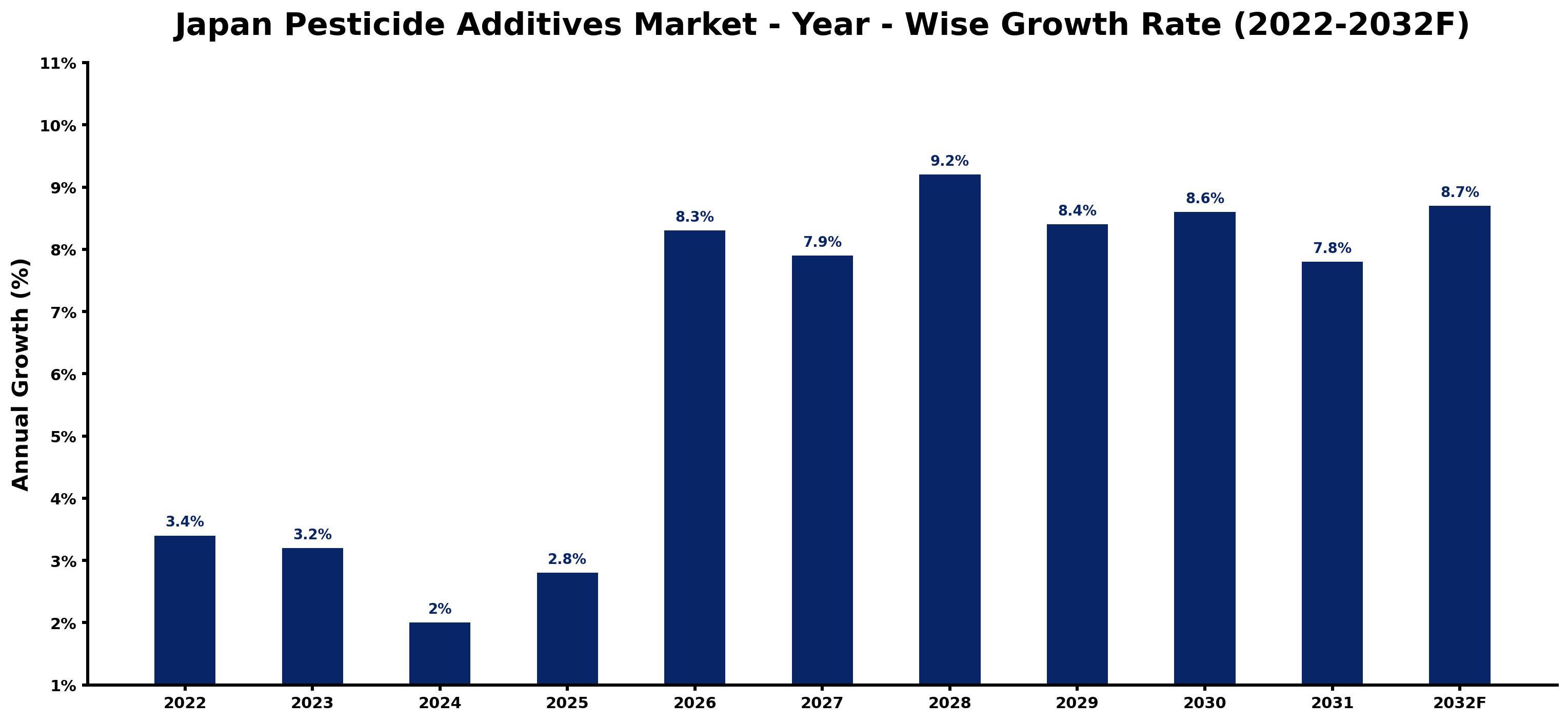
The yearly estimates that follow link every growth rate to its principal driver, so readers can see why the pace changed in each period.
| Year | Estimated Annual Growth (%) | Market Rationale |
| 2022 | 3.4 | The market experienced steady growth due to consistent demand from local pesticide manufacturers. |
| 2023 | 3.2 | Growth slowed slightly as pesticide manufacturers adjusted to changing agricultural practices. |
| 2024 | 2.0 | A further slowdown occurred as farmers began adopting precision agriculture techniques. |
| 2025 | 2.8 | Growth accelerated as the Agrochemical Association of Japan promoted safe pesticide practices. |
| 2026 | 8.3 | Demand is expected to surge as farmers increasingly utilise pesticide additives for improved efficiency. |
| 2027 | 7.9 | Growth is projected to slow again as market saturation begins to impact new product introductions. |
| 2028 | 9.2 | The market is expected to peak as a new program aimed at reducing pesticide residues is launched. |
| 2029 | 8.4 | Growth is projected to slow as farmers adjust to new regulations and practices. |
| 2030 | 8.6 | Demand will increase as pesticide manufacturers seek JIS certification for quality assurance. |
| 2031 | 7.8 | Growth is expected to slow as the market stabilises following the peak in 2028. |
| 2032 | 8.7 | A renewed focus on sustainability is projected to drive demand for effective additives. |
Note: Market size estimations and growth projections presented in this report are based on 6Wresearch's proprietary forecasting methodology, utilizing the latest available industry data, government publications, and primary research inputs.
Japan Pesticide Additives Market Synopsis
Pesticide additives are chemical substances used to enhance the effectiveness of pesticides, produced through chemical synthesis. Their main applications include improving adhesion to plant surfaces and increasing the absorption of active ingredients. The Japan Pesticide Additives Market is expanding due to rising demand from local pesticide manufacturers, increased adoption of precision agriculture techniques, and government initiatives aimed at reducing pesticide residues by 30% in 2023, which collectively drive higher purchases of these essential substances.
Market Dynamics Impact Analysis (2026–2032)
| Factor | Type | Impact | Primary Segment Affected |
| Growing adoption of precision agriculture techniques | Driver | High | Wetting Agent |
| Increased focus on sustainability and safety standards | Driver | High | Adhesion Enhancer |
| Expansion of the pesticide market due to new regulations | Opportunity | High | Pesticide Manufacturers |
| Rising demand for quality assurance certifications among manufacturers | Opportunity | High | Chemical Suppliers |
| Market saturation affecting new product introductions | Restraint | Medium | Sprayer Companies |
| Challenges in meeting stringent regulatory requirements | Restraint | High | Pesticide Manufacturers |
| High costs associated with compliance and certification | Challenge | High | Farmers |
| Limited access to advanced formulations for smaller manufacturers | Challenge | Medium | Crop Consultants |
Evaluation of Drivers in Japan Pesticide Additives Market (2026–2032)
Below are the drivers that matter most for revenue growth, with supporting evidence.
| Drivers | Primary Segment Affected | Why It Matters (Evidence) |
| Increased adoption of precision agriculture techniques | Wetting Agent | This method improves pesticide application efficiency, leading to higher demand for additives. |
| Focus on sustainability and safety standards | Adhesion Enhancer | Manufacturers are seeking additives that comply with new regulations, prompting increased purchases. |
| Expansion of the pesticide market | Pesticide Manufacturers | With over 1,000 registered products, demand for additives is driven by new formulations. |
| Growing need for quality assurance certifications | Chemical Suppliers | JIS certification is becoming essential for manufacturers, increasing the need for reliable additives. |
| Government initiatives to reduce pesticide residues | Farmers | The 2023 program aims for a 30% reduction, encouraging farmers to use more effective additives. |
Volumes grow on the back of increased adoption of precision agriculture techniques, which improve pesticide application efficiency. In 2022, Japan's pesticide market was valued at approximately 600 billion yen, driving demand for additives that improve effectiveness.
Evaluation of Restraints in Japan Pesticide Additives Market
Several factors work against faster growth; the main ones are summarised below.
| Market Restraint | Primary Segment Affected | Why It Matters (Evidence) |
| Market saturation affecting new product introductions | Sprayer Companies | With over 1,000 registered products, the market has become saturated, limiting innovation. |
| Challenges in meeting stringent regulatory requirements | Pesticide Manufacturers | Compliance with the PRTR Law and Chemical Substances Control Law increases operational costs. |
| High costs associated with compliance and certification | Farmers | Farmers face increased expenses to meet safety standards, impacting their purchasing power. |
| Limited access to advanced formulations for smaller manufacturers | Crop Consultants | Smaller manufacturers struggle to access effective additives, limiting their competitiveness. |
| Dependence on traditional pesticide practices | Pesticide Manufacturers | Many manufacturers are slow to adopt new technologies, hindering market growth. |
Japan Pesticide Additives Market Challenges
Inefficient application technology limits additive effectiveness, forcing farmers to use up to 20% more pesticide per hectare. Many local farms, averaging 1.5 hectares, lack the capital to upgrade equipment, significantly raising operational costs. Regulatory complexities delay the approval of new additives, extending product launch timelines by six months for manufacturers. With intense competition among over 1,000 registered products, suppliers face reduced margins, restricting their ability to invest in quality improvements. Buyers struggle to meet JIS standards, resulting in inconsistent availability of effective additives.
Trends in the Japan Pesticide Additives Market
The following changes are redrawing the Japan Pesticide Additives Market.
- Shift towards Sustainable Practices: Japan's agricultural sector is increasingly prioritising sustainable practices, with the Agrochemical Association advocating for safe pesticide use. In 2023, a programme aimed at reducing pesticide residues by 30% was launched, influencing buyer behaviour.
- Transition from Conventional to Precision Agriculture: Since 2022, farmers have been adopting precision agriculture techniques to enhance efficiency. This shift is particularly evident in regions like Tokyo and Hokkaido, where technology adoption is driving demand for effective additives.
- Emergence of Quality Assurance Standards: The push for JIS certification among pesticide manufacturers began in 2022, leading to a greater emphasis on quality. This trend is reshaping supplier relationships and product formulations throughout the industry.
- Growing Importance of Regulatory Compliance: As regulations tighten, pesticide manufacturers are increasingly focused on compliance with the PRTR Law. This shift influences purchasing decisions, as buyers seek certified additives that meet new standards.
Investment Opportunities in the Japan Pesticide Additives Market
Investors looking at the Japan Pesticide Additives Market should consider the following areas.
- Investment in Agrochemical Facilities: Japan's agrochemical sector is expanding, with a projected investment of 50 billion yen in new facilities. Agro Distributors are seeking suppliers to meet this growing demand, creating opportunities for partnerships.
- Expansion of Online Sales Channels: With a 15% growth in online pesticide sales anticipated, suppliers can leverage this channel. Collaborating with online platforms will facilitate access to smaller buyers in urban areas.
- Development of Eco-friendly Additives: As sustainability becomes a priority, there is an increasing need for eco-friendly pesticide additives. Pesticide Manufacturers are pursuing solutions to meet consumer demand for safer products.
- Collaboration with Crop Consultants: The rising reliance on Crop Consultants for pesticide application advice offers opportunities for suppliers. By partnering with these consultants, companies can effectively promote their additives.
Government Initiatives in the Japan Pesticide Additives Market
The PRTR Law requires businesses to report the release of designated chemical substances, impacting pesticide manufacturers by increasing transparency and compliance costs. Adhering to this law necessitates investment in monitoring and reporting systems, which can be burdensome for smaller firms.
The Ministry of Agriculture, Forestry and Fisheries oversees pesticide regulations, ensuring that manufacturers comply with safety standards. This oversight includes approving new pesticide formulations and additives, which affects the availability of products in the market.
Future Insight of the Japan Pesticide Additives Market
By 2032, investment in advanced agricultural technology will drive demand for more effective pesticide additives, particularly as rice cultivation expands across 1.5 million hectares. New initiatives aimed at reducing pesticide residues will stimulate the development of innovative additive formulations. The growing trend of ISO 9001 certification will enhance product quality and safety standards, benefiting buyers. An increasing number of licensed pesticide applicators will improve field expertise, prompting suppliers to create tailored solutions that align with modern agricultural practices.
Market Segmentation Analysis
Japan Pesticide Additives Market report covers a detailed analysis of the following market segments:
By Additive Type – Surfactants Lead, Stickers Expected to Grow Fastest
According to Navya, Research Analyst at 6Wresearch, Surfactants took 36% of additive type revenue in 2025, more than any other category. Surfactants hold the largest share because they are essential for improving the wetting and spreading of pesticides, which is vital for effective application. Their extensive use among pesticide manufacturers in key agricultural regions such as Tokyo and Hokkaido underscores their importance. Over 2026–2032, Stickers are expected to post the fastest growth, at a CAGR of 11.6%. Stickers are experiencing rapid growth as they enhance the adhesion of pesticides to surfaces, which is increasingly crucial with the rise of precision agriculture techniques. This trend is evident as farmers seek better application methods to maximise efficacy and reduce waste. Suppliers should focus on developing advanced sticker formulations to meet the increasing demand from farmers.
By Function Type – Wetting Agent Leads, Adhesion Enhancer Expected to Grow Fastest
Wetting Agent held 45% of the Japan Pesticide Additives Market by function type in 2025. Wetting Agents dominate the market as they are necessary for reducing the surface tension of spray solutions, ensuring effective pesticide application. Their critical role in the formulation of numerous registered pesticide products in Japan highlights their significance. Adhesion Enhancer is set to record the highest CAGR in this split, 11.9% over 2026–2032. Adhesion Enhancers are growing quickly because they help pesticides stick to plant surfaces, which is vital for maximising effectiveness. The initiative to reduce pesticide residues in food by 30% has further increased the focus on effective adhesion techniques. Buyers will benefit from investing in high-quality adhesion enhancers to improve application efficiency and comply with regulatory standards.
By Distribution Channel – Agro Distributors Lead, Direct Sales Expected to Grow Fastest
With 37% of distribution channel revenue in 2025, Agro Distributors was the largest category. Agro Distributors are the leading channel as they are key for reaching farmers and manufacturers, facilitating the distribution of pesticide additives across Japan. Their established networks ensure that products are readily available to end-users in agricultural regions. Direct Sales is projected to grow fastest, at a CAGR of 10.8% during 2026–2032. Direct Sales are growing rapidly as they allow for important transactions with large users, providing a streamlined purchasing process. The increasing number of licensed pesticide applicators in Japan is driving demand for direct sales channels to meet their needs. Suppliers should enhance their direct sales strategies to capture the growing market segment of large-scale users.
By End User – Pesticide Manufacturers Lead, Farmers Expected to Grow Fastest
The largest end user category in 2025 was Pesticide Manufacturers, at 54% of revenue. Pesticide Manufacturers lead the market as the primary users of additives in product formulations, driving demand for various types of additives. Their significant role in the formulation process is evident given the scale of pesticide production in Japan. The quickest growth will come from Farmers, forecast to expand at a CAGR of 10.6% between 2026 and 2032. Farmers are the fastest-growing end-user segment as they apply pesticides with additives directly in the field, influenced by the adoption of precision agriculture techniques. This trend is likely to continue as farmers seek to improve their application methods and overall productivity. Suppliers must tailor their offerings to meet the specific needs of farmers to capitalise on this growing end-user segment.
Key Attractiveness of the Report
- 10 Years of Market Numbers
- Historical Data Starting from 2022 to 2025
- Base Year 2025
- Forecast Data until 2032
- Key Performance Indicators Impacting the Market
- Major Upcoming Developments and Projects
Key Highlights of the Report:
- Japan Pesticide Additives Market Outlook
- Market Size of Japan Pesticide Additives Market, 2025
- Forecast of Japan Pesticide Additives Market, 2032
- Historical Data and Forecast of Japan Pesticide Additives Revenues & Volume for the Period 2022-2032F
- Japan Pesticide Additives Market Trend Evolution
- Japan Pesticide Additives Market Drivers and Challenges
- Japan Pesticide Additives Price Trends
- Japan Pesticide Additives Porter's Five Forces
- Japan Pesticide Additives Industry Life Cycle
- Historical Data and Forecast of Japan Pesticide Additives Market Revenues & Volume By Additive Type for the Period 2022-2032F
- Historical Data and Forecast of Japan Pesticide Additives Market Revenues & Volume By Surfactants for the Period 2022-2032F
- Historical Data and Forecast of Japan Pesticide Additives Market Revenues & Volume By Stickers for the Period 2022-2032F
- Historical Data and Forecast of Japan Pesticide Additives Market Revenues & Volume By Spreaders for the Period 2022-2032F
- Historical Data and Forecast of Japan Pesticide Additives Market Revenues & Volume By Penetrants for the Period 2022-2032F
- Historical Data and Forecast of Japan Pesticide Additives Market Revenues & Volume By Function Type for the Period 2022-2032F
- Historical Data and Forecast of Japan Pesticide Additives Market Revenues & Volume By Wetting Agent for the Period 2022-2032F
- Historical Data and Forecast of Japan Pesticide Additives Market Revenues & Volume By Adhesion Enhancer for the Period 2022-2032F
- Historical Data and Forecast of Japan Pesticide Additives Market Revenues & Volume By Coverage Booster for the Period 2022-2032F
- Historical Data and Forecast of Japan Pesticide Additives Market Revenues & Volume By Absorption Enhancer for the Period 2022-2032F
- Historical Data and Forecast of Japan Pesticide Additives Market Revenues & Volume By Distribution Channel for the Period 2022-2032F
- Historical Data and Forecast of Japan Pesticide Additives Market Revenues & Volume By Agro Distributors for the Period 2022-2032F
- Historical Data and Forecast of Japan Pesticide Additives Market Revenues & Volume By Direct Sales for the Period 2022-2032F
- Historical Data and Forecast of Japan Pesticide Additives Market Revenues & Volume By Online Platforms for the Period 2022-2032F
- Historical Data and Forecast of Japan Pesticide Additives Market Revenues & Volume By Chemical Suppliers for the Period 2022-2032F
- Historical Data and Forecast of Japan Pesticide Additives Market Revenues & Volume By End User for the Period 2022-2032F
- Historical Data and Forecast of Japan Pesticide Additives Market Revenues & Volume By Pesticide Manufacturers for the Period 2022-2032F
- Historical Data and Forecast of Japan Pesticide Additives Market Revenues & Volume By Farmers for the Period 2022-2032F
- Historical Data and Forecast of Japan Pesticide Additives Market Revenues & Volume By Sprayer Companies for the Period 2022-2032F
- Historical Data and Forecast of Japan Pesticide Additives Market Revenues & Volume By Crop Consultants for the Period 2022-2032F
- Japan Pesticide Additives Import Export Trade Statistics
- Market Opportunity Assessment By Additive Type
- Market Opportunity Assessment By Function Type
- Market Opportunity Assessment By Distribution Channel
- Market Opportunity Assessment By End User
- Japan Pesticide Additives Top Companies Market Share
- Japan Pesticide Additives Competitive Benchmarking By Technical and Operational Parameters
- Japan Pesticide Additives Company Profiles
- Japan Pesticide Additives Key Strategic Recommendations
Market Covered
The report covers the following segments.
By Additive Type
- Surfactants
- Stickers
- Spreaders
- Penetrants
By Function Type
- Wetting Agent
- Adhesion Enhancer
- Coverage Booster
- Absorption Enhancer
By Distribution Channel
- Agro Distributors
- Direct Sales
- Online Platforms
- Chemical Suppliers
By End User
- Pesticide Manufacturers
- Farmers
- Sprayer Companies
- Crop Consultants






































