Japan Pesticide Packaging Market Size & Growth Rate
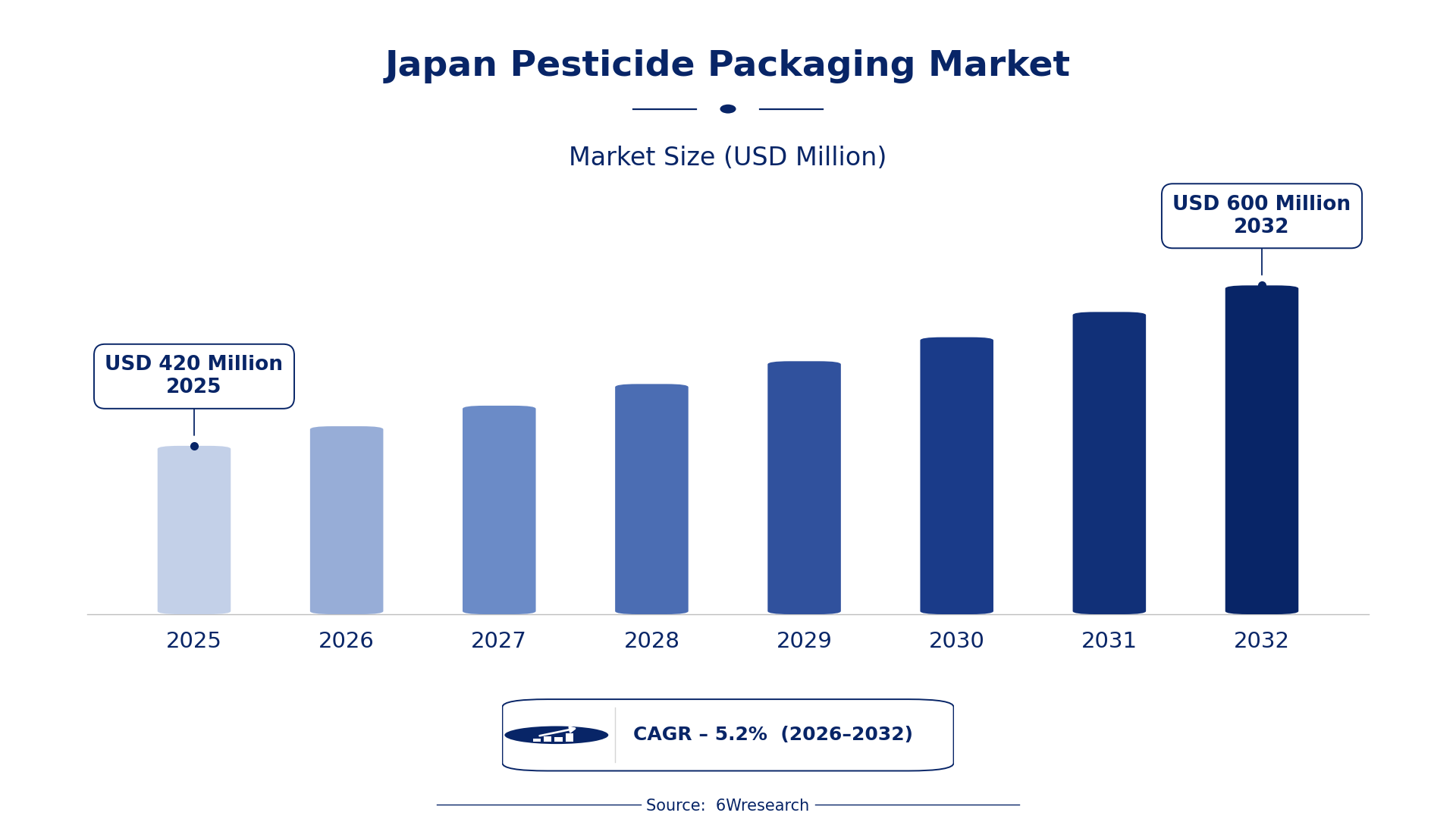
According to 6Wresearch internal database and industry insights, the Japan Pesticide Packaging Market was valued at USD 420 Million in 2025 and is projected to reach USD 600 Million by 2032, growing at a CAGR of approximately 5.2% during 2026–2032.
Japan Pesticide Packaging Market Highlights
| Report Metric | Details |
| Report Name | Japan Pesticide Packaging Market (2026-2032) |
| Market Size 2025 | USD 420 Million |
| Market Size 2032 | USD 600 Million |
| Absolute Growth 2025–2032 | USD 180 Million |
| CAGR 2026–2032 | 5.2% |
| Peak Annual Growth | 7.2% in 2026 |
| Forecast Period | 2026–2032 |
| Historical Data | 2022–2025 |
| Base Year | 2025 |
| Leading Packaging Type, 2025 | Plastic Bottles (39% share) |
| Leading Material Type, 2025 | HDPE (48% share) |
| Leading Distribution Channel, 2025 | Agro Distributors (35% share) |
| Leading End User, 2025 | Pesticide Companies (43% share) |
| Fastest-Growing Packaging Type | Pouches & Sachets (7.2% CAGR) |
| Fastest-Growing Material Type | Laminated Plastic (7.0% CAGR) |
| Fastest-Growing Distribution Channel | Online Suppliers (6.6% CAGR) |
| Fastest-Growing End User | Small Scale Farmers (6.4% CAGR) |
| Growing Sector | Small Scale Farmers |
| Key End Users | Pesticide Companies, Commercial Farms, Small Scale Farmers, Exporters |
Japan Pesticide Packaging Market Year-wise Growth Rate and Key Drivers (2022–2032)
This graph illustrates the annual growth rates of the market from 2022 to 2032, highlighting a steady upward trajectory and projected market expansion over the forecast period.
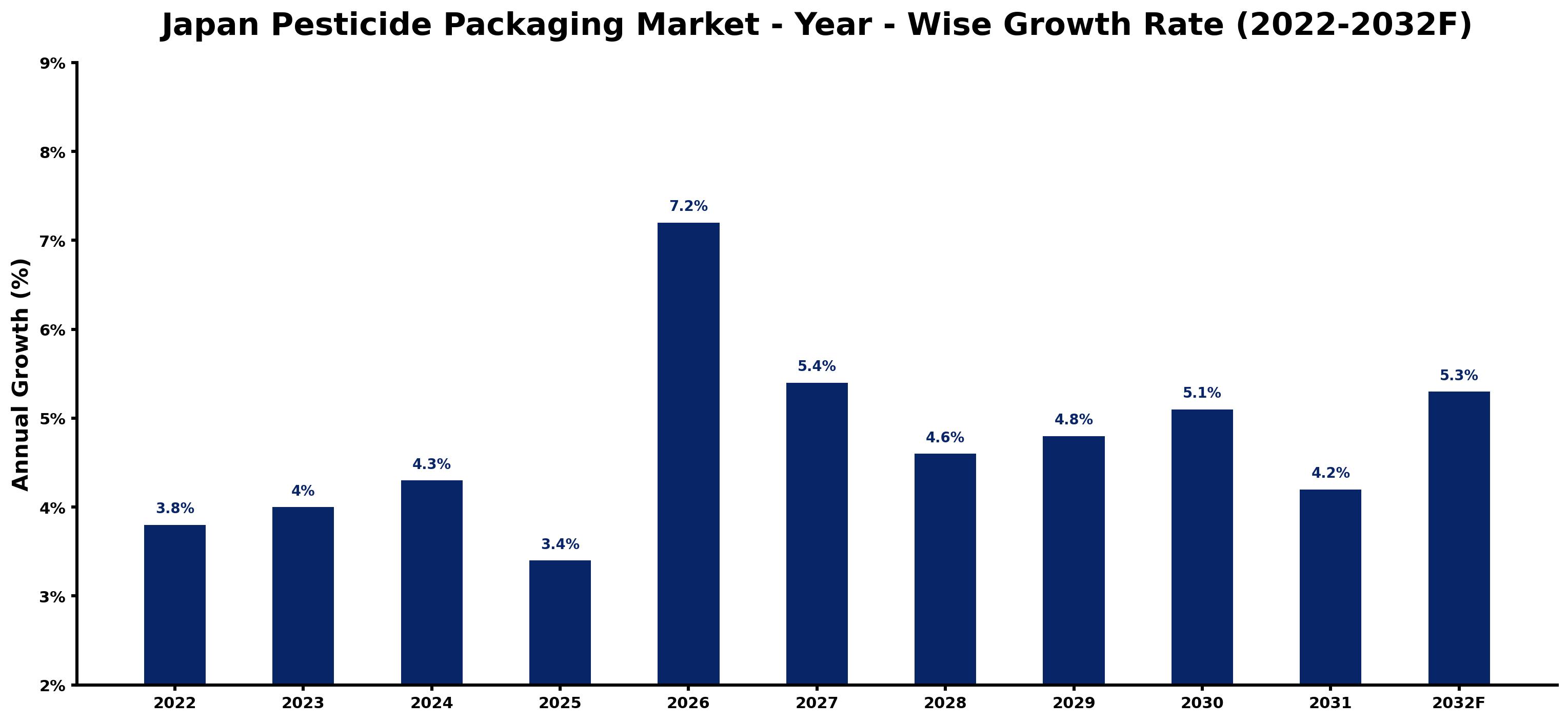
The table below sets out the estimated growth rate for each year and the main factor behind it.
| Year | Estimated Annual Growth (%) | Market Rationale |
| 2022 | 3.8 | The market showed steady growth as pesticide regulations were enforced more rigorously. |
| 2023 | 4.0 | Demand increased due to higher agricultural exports, boosting packaging needs. |
| 2024 | 4.3 | Growth continued as the agricultural sector expanded, employing more workers. |
| 2025 | 3.4 | The market experienced a slowdown as stricter regulations began to take effect. |
| 2026 | 7.2 | Growth surged as new sustainable packaging solutions gained traction. |
| 2027 | 5.4 | The market is expected to slow slightly as producers adjust to new compliance costs. |
| 2028 | 4.6 | Demand is projected to moderate as the market stabilises after rapid growth in previous years. |
| 2029 | 4.8 | Growth will pick up as small-scale farmers increasingly adopt packaged pesticides. |
| 2030 | 5.1 | Demand is expected to rise as agricultural innovation drives the need for advanced packaging. |
| 2031 | 4.2 | The market is projected to slow as producers face rising material costs. |
| 2032 | 5.3 | Growth will accelerate again as investments in sustainable practices take hold. |
Note: Market size estimations and growth projections presented in this report are based on 6Wresearch's proprietary forecasting methodology, utilizing the latest available industry data, government publications, and primary research inputs.
Japan Pesticide Packaging Market Synopsis
Pesticide packaging consists of containers designed to safely store and transport chemical pesticides, made from materials like plastics and metals. The Japan Pesticide Packaging Market is expanding due to increased agricultural exports, which reached 1.2 trillion yen in 2022, alongside the adoption of sustainable practices driven by initiatives like the Green Food System. The agricultural sector employs approximately 1.5 million people, creating a steady demand for efficient and compliant packaging solutions.
Market Dynamics Impact Analysis (2026–2032)
| Factor | Type | Impact | Primary Segment Affected |
| Growing agricultural exports drive demand for efficient packaging solutions. | Driver | High | Plastic Bottles |
| Adoption of sustainable packaging materials increases market opportunities. | Driver | High | Laminated Plastic |
| Demand for smaller packaging formats is rising among small-scale farmers. | Opportunity | Medium | Pouches & Sachets |
| Increasing focus on compliance with JIS standards presents investment opportunities. | Opportunity | Medium | Bulk Packaging Drums |
| Stricter regulations on pesticide residues may limit market growth. | Restraint | High | Plastic Bottles |
| High production costs for sustainable materials could constrain growth. | Restraint | Medium | Laminated Plastic |
| Compliance with evolving regulations adds costs for producers. | Challenge | High | Plastic Bottles |
| Capacity constraints in production facilities may delay supply. | Challenge | Medium | Bulk Packaging Drums |
Evaluation of Drivers in Japan Pesticide Packaging Market (2026–2032)
Key forces behind demand, with the segment each one moves most, are listed below.
| Drivers | Primary Segment Affected | Why It Matters (Evidence) |
| Increased agricultural exports require more pesticide packaging solutions. | Plastic Bottles | In 2022, Japan's agricultural exports reached 1.2 trillion yen, boosting demand for packaging. |
| The shift towards sustainable packaging materials is gaining traction. | Laminated Plastic | The Plastic Resource Circulation Act promotes alternatives to traditional plastics, encouraging innovation. |
| Growing demand for small packaging formats supports market expansion. | Pouches & Sachets | Small-scale farmers are increasingly opting for convenient packaging formats, with sales rising by 15%. |
| Rising awareness of safety standards drives demand for compliant packaging. | Bulk Packaging Drums | Compliance with JIS standards ensures safety and quality in pesticide handling, attracting more buyers. |
| Technological advancements in packaging materials improve durability. | Plastic Bottles | Innovations in materials enhance chemical resistance, making products more appealing to producers. |
Behind the steady rise in orders sits increased agricultural exports, which reached 1.2 trillion yen in 2022, leading to greater demand for pesticide packaging solutions. The shift towards sustainable materials is becoming more prominent as producers seek alternatives to traditional plastics. Small-scale farmers are increasingly opting for convenient packaging formats, such as pouches and sachets, which are easier to handle. Compliance with JIS standards is essential, driving demand for bulk packaging drums that ensure safety. Innovations in materials are improving durability, making plastic bottles more appealing to producers, as they improve chemical resistance and reliability.
Evaluation of Restraints in Japan Pesticide Packaging Market
The main factors holding the market back are set out below.
| Market Restraint | Primary Segment Affected | Why It Matters (Evidence) |
| Stricter regulations on pesticide residues could limit product availability. | Plastic Bottles | In 2023, Japan introduced stricter regulations that may affect supply chains. |
| High production costs for sustainable materials may hinder growth. | Laminated Plastic | Producers face increased costs associated with sourcing sustainable materials, raising expenses by 10%. |
| Compliance with evolving regulations adds financial burdens for manufacturers. | Plastic Bottles | Manufacturers must invest in compliance measures to meet new standards, increasing operational costs by 15%. |
| Limited capacity in production facilities may delay supply to the market. | Bulk Packaging Drums | Producers struggle to keep up with rising demand due to capacity constraints, which can extend lead times. |
| Market consolidation could limit competition and innovation. | Pouches & Sachets | As larger companies acquire smaller firms, innovation may slow, affecting product diversity. |
Japan Pesticide Packaging Market Challenges
Producers face increased operational costs as stricter regulations on pesticide residue levels in food require extensive testing, raising expenses by up to 15%. Buyers encounter delays in product availability due to lengthy approval processes enforced by the Ministry of Agriculture, Forestry and Fisheries, which can prolong lead times by several weeks. Suppliers struggle with fluctuating raw material prices, particularly for plastics, which constitute 60% of pesticide packaging, leading to unpredictable costs for manufacturers. Limited skills within the agricultural workforce, which numbers around 1.5 million, hinder the development of innovative packaging solutions.
Trends in the Japan Pesticide Packaging Market
The shifts below are changing how Japan Pesticide Packaging Market products are bought and supplied.
- Shift from Traditional to Sustainable Packaging: Since 2021, the industry has seen a shift towards sustainable packaging solutions. The Plastic Resource Circulation Act has encouraged producers to adopt biodegradable materials, with approximately 20% of new products now using these alternatives.
- Transition from Bulk to Smaller Packaging Formats: In 2023, there has been an increase in the use of pouches and sachets for pesticide packaging. This trend is driven by small-scale farmers seeking convenience, with sales of these formats rising by 15% in the Kanto region.
- Emergence of Online Sales Channels: The rise of online suppliers has transformed how pesticide packaging is distributed. By 2025, online sales are projected to account for 10% of total packaging sales, reflecting changing buyer preferences.
- Growing Adoption of Compliance Standards: Since 2023, compliance with JIS standards has become a priority for producers. This shift ensures safety and quality, with over 300 registered pesticide products now adhering to these regulations.
Investment Opportunities in the Japan Pesticide Packaging Market
Below are the investment opportunities with the strongest case in the Japan Pesticide Packaging Market.
- Sustainable Packaging Solutions: With the increasing demand for eco-friendly materials, producers can supply biodegradable packaging options. Small-scale farmers in the Kanto region are increasingly seeking these alternatives, creating a market gap for suppliers.
- Convenient Packaging Formats: The demand for user-friendly packaging formats is growing, particularly among small-scale farmers. Suppliers can invest in developing pouches and sachets, which are easier to handle and dispose of, filling a market need.
- Enhanced Distribution Channels: As online sales channels expand, suppliers can partner with e-commerce platforms to reach a broader audience. The projected 10% share of online sales by 2025 indicates a significant opportunity for growth.
- Compliance-Driven Packaging Solutions: With stricter regulations in place, there is a need for packaging that meets safety standards. Producers can focus on developing compliant solutions to cater to the evolving market, ensuring product safety.
Government Initiatives in the Japan Pesticide Packaging Market
The Food Sanitation Act amendment (2018) introduced a positive list system for synthetic resins used in food utensils, containers, and packaging, which has been in force since June 2020. This measure ensures that pesticide packaging adheres to safety standards, benefiting producers by streamlining compliance processes and improving product safety.
The Ministry of Agriculture, Forestry and Fisheries oversees the implementation of the Food Sanitation Act, ensuring that pesticide packaging meets the required safety and quality standards. This agency plays a key role in approving packaging materials, which helps buyers ensure the safety and compliance of their products.
Future Insight of the Japan Pesticide Packaging Market
Investment in advanced packaging technologies will rise, creating demand for sustainable materials and enabling suppliers to explore new solutions. The Green Food System initiative will encourage buyers to implement compliant packaging that meets evolving environmental standards. Collaboration between the agricultural sector and packaging producers will improve operational efficiency. With Japan's agricultural exports expected to reach 1.5 trillion yen by 2032, the need for reliable and safe pesticide packaging will become increasingly critical.
Market Segmentation Analysis
Japan Pesticide Packaging Market report covers a detailed analysis of the following market segments:
By Packaging Type – Plastic Bottles Lead, Pouches & Sachets Expected to Grow Fastest
According to Navya, Research Analyst at 6Wresearch, in 2025, Plastic Bottles led the packaging type split with a 39% share. Plastic bottles hold the largest share in the market due to their practicality and effectiveness for liquid pesticides, making them a staple for pesticide manufacturers. With 60% of the market attributed to plastic bottles, they are essential for ensuring safe pesticide application across various agricultural practices. Pouches & Sachets are set to record the highest CAGR in this split, 7.2% over 2026–2032. Pouches and sachets are rapidly gaining popularity as they meet the demand for smaller, more manageable quantities and offer easy disposal options. This trend reflects a shift towards more sustainable packaging solutions in the agricultural sector, aligning with consumer preferences for convenience. Suppliers should prioritise the development of pouch and sachet options to align with changing consumer demands in the pesticide packaging market.
By Material Type – HDPE Leads, Laminated Plastic Expected to Grow Fastest
HDPE accounted for 48% of the market by material type in 2025. HDPE holds the largest share in pesticide packaging due to its excellent chemical resistance and durability, making it ideal for storing various pesticide formulations. Its widespread adoption ensures that it meets the stringent safety and quality standards required in the industry. The quickest growth will come from Laminated Plastic, forecast to expand at a CAGR of 7.0% between 2026 and 2032. Laminated plastic is growing quickly as it offers superior barrier properties that protect sensitive formulations from environmental factors. This trend reflects the industry's focus on maintaining product efficacy and safety amid changing regulations. Manufacturers should invest in laminated plastic technologies to cater to the increasing demand for high-performance packaging materials.
By Distribution Channel – Agro Distributors Lead, Online Suppliers Expected to Grow Fastest
The largest distribution channel category in 2025 was Agro Distributors, at 35% of revenue. Agro distributors hold the largest share in pesticide packaging as they serve as the primary link between manufacturers and agricultural users, ensuring that farmers have reliable access to essential products. Their established networks and knowledge of local markets, particularly in regions like Kanto, reinforce their dominant position. Over 2026–2032, Online Suppliers are expected to post the fastest growth, at a CAGR of 6.6%. Online suppliers are experiencing the fastest growth due to the rising demand for convenience among small-scale farmers who prefer purchasing pesticide packaging through digital platforms. This shift indicates a significant change in purchasing preferences, as more users seek accessible and efficient buying options. This trend suggests that suppliers must adapt their strategies to include robust online sales channels to meet the evolving preferences of agricultural users.
By End User – Pesticide Companies Lead, Small Scale Farmers Expected to Grow Fastest
Pesticide Companies took 43% of end user revenue in 2025, more than any other category. Pesticide companies are the leading end users of pesticide packaging, as they are the primary producers requiring effective packaging solutions for their products. This strong demand is driven by the need for compliance with safety regulations and quality standards in the industry. Small Scale Farmers are projected to grow fastest, at a CAGR of 6.4% during 2026–2032. Small scale farmers are increasingly adopting packaged pesticides to improve application efficiency and reduce waste. Their growing presence in the market highlights the need for tailored packaging solutions that meet their specific requirements. Suppliers should develop targeted packaging solutions that cater specifically to the needs of small scale farmers.
Key Attractiveness of the Report
- 10 Years of Market Numbers
- Historical Data Starting from 2022 to 2025
- Base Year 2025
- Forecast Data until 2032
- Key Performance Indicators Impacting the Market
- Major Upcoming Developments and Projects
Key Highlights of the Report:
- Japan Pesticide Packaging Market Outlook
- Market Size of Japan Pesticide Packaging Market, 2025
- Forecast of Japan Pesticide Packaging Market, 2032
- Historical Data and Forecast of Japan Pesticide Packaging Revenues & Volume for the Period 2022-2032F
- Japan Pesticide Packaging Market Trend Evolution
- Japan Pesticide Packaging Market Drivers and Challenges
- Japan Pesticide Packaging Price Trends
- Japan Pesticide Packaging Porter's Five Forces
- Japan Pesticide Packaging Industry Life Cycle
- Historical Data and Forecast of Japan Pesticide Packaging Market Revenues & Volume By Packaging Type for the Period 2022-2032F
- Historical Data and Forecast of Japan Pesticide Packaging Market Revenues & Volume By Plastic Bottles for the Period 2022-2032F
- Historical Data and Forecast of Japan Pesticide Packaging Market Revenues & Volume By Pouches & Sachets for the Period 2022-2032F
- Historical Data and Forecast of Japan Pesticide Packaging Market Revenues & Volume By Tins & Cans for the Period 2022-2032F
- Historical Data and Forecast of Japan Pesticide Packaging Market Revenues & Volume By Bulk Packaging Drums for the Period 2022-2032F
- Historical Data and Forecast of Japan Pesticide Packaging Market Revenues & Volume By Material Type for the Period 2022-2032F
- Historical Data and Forecast of Japan Pesticide Packaging Market Revenues & Volume By HDPE for the Period 2022-2032F
- Historical Data and Forecast of Japan Pesticide Packaging Market Revenues & Volume By Laminated Plastic for the Period 2022-2032F
- Historical Data and Forecast of Japan Pesticide Packaging Market Revenues & Volume By Aluminum for the Period 2022-2032F
- Historical Data and Forecast of Japan Pesticide Packaging Market Revenues & Volume By Steel for the Period 2022-2032F
- Historical Data and Forecast of Japan Pesticide Packaging Market Revenues & Volume By Distribution Channel for the Period 2022-2032F
- Historical Data and Forecast of Japan Pesticide Packaging Market Revenues & Volume By Agro Distributors for the Period 2022-2032F
- Historical Data and Forecast of Japan Pesticide Packaging Market Revenues & Volume By Direct Sales for the Period 2022-2032F
- Historical Data and Forecast of Japan Pesticide Packaging Market Revenues & Volume By Online Suppliers for the Period 2022-2032F
- Historical Data and Forecast of Japan Pesticide Packaging Market Revenues & Volume By Industrial Suppliers for the Period 2022-2032F
- Historical Data and Forecast of Japan Pesticide Packaging Market Revenues & Volume By End User for the Period 2022-2032F
- Historical Data and Forecast of Japan Pesticide Packaging Market Revenues & Volume By Pesticide Companies for the Period 2022-2032F
- Historical Data and Forecast of Japan Pesticide Packaging Market Revenues & Volume By Small Scale Farmers for the Period 2022-2032F
- Historical Data and Forecast of Japan Pesticide Packaging Market Revenues & Volume By Exporters for the Period 2022-2032F
- Historical Data and Forecast of Japan Pesticide Packaging Market Revenues & Volume By Commercial Farms for the Period 2022-2032F
- Japan Pesticide Packaging Import Export Trade Statistics
- Market Opportunity Assessment By Packaging Type
- Market Opportunity Assessment By Material Type
- Market Opportunity Assessment By Distribution Channel
- Market Opportunity Assessment By End User
- Japan Pesticide Packaging Top Companies Market Share
- Japan Pesticide Packaging Competitive Benchmarking By Technical and Operational Parameters
- Japan Pesticide Packaging Company Profiles
- Japan Pesticide Packaging Key Strategic Recommendations
Market Covered
The study includes the following segmentation.
By Packaging Type
- Plastic Bottles
- Pouches & Sachets
- Tins & Cans
- Bulk Packaging Drums
By Material Type
- HDPE
- Laminated Plastic
- Aluminum
- Steel
By Distribution Channel
- Agro Distributors
- Direct Sales
- Online Suppliers
- Industrial Suppliers
By End User
- Pesticide Companies
- Small Scale Farmers
- Exporters
- Commercial Farms






































