Japan Petri Dish Market Size & Growth Rate
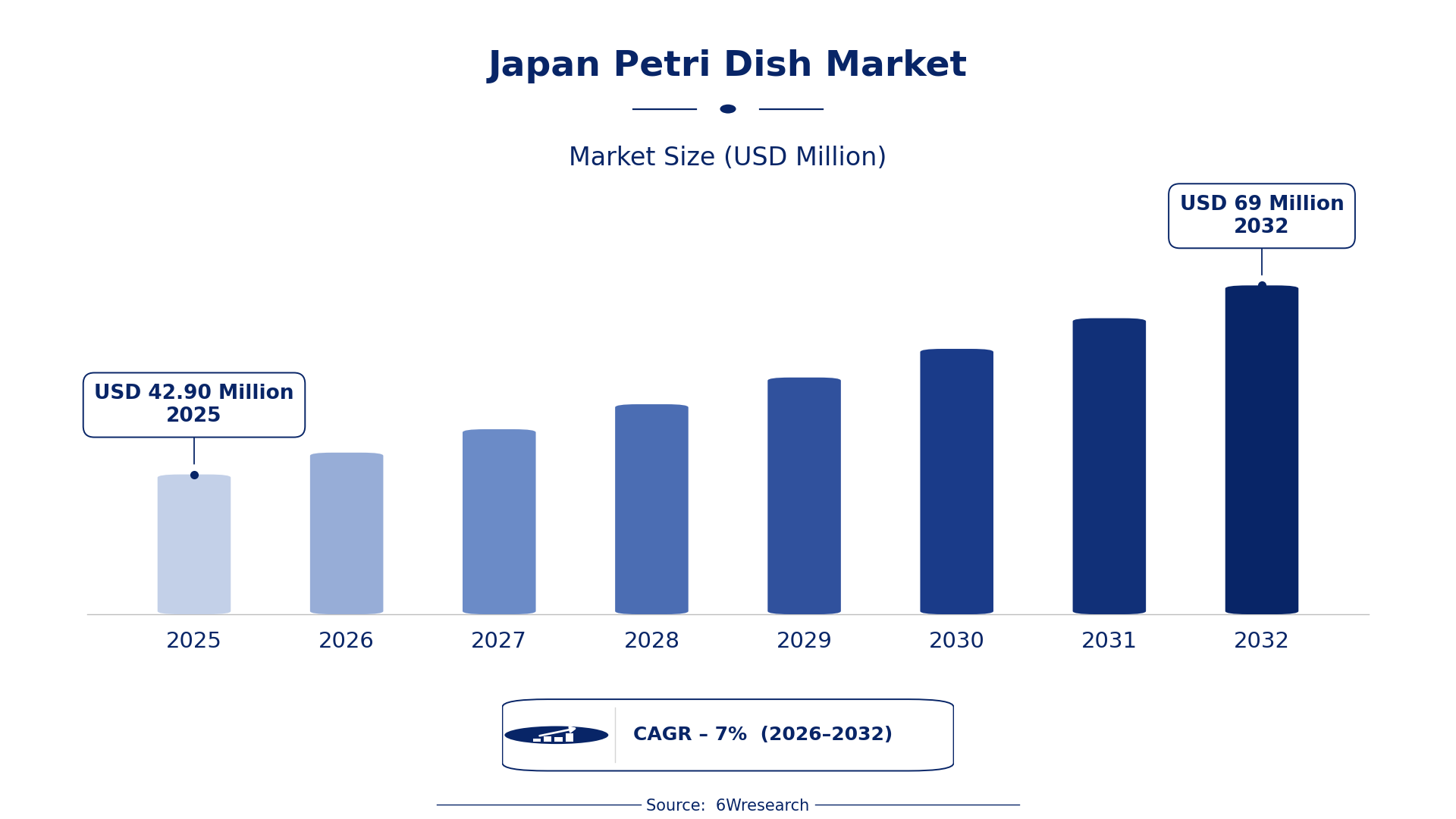
According to 6Wresearch internal database and industry insights, the Japan Petri Dish Market was valued at USD 42.90 Million in 2025 and is projected to reach USD 69 Million by 2032, growing at a CAGR of approximately 7% during 2026–2032.
Japan Petri Dish Market Highlights
| Report Metric | Details |
| Report Name | Japan Petri Dish Market (2026-2032) |
| Market Size 2025 | USD 42.90 Million |
| Market Size 2032 | USD 69 Million |
| Absolute Growth 2025–2032 | USD 26.10 Million |
| CAGR 2026–2032 | 7% |
| Peak Annual Growth | 7.7% in 2026 |
| Forecast Period | 2026–2032 |
| Historical Data | 2022–2025 |
| Base Year | 2025 |
| Leading End use area, 2025 | Microbiology (30% share) |
| Leading Material, 2025 | Plastic (46% share) |
| Fastest-Growing End use area | Chemical (8.9% CAGR) |
| Fastest-Growing Material | Glass (9.4% CAGR) |
| Growing Sector | Microbiology |
| Key End Users | Laboratories, Research Institutions, Educational Facilities, Pharmaceutical Companies |
Japan Petri Dish Market Year-wise Growth Rate and Key Drivers (2022–2032)
This graph illustrates the annual growth rates of the market from 2022 to 2032, highlighting a steady upward trajectory and projected market expansion over the forecast period.
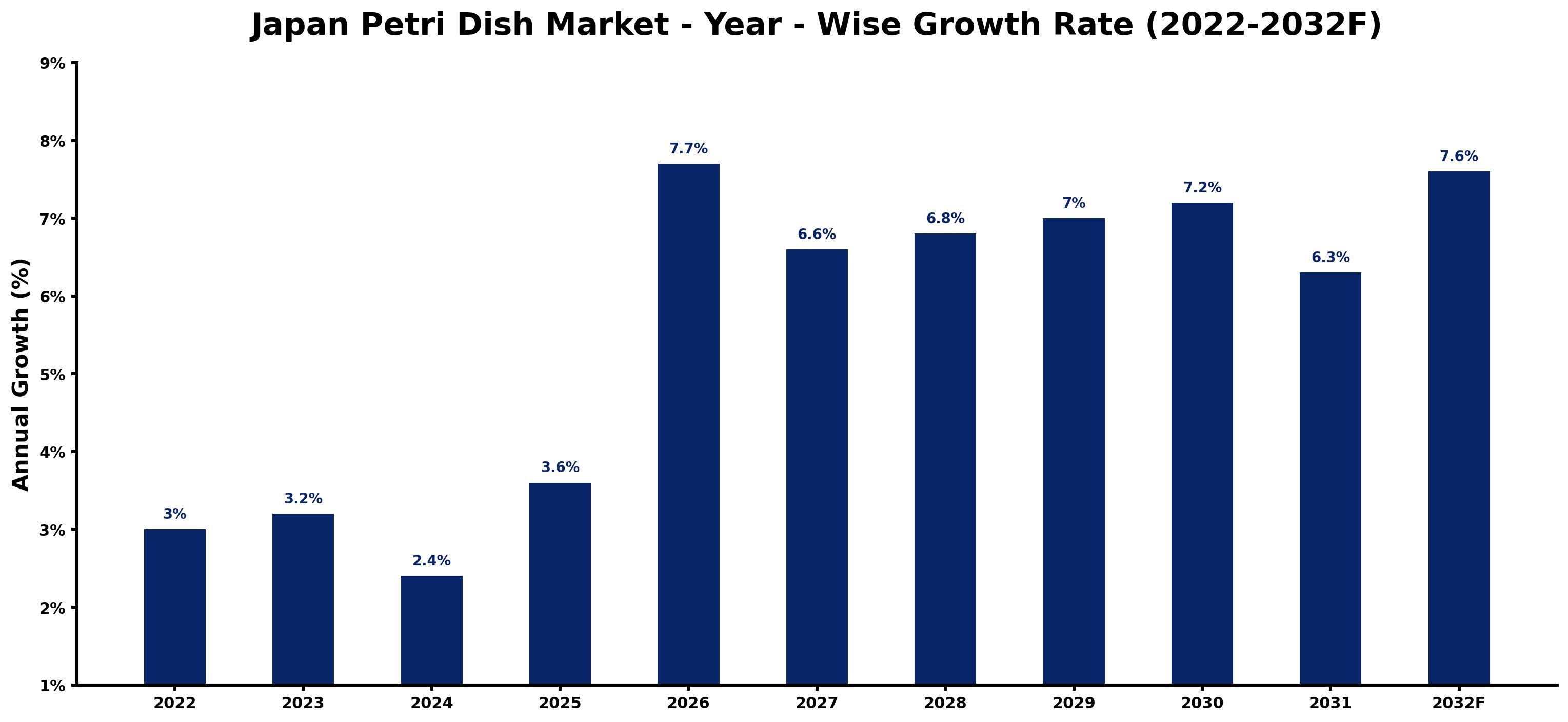
Year by year, the estimates below pair each growth rate with the development that shaped it.
| Year | Estimated Annual Growth (%) | Market Rationale |
| 2022 | 3.0 | The market showed steady growth, supported by laboratory expansions and increased research activities. |
| 2023 | 3.2 | Growth accelerated as more microbiology laboratories registered, boosting demand for Petri dishes. |
| 2024 | 2.4 | Growth slowed slightly due to market saturation in some segments, yet demand remained stable. |
| 2025 | 3.6 | A resurgence in pharmaceutical testing boosted demand, leading to faster growth than previous years. |
| 2026 | 7.7 | The peak growth rate is expected to be achieved as biotechnology initiatives gain traction, driving higher purchases. |
| 2027 | 6.6 | Growth will moderate as the market adjusts to previous peaks, but demand from laboratories will persist. |
| 2028 | 6.8 | A slight increase in growth is projected as new research projects commence, stimulating Petri dish consumption. |
| 2029 | 7.0 | Demand will rise further as educational institutions expand their laboratory facilities and resources. |
| 2030 | 7.2 | Growth is expected to continue as advancements in microbiological research increase the need for Petri dishes. |
| 2031 | 6.3 | The market will see a slowdown as growth stabilises, reflecting a mature phase in laboratory supplies. |
| 2032 | 7.6 | Demand is projected to rise again as new biotechnology initiatives are launched, increasing laboratory needs. |
Note: Market size estimations and growth projections presented in this report are based on 6Wresearch's proprietary forecasting methodology, utilizing the latest available industry data, government publications, and primary research inputs.
Japan Petri Dish Market Synopsis
Petri dishes are shallow, flat, cylindrical vessels primarily made of glass or plastic, used for culturing microorganisms and conducting biological experiments. The Japan Petri Dish Market is expanding due to rising investments in biotechnology research and a strong presence of domestic laboratories. With over 1,200 registered microbiology laboratories, the market is projected to grow as research initiatives and laboratory expansions continue to drive demand, with plastic dishes accounting for approximately 80% of the market share.
Market Dynamics Impact Analysis (2026–2032)
| Factor | Type | Impact | Primary Segment Affected |
| Growing investment in biotechnology research initiatives | Driver | High | Microbiology |
| Increased focus on pharmaceutical testing and development | Driver | High | Pharmaceutical |
| Expansion of microbiology laboratories in urban areas | Opportunity | High | Microbiology |
| Rising demand for high-quality laboratory supplies | Opportunity | Medium | Chemical |
| Market saturation in certain segments limiting growth potential | Restraint | High | Chemical |
| High competition among suppliers affecting pricing strategies | Restraint | Medium | Pharmaceutical |
| Challenges in maintaining sterility during production processes | Challenge | High | Microbiology |
| Regulatory compliance requirements increasing operational costs | Challenge | Medium | Pharmaceutical |
Evaluation of Drivers in Japan Petri Dish Market (2026–2032)
The following drivers explain most of the expected growth.
| Drivers | Primary Segment Affected | Why It Matters (Evidence) |
| Investment in biotechnology research | Microbiology | This investment leads to the establishment of new laboratories, driving higher demand for Petri dishes in research settings. |
| Rising pharmaceutical testing requirements | Pharmaceutical | Increased drug development activities necessitate more Petri dishes for testing, boosting purchases from laboratories. |
| Expansion of educational laboratory facilities | Microbiology | The establishment of more educational institutions increases the demand for Petri dishes for practical experiments. |
| Growth in microbiology research funding | Bio-chemical | Increased funding for microbiological studies raises the need for Petri dishes in various research applications. |
| Technological advancements in laboratory equipment | Chemical | New technologies improve testing capabilities, resulting in higher demand for quality Petri dishes. |
Buyers are adding capacity as investments in biotechnology research grow, with over 1,200 registered microbiology laboratories in Japan. The installed base of laboratory equipment is valued at over ¥500 billion, which is driving demand for Petri dishes. Pharmaceutical testing requirements are increasing, with over 1,000 registered pharmaceutical companies in the country, leading to higher purchases. The Tokyo metropolitan area serves as a hub for research and development, further increasing the need for laboratory supplies. As educational institutions expand their facilities, the demand for Petri dishes continues to rise, reflecting a strong market outlook.
Evaluation of Restraints in Japan Petri Dish Market
The table below lists the restraints and the evidence behind each.
| Market Restraint | Primary Segment Affected | Why It Matters (Evidence) |
| Market saturation in certain laboratory segments | Chemical | As more laboratories enter the market, competition increases, limiting growth opportunities for suppliers. |
| High competition affecting pricing strategies | Pharmaceutical | Intense competition among suppliers can lead to price wars, impacting profitability for manufacturers. |
| Challenges in maintaining sterility during production | Microbiology | Ensuring sterility for laboratory use complicates production processes and increases costs. |
| Regulatory compliance requirements increasing costs | Pharmaceutical | Strict regulations necessitate additional investments in quality control and certification, raising operational expenses. |
| Limited applications for alternative materials | Other Materials | The rarity of alternative materials restricts their use in Petri dishes, limiting market expansion. |
Japan Petri Dish Market Challenges
High production costs for Petri dishes pose a hurdle, as manufacturers in Japan face rising material prices that inflate expenses for laboratories. Technology adoption lags, with over 1,200 registered microbiology labs frequently using outdated equipment, which delays research timelines and reduces productivity. Buyers encounter inconsistent supply quality in antimicrobial plastics, risking compromised experimental results and incurring additional costs for re-testing that can exceed ¥2 million annually. Shortages of skilled laboratory personnel are evident, as the demand for advanced techniques outpaces available training programmes, resulting in extended project durations for research institutions.
Trends in the Japan Petri Dish Market
The following changes are redrawing the Japan Petri Dish Market.
- Shift in Research Focus to Biotechnology: Laboratories are increasingly prioritising biotechnology research, with funding for such initiatives on the rise. In 2023, Japan launched a new initiative to promote biotechnology research, reflecting a shift in focus that benefits suppliers of laboratory equipment.
- Transition from Glass to Plastic Petri Dishes: The demand for plastic Petri dishes is increasing, accounting for approximately 80% of the market share. This shift is driven by their cost-effectiveness and ease of use in various laboratory settings.
- Emergence of Nanotechnology Applications: Nanotechnology applications in Japan are expanding, supported by increasing research funding. This trend is expected to boost the use of Petri dishes for specific applications, reflecting a growing interest in advanced materials.
- Growth of Educational Laboratory Facilities: Educational institutions are expanding their laboratory facilities, leading to increased demand for Petri dishes. The average population served by a microbiology lab is around 200,000 people, indicating a significant market opportunity.
Investment Opportunities in the Japan Petri Dish Market
Several openings in the Japan Petri Dish Market merit attention from investors.
- Gap in High-Quality Laboratory Supplies: With the market valued at USD 42.90 million, there is a gap for high-quality laboratory supplies. Collaborating with educational institutions can help suppliers meet this demand effectively.
- Investment in Microbiology Laboratories: The Tokyo metropolitan area is a hub for pharmaceutical research, presenting an opportunity for investment in microbiology laboratories. Establishing partnerships with local research institutions can facilitate market entry.
- Expansion of Pharmaceutical Testing Facilities: The total number of registered pharmaceutical companies exceeds 1,000, indicating a growing need for testing facilities. Suppliers can enter this market by forming joint ventures with established laboratories.
- Rising Demand for Biochemical Applications: The increasing focus on biochemical assays presents an opportunity for suppliers. Investing in high-quality Petri dishes tailored for biochemical applications can attract buyers in this sector.
Government Initiatives in the Japan Petri Dish Market
The PRTR Law, enacted in 1999, mandates businesses to report the release and transfer of designated chemical substances, ensuring safety in laboratory environments. This law, alongside the Chemical Substances Control Law from 1973, requires the evaluation and control of chemical substances, impacting how Petri dishes are produced and used in laboratories.
In 2023, Japan allocated ¥10 billion to promote biotechnology research, overseen by the Ministry of Health, Labour and Welfare. This funding supports initiatives that improve laboratory standards and the quality of Petri dishes used in research and testing.
Future Insight of the Japan Petri Dish Market
The launch of new biotechnology research initiatives will reshape laboratory practices by 2032, improving the efficiency of Petri dish production. Enhanced sterilisation technologies will ensure greater product safety and reliability for laboratories. Increased funding for research will expand the applications of Petri dishes in various scientific fields. Collaboration between research institutions and pharmaceutical companies will drive innovative applications, creating valuable opportunities for both buyers and suppliers in the market.
Market Segmentation Analysis
Japan Petri Dish Market report covers a detailed analysis of the following market segments:
By End use area – Microbiology Leads, Chemical Expected to Grow Fastest
According to Sumit Sagar, AM at 6Wresearch, with 30% of end use area revenue in 2025, Microbiology was the largest category. Microbiology holds the largest share as it supports over 1,200 registered laboratories in Japan, essential for culturing microorganisms. This segment is pivotal for both educational purposes and testing in various scientific fields, ensuring consistent demand for Petri dishes. Over 2026–2032, Chemical is expected to post the fastest growth, at a CAGR of 8.9%. The chemical segment is rapidly expanding as laboratories increasingly adopt Petri dishes for chemical testing, spurred by recent government initiatives to boost biotechnology research. This growth suggests a shift in laboratory practices towards more diverse applications of Petri dishes. Suppliers must focus on meeting the needs of microbiology while also exploring the emerging opportunities within the chemical testing sector.
By Material – Plastic Leads, Glass Expected to Grow Fastest
Plastic took 46% of material revenue in 2025, more than any other category. Plastic Petri dishes dominate the market due to their widespread use in laboratories, accounting for approximately 80% of the total share. Their cost-effectiveness and ability to maintain sterility make them the preferred choice for various laboratory applications. The quickest growth will come from Glass, forecast to expand at a CAGR of 9.4% between 2026 and 2032. Glass Petri dishes are experiencing the highest growth as they are favoured for high-temperature applications, which are critical in specific laboratory settings. This trend indicates a growing preference for materials that can withstand rigorous testing conditions. Buyers should ensure they have access to both plastic and glass Petri dishes to cater to their diverse experimental requirements.
Key Attractiveness of the Report
- 10 Years of Market Numbers
- Historical Data Starting from 2022 to 2025
- Base Year 2025
- Forecast Data until 2032
- Key Performance Indicators Impacting the Market
- Major Upcoming Developments and Projects
Key Highlights of the Report:
- Japan Petri Dish Market Outlook
- Market Size of Japan Petri Dish Market, 2025
- Forecast of Japan Petri Dish Market, 2032
- Historical Data and Forecast of Japan Petri Dish Revenues & Volume for the Period 2022-2032
- Japan Petri Dish Market Trend Evolution
- Japan Petri Dish Market Drivers and Challenges
- Japan Petri Dish Price Trends
- Japan Petri Dish Porter's Five Forces
- Japan Petri Dish Industry Life Cycle
- Historical Data and Forecast of Japan Petri Dish Market Revenues & Volume By End use area for the Period 2022-2032
- Historical Data and Forecast of Japan Petri Dish Market Revenues & Volume By Microbiology for the Period 2022-2032
- Historical Data and Forecast of Japan Petri Dish Market Revenues & Volume By Chemical for the Period 2022-2032
- Historical Data and Forecast of Japan Petri Dish Market Revenues & Volume By Bio-chemical for the Period 2022-2032
- Historical Data and Forecast of Japan Petri Dish Market Revenues & Volume By Nanotechnology for the Period 2022-2032
- Historical Data and Forecast of Japan Petri Dish Market Revenues & Volume By Pharmaceutical for the Period 2022-2032
- Historical Data and Forecast of Japan Petri Dish Market Revenues & Volume By Other Applications for the Period 2022-2032
- Historical Data and Forecast of Japan Petri Dish Market Revenues & Volume By Material for the Period 2022-2032
- Historical Data and Forecast of Japan Petri Dish Market Revenues & Volume By Plastic for the Period 2022-2032
- Historical Data and Forecast of Japan Petri Dish Market Revenues & Volume By Glass for the Period 2022-2032
- Historical Data and Forecast of Japan Petri Dish Market Revenues & Volume By Other Materials for the Period 2022-2032
- Japan Petri Dish Import Export Trade Statistics
- Market Opportunity Assessment By End use area
- Market Opportunity Assessment By Material
- Japan Petri Dish Top Companies Market Share
- Japan Petri Dish Competitive Benchmarking By Technical and Operational Parameters
- Japan Petri Dish Company Profiles
- Japan Petri Dish Key Strategic Recommendations
Market Covered
The report covers the following segments.
By End use area
- Microbiology
- Chemical
- Bio-chemical
- Nanotechnology
- Pharmaceutical
- Other Applications
By Material
- Plastic
- Glass
- Other Materials






































