Japan Pharmaceutical Raw Materials Market Size & Growth Rate
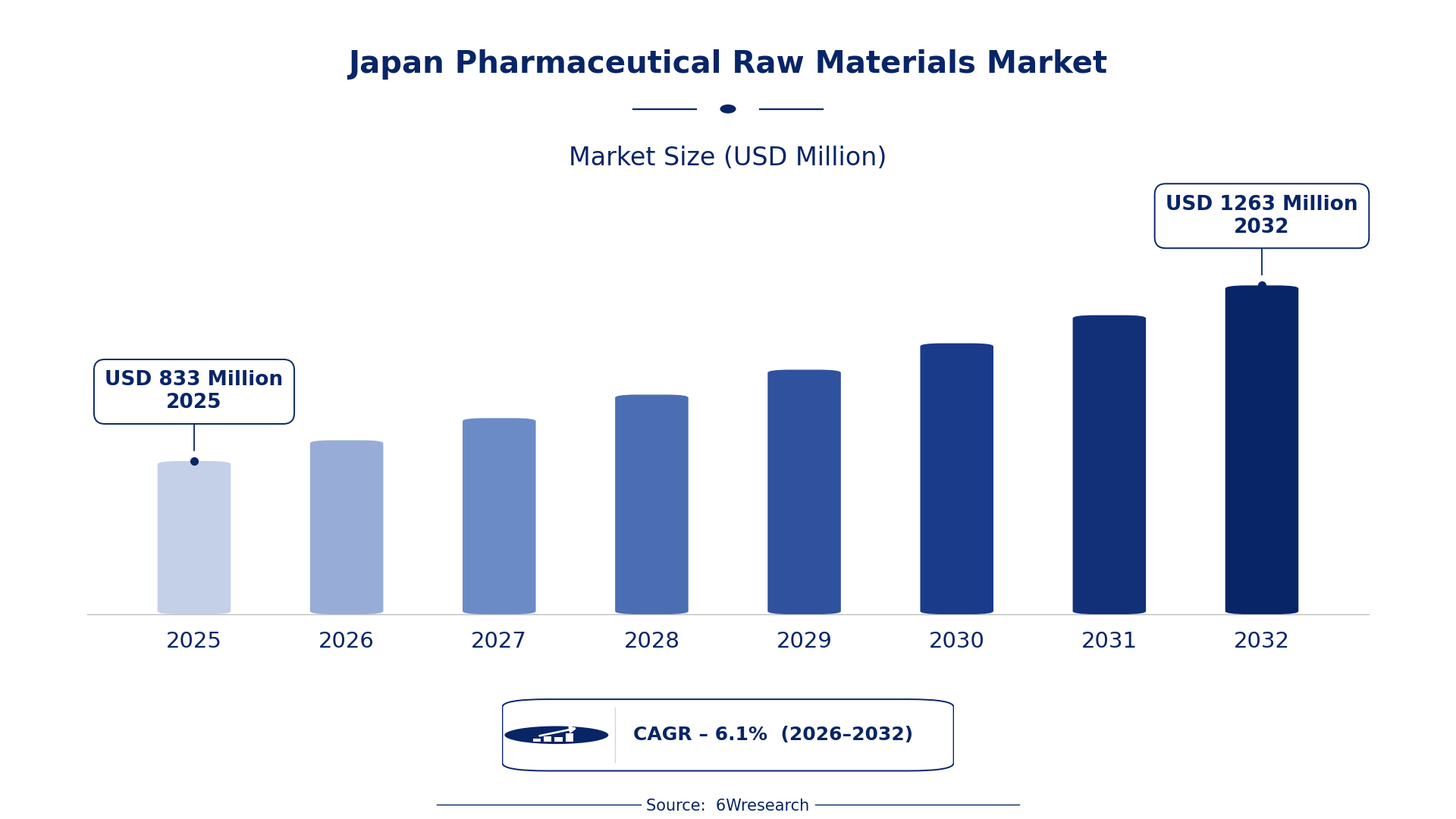
According to 6Wresearch internal database and industry insights, the Japan Pharmaceutical Raw Materials Market was valued at USD 833 Million in 2025 and is projected to reach USD 1,263 Million by 2032, growing at a CAGR of approximately 6.1% during 2026–2032.
Japan Pharmaceutical Raw Materials Market Highlights
| Report Metric | Details |
| Report Name | Japan Pharmaceutical Raw Materials Market (2026-2032) |
| Market Size 2025 | USD 833 Million |
| Market Size 2032 | USD 1,263 Million |
| Absolute Growth 2025–2032 | USD 430 Million |
| CAGR 2026–2032 | 6.1% |
| Peak Annual Growth | 6.7% in 2032 |
| Forecast Period | 2026–2032 |
| Historical Data | 2022–2025 |
| Base Year | 2025 |
| Leading Material Type, 2025 | Active Ingredients (46% share) |
| Leading Source Type, 2025 | Synthetic (42% share) |
| Leading Distribution Channel, 2025 | Direct Sales (36% share) |
| Leading End User, 2025 | Drug Manufacturers (49% share) |
| Fastest-Growing Material Type | Inactive Ingredients (8.7% CAGR) |
| Fastest-Growing Source Type | Natural (9.2% CAGR) |
| Fastest-Growing Distribution Channel | Industrial Suppliers (7.9% CAGR) |
| Fastest-Growing End User | Research Organizations (8.1% CAGR) |
| Growing Sector | Pharmaceutical Manufacturing |
| Key End Users | Drug Manufacturers, Research Organizations, Biotech Firms |
Japan Pharmaceutical Raw Materials Market Year-wise Growth Rate and Key Drivers (2022–2032)
This graph illustrates the annual growth rates of the market from 2022 to 2032, highlighting a steady upward trajectory and projected market expansion over the forecast period.
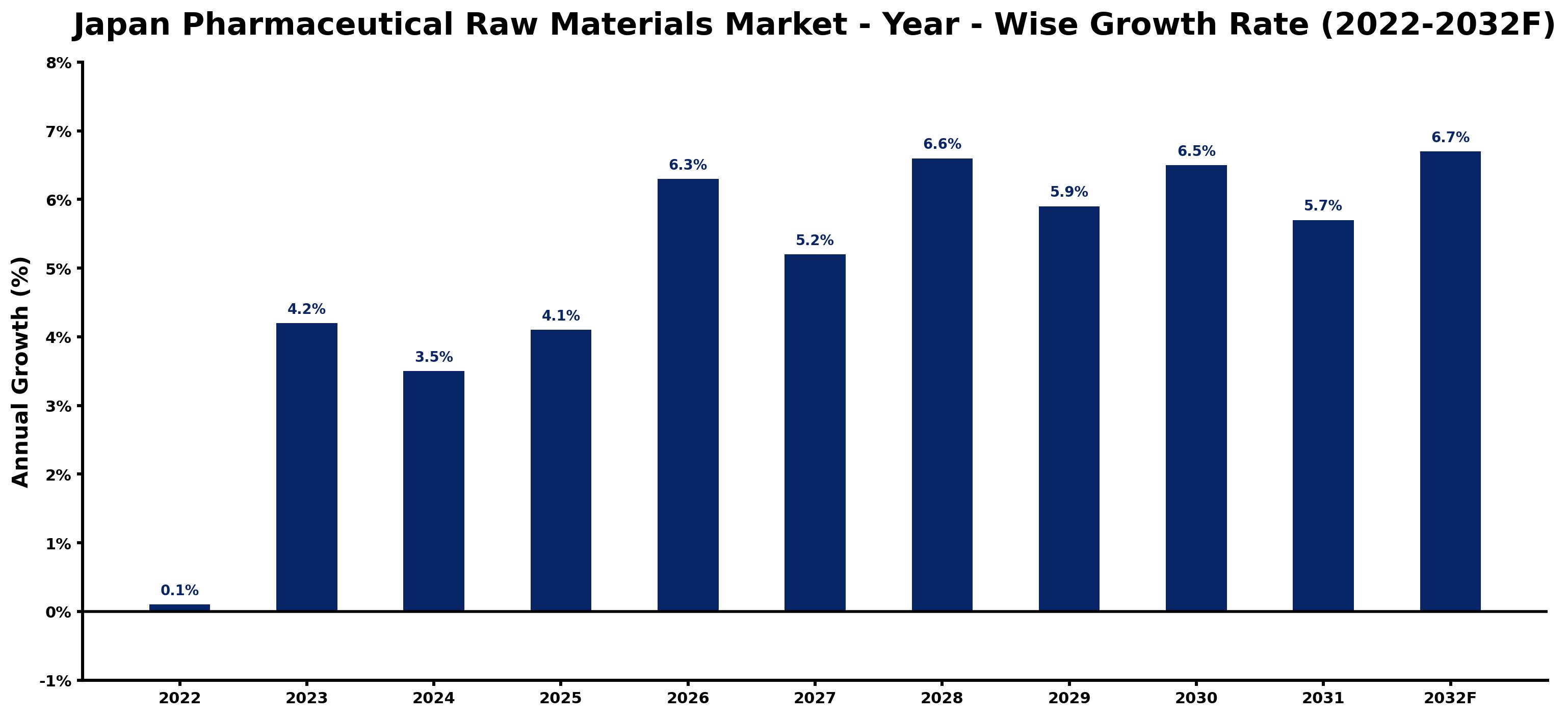
Annual growth estimates for each year appear below with the principal reason behind them, explaining the shifts that set the pace of the market.
| Year | Estimated Annual Growth (%) | Market Rationale |
| 2022 | 0.1 | The market was stable, reflecting ongoing demand from local drug manufacturers. |
| 2023 | 4.2 | Growth was supported by increased investment in pharmaceutical production capabilities. |
| 2024 | 3.5 | A slowdown occurred as manufacturers adjusted to changing market conditions and demand patterns. |
| 2025 | 4.1 | Demand surged again due to the introduction of new drug formulations. |
| 2026 | 6.3 | Growth is anticipated to accelerate as research projects expand and collaborations increase. |
| 2027 | 5.2 | A slowdown is projected as the market stabilises after previous growth phases. |
| 2028 | 6.6 | The market is expected to rebound with renewed interest in drug development. |
| 2029 | 5.9 | A slowdown is anticipated as capacity adjustments take place within the supply chain. |
| 2030 | 6.5 | Growth is projected to resume as drug manufacturers increase production to meet rising needs. |
| 2031 | 5.7 | A slowdown is expected as market conditions shift towards consolidation and efficiency. |
| 2032 | 6.7 | Demand is projected to peak as the market adapts to new technologies and production methods. |
Note: Market size estimations and growth projections presented in this report are based on 6Wresearch's proprietary forecasting methodology, utilizing the latest available industry data, government publications, and primary research inputs.
Japan Pharmaceutical Raw Materials Market Synopsis
Pharmaceutical raw materials are chemical compounds used in medication production, primarily as active pharmaceutical ingredients and excipients. The Japan Pharmaceutical Raw Materials Market is growing due to robust domestic demand from drug manufacturers and research organisations, along with substantial investments in drug development. The country's pharmaceutical sector is valued at approximately $100 billion, focusing on production capabilities and sustainability initiatives, which will drive further growth in the coming years.
Market Dynamics Impact Analysis (2026–2032)
| Factor | Type | Impact | Primary Segment Affected |
| Increased investment in drug development and production facilities | Driver | High | Active Ingredients |
| Growing elderly population requiring more medications | Driver | High | Active Ingredients |
| Rising demand for bio-based materials in pharmaceuticals | Opportunity | Medium | Bio-based Materials |
| Expansion of research organizations focusing on innovative drug solutions | Opportunity | High | Research Organizations |
| Regulatory compliance costs impacting production | Restraint | High | Synthetic |
| Limited adoption of natural materials due to higher costs | Restraint | Medium | Natural |
| Talent shortages in pharmaceutical manufacturing | Challenge | High | Drug Manufacturers |
| Supply chain disruptions affecting raw material availability | Challenge | Medium | Synthetic |
Evaluation of Drivers in Japan Pharmaceutical Raw Materials Market (2026–2032)
Below are the drivers that matter most for revenue growth, with supporting evidence.
| Drivers | Primary Segment Affected | Why It Matters (Evidence) |
| Increased production of active pharmaceutical ingredients | Active Ingredients | Active pharmaceutical ingredients account for 60% of raw material costs in drug production, prompting manufacturers to invest more. |
| Demand from the aging population | Active Ingredients | 29.3% of Japan's population was aged 65 or older, increasing the need for medications. |
| Investment in drug development | Research Organizations | Research organizations are expanding their projects, leading to higher demand for raw materials. |
| Focus on sustainability in pharmaceuticals | Bio-based Materials | The government launched a program to promote bio-based materials in pharmaceuticals, driving new demand. |
| Expansion of distribution channels | Industrial Suppliers | Industrial suppliers are becoming key channels for bulk supply, enhancing market reach. |
Most of the extra volume comes from the growing demand for active pharmaceutical ingredients, which are essential for drug formulation. In 2022, Japan's national medical care expenditure reached approximately JPY 46.7 trillion, reflecting increased spending on healthcare. The aging population, with 29.3% aged 65 or older, drives higher medication needs, prompting drug manufacturers to increase production capabilities. Research organizations are expanding their projects, leading to a surge in demand for raw materials. The focus on sustainability encourages manufacturers to invest in eco-friendly practices, further increasing the volume of pharmaceutical raw materials required.
Evaluation of Restraints in Japan Pharmaceutical Raw Materials Market
The following restraints limit how fast demand can grow.
| Market Restraint | Primary Segment Affected | Why It Matters (Evidence) |
| Rising regulatory compliance costs due to stringent laws | Active Ingredients | Compliance with regulations can raise production costs significantly, affecting pricing strategies for manufacturers. |
| Delays in product approvals impacting market entry | Inactive Ingredients | The lengthy approval process can postpone the availability of essential excipients, hindering production schedules. |
| Increased raw material costs from global supply chain issues | Synthetic | Supply chain disruptions have led to higher prices for synthetic materials, impacting overall production expenses. |
| Limited availability of bio-based materials due to niche applications | Bio-based Materials | The restricted use of bio-based materials limits options for manufacturers seeking sustainable alternatives. |
| Competition from international markets driving innovation pressures | Natural | Local producers must innovate rapidly to compete, straining resources and extending development timelines. |
Japan Pharmaceutical Raw Materials Market Challenges
Active pharmaceutical ingredients account for 60% of raw material costs in drug production, so regulatory changes can significantly raise expenses for manufacturers. Japan's stringent compliance requirements, enforced by the Pharmaceuticals and Medical Devices Agency, often lead to delays in product approvals, costing producers up to six months in a competitive market. Rising raw material costs, driven by global supply chain pressures, can increase production expenses for drug manufacturers, impacting their pricing strategies and reducing profit margins. Increased competition from international markets compels local producers to innovate rapidly, straining resources and extending development timelines for clinics.
Trends in the Japan Pharmaceutical Raw Materials Market
Four trends stand out in the Japan Pharmaceutical Raw Materials Market.
- Shift towards Bio-based Materials: In 2022, the government launched a programme to promote bio-based materials in pharmaceuticals, aiming for a more sustainable industry. This initiative is expected to increase the adoption of eco-friendly raw materials among manufacturers.
- Transition from Synthetic to Natural Sources: Since 2023, there has been a noticeable shift towards using natural sources for raw materials, driven by sustainability concerns. This change is evident in the growing interest among drug manufacturers in sourcing bio-based ingredients.
- Emergence of Advanced Drug Formulations: The introduction of new drug formulations began in 2023, responding to the need for more effective treatments. This trend is reshaping the raw materials market as manufacturers seek specialised ingredients.
- Focus on Streamlined Drug Approval Processes: In 2023, Japan's drug approval process was streamlined, enhancing efficiency for new products. This change is encouraging manufacturers to accelerate their development timelines and increase raw material orders.
Investment Opportunities in the Japan Pharmaceutical Raw Materials Market
The following areas offer the clearest openings for investors and suppliers in the Japan Pharmaceutical Raw Materials Market.
- Growing Demand from Drug Manufacturers: With Japan's pharmaceutical market valued at approximately $100 billion, drug manufacturers are seeking reliable suppliers of high-quality raw materials to meet increasing production needs.
- Investment in Sustainable Practices: The government’s GX Basic Policy targets about JPY 150 trillion of investment in decarbonisation over ten years, creating opportunities for suppliers of bio-based materials.
- Expansion of Research Organizations: Research organisations are increasingly investing in drug solutions, leading to a higher demand for specialised raw materials. Collaborating with these entities can open new supply routes.
- Market Entry for New Suppliers: With the growing interest in natural materials, suppliers can enter the market by partnering with local manufacturers to meet the demand for bio-based raw materials.
Government Initiatives in the Japan Pharmaceutical Raw Materials Market
The regulatory framework for pharmaceutical raw materials in Japan is shaped by several key laws, including the Chemical Substances Control Law of 1973 and the PRTR Law of 1999. These regulations require manufacturers to evaluate and control chemical substances, ensuring safety and compliance in production processes. The establishment of the Pharmaceuticals and Medical Devices Agency in 2004 further strengthened oversight, facilitating drug approvals and building market confidence.
In 2023, the GX Promotion Act was introduced, supporting the transition to a low-carbon economy. The Japan Agency for Medical Research and Development oversees funding for innovative projects, promoting research in sustainable pharmaceuticals. This agency plays a significant role in approving initiatives that align with national decarbonisation targets, ensuring that pharmaceutical producers can access necessary resources for compliance and innovation.
Future Insight of the Japan Pharmaceutical Raw Materials Market
Japan's investment pipeline for decarbonisation is projected at about JPY 150 trillion over the next decade, creating substantial demand for pharmaceutical raw materials. By 2032, advancements in bio-based materials will reshape pharmaceutical formulations, offering buyers greener alternatives. The streamlined drug approval process initiated in 2023 will further accelerate market entry for new products, benefiting both suppliers and healthcare providers. An expected rise in the elderly population will drive demand for new therapies, prompting increased investment in research and development across the sector.
Market Segmentation Analysis
Japan Pharmaceutical Raw Materials Market report covers a detailed analysis of the following market segments:
By Material Type – Active Ingredients Lead, Inactive Ingredients Expected to Grow Fastest
According to Navya, Research Analyst at 6Wresearch, with 46% of material type revenue in 2025, Active Ingredients was the largest category. Active ingredients hold the largest share due to their essential role in drug formulation, directly impacting the effectiveness of medications. They represent a significant portion of raw material costs, highlighting their critical importance in the pharmaceutical industry. The quickest growth will come from Inactive Ingredients, forecast to expand at a CAGR of 8.7% between 2026 and 2032. Inactive ingredients are experiencing rapid growth as their role as excipients in formulations gains recognition, particularly following government initiatives that promote their use. This trend is set to continue as manufacturers seek to improve drug delivery systems. Suppliers should consider expanding their product offerings in inactive ingredients to capitalise on this increasing demand.
By Source Type – Synthetic Leads, Natural Expected to Grow Fastest
Synthetic held 42% of the Japan Pharmaceutical Raw Materials Market by source type in 2025. Synthetic sources dominate the market as they serve as the primary source for active pharmaceutical ingredients, ensuring reliability and consistency in drug production. This is reflected in Japan's robust pharmaceutical manufacturing sector, which relies heavily on synthetic materials. Over 2026–2032, Natural is expected to post the fastest growth, at a CAGR of 9.2%. Natural sources are growing quickly due to an increasing interest in sustainable compounds, driven by recent government initiatives. This shift indicates a potential change in sourcing strategies within the pharmaceutical industry. Buyers may need to adjust their sourcing strategies to include natural materials in response to changing regulatory and consumer preferences.
By Distribution Channel – Direct Sales Leads, Industrial Suppliers Expected to Grow Fastest
The largest distribution channel category in 2025 was Direct Sales, at 36% of revenue. Direct sales are the leading distribution channel, allowing manufacturers to maintain close relationships with suppliers, which ensures quality and reliability in supply. This method is prevalent among Japan's extensive network of pharmaceutical manufacturers. Industrial Suppliers are set to record the highest CAGR in this split, 7.9% over 2026–2032. The industrial suppliers segment is experiencing rapid growth as they provide a key channel for bulk supply, enabling manufacturers to optimise their procurement processes. This growth reflects the increasing demand for efficiency within the supply chain. Suppliers should strengthen their partnerships with industrial suppliers to improve market reach and operational efficiency.
By End User – Drug Manufacturers Lead, Research Organizations Expected to Grow Fastest
Drug Manufacturers took 49% of end user revenue in 2025, more than any other category. Drug manufacturers represent the largest end-user segment, supported by Japan's substantial pharmaceutical market valued at approximately $100 billion. Their ongoing demand for raw materials underscores the strength of the country's domestic production capabilities. Research Organizations are projected to grow fastest, at a CAGR of 8.1% during 2026–2032. Research organizations are experiencing the fastest growth as they are crucial for drug development and innovation, particularly with the current emphasis on R&D in Japan's pharmaceutical sector. Their need for raw materials is expected to rise as new drugs are developed. Suppliers should focus on tailoring their offerings to meet the specific needs of research organizations to seize this growth opportunity.
Key Attractiveness of the Report
- 10 Years of Market Numbers
- Historical Data Starting from 2022 to 2025
- Base Year 2025
- Forecast Data until 2032
- Key Performance Indicators Impacting the Market
- Major Upcoming Developments and Projects
Key Highlights of the Report:
- Japan Pharmaceutical Raw Materials Market Outlook
- Market Size of Japan Pharmaceutical Raw Materials Market, 2025
- Forecast of Japan Pharmaceutical Raw Materials Market, 2032
- Historical Data and Forecast of Japan Pharmaceutical Raw Materials Revenues & Volume for the Period 2022-2032F
- Japan Pharmaceutical Raw Materials Market Trend Evolution
- Japan Pharmaceutical Raw Materials Market Drivers and Challenges
- Japan Pharmaceutical Raw Materials Price Trends
- Japan Pharmaceutical Raw Materials Porter's Five Forces
- Japan Pharmaceutical Raw Materials Industry Life Cycle
- Historical Data and Forecast of Japan Pharmaceutical Raw Materials Market Revenues & Volume By Material Type for the Period 2022-2032F
- Historical Data and Forecast of Japan Pharmaceutical Raw Materials Market Revenues & Volume By Active Ingredients for the Period 2022-2032F
- Historical Data and Forecast of Japan Pharmaceutical Raw Materials Market Revenues & Volume By Inactive Ingredients for the Period 2022-2032F
- Historical Data and Forecast of Japan Pharmaceutical Raw Materials Market Revenues & Volume By Bio-based Materials for the Period 2022-2032F
- Historical Data and Forecast of Japan Pharmaceutical Raw Materials Market Revenues & Volume By Solvents for the Period 2022-2032F
- Historical Data and Forecast of Japan Pharmaceutical Raw Materials Market Revenues & Volume By Source Type for the Period 2022-2032F
- Historical Data and Forecast of Japan Pharmaceutical Raw Materials Market Revenues & Volume By Synthetic for the Period 2022-2032F
- Historical Data and Forecast of Japan Pharmaceutical Raw Materials Market Revenues & Volume By Natural for the Period 2022-2032F
- Historical Data and Forecast of Japan Pharmaceutical Raw Materials Market Revenues & Volume By Biological for the Period 2022-2032F
- Historical Data and Forecast of Japan Pharmaceutical Raw Materials Market Revenues & Volume By Petrochemical for the Period 2022-2032F
- Historical Data and Forecast of Japan Pharmaceutical Raw Materials Market Revenues & Volume By Distribution Channel for the Period 2022-2032F
- Historical Data and Forecast of Japan Pharmaceutical Raw Materials Market Revenues & Volume By Direct Sales for the Period 2022-2032F
- Historical Data and Forecast of Japan Pharmaceutical Raw Materials Market Revenues & Volume By Industrial Suppliers for the Period 2022-2032F
- Historical Data and Forecast of Japan Pharmaceutical Raw Materials Market Revenues & Volume By Online Platforms for the Period 2022-2032F
- Historical Data and Forecast of Japan Pharmaceutical Raw Materials Market Revenues & Volume By Wholesale Distributors for the Period 2022-2032F
- Historical Data and Forecast of Japan Pharmaceutical Raw Materials Market Revenues & Volume By End User for the Period 2022-2032F
- Historical Data and Forecast of Japan Pharmaceutical Raw Materials Market Revenues & Volume By Drug Manufacturers for the Period 2022-2032F
- Historical Data and Forecast of Japan Pharmaceutical Raw Materials Market Revenues & Volume By Research Organizations for the Period 2022-2032F
- Historical Data and Forecast of Japan Pharmaceutical Raw Materials Market Revenues & Volume By Biotech Firms for the Period 2022-2032F
- Historical Data and Forecast of Japan Pharmaceutical Raw Materials Market Revenues & Volume By Contract Manufacturers for the Period 2022-2032F
- Japan Pharmaceutical Raw Materials Import Export Trade Statistics
- Market Opportunity Assessment By Material Type
- Market Opportunity Assessment By Source Type
- Market Opportunity Assessment By Distribution Channel
- Market Opportunity Assessment By End User
- Japan Pharmaceutical Raw Materials Top Companies Market Share
- Japan Pharmaceutical Raw Materials Competitive Benchmarking By Technical and Operational Parameters
- Japan Pharmaceutical Raw Materials Company Profiles
- Japan Pharmaceutical Raw Materials Key Strategic Recommendations
Market Covered
The study includes the following segmentation.
By Material Type
- Active Ingredients
- Inactive Ingredients
- Bio-based Materials
- Solvents
By Source Type
- Synthetic
- Natural
- Biological
- Petrochemical
By Distribution Channel
- Direct Sales
- Industrial Suppliers
- Online Platforms
- Wholesale Distributors
By End User
- Drug Manufacturers
- Research Organizations
- Biotech Firms
- Contract Manufacturers































