Japan Phosphate Fertilizers Market Size & Growth Rate
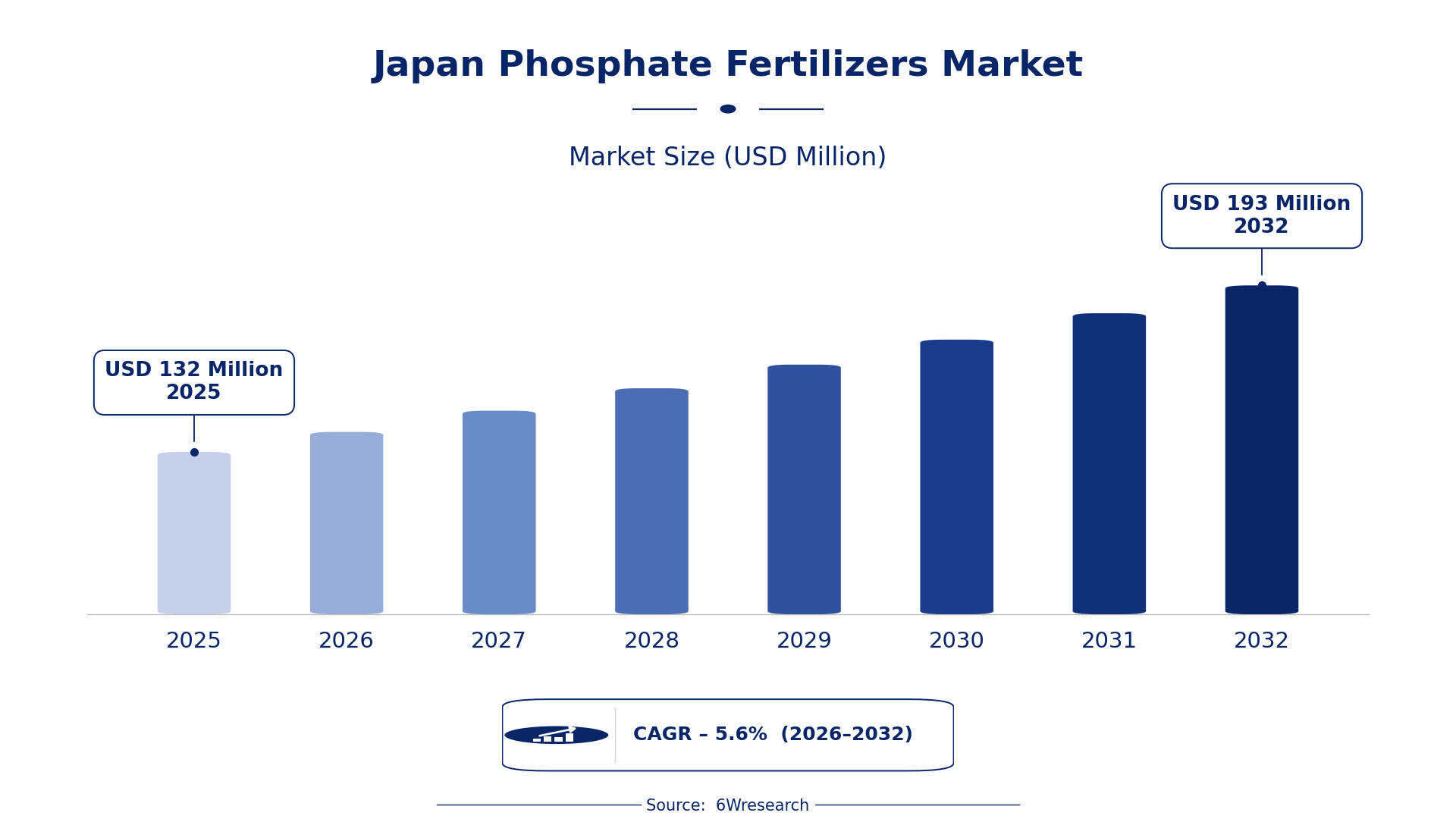
According to 6Wresearch internal database and industry insights, the Japan Phosphate Fertilizers Market was valued at USD 132 Million in 2025 and is projected to reach USD 193 Million by 2032, growing at a CAGR of approximately 5.6% during 2026–2032.
Japan Phosphate Fertilizers Market Highlights
| Report Metric | Details |
| Report Name | Japan Phosphate Fertilizers Market (2026-2032) |
| Market Size 2025 | USD 132 Million |
| Market Size 2032 | USD 193 Million |
| Absolute Growth 2025–2032 | USD 61 Million |
| CAGR 2026–2032 | 5.6% |
| Peak Annual Growth | 7.1% in 2026 |
| Forecast Period | 2026–2032 |
| Historical Data | 2022–2025 |
| Base Year | 2025 |
| Leading Product, 2025 | Diammonium Phosphate (DAP) (40% share) |
| Leading Applications, 2025 | Cereals & Grains (36% share) |
| Fastest-Growing Product | Monoammonium Phosphate (MAP) (7.5% CAGR) |
| Fastest-Growing Applications | Fruits & Vegetables (7.4% CAGR) |
| Growing Sector | Agriculture |
| Key End Users | Farmers, Agricultural Cooperatives, Crop Producers, Agricultural Consultants |
Japan Phosphate Fertilizers Market Year-wise Growth Rate and Key Drivers (2022–2032)
This graph illustrates the annual growth rates of the market from 2022 to 2032, highlighting a steady upward trajectory and projected market expansion over the forecast period.
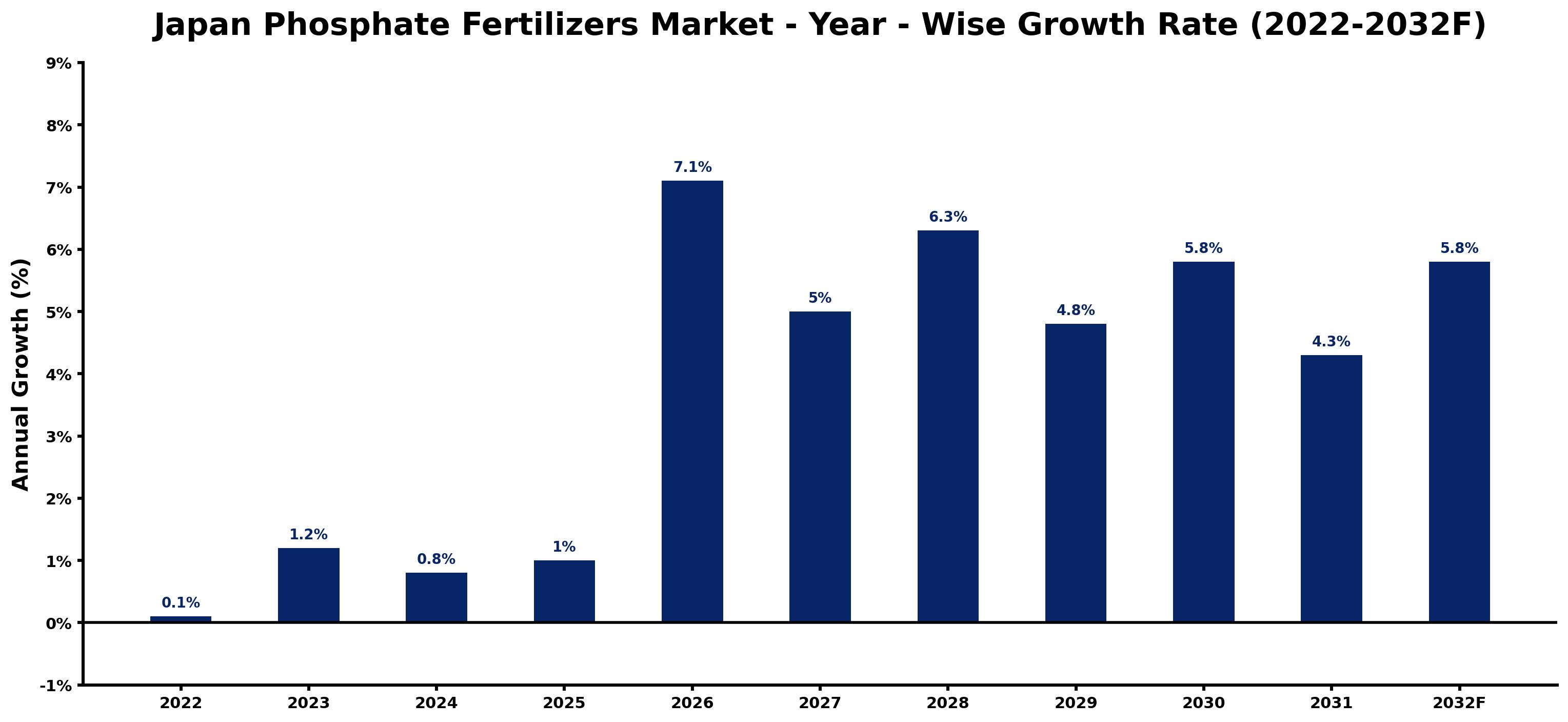
Annual growth estimates for each year appear below with the principal reason behind them, explaining the shifts that set the pace of the market.
| Year | Estimated Annual Growth (%) | Market Rationale |
| 2022 | 0.1 | The market experienced minimal growth, reflecting steady agricultural practices. |
| 2023 | 1.2 | Growth accelerated as domestic farmers increased fertilizer usage for improved crop yields. |
| 2024 | 0.8 | The growth rate slowed due to market saturation and cautious spending by farmers. |
| 2025 | 1.0 | Demand rose again as agricultural cooperatives promoted fertilizer application for crop improvement. |
| 2026 | 7.1 | A surge in growth is expected, driven by increased investment in agricultural technology. |
| 2027 | 5.0 | Growth is projected to moderate as farmers adjust to new fertilizer regulations and practices. |
| 2028 | 6.3 | Demand is expected to pick up again as crop yields improve with better fertilizer application. |
| 2029 | 4.8 | Growth is projected to slow as market dynamics stabilise and farmers become more selective. |
| 2030 | 5.8 | An increase in demand is expected as sustainable farming practices gain traction. |
| 2031 | 4.3 | Growth is projected to decelerate slightly as the market approaches a saturation point. |
| 2032 | 5.8 | Demand is expected to rise again as innovations in fertilizer formulations emerge. |
Note: Market size estimations and growth projections presented in this report are based on 6Wresearch's proprietary forecasting methodology, utilizing the latest available industry data, government publications, and primary research inputs.
Japan Phosphate Fertilizers Market Synopsis
Phosphate fertilizers are chemical compounds that improve soil fertility and promote plant growth, produced through reactions of phosphate rock with acids. In Japan, the agricultural sector, particularly rice cultivation, actively utilises these fertilizers, with demand driven by farmers and cooperatives. The Japan Phosphate Fertilizers Market is growing due to rising crop yield requirements and investments in sustainable practices. In 2023, a subsidy program for sustainable farming practices allocated JPY 10 billion, further driving demand for phosphate fertilizers.
Market Dynamics Impact Analysis (2026–2032)
| Factor | Type | Impact | Primary Segment Affected |
| Increasing crop yields driven by domestic farmers | Driver | High | Monoammonium Phosphate (MAP) |
| Rising adoption of sustainable farming practices | Driver | High | Diammonium Phosphate (DAP) |
| Growing demand for organic alternatives in farming | Opportunity | Medium | Superphosphate |
| Expansion of agricultural cooperatives promoting fertilizer use | Opportunity | High | Others |
| Regulatory pressures to reduce fertilizer usage | Restraint | High | Cereals & Grains |
| Market saturation limiting new entrants | Restraint | Medium | Oilseeds |
| High production costs affecting profitability | Challenge | High | Fruits & Vegetables |
| Technological barriers in fertilizer production | Challenge | Medium | Others |
Evaluation of Drivers in Japan Phosphate Fertilizers Market (2026–2032)
The following drivers explain most of the expected growth.
| Drivers | Primary Segment Affected | Why It Matters (Evidence) |
| Increased rice production in the Tohoku region | Monoammonium Phosphate (MAP) | The Tohoku region's rice yield of 2.5 tons per hectare drives demand for phosphate fertilizers. |
| Higher nutrient content in fertilizers | Diammonium Phosphate (DAP) | DAP's nutrient density encourages farmers to apply more for optimal crop growth. |
| Adoption of sustainable farming practices | Superphosphate | New subsidies for sustainable practices promote the use of phosphate fertilizers to improve soil quality. |
| Support from agricultural cooperatives | Others | Agricultural Cooperatives (JA) network facilitates increased fertilizer distribution to local farmers. |
| Focus on improving oilseed yields | Cereals & Grains | Growing oilseed production requires effective fertilizer application to meet rising demand. |
Purchasing is picking up as farmers in the Tohoku region increase rice production, with yields averaging 2.5 tons per hectare. The adoption of high-nutrient fertilizers supports optimal crop growth, leading to higher application rates. The focus on improving crop yields fuels the need for effective fertilizer application across various crops. In 2023, the average annual consumption of phosphate fertilizers in Japan reached around 1 million tons, indicating a shift towards more targeted applications. Support from agricultural cooperatives improves distribution efficiency, driving demand among local farmers.
Evaluation of Restraints in Japan Phosphate Fertilizers Market
Several factors work against faster growth; the main ones are summarised below.
| Market Restraint | Primary Segment Affected | Why It Matters (Evidence) |
| Regulatory pressures to reduce fertilizer usage | Cereals & Grains | The Japanese government aims to reduce fertilizer usage by promoting organic alternatives, affecting demand. |
| Market saturation limiting new entrants | Oilseeds | With established players dominating, new entrants find it challenging to compete in the saturated market. |
| High production costs affecting profitability | Fruits & Vegetables | Rising production costs squeeze margins for producers, limiting their ability to invest in fertilizers. |
| Technological barriers in fertilizer production | Others | Complex production processes hinder smaller producers from entering the phosphate fertilizer market. |
| Consumer preference for organic products | Diammonium Phosphate (DAP) | Growing consumer demand for organic farming reduces reliance on chemical fertilizers like DAP. |
Japan Phosphate Fertilizers Market Challenges
Japan's average annual consumption of phosphate fertilizers is around 1 million tons, but outdated production technology leads to inefficiencies that inflate costs for producers by up to 15%. A shortage of skilled agricultural workers hinders the adoption of modern farming practices, which can reduce crop yields for farmers by as much as 20%. Stricter regulatory guidelines from the Ministry of Agriculture, Forestry and Fisheries raise compliance costs for suppliers, complicating their operations. Buyers face challenges as the government promotes organic alternatives, potentially limiting phosphate fertilizer availability and impacting crop yield maintenance.
Trends in the Japan Phosphate Fertilizers Market
The shifts below are changing how Japan Phosphate Fertilizers Market products are bought and supplied.
- Shift towards Sustainable Farming Practices: In 2023, Japan implemented a subsidy program for sustainable farming practices, encouraging farmers to adopt eco-friendly methods. This shift is expected to increase the use of organic fertilizers, with a target of reducing chemical fertilizer use by 2025.
- Increase in Fertilizer Efficiency: Farmers are increasingly utilising precision agriculture techniques to improve fertilizer efficiency. This trend began in 2022, with the average annual consumption of phosphate fertilizers reaching around 1 million tons, indicating a shift towards more targeted applications.
- Growth in Organic Fertilizer Adoption: The Japanese agricultural sector is seeing a rise in organic fertilizer usage, particularly among rice farmers. This trend, which started in 2023, aligns with the government's goal to promote sustainable farming practices and reduce chemical fertilizer dependency.
- Expansion of Agricultural Cooperatives: The Agricultural Cooperatives (JA) network is expanding its support for fertilizer distribution. This trend, evident since 2022, has facilitated increased access to phosphate fertilizers for farmers across Japan.
Investment Opportunities in the Japan Phosphate Fertilizers Market
Below are the investment opportunities with the strongest case in the Japan Phosphate Fertilizers Market.
- 1 million tons of phosphate fertilizers consumed annually: With an average annual consumption of around 1 million tons, there is an opportunity for suppliers to meet this demand in the agricultural sector, particularly in the Tohoku region.
- Tohoku region as a key market: The Tohoku region, known for rice cultivation, presents a prime opportunity for suppliers to invest in phosphate fertilizers, enhancing crop yields for local farmers.
- Supply of organic alternatives: As the government promotes organic farming, there is a growing opportunity for suppliers to provide organic fertilizers to meet the changing preferences of farmers and consumers.
- Partnerships with agricultural cooperatives: Collaborating with Agricultural Cooperatives (JA) can facilitate entry into the market, allowing suppliers to reach a broader customer base in Japan.
Government Initiatives in the Japan Phosphate Fertilizers Market
The Industrial Standardization Act, established in 1949 and amended in 2019, governs product and test standards for fertilizers in Japan, ensuring that producers adhere to safety and quality standards. This law mandates that fertilizers meet specific criteria and undergo testing to protect soil health and agricultural productivity. Additionally, the Waste Management and Public Cleansing Act regulates the treatment and disposal of industrial and municipal waste, further ensuring compliance with safety regulations.
The Agricultural Cooperatives (JA) network oversees the implementation of various agricultural schemes, including the subsidy program for sustainable farming practices initiated in 2023. This program provides financial support to farmers who adopt eco-friendly practices, promoting the use of phosphate fertilizers that improve soil quality while aligning with environmental goals. In 2023, the program allocated JPY 10 billion to support farmers transitioning to sustainable practices.
Future Insight of the Japan Phosphate Fertilizers Market
Precision agriculture technologies will reshape phosphate fertilizer demand by 2032, allowing farmers to optimise nutrient application. The subsidy programme for sustainable farming practices will encourage eco-friendly fertilizer use, supporting the government's aim to cut overall fertilizer consumption. Compliance with ISO 14001 standards will drive suppliers to enhance environmental management practices. By 2032, advancements in fertilizer application techniques in the Tohoku region are expected to increase rice productivity by 10%, benefiting local agricultural cooperatives.
Market Segmentation Analysis
Japan Phosphate Fertilizers Market report covers a detailed analysis of the following market segments:
By Product – Diammonium Phosphate (DAP) Leads, Monoammonium Phosphate (MAP) Expected to Grow Fastest
According to Sumit Sagar, AM at 6Wresearch, Diammonium Phosphate (DAP) held 40% of the Japan Phosphate Fertilizers Market by product in 2025. Diammonium Phosphate (DAP) commands the largest share because of its high nutrient content, making it a preferred choice for domestic farmers across various crops. Its widespread use in the Tohoku region, known for rice cultivation, highlights its critical role in enhancing agricultural productivity. Monoammonium Phosphate (MAP) is set to record the highest CAGR in this split, 7.5% over 2026–2032. Monoammonium Phosphate (MAP) is experiencing rapid growth as it serves as a primary phosphorus source for crops, effectively meeting farmers' specific requirements. The recent subsidy programme for sustainable farming practices is likely to boost the adoption of MAP among agricultural producers. Suppliers should focus on DAP and MAP to meet the growing demands of Japan's agricultural sector.
By Applications – Cereals & Grains Lead, Fruits & Vegetables Expected to Grow Fastest
In 2025, Cereals & Grains led the applications split with a 36% share. Cereals & Grains lead the market as they are a major application area for phosphate fertilizers, crucial for improving yields in staple crops. The high average yield of rice in Japan highlights the reliance on these fertilizers for cereal production. The quickest growth will come from Fruits & Vegetables, forecast to expand at a CAGR of 7.4% between 2026 and 2032. Fruits & Vegetables represent the fastest-growing application area due to increasing consumer demand for fresh produce and healthier diets. This growth is supported by a rising focus on sustainable farming practices that enhance the quality of fruits and vegetables. Buyers should consider phosphate fertilizers tailored for fruits and vegetables to capitalise on this expanding market segment.
Key Attractiveness of the Report
- 10 Years of Market Numbers
- Historical Data Starting from 2022 to 2025
- Base Year 2025
- Forecast Data until 2032
- Key Performance Indicators Impacting the Market
- Major Upcoming Developments and Projects
Key Highlights of the Report:
- Japan Phosphate Fertilizers Market Outlook
- Market Size of Japan Phosphate Fertilizers Market, 2025
- Forecast of Japan Phosphate Fertilizers Market, 2032
- Historical Data and Forecast of Japan Phosphate Fertilizers Revenues & Volume for the Period 2022-2032
- Japan Phosphate Fertilizers Market Trend Evolution
- Japan Phosphate Fertilizers Market Drivers and Challenges
- Japan Phosphate Fertilizers Price Trends
- Japan Phosphate Fertilizers Porter's Five Forces
- Japan Phosphate Fertilizers Industry Life Cycle
- Historical Data and Forecast of Japan Phosphate Fertilizers Market Revenues & Volume By Product for the Period 2022-2032
- Historical Data and Forecast of Japan Phosphate Fertilizers Market Revenues & Volume By Monoammonium Phosphate (MAP) for the Period 2022-2032
- Historical Data and Forecast of Japan Phosphate Fertilizers Market Revenues & Volume By Diammonium Phosphate (DAP) for the Period 2022-2032
- Historical Data and Forecast of Japan Phosphate Fertilizers Market Revenues & Volume By Superphosphate for the Period 2022-2032
- Historical Data and Forecast of Japan Phosphate Fertilizers Market Revenues & Volume By Others for the Period 2022-2032
- Historical Data and Forecast of Japan Phosphate Fertilizers Market Revenues & Volume By Applications for the Period 2022-2032
- Historical Data and Forecast of Japan Phosphate Fertilizers Market Revenues & Volume By Cereals & Grains for the Period 2022-2032
- Historical Data and Forecast of Japan Phosphate Fertilizers Market Revenues & Volume By Oilseeds for the Period 2022-2032
- Historical Data and Forecast of Japan Phosphate Fertilizers Market Revenues & Volume By Fruits & Vegetables for the Period 2022-2032
- Historical Data and Forecast of Japan Phosphate Fertilizers Market Revenues & Volume By Others for the Period 2022-2032
- Japan Phosphate Fertilizers Import Export Trade Statistics
- Market Opportunity Assessment By Product
- Market Opportunity Assessment By Applications
- Japan Phosphate Fertilizers Top Companies Market Share
- Japan Phosphate Fertilizers Competitive Benchmarking By Technical and Operational Parameters
- Japan Phosphate Fertilizers Company Profiles
- Japan Phosphate Fertilizers Key Strategic Recommendations
Market Covered
The study includes the following segmentation.
By Product
- Monoammonium Phosphate (MAP)
- Diammonium Phosphate (DAP)
- Superphosphate
- Others
By Applications
- Cereals & Grains
- Oilseeds
- Fruits & Vegetables
- Others






































