Japan Phytase Market Size & Growth Rate
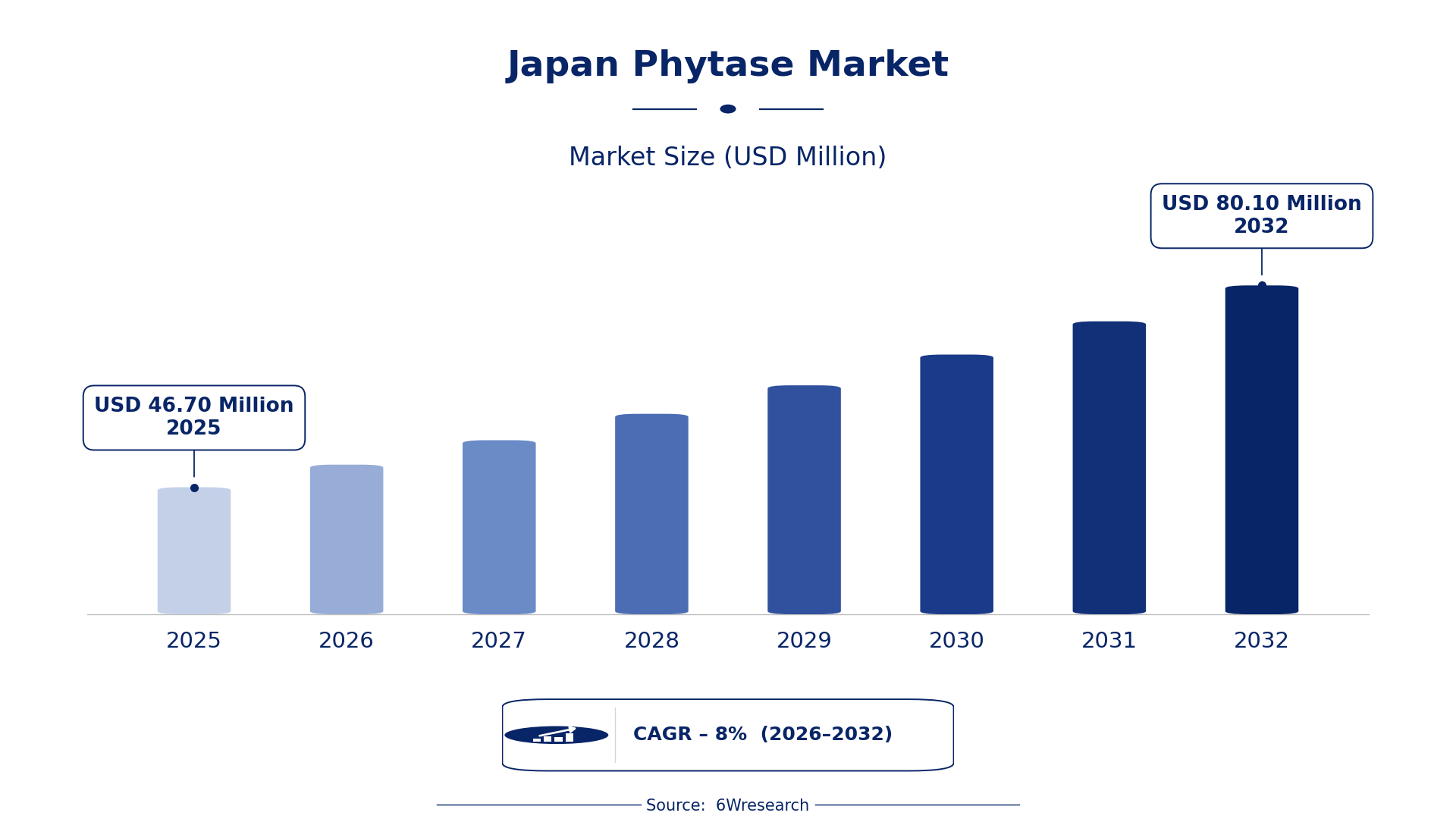
According to 6Wresearch internal database and industry insights, the Japan Phytase Market was valued at USD 46.70 Million in 2025 and is projected to reach USD 80.10 Million by 2032, growing at a CAGR of approximately 8% during 2026–2032.
Japan Phytase Market Highlights
| Report Metric | Details |
| Report Name | Japan Phytase Market (2026-2032) |
| Market Size 2025 | USD 46.70 Million |
| Market Size 2032 | USD 80.10 Million |
| Absolute Growth 2025–2032 | USD 33.40 Million |
| CAGR 2026–2032 | 8% |
| Peak Annual Growth | 9.0% in 2031 |
| Forecast Period | 2026–2032 |
| Historical Data | 2022–2025 |
| Base Year | 2025 |
| Leading Product Type, 2025 | Acid Phytase (43% share) |
| Leading Source Type, 2025 | Microbial (46% share) |
| Leading Distribution Channel, 2025 | Direct Sales (39% share) |
| Leading End User, 2025 | Animal Feed Industry (42% share) |
| Fastest-Growing Product Type | Alkaline Phytase (11.3% CAGR) |
| Fastest-Growing Source Type | Fungal (11.8% CAGR) |
| Fastest-Growing Distribution Channel | Distributors (10.7% CAGR) |
| Fastest-Growing End User | Poultry Industry (10.4% CAGR) |
| Growing Sector | Animal Feed Industry |
| Key End Users | Poultry Industry, Swine Producers, Aquaculture Farms |
Japan Phytase Market Year-wise Growth Rate and Key Drivers (2022–2032)
This graph illustrates the annual growth rates of the market from 2022 to 2032, highlighting a steady upward trajectory and projected market expansion over the forecast period.
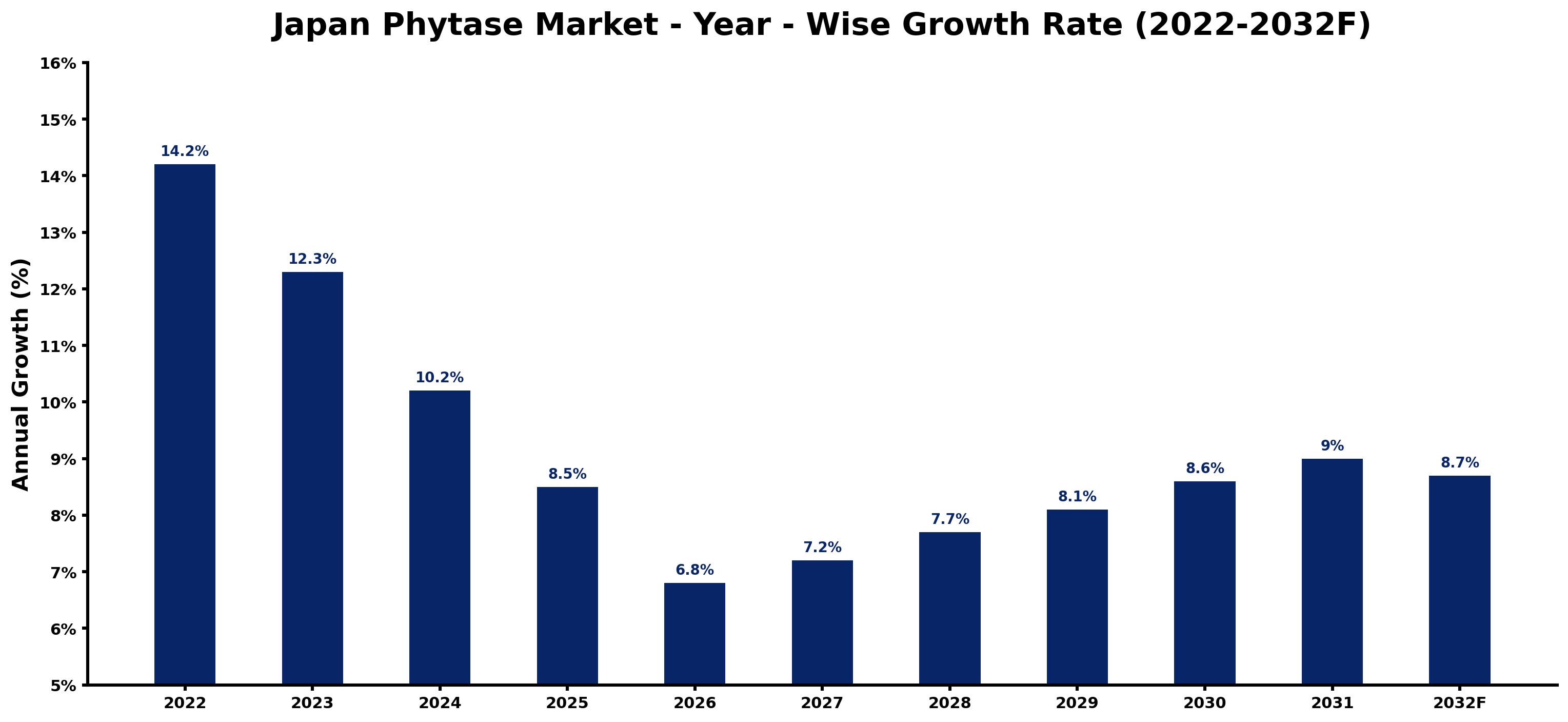
For each year, the table pairs the estimated growth rate with the leading influence on demand, showing how the drivers changed across the period.
| Year | Estimated Annual Growth (%) | Market Rationale |
| 2022 | 14.2 | The market experienced growth due to heightened demand for livestock nutrition. |
| 2023 | 12.3 | Growth slowed as the market adjusted to previous high levels of phytase usage. |
| 2024 | 10.2 | Continued demand for animal feed contributed to the slower growth rate. |
| 2025 | 8.5 | The market maintained steady growth as producers focused on sustainable practices. |
| 2026 | 6.8 | A further slowdown is expected as the market stabilises after rapid expansion. |
| 2027 | 7.2 | Growth is projected to accelerate as producers adopt more enzyme supplementation in feeds. |
| 2028 | 7.7 | The upward trend is expected to continue with increased demand from the aquaculture sector. |
| 2029 | 8.1 | Rising interest in nutrient efficiency will lead to higher phytase consumption. |
| 2030 | 8.6 | Demand is projected to increase as livestock producers seek to optimise feed conversion. |
| 2031 | 9.0 | The market is expected to peak with strong investments in enzyme technologies. |
| 2032 | 8.7 | Growth is expected to slow as the market matures and competition intensifies. |
Note: Market size estimations and growth projections presented in this report are based on 6Wresearch's proprietary forecasting methodology, utilizing the latest available industry data, government publications, and primary research inputs.
Japan Phytase Market Synopsis
Phytase is an enzyme that catalyzes the hydrolysis of phytic acid, primarily produced through fermentation of microbial sources. Its main applications are in the animal feed industry, particularly for poultry and swine. The Japan Phytase Market is expanding due to rising demand from domestic livestock production and aquaculture operations, with the poultry industry producing approximately 1.5 million tons of meat annually. The aquaculture sector, valued at over 600 billion yen, drives phytase usage, as it can reduce phosphorus excretion by up to 30%.
Market Dynamics Impact Analysis (2026–2032)
| Factor | Type | Impact | Primary Segment Affected |
| Rising livestock production | Driver | High | Animal Feed Industry |
| Increased focus on sustainability | Driver | High | Poultry Industry |
| Growing aquaculture sector | Opportunity | High | Aquaculture Farms |
| Emerging enzyme technologies | Opportunity | Medium | Animal Feed Industry |
| Regulatory compliance costs | Restraint | High | Animal Feed Industry |
| Limited awareness of phytase benefits | Restraint | Medium | Poultry Industry |
| Competition from alternative feed additives | Challenge | High | Animal Feed Industry |
| Dependence on specific microbial sources | Challenge | Medium | Microbial |
Evaluation of Drivers in Japan Phytase Market (2026–2032)
These are the developments adding the most demand over the forecast period.
| Drivers | Primary Segment Affected | Why It Matters (Evidence) |
| Increased livestock production levels | Animal Feed Industry | Japan's livestock population reached about 4 million pigs and 150 million chickens, driving demand for phytase. |
| Focus on reducing feed costs | Poultry Industry | The average feed conversion ratio in poultry can improve by 5-10% with phytase, encouraging more purchases. |
| Sustainability initiatives in aquaculture | Aquaculture Farms | The Japanese aquaculture industry is focusing on reducing environmental impact, increasing phytase usage. |
| Regulatory support for enzyme use | Animal Feed Industry | The Ministry of Agriculture, Forestry and Fisheries promotes phytase for sustainability in animal feed. |
| Rising consumer demand for meat | Poultry Industry | Japan's poultry industry produces approximately 1.5 million tons of meat annually, boosting feed additive demand. |
Orders keep climbing as livestock production increases, with Japan's livestock population at about 4 million pigs and 150 million chickens. The average feed conversion ratio in poultry can improve by 5-10% with phytase, leading to greater purchases by producers. Sustainability efforts in aquaculture are pushing the industry to adopt phytase, as the sector aims to reduce environmental impact. Rising consumer demand for meat drives the poultry industry, which produces around 1.5 million tons of meat annually, increasing the need for effective feed additives.
Evaluation of Restraints in Japan Phytase Market
The main factors holding the market back are set out below.
| Market Restraint | Primary Segment Affected | Why It Matters (Evidence) |
| High compliance costs for feed safety regulations | Animal Feed Industry | Producers must invest in compliance with the PRTR Law, increasing operational costs. |
| Limited awareness of phytase advantages among farmers | Poultry Industry | Many farmers remain unaware of phytase's benefits, hindering market growth. |
| Competition from alternative feed additives | Animal Feed Industry | Producers may opt for other additives perceived as more effective or cost-efficient. |
| Dependence on specific microbial sources for production | Microbial | Limited availability of preferred microbial strains can disrupt supply chains. |
| Regulatory hurdles for new product introduction | Animal Feed Industry | New phytase products must meet stringent regulations, delaying market entry. |
Japan Phytase Market Challenges
Animal feed producers in Japan face challenges due to a shortage of skilled workers, stemming from an ageing population and inadequate training initiatives. This scarcity leads to delays in adopting phytase technologies, raising labour costs by as much as 20% for producers. Technological limitations hinder the use of advanced fermentation processes, causing operational inefficiencies that can inflate production costs by 15%. Additionally, high prices for quality raw materials compel suppliers to raise feed prices, which directly reduces profit margins for livestock producers.
Trends in the Japan Phytase Market
The shifts below are changing how Japan Phytase Market products are bought and supplied.
- Shift towards Sustainable Feed Practices: The animal feed industry is increasingly adopting sustainable practices, driven by consumer demand for environmentally friendly products. In 2023, Japan's aquaculture sector is focusing on enzyme use to reduce environmental impact.
- Transition from Traditional to Enzyme-Supplemented Feeds: The use of phytase in animal feed is gaining traction as producers seek to improve nutrient efficiency. The Japanese feed industry association promotes phytase for sustainability, aligning with the growing trend towards enzyme supplementation.
- Emergence of New Feed Technologies: New feed technologies are becoming more prevalent in Japan, with a focus on improving livestock nutrition. Research grants for enzyme applications in feed are being provided by the government, supporting advancements in this area.
- Growing Demand for Phytase in Aquaculture: Aquaculture farms are increasingly utilising phytase to improve feed efficiency and reduce phosphorus excretion. The Japanese aquaculture industry is projected to expand, further driving phytase demand.
Investment Opportunities in the Japan Phytase Market
The openings below show where demand in the Japan Phytase Market is visible and how suppliers can enter.
- Collaborate with Local Producers: Local partnerships with Japanese animal feed manufacturers can facilitate entry into the phytase market, responding to the need for sustainable practices. The total feed production in Japan is estimated at 20 million tons annually.
- Establish Enzyme Production Facilities: Establishing enzyme production facilities in Japan can meet the growing need for phytase. The animal feed industry is evolving towards more sustainable practices, creating opportunities for new entrants.
- Provide Phytase to Aquaculture Farms: The aquaculture sector is increasingly adopting phytase to improve feed efficiency. Collaborating with aquaculture farms can provide access to this expanding market, valued at over 600 billion yen.
- Offer Regulatory Compliance Services: Offering services that assist producers in meeting feed safety regulations can be beneficial. The Ministry of Agriculture, Forestry and Fisheries oversees feed safety regulations, creating a need for compliance support.
Government Initiatives in the Japan Phytase Market
The PRTR Law (1999) and the Chemical Substances Control Law (1973) require businesses to report and evaluate chemical substances, ensuring safety in feed production. These laws strengthen the regulatory framework for phytase producers, ensuring compliance with safety standards and promoting sustainable practices in feed production.
In 2023, the government allocated 1 billion yen for research grants aimed at enzyme applications in feed. The Ministry of Agriculture, Forestry and Fisheries oversees these initiatives, supporting innovation and sustainability in the animal feed sector.
Future Insight of the Japan Phytase Market
Innovative enzyme technologies will transform the demand for phytase in Japan's animal feed sector by 2032. Advanced fermentation methods will enhance phytase production efficiency, allowing suppliers to meet the needs of livestock producers more effectively. Government programmes aimed at sustainable agriculture will promote phytase use, facilitating a reduction in phosphorus excretion by 30%. Research funding will stimulate advancements in enzyme applications, fostering competition among producers and improving overall feed efficiency.
Market Segmentation Analysis
Japan Phytase Market report covers a detailed analysis of the following market segments:
By Product Type – Acid Phytase Leads, Alkaline Phytase Expected to Grow Fastest
According to Navya, Research Analyst at 6Wresearch, Acid Phytase accounted for 43% of the market by product type in 2025. Acid Phytase commands the largest share as it is crucial for improving phosphorus availability in animal feed, which is essential for livestock nutrition. Its widespread use in the poultry sector, which produces approximately 1.5 million tons of meat annually, solidifies its leading position. Alkaline Phytase is projected to grow fastest, at a CAGR of 11.3% during 2026–2032. Alkaline Phytase is rapidly growing due to its effectiveness in breaking down phytic acid in alkaline conditions, catering to the increasing demand for efficient feed solutions. The rising trend towards enzyme supplementation in aquaculture feeds significantly contributes to its swift adoption. Suppliers should prioritise the development of Alkaline Phytase to align with the growing market demand.
By Source Type – Microbial Leads, Fungal Expected to Grow Fastest
Microbial held 46% of the Japan Phytase Market by source type in 2025. Microbial sources hold the largest share in the phytase market as they are the primary method for producing this enzyme in animal feed. Their established effectiveness and widespread application underscore the industry's reliance on microbial-derived phytase. Fungal is set to record the highest CAGR in this split, 11.8% over 2026–2032. Fungal sources are experiencing the fastest growth, significantly contributing to phytase production, which aligns with the industry's focus on sustainable practices. This growth is further supported by government initiatives promoting enzyme applications in feed. Buyers should consider incorporating fungal-derived phytase to improve feed efficiency and sustainability.
By Distribution Channel – Direct Sales Leads, Distributors Expected to Grow Fastest
With 39% of distribution channel revenue in 2025, Direct Sales was the largest category. Direct Sales is the leading distribution channel as it serves as the primary method for phytase distribution to manufacturers within the animal feed sector. This channel facilitates strong relationships between producers and consumers, allowing for tailored solutions. Over 2026–2032, Distributors are expected to post the fastest growth, at a CAGR of 10.7%. Distributors are rapidly becoming key players in the supply chain, providing vital support for the increasing demand in the animal feed market. Their role is essential as the industry seeks more efficient distribution methods. Suppliers should enhance collaborations with distributors to improve market access and responsiveness.
By End User – Animal Feed Industry Leads, Poultry Industry Expected to Grow Fastest
Animal Feed Industry took 42% of end user revenue in 2025, more than any other category. The Animal Feed Industry is the largest consumer of phytase, extensively using it to enhance livestock nutrition and efficiency. This sector's substantial size and focus on nutrient management highlight its dominant role in the market. The quickest growth will come from Poultry Industry, forecast to expand at a CAGR of 10.4% between 2026 and 2032. The Poultry Industry is the fastest-growing end user of phytase, driven by the need to improve feed efficiency and reduce phosphorus excretion. With Japan's poultry production at 1.5 million tons annually, this segment's growth is vital for the market. Suppliers should customise their offerings to meet the specific needs of the Poultry Industry to leverage its growth opportunities.
Key Attractiveness of the Report
- 10 Years of Market Numbers
- Historical Data Starting from 2022 to 2025
- Base Year 2025
- Forecast Data until 2032
- Key Performance Indicators Impacting the Market
- Major Upcoming Developments and Projects
Key Highlights of the Report:
- Japan Phytase Market Outlook
- Market Size of Japan Phytase Market, 2025
- Forecast of Japan Phytase Market, 2032
- Historical Data and Forecast of Japan Phytase Revenues & Volume for the Period 2022-2032F
- Japan Phytase Market Trend Evolution
- Japan Phytase Market Drivers and Challenges
- Japan Phytase Price Trends
- Japan Phytase Porter's Five Forces
- Japan Phytase Industry Life Cycle
- Historical Data and Forecast of Japan Phytase Market Revenues & Volume By Product Type for the Period 2022-2032F
- Historical Data and Forecast of Japan Phytase Market Revenues & Volume By Acid Phytase for the Period 2022-2032F
- Historical Data and Forecast of Japan Phytase Market Revenues & Volume By Alkaline Phytase for the Period 2022-2032F
- Historical Data and Forecast of Japan Phytase Market Revenues & Volume By Thermostable Phytase for the Period 2022-2032F
- Historical Data and Forecast of Japan Phytase Market Revenues & Volume By Liquid Phytase for the Period 2022-2032F
- Historical Data and Forecast of Japan Phytase Market Revenues & Volume By Source Type for the Period 2022-2032F
- Historical Data and Forecast of Japan Phytase Market Revenues & Volume By Microbial for the Period 2022-2032F
- Historical Data and Forecast of Japan Phytase Market Revenues & Volume By Fungal for the Period 2022-2032F
- Historical Data and Forecast of Japan Phytase Market Revenues & Volume By Bacterial for the Period 2022-2032F
- Historical Data and Forecast of Japan Phytase Market Revenues & Volume By Enzymatic for the Period 2022-2032F
- Historical Data and Forecast of Japan Phytase Market Revenues & Volume By Distribution Channel for the Period 2022-2032F
- Historical Data and Forecast of Japan Phytase Market Revenues & Volume By Direct Sales for the Period 2022-2032F
- Historical Data and Forecast of Japan Phytase Market Revenues & Volume By Online Platforms for the Period 2022-2032F
- Historical Data and Forecast of Japan Phytase Market Revenues & Volume By Distributors for the Period 2022-2032F
- Historical Data and Forecast of Japan Phytase Market Revenues & Volume By Specialty Stores for the Period 2022-2032F
- Historical Data and Forecast of Japan Phytase Market Revenues & Volume By End User for the Period 2022-2032F
- Historical Data and Forecast of Japan Phytase Market Revenues & Volume By Animal Feed Industry for the Period 2022-2032F
- Historical Data and Forecast of Japan Phytase Market Revenues & Volume By Poultry Industry for the Period 2022-2032F
- Historical Data and Forecast of Japan Phytase Market Revenues & Volume By Aquaculture Farms for the Period 2022-2032F
- Historical Data and Forecast of Japan Phytase Market Revenues & Volume By Swine Producers for the Period 2022-2032F
- Japan Phytase Import Export Trade Statistics
- Market Opportunity Assessment By Product Type
- Market Opportunity Assessment By Source Type
- Market Opportunity Assessment By Distribution Channel
- Market Opportunity Assessment By End User
- Japan Phytase Top Companies Market Share
- Japan Phytase Competitive Benchmarking By Technical and Operational Parameters
- Japan Phytase Company Profiles
- Japan Phytase Key Strategic Recommendations
Market Covered
Segments analysed in this report are listed below.
By Product Type
- Acid Phytase
- Alkaline Phytase
- Thermostable Phytase
- Liquid Phytase
By Source Type
- Microbial
- Fungal
- Bacterial
- Enzymatic
By Distribution Channel
- Direct Sales
- Online Platforms
- Distributors
- Specialty Stores
By End User
- Animal Feed Industry
- Poultry Industry
- Aquaculture Farms
- Swine Producers






































