Japan Pipeline Maintenance Market Size & Growth Rate
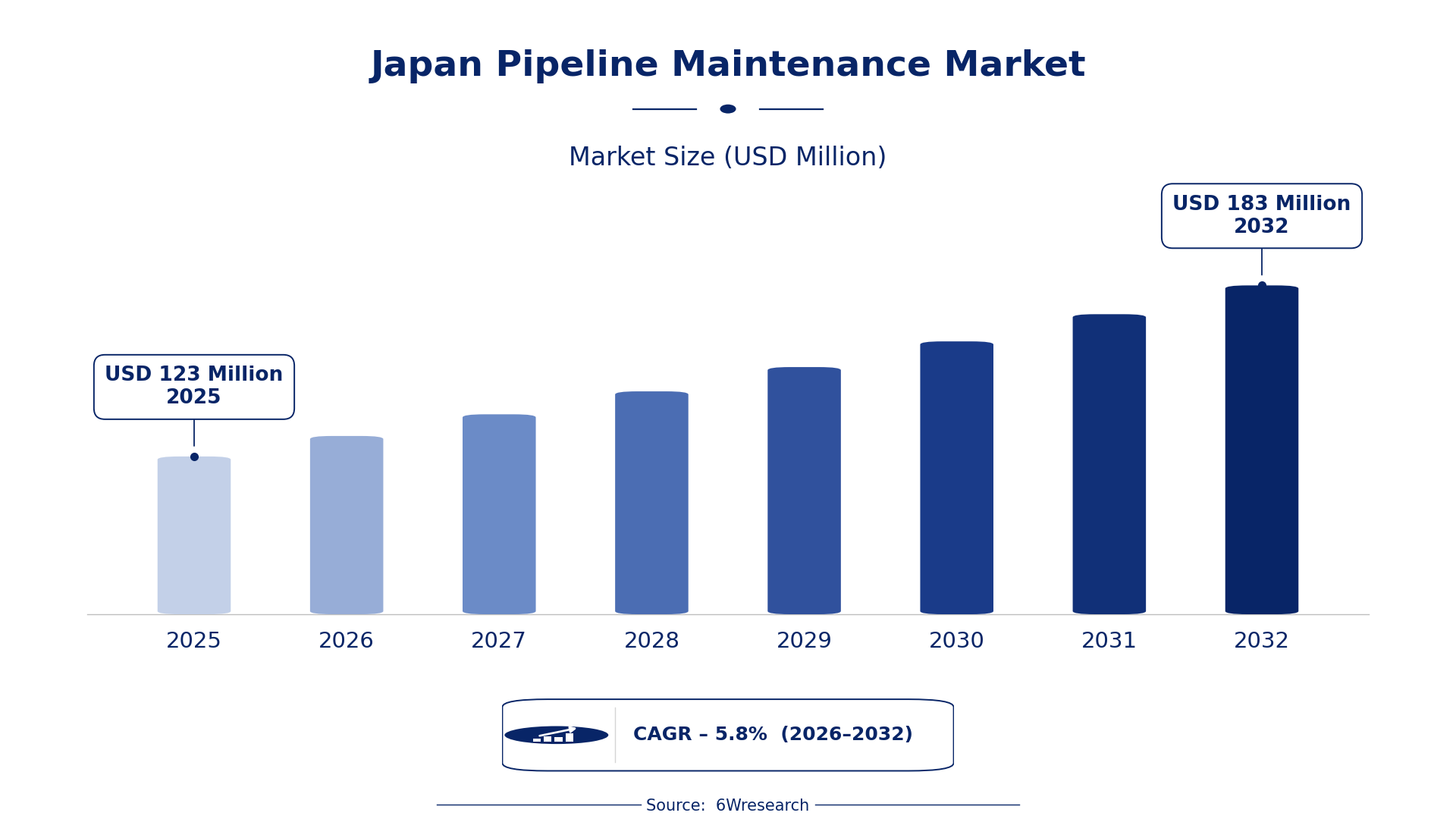
According to 6Wresearch internal database and industry insights, the Japan Pipeline Maintenance Market was valued at USD 123 Million in 2025 and is projected to reach USD 183 Million by 2032, growing at a CAGR of approximately 5.8% during 2026–2032.
Japan Pipeline Maintenance Market Highlights
| Report Metric | Details |
| Report Name | Japan Pipeline Maintenance Market (2026-2032) |
| Market Size 2025 | USD 123 Million |
| Market Size 2032 | USD 183 Million |
| Absolute Growth 2025–2032 | USD 60 Million |
| CAGR 2026–2032 | 5.8% |
| Peak Annual Growth | 6.7% in 2028 |
| Forecast Period | 2026–2032 |
| Historical Data | 2022–2025 |
| Base Year | 2025 |
| Leading Service Type, 2025 | Pigging (35% share) |
| Leading Location of Deployment, 2025 | Onshore (57% share) |
| Fastest-Growing Service Type | Flushing & Chemical Cleaning (7.9% CAGR) |
| Fastest-Growing Location of Deployment | Offshore (7.7% CAGR) |
| Growing Sector | Energy Sector |
| Key End Users | Oil and gas operators, water utilities, infrastructure maintenance contractors |
Japan Pipeline Maintenance Market Year-wise Growth Rate and Key Drivers (2022–2032)
This graph illustrates the annual growth rates of the market from 2022 to 2032, highlighting a steady upward trajectory and projected market expansion over the forecast period.
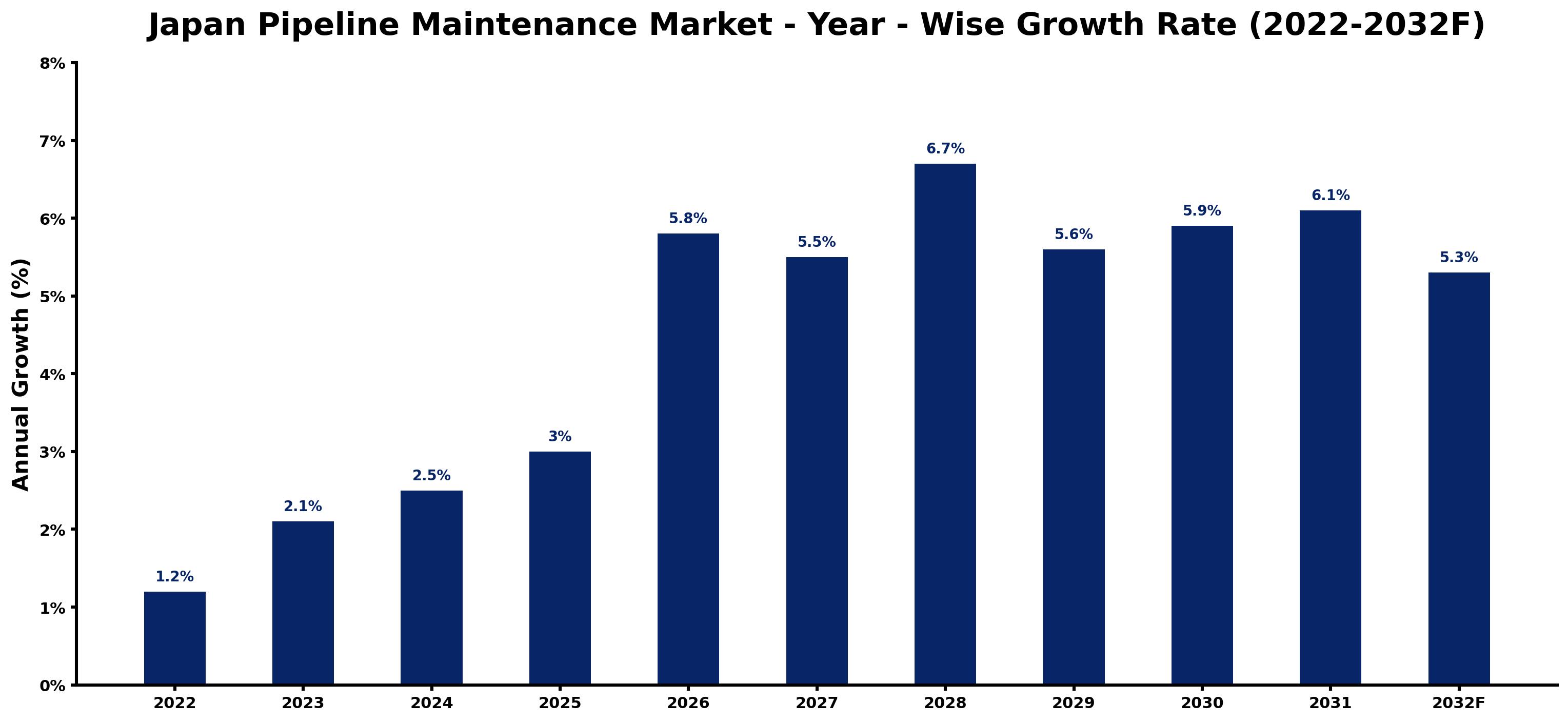
The yearly estimates that follow link every growth rate to its principal driver, so readers can see why the pace changed in each period.
| Year | Estimated Annual Growth (%) | Market Rationale |
| 2022 | 1.2 | The market showed steady activity with ongoing infrastructure maintenance projects. |
| 2023 | 2.1 | Growth accelerated as domestic users increased pipeline upkeep efforts. |
| 2024 | 2.5 | Demand continued to rise due to ageing pipeline infrastructure requiring attention. |
| 2025 | 3.0 | The market reached its historical peak, driven by heightened safety standards. |
| 2026 | 5.8 | Growth surged as investments in pipeline safety upgrades became more prevalent. |
| 2027 | 5.5 | A slight slowdown occurred as the market adjusted to previous high growth rates. |
| 2028 | 6.7 | Demand surged again, driven by increased investment in pipeline technologies. |
| 2029 | 5.6 | Growth slowed slightly as the market stabilised after rapid expansion. |
| 2030 | 5.9 | Demand rose again due to ongoing infrastructure projects and maintenance needs. |
| 2031 | 6.1 | The market continued to grow as ageing infrastructure required consistent upkeep. |
| 2032 | 5.3 | Growth slowed as the market matured, but demand remained strong. |
Note: Market size estimations and growth projections presented in this report are based on 6Wresearch's proprietary forecasting methodology, utilizing the latest available industry data, government publications, and primary research inputs.
Japan Pipeline Maintenance Market Synopsis
Pipeline maintenance involves the upkeep and repair of pipelines transporting oil, gas, and water, utilising techniques such as pigging and chemical cleaning. The Japan Pipeline Maintenance Market is propelled by over 40,000 km of pipelines requiring regular maintenance and the government's allocation of ¥1 billion for safety upgrades in 2022. The energy sector, particularly oil and gas distribution, serves as the primary demand source, while ongoing infrastructure projects further stimulate investment in maintenance services.
Market Dynamics Impact Analysis (2026–2032)
| Factor | Type | Impact | Primary Segment Affected |
| Aging pipeline infrastructure necessitates regular maintenance to ensure safety and efficiency. | Driver | High | Pipeline Repair & Maintenance |
| Growing safety regulations and standards drive demand for compliance in maintenance services. | Driver | High | Flushing & Chemical Cleaning |
| Increased investments in infrastructure projects create demand for maintenance services. | Opportunity | High | Pipeline Repair & Maintenance |
| Rising demand for chemical cleaning services presents growth opportunities for suppliers. | Opportunity | Medium | Flushing & Chemical Cleaning |
| High costs associated with major repairs can deter investment in maintenance. | Restraint | High | Pipeline Repair & Maintenance |
| Limited availability of skilled labour can hinder service delivery in the sector. | Restraint | Medium | Pipeline Repair & Maintenance |
| Compliance with stringent regulations can increase operational costs for service providers. | Challenge | High | Flushing & Chemical Cleaning |
| Capacity constraints in service delivery can delay maintenance schedules for operators. | Challenge | Medium | Pipeline Repair & Maintenance |
Evaluation of Drivers in Japan Pipeline Maintenance Market (2026–2032)
The main growth drivers and the segments they affect most are set out below.
| Drivers | Primary Segment Affected | Why It Matters (Evidence) |
| Increased demand for pipeline repair services due to ageing infrastructure. | Pipeline Repair & Maintenance | The average age of pipelines in Japan exceeds 30 years, necessitating frequent repairs. |
| Growing adoption of chemical cleaning techniques to enhance pipeline efficiency. | Flushing & Chemical Cleaning | Chemical cleaning is employed in 60% of maintenance procedures to ensure cleanliness. |
| Investment in safety upgrades driven by government initiatives. | Pipeline Repair & Maintenance | The Japanese government allocated ¥1 billion for pipeline safety upgrades in 2022. |
| Rising operational standards in the energy sector requiring compliance. | Flushing & Chemical Cleaning | ISO 9001 is a standard applied in pipeline maintenance services in Japan. |
| Expansion of pipeline networks leading to increased maintenance needs. | Pipeline Repair & Maintenance | Japan has over 40,000 km of oil and gas pipelines requiring regular maintenance. |
Spending rises because the average age of pipelines in Japan exceeds 30 years, increasing demand for repair services. The allocation of ¥1 billion for pipeline safety upgrades in 2022 prompted operators to invest in maintenance. Chemical cleaning is employed in 60% of procedures, ensuring cleanliness and operational efficiency. As pipeline networks expand, the need for reliable maintenance services continues to grow, particularly in the energy sector.
Evaluation of Restraints in Japan Pipeline Maintenance Market
The main factors holding the market back are set out below.
| Market Restraint | Primary Segment Affected | Why It Matters (Evidence) |
| High repair costs can deter timely maintenance actions. | Pipeline Repair & Maintenance | Pipeline repair costs can exceed ¥100 million for significant leaks or failures. |
| Limited skilled workforce may impact service delivery. | Pipeline Repair & Maintenance | The industry faces challenges in attracting and retaining qualified maintenance personnel. |
| Stringent compliance requirements increase operational costs. | Flushing & Chemical Cleaning | Compliance with the PRTR Law adds reporting burdens for service providers. |
| Inconsistent demand fluctuations can affect service availability. | Pipeline Repair & Maintenance | Seasonal variations in maintenance needs can lead to uneven workload for service providers. |
| Economic uncertainties may limit investment in infrastructure upgrades. | Pipeline Repair & Maintenance | Market fluctuations can lead to hesitance in committing to costly maintenance projects. |
Japan Pipeline Maintenance Market Challenges
A gap in skilled technicians hampers maintenance operations, as many experienced workers retire without adequate replacements. This shortage delays essential repairs, causing safety concerns for pipeline operators. Limited domestic suppliers for maintenance materials create supply chain disruptions, resulting in increased costs and project delays for contractors. Heightened competition among service providers forces price reductions, which can compromise service quality and elevate risks for buyers managing over 40,000 km of aging pipelines. Regulatory changes from the Ministry of Land, Infrastructure, Transport and Tourism necessitate costly compliance updates, straining budgets for operators responsible for pipeline safety.
Trends in the Japan Pipeline Maintenance Market
Four trends stand out in the Japan Pipeline Maintenance Market.
- Shift from Reactive to Planned Maintenance: Japan is increasingly adopting planned maintenance strategies to improve pipeline integrity. The Pipeline Technology Conference in 2023 showcased advancements in predictive maintenance technologies, with over 500 participants discussing new methodologies.
- Transition from Manual to Automated Inspection: The Chubu region is embracing automated inspection technologies for pipeline maintenance. This shift improves efficiency and accuracy, with a reported 30% reduction in inspection times.
- Emergence of Advanced Cleaning Technologies: New chemical cleaning solutions are gaining traction in Japan, with 60% of operators employing these methods. This trend improves pipeline efficiency and reduces downtime during maintenance.
- Prioritisation of Safety Standards in Maintenance: The energy sector is focusing on compliance with ISO 9001 standards, ensuring high-quality maintenance services. This emphasis is expected to drive demand for certified maintenance providers.
Investment Opportunities in the Japan Pipeline Maintenance Market
The openings below show where demand in the Japan Pipeline Maintenance Market is visible and how suppliers can enter.
- Energy Sector Operators Seeking Reliable Maintenance: Energy sector operators are increasingly looking for reliable pipeline maintenance services to ensure safety. The demand for such services is rising, with over 40,000 km of pipelines requiring attention.
- Collaborations for Advanced Maintenance Solutions: Local firms can enter the market through partnerships with technology providers to improve service offerings. Collaborations can lead to effective solutions that meet evolving maintenance needs.
- Investment in Onshore Pipeline Infrastructure: With the Chubu region known for its extensive natural gas pipeline network, there is a significant opportunity for investment in maintenance services. This region's infrastructure requires consistent upkeep to ensure operational efficiency.
- Gap in Skilled Labour for Maintenance Services: The industry faces a skilled labour gap, with demand for qualified personnel rising. Investing in training programs can help address this shortage and improve service delivery.
Government Initiatives in the Japan Pipeline Maintenance Market
The Water Supply Act (1957) sets standards for drinking-water quality and supply, impacting pipeline maintenance practices for water transport. Compliance with these standards ensures safe and efficient operations, requiring regular inspections and upgrades to infrastructure.
In 2022, the Ministry of Land, Infrastructure, Transport and Tourism funded pipeline safety upgrades with an allocation of ¥1 billion. This funding supports maintenance projects and ensures compliance with safety regulations, improving the overall integrity of pipeline systems.
Future Insight of the Japan Pipeline Maintenance Market
By 2032, investment in pipeline safety upgrades will reach ¥1 billion, driving demand for maintenance services. Advanced technologies will emerge, improving operational efficiency for buyers and suppliers. New safety standards will enhance service quality across the industry. As the average age of pipelines exceeds 30 years, the need for innovative maintenance solutions will rise, presenting opportunities for suppliers to introduce cutting-edge services and technologies.
Market Segmentation Analysis
Japan Pipeline Maintenance Market report covers a detailed analysis of the following market segments:
By Service Type – Pigging Leads, Flushing & Chemical Cleaning Expected to Grow Fastest
According to Dhaval Chaurasia, Assistant Manager at 6Wresearch, Pigging held 35% of the Japan Pipeline Maintenance Market by service type in 2025. Pigging services are essential for over 70% of pipeline operators in Japan, ensuring both flow efficiency and pipeline integrity. This critical role in maintaining the extensive network of over 40,000 km of oil and gas pipelines solidifies its leading position in the market. Flushing & Chemical Cleaning is projected to grow fastest, at a CAGR of 7.9% during 2026–2032. Flushing and chemical cleaning are becoming increasingly important due to the average age of pipelines exceeding 30 years, which necessitates more frequent maintenance. The application of chemical cleaning in 60% of maintenance procedures highlights its growing relevance in the industry. Suppliers should prioritise offerings in flushing and chemical cleaning to align with the increasing maintenance needs.
By Location of Deployment – Onshore Leads, Offshore Expected to Grow Fastest
Onshore took 57% of location of deployment revenue in 2025, more than any other category. Onshore maintenance holds the largest share as it addresses the needs of over 40,000 km of pipelines across Japan. This extensive infrastructure necessitates regular upkeep to ensure the efficiency and safety of oil and gas distribution. Over 2026–2032, Offshore is expected to post the fastest growth, at a CAGR of 7.7%. Offshore maintenance is experiencing rapid growth due to increased activities in the Tokyo Bay area, which is becoming a focal point for pipeline operations. The recent Pipeline Technology Conference highlighted the industry's commitment to enhancing offshore maintenance practices. Suppliers should consider developing targeted solutions for offshore maintenance to capitalise on this growing segment.
Key Attractiveness of the Report
- 10 Years of Market Numbers
- Historical Data Starting from 2022 to 2025
- Base Year 2025
- Forecast Data until 2032
- Key Performance Indicators Impacting the Market
- Major Upcoming Developments and Projects
Key Highlights of the Report:
- Japan Pipeline Maintenance Market Outlook
- Market Size of Japan Pipeline Maintenance Market, 2025
- Forecast of Japan Pipeline Maintenance Market, 2032
- Historical Data and Forecast of Japan Pipeline Maintenance Revenues & Volume for the Period 2022-2032
- Japan Pipeline Maintenance Market Trend Evolution
- Japan Pipeline Maintenance Market Drivers and Challenges
- Japan Pipeline Maintenance Price Trends
- Japan Pipeline Maintenance Porter's Five Forces
- Japan Pipeline Maintenance Industry Life Cycle
- Historical Data and Forecast of Japan Pipeline Maintenance Market Revenues & Volume By Service Type for the Period 2022-2032
- Historical Data and Forecast of Japan Pipeline Maintenance Market Revenues & Volume By Pigging for the Period 2022-2032
- Historical Data and Forecast of Japan Pipeline Maintenance Market Revenues & Volume By Flushing & Chemical Cleaning for the Period 2022-2032
- Historical Data and Forecast of Japan Pipeline Maintenance Market Revenues & Volume By Pipeline Repair & Maintenance for the Period 2022-2032
- Historical Data and Forecast of Japan Pipeline Maintenance Market Revenues & Volume By Drying and Others for the Period 2022-2032
- Historical Data and Forecast of Japan Pipeline Maintenance Market Revenues & Volume By Location of Deployment for the Period 2022-2032
- Historical Data and Forecast of Japan Pipeline Maintenance Market Revenues & Volume By Onshore for the Period 2022-2032
- Historical Data and Forecast of Japan Pipeline Maintenance Market Revenues & Volume By Offshore for the Period 2022-2032
- Japan Pipeline Maintenance Import Export Trade Statistics
- Market Opportunity Assessment By Service Type
- Market Opportunity Assessment By Location of Deployment
- Japan Pipeline Maintenance Top Companies Market Share
- Japan Pipeline Maintenance Competitive Benchmarking By Technical and Operational Parameters
- Japan Pipeline Maintenance Company Profiles
- Japan Pipeline Maintenance Key Strategic Recommendations
Market Covered
Segments analysed in this report are listed below.
By Service Type
- Pigging
- Flushing & Chemical Cleaning
- Pipeline Repair & Maintenance
- Drying and Others
By Location of Deployment
- Onshore
- Offshore































