Japan Plant-Based Feed Ingredients Market Size & Growth Rate
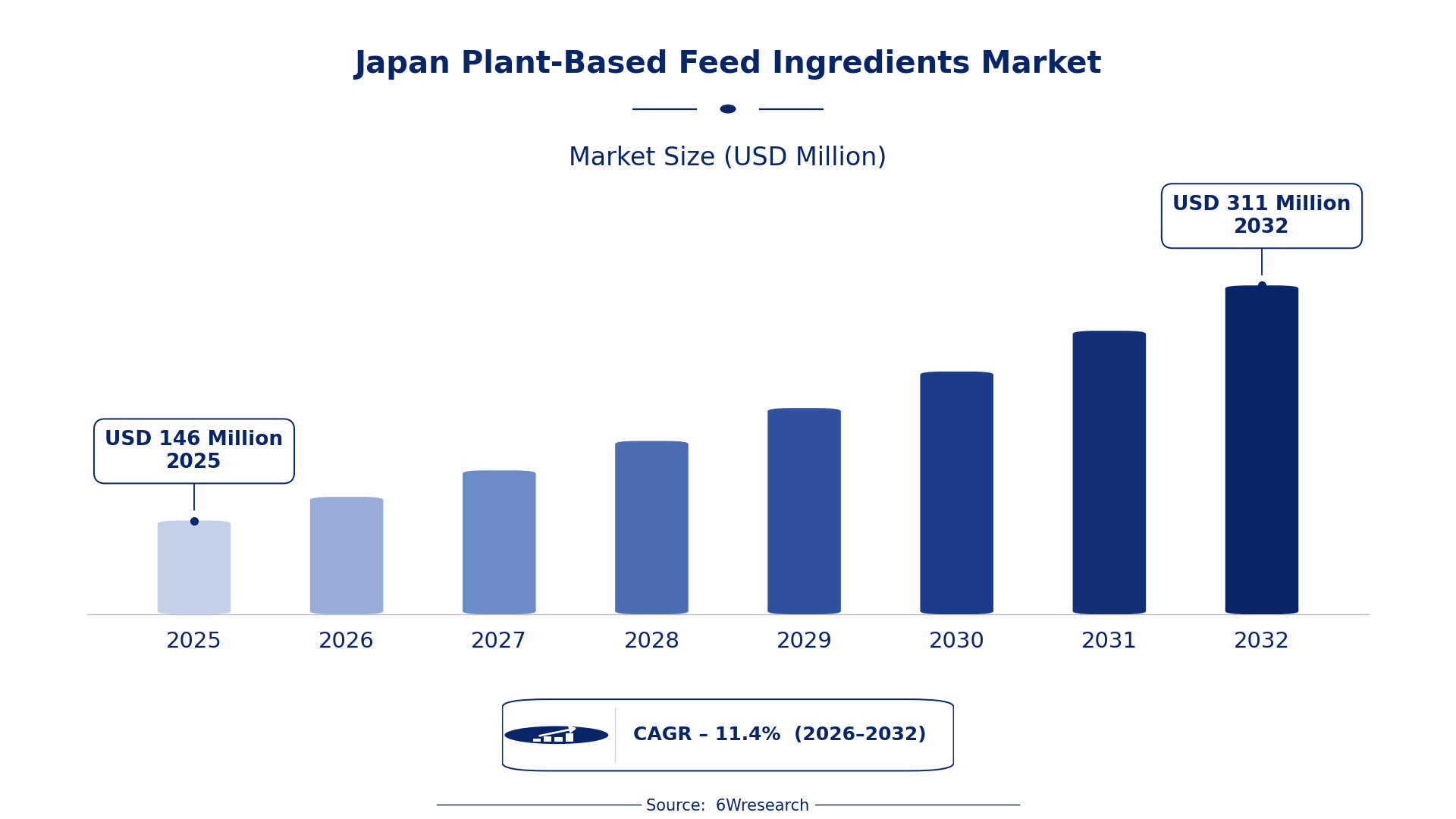
According to 6Wresearch internal database and industry insights, the Japan Plant-Based Feed Ingredients Market was valued at USD 146 Million in 2025 and is projected to reach USD 311 Million by 2032, growing at a CAGR of approximately 11.4% during 2026–2032.
Japan Plant-Based Feed Ingredients Market Highlights
| Report Metric | Details |
| Report Name | Japan Plant-Based Feed Ingredients Market (2026-2032) |
| Market Size 2025 | USD 146 Million |
| Market Size 2032 | USD 311 Million |
| Absolute Growth 2025–2032 | USD 165 Million |
| CAGR 2026–2032 | 11.4% |
| Peak Annual Growth | 12.4% in 2026 |
| Forecast Period | 2026–2032 |
| Historical Data | 2022–2025 |
| Base Year | 2025 |
| Leading Ingredient Type, 2025 | Soybean Meal (37% share) |
| Leading Nutrient Focus, 2025 | Protein (46% share) |
| Leading Distribution Channel, 2025 | Direct Sales (36% share) |
| Leading End User, 2025 | Animal Feed Manufacturers (41% share) |
| Fastest-Growing Ingredient Type | Alfalfa (15.7% CAGR) |
| Fastest-Growing Nutrient Focus | Fiber (15.9% CAGR) |
| Fastest-Growing Distribution Channel | Online Platforms (14.8% CAGR) |
| Fastest-Growing End User | Fish Farms (14.5% CAGR) |
| Growing Sector | aquaculture |
| Key End Users | Animal Feed Manufacturers, Poultry Farms, Dairy Farmers, Fish Farms |
Japan Plant-Based Feed Ingredients Market Year-wise Growth Rate and Key Drivers (2022–2032)
This graph illustrates the annual growth rates of the market from 2022 to 2032, highlighting a steady upward trajectory and projected market expansion over the forecast period.
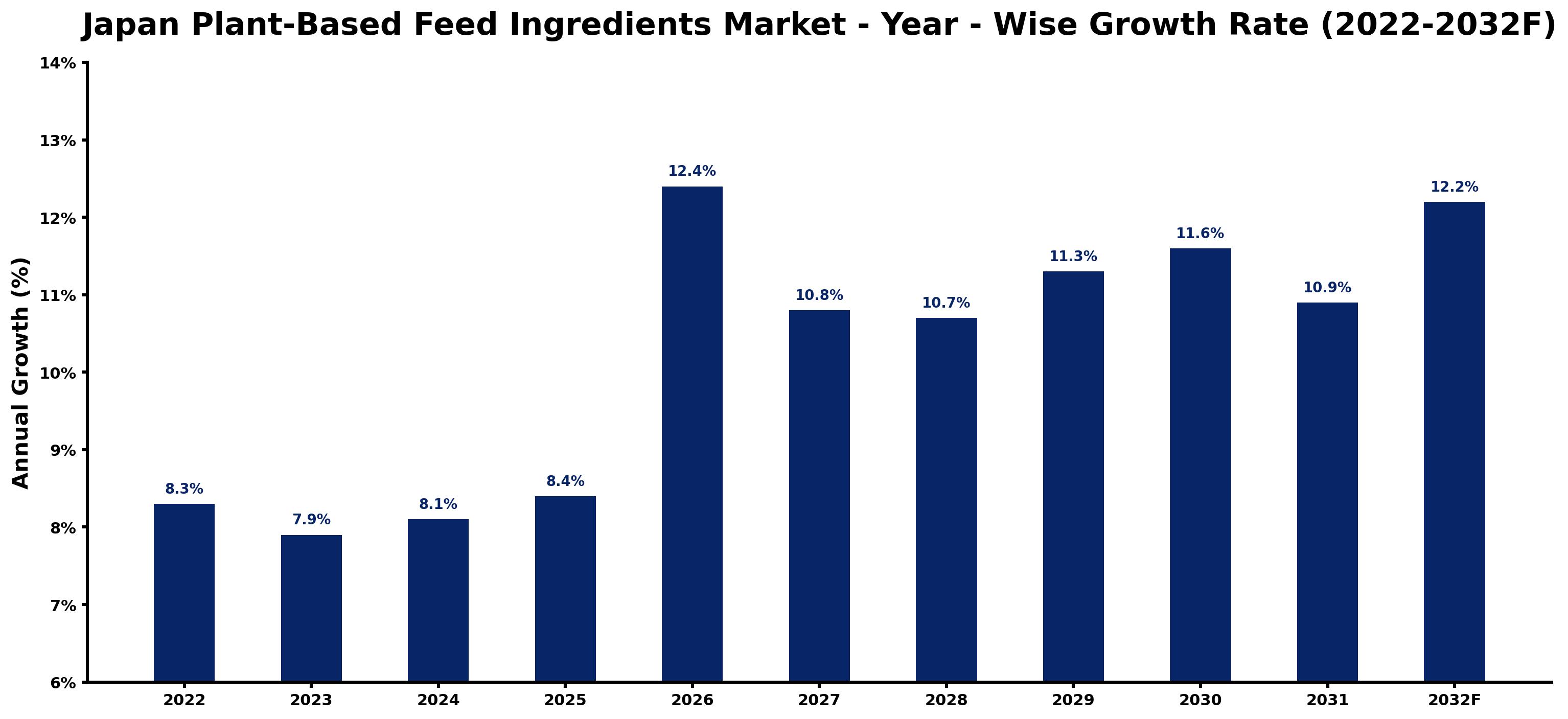
Below, each year's estimated growth is shown next to the factor that most influenced it.
| Year | Estimated Annual Growth (%) | Market Rationale |
| 2022 | 8.3 | The market showed steady growth due to increased livestock numbers and feed demand. |
| 2023 | 7.9 | Growth slowed slightly as feed ingredient prices rose amid global supply chain issues. |
| 2024 | 8.1 | Demand increased as local aquaculture expanded, boosting feed ingredient purchases. |
| 2025 | 8.4 | Growth accelerated as animal feed manufacturers sought higher protein sources. |
| 2026 | 12.4 | The market is expected to peak with strong investments in sustainable feed practices and technology. |
| 2027 | 10.8 | Growth is projected to slow as supply chain challenges persist, affecting ingredient availability. |
| 2028 | 10.7 | Demand will continue to rise, driven by increasing livestock production and consumption. |
| 2029 | 11.3 | Growth is expected to pick up as more farmers adopt plant-based feed alternatives. |
| 2030 | 11.6 | Demand will rise further as aquaculture and dairy sectors expand their feed requirements. |
| 2031 | 10.9 | Growth is projected to slow as market saturation begins to affect new investments. |
| 2032 | 12.2 | Demand is expected to rise with ongoing investments in alternative feed sources. |
Note: Market size estimations and growth projections presented in this report are based on 6Wresearch's proprietary forecasting methodology, utilizing the latest available industry data, government publications, and primary research inputs.
Japan Plant-Based Feed Ingredients Market Synopsis
Plant-Based Feed Ingredients come from various plant sources and play a crucial role in animal nutrition, supplying essential nutrients like protein and fibre. The Japan Plant-Based Feed Ingredients Market is growing due to increasing livestock populations, especially in poultry and aquaculture, along with rising investments in sustainable practices. The aquaculture industry, valued at approximately 1.2 billion USD, is a primary driver of demand, necessitating new feed formulations that cater to the nutritional requirements of livestock and support sector growth.
Market Dynamics Impact Analysis (2026–2032)
| Factor | Type | Impact | Primary Segment Affected |
| Rising livestock population | Driver | High | Soybean Meal |
| Increased aquaculture demand | Driver | High | Alfalfa |
| Growing interest in sustainable feed | Opportunity | Medium | Canola Meal |
| Expansion of online sales channels | Opportunity | Medium | Direct Sales |
| Fluctuating raw material prices | Restraint | High | Protein |
| Quality control regulations | Restraint | Medium | Fiber |
| High production costs | Challenge | High | Oil & Protein |
| Supply chain disruptions | Challenge | Medium | Starch & Fiber |
Evaluation of Drivers in Japan Plant-Based Feed Ingredients Market (2026–2032)
The factors lifting demand, and the evidence behind each, are summarised below.
| Drivers | Primary Segment Affected | Why It Matters (Evidence) |
| Increasing livestock numbers | Soybean Meal | Japan's livestock population is approximately 4.5 million cattle and 150 million poultry, driving demand for high-protein feed. |
| Growth in aquaculture | Alfalfa | The aquaculture industry in Japan is valued at around 1.2 billion USD, increasing the need for nutritious feed ingredients. |
| Sustainable farming practices | Canola Meal | Government initiatives promote sustainable feed practices, leading to higher demand for plant-based ingredients. |
| Direct sales channel dominance | Direct Sales | Direct sales account for 70% of the market, facilitating bulk purchases by animal feed manufacturers. |
| ISO 22000 standards adoption | Fiber | The application of ISO 22000 standards in feed safety management builds consumer confidence and drives ingredient demand. |
Buyers are adding capacity as livestock numbers in Japan rise, with approximately 4.5 million cattle and 150 million poultry. This growth boosts demand for high-protein feed, particularly soybean meal, which has an average protein content of around 44%. The aquaculture sector, valued at approximately 1.2 billion USD, is expanding, leading to increased purchases of plant-based ingredients. Sustainable farming practices are gaining traction, encouraging the shift towards plant-based alternatives. Direct sales, which dominate the market, ensure that animal feed manufacturers can easily access these essential ingredients, further driving demand.
Evaluation of Restraints in Japan Plant-Based Feed Ingredients Market
The table below lists the restraints and the evidence behind each.
| Market Restraint | Primary Segment Affected | Why It Matters (Evidence) |
| High production costs | Oil & Protein | Production costs for plant-based feeds can be high, limiting profit margins for manufacturers. |
| Quality control regulations | Fiber | Strict regulations require compliance, increasing operational costs for producers. |
| Fluctuating raw material prices | Protein | Volatility in raw material prices impacts the pricing strategies of feed manufacturers. |
| Supply chain disruptions | Starch & Fiber | Global supply chain issues can delay ingredient availability, impacting production schedules. |
| Limited consumer awareness | Alfalfa | Low awareness of the benefits of plant-based feeds can restrict market growth. |
Japan Plant-Based Feed Ingredients Market Challenges
Producers encounter supply chain disruptions due to limited domestic production of key ingredients, which can delay deliveries by up to two weeks. Many facilities still rely on traditional processing methods, causing operational costs to rise by 15% for producers. Buyers in the livestock sector face increasing prices for plant-based feed ingredients, potentially raising their costs by 10%. Competition intensifies as new entrants introduce alternative feed sources, compelling established producers to adapt or risk losing market share.
Trends in the Japan Plant-Based Feed Ingredients Market
The following changes are redrawing the Japan Plant-Based Feed Ingredients Market.
- Shift towards Sustainable Feed Practices: Japan is increasingly adopting sustainable feed practices, driven by government initiatives. In 2023, a program allocated 500 million JPY for research on alternative feed sources, encouraging innovation in the sector.
- Growth of Online Sales Channels: The distribution of plant-based feed ingredients is shifting towards online platforms, with a projected CAGR of 14.8%. This trend allows smaller buyers, such as local farms, to access a wider range of products.
- Increased Focus on Protein Content: There is a growing emphasis on high-protein feed ingredients, particularly soybean meal, which has an average protein content of around 44%. This shift supports the nutritional needs of livestock and aquaculture.
- Expansion of Aquaculture Industry: The aquaculture sector in Japan is experiencing growth, valued at approximately 1.2 billion USD. This expansion drives demand for specialized plant-based feed ingredients tailored for fish farming.
Investment Opportunities in the Japan Plant-Based Feed Ingredients Market
The openings below show where demand in the Japan Plant-Based Feed Ingredients Market is visible and how suppliers can enter.
- Increasing Demand for Alternative Feed Sources: With a projected market size of USD 311 million by 2032, there is a chance for investment in alternative feed sources. Animal feed manufacturers are pursuing innovative solutions to meet growing nutritional demands.
- Expansion into Online Sales Channels: As online platforms for feed sales expand, there is an opportunity to collaborate with local distributors to access this emerging market. The online sales segment is anticipated to grow at a CAGR of 14.8%.
- Investment in Sustainable Practices: The current climate is favourable for investing in sustainable feed practices, supported by government initiatives. The Ministry of Agriculture allocated 500 million JPY for research in 2023, indicating strong support for innovation.
- Focus on High-Protein Ingredients: Animal feed manufacturers are increasingly seeking high-protein ingredients to improve livestock nutrition. This trend presents an opportunity for suppliers of soybean meal and canola meal.
Government Initiatives in the Japan Plant-Based Feed Ingredients Market
The Food Sanitation Act amendment (2018) requires hygiene management for food businesses, ensuring that producers comply with safety standards in feed production. This regulation improves the safety and quality of animal feed ingredients, building consumer confidence. Additionally, the Waste Management and Public Cleansing Act (1970) governs the treatment and disposal of industrial waste, affecting feed production processes and environmental compliance.
In 2023, a government programme allocated 500 million JPY for research on alternative feed sources, managed by the Ministry of Agriculture, Forestry and Fisheries. This funding promotes innovation and development in sustainable feed practices, benefiting producers and improving the quality of plant-based feed ingredients.
Future Insight of the Japan Plant-Based Feed Ingredients Market
Investment in alternative feed sources will increase, driven by a government programme allocating 500 million JPY for research, creating new opportunities for suppliers. By 2032, the livestock population is projected to rise, particularly in poultry and aquaculture, boosting demand for plant-based feed ingredients. Advanced processing technologies will emerge, improving efficiency and reducing costs for producers. Compliance with ISO 22000 standards will become more widespread, ensuring higher safety and quality in feed management.
Market Segmentation Analysis
Japan Plant-Based Feed Ingredients Market report covers a detailed analysis of the following market segments:
By Ingredient Type – Soybean Meal Leads, Alfalfa Expected to Grow Fastest
According to Navya, Research Analyst at 6Wresearch, Soybean Meal held 37% of the Japan Plant-Based Feed Ingredients Market by ingredient type in 2025. Soybean meal holds the largest share because it is essential for livestock nutrition, providing high protein content. In 2022, Japan produced 3.5 million tons of soybean meal, underscoring its importance in the animal feed sector. The quickest growth will come from Alfalfa, forecast to expand at a CAGR of 15.7% between 2026 and 2032. Alfalfa is experiencing rapid growth due to its high fibre content, which is particularly advantageous for ruminants. The emphasis on sustainable feed practices has led to increased interest in alfalfa, especially in Hokkaido where it is primarily cultivated. Suppliers should focus on expanding their alfalfa product lines to cater to the rising demand from livestock producers.
By Nutrient Focus – Protein Leads, Fiber Expected to Grow Fastest
In 2025, Protein led the nutrient focus split with a 46% share. Protein is the leading nutrient focus as it is a critical component in animal feed formulations, ensuring livestock receive adequate nutrition. The average protein content in soybean meal, around 44%, highlights its significance in this market. Fiber is set to record the highest CAGR in this split, 15.9% over 2026–2032. The fibre segment is growing swiftly due to its importance for digestive health in animals, particularly in ruminants. As awareness of animal health increases, the demand for fibre-rich feed ingredients is expected to rise. Buyers will benefit from diversifying their feed formulations to include higher fibre content for better animal health.
By Distribution Channel – Direct Sales Leads, Online Platforms Expected to Grow Fastest
Direct Sales took 36% of distribution channel revenue in 2025, more than any other category. Direct sales dominate the market, accounting for 70% of plant-based feed ingredients sales, primarily due to the bulk nature of feed transactions. This channel allows manufacturers to establish direct relationships with animal feed producers. Over 2026–2032, Online Platforms are expected to post the fastest growth, at a CAGR of 14.8%. Online platforms are rapidly gaining traction as a distribution channel, catering to smaller purchases and providing convenience for buyers. The growing digitalisation of the market is driving this shift towards online sales. Suppliers should invest in online platforms to capture the increasing segment of buyers preferring digital purchasing options.
By End User – Animal Feed Manufacturers Lead, Fish Farms Expected to Grow Fastest
With 41% of end user revenue in 2025, Animal Feed Manufacturers was the largest category. Animal feed manufacturers lead the market as they are the main users of various feed ingredients necessary for livestock. Their central position in the supply chain guarantees a steady demand for plant-based feed ingredients. Fish Farms are projected to grow fastest, at a CAGR of 14.5% during 2026–2032. Fish farms are the fastest-growing end user segment, driven by the increasing need for aquaculture feeds in Japan's aquaculture industry, valued at approximately 1.2 billion USD. This trend indicates a growing emphasis on sustainable seafood production practices. Suppliers need to adapt their offerings to meet the specific requirements of fish farms to take advantage of this growth opportunity.
Key Attractiveness of the Report
- 10 Years of Market Numbers
- Historical Data Starting from 2022 to 2025
- Base Year 2025
- Forecast Data until 2032
- Key Performance Indicators Impacting the Market
- Major Upcoming Developments and Projects
Key Highlights of the Report:
- Japan Plant-Based Feed Ingredients Market Outlook
- Market Size of Japan Plant-Based Feed Ingredients Market, 2025
- Forecast of Japan Plant-Based Feed Ingredients Market, 2032
- Historical Data and Forecast of Japan Plant-Based Feed Ingredients Revenues & Volume for the Period 2022-2032F
- Japan Plant-Based Feed Ingredients Market Trend Evolution
- Japan Plant-Based Feed Ingredients Market Drivers and Challenges
- Japan Plant-Based Feed Ingredients Price Trends
- Japan Plant-Based Feed Ingredients Porter's Five Forces
- Japan Plant-Based Feed Ingredients Industry Life Cycle
- Historical Data and Forecast of Japan Plant-Based Feed Ingredients Market Revenues & Volume By Ingredient Type for the Period 2022-2032F
- Historical Data and Forecast of Japan Plant-Based Feed Ingredients Market Revenues & Volume By Soybean Meal for the Period 2022-2032F
- Historical Data and Forecast of Japan Plant-Based Feed Ingredients Market Revenues & Volume By Alfalfa for the Period 2022-2032F
- Historical Data and Forecast of Japan Plant-Based Feed Ingredients Market Revenues & Volume By Canola Meal for the Period 2022-2032F
- Historical Data and Forecast of Japan Plant-Based Feed Ingredients Market Revenues & Volume By Lentil By-products for the Period 2022-2032F
- Historical Data and Forecast of Japan Plant-Based Feed Ingredients Market Revenues & Volume By Nutrient Focus for the Period 2022-2032F
- Historical Data and Forecast of Japan Plant-Based Feed Ingredients Market Revenues & Volume By Protein for the Period 2022-2032F
- Historical Data and Forecast of Japan Plant-Based Feed Ingredients Market Revenues & Volume By Fiber for the Period 2022-2032F
- Historical Data and Forecast of Japan Plant-Based Feed Ingredients Market Revenues & Volume By Oil & Protein for the Period 2022-2032F
- Historical Data and Forecast of Japan Plant-Based Feed Ingredients Market Revenues & Volume By Starch & Fiber for the Period 2022-2032F
- Historical Data and Forecast of Japan Plant-Based Feed Ingredients Market Revenues & Volume By Distribution Channel for the Period 2022-2032F
- Historical Data and Forecast of Japan Plant-Based Feed Ingredients Market Revenues & Volume By Direct Sales for the Period 2022-2032F
- Historical Data and Forecast of Japan Plant-Based Feed Ingredients Market Revenues & Volume By Online Platforms for the Period 2022-2032F
- Historical Data and Forecast of Japan Plant-Based Feed Ingredients Market Revenues & Volume By Specialty Stores for the Period 2022-2032F
- Historical Data and Forecast of Japan Plant-Based Feed Ingredients Market Revenues & Volume By Industrial Suppliers for the Period 2022-2032F
- Historical Data and Forecast of Japan Plant-Based Feed Ingredients Market Revenues & Volume By End User for the Period 2022-2032F
- Historical Data and Forecast of Japan Plant-Based Feed Ingredients Market Revenues & Volume By Poultry Farms for the Period 2022-2032F
- Historical Data and Forecast of Japan Plant-Based Feed Ingredients Market Revenues & Volume By Dairy Farmers for the Period 2022-2032F
- Historical Data and Forecast of Japan Plant-Based Feed Ingredients Market Revenues & Volume By Animal Feed Manufacturers for the Period 2022-2032F
- Historical Data and Forecast of Japan Plant-Based Feed Ingredients Market Revenues & Volume By Fish Farms for the Period 2022-2032F
- Japan Plant-Based Feed Ingredients Import Export Trade Statistics
- Market Opportunity Assessment By Ingredient Type
- Market Opportunity Assessment By Nutrient Focus
- Market Opportunity Assessment By Distribution Channel
- Market Opportunity Assessment By End User
- Japan Plant-Based Feed Ingredients Top Companies Market Share
- Japan Plant-Based Feed Ingredients Competitive Benchmarking By Technical and Operational Parameters
- Japan Plant-Based Feed Ingredients Company Profiles
- Japan Plant-Based Feed Ingredients Key Strategic Recommendations
Market Covered
This report examines the market across the segments below.
By Ingredient Type
- Soybean Meal
- Alfalfa
- Canola Meal
- Lentil By-products
By Nutrient Focus
- Protein
- Fiber
- Oil & Protein
- Starch & Fiber
By Distribution Channel
- Direct Sales
- Online Platforms
- Specialty Stores
- Industrial Suppliers
By End User
- Poultry Farms
- Dairy Farmers
- Animal Feed Manufacturers
- Fish Farms






































