Japan Plant Breeding Technology Market Size & Growth Rate
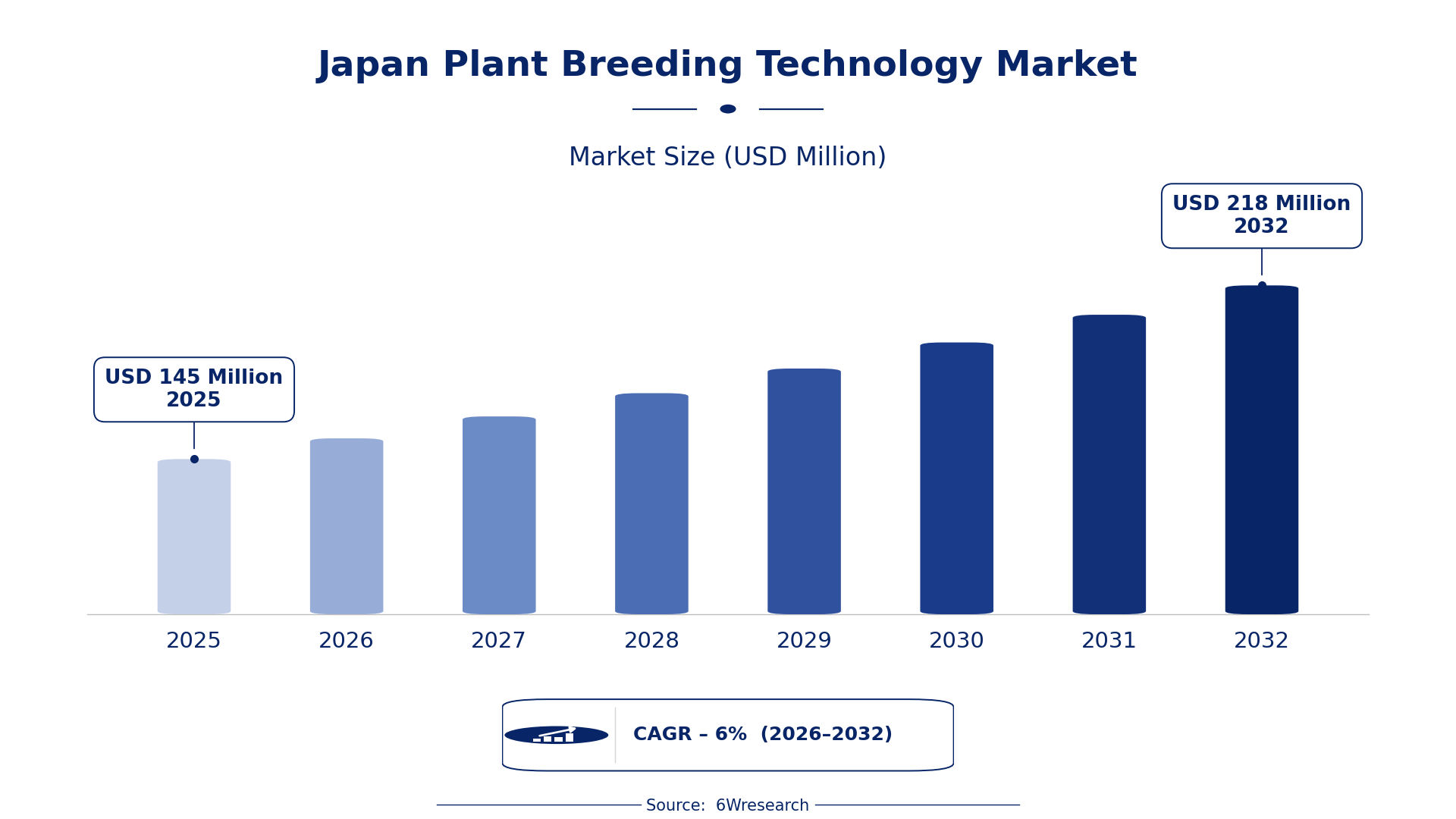
According to 6Wresearch internal database and industry insights, the Japan Plant Breeding Technology Market was valued at USD 145 Million in 2025 and is projected to reach USD 218 Million by 2032, growing at a CAGR of approximately 6% during 2026–2032.
Japan Plant Breeding Technology Market Highlights
| Report Metric | Details |
| Report Name | Japan Plant Breeding Technology Market (2026-2032) |
| Market Size 2025 | USD 145 Million |
| Market Size 2032 | USD 218 Million |
| Absolute Growth 2025–2032 | USD 73 Million |
| CAGR 2026–2032 | 6% |
| Peak Annual Growth | 7.6% in 2026 |
| Forecast Period | 2026–2032 |
| Historical Data | 2022–2025 |
| Base Year | 2025 |
| Leading Technology Type, 2025 | Genomic Selection (39% share) |
| Leading Breeding Method, 2025 | Hybridization (48% share) |
| Leading Distribution Channel, 2025 | Direct Sales (54% share) |
| Leading End User, 2025 | Seed Companies (40% share) |
| Fastest-Growing Technology Type | CRISPR Gene Editing (8.4% CAGR) |
| Fastest-Growing Breeding Method | Biotech Breeding (8.5% CAGR) |
| Fastest-Growing Distribution Channel | Online Platforms (7.5% CAGR) |
| Fastest-Growing End User | Agricultural Labs (7.4% CAGR) |
| Growing Sector | agriculture |
| Key End Users | seed companies, agricultural labs, crop research institutes, government agriculture departments |
Japan Plant Breeding Technology Market Year-wise Growth Rate and Key Drivers (2022–2032)
This graph illustrates the annual growth rates of the market from 2022 to 2032, highlighting a steady upward trajectory and projected market expansion over the forecast period.
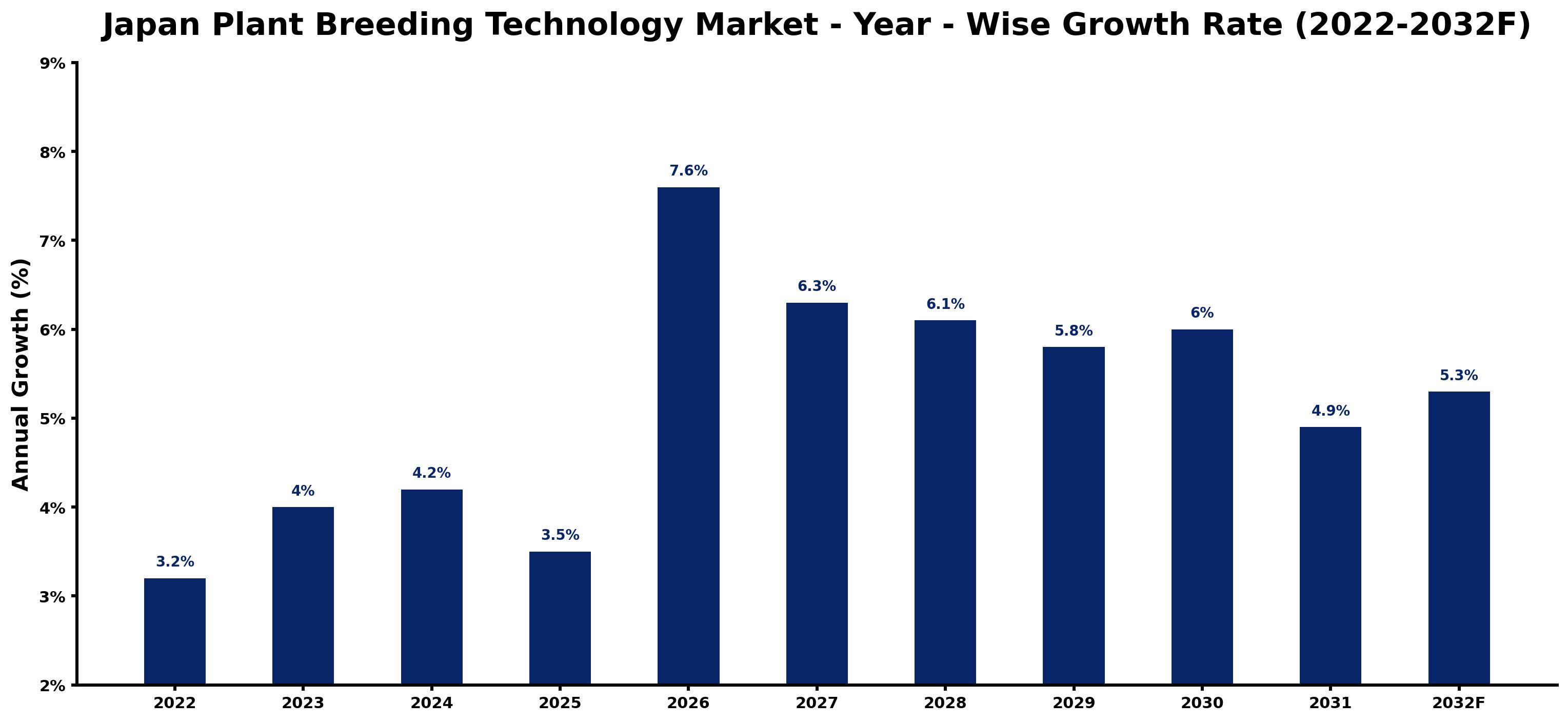
For each year, the table pairs the estimated growth rate with the leading influence on demand, showing how the drivers changed across the period.
| Year | Estimated Annual Growth (%) | Market Rationale |
| 2022 | 3.2 | The market showed steady activity, driven by ongoing agricultural research efforts. |
| 2023 | 4.0 | Demand increased due to heightened interest in sustainable farming practices. |
| 2024 | 4.2 | Growth continued as seed companies expanded their breeding programs. |
| 2025 | 3.5 | Growth slowed as the market adjusted to regulatory changes and funding constraints. |
| 2026 | 7.6 | Demand surged with the introduction of advanced breeding technologies. |
| 2027 | 6.3 | Market expansion slowed as competition intensified among breeding methods. |
| 2028 | 6.1 | Growth decelerated as market saturation began to take effect. |
| 2029 | 5.8 | Demand continued to slow as buyers became more selective in technology adoption. |
| 2030 | 6.0 | Growth resumed as new funding initiatives were announced for biotechnology. |
| 2031 | 4.9 | Market growth slowed, reflecting a stabilisation after rapid advancements. |
| 2032 | 5.3 | Demand increased as agricultural technology adoption reached new heights. |
Note: Market size estimations and growth projections presented in this report are based on 6Wresearch's proprietary forecasting methodology, utilizing the latest available industry data, government publications, and primary research inputs.
Japan Plant Breeding Technology Market Synopsis
Plant Breeding Technology encompasses genomic selection, CRISPR gene editing, and mutagenesis to improve crop traits, primarily used in agriculture for yield improvement and disease resistance. The Japan Plant Breeding Technology Market is expanding due to rising demand from seed companies and agricultural research institutions, supported by a substantial agricultural research budget. Government initiatives promote biotechnology, facilitating investment and innovation in this sector, with a focus on improving food security and sustainability in agriculture.
Market Dynamics Impact Analysis (2026–2032)
| Factor | Type | Impact | Primary Segment Affected |
| Growing adoption of genomic selection techniques | Driver | High | Genomic Selection |
| Increased investment in CRISPR technology | Driver | High | CRISPR Gene Editing |
| Rising demand for uniform seed lines | Opportunity | High | Doubled Haploids |
| Need for advanced breeding methods | Opportunity | High | Biotech Breeding |
| Regulatory concerns surrounding genetic modifications | Restraint | High | CRISPR Gene Editing |
| Limited adoption of biotech crops | Restraint | Medium | Genomic Selection |
| High costs associated with compliance and testing | Challenge | High | CRISPR Gene Editing |
| Intense competition among breeding technologies | Challenge | Medium | Biotech Breeding |
Evaluation of Drivers in Japan Plant Breeding Technology Market (2026–2032)
The main growth drivers and the segments they affect most are set out below.
| Drivers | Primary Segment Affected | Why It Matters (Evidence) |
| Increased crop yield through genomic selection | Genomic Selection | Genomic selection improves breeding efficiency, leading to higher yields, with over 2 million people employed in Japan's agricultural sector. |
| Precision improvements from CRISPR technology | CRISPR Gene Editing | CRISPR allows for targeted genetic modifications, increasing adoption rates among seed companies, which currently stands at around 10%. |
| Demand for hybrid rice production | Doubled Haploids | Doubled haploid technology is essential for producing uniform seed lines, especially in hybrid rice production, vital for food security. |
| Integration of biotech methods in breeding programs | Biotech Breeding | Biotech breeding techniques are increasingly used to improve crop traits, supported by the 200 billion yen agricultural research budget. |
| Enhanced selection efficiency through marker-assisted techniques | Marker-assisted | Marker-assisted selection is widely used in rice breeding, improving efficiency and outcomes for seed companies. |
Spending rises because agricultural labs are increasingly adopting genomic selection techniques, which improve crop yields. In Japan, over 2 million people work in agriculture, driving demand for efficient breeding methods. The integration of CRISPR technology allows for precise genetic modifications that enhance crop traits. With a 10% adoption rate of biotech crops, seed companies are investing more in advanced breeding technologies. The substantial agricultural research budget supports innovation, focusing on hybrid rice production, which is vital for food security.
Evaluation of Restraints in Japan Plant Breeding Technology Market
Below are the constraints most often cited by buyers and suppliers, with the segment each affects.
| Market Restraint | Primary Segment Affected | Why It Matters (Evidence) |
| Regulatory hurdles for CRISPR technology | CRISPR Gene Editing | Strict regulations under the Cartagena Protocol limit the use of CRISPR, affecting seed companies' ability to innovate. |
| Low adoption rates of biotech crops | Genomic Selection | The adoption rate of biotech crops in Japan is around 10%, limiting the market's growth potential. |
| High costs for compliance and testing | CRISPR Gene Editing | Compliance with stringent regulations incurs high costs for producers, impacting their financial viability by approximately 15%. |
| Limited public acceptance of genetically modified organisms | Biotech Breeding | Public hesitance towards GMOs slows down the adoption of biotech breeding methods among farmers. |
| Competition from traditional breeding methods | Hybridization | Traditional methods like hybridization remain prevalent, posing challenges for the adoption of advanced technologies. |
Japan Plant Breeding Technology Market Challenges
CRISPR gene editing faces strict regulations under the Cartagena Protocol, which delays technology adoption for buyers and can extend product development timelines by up to 12 months. Buyers encounter high compliance costs due to stringent regulations enforced by the Ministry of Agriculture, Forestry and Fisheries, potentially increasing operational expenses by 15%. A shortage of skilled professionals in advanced breeding techniques limits the workforce available to agricultural research institutions, hindering their capacity to innovate. Supply chain disruptions linked to the low adoption rate of biotech crops, currently around 10%, can lead to inconsistent availability of improved seeds for producers, negatively impacting crop yields.
Trends in the Japan Plant Breeding Technology Market
Several trends are reshaping the Japan Plant Breeding Technology Market; the most important are set out below.
- Shift towards CRISPR Gene Editing: In 2023, seed companies began prioritising CRISPR gene editing for precise genetic modifications, with adoption rates expected to rise as regulations evolve. This shift is important for improving crop traits and increasing yields.
- Increase in Marker-Assisted Selection: Agricultural labs are increasingly using marker-assisted selection techniques, which improve efficiency in breeding programs. With over 30% of plant propagation employing tissue culture, this trend is reshaping breeding practices.
- Growing Focus on Biotech Breeding: Since 2023, there has been a notable shift towards biotech breeding methods, driven by the need for improved crop resilience. This trend is supported by substantial research funding and government initiatives.
- Expansion of Online Platforms for Seed Distribution: In recent years, online platforms have become a significant channel for seed distribution, with a projected growth rate of 7.5% in the coming years. This change allows seed companies to reach a broader audience.
Investment Opportunities in the Japan Plant Breeding Technology Market
Investors looking at the Japan Plant Breeding Technology Market should consider the following areas.
- Seed Companies seeking advanced breeding technologies: With a 10% adoption rate of biotech crops, seed companies are pursuing advanced breeding solutions to improve crop traits. Collaborating with agricultural research institutes can facilitate technology transfer.
- Investment in CRISPR technology development: The ongoing regulatory evolution presents an opportunity to invest in CRISPR technology, which is expected to expand. Agricultural labs can lead this effort by developing precise genetic modification techniques.
- Demand for hybrid rice production technologies: The need for hybrid rice production is pressing, with doubled haploid technology being a key focus area. Investing in research and development can effectively meet this demand.
- Growth in agricultural technology funding: The Japanese government has allocated a budget of 500 billion yen for advancements in agricultural technology, creating opportunities for investment in breeding projects.
Government Initiatives in the Japan Plant Breeding Technology Market
The 'Bioeconomy Strategy' initiated in 2023 updates the existing framework for agricultural biotechnology, promoting research and development in plant breeding technologies. This strategy builds on previous laws by providing additional funding and support for practices aimed at improving food security and sustainability in agriculture.
The Agricultural and Food Research Organization oversees the approval and funding of agricultural biotechnology projects. With a budget of approximately 500 billion yen for agricultural research, this organisation plays a key role in supporting advancements in plant breeding technology, ensuring compliance with regulations while promoting innovation.
Future Insight of the Japan Plant Breeding Technology Market
Investment in agricultural research will generate demand for advanced plant breeding technologies, driving innovation in the sector. By 2032, Japan's agricultural research budget will reach approximately 200 billion yen, supporting various projects. The establishment of over 100 agricultural research institutes will facilitate collaboration among stakeholders, encouraging knowledge exchange. As Japan's population of 126 million continues to grow, the need for improved crop traits will become increasingly critical, prompting suppliers to develop new solutions.
Market Segmentation Analysis
Japan Plant Breeding Technology Market report covers a detailed analysis of the following market segments:
By Technology Type – Genomic Selection Leads, CRISPR Gene Editing Expected to Grow Fastest
According to Navya, Research Analyst at 6Wresearch, Genomic Selection took 39% of technology type revenue in 2025, more than any other category. Genomic selection holds the largest share due to its widespread use in enhancing crop traits, especially in rice breeding programs. This method is supported by a strong network of over 100 agricultural research institutes dedicated to crop improvement. CRISPR Gene Editing is set to record the highest CAGR in this split, 8.4% over 2026–2032. CRISPR gene editing is witnessing rapid growth because of its ability to make precise genetic modifications, crucial for improving crop resilience. The government's 2023 'Bioeconomy Strategy' is further encouraging the adoption of such advanced techniques. Suppliers should focus on advancing genomic selection while also investing in CRISPR technology to align with increasing market demand.
By Breeding Method – Hybridization Leads, Biotech Breeding Expected to Grow Fastest
Hybridization held 48% of the Japan Plant Breeding Technology Market by breeding method in 2025. Hybridization is the leading method as it remains a traditional approach effectively used for decades in crop breeding, especially for staple crops. Its deep integration into seed company practices in Japan solidifies its position. The quickest growth will come from Biotech Breeding, forecast to expand at a CAGR of 8.5% between 2026 and 2032. Biotech breeding is the fastest-growing method as it utilises genetic engineering techniques, enabling quicker development of improved crop varieties. The rising emphasis on sustainable agriculture and food security in Japan is accelerating this growth. Buyers should invest in biotech breeding solutions to maintain competitiveness in the agricultural sector.
By Distribution Channel – Direct Sales Leads, Online Platforms Expected to Grow Fastest
The largest distribution channel category in 2025 was Direct Sales, at 54% of revenue. Direct sales lead the distribution channel as they are the most prevalent method for selling seeds and breeding technologies directly to agricultural stakeholders. This approach allows for better communication and support between suppliers and end-users. Over 2026–2032, Online Platforms are expected to post the fastest growth, at a CAGR of 7.5%. Online platforms are experiencing the fastest growth due to their ability to provide essential information and resources, making breeding technologies more accessible. The trend towards digitalisation in agriculture is driving this shift. Suppliers must strengthen their online strategies to cater to the rising preference for digital channels among buyers.
By End User – Seed Companies Lead, Agricultural Labs Expected to Grow Fastest
In 2025, Seed Companies led the end user split with a 40% share. Seed companies are the primary users of breeding technologies, employing these methods to create new crop varieties that meet market needs. Their pivotal role in the agricultural sector ensures a steady demand for advanced breeding solutions. Agricultural Labs are projected to grow fastest, at a CAGR of 7.4% during 2026–2032. Agricultural labs are growing rapidly as they play a vital role in research and development, fostering innovation in plant breeding technologies. Increased funding for research initiatives is propelling this growth. Suppliers should consider partnerships with agricultural labs to drive innovative advancements in plant breeding.
Key Attractiveness of the Report
- 10 Years of Market Numbers
- Historical Data Starting from 2022 to 2025
- Base Year 2025
- Forecast Data until 2032
- Key Performance Indicators Impacting the Market
- Major Upcoming Developments and Projects
Key Highlights of the Report:
- Japan Plant Breeding Technology Market Outlook
- Market Size of Japan Plant Breeding Technology Market, 2025
- Forecast of Japan Plant Breeding Technology Market, 2032
- Historical Data and Forecast of Japan Plant Breeding Technology Revenues & Volume for the Period 2022-2032F
- Japan Plant Breeding Technology Market Trend Evolution
- Japan Plant Breeding Technology Market Drivers and Challenges
- Japan Plant Breeding Technology Price Trends
- Japan Plant Breeding Technology Porter's Five Forces
- Japan Plant Breeding Technology Industry Life Cycle
- Historical Data and Forecast of Japan Plant Breeding Technology Market Revenues & Volume By Technology Type for the Period 2022-2032F
- Historical Data and Forecast of Japan Plant Breeding Technology Market Revenues & Volume By Genomic Selection for the Period 2022-2032F
- Historical Data and Forecast of Japan Plant Breeding Technology Market Revenues & Volume By CRISPR Gene Editing for the Period 2022-2032F
- Historical Data and Forecast of Japan Plant Breeding Technology Market Revenues & Volume By Mutagenesis for the Period 2022-2032F
- Historical Data and Forecast of Japan Plant Breeding Technology Market Revenues & Volume By Doubled Haploids for the Period 2022-2032F
- Historical Data and Forecast of Japan Plant Breeding Technology Market Revenues & Volume By Breeding Method for the Period 2022-2032F
- Historical Data and Forecast of Japan Plant Breeding Technology Market Revenues & Volume By Hybridization for the Period 2022-2032F
- Historical Data and Forecast of Japan Plant Breeding Technology Market Revenues & Volume By Marker-assisted for the Period 2022-2032F
- Historical Data and Forecast of Japan Plant Breeding Technology Market Revenues & Volume By Biotech Breeding for the Period 2022-2032F
- Historical Data and Forecast of Japan Plant Breeding Technology Market Revenues & Volume By Tissue Culture for the Period 2022-2032F
- Historical Data and Forecast of Japan Plant Breeding Technology Market Revenues & Volume By Distribution Channel for the Period 2022-2032F
- Historical Data and Forecast of Japan Plant Breeding Technology Market Revenues & Volume By Direct Sales for the Period 2022-2032F
- Historical Data and Forecast of Japan Plant Breeding Technology Market Revenues & Volume By Online Platforms for the Period 2022-2032F
- Historical Data and Forecast of Japan Plant Breeding Technology Market Revenues & Volume By Specialty Stores for the Period 2022-2032F
- Historical Data and Forecast of Japan Plant Breeding Technology Market Revenues & Volume By Distributors for the Period 2022-2032F
- Historical Data and Forecast of Japan Plant Breeding Technology Market Revenues & Volume By End User for the Period 2022-2032F
- Historical Data and Forecast of Japan Plant Breeding Technology Market Revenues & Volume By Seed Companies for the Period 2022-2032F
- Historical Data and Forecast of Japan Plant Breeding Technology Market Revenues & Volume By Agricultural Labs for the Period 2022-2032F
- Historical Data and Forecast of Japan Plant Breeding Technology Market Revenues & Volume By Crop Research Institutes for the Period 2022-2032F
- Historical Data and Forecast of Japan Plant Breeding Technology Market Revenues & Volume By Government Agriculture Depts for the Period 2022-2032F
- Japan Plant Breeding Technology Import Export Trade Statistics
- Market Opportunity Assessment By Technology Type
- Market Opportunity Assessment By Breeding Method
- Market Opportunity Assessment By Distribution Channel
- Market Opportunity Assessment By End User
- Japan Plant Breeding Technology Top Companies Market Share
- Japan Plant Breeding Technology Competitive Benchmarking By Technical and Operational Parameters
- Japan Plant Breeding Technology Company Profiles
- Japan Plant Breeding Technology Key Strategic Recommendations
Market Covered
This report examines the market across the segments below.
By Technology Type
- Genomic Selection
- CRISPR Gene Editing
- Mutagenesis
- Doubled Haploids
By Breeding Method
- Hybridization
- Marker-assisted
- Biotech Breeding
- Tissue Culture
By Distribution Channel
- Direct Sales
- Online Platforms
- Specialty Stores
- Distributors
By End User
- Seed Companies
- Agricultural Labs
- Crop Research Institutes
- Government Agriculture Depts






































