Japan Plant Growth Enhancer Market Size & Growth Rate
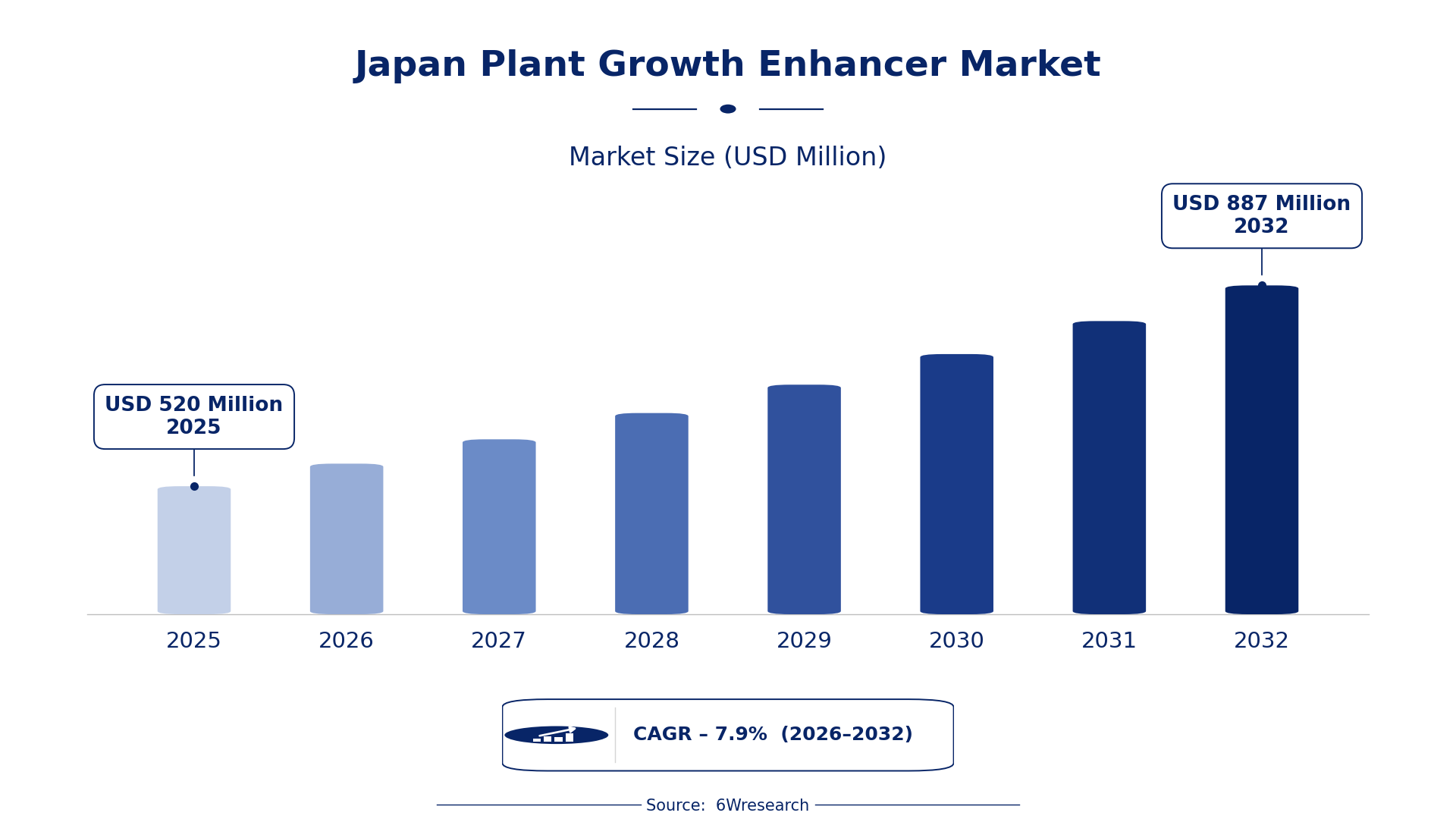
According to 6Wresearch internal database and industry insights, the Japan Plant Growth Enhancer Market was valued at USD 520 Million in 2025 and is projected to reach USD 887 Million by 2032, growing at a CAGR of approximately 7.9% during 2026–2032.
Japan Plant Growth Enhancer Market Highlights
| Report Metric | Details |
| Report Name | Japan Plant Growth Enhancer Market (2026-2032) |
| Market Size 2025 | USD 520 Million |
| Market Size 2032 | USD 887 Million |
| Absolute Growth 2025–2032 | USD 367 Million |
| CAGR 2026–2032 | 7.9% |
| Peak Annual Growth | 8.4% in 2032 |
| Forecast Period | 2026–2032 |
| Historical Data | 2022–2025 |
| Base Year | 2025 |
| Leading Product Type, 2025 | Amino Acid-Based (46% share) |
| Leading Application Method, 2025 | Foliar Spray (39% share) |
| Leading Distribution Channel, 2025 | Direct Sales (39% share) |
| Leading End User, 2025 | Organic Growers (37% share) |
| Fastest-Growing Product Type | Humic Acid-Based (11.0% CAGR) |
| Fastest-Growing Application Method | Drip Irrigation (10.6% CAGR) |
| Fastest-Growing Distribution Channel | Online Platforms (10.3% CAGR) |
| Fastest-Growing End User | Hydroponic Farms (10.4% CAGR) |
| Growing Sector | organic farming |
| Key End Users | organic growers, horticulturists, hydroponic farms, crop cultivation firms |
Japan Plant Growth Enhancer Market Year-wise Growth Rate and Key Drivers (2022–2032)
This graph illustrates the annual growth rates of the market from 2022 to 2032, highlighting a steady upward trajectory and projected market expansion over the forecast period.
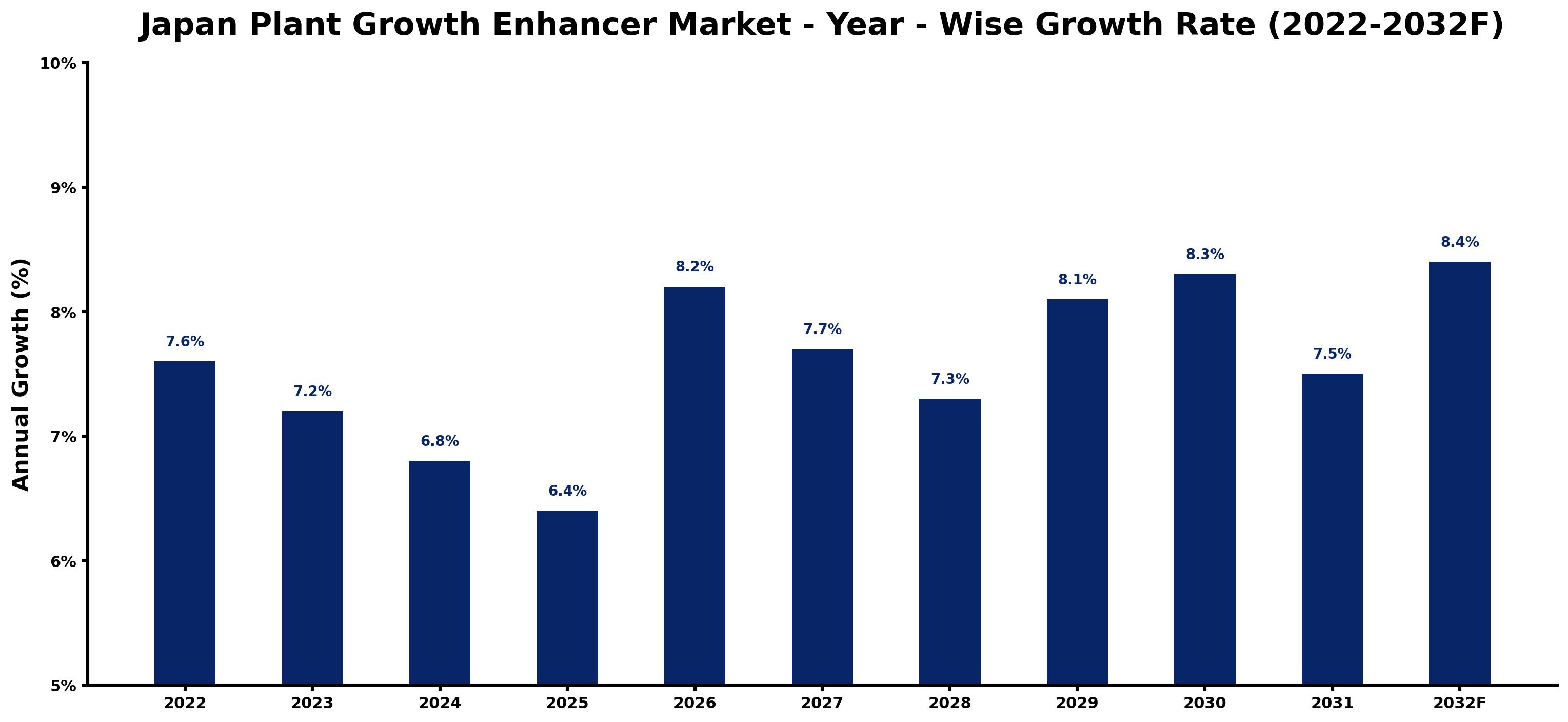
Below, each year's estimated growth is shown next to the factor that most influenced it.
| Year | Estimated Annual Growth (%) | Market Rationale |
| 2022 | 7.6 | The market experienced steady growth due to increased awareness of sustainable agriculture practices. |
| 2023 | 7.2 | Demand for plant growth products continued, although growth slowed from the previous year. |
| 2024 | 6.8 | Market growth slowed further as organic farming practices began to stabilise. |
| 2025 | 6.4 | Growth continued to decelerate as the market approached a more mature phase. |
| 2026 | 8.2 | Purchasing is anticipated to rise as new initiatives for organic farming are launched. |
| 2027 | 7.7 | Growth is projected to slow slightly as the market adjusts to increased supply levels. |
| 2028 | 7.3 | Demand will remain strong, supported by ongoing educational programs for farmers. |
| 2029 | 8.1 | Purchasing is expected to rise as hydroponic farming gains popularity in urban areas. |
| 2030 | 8.3 | Demand is projected to rise as the government targets increased organic farmland. |
| 2031 | 7.5 | Growth is expected to slow as the market stabilises but remains positive overall. |
| 2032 | 8.4 | Purchasing is projected to rise as the market reaches its peak growth rate. |
Note: Market size estimations and growth projections presented in this report are based on 6Wresearch's proprietary forecasting methodology, utilizing the latest available industry data, government publications, and primary research inputs.
Japan Plant Growth Enhancer Market Synopsis
Plant growth enhancers are substances that improve nutrient uptake and soil health, primarily used to boost crop yields and support organic farming. The Japan Plant Growth Enhancer Market is growing, driven by approximately 1.23 million organic farms and a government programme promoting organic practices. The increasing adoption of hydroponic farming and educational programmes for farmers further supports this demand, indicating a strong future for the market, with a projected size of USD 520 million by 2025.
Market Dynamics Impact Analysis (2026–2032)
| Factor | Type | Impact | Primary Segment Affected |
| Growing number of organic farms drives demand for plant growth enhancers. | Driver | High | Organic Growers |
| Rising interest in hydroponic farming increases the need for effective enhancers. | Driver | High | Hydroponic Farms |
| The government aims to increase organic farmland to 3% by 2030, creating opportunities for suppliers. | Opportunity | High | Organic Growers |
| Educational programs for farmers on the benefits of enhancers present a market entry point. | Opportunity | Medium | Horticulturists |
| Strict compliance requirements for organic certification can limit market access for new products. | Restraint | High | Micronutrient Formulas |
| The average age of farmers at 67 years may hinder the adoption of new technologies. | Restraint | Medium | Organic Growers |
| High costs of developing and marketing new formulations can deter smaller suppliers. | Challenge | High | Amino Acid-Based |
| Competition from imported products may pressure local manufacturers' pricing strategies. | Challenge | Medium | Seaweed Extracts |
Evaluation of Drivers in Japan Plant Growth Enhancer Market (2026–2032)
Below are the drivers that matter most for revenue growth, with supporting evidence.
| Drivers | Primary Segment Affected | Why It Matters (Evidence) |
| Increase in organic farms boosts demand for plant growth products. | Organic Growers | In 2022, Japan had approximately 1.23 million organic farms, leading to higher purchases of growth products. |
| Hydroponic farming's rise necessitates effective nutrient management solutions. | Hydroponic Farms | The growing trend of urban hydroponic farming is increasing the need for effective nutrient management solutions. |
| Government initiatives promote sustainable agricultural practices. | Horticulturists | In 2023, a program launched by the Ministry of Agriculture, Forestry and Fisheries supports organic farming. |
| Educational programs increase awareness of growth products' benefits. | Crop Cultivation Firms | Nationwide educational initiatives are informing farmers about the advantages of using growth products. |
| Amino acid-based products significantly improve crop yield. | Amino Acid-Based | These products have been noted to improve yields, driving their adoption among growers. |
Purchasing is picking up as the number of organic farms in Japan reached approximately 1.23 million, creating a strong demand for plant growth enhancers. The rise of hydroponic farming, particularly in urban areas, is increasing the need for effective nutrient management solutions. The use of amino acid-based products has been noted to improve crop yields, encouraging more growers to invest in these solutions.
Evaluation of Restraints in Japan Plant Growth Enhancer Market
Several factors work against faster growth; the main ones are summarised below.
| Market Restraint | Primary Segment Affected | Why It Matters (Evidence) |
| Compliance with strict organic certification requirements can limit market entry. | Micronutrient Formulas | Organic certification in Japan requires adherence to guidelines set by the Ministry of Agriculture, Forestry and Fisheries. |
| Older farmers may resist adopting new agricultural technologies. | Organic Growers | The average age of farmers in Japan is 67, which can slow the uptake of new solutions. |
| High development costs for new formulations can deter smaller suppliers. | Humic Acid-Based | Developing and marketing new products requires substantial investment, limiting participation from smaller firms. |
| Imported products may offer lower prices, affecting local competitiveness. | Seaweed Extracts | Competition from imports can pressure local manufacturers to reduce prices, impacting profitability. |
| Limited awareness of the benefits of certain products can restrict market growth. | Amino Acid-Based | Despite their advantages, amino acid-based products are not widely recognised among all growers. |
Japan Plant Growth Enhancer Market Challenges
Organic growers in Japan face high costs when importing specific formulations, raising their production expenses by up to 15%. Local producers experience fierce competition, leading to price wars that squeeze profit margins for suppliers. Many small-scale farmers struggle to adopt new technologies, delaying their access to effective plant growth solutions. Compliance with stringent regulations from the Ministry of Agriculture, Forestry and Fisheries results in lengthy approval processes for new products, causing market entry delays for suppliers that can extend by several months.
Trends in the Japan Plant Growth Enhancer Market
The following changes are redrawing the Japan Plant Growth Enhancer Market.
- Shift from Traditional to Hydroponic Farming: Since 2022, there has been a notable shift towards hydroponic farming in urban areas, with demand for plant growth enhancers increasing. This trend is supported by the growing interest in efficient farming methods, with hydroponic farms adopting products to optimise nutrient management.
- Increase in Educational Initiatives for Farmers: In 2023, educational programmes were introduced to inform farmers about the benefits of plant growth enhancers. This initiative aims to increase adoption rates, resulting in a more informed agricultural community and a projected rise in product usage across various farming sectors.
- Growing Adoption of Amino Acid-Based Products: The use of amino acid-based products has gained traction, particularly among organic growers. These products are recognised for their ability to improve crop yields, encouraging their adoption in sustainable farming practices.
- Expansion of Online Sales Channels: The rise of online platforms for purchasing plant growth enhancers began in 2022, facilitating easier access for farmers. This shift is projected to continue, with online sales growing as a significant distribution channel.
Investment Opportunities in the Japan Plant Growth Enhancer Market
The openings below show where demand in the Japan Plant Growth Enhancer Market is visible and how suppliers can enter.
- Urban Hydroponic Farms: Urban hydroponic farms are increasingly adopting plant growth enhancers to optimise nutrient management. With the rise of hydroponics, suppliers can target this growing market, which is projected to expand in the coming years.
- Government Support for Organic Farming: The Japanese government aims to increase organic farmland to 3% by 2030, creating opportunities for suppliers. Engaging with local agricultural cooperatives can facilitate market entry and align with government goals.
- Educational Programs for Farmers: With increasing awareness of plant growth enhancers, educational programmes for farmers present a timely investment opportunity. Collaborating with agricultural institutions can enhance outreach and promote product adoption among growers.
- Direct Sales Channels: Direct sales remain a strong channel for reaching agricultural customers. Investing in this traditional method can yield returns, especially in regions like Tokyo and Hokkaido, where horticulture is prominent.
Government Initiatives in the Japan Plant Growth Enhancer Market
The Waste Management and Public Cleansing Act (1970) regulates the treatment of agricultural waste, adding to existing laws by enforcing stricter disposal standards. This measure ensures that producers of plant growth enhancers adhere to environmental regulations, promoting sustainable practices in the industry.
In 2023, the Ministry of Agriculture, Forestry and Fisheries allocated USD 10 million to support organic farming initiatives, including the promotion of growth enhancers. This funding aims to improve the adoption of sustainable practices among farmers and enhance overall agricultural productivity.
Future Insight of the Japan Plant Growth Enhancer Market
The introduction of new organic farming programmes will reshape agricultural practices by 2032. Urban vertical farms will emerge, driven by a growing consumer preference for locally sourced produce. The government aims to increase organic farmland to 3% of total agricultural land by 2030, which will create opportunities for both buyers and suppliers. Initiatives promoting the use of micronutrient formulas in rice cultivation will further enhance productivity.
Market Segmentation Analysis
Japan Plant Growth Enhancer Market report covers a detailed analysis of the following market segments:
By Product Type – Amino Acid-Based Leads, Humic Acid-Based Expected to Grow Fastest
According to Navya, Research Analyst at 6Wresearch, Amino Acid-Based took 46% of product type revenue in 2025, more than any other category. Amino acid-based enhancers lead the market due to their proven effectiveness in improving nutrient absorption, essential for the 1.23 million organic farms in Japan. Their ability to boost crop yield by 10-20% makes them highly sought after by organic growers. Over 2026–2032, Humic Acid-Based is expected to post the fastest growth, at a CAGR of 11.0%. The humic acid-based segment is experiencing rapid growth as it enhances soil structure and nutrient availability, particularly with government initiatives promoting organic farming. Educational programs are also raising awareness among farmers about the importance of soil health, driving demand. Suppliers should focus on developing amino acid-based products while also considering humic acid formulations to meet the needs of organic growers.
By Application Method – Foliar Spray Leads, Drip Irrigation Expected to Grow Fastest
In 2025, Foliar Spray led the application method split with a 39% share. Foliar spray is the preferred application method as it delivers nutrients directly to plant leaves, maximising absorption and effectiveness. This method is especially popular among organic growers seeking immediate improvements in plant health and yield. Drip Irrigation is projected to grow fastest, at a CAGR of 10.6% during 2026–2032. Drip irrigation is growing quickly due to its efficient water usage and nutrient delivery, aligning with the increasing emphasis on sustainable agricultural practices. The rise of urban hydroponic farming further supports this method's adoption. Suppliers must adapt to the rising preference for drip irrigation systems by providing compatible growth enhancers that ensure effective nutrient delivery.
By Distribution Channel – Direct Sales Leads, Online Platforms Expected to Grow Fastest
The largest distribution channel category in 2025 was Direct Sales, at 39% of revenue. Direct sales dominate the distribution landscape as they foster established relationships with agricultural customers, allowing for tailored solutions. This method enables suppliers to engage directly with organic growers, effectively addressing their specific requirements. Online Platforms are set to record the highest CAGR in this split, 10.3% over 2026–2032. Online platforms are rapidly becoming a popular distribution channel, driven by the digitalisation of purchasing processes among farmers. This trend is evident as more growers seek convenient access to plant growth enhancers from home. Suppliers should strengthen their online presence and digital marketing strategies to capture the expanding market of online buyers.
By End User – Organic Growers Lead, Hydroponic Farms Expected to Grow Fastest
With 37% of end user revenue in 2025, Organic Growers was the largest category. Organic growers constitute the largest end-user group, relying on plant growth enhancers to maximise crop yields and uphold sustainable practices. With around 1.23 million organic farms in Japan, their demand is vital for market stability. The quickest growth will come from Hydroponic Farms, forecast to expand at a CAGR of 10.4% between 2026 and 2032. Hydroponic farms are the fastest-growing end-user segment, utilising plant growth enhancers for efficient nutrient management in controlled environments. The growth of urban agriculture and hydroponic systems is significantly boosting this segment's expansion. Suppliers need to concentrate on developing specialised products for hydroponic systems to take advantage of this expanding market.
Key Attractiveness of the Report
- 10 Years of Market Numbers
- Historical Data Starting from 2022 to 2025
- Base Year 2025
- Forecast Data until 2032
- Key Performance Indicators Impacting the Market
- Major Upcoming Developments and Projects
Key Highlights of the Report:
- Japan Plant Growth Enhancer Market Outlook
- Market Size of Japan Plant Growth Enhancer Market, 2025
- Forecast of Japan Plant Growth Enhancer Market, 2032
- Historical Data and Forecast of Japan Plant Growth Enhancer Revenues & Volume for the Period 2022-2032F
- Japan Plant Growth Enhancer Market Trend Evolution
- Japan Plant Growth Enhancer Market Drivers and Challenges
- Japan Plant Growth Enhancer Price Trends
- Japan Plant Growth Enhancer Porter's Five Forces
- Japan Plant Growth Enhancer Industry Life Cycle
- Historical Data and Forecast of Japan Plant Growth Enhancer Market Revenues & Volume By Product Type for the Period 2022-2032F
- Historical Data and Forecast of Japan Plant Growth Enhancer Market Revenues & Volume By Amino Acid-Based for the Period 2022-2032F
- Historical Data and Forecast of Japan Plant Growth Enhancer Market Revenues & Volume By Seaweed Extracts for the Period 2022-2032F
- Historical Data and Forecast of Japan Plant Growth Enhancer Market Revenues & Volume By Humic Acid-Based for the Period 2022-2032F
- Historical Data and Forecast of Japan Plant Growth Enhancer Market Revenues & Volume By Micronutrient Formulas for the Period 2022-2032F
- Historical Data and Forecast of Japan Plant Growth Enhancer Market Revenues & Volume By Application Method for the Period 2022-2032F
- Historical Data and Forecast of Japan Plant Growth Enhancer Market Revenues & Volume By Foliar Spray for the Period 2022-2032F
- Historical Data and Forecast of Japan Plant Growth Enhancer Market Revenues & Volume By Soil Application for the Period 2022-2032F
- Historical Data and Forecast of Japan Plant Growth Enhancer Market Revenues & Volume By Drip Irrigation for the Period 2022-2032F
- Historical Data and Forecast of Japan Plant Growth Enhancer Market Revenues & Volume By Seed Treatment for the Period 2022-2032F
- Historical Data and Forecast of Japan Plant Growth Enhancer Market Revenues & Volume By Distribution Channel for the Period 2022-2032F
- Historical Data and Forecast of Japan Plant Growth Enhancer Market Revenues & Volume By Online Platforms for the Period 2022-2032F
- Historical Data and Forecast of Japan Plant Growth Enhancer Market Revenues & Volume By Direct Sales for the Period 2022-2032F
- Historical Data and Forecast of Japan Plant Growth Enhancer Market Revenues & Volume By Specialty Stores for the Period 2022-2032F
- Historical Data and Forecast of Japan Plant Growth Enhancer Market Revenues & Volume By Distributors for the Period 2022-2032F
- Historical Data and Forecast of Japan Plant Growth Enhancer Market Revenues & Volume By End User for the Period 2022-2032F
- Historical Data and Forecast of Japan Plant Growth Enhancer Market Revenues & Volume By Organic Growers for the Period 2022-2032F
- Historical Data and Forecast of Japan Plant Growth Enhancer Market Revenues & Volume By Horticulturists for the Period 2022-2032F
- Historical Data and Forecast of Japan Plant Growth Enhancer Market Revenues & Volume By Hydroponic Farms for the Period 2022-2032F
- Historical Data and Forecast of Japan Plant Growth Enhancer Market Revenues & Volume By Crop Cultivation Firms for the Period 2022-2032F
- Japan Plant Growth Enhancer Import Export Trade Statistics
- Market Opportunity Assessment By Product Type
- Market Opportunity Assessment By Application Method
- Market Opportunity Assessment By Distribution Channel
- Market Opportunity Assessment By End User
- Japan Plant Growth Enhancer Top Companies Market Share
- Japan Plant Growth Enhancer Competitive Benchmarking By Technical and Operational Parameters
- Japan Plant Growth Enhancer Company Profiles
- Japan Plant Growth Enhancer Key Strategic Recommendations
Market Covered
Segments analysed in this report are listed below.
By Product Type
- Amino Acid-Based
- Seaweed Extracts
- Humic Acid-Based
- Micronutrient Formulas
By Application Method
- Foliar Spray
- Soil Application
- Drip Irrigation
- Seed Treatment
By Distribution Channel
- Online Platforms
- Direct Sales
- Specialty Stores
- Distributors
By End User
- Organic Growers
- Horticulturists
- Hydroponic Farms
- Crop Cultivation Firms






































