Japan Plant Growth Promoters Market Size & Growth Rate
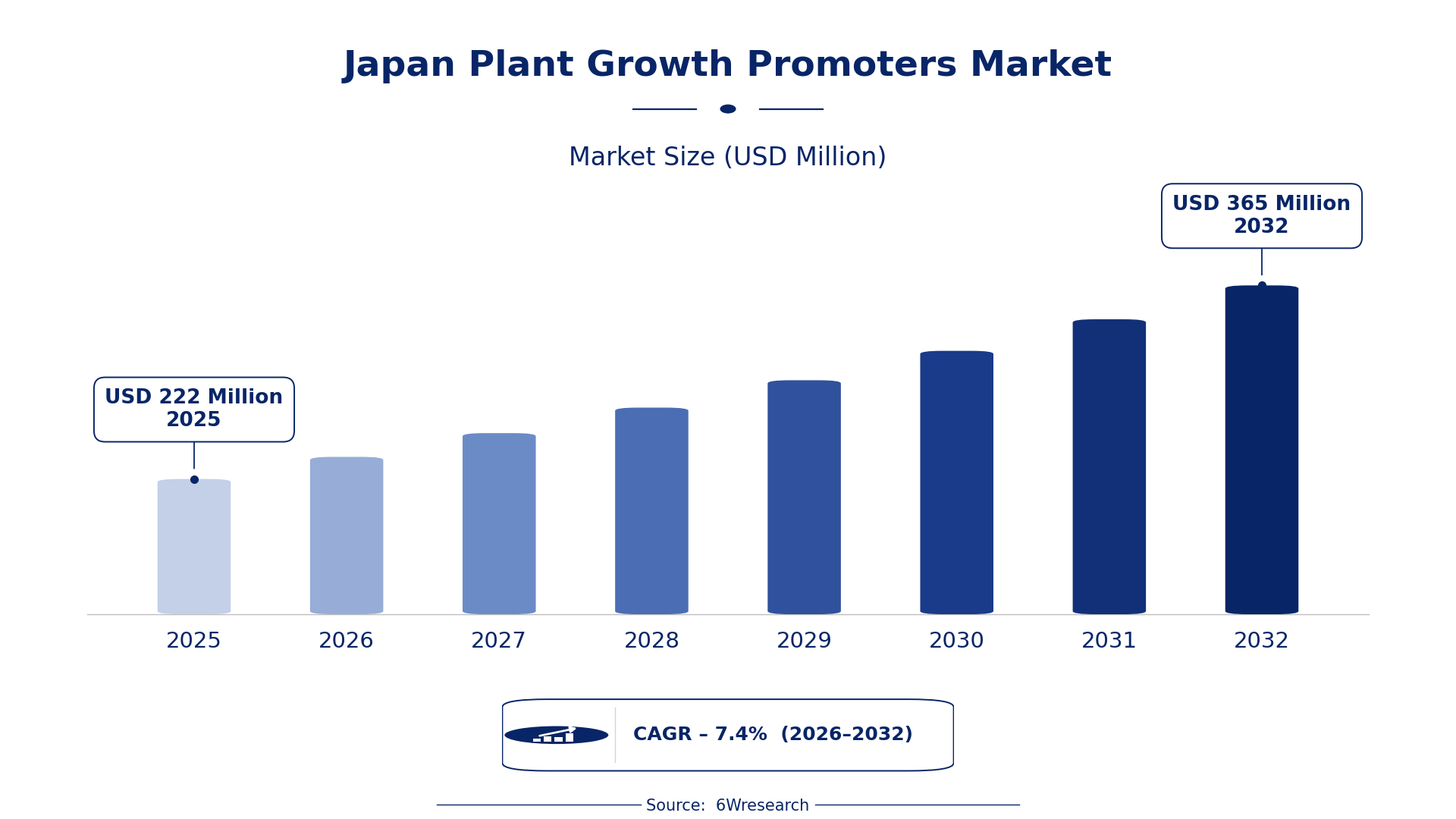
According to 6Wresearch internal database and industry insights, the Japan Plant Growth Promoters Market was valued at USD 222 Million in 2025 and is projected to reach USD 365 Million by 2032, growing at a CAGR of approximately 7.4% during 2026–2032.
Japan Plant Growth Promoters Market Highlights
| Report Metric | Details |
| Report Name | Japan Plant Growth Promoters Market (2026-2032) |
| Market Size 2025 | USD 222 Million |
| Market Size 2032 | USD 365 Million |
| Absolute Growth 2025–2032 | USD 143 Million |
| CAGR 2026–2032 | 7.4% |
| Peak Annual Growth | 8.6% in 2027 |
| Forecast Period | 2026–2032 |
| Historical Data | 2022–2025 |
| Base Year | 2025 |
| Leading Promoter Type, 2025 | Cytokinins (36% share) |
| Leading Chemical Type, 2025 | Natural Hormone (45% share) |
| Leading Distribution Channel, 2025 | Direct Sales (48% share) |
| Leading End User, 2025 | Horticulture Farms (43% share) |
| Fastest-Growing Promoter Type | Gibberellins (10.0% CAGR) |
| Fastest-Growing Chemical Type | Organic Compound (10.2% CAGR) |
| Fastest-Growing Distribution Channel | Online Platforms (9.4% CAGR) |
| Fastest-Growing End User | Agri Product Companies (9.5% CAGR) |
| Growing Sector | Horticulture |
| Key End Users | Horticulture Farms, Agricultural Colleges, Agri Product Companies |
Japan Plant Growth Promoters Market Year-wise Growth Rate and Key Drivers (2022–2032)
This graph illustrates the annual growth rates of the market from 2022 to 2032, highlighting a steady upward trajectory and projected market expansion over the forecast period.
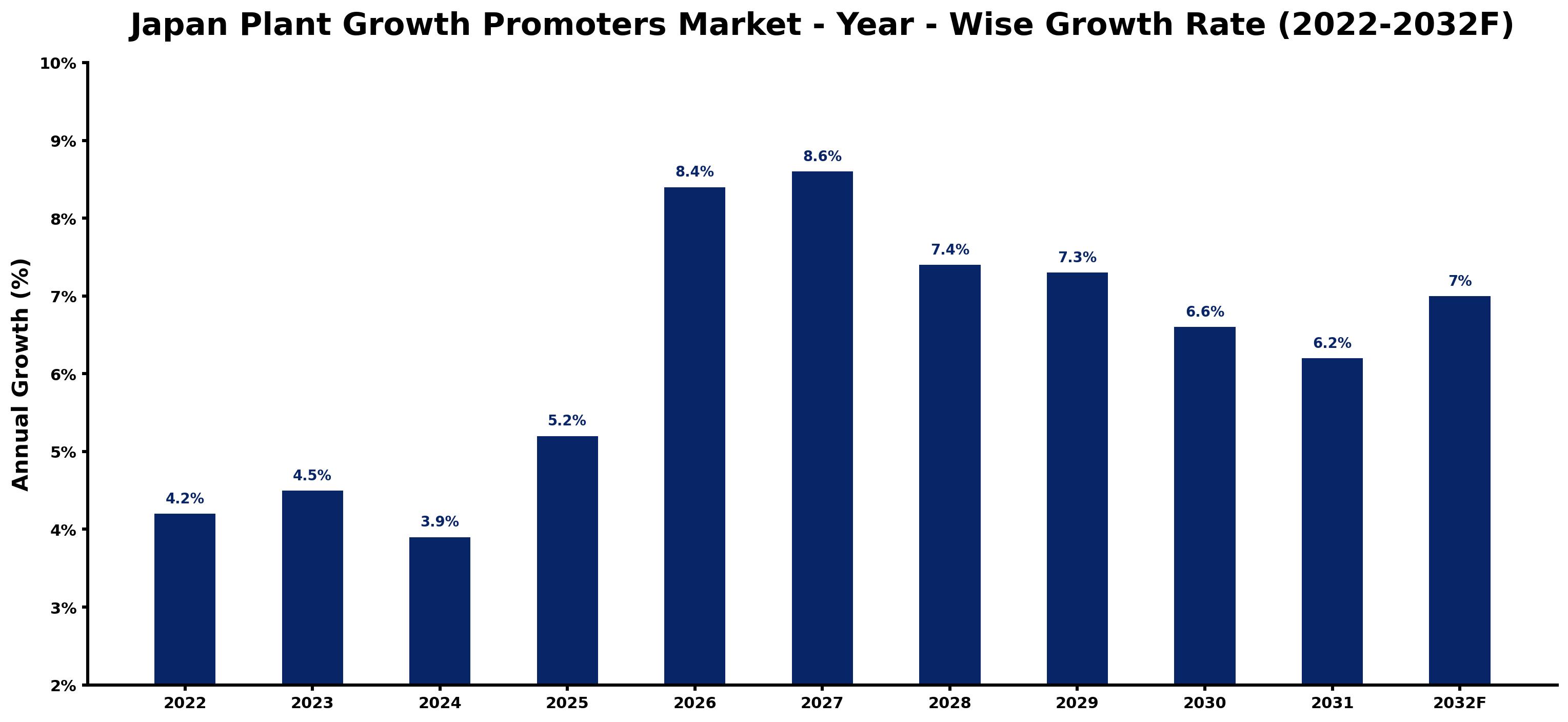
Each row of the following table gives one year's estimated growth and the event or demand shift that explains it.
| Year | Estimated Annual Growth (%) | Market Rationale |
| 2022 | 4.2 | The market experienced steady growth as horticulture farms adopted growth promoters. |
| 2023 | 4.5 | Demand increased as more farmers recognised the benefits of using plant growth promoters. |
| 2024 | 3.9 | Growth slowed slightly due to market saturation in some regions. |
| 2025 | 5.2 | The market rebounded with increased adoption of organic growth promoters by farmers. |
| 2026 | 8.4 | Demand is expected to surge as investment in sustainable agricultural practices gains momentum. |
| 2027 | 8.6 | The peak growth will be driven by heightened interest in new plant growth technologies. |
| 2028 | 7.4 | Growth is projected to slow as the market begins to stabilise after rapid expansion. |
| 2029 | 7.3 | Demand will continue to grow, albeit at a slower rate compared to previous years. |
| 2030 | 6.6 | The market is expected to maintain a steady growth rate as organic farming practices become more mainstream. |
| 2031 | 6.2 | Growth is projected to slow as competition intensifies among suppliers of growth promoters. |
| 2032 | 7.0 | Demand is expected to rise as the agricultural sector shifts towards sustainability. |
Note: Market size estimations and growth projections presented in this report are based on 6Wresearch's proprietary forecasting methodology, utilizing the latest available industry data, government publications, and primary research inputs.
Japan Plant Growth Promoters Market Synopsis
Plant Growth Promoters are substances that enhance plant growth and development through various biochemical processes. The Japan Plant Growth Promoters Market is expanding due to the increasing adoption of organic growth promoters and substantial investment in sustainable agricultural practices. In 2023, the Ministry of Agriculture initiated a program promoting organic growth promoters, aiming for a 30% increase in organic farming by 2025, creating opportunities for suppliers in this evolving market.
Market Dynamics Impact Analysis (2026–2032)
| Factor | Type | Impact | Primary Segment Affected |
| Growing adoption of organic growth promoters | Driver | High | Natural Hormone |
| Increased focus on sustainable agricultural practices | Driver | High | Organic Compound |
| Rising number of horticulture farms | Opportunity | High | Horticulture Farms |
| Expansion of online distribution channels | Opportunity | Medium | Online Platforms |
| Regulatory compliance costs for chemical substances | Restraint | High | Cytokinins |
| Market saturation in certain regions | Restraint | Medium | Gibberellins |
| High costs of compliance with agricultural regulations | Challenge | High | Ethylene Releasers |
| Limited capacity for production scaling | Challenge | Medium | Auxins |
Evaluation of Drivers in Japan Plant Growth Promoters Market (2026–2032)
Below are the drivers that matter most for revenue growth, with supporting evidence.
| Drivers | Primary Segment Affected | Why It Matters (Evidence) |
| Increased demand for organic farming practices | Organic Compound | The average yield increase reported by farms using organic growth promoters is around 15%, prompting farmers to adopt these practices. |
| High usage of Cytokinins in commercial horticulture | Cytokinins | Cytokinins are utilised in over 60% of commercial horticulture applications, driving demand among horticulture farms. |
| Widespread adoption of Gibberellins in rice cultivation | Gibberellins | Gibberellins are commonly used in rice cultivation across Japan's agricultural regions, increasing their demand. |
| Growing preference for natural hormones among farmers | Natural Hormone | Natural hormones are increasingly preferred due to sustainability initiatives in agriculture, leading to higher purchases. |
| The influence of the 'Green Agriculture' initiative | Ethylene Releasers | The 'Green Agriculture' initiative promotes organic compounds, driving demand for ethylene releasers in controlled environments. |
The strongest pull on demand comes from the increasing preference for organic farming practices, with farms using organic growth promoters reporting an average yield increase of around 15%. High usage of Cytokinins in commercial horticulture drives demand among horticulture farms, while widespread adoption in rice cultivation across agricultural regions boosts market presence.
Evaluation of Restraints in Japan Plant Growth Promoters Market
The key brakes on demand, and where they bite hardest, are shown below.
| Market Restraint | Primary Segment Affected | Why It Matters (Evidence) |
| High costs associated with compliance to agricultural regulations | Cytokinins | Compliance with the Chemical Substances Control Law incurs costs for producers, affecting pricing. |
| Market saturation in certain regions limiting growth potential | Gibberellins | In regions with established usage, growth potential for Gibberellins is constrained due to market saturation. |
| Limited availability of skilled workforce in agriculture | Auxins | The agricultural sector employs approximately 1.5 million people, but skilled labour shortages hinder production. |
| Regulatory scrutiny on chemical substances affecting supply | Ethylene Releasers | The Chemical Substances Control Law requires rigorous evaluation, impacting the availability of ethylene releasers. |
| Competition among suppliers driving prices down | Natural Hormone | Intense competition in the market for natural hormones leads to price reductions, affecting profitability. |
Japan Plant Growth Promoters Market Challenges
Buyers face increased costs due to outdated technology, which raises production expenses by approximately 20%. This inefficiency results in delays of up to two weeks for producers, affecting their ability to fulfil orders. Supply chain issues arise from inconsistent availability of natural hormones, forcing producers to stockpile resources and increasing their operational costs. Skills shortages in the agricultural sector hinder effective application of growth promoters, leading to a 15% decrease in yield for some farms. Regulatory compliance under the Agricultural Chemicals Regulation Law complicates operations, adding around 10% to producers' costs.
Trends in the Japan Plant Growth Promoters Market
The following changes are redrawing the Japan Plant Growth Promoters Market.
- Shift towards Organic Growth Promoters: In 2023, the Ministry of Agriculture initiated a program promoting organic growth promoters, aiming for a 30% increase in organic farming by 2025, creating new opportunities for suppliers.
- Emergence of Online Distribution Channels: The rise of online platforms for agricultural products began in 2022, providing farmers with easier access to plant growth promoters. This shift is projected to grow by 9.4% annually, expanding market reach.
- Increased Focus on Sustainability: The Japanese government supports innovation in plant growth technologies through funding programs. This focus on sustainability is driving demand for organic compounds, projected to grow significantly.
- Growing Integration of Biopesticides: In 2023, a new initiative was launched to enhance the use of biopesticides alongside growth promoters. This integration is expected to improve crop yields and sustainability in agricultural practices.
Investment Opportunities in the Japan Plant Growth Promoters Market
The opportunities below stand out in the Japan Plant Growth Promoters Market for new entrants and existing suppliers.
- Organic Growth Promoters: With the Ministry of Agriculture targeting a 30% increase in organic farming by 2025, there is an opportunity to supply organic growth promoters to farmers across Japan.
- Online Sales Platforms: The shift towards online sales channels presents an opportunity to reach a broader audience. Investing in e-commerce solutions can help suppliers tap into this growing market segment.
- Horticulture Farms Expansion: The presence of over 1,000 horticulture farms in Japan indicates a strong market for growth promoters. Suppliers can partner with these farms to enhance product offerings.
- Greenhouse Cultivation: With approximately 20,000 hectares under greenhouse cultivation, suppliers can focus on providing tailored growth promoters for controlled environments, addressing specific crop needs.
Government Initiatives in the Japan Plant Growth Promoters Market
The Hydrogen Society Promotion Act, adopted in 2024, supports low-carbon hydrogen and ammonia supply chains, adding to the regulatory framework for plant growth promoters. This act complements the Chemical Substances Control Law, which mandates evaluation and control of chemical substances, ensuring safer usage in agriculture.
Horticulture farms benefit from the Digital Agency's initiatives, which streamline processes for obtaining approvals for new growth promoters. This agency's efforts in digital transformation support farmers by simplifying compliance with regulations, ultimately improving product availability.
Future Insight of the Japan Plant Growth Promoters Market
Investment in innovative plant growth technologies will drive demand for advanced solutions, creating opportunities for suppliers. By 2032, the use of organic growth promoters will increase significantly, supported by government initiatives aimed at enhancing sustainable practices. Agricultural training programmes will cultivate a skilled workforce, essential for the sector's evolution. The integration of biopesticides with growth promoters will lead to improved crop yields, with reports indicating an average yield increase of around 15% for farms adopting these methods.
Market Segmentation Analysis
Japan Plant Growth Promoters Market report covers a detailed analysis of the following market segments:
By Promoter Type – Cytokinins Lead, Gibberellins Expected to Grow Fastest
According to Navya, Research Analyst at 6Wresearch, Cytokinins took 36% of promoter type revenue in 2025, more than any other category. Cytokinins hold the largest share as they are essential for promoting cell division and growth in over 60% of commercial horticulture applications. Their widespread use in horticulture farms across Japan underscores their importance in enhancing plant development. Over 2026–2032, Gibberellins are expected to post the fastest growth, at a CAGR of 10.0%. Gibberellins are experiencing rapid growth due to their critical role in rice cultivation, a staple crop in Japan. The average yield increase of approximately 15% reported by farms using gibberellins highlights their effectiveness in boosting agricultural output. Suppliers should focus on gibberellins to capitalise on the growing demand in rice cultivation.
By Chemical Type – Natural Hormone Leads, Organic Compound Expected to Grow Fastest
The largest chemical type category in 2025 was Natural Hormone, at 45% of revenue. Natural hormones dominate the market as they are derived from plant sources, appealing to environmentally conscious farmers. Their integration into sustainable agricultural practices aligns with Japan's focus on promoting organic growth methods. Organic Compound is projected to grow fastest, at a CAGR of 10.2% during 2026–2032. Organic compounds are rapidly gaining traction due to government initiatives aimed at increasing organic farming practices by 30% by 2025. This shift reflects a broader trend towards sustainability in agriculture, driving demand for organic solutions. Buyers should consider sourcing organic compounds to align with sustainability goals and government initiatives.
By Distribution Channel – Direct Sales Leads, Online Platforms Expected to Grow Fastest
Direct Sales held 48% of the Japan Plant Growth Promoters Market by distribution channel in 2025. Direct sales lead the distribution channels as they provide farmers with immediate access to growth promoters, ensuring effective delivery to end users. This method allows suppliers to engage directly with farmers, tailoring their offerings to meet specific agricultural needs. Online Platforms are set to record the highest CAGR in this split, 9.4% over 2026–2032. Online platforms are emerging as the fastest-growing distribution channel, improving accessibility for farmers seeking plant growth promoters. The increasing trend towards digital purchasing reflects a shift in how farmers prefer to acquire agricultural products. Suppliers must enhance their online presence to meet the rising demand for convenient purchasing options among farmers.
By End User – Horticulture Farms Lead, Agri Product Companies Expected to Grow Fastest
In 2025, Horticulture Farms led the end user split with a 43% share. Horticulture farms represent the largest user segment of plant growth promoters, employing these products to maximise crop yield and quality. Their significant contribution to the agricultural sector highlights the essential role of growth promoters in enhancing productivity. The quickest growth will come from Agri Product Companies, forecast to expand at a CAGR of 9.5% between 2026 and 2032. Agri product companies are the fastest-growing end users as they increasingly integrate plant growth promoters into their product lines for farmers. This trend indicates a movement towards providing comprehensive solutions that improve agricultural efficiency. Suppliers should seek partnerships with agri product companies to broaden their market reach and increase sales.
Key Attractiveness of the Report
- 10 Years of Market Numbers
- Historical Data Starting from 2022 to 2025
- Base Year 2025
- Forecast Data until 2032
- Key Performance Indicators Impacting the Market
- Major Upcoming Developments and Projects
Key Highlights of the Report:
- Japan Plant Growth Promoters Market Outlook
- Market Size of Japan Plant Growth Promoters Market, 2025
- Forecast of Japan Plant Growth Promoters Market, 2032
- Historical Data and Forecast of Japan Plant Growth Promoters Revenues & Volume for the Period 2022-2032F
- Japan Plant Growth Promoters Market Trend Evolution
- Japan Plant Growth Promoters Market Drivers and Challenges
- Japan Plant Growth Promoters Price Trends
- Japan Plant Growth Promoters Porter's Five Forces
- Japan Plant Growth Promoters Industry Life Cycle
- Historical Data and Forecast of Japan Plant Growth Promoters Market Revenues & Volume By Promoter Type for the Period 2022-2032F
- Historical Data and Forecast of Japan Plant Growth Promoters Market Revenues & Volume By Cytokinins for the Period 2022-2032F
- Historical Data and Forecast of Japan Plant Growth Promoters Market Revenues & Volume By Gibberellins for the Period 2022-2032F
- Historical Data and Forecast of Japan Plant Growth Promoters Market Revenues & Volume By Auxins for the Period 2022-2032F
- Historical Data and Forecast of Japan Plant Growth Promoters Market Revenues & Volume By Ethylene Releasers for the Period 2022-2032F
- Historical Data and Forecast of Japan Plant Growth Promoters Market Revenues & Volume By Chemical Type for the Period 2022-2032F
- Historical Data and Forecast of Japan Plant Growth Promoters Market Revenues & Volume By Natural Hormone for the Period 2022-2032F
- Historical Data and Forecast of Japan Plant Growth Promoters Market Revenues & Volume By Organic Compound for the Period 2022-2032F
- Historical Data and Forecast of Japan Plant Growth Promoters Market Revenues & Volume By Indole Derivatives for the Period 2022-2032F
- Historical Data and Forecast of Japan Plant Growth Promoters Market Revenues & Volume By Gaseous Compound for the Period 2022-2032F
- Historical Data and Forecast of Japan Plant Growth Promoters Market Revenues & Volume By Distribution Channel for the Period 2022-2032F
- Historical Data and Forecast of Japan Plant Growth Promoters Market Revenues & Volume By Direct Sales for the Period 2022-2032F
- Historical Data and Forecast of Japan Plant Growth Promoters Market Revenues & Volume By Online Platforms for the Period 2022-2032F
- Historical Data and Forecast of Japan Plant Growth Promoters Market Revenues & Volume By Distributors for the Period 2022-2032F
- Historical Data and Forecast of Japan Plant Growth Promoters Market Revenues & Volume By Specialty Stores for the Period 2022-2032F
- Historical Data and Forecast of Japan Plant Growth Promoters Market Revenues & Volume By End User for the Period 2022-2032F
- Historical Data and Forecast of Japan Plant Growth Promoters Market Revenues & Volume By Horticulture Farms for the Period 2022-2032F
- Historical Data and Forecast of Japan Plant Growth Promoters Market Revenues & Volume By Agri Product Companies for the Period 2022-2032F
- Historical Data and Forecast of Japan Plant Growth Promoters Market Revenues & Volume By Greenhouse Nurseries for the Period 2022-2032F
- Historical Data and Forecast of Japan Plant Growth Promoters Market Revenues & Volume By Agricultural Colleges for the Period 2022-2032F
- Japan Plant Growth Promoters Import Export Trade Statistics
- Market Opportunity Assessment By Promoter Type
- Market Opportunity Assessment By Chemical Type
- Market Opportunity Assessment By Distribution Channel
- Market Opportunity Assessment By End User
- Japan Plant Growth Promoters Top Companies Market Share
- Japan Plant Growth Promoters Competitive Benchmarking By Technical and Operational Parameters
- Japan Plant Growth Promoters Company Profiles
- Japan Plant Growth Promoters Key Strategic Recommendations
Market Covered
The report covers the following segments.
By Promoter Type
- Cytokinins
- Gibberellins
- Auxins
- Ethylene Releasers
By Chemical Type
- Natural Hormone
- Organic Compound
- Indole Derivatives
- Gaseous Compound
By Distribution Channel
- Direct Sales
- Online Platforms
- Distributors
- Specialty Stores
By End User
- Horticulture Farms
- Agri Product Companies
- Greenhouse Nurseries
- Agricultural Colleges






































