Japan Plant Growth-Promoting Rhizobacteria PGPR Market Size & Growth Rate
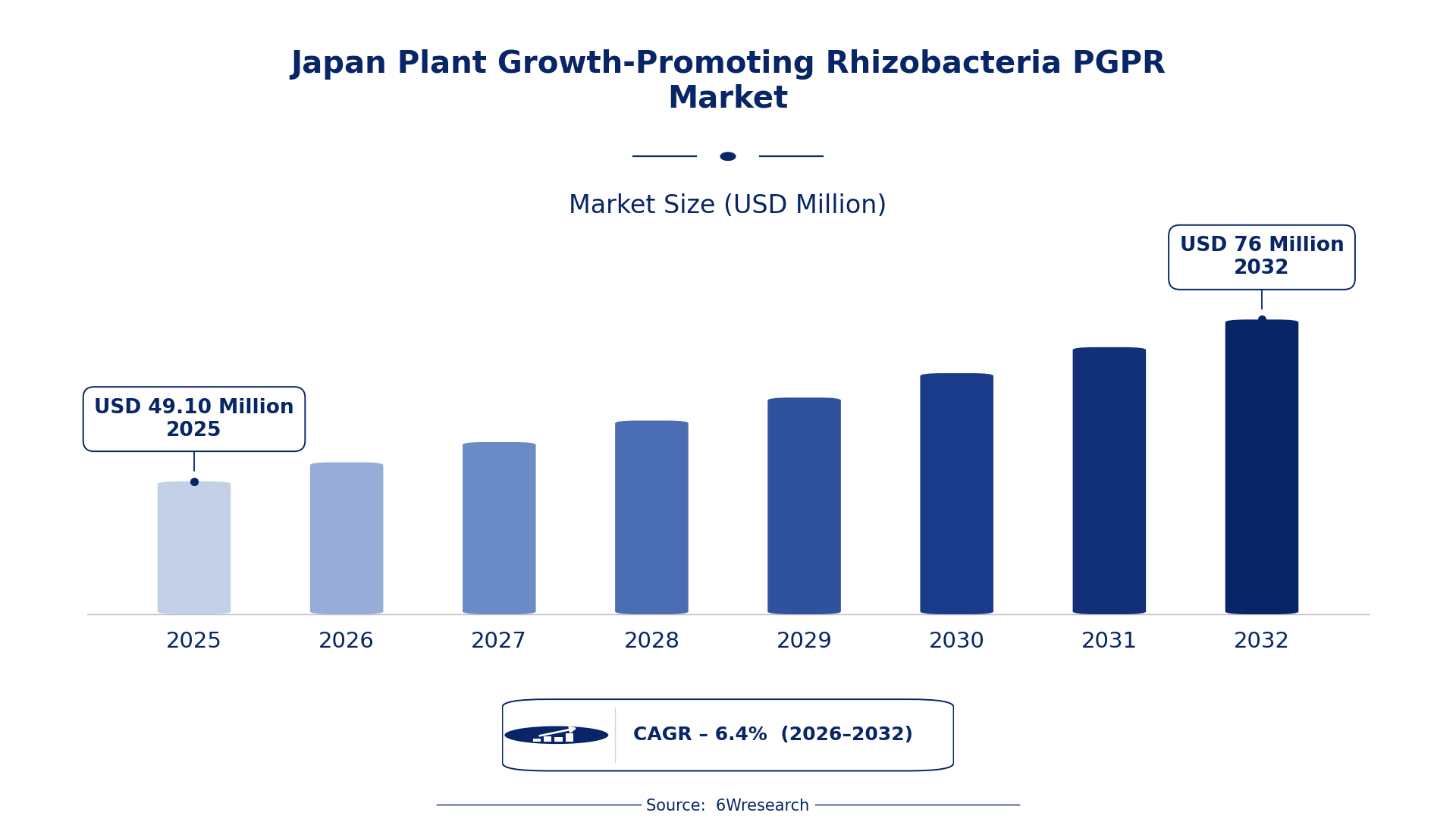
According to 6Wresearch internal database and industry insights, the Japan Plant Growth-Promoting Rhizobacteria PGPR Market was valued at USD 49.10 Million in 2025 and is projected to reach USD 76 Million by 2032, growing at a CAGR of approximately 6.4% during 2026–2032.
Japan Plant Growth-Promoting Rhizobacteria PGPR Market Highlights
| Report Metric | Details |
| Report Name | Japan Plant Growth-Promoting Rhizobacteria PGPR Market (2026-2032) |
| Market Size 2025 | USD 49.10 Million |
| Market Size 2032 | USD 76 Million |
| Absolute Growth 2025–2032 | USD 26.90 Million |
| CAGR 2026–2032 | 6.4% |
| Peak Annual Growth | 7.7% in 2028 |
| Forecast Period | 2026–2032 |
| Historical Data | 2022–2025 |
| Base Year | 2025 |
| Leading Bacteria Type, 2025 | Rhizobium (40% share) |
| Leading Carrier Medium, 2025 | Liquid Culture (36% share) |
| Leading Distribution Channel, 2025 | Direct Sales (36% share) |
| Leading End User, 2025 | Organic Farmers (50% share) |
| Fastest-Growing Bacteria Type | Azospirillum (8.7% CAGR) |
| Fastest-Growing Distribution Channel | Online Platforms (8.1% CAGR) |
| Fastest-Growing End User | Soybean & Legume Growers (8.2% CAGR) |
| Growing Sector | Organic Farming |
| Key End Users | Organic Farmers, Soybean & Legume Growers, Agricultural Universities |
Japan Plant Growth-Promoting Rhizobacteria PGPR Market Year-wise Growth Rate and Key Drivers (2022–2032)
This graph illustrates the annual growth rates of the market from 2022 to 2032, highlighting a steady upward trajectory and projected market expansion over the forecast period.
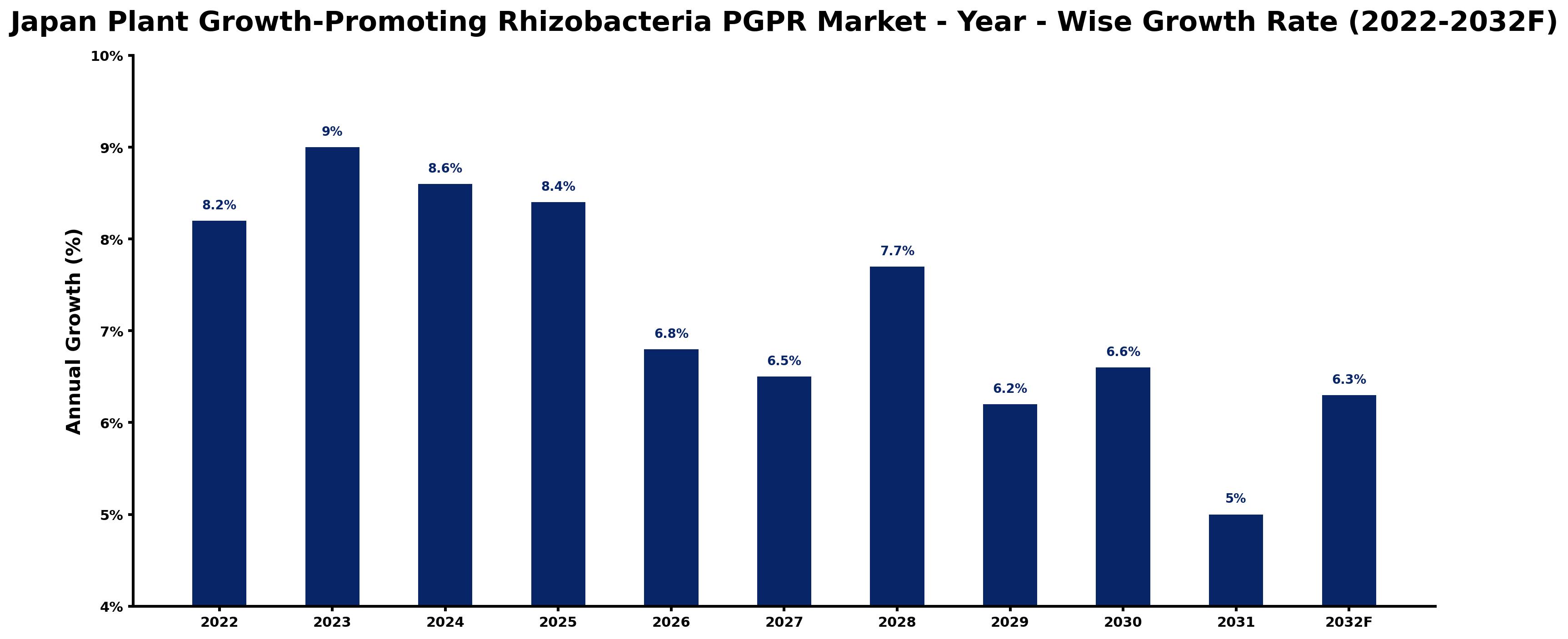
Annual growth estimates for each year appear below with the principal reason behind them, explaining the shifts that set the pace of the market.
| Year | Estimated Annual Growth (%) | Market Rationale |
| 2022 | 8.2 | The market showed solid growth due to increased adoption among organic farmers. |
| 2023 | 9.0 | Demand surged as farmers embraced sustainable practices and the benefits of PGPR became more widely recognised. |
| 2024 | 8.6 | Growth slowed slightly as market saturation began to affect new user acquisition. |
| 2025 | 8.4 | Demand continued to grow, but at a slower pace as competition intensified in the sector. |
| 2026 | 6.8 | Market expansion is expected to decelerate as existing users maximise their applications. |
| 2027 | 6.5 | Growth will further slow as the market matures and new entrants face challenges. |
| 2028 | 7.7 | Demand is projected to accelerate again as new applications of PGPR gain traction among farmers. |
| 2029 | 6.2 | Growth is expected to slow as user adoption reaches a plateau. |
| 2030 | 6.6 | The market is projected to rebound with renewed interest in sustainable agriculture and soil health. |
| 2031 | 5.0 | Growth will slow as the market adjusts to new standards and practices. |
| 2032 | 6.3 | Demand is expected to rise again as the focus on sustainable agriculture intensifies. |
Note: Market size estimations and growth projections presented in this report are based on 6Wresearch's proprietary forecasting methodology, utilizing the latest available industry data, government publications, and primary research inputs.
Japan Plant Growth-Promoting Rhizobacteria PGPR Market Synopsis
Plant Growth-Promoting Rhizobacteria (PGPR) are beneficial bacteria that improve nutrient uptake and enhance soil health. The Japan Plant Growth-Promoting Rhizobacteria PGPR Market is propelled by the agricultural sector, especially organic farming, which encompasses 2.3 million hectares. The average adoption rate of PGPR among organic farmers stands at approximately 30%. Factors such as increased awareness of PGPR advantages and government initiatives that support sustainable agriculture are driving demand.
Market Dynamics Impact Analysis (2026–2032)
| Factor | Type | Impact | Primary Segment Affected |
| Increasing adoption of sustainable farming practices | Driver | High | Organic Farmers |
| Rising interest in soil health and microbial solutions | Driver | High | Soybean & Legume Growers |
| Growing demand for organic products in international markets | Opportunity | High | Organic Farmers |
| Emerging research on PGPR applications in various crops | Opportunity | Medium | Crop Researchers |
| Regulatory complexities surrounding PGPR usage | Restraint | High | Rhizobium |
| Limited awareness among conventional farmers about PGPR benefits | Restraint | Medium | Soybean & Legume Growers |
| Competition from synthetic fertilisers and chemicals | Challenge | High | Rhizobium |
| Challenges in scaling production of PGPR products | Challenge | Medium | Liquid Culture |
Evaluation of Drivers in Japan Plant Growth-Promoting Rhizobacteria PGPR Market (2026–2032)
These are the developments adding the most demand over the forecast period.
| Drivers | Primary Segment Affected | Why It Matters (Evidence) |
| Rising organic farming area | Organic Farmers | Japan's organic farming area reached 2.3 million hectares in 2022, leading to increased PGPR usage among farmers. |
| Government initiatives promoting sustainable agriculture | Soybean & Legume Growers | The 'Green Food System' initiative promotes sustainable agriculture, driving PGPR demand among farmers. |
| Research showing yield increases from PGPR | Crop Researchers | Studies indicate an average yield increase of 15% in soybeans from PGPR application, motivating more farmers to adopt these solutions. |
| Growing consumer preference for organic products | Organic Farmers | Japan's agricultural exports reached $10 billion in 2023, with organic products gaining popularity, driving PGPR demand. |
| Increased collaboration among research institutions | Agricultural Universities | Research institutions have published over 100 studies on PGPR in the last decade, promoting innovation and adoption. |
Most of the extra volume comes from the rising organic farming area, which reached 2.3 million hectares in 2022, prompting farmers to adopt PGPR for improved yields. Research indicates an average yield increase of 15% in soybeans from PGPR application, motivating more farmers to utilise these solutions. The growing consumer preference for organic products, with agricultural exports reaching $10 billion in 2023, supports PGPR adoption. Collaboration among research institutions has resulted in over 100 studies on PGPR, promoting innovation and encouraging uptake among farmers.
Evaluation of Restraints in Japan Plant Growth-Promoting Rhizobacteria PGPR Market
The following restraints limit how fast demand can grow.
| Market Restraint | Primary Segment Affected | Why It Matters (Evidence) |
| Regulatory complexities surrounding PGPR usage | Rhizobium | Regulatory frameworks create hurdles for producers and limit market entry, impacting overall growth. |
| Limited awareness among conventional farmers about PGPR benefits | Soybean & Legume Growers | Many conventional farmers remain unaware of PGPR advantages, hindering broader adoption and limiting market growth. |
| High production costs for PGPR products | Liquid Culture | The costs associated with producing effective PGPR solutions can deter smaller producers from entering the market. |
| Competition from synthetic fertilisers and chemicals | Rhizobium | Synthetic alternatives often offer immediate results, making it challenging for PGPR to compete on price and effectiveness. |
| Inconsistent quality of PGPR products in the market | Liquid Culture | Variability in product quality can lead to distrust among farmers, limiting widespread adoption. |
Japan Plant Growth-Promoting Rhizobacteria PGPR Market Challenges
Producers face a shortage of skilled labour, limiting their ability to implement advanced agricultural practices, which results in an estimated 15% lower yield in soybean crops. Strict regulations under the Agricultural Chemicals Regulation Law create complexities in the supply chain, causing importers to encounter delays that can extend product availability by several weeks. Increased competition from alternative agricultural solutions pressures buyers to pursue lower-cost options, potentially undermining the perceived benefits of microbial applications. Limited awareness among buyers regarding the advantages of these solutions results in only 30% adoption among organic farmers, hindering overall market growth.
Trends in the Japan Plant Growth-Promoting Rhizobacteria PGPR Market
Below are the shifts with the largest effect on the Japan Plant Growth-Promoting Rhizobacteria PGPR Market.
- Rise of Organic Farming Practices: The Tokyo region has experienced a notable increase in organic farming practices, with the organic farming area reaching 2.3 million hectares in 2022. This shift is driving greater PGPR usage among farmers seeking sustainable solutions.
- Growth of Online Sales Channels: Online platforms are emerging as a popular distribution channel for PGPR products, particularly among younger farmers. This trend is reflected in a projected 8.1% CAGR for online sales channels through 2032.
- Focus on Soil Health Initiatives: Since 2023, Japan has prioritised soil health through various initiatives, including a new programme aimed at enhancing soil health with microbial solutions. This focus is likely to increase PGPR applications in agriculture.
- Increased Research into PGPR Applications: Research institutions in Japan have published over 100 studies on PGPR in the last decade, demonstrating strong interest in exploring new applications. This trend supports the development of effective PGPR solutions.
Investment Opportunities in the Japan Plant Growth-Promoting Rhizobacteria PGPR Market
The following areas offer the clearest openings for investors and suppliers in the Japan Plant Growth-Promoting Rhizobacteria PGPR Market.
- Investment in PGPR Research and Development: With Japan's agricultural exports reaching $10 billion in 2023, there is a chance to invest in PGPR research and development. Collaborating with agricultural universities can spur innovation and facilitate market entry.
- Expansion of PGPR Use in Conventional Farming: The average adoption rate of PGPR among organic farmers is estimated at 30%. Targeting conventional farmers with educational initiatives can elevate this rate and significantly expand the market.
- Development of New PGPR Formulations: There is a rising demand for effective PGPR formulations, especially in the liquid culture segment, projected to grow at an 8.5% rate. Investing in new formulations can capture this expanding market.
- Partnerships with Agricultural Cooperatives: The Japan Agricultural Cooperatives (JA) promote PGPR among farmers, creating an opportunity for partnerships. Collaborating with JA can improve distribution and enhance product visibility.
Government Initiatives in the Japan Plant Growth-Promoting Rhizobacteria PGPR Market
The Agricultural Chemicals Regulation Law governs the use of PGPR in agriculture, ensuring safety and efficacy for buyers. This law mandates that producers adhere to strict testing and reporting standards, influencing how PGPR products are developed and marketed. The Ministry of Agriculture, Forestry and Fisheries promotes sustainable agriculture through the 'Green Food System' initiative, which supports research and development of PGPR applications, benefiting both producers and buyers.
The Japan Agricultural Research Organization supports research on PGPR, funding projects that explore new applications. This agency plays a crucial role in advancing knowledge and technology in the field, benefiting both producers and buyers.
Future Insight of the Japan Plant Growth-Promoting Rhizobacteria PGPR Market
The investment pipeline for agricultural research will drive advancements in microbial technologies, creating substantial demand for effective solutions. By 2032, the government will strengthen its commitment to sustainable practices, particularly through the Green Food System initiative. New soil health programmes will emerge, focusing on innovative microbial solutions. Agricultural exports, including organic products, are expected to reach $15 billion, reflecting a growing market for these applications.
Market Segmentation Analysis
Japan Plant Growth-Promoting Rhizobacteria PGPR Market report covers a detailed analysis of the following market segments:
By Bacteria Type – Rhizobium Leads, Azospirillum Expected to Grow Fastest
According to Navya, Research Analyst at 6Wresearch, in 2025, Rhizobium led the bacteria type split with a 40% share. Rhizobium commands the largest share due to its essential role in legume symbiosis, which is critical for nitrogen fixation. In Japan, where legume cultivation is prevalent, this bacterium significantly contributes to enhancing soil health and crop yields. Azospirillum is projected to grow fastest, at a CAGR of 8.7% during 2026–2032. Azospirillum is experiencing rapid growth as its benefits for nitrogen fixation are increasingly recognised among various crops. The reported 15% average yield increase from PGPR application in soybeans highlights its effectiveness and potential for wider adoption. Suppliers should focus on promoting Azospirillum to capitalise on its growing popularity among farmers.
By Carrier Medium – Liquid Culture Leads and Records the Fastest Growth
With 36% of carrier medium revenue in 2025, Liquid Culture was the largest category. Liquid Culture dominates the market as it is commonly used for easy application, making it highly preferred by farmers. Its convenience aligns well with the practices of organic farmers in Japan. Liquid Culture is also forecast to expand faster than any other category, at a CAGR of 8.5% over 2026–2032. Liquid Culture is also the fastest-growing segment, as its ease of use continues to attract more farmers looking for efficient application methods. This trend is likely to strengthen its market position further. Suppliers should ensure a steady supply of Liquid Culture to meet the increasing demand from farmers.
By Distribution Channel – Direct Sales Leads, Online Platforms Expected to Grow Fastest
Direct Sales accounted for 36% of the market by distribution channel in 2025. Direct Sales is the primary method for farmers to obtain PGPR, ensuring immediate access to essential products. This channel has established trust within the agricultural community, making it a preferred choice for many farmers in Japan. Over 2026–2032, Online Platforms are expected to post the fastest growth, at a CAGR of 8.1%. Online Platforms are rapidly gaining traction, providing convenience and accessibility for farmers, which reflects a shift in purchasing habits. The rise in organic farming practices is expected to further accelerate the growth of this distribution channel. Suppliers need to strengthen their online sales strategies to align with the changing purchasing preferences of farmers.
By End User – Organic Farmers Lead, Soybean & Legume Growers Expected to Grow Fastest
Organic Farmers held 50% of the Japan Plant Growth-Promoting Rhizobacteria PGPR Market by end user in 2025. Organic Farmers represent the largest user base of PGPR, actively pursuing sustainable farming practices to improve crop yields. With an estimated 30% adoption rate of PGPR among this group, their commitment to utilising these beneficial bacteria is evident. The quickest growth will come from Soybean & Legume Growers, forecast to expand at a CAGR of 8.2% between 2026 and 2032. Soybean & Legume Growers are the fastest-growing segment, driven by the rising importance of nitrogen-fixing bacteria for enhancing yields. This trend aligns with sustainable agriculture practices, making them a vital target for suppliers. Suppliers should tailor their offerings to meet the specific requirements of Soybean & Legume Growers to maximise market penetration.
Key Attractiveness of the Report
- 10 Years of Market Numbers
- Historical Data Starting from 2022 to 2025
- Base Year 2025
- Forecast Data until 2032
- Key Performance Indicators Impacting the Market
- Major Upcoming Developments and Projects
Key Highlights of the Report:
- Japan Plant Growth-Promoting Rhizobacteria PGPR Market Outlook
- Market Size of Japan Plant Growth-Promoting Rhizobacteria PGPR Market, 2025
- Forecast of Japan Plant Growth-Promoting Rhizobacteria PGPR Market, 2032
- Historical Data and Forecast of Japan Plant Growth-Promoting Rhizobacteria PGPR Revenues & Volume for the Period 2022-2032F
- Japan Plant Growth-Promoting Rhizobacteria PGPR Market Trend Evolution
- Japan Plant Growth-Promoting Rhizobacteria PGPR Market Drivers and Challenges
- Japan Plant Growth-Promoting Rhizobacteria PGPR Price Trends
- Japan Plant Growth-Promoting Rhizobacteria PGPR Porter's Five Forces
- Japan Plant Growth-Promoting Rhizobacteria PGPR Industry Life Cycle
- Historical Data and Forecast of Japan Plant Growth-Promoting Rhizobacteria PGPR Market Revenues & Volume By Bacteria Type for the Period 2022-2032F
- Historical Data and Forecast of Japan Plant Growth-Promoting Rhizobacteria PGPR Market Revenues & Volume By Azospirillum for the Period 2022-2032F
- Historical Data and Forecast of Japan Plant Growth-Promoting Rhizobacteria PGPR Market Revenues & Volume By Rhizobium for the Period 2022-2032F
- Historical Data and Forecast of Japan Plant Growth-Promoting Rhizobacteria PGPR Market Revenues & Volume By Bacillus for the Period 2022-2032F
- Historical Data and Forecast of Japan Plant Growth-Promoting Rhizobacteria PGPR Market Revenues & Volume By Pseudomonas for the Period 2022-2032F
- Historical Data and Forecast of Japan Plant Growth-Promoting Rhizobacteria PGPR Market Revenues & Volume By Carrier Medium for the Period 2022-2032F
- Historical Data and Forecast of Japan Plant Growth-Promoting Rhizobacteria PGPR Market Revenues & Volume By Liquid Culture for the Period 2022-2032F
- Historical Data and Forecast of Japan Plant Growth-Promoting Rhizobacteria PGPR Market Revenues & Volume By Peat Based for the Period 2022-2032F
- Historical Data and Forecast of Japan Plant Growth-Promoting Rhizobacteria PGPR Market Revenues & Volume By Granular Form for the Period 2022-2032F
- Historical Data and Forecast of Japan Plant Growth-Promoting Rhizobacteria PGPR Market Revenues & Volume By Powdered Bioform for the Period 2022-2032F
- Historical Data and Forecast of Japan Plant Growth-Promoting Rhizobacteria PGPR Market Revenues & Volume By Distribution Channel for the Period 2022-2032F
- Historical Data and Forecast of Japan Plant Growth-Promoting Rhizobacteria PGPR Market Revenues & Volume By Direct Sales for the Period 2022-2032F
- Historical Data and Forecast of Japan Plant Growth-Promoting Rhizobacteria PGPR Market Revenues & Volume By Online Platforms for the Period 2022-2032F
- Historical Data and Forecast of Japan Plant Growth-Promoting Rhizobacteria PGPR Market Revenues & Volume By Specialty Stores for the Period 2022-2032F
- Historical Data and Forecast of Japan Plant Growth-Promoting Rhizobacteria PGPR Market Revenues & Volume By Distributors for the Period 2022-2032F
- Historical Data and Forecast of Japan Plant Growth-Promoting Rhizobacteria PGPR Market Revenues & Volume By End User for the Period 2022-2032F
- Historical Data and Forecast of Japan Plant Growth-Promoting Rhizobacteria PGPR Market Revenues & Volume By Organic Farmers for the Period 2022-2032F
- Historical Data and Forecast of Japan Plant Growth-Promoting Rhizobacteria PGPR Market Revenues & Volume By Soybean & Legume Growers for the Period 2022-2032F
- Historical Data and Forecast of Japan Plant Growth-Promoting Rhizobacteria PGPR Market Revenues & Volume By Crop Researchers for the Period 2022-2032F
- Historical Data and Forecast of Japan Plant Growth-Promoting Rhizobacteria PGPR Market Revenues & Volume By Agricultural Universities for the Period 2022-2032F
- Japan Plant Growth-Promoting Rhizobacteria PGPR Import Export Trade Statistics
- Market Opportunity Assessment By Bacteria Type
- Market Opportunity Assessment By Carrier Medium
- Market Opportunity Assessment By Distribution Channel
- Market Opportunity Assessment By End User
- Japan Plant Growth-Promoting Rhizobacteria PGPR Top Companies Market Share
- Japan Plant Growth-Promoting Rhizobacteria PGPR Competitive Benchmarking By Technical and Operational Parameters
- Japan Plant Growth-Promoting Rhizobacteria PGPR Company Profiles
- Japan Plant Growth-Promoting Rhizobacteria PGPR Key Strategic Recommendations
Market Covered
The study includes the following segmentation.
By Bacteria Type
- Azospirillum
- Rhizobium
- Bacillus
- Pseudomonas
By Carrier Medium
- Liquid Culture
- Peat Based
- Granular Form
- Powdered Bioform
By Distribution Channel
- Direct Sales
- Online Platforms
- Specialty Stores
- Distributors
By End User
- Organic Farmers
- Soybean & Legume Growers
- Crop Researchers
- Agricultural Universities






































