Japan Plastic Bottles Market Size, Share & Growth Rate
The Japan Plastic Bottles Market was estimated at USD 87 Million in 2025 and is projected to reach USD 93 Million by 2032, growing at a CAGR of 1.0% from 2026 to 2032. This steady growth trajectory reflects the increasing consumer demand for convenient and portable packaging solutions across various sectors, particularly beverages and personal care. Additionally, rising awareness regarding sustainability is prompting manufacturers to innovate, thereby enhancing the overall market landscape.
Japan Plastic Bottles Market Year-wise Growth Rate and Key Drivers
This graph highlights how the Japan Plastic Bottles Market has steadily grown over the years, supported by major growth factors.
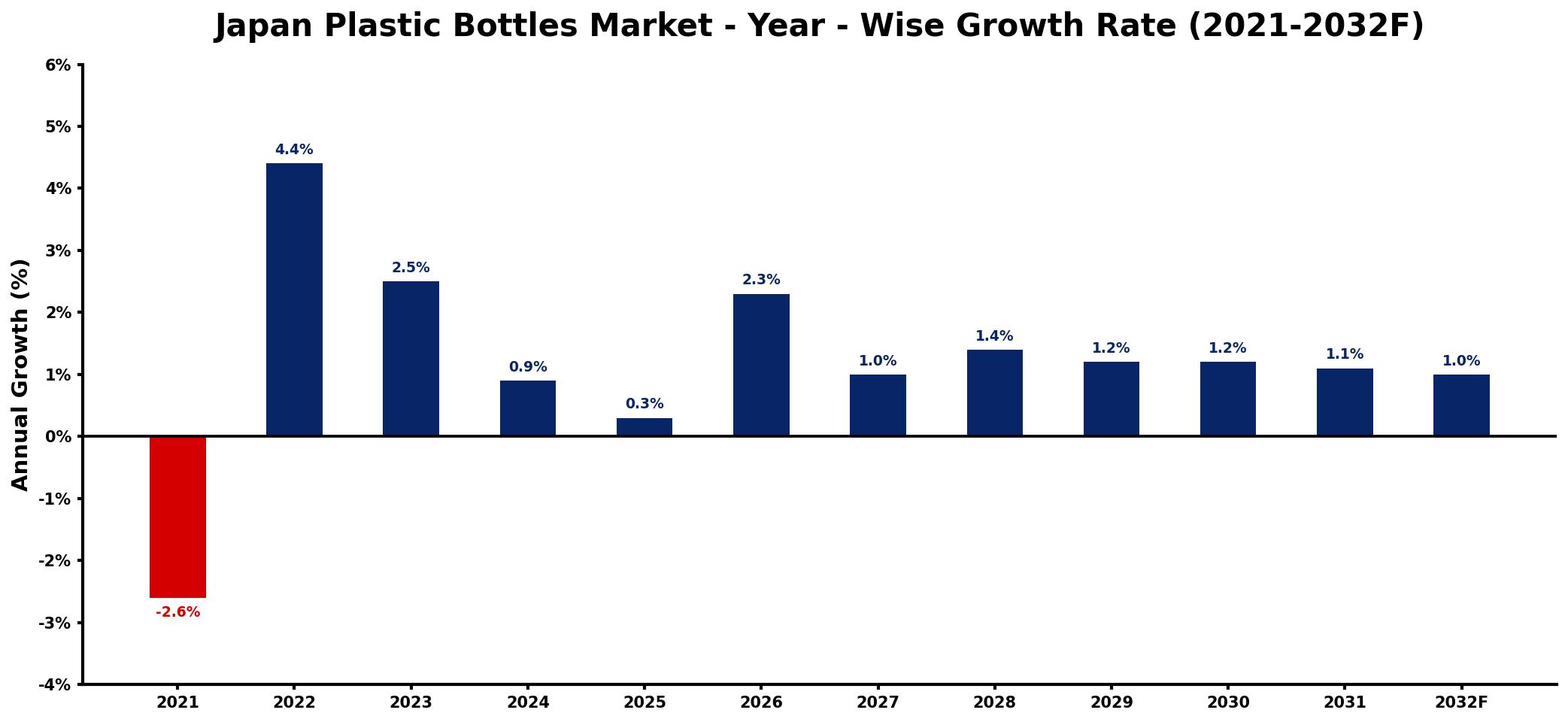
The table below presents the year‑wise growth rates along with the key drivers influencing the market
| Year | Growth Rate | Major Drivers |
| 2021 | -2.6% | Shift towards alternative materials |
| 2022 | 4.4% | Rising consumer health awareness |
| 2023 | 2.5% | Expansion of beverage sector |
| 2024 | 0.9% | Increased recycling initiatives adopted |
| 2025 | 0.3% | Growth in e-commerce platforms |
| 2026 | 2.3% | Technological advancements in production |
| 2027 | 1.0% | Sustainability trends gaining traction |
| 2028 | 1.4% | Higher demand for convenience packaging |
| 2029 | 1.2% | Investments in renewable resources |
| 2030 | 1.2% | Focus on lightweight packaging solutions |
| 2031 | 1.1% | Emergence of new market players |
| 2032 | 1.0% | Regulatory support for sustainable practices |
Note: Market size estimations and growth projections presented in this report are based on 6Wresearch's proprietary forecasting methodology, utilizing the latest available industry data, government publications, and primary research inputs.
Japan Plastic Bottles Market Synopsis
The strongest force shaping the Japan Plastic Bottles Market today is the shift towards sustainable and eco-friendly packaging. This shift is driven by heightened consumer awareness and stringent government regulations aimed at reducing plastic waste. Consequently, manufacturers are actively exploring options such as recycled PET and biodegradable materials to meet these evolving consumer preferences.
Innovation plays a pivotal role in this market, with companies investing heavily in advanced technologies for the development of lightweight and functional bottle designs. As Japanese consumers increasingly prioritize hygiene and convenience, the demand for innovative packaging formats—such as resealable bottles—continues to rise, further fueling market expansion.
Japan Plastic Bottles Market Key Takeaways
- The market is undergoing a notable transition towards eco-friendly alternatives, reflecting global sustainability trends.
- Consumer preferences for convenience and hygiene are major drivers of demand for plastic bottles.
- Investment in recycling technologies is critical for manufacturers to maintain competitiveness and meet regulations.
- Functional packaging formats are gaining popularity in response to the fast-paced lifestyles of consumers.
- Market dynamics are increasingly influenced by regulatory frameworks focused on reducing plastic waste and promoting recycling.
Evaluation of Restraints in Japan Plastic Bottles Market
Despite its growth, the Japan Plastic Bottles Market faces significant restraints primarily related to environmental concerns surrounding plastic waste. Increasing public scrutiny regarding the sustainability of packaging solutions is pressuring manufacturers to adapt swiftly. The fluctuations in raw material prices, particularly for petroleum-based plastics, further complicate production costs, thus impacting profitability. Additionally, stringent recycling regulations imposed by the government necessitate substantial investments in improving waste management processes, placing additional strain on the industry.
Japan Plastic Bottles Market Trends
Sustainability is the prevailing trend in the Japan Plastic Bottles Market, characterized by a noticeable shift towards biodegradable and recyclable materials. As consumers increasingly demand environmentally responsible products, companies are investing in bio-based plastics and enhancing recycling processes. Concurrently, innovative design solutions are emerging, focusing on lightweight and functional features that cater to convenience. The popularity of resealable and easy-to-carry bottles is indicative of changing consumer lifestyles, aligning with the broader trend of product personalization and customization.
Japan Plastic Bottles Market Opportunities
The Japan Plastic Bottles Market presents lucrative investment opportunities across various sectors, particularly in beverages and personal care products. The increasing emphasis on sustainability creates a demand for eco-friendly packaging, positioning companies that invest in biodegradable and recycled materials favorably. Furthermore, there is potential for growth in niche markets that require specialized packaging solutions. Collaborations aimed at enhancing production efficiency and reducing costs while maintaining quality standards can yield significant returns in this evolving landscape.
Government Initiatives in the Japan Plastic Bottles Market
The Japanese government has instituted several policies to address environmental concerns in the plastic bottles market, notably the Plastic Resource Recycling Law. This legislation mandates businesses to enhance recycling efforts for plastic containers and packaging. Additionally, the government has set ambitious recycling targets for plastic bottles to boost collection rates and promote sustainability. Programs such as eco-points incentivize consumers to choose environmentally friendly packaging solutions, further aligning public behavior with national waste reduction goals.
Future Insights of the Japan Plastic Bottles Market
Looking ahead to 2026-2032, the Japan Plastic Bottles Market is poised for steady growth driven by rising consumer demand for bottled beverages and an overarching focus on environmental sustainability. Despite facing regulatory challenges aimed at reducing plastic waste, the market is likely to witness an increasing shift towards the utilization of recycled materials and innovative packaging solutions. As companies prioritize sustainability in their strategies, the market will adapt to meet both consumer expectations and regulatory requirements, paving the way for a more eco-conscious future.
Japan Plastic Bottles Market Latest Developments (2025 - 2026)
Recent developments in the Japan Plastic Bottles Market indicate a heightened focus on sustainability and innovation. Companies are increasingly adopting advanced manufacturing techniques to produce eco-friendly bottles that comply with the latest regulatory standards. There's also a noticeable surge in collaborative efforts among manufacturers to improve recycling infrastructure, driven by the need for efficient waste management solutions. These initiatives are anticipated to further influence market dynamics and consumer preferences moving forward.
Japan Plastic Bottles Market - Key Attractiveness of the Report
- 10 Years of Market Numbers
- Historical Data Starting from 2022 to 2025
- Base Year: 2025
- Forecast Data until 2032
- Key Performance Indicators Impacting the Market
- Major Upcoming Developments and Projects
Key Highlights of the Report:
- Japan Plastic Bottles Market Outlook
- Market Size of Japan Plastic Bottles Market, 2025
- Forecast of Japan Plastic Bottles Market, 2032
- Historical Data and Forecast of Japan Plastic Bottles Revenues & Volume for the Period 2022-2032F
- Japan Plastic Bottles Market Trend Evolution
- Japan Plastic Bottles Market Drivers and Challenges
- Japan Plastic Bottles Price Trends
- Japan Plastic Bottles Porter's Five Forces
- Japan Plastic Bottles Industry Life Cycle
- Historical Data and Forecast of Japan Plastic Bottles Market Revenues & Volume By Raw Material Type for the Period 2022-2032F
- Historical Data and Forecast of Japan Plastic Bottles Market Revenues & Volume By Polyethylene Terephthalate (PET) for the Period 2022-2032F
- Historical Data and Forecast of Japan Plastic Bottles Market Revenues & Volume By Poly Propylene (PP) for the Period 2022-2032F
- Historical Data and Forecast of Japan Plastic Bottles Market Revenues & Volume By Low-density Polyethylene (LDPE) for the Period 2022-2032F
- Historical Data and Forecast of Japan Plastic Bottles Market Revenues & Volume By High-density Polyethylene (HDPE) for the Period 2022-2032F
- Historical Data and Forecast of Japan Plastic Bottles Market Revenues & Volume By Other Raw Materials for the Period 2022-2032F
- Historical Data and Forecast of Japan Plastic Bottles Market Revenues & Volume By End-user for the Period 2022-2032F
- Historical Data and Forecast of Japan Plastic Bottles Market Revenues & Volume By Beverage for the Period 2022-2032F
- Historical Data and Forecast of Japan Plastic Bottles Market Revenues & Volume By Food for the Period 2022-2032F
- Historical Data and Forecast of Japan Plastic Bottles Market Revenues & Volume By Cosmetics for the Period 2022-2032F
- Historical Data and Forecast of Japan Plastic Bottles Market Revenues & Volume By Pharmaceutical for the Period 2022-2032F
- Historical Data and Forecast of Japan Plastic Bottles Market Revenues & Volume By Household Care for the Period 2022-2032F
- Historical Data and Forecast of Japan Plastic Bottles Market Revenues & Volume By Other for the Period 2022-2032F
- Japan Plastic Bottles Import Export Trade Statistics
- Market Opportunity Assessment By Raw Material Type
- Market Opportunity Assessment By End-user
- Japan Plastic Bottles Top Companies Market Share
- Japan Plastic Bottles Competitive Benchmarking By Technical and Operational Parameters
- Japan Plastic Bottles Company Profiles
- Japan Plastic Bottles Key Strategic Recommendations






































