Japan Plastic Market Size & Growth Rate
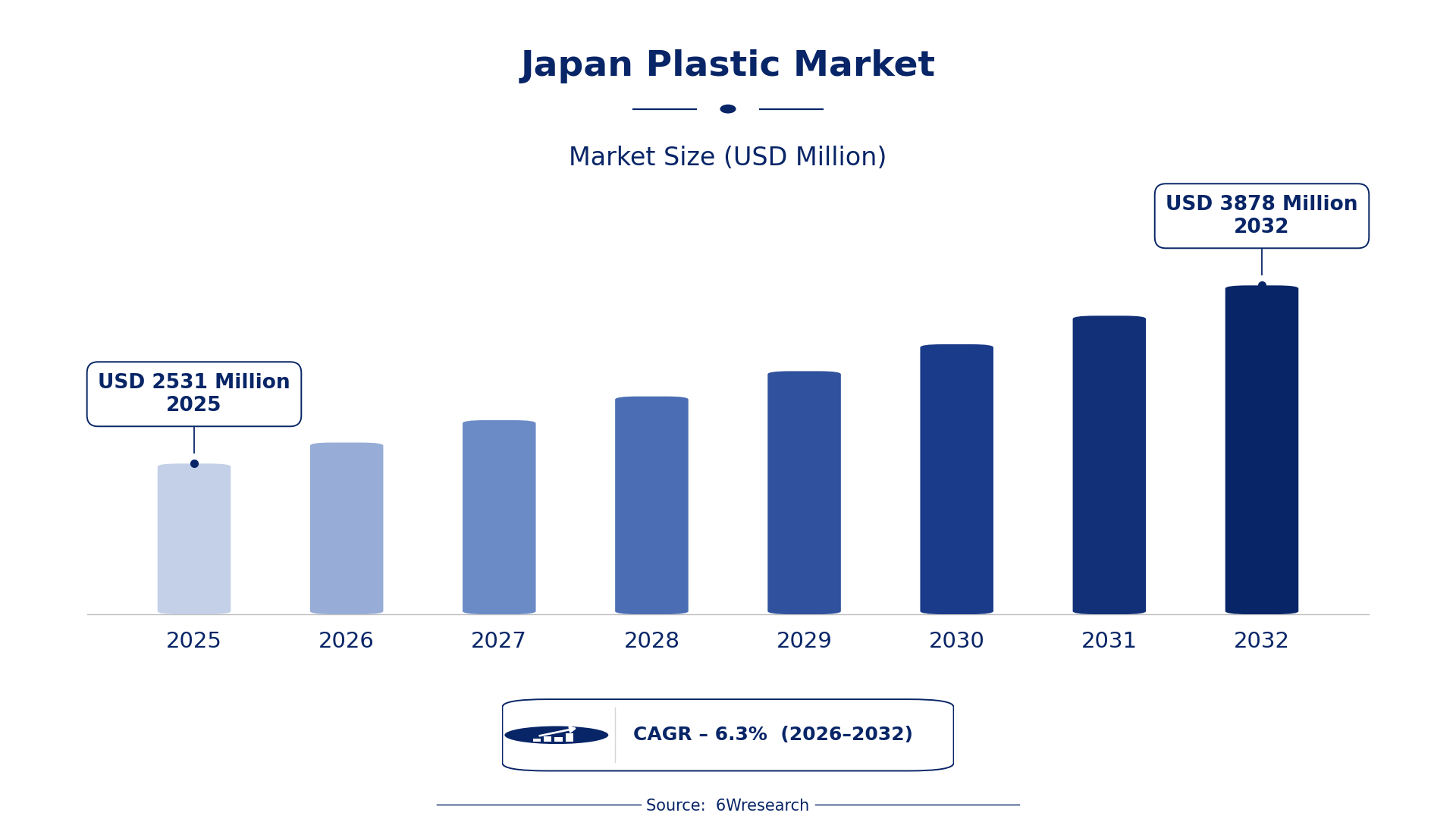
According to 6Wresearch internal database and industry insights, the Japan Plastic Market was valued at USD 2,531 Million in 2025 and is projected to reach USD 3,878 Million by 2032, growing at a CAGR of approximately 6.3% during 2026–2032.
Japan Plastic Market Highlights
| Report Metric | Details |
| Report Name | Japan Plastic Market (2026-2032) |
| Market Size 2025 | USD 2,531 Million |
| Market Size 2032 | USD 3,878 Million |
| Absolute Growth 2025–2032 | USD 1,347 Million |
| CAGR 2026–2032 | 6.3% |
| Peak Annual Growth | 7.4% in 2028 |
| Forecast Period | 2026–2032 |
| Historical Data | 2022–2025 |
| Base Year | 2025 |
| Leading Product, 2025 | Polyethylene (PE) (33% share) |
| Leading Application, 2025 | Injection Molding (34% share) |
| Leading End-use, 2025 | Packaging (35% share) |
| Fastest-Growing Product | Polypropylene (PP) (9.3% CAGR) |
| Fastest-Growing Application | Blow Molding (8.9% CAGR) |
| Fastest-Growing End-use | Construction (8.7% CAGR) |
| Growing Sector | Packaging |
| Key End Users | Manufacturers, construction firms, automotive producers, recycling facilities |
Japan Plastic Market Year-wise Growth Rate and Key Drivers (2022–2032)
This graph illustrates the annual growth rates of the market from 2022 to 2032, highlighting a steady upward trajectory and projected market expansion over the forecast period.
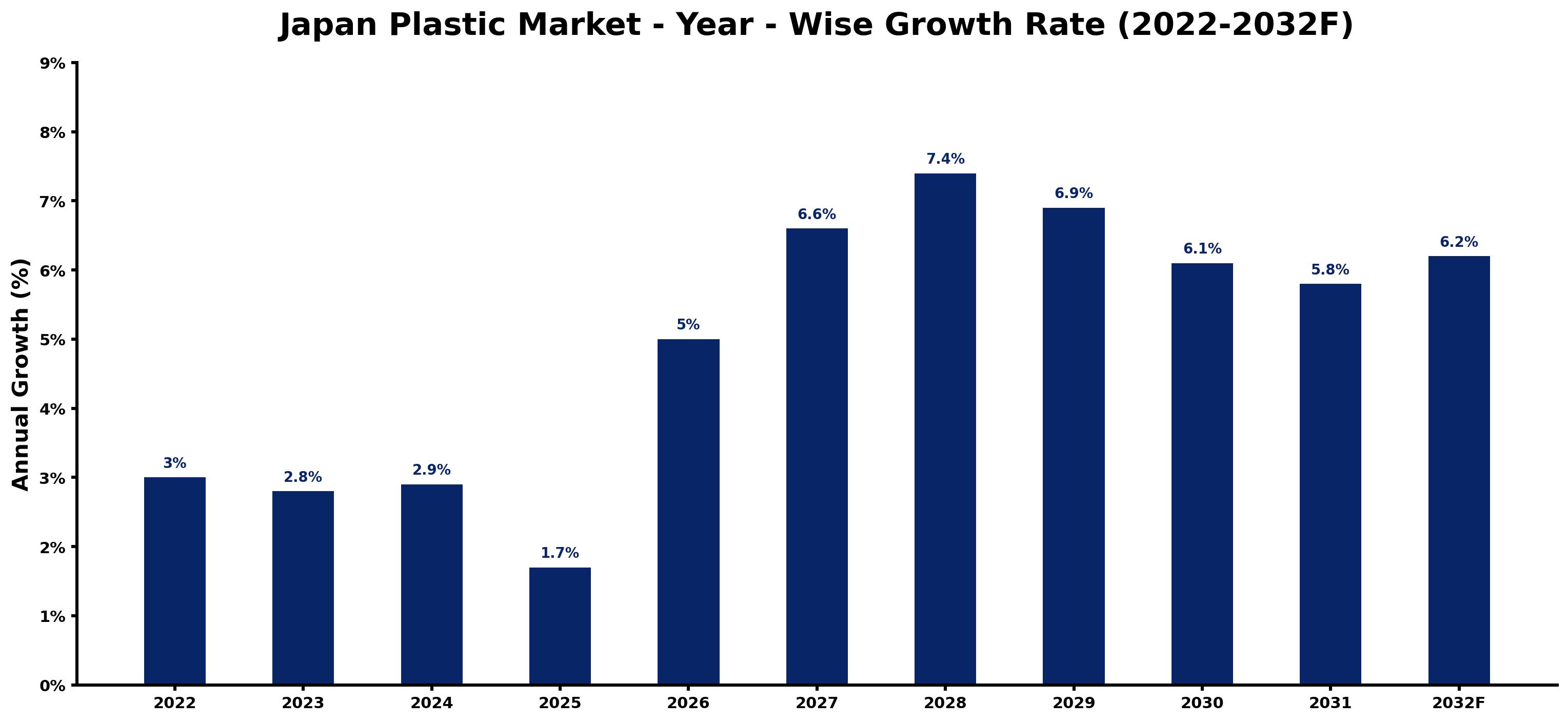
The table below sets out the estimated growth rate for each year and the main factor behind it.
| Year | Estimated Annual Growth (%) | Market Rationale |
| 2022 | 3.0 | The market showed steady growth due to strong domestic demand for plastics in various sectors. |
| 2023 | 2.8 | Growth slowed as manufacturers adjusted to changing consumer preferences and sustainability concerns. |
| 2024 | 2.9 | Demand increased as industries began to adopt more sustainable plastic alternatives and recycling methods. |
| 2025 | 1.7 | Growth slowed again as the market faced challenges from rising raw material costs and competition. |
| 2026 | 5.0 | Demand is expected to rise as investments in recycling facilities and sustainable practices gain momentum. |
| 2027 | 6.6 | The market will continue to grow as technological advancements in plastic production are implemented. |
| 2028 | 7.4 | A peak growth rate is anticipated as the automotive sector increases its plastic usage. |
| 2029 | 6.9 | Growth is projected to slow slightly as the market stabilises after the peak. |
| 2030 | 6.1 | A further slowdown is expected as the market adjusts to new regulations and consumer trends. |
| 2031 | 5.8 | Growth will continue to slow as the industry focuses on compliance and sustainability initiatives. |
| 2032 | 6.2 | Demand is expected to rise again as new recycling technologies are adopted across sectors. |
Note: Market size estimations and growth projections presented in this report are based on 6Wresearch's proprietary forecasting methodology, utilizing the latest available industry data, government publications, and primary research inputs.
Japan Plastic Market Synopsis
Plastic is a synthetic material made from petrochemicals, produced primarily through polymerization and polycondensation. Its main applications include packaging, construction, automotive parts, and medical devices. The Japan Plastic Market is expanding due to strong domestic demand from sectors such as packaging, which is valued at approximately $10 billion. The automotive sector consumes around 1.2 million tons of plastics annually, while ongoing investments in recycling facilities support sustainable practices and increase overall demand.
Market Dynamics Impact Analysis (2026–2032)
| Factor | Type | Impact | Primary Segment Affected |
| Rising demand for sustainable packaging solutions | Driver | High | Packaging |
| Increased automotive production requiring lightweight materials | Driver | High | Automotive |
| Growing investment in recycling facilities | Opportunity | High | Polyethylene (PE) |
| Expansion of construction projects requiring plastic materials | Opportunity | High | Construction |
| Fluctuating raw material prices affecting production costs | Restraint | High | Polyethylene (PE) |
| Regulatory compliance costs related to sustainability initiatives | Restraint | Medium | Polyethylene (PE) |
| Limited capacity of recycling facilities to meet demand | Challenge | High | Polyethylene (PE) |
| Stringent regulations on plastic waste management | Challenge | Medium | Polyethylene (PE) |
Evaluation of Drivers in Japan Plastic Market (2026–2032)
Below are the drivers that matter most for revenue growth, with supporting evidence.
| Drivers | Primary Segment Affected | Why It Matters (Evidence) |
| Increased demand for packaging solutions | Packaging | The packaging sector drives demand as it accounts for 35% of plastic use, with a market value of approximately $10 billion. |
| Rising automotive production | Automotive | The automotive sector consumes around 1.2 million tons of plastics annually, increasing demand for lightweight materials. |
| Growth in construction projects | Construction | Construction uses a substantial amount of plastics, contributing to the overall market growth as infrastructure projects expand. |
| Adoption of sustainable practices | Polyethylene (PE) | Investments in recycling facilities are increasing, with over 100 facilities operational, boosting the recycling rate to 84%. |
| Technological advancements in production methods | Polyethylene (PE) | Innovations in plastic manufacturing processes are improving efficiency and reducing costs, attracting more buyers. |
Buyers are adding capacity as demand for packaging solutions rises, with the packaging sector valued at approximately $10 billion. The automotive industry consumes around 1.2 million tons of plastics annually, leading to increased production of lightweight materials. Growth in construction projects is also apparent, as infrastructure development requires substantial plastic use. Investments in recycling facilities are improving sustainability, with over 100 operational facilities increasing recycling rates. Advances in production methods are improving efficiency, attracting more buyers in various sectors.
Evaluation of Restraints in Japan Plastic Market
Below are the constraints most often cited by buyers and suppliers, with the segment each affects.
| Market Restraint | Primary Segment Affected | Why It Matters (Evidence) |
| Fluctuating raw material prices | Polyethylene (PE) | Rising costs of petrochemicals impact production expenses, affecting profitability across the plastic industry. |
| Regulatory compliance costs | Polyethylene (PE) | Meeting stringent sustainability regulations increases operational costs for producers, impacting pricing strategies. |
| Limited recycling capacity | Polyethylene (PE) | The current capacity of over 100 recycling facilities struggles to meet the growing demand for recycled plastics. |
| Consumer preference for biodegradable options | Polyethylene (PE) | Shifting consumer preferences towards sustainable alternatives challenge traditional plastic producers to adapt. |
| Competition from alternative materials | Construction | The rise of alternative materials in packaging and construction sectors pressures plastic demand. |
Japan Plastic Market Challenges
Japan's plastic industry faces stringent regulations, as compliance with JIS K 6768 standards raises production costs for suppliers, potentially increasing prices for buyers by 15%. Supply chain disruptions are critical since the Tokyo region accounts for 30% of production, causing delays for manufacturers if local issues arise. Intense price competition among suppliers leads to reduced margins, resulting in a 10% decline in profitability that limits their capacity to invest in new technologies. Buyers experience fluctuating costs due to these competitive pressures, forcing them to frequently adjust budgets and stock levels.
Trends in the Japan Plastic Market
The shifts below are changing how Japan Plastic Market products are bought and supplied.
- Shift towards Sustainable Packaging Solutions: Producers are increasingly adopting sustainable materials, influenced by consumer demand. In 2023, Japan launched a campaign to reduce single-use plastics by 50%, impacting market dynamics.
- Emergence of Advanced Recycling Technologies: The development of advanced recycling technologies is transforming the industry. Japan's recycling rate reached 84% in 2022, showcasing the effectiveness of new methods in waste management.
- Transition from Traditional to Lightweight Automotive Plastics: The automotive sector is transitioning to lightweight plastics to improve fuel efficiency. In 2022, this sector utilised around 1.2 million tons of plastics, reflecting a growing trend.
- Growth in Construction Plastics Usage: The construction industry is increasingly utilising plastics for various applications. In 2022, plastic use in construction grew significantly, driven by ongoing infrastructure projects.
Investment Opportunities in the Japan Plastic Market
Several openings in the Japan Plastic Market merit attention from investors.
- Investment in Construction Plastics: The construction sector is expanding, requiring more plastic materials. Collaborating with construction firms can open new avenues for suppliers.
- Enhancing Recycling Infrastructure: With Japan's recycling rate at 84%, there is a need for advanced recycling technologies. Investing in innovative recycling facilities can cater to this demand, especially in urban areas.
- Development of Biodegradable Plastics: As consumer preferences shift towards sustainability, there is a growing market for biodegradable plastics. Suppliers can target eco-conscious buyers in various sectors.
- Expansion into Medical Plastics: The medical devices sector is increasingly utilising plastics for sterile and disposable items. Suppliers can explore partnerships with healthcare providers to meet this demand.
Government Initiatives in the Japan Plastic Market
The Plastic Resource Circulation Act, enacted in 2021, updates previous regulations by promoting the reduction, reuse, and recycling of plastics. This law supports the transition to alternatives like biomass and biodegradable plastics, ensuring compliance with modern sustainability standards. In 2022, Japan allocated $50 million to improve recycling initiatives, aiming to enhance recycling infrastructure and promote sustainable practices across the industry.
In 2022, the Ministry of the Environment allocated $50 million to support recycling initiatives under the Plastic Resource Circulation Act. This funding aims to improve recycling infrastructure and promote sustainable practices across the industry.
Future Insight of the Japan Plastic Market
The investment pipeline for recycling facilities will grow, creating demand for high-quality recycled materials. By 2032, Japan's plastic production will evolve with advancements in polymer technology, enabling more efficient manufacturing processes. The automotive sector will continue to require around 1.2 million tons of plastics annually, driving innovation in lightweight alternatives. Government initiatives will support waste reduction, further promoting a shift towards sustainable practices in the industry.
Market Segmentation Analysis
Japan Plastic Market report covers a detailed analysis of the following market segments:
By Product – Polyethylene (PE) Leads, Polypropylene (PP) Expected to Grow Fastest
According to Shubham Padhi, Research Analyst at 6Wresearch, with 33% of product revenue in 2025, Polyethylene (PE) was the largest category. Polyethylene holds the largest share because it is extensively utilised in packaging and containers, essential for various industries. The Tokyo region's significant contribution of 30% to Japan's plastic production underscores polyethylene's critical role in meeting local packaging needs. Over 2026–2032, Polypropylene (PP) is expected to post the fastest growth, at a CAGR of 9.3%. Polypropylene is experiencing rapid growth due to its increasing application in automotive and consumer products, which are seeing heightened demand. The automotive sector's consumption of around 1.2 million tons of plastics annually indicates a strong upward trajectory for polypropylene. Suppliers should focus on expanding their polypropylene offerings to capitalise on the increasing demand in key sectors.
By Application – Injection Molding Leads, Blow Molding Expected to Grow Fastest
The largest application category in 2025 was Injection Molding, at 34% of revenue. Injection Molding leads the market as it is the primary method for producing plastic parts across various sectors, ensuring high efficiency and precision. This method is widely adopted in the manufacturing of consumer goods and automotive components. The quickest growth will come from Blow Molding, forecast to expand at a CAGR of 8.9% between 2026 and 2032. Blow Molding is experiencing the fastest growth due to its application in producing hollow plastic products like bottles, which are in high demand. The increasing focus on sustainable packaging solutions further propels this segment. Buyers should consider investing in blow molding technologies to meet the rising demand for sustainable packaging solutions.
By End-use – Packaging Leads, Construction Expected to Grow Fastest
Packaging took 35% of end-use revenue in 2025, more than any other category. Packaging is the dominant application for plastics, driven by substantial demand from the consumer goods sector. The plastic packaging market's valuation at approximately $10 billion highlights its vital importance in Japan's economy. Construction is projected to grow fastest, at a CAGR of 8.7% during 2026–2032. The construction sector's consumption of plastics is rising sharply, particularly for building materials, as infrastructure projects gain momentum. This trend is likely to continue as Japan prioritises modernising its infrastructure. Suppliers must adapt their product lines to align with the growing requirements of the construction sector for plastic materials.
Key Attractiveness of the Report
- 10 Years of Market Numbers
- Historical Data Starting from 2022 to 2025
- Base Year 2025
- Forecast Data until 2032
- Key Performance Indicators Impacting the Market
- Major Upcoming Developments and Projects
Key Highlights of the Report:
- Japan Plastic Market Outlook
- Market Size of Japan Plastic Market, 2025
- Forecast of Japan Plastic Market, 2032
- Historical Data and Forecast of Japan Plastic Revenues & Volume for the Period 2022-2032
- Japan Plastic Market Trend Evolution
- Japan Plastic Market Drivers and Challenges
- Japan Plastic Price Trends
- Japan Plastic Porter's Five Forces
- Japan Plastic Industry Life Cycle
- Historical Data and Forecast of Japan Plastic Market Revenues & Volume By Product for the Period 2022-2032
- Historical Data and Forecast of Japan Plastic Market Revenues & Volume By Polyethylene (PE) for the Period 2022-2032
- Historical Data and Forecast of Japan Plastic Market Revenues & Volume By Polypropylene (PP) for the Period 2022-2032
- Historical Data and Forecast of Japan Plastic Market Revenues & Volume By Polyurethane (PU) for the Period 2022-2032
- Historical Data and Forecast of Japan Plastic Market Revenues & Volume By Polyvinyl chloride (PVC) for the Period 2022-2032
- Historical Data and Forecast of Japan Plastic Market Revenues & Volume By Polyethylene terephthalate (PET) for the Period 2022-2032
- Historical Data and Forecast of Japan Plastic Market Revenues & Volume By Polystyrene (PS) for the Period 2022-2032
- Historical Data and Forecast of Japan Plastic Market Revenues & Volume By Acrylonitrile butadiene styrene (ABS) for the Period 2022-2032
- Historical Data and Forecast of Japan Polyethylene (PE) Plastic Market Revenues & Volume By Others for the Period 2022-2032
- Historical Data and Forecast of Japan Plastic Market Revenues & Volume By Application for the Period 2022-2032
- Historical Data and Forecast of Japan Plastic Market Revenues & Volume By Injection Molding for the Period 2022-2032
- Historical Data and Forecast of Japan Plastic Market Revenues & Volume By Blow Molding for the Period 2022-2032
- Historical Data and Forecast of Japan Plastic Market Revenues & Volume By Roto Molding for the Period 2022-2032
- Historical Data and Forecast of Japan Plastic Market Revenues & Volume By Compression Molding for the Period 2022-2032
- Historical Data and Forecast of Japan Plastic Market Revenues & Volume By Casting for the Period 2022-2032
- Historical Data and Forecast of Japan Plastic Market Revenues & Volume By Thermoforming for the Period 2022-2032
- Historical Data and Forecast of Japan Plastic Market Revenues & Volume By Extrusion for the Period 2022-2032
- Historical Data and Forecast of Japan Plastic Market Revenues & Volume By Others for the Period 2022-2032
- Historical Data and Forecast of Japan Plastic Market Revenues & Volume By End-use for the Period 2022-2032
- Historical Data and Forecast of Japan Plastic Market Revenues & Volume By Packaging for the Period 2022-2032
- Historical Data and Forecast of Japan Plastic Market Revenues & Volume By Construction for the Period 2022-2032
- Historical Data and Forecast of Japan Plastic Market Revenues & Volume By Electrical & Electronics for the Period 2022-2032
- Historical Data and Forecast of Japan Plastic Market Revenues & Volume By Automotive for the Period 2022-2032
- Historical Data and Forecast of Japan Plastic Market Revenues & Volume By Medical Devices for the Period 2022-2032
- Historical Data and Forecast of Japan Plastic Market Revenues & Volume By Agriculture for the Period 2022-2032
- Historical Data and Forecast of Japan Plastic Market Revenues & Volume By Furniture & Bedding for the Period 2022-2032
- Historical Data and Forecast of Japan Plastic Market Revenues & Volume By Others for the Period 2022-2032
- Japan Plastic Import Export Trade Statistics
- Market Opportunity Assessment By Product
- Market Opportunity Assessment By Application
- Market Opportunity Assessment By End-use
- Japan Plastic Top Companies Market Share
- Japan Plastic Competitive Benchmarking By Technical and Operational Parameters
- Japan Plastic Company Profiles
- Japan Plastic Key Strategic Recommendations
Market Covered
The report covers the following segments.
By Product
- Polyethylene (PE)
- Polypropylene (PP)
- Polyurethane (PU)
- Polyvinyl chloride (PVC)
- Polyethylene terephthalate (PET)
- Polystyrene (PS)
- Acrylonitrile butadiene styrene (ABS)
- Others
By Application
- Injection Molding
- Blow Molding
- Roto Molding
- Compression Molding
- Casting
- Thermoforming
- Extrusion
- Others
By End-use
- Packaging
- Construction
- Electrical & Electronics
- Automotive
- Medical Devices
- Agriculture
- Furniture & Bedding
- Others






































