Japan Plastic Resin Market Size & Growth Rate
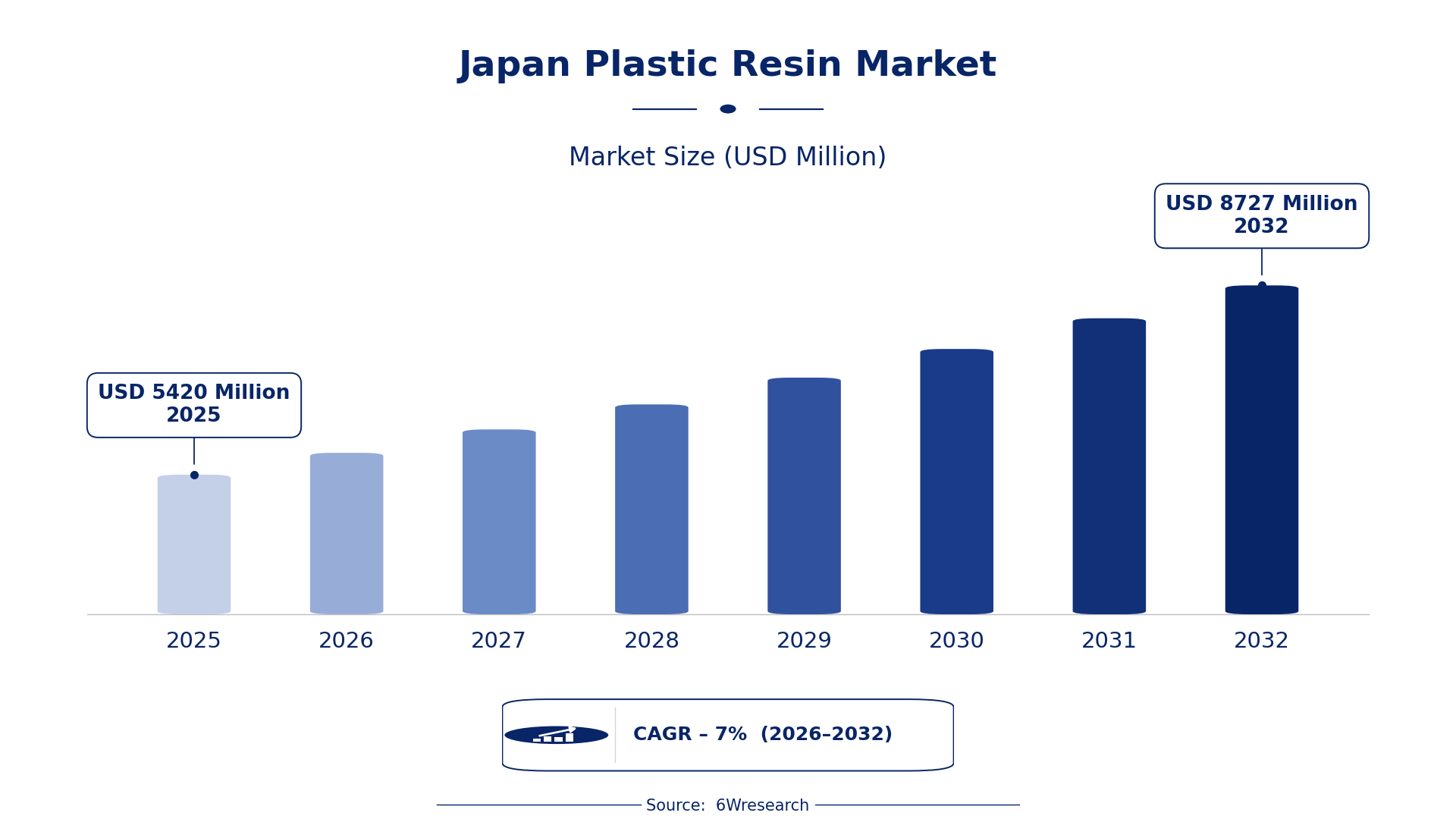
According to 6Wresearch internal database and industry insights, the Japan Plastic Resin Market was valued at USD 5,420 Million in 2025 and is projected to reach USD 8,727 Million by 2032, growing at a CAGR of approximately 7% during 2026–2032.
Japan Plastic Resin Market Highlights
| Report Metric | Details |
| Report Name | Japan Plastic Resin Market (2026-2032) |
| Market Size 2025 | USD 5,420 Million |
| Market Size 2032 | USD 8,727 Million |
| Absolute Growth 2025–2032 | USD 3,307 Million |
| CAGR 2026–2032 | 7% |
| Peak Annual Growth | 7.6% in 2032 |
| Forecast Period | 2026–2032 |
| Historical Data | 2022–2025 |
| Base Year | 2025 |
| Leading Type, 2025 | Thermoplastic (43% share) |
| Leading Resin Type, 2025 | PE (45% share) |
| Leading End User, 2025 | Packaging (58% share) |
| Leading Application, 2025 | Automotive (64% share) |
| Fastest-Growing Type | Thermosetting (10.2% CAGR) |
| Fastest-Growing Resin Type | PP (10.5% CAGR) |
| Fastest-Growing End User | Electronics (8.8% CAGR) |
| Fastest-Growing Application | Medical Devices (9.1% CAGR) |
| Growing Sector | Packaging |
| Key End Users | Packaging manufacturers, automotive producers, electronics manufacturers |
Japan Plastic Resin Market Year-wise Growth Rate and Key Drivers (2022–2032)
This graph illustrates the annual growth rates of the market from 2022 to 2032, highlighting a steady upward trajectory and projected market expansion over the forecast period.
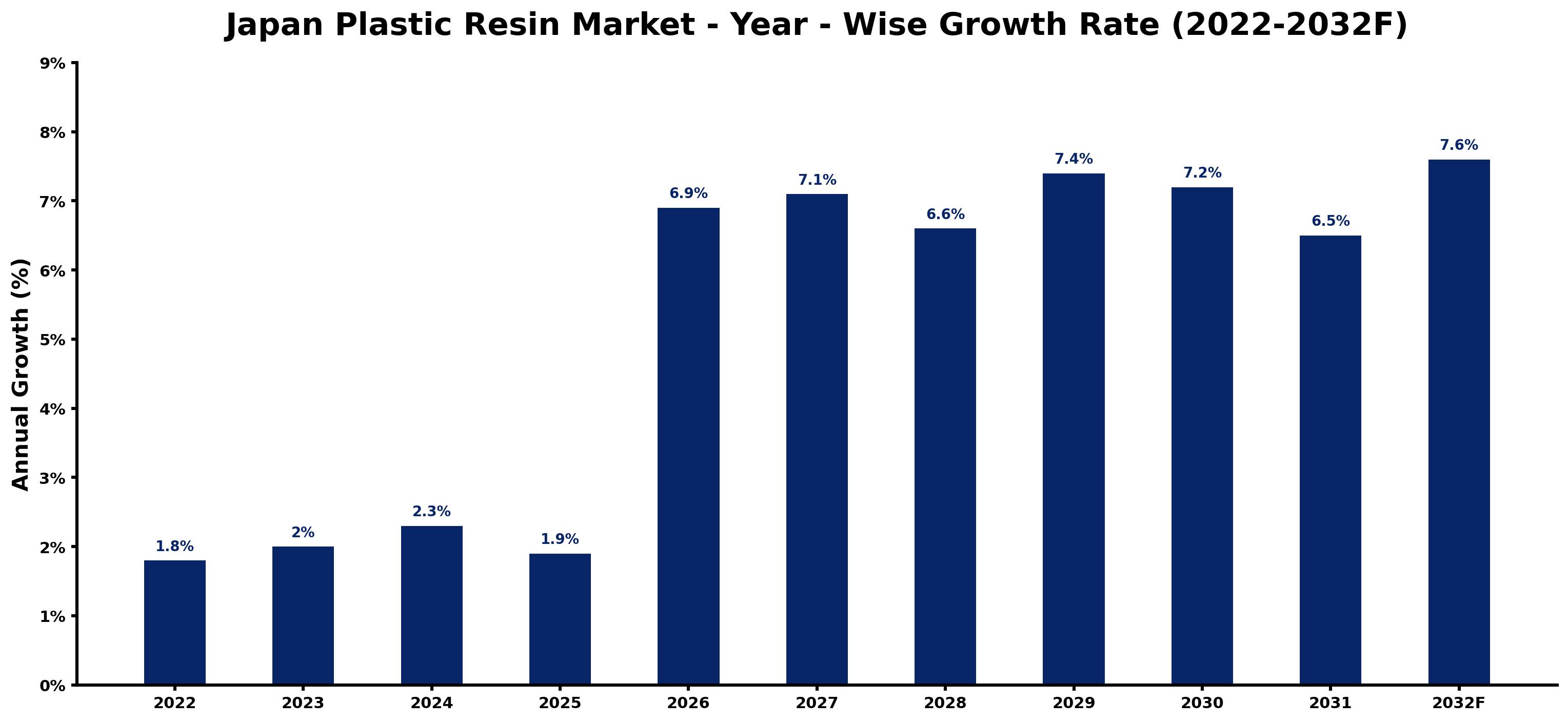
The table below sets out the estimated growth rate for each year and the main factor behind it.
| Year | Estimated Annual Growth (%) | Market Rationale |
| 2022 | 1.8 | The market experienced steady growth, supported by strong domestic demand for plastic products. |
| 2023 | 2.0 | Growth accelerated due to increased consumption in the packaging sector, reflecting consumer preferences. |
| 2024 | 2.3 | Demand continued to rise, driven by the automotive industry's expansion and production increases. |
| 2025 | 1.9 | Growth slowed as the market adjusted to previous peaks in consumption and demand stabilised. |
| 2026 | 6.9 | The market is set to grow rapidly due to rising investments in recycling technologies and sustainability. |
| 2027 | 7.1 | Demand is expected to increase further as sustainability initiatives gain traction among manufacturers. |
| 2028 | 6.6 | Growth will moderate slightly as the market stabilises after rapid expansion and investment. |
| 2029 | 7.4 | Demand is projected to rise again, driven by new applications in electronics and packaging. |
| 2030 | 7.2 | Growth will continue, supported by advancements in bioplastics and increased recycling efforts. |
| 2031 | 6.5 | The market is expected to grow at a slower rate as competition intensifies and stabilises. |
| 2032 | 7.6 | Demand will peak as advanced recycling technologies become mainstream and widely adopted. |
Note: Market size estimations and growth projections presented in this report are based on 6Wresearch's proprietary forecasting methodology, utilizing the latest available industry data, government publications, and primary research inputs.
Japan Plastic Resin Market Synopsis
Plastic resin is a synthetic material produced through polymerization, crucial in manufacturing products like packaging and electronic components. The Japan Plastic Resin Market is growing due to strong demand from the packaging sector, which accounted for 40% of consumption in 2022, alongside the automotive industry, a major consumer. Investment in recycling technologies and sustainability initiatives is propelling market growth, backed by government programmes aimed at reducing plastic waste.
Market Dynamics Impact Analysis (2026–2032)
| Factor | Type | Impact | Primary Segment Affected |
| Rising demand for packaging materials | Driver | High | Packaging |
| Increased use of plastic resins in automotive applications | Driver | High | Automotive |
| Growing interest in bioplastics and sustainable materials | Opportunity | High | Specialty Resins |
| Expansion of the electronics sector requiring advanced materials | Opportunity | High | Electronics |
| Strict regulations on plastic waste management | Restraint | High | Thermoplastic |
| High production costs affecting profitability | Restraint | Medium | Thermosetting |
| Limited recycling infrastructure for plastic materials | Challenge | High | Thermoplastic |
| Fluctuating raw material prices impacting production | Challenge | Medium | PP |
Evaluation of Drivers in Japan Plastic Resin Market (2026–2032)
Below are the drivers that matter most for revenue growth, with supporting evidence.
| Drivers | Primary Segment Affected | Why It Matters (Evidence) |
| Increased consumption of packaging materials | Packaging | The packaging sector accounted for 40% of plastic resin consumption in 2022, driving demand for PE and PET materials. |
| Growth in the automotive industry | Automotive | The automotive sector consumed approximately 25% of plastic resins in 2022, leading to increased purchases. |
| Demand for sustainable materials | Specialty Resins | Investment in bioplastics is increasing, with a projected growth of 15% in the next five years due to environmental concerns. |
| Expansion of electronics manufacturing | Electronics | The electronics industry in Japan is valued at over 10 trillion yen, boosting demand for plastic resins in components. |
| Government initiatives promoting recycling | Thermoplastic | The Plastic Resource Circulation Act encourages recycling, aiming for a 25% reduction in plastic waste by 2030. |
Orders keep climbing as the packaging sector remains a dominant force, accounting for 40% of plastic resin consumption in 2022. The automotive industry, consuming around 25% of plastic resins, is another key driver, as rising production levels lead to increased demand. The electronics sector, valued at over 10 trillion yen, is also contributing to growth, as manufacturers seek advanced materials for components. This combination of factors is expected to sustain growth in the coming years.
Evaluation of Restraints in Japan Plastic Resin Market
The table below lists the restraints and the evidence behind each.
| Market Restraint | Primary Segment Affected | Why It Matters (Evidence) |
| Strict regulations on plastic waste management | Thermoplastic | Japan's stringent regulations influence production processes, increasing compliance costs for manufacturers by 10%. |
| High production costs affecting profitability | Thermosetting | Rising raw material prices have led to increased costs in thermosetting resin production by approximately 15%. |
| Limited recycling infrastructure for plastic materials | Thermoplastic | The existing recycling infrastructure is insufficient to handle the volume of plastic waste generated, limiting recovery rates to below 20%. |
| Fluctuating raw material prices impacting production | PP | Volatile prices for polypropylene can disrupt production schedules and pricing strategies, affecting profitability for manufacturers by 10%. |
| Competition from alternative materials | Specialty Resins | The rise of alternative materials poses a challenge to the market share of specialty resins, impacting demand. |
Japan Plastic Resin Market Challenges
Producers in Japan face escalating costs due to strict regulations on plastic waste management, raising production expenses by 10% for manufacturers. Delays in product development arise from skills shortages in advanced recycling technologies, extending timelines by six months for suppliers. Compliance with JIS K 6726 standards complicates operations, resulting in additional costs of around 5% for producers who must invest in quality assurance. Competition from imports of high-quality plastic resins pressures local suppliers, compelling them to lower prices and affecting profit margins for domestic manufacturers.
Trends in the Japan Plastic Resin Market
Buyers and suppliers in the Japan Plastic Resin Market are adjusting to the following trends.
- Shift towards Sustainable Packaging Solutions: The packaging sector is increasingly adopting sustainable materials, with 40% of plastic resin consumption in 2022 focused on eco-friendly options. This shift responds to consumer demand for environmentally responsible products, particularly in urban areas like Tokyo.
- Emergence of Bioplastics: Since 2023, bioplastics have gained traction in Japan, with investments rising by 20%. This trend reflects growing environmental concerns and the need for sustainable alternatives in various applications, such as packaging and automotive.
- Increase in Advanced Electronics Manufacturing: The electronics sector is expanding, with over 10 trillion yen in value, leading to higher demand for high-performance plastic resins. This trend supports innovation in product design and functionality, particularly in consumer electronics.
- Focus on Recycling Technologies: The government launched a programme in 2023 to promote recycling technologies, aiming to reduce plastic waste by 25% by 2030. This initiative underscores the importance of sustainability in resin production and encourages investment.
Investment Opportunities in the Japan Plastic Resin Market
The following opportunities in the Japan Plastic Resin Market pair current demand with a clear way in.
- Investment in Bioplastics: Now is the time to invest in bioplastics, as environmental concerns drive demand. The specialty resin sector is growing, with potential in packaging and automotive applications, particularly in urban areas.
- Expansion in Electronics Manufacturing: With the electronics sector valued at over 10 trillion yen, there is a strong need for advanced plastic resins. Suppliers can enter this market by partnering with local manufacturers and technology firms.
- Development of Recycling Infrastructure: Investment in recycling infrastructure is crucial, with the government targeting a 25% reduction in plastic waste by 2030. Collaborating with recycling facilities can enhance market presence and sustainability efforts.
- Focus on Sustainable Packaging Solutions: The packaging sector's shift towards sustainability presents opportunities for suppliers of eco-friendly materials. Engaging with packaging manufacturers can facilitate market entry and align with consumer preferences.
Government Initiatives in the Japan Plastic Resin Market
The Plastic Resource Circulation Act, enacted in 2021, strengthens previous regulations by promoting the reduction, reuse, and recycling of plastics. This law encourages producers to adopt sustainable practices and invest in biodegradable alternatives, aligning with Japan’s environmental goals by targeting a 25% reduction in plastic waste by 2030.
The Ministry of the Environment (MoE) and the Ministry of Economy, Trade and Industry (METI) oversee the implementation of the Plastic Resource Circulation Act. They approve initiatives that support recycling technologies and sustainable practices, ensuring compliance with environmental standards and funding projects aimed at enhancing recycling capabilities.
Future Insight of the Japan Plastic Resin Market
The introduction of advanced recycling technologies will reshape demand for plastic resins by 2032, allowing for more efficient material recovery and benefiting suppliers. Government initiatives to reduce plastic waste by 2030 will drive innovation in bioplastics, appealing to environmentally conscious buyers. Growth in the medical device sector will increase the need for high-performance materials, influencing suppliers to develop new formulations. The electronics industry will demand sustainable practices, prompting local manufacturers to adapt their production methods.
Market Segmentation Analysis
Japan Plastic Resin Market report covers a detailed analysis of the following market segments:
By Type – Thermoplastic Leads, Thermosetting Expected to Grow Fastest
According to Ravi Bhandari, Research Head at 6Wresearch, Thermoplastic took 43% of type revenue in 2025, more than any other category. Thermoplastic holds the largest share due to its extensive use in packaging and consumer goods, which are essential for daily life. For instance, the packaging sector accounted for 40% of plastic resin consumption in 2022, highlighting its critical role. Over 2026–2032, Thermosetting is expected to post the fastest growth, at a CAGR of 10.2%. Thermosetting is experiencing rapid growth as its applications expand, particularly in high-performance sectors such as electronics and automotive. The increasing demand for durable materials in these industries is a key factor in this sub-segment's growth. Suppliers should focus on thermosetting materials to capture emerging opportunities in high-performance applications.
By Resin Type – PE Leads, PP Expected to Grow Fastest
PE accounted for 45% of the market by resin type in 2025. PE leads the market due to its extensive use in packaging materials, essential for safeguarding products during transport and storage. The strong demand from the packaging sector solidifies PE's dominant position in the resin type category. PP is projected to grow fastest, at a CAGR of 10.5% during 2026–2032. PP is experiencing rapid growth as it is commonly used in automotive and consumer products, reflecting a shift towards lightweight materials. The automotive industry's focus on improving fuel efficiency is a critical factor in this growth. Buyers should consider incorporating PP into their sourcing strategies to align with industry trends.
By End User – Packaging Leads, Electronics Expected to Grow Fastest
The largest end user category in 2025 was Packaging, at 58% of revenue. Packaging is the leading end user of plastic resins, reflecting its critical role in various sectors, including food and consumer goods. The high consumption levels in this area underline the importance of packaging in daily life. The quickest growth will come from Electronics, forecast to expand at a CAGR of 8.8% between 2026 and 2032. Electronics is the fastest-growing end user as the demand for electronic components continues to rise, particularly in advanced technologies. The electronics industry's substantial value, over 10 trillion yen, supports this rapid growth. Suppliers must adapt to the increasing demand from the electronics sector to remain competitive.
By Application – Automotive Leads, Medical Devices Expected to Grow Fastest
With 64% of application revenue in 2025, Automotive was the largest category. Automotive is the leading application for plastic resins, primarily due to its extensive use in components and assemblies that enhance vehicle performance. The industry's need for lightweight materials to improve fuel efficiency solidifies this segment's dominance. Medical Devices are set to record the highest CAGR in this split, 9.1% over 2026–2032. Medical Devices is the fastest-growing application as the sector expands, requiring specific materials for advanced medical technologies. The rising focus on healthcare advancements is driving the demand for specialised resins, ensuring continued growth. Suppliers should direct efforts towards the medical devices sector to leverage its growth potential.
Key Attractiveness of the Report
- 10 Years of Market Numbers
- Historical Data Starting from 2022 to 2025
- Base Year 2025
- Forecast Data until 2032
- Key Performance Indicators Impacting the Market
- Major Upcoming Developments and Projects
Key Highlights of the Report:
- Japan Plastic Resin Market Outlook
- Market Size of Japan Plastic Resin Market,2025
- Forecast of Japan Plastic Resin Market, 2032
- Historical Data and Forecast of Japan Plastic Resin Revenues & Volume for the Period 2022-2032
- Japan Plastic Resin Market Trend Evolution
- Japan Plastic Resin Market Drivers and Challenges
- Japan Plastic Resin Price Trends
- Japan Plastic Resin Porter's Five Forces
- Japan Plastic Resin Industry Life Cycle
- Historical Data and Forecast of Japan Plastic Resin Market Revenues & Volume By Type for the Period 2022-2032
- Historical Data and Forecast of Japan Plastic Resin Market Revenues & Volume By Thermoplastic for the Period 2022-2032
- Historical Data and Forecast of Japan Plastic Resin Market Revenues & Volume By Thermosetting for the Period 2022-2032
- Historical Data and Forecast of Japan Plastic Resin Market Revenues & Volume By Specialty Resins for the Period 2022-2032
- Historical Data and Forecast of Japan Plastic Resin Market Revenues & Volume By Resin Type for the Period 2022-2032
- Historical Data and Forecast of Japan Plastic Resin Market Revenues & Volume By PE for the Period 2022-2032
- Historical Data and Forecast of Japan Plastic Resin Market Revenues & Volume By PP for the Period 2022-2032
- Historical Data and Forecast of Japan Plastic Resin Market Revenues & Volume By PVC for the Period 2022-2032
- Historical Data and Forecast of Japan Plastic Resin Market Revenues & Volume By PET for the Period 2022-2032
- Historical Data and Forecast of Japan Plastic Resin Market Revenues & Volume By Polycarbonate for the Period 2022-2032
- Historical Data and Forecast of Japan Plastic Resin Market Revenues & Volume By Nylon for the Period 2022-2032
- Historical Data and Forecast of Japan Plastic Resin Market Revenues & Volume By End User for the Period 2022-2032
- Historical Data and Forecast of Japan Plastic Resin Market Revenues & Volume By Packaging for the Period 2022-2032
- Historical Data and Forecast of Japan Plastic Resin Market Revenues & Volume By Electronics for the Period 2022-2032
- Historical Data and Forecast of Japan Plastic Resin Market Revenues & Volume By Application for the Period 2022-2032
- Historical Data and Forecast of Japan Plastic Resin Market Revenues & Volume By Automotive for the Period 2022-2032
- Historical Data and Forecast of Japan Plastic Resin Market Revenues & Volume By Medical Devices for the Period 2022-2032
- Japan Plastic Resin Import Export Trade Statistics
- Market Opportunity Assessment By Type
- Market Opportunity Assessment By Resin Type
- Market Opportunity Assessment By End User
- Market Opportunity Assessment By Application
- Japan Plastic Resin Top Companies Market Share
- Japan Plastic Resin Competitive Benchmarking By Technical and Operational Parameters
- Japan Plastic Resin Company Profiles
- Japan Plastic Resin Key Strategic Recommendations
Market Covered
Segments analysed in this report are listed below.
By Type
- Thermoplastic
- Thermosetting
- Specialty Resins
By Resin Type
- PE
- PP
- PVC
- PET
- Polycarbonate
- Nylon
By End User
- Packaging
- Electronics
By Application
- Automotive
- Medical Devices































