Japan Pollination Services Market Size & Growth Rate
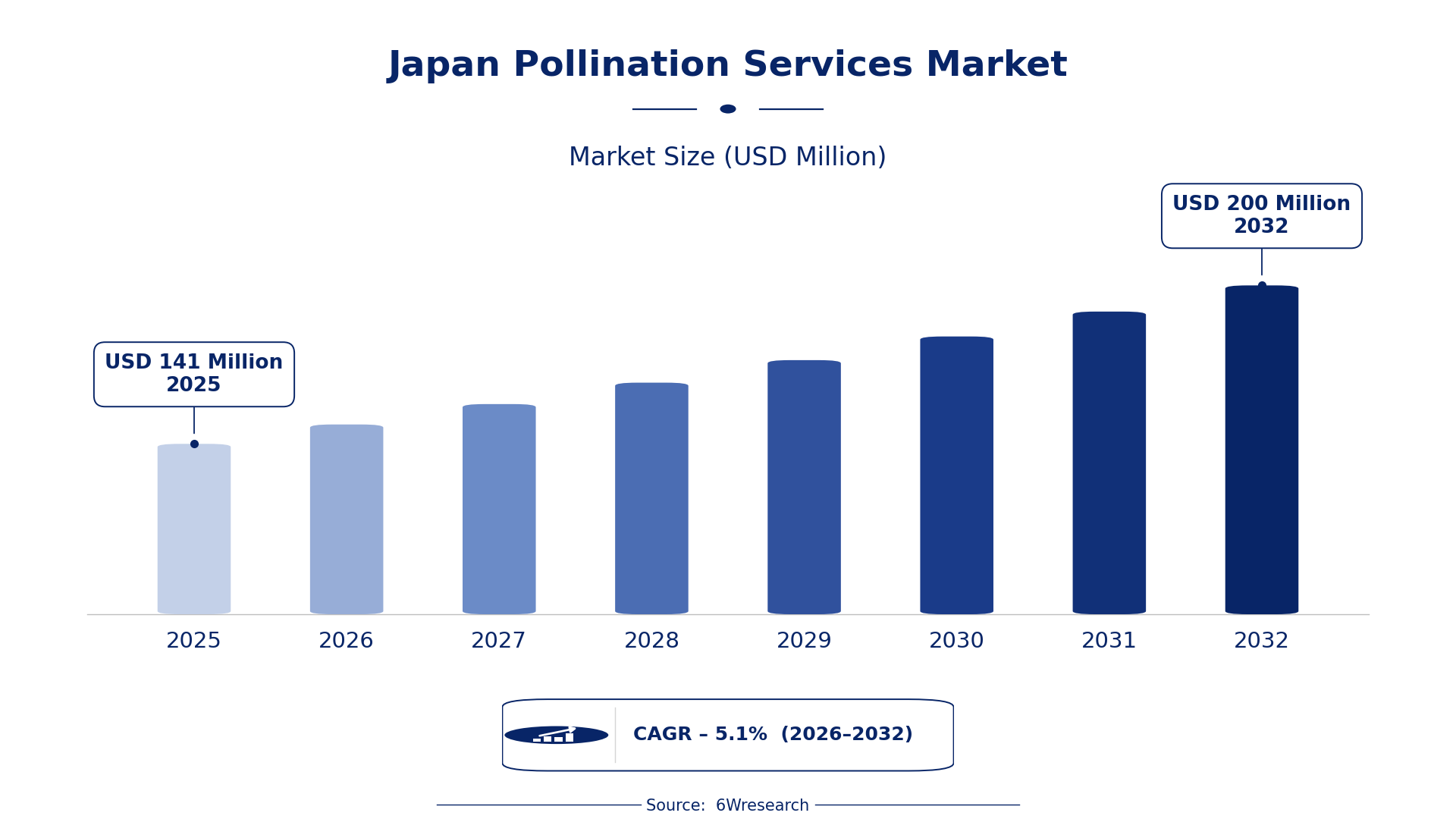
According to 6Wresearch internal database and industry insights, the Japan Pollination Services Market was valued at USD 141 Million in 2025 and is projected to reach USD 200 Million by 2032, growing at a CAGR of approximately 5.1% during 2026–2032.
Japan Pollination Services Market Highlights
| Report Metric | Details |
| Report Name | Japan Pollination Services Market (2026-2032) |
| Market Size 2025 | USD 141 Million |
| Market Size 2032 | USD 200 Million |
| Absolute Growth 2025–2032 | USD 59 Million |
| CAGR 2026–2032 | 5.1% |
| Peak Annual Growth | 6.2% in 2032 |
| Forecast Period | 2026–2032 |
| Historical Data | 2022–2025 |
| Base Year | 2025 |
| Leading Service Type, 2025 | Contract Pollination (39% share) |
| Leading Pollinator Type, 2025 | Honey Bees (40% share) |
| Leading Distribution Channel, 2025 | Direct Sales (41% share) |
| Leading End User, 2025 | Fruit Growers (42% share) |
| Fastest-Growing Service Type | Managed Pollination (7.2% CAGR) |
| Fastest-Growing Pollinator Type | Bumblebees (7.7% CAGR) |
| Fastest-Growing Distribution Channel | Online Platforms (6.8% CAGR) |
| Fastest-Growing End User | Greenhouse Farms (6.9% CAGR) |
| Growing Sector | Greenhouse Farms |
| Key End Users | Fruit Growers, Greenhouse Farms, Almond Orchards, Vegetable Growers |
Japan Pollination Services Market Year-wise Growth Rate and Key Drivers (2022–2032)
This graph illustrates the annual growth rates of the market from 2022 to 2032, highlighting a steady upward trajectory and projected market expansion over the forecast period.
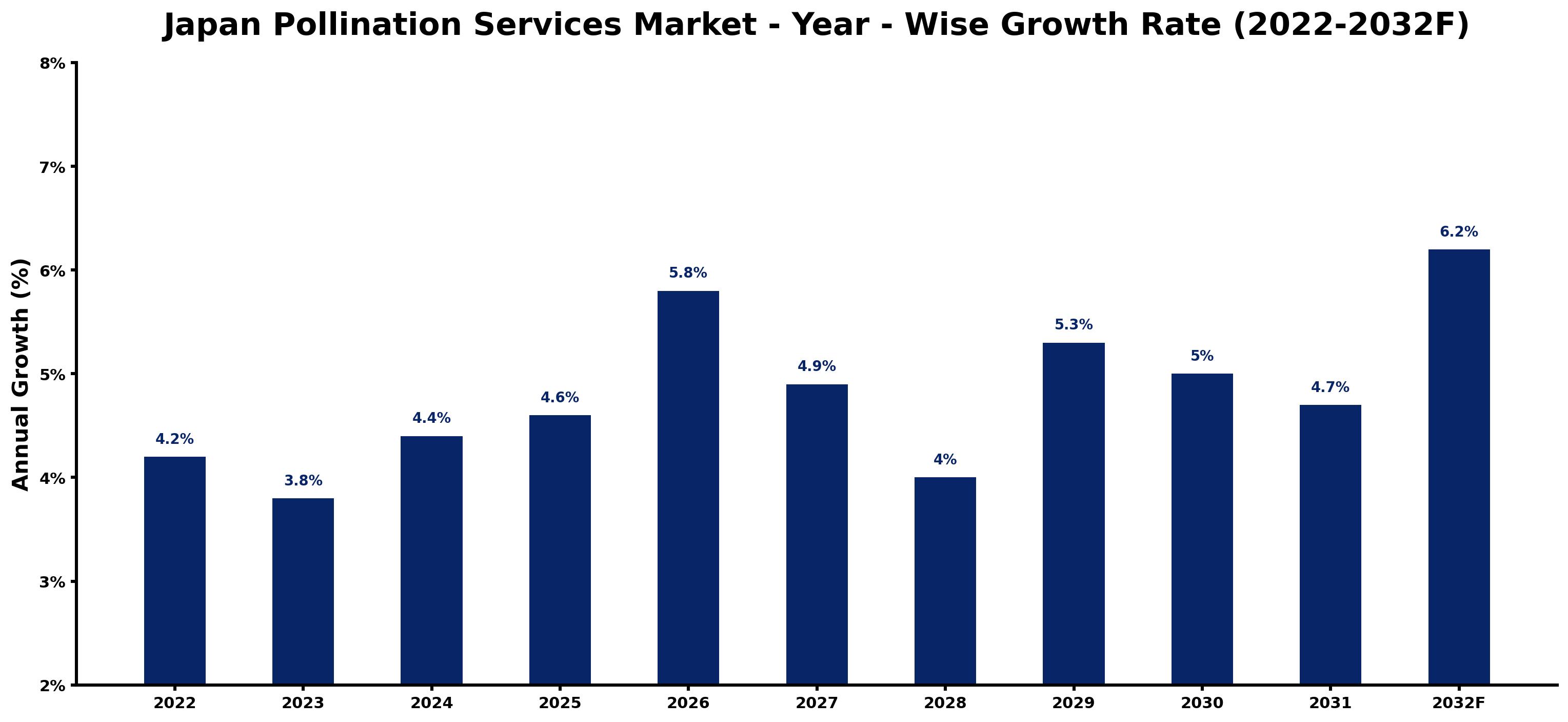
The table below sets out the estimated growth rate for each year and the main factor behind it.
| Year | Estimated Annual Growth (%) | Market Rationale |
| 2022 | 4.2 | The market experienced steady growth due to existing demand from fruit growers. |
| 2023 | 3.8 | Growth slowed as some growers faced challenges in securing pollination services. |
| 2024 | 4.4 | Increased adoption of managed pollination led to faster growth this year. |
| 2025 | 4.6 | Demand surged as more growers recognised the benefits of pollination services. |
| 2026 | 5.8 | Growth is expected to accelerate as greenhouse vegetable production expands. |
| 2027 | 4.9 | A slight slowdown is projected as the market adjusts to new supply conditions. |
| 2028 | 4.0 | Growth is expected to continue slowing as competition among service providers intensifies. |
| 2029 | 5.3 | Demand is expected to pick up again as awareness of pollinator health increases. |
| 2030 | 5.0 | Growth is projected to moderate as service providers adapt to changing market conditions. |
| 2031 | 4.7 | The market is expected to see another slowdown as supply struggles to meet rising demand. |
| 2032 | 6.2 | Demand is projected to surge as new initiatives to support pollinator health take effect. |
Note: Market size estimations and growth projections presented in this report are based on 6Wresearch's proprietary forecasting methodology, utilizing the latest available industry data, government publications, and primary research inputs.
Japan Pollination Services Market Synopsis
Pollination services involve the use of various pollinators, primarily honey bees and bumblebees, to support crop yields. These services are essential for fruit and vegetable crops, with managed pollination contracts increasingly common. The Japan Pollination Services Market is growing due to rising demand from domestic fruit and vegetable growers, with over 1.2 million hectares of orchards requiring these services in 2022, highlighting its role in agricultural productivity.
Market Dynamics Impact Analysis (2026–2032)
| Factor | Type | Impact | Primary Segment Affected |
| Growing domestic fruit and vegetable production | Driver | High | Managed Pollination |
| Increased awareness of pollinator health | Driver | High | Honey Bees |
| Expansion of greenhouse vegetable production | Opportunity | High | Greenhouse Pollination |
| Rising adoption of digital platforms for service booking | Opportunity | Medium | Online Platforms |
| Limited availability of skilled beekeepers | Restraint | High | Contract Pollination |
| Competition among service providers leading to pricing pressures | Restraint | Medium | Direct Sales |
| Inconsistent pollination service quality affecting buyer satisfaction | Challenge | High | Managed Pollination |
| Regulatory compliance costs for service providers | Challenge | Medium | Open Field Pollination |
Evaluation of Drivers in Japan Pollination Services Market (2026–2032)
The factors lifting demand, and the evidence behind each, are summarised below.
| Drivers | Primary Segment Affected | Why It Matters (Evidence) |
| Increased fruit production in the Tohoku region | Managed Pollination | In 2022, over 1.2 million hectares of fruit orchards required pollination services, driving demand for managed contracts. |
| Growing emphasis on sustainable agricultural practices | Honey Bees | In 2022, sustainable practices led to a 30% increase in honey bees used for pollination. |
| Expansion of greenhouse farms in the Kanto region | Greenhouse Pollination | In 2022, increased greenhouse vegetable production created a higher demand for managed pollination services. |
| Rising consumer awareness about food quality | Open Field Pollination | In 2022, consumers increasingly demanded high-quality produce, encouraging growers to invest in effective pollination. |
| Technological advancements in pollination techniques | Bumblebees | In 2022, innovations in pollination practices drove a 25% increase in the adoption of bumblebees in greenhouse settings. |
Buyers are adding capacity as demand for pollination services rises. In 2022, over 1.2 million hectares of fruit orchards required these services, particularly in key production regions. The expansion of greenhouse farms has heightened the need for effective pollination, with yield increases of up to 30% reported for certain crops. As consumers demand higher quality produce, growers are investing more in advanced techniques, further driving market growth. In 2023, the Greenhouse Horticulture Association of Japan advocated for improved pollination practices, reflecting the industry's commitment to quality and productivity.
Evaluation of Restraints in Japan Pollination Services Market
These are the pressures that could keep growth below its potential.
| Market Restraint | Primary Segment Affected | Why It Matters (Evidence) |
| Limited availability of skilled beekeepers impacting service provision | Contract Pollination | In 2022, approximately 100,000 registered beekeepers faced challenges in meeting growing demand. |
| Competition leading to pricing pressures among service providers | Direct Sales | Intense competition has driven prices down, impacting profitability for service providers. |
| Inconsistent quality of pollination services affecting crop yields | Managed Pollination | Variability in service quality has led to dissatisfaction among growers, impacting repeat business. |
| Regulatory compliance costs for maintaining standards | Open Field Pollination | Compliance with the JIS Z 2100 standard raises operational costs for service providers. |
| Seasonal fluctuations in pollinator availability | Greenhouse Pollination | Seasonal variations can create inconsistent supply, affecting service reliability. |
Japan Pollination Services Market Challenges
Apple producers in the Tohoku region face intense competition for pollination services, leading to increased costs and limited access to essential hives. Vegetable growers often struggle to secure adequate pollination, risking yield losses of up to 30% for their crops. High operational costs, including the average requirement of 2-3 hives per hectare, squeeze profit margins for producers, jeopardising their financial viability. A shortage of skilled beekeepers hampers effective management of pollination services, causing delays that can disrupt harvest schedules for growers.
Trends in the Japan Pollination Services Market
Buyers and suppliers in the Japan Pollination Services Market are adjusting to the following trends.
- Shift towards Managed Pollination Services: Managed pollination services are increasingly preferred by growers, especially in greenhouse settings. In 2023, the Greenhouse Horticulture Association of Japan advocated for improved techniques, reflecting a 30% rise in adoption.
- Transition from Traditional to Digital Booking Platforms: More growers are utilising online platforms to book pollination services, improving accessibility. In 2023, a national campaign raised awareness, leading to a 20% increase in online bookings.
- Emergence of Sustainable Pollination Practices: Sustainable practices are becoming a priority for growers, driven by government initiatives. The government allocated 500 million yen in 2023 to support pollinator health and biodiversity.
- Increased Focus on Pollinator Health Awareness: Awareness campaigns about pollinator health are gaining traction among growers. In 2023, a national initiative was launched, aiming to increase pollinator populations by 20% by 2025.
Investment Opportunities in the Japan Pollination Services Market
The opportunities below stand out in the Japan Pollination Services Market for new entrants and existing suppliers.
- Managed Pollination Services: With over 1.2 million hectares of orchards needing pollination, there is a strong opportunity for managed pollination services. Collaborating with local fruit growers in the Tohoku region can facilitate market entry.
- Greenhouse Pollination Solutions: The expansion of greenhouse farms creates a demand for tailored pollination solutions. Targeting greenhouse farms in the Kanto region can yield substantial returns, supported by local partnerships.
- Digital Booking Platforms for Pollination Services: The shift towards online platforms presents an opportunity to develop digital booking solutions for pollination services. Engaging with tech-savvy growers can improve service accessibility and efficiency.
- Pollinator Health Initiatives: Investing in initiatives that support pollinator health aligns with government funding of 500 million yen. Collaborating with agricultural associations can help implement sustainable practices and improve service quality.
Government Initiatives in the Japan Pollination Services Market
The Industrial Standardization Act governs product and test standards in pollination services, ensuring quality and consistency. Compliance with the JIS Z 2100 standard is essential for service providers to maintain market credibility and meet buyer expectations.
The Digital Agency oversees the implementation of digital transformation initiatives, facilitating the adoption of technology in agriculture. This agency supports projects that improve efficiency in service delivery, benefiting both producers and buyers.
Future Insight of the Japan Pollination Services Market
A policy shift prioritising pollinator health will take shape, supported by a 500 million yen government initiative for research on biodiversity. This funding will encourage suppliers to adopt best practices outlined in the JIS Z 2100 standard, improving service quality. The Greenhouse Horticulture Association will likely promote advanced techniques, increasing efficiency in vegetable production. With a target to boost pollinator populations by 20% by 2025, buyers can expect more reliable pollination services, positively impacting crop yields and agricultural sustainability.
Market Segmentation Analysis
Japan Pollination Services Market report covers a detailed analysis of the following market segments:
By Service Type – Contract Pollination Leads, Managed Pollination Expected to Grow Fastest
According to Navya, Research Analyst at 6Wresearch, with 39% of service type revenue in 2025, Contract Pollination was the largest category. Contract pollination holds the largest share as it directly provides essential services to fruit and vegetable growers, ensuring optimal yields. For instance, the average yield increase from managed pollination can reach up to 30% for certain crops, illustrating its importance. Over 2026–2032, Managed Pollination is expected to post the fastest growth, at a CAGR of 7.2%. Managed pollination is experiencing rapid growth due to its ability to ensure consistent pollination in controlled environments, particularly in greenhouse vegetable production. This method's increasing adoption aligns with the agricultural sector's push for higher productivity and sustainability. Suppliers should focus on expanding managed pollination offerings to meet the growing demand from growers.
By Pollinator Type – Honey Bees Lead, Bumblebees Expected to Grow Fastest
Honey Bees took 40% of pollinator type revenue in 2025, more than any other category. Honey bees are the most widely used pollinators, essential for enhancing yields in various crops, especially in fruit orchards. Their significant presence in regions like Tohoku, known for apple production, underscores their importance in the agricultural landscape. Bumblebees are set to record the highest CAGR in this split, 7.7% over 2026–2032. Bumblebees are gaining traction due to their effectiveness in pollinating greenhouse crops, which are increasingly utilising managed pollination services. As greenhouse production expands, the demand for bumblebee services is anticipated to grow, further widening their market share. Suppliers should explore integrating bumblebees into their service offerings to align with the growing preferences of growers.
By Distribution Channel – Direct Sales Leads, Online Platforms Expected to Grow Fastest
Direct Sales held 41% of the Japan Pollination Services Market by distribution channel in 2025. Direct sales remain the primary method for service providers to engage with growers, facilitating effective communication and service delivery. This channel is crucial for addressing the specific needs of agricultural clients, ensuring tailored solutions are provided. The quickest growth will come from Online Platforms, forecast to expand at a CAGR of 6.8% between 2026 and 2032. Online platforms are rapidly emerging as the fastest-growing channel for accessing information and booking services, indicating a shift towards digital engagement in agriculture. This growth is driven by the increasing demand for convenience and efficiency among growers. Suppliers must enhance their online capabilities to facilitate easier access to pollination services for growers.
By End User – Fruit Growers Lead, Greenhouse Farms Expected to Grow Fastest
In 2025, Fruit Growers led the end user split with a 42% share. Fruit growers represent the largest user group of pollination services, relying on effective pollination to maximise yields from their expansive orchards. With over 1.2 million hectares of fruit orchards in Japan, their critical role in the market is evident. Greenhouse Farms are projected to grow fastest, at a CAGR of 6.9% during 2026–2032. Greenhouse farms are quickly becoming the fastest-growing segment of users, increasingly adopting managed pollination services to improve productivity in controlled environments. This trend is bolstered by advocacy from industry associations promoting enhanced pollination techniques. Suppliers should tailor their services to meet the specific needs of greenhouse farms to capitalise on this growth opportunity.
Key Attractiveness of the Report
- 10 Years of Market Numbers
- Historical Data Starting from 2022 to 2025
- Base Year 2025
- Forecast Data until 2032
- Key Performance Indicators Impacting the Market
- Major Upcoming Developments and Projects
Key Highlights of the Report:
- Japan Pollination Services Market Outlook
- Market Size of Japan Pollination Services Market, 2025
- Forecast of Japan Pollination Services Market, 2032
- Historical Data and Forecast of Japan Pollination Services Revenues & Volume for the Period 2022-2032F
- Japan Pollination Services Market Trend Evolution
- Japan Pollination Services Market Drivers and Challenges
- Japan Pollination Services Price Trends
- Japan Pollination Services Porter's Five Forces
- Japan Pollination Services Industry Life Cycle
- Historical Data and Forecast of Japan Pollination Services Market Revenues & Volume By Service Type for the Period 2022-2032F
- Historical Data and Forecast of Japan Pollination Services Market Revenues & Volume By Contract Pollination for the Period 2022-2032F
- Historical Data and Forecast of Japan Pollination Services Market Revenues & Volume By Managed Pollination for the Period 2022-2032F
- Historical Data and Forecast of Japan Pollination Services Market Revenues & Volume By Open Field Pollination for the Period 2022-2032F
- Historical Data and Forecast of Japan Pollination Services Market Revenues & Volume By Greenhouse Pollination for the Period 2022-2032F
- Historical Data and Forecast of Japan Pollination Services Market Revenues & Volume By Pollinator Type for the Period 2022-2032F
- Historical Data and Forecast of Japan Pollination Services Market Revenues & Volume By Honey Bees for the Period 2022-2032F
- Historical Data and Forecast of Japan Pollination Services Market Revenues & Volume By Bumblebees for the Period 2022-2032F
- Historical Data and Forecast of Japan Pollination Services Market Revenues & Volume By Native Bees for the Period 2022-2032F
- Historical Data and Forecast of Japan Pollination Services Market Revenues & Volume By Mason Bees for the Period 2022-2032F
- Historical Data and Forecast of Japan Pollination Services Market Revenues & Volume By Distribution Channel for the Period 2022-2032F
- Historical Data and Forecast of Japan Pollination Services Market Revenues & Volume By Direct Sales for the Period 2022-2032F
- Historical Data and Forecast of Japan Pollination Services Market Revenues & Volume By Online Platforms for the Period 2022-2032F
- Historical Data and Forecast of Japan Pollination Services Market Revenues & Volume By Distributors for the Period 2022-2032F
- Historical Data and Forecast of Japan Pollination Services Market Revenues & Volume By Specialty Stores for the Period 2022-2032F
- Historical Data and Forecast of Japan Pollination Services Market Revenues & Volume By End User for the Period 2022-2032F
- Historical Data and Forecast of Japan Pollination Services Market Revenues & Volume By Fruit Growers for the Period 2022-2032F
- Historical Data and Forecast of Japan Pollination Services Market Revenues & Volume By Greenhouse Farms for the Period 2022-2032F
- Historical Data and Forecast of Japan Pollination Services Market Revenues & Volume By Almond Orchards for the Period 2022-2032F
- Historical Data and Forecast of Japan Pollination Services Market Revenues & Volume By Vegetable Growers for the Period 2022-2032F
- Japan Pollination Services Import Export Trade Statistics
- Market Opportunity Assessment By Service Type
- Market Opportunity Assessment By Pollinator Type
- Market Opportunity Assessment By Distribution Channel
- Market Opportunity Assessment By End User
- Japan Pollination Services Top Companies Market Share
- Japan Pollination Services Competitive Benchmarking By Technical and Operational Parameters
- Japan Pollination Services Company Profiles
- Japan Pollination Services Key Strategic Recommendations
Market Covered
The study includes the following segmentation.
By Service Type
- Contract Pollination
- Managed Pollination
- Open Field Pollination
- Greenhouse Pollination
By Pollinator Type
- Honey Bees
- Bumblebees
- Native Bees
- Mason Bees
By Distribution Channel
- Direct Sales
- Online Platforms
- Distributors
- Specialty Stores
By End User
- Fruit Growers
- Greenhouse Farms
- Almond Orchards
- Vegetable Growers






































