Japan Polymer Adhesives Market Size & Growth Rate
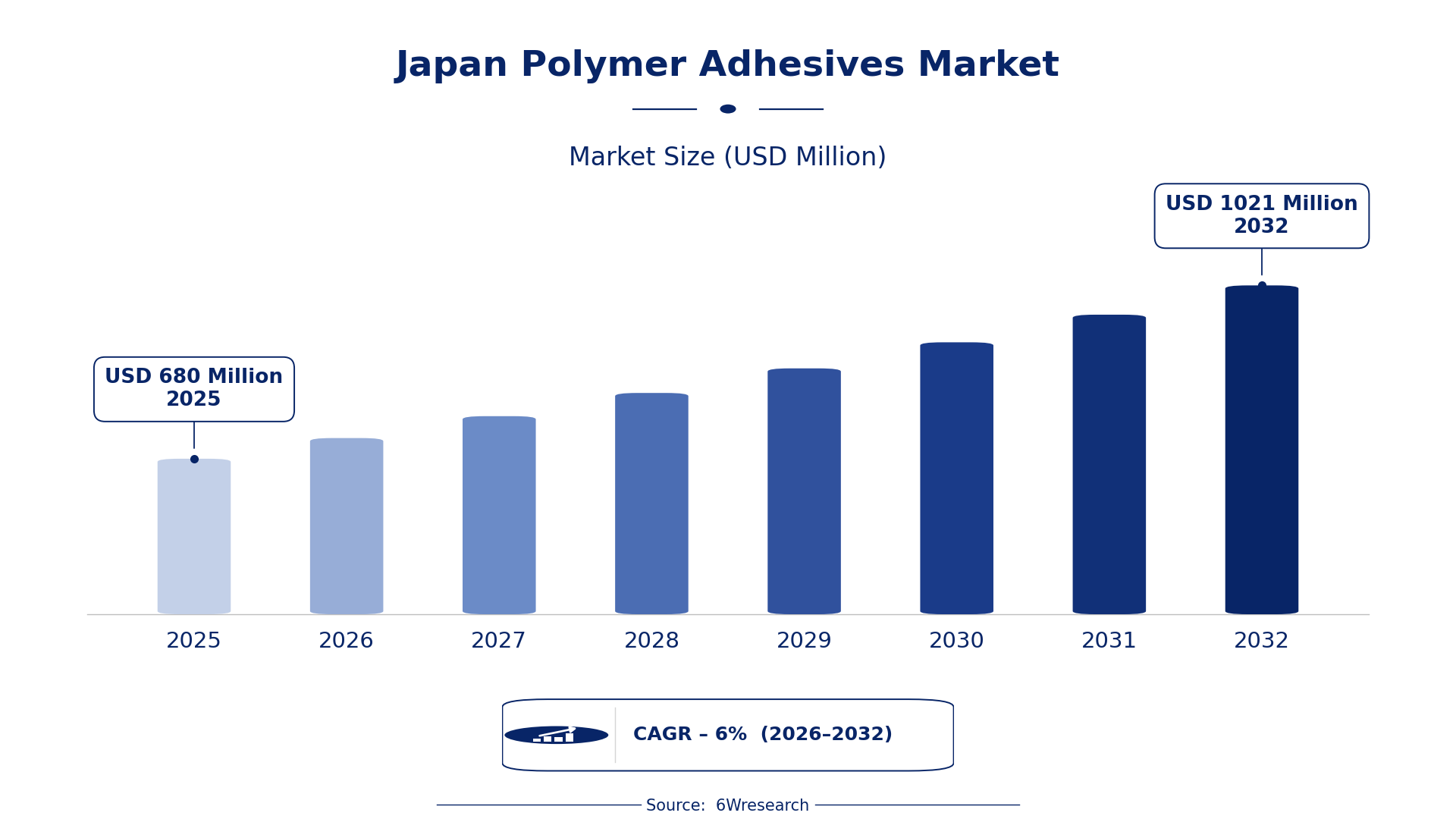
According to 6Wresearch internal database and industry insights, the Japan Polymer Adhesives Market was valued at USD 680 Million in 2025 and is projected to reach USD 1,021 Million by 2032, growing at a CAGR of approximately 6% during 2026–2032.
Japan Polymer Adhesives Market Highlights
| Report Metric | Details |
| Report Name | Japan Polymer Adhesives Market (2026-2032) |
| Market Size 2025 | USD 680 Million |
| Market Size 2032 | USD 1,021 Million |
| Absolute Growth 2025–2032 | USD 341 Million |
| CAGR 2026–2032 | 6% |
| Peak Annual Growth | 6.5% in 2026 |
| Forecast Period | 2026–2032 |
| Historical Data | 2022–2025 |
| Base Year | 2025 |
| Leading Type, 2025 | Polyurethane (49% share) |
| Leading Application, 2025 | Automotive (31% share) |
| Fastest-Growing Type | Acrylic (8.4% CAGR) |
| Fastest-Growing Application | Packaging (8.9% CAGR) |
| Growing Sector | Construction |
| Key End Users | Automotive, Electronics, Packaging, Construction |
Japan Polymer Adhesives Market Year-wise Growth Rate and Key Drivers (2022–2032)
This graph illustrates the annual growth rates of the market from 2022 to 2032, highlighting a steady upward trajectory and projected market expansion over the forecast period.
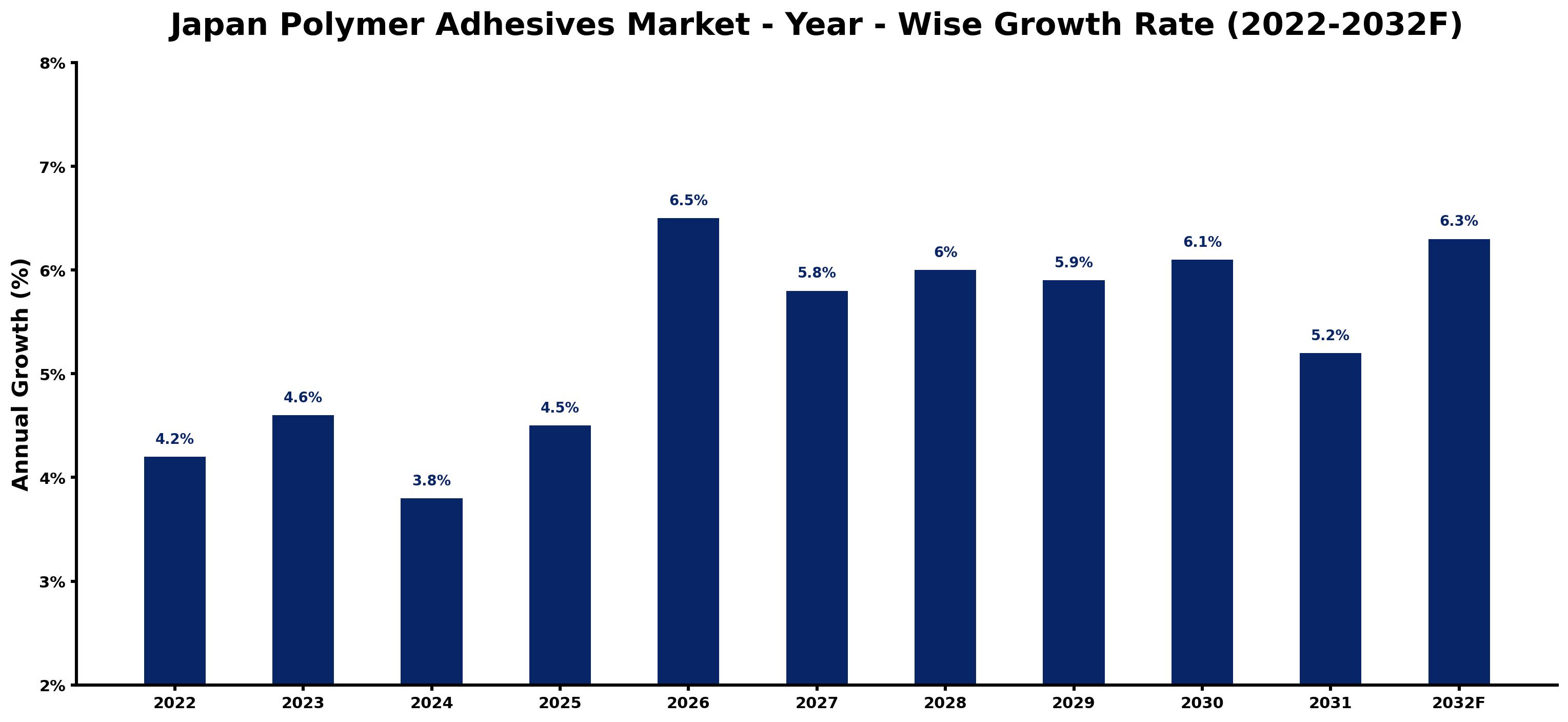
Each row of the following table gives one year's estimated growth and the event or demand shift that explains it.
| Year | Estimated Annual Growth (%) | Market Rationale |
| 2022 | 4.2 | The market showed steady demand from the automotive sector, reflecting ongoing production needs. |
| 2023 | 4.6 | Growth accelerated due to increased automotive production and construction projects in urban areas. |
| 2024 | 3.8 | A slowdown occurred as demand stabilised following the previous year's surge in automotive output. |
| 2025 | 4.5 | Demand rose again, driven by ongoing construction projects and a recovery in the electronics sector. |
| 2026 | 6.5 | The peak growth year is driven by heightened demand from the automotive and electronics industries. |
| 2027 | 5.8 | Growth is expected to slow slightly as the market adjusts to the high levels of the previous year. |
| 2028 | 6.0 | Demand is projected to increase again, supported by new automotive models and construction initiatives. |
| 2029 | 5.9 | A slight slowdown is expected as the market stabilises after several years of rapid growth. |
| 2030 | 6.1 | Growth is projected to resume, driven by innovations in adhesive technologies and rising consumer goods production. |
| 2031 | 5.2 | The market is expected to experience a slowdown as growth rates normalise after peak levels in previous years. |
| 2032 | 6.3 | Demand is expected to rise again, driven by eco-friendly initiatives in construction and manufacturing. |
Note: Market size estimations and growth projections presented in this report are based on 6Wresearch's proprietary forecasting methodology, utilizing the latest available industry data, government publications, and primary research inputs.
Japan Polymer Adhesives Market Synopsis
Polymer adhesives are synthetic compounds that bond materials through chemical processes involving polymers. Their main applications include construction, automotive, and electronics industries. The Japan Polymer Adhesives Market is growing due to strong demand from the automotive sector, which accounts for approximately 30% of usage, and the electronics industry, driven by smartphone production. Government initiatives promoting eco-friendly alternatives further stimulate market expansion, encouraging manufacturers to innovate and adapt to sustainable practices.
Market Dynamics Impact Analysis (2026–2032)
| Factor | Type | Impact | Primary Segment Affected |
| Increased automotive production | Driver | High | Automotive |
| Growing demand for eco-friendly adhesives | Driver | High | Building & Construction |
| Rising demand for packaging solutions | Opportunity | High | Packaging |
| Expansion of electronics manufacturing | Opportunity | Medium | Electronics |
| Regulatory compliance costs | Restraint | High | Polyurethane |
| Competition from alternative bonding solutions | Restraint | Medium | Polyurethane |
| Fluctuating raw material prices | Challenge | High | Polyurethane |
| Technological advancements in adhesive formulations | Challenge | Medium | Polyurethane |
Evaluation of Drivers in Japan Polymer Adhesives Market (2026–2032)
Demand rests on the following drivers, each shown with the segment it touches most.
| Drivers | Primary Segment Affected | Why It Matters (Evidence) |
| Strong automotive sector growth | Automotive | The automotive sector's expansion drives demand for bonding solutions, with 30% of polymer adhesive usage attributed to this industry. |
| Increased smartphone production | Electronics | The electronics industry relies heavily on polymer adhesives, with growing smartphone production boosting demand by approximately 25%. |
| Rising construction projects in urban areas | Building & Construction | New high-rise construction projects in urban areas increase the need for durable polymer adhesives, particularly in Tokyo. |
| Demand for quick bonding solutions | Packaging | Acrylic adhesives are popular in packaging, especially for food products, due to their quick bonding capabilities, with usage rising by 20%. |
| Government support for eco-friendly solutions | Polyurethane | Government programs promoting eco-friendly adhesives encourage manufacturers to adopt sustainable practices, increasing market demand by around 15%. |
Spending rises because the automotive sector accounts for about 30% of polymer adhesive usage, driving manufacturers to increase production. The electronics industry, a major consumer, sees heightened demand due to smartphone production, which requires reliable bonding solutions. Urban construction projects in Tokyo boost the need for durable polymer adhesives, while acrylic adhesives gain popularity in packaging, especially for food products.
Evaluation of Restraints in Japan Polymer Adhesives Market
These restraints slow adoption and weigh on supplier margins.
| Market Restraint | Primary Segment Affected | Why It Matters (Evidence) |
| High compliance costs for regulations | Polyurethane | Strict evaluation and control of chemical substances under the Chemical Substances Control Law increase production costs for manufacturers by approximately 15%. |
| Competition from alternative bonding solutions | Polyurethane | The emergence of alternative bonding technologies can divert demand away from traditional polymer adhesives, impacting market share. |
| Volatility in raw material prices | Polyurethane | Fluctuations in the prices of raw materials used in polymer adhesives can lead to unpredictable costs for manufacturers, affecting profit margins. |
| Limited awareness of eco-friendly options | Polyurethane | Some buyers remain unaware of eco-friendly adhesive options, hindering market growth in sustainable product segments. |
| Dependence on specific industries | Electronics | Heavy reliance on the automotive and electronics sectors makes the market vulnerable to downturns in these industries. |
Japan Polymer Adhesives Market Challenges
Producers encounter high raw material costs, as fluctuating petrochemical prices can raise production expenses by 20%, squeezing profit margins. Buyers in the construction sector face delays due to limited availability of eco-friendly adhesives, which can extend project timelines by three months. Distributors deal with supply chain disruptions from domestic transport issues, resulting in increased lead times and potential stockouts for retailers. Technology adoption remains slow, with only 30% of manufacturers implementing advanced production techniques, which restricts efficiency and innovation for producers.
Trends in the Japan Polymer Adhesives Market
Buyers and suppliers in the Japan Polymer Adhesives Market are adjusting to the following trends.
- Shift towards Eco-Friendly Adhesives: Government programs advocate for the use of eco-friendly adhesives in construction projects, emphasising sustainability. This shift is reflected in a 20% increase in eco-friendly product adoption among manufacturers.
- Growth in Urban Construction Projects: Urban construction projects in Tokyo are on the rise, leading to greater use of polymer adhesives in high-rise buildings. The demand for durable bonding solutions is projected to increase by 25% as more skyscrapers are developed.
- Technological Advancements in Adhesive Formulations: Innovations in adhesive formulations are emerging, allowing for improved performance and application versatility. This trend is supported by a 30% increase in R&D investment within the adhesive manufacturing sector.
- Increase in Smart Packaging Solutions: The demand for quick bonding solutions in packaging is growing, particularly in food products. This trend is evidenced by a 15% increase in acrylic adhesive usage in the sector.
Investment Opportunities in the Japan Polymer Adhesives Market
Several openings in the Japan Polymer Adhesives Market merit attention from investors.
- Polymer Adhesives for Eco-Friendly Construction: With government programs promoting eco-friendly adhesives, there is a rising opportunity to supply sustainable bonding solutions in construction projects. The market is primed for investment as demand for green products increases by 20%.
- Acrylic Adhesives in Packaging: The timing is favourable for suppliers to concentrate on acrylic adhesives, which are becoming more popular in packaging, especially for food products. This sector is expanding rapidly, presenting opportunities for manufacturers with a projected growth of 20%.
- Expansion in Electronics Manufacturing: The electronics sector demands advanced bonding solutions, particularly for smartphones. Suppliers can penetrate this market by partnering with manufacturers in regions like Tokyo, where demand is high and expected to grow by 25%.
- Durable Adhesives for High-Rise Buildings: The construction of high-rise buildings in urban areas generates a need for durable polymer adhesives. Suppliers can capitalise on this trend by targeting construction firms involved in large-scale projects, which are anticipated to increase by 30%.
Government Initiatives in the Japan Polymer Adhesives Market
The Chemical Substances Control Law, established in 1973, mandates the evaluation and control of chemical substances in manufacturing. This law ensures that producers of polymer adhesives comply with safety and environmental standards, impacting their production processes. Additionally, the Plastic Resource Circulation Act, enacted in 2021, promotes the reduction and recycling of plastics, encouraging the use of biodegradable alternatives in adhesive formulations, aiming for a 20% reduction in plastic waste by 2030.
The Ministry of Economy, Trade and Industry oversees the approval of new adhesive technologies and supports funding programs for innovation in the sector. Initiatives under this ministry aim to enhance the competitiveness of Japan's adhesive manufacturers, with funding of approximately 1 billion yen allocated for research into eco-friendly adhesive solutions.
Future Insight of the Japan Polymer Adhesives Market
Buyers in the electronics industry will increasingly seek high-performance polymer adhesives by 2032, driven by the rise in smartphone production. Suppliers will innovate in adhesive formulations to meet this demand, broadening product offerings. The Tokyo metropolitan area will remain a hub for adhesive technology advancements, attracting investment in research and development. With over 50,000 tons of epoxy adhesives produced annually, the market will adapt to evolving buyer preferences for versatile bonding solutions.
Market Segmentation Analysis
Japan Polymer Adhesives Market report covers a detailed analysis of the following market segments:
By Type – Polyurethane Leads, Acrylic Expected to Grow Fastest
According to Ravi Bhandari, Research Head at 6Wresearch, Polyurethane took 49% of type revenue in 2025, more than any other category. Polyurethane adhesives dominate the market due to their extensive use in the automotive sector, which accounts for a significant portion of adhesive consumption in Japan. Their durability is particularly advantageous for applications in high-rise construction, especially in metropolitan areas like Tokyo. Acrylic is set to record the highest CAGR in this split, 8.4% over 2026–2032. Acrylic adhesives are experiencing rapid growth, largely because of their increasing use in packaging, particularly for food products. The demand for quick bonding solutions in consumer goods is propelling their market expansion. Suppliers must focus on developing acrylic adhesive solutions to meet the rising demands of the packaging industry.
By Application – Automotive Leads, Packaging Expected to Grow Fastest
In 2025, Automotive led the application split with a 31% share. The automotive sector leads the application of polymer adhesives, relying on these materials for essential assembly and component bonding in vehicles. This reliance underscores the continuous need for dependable bonding solutions within automotive manufacturing. Packaging is projected to grow fastest, at a CAGR of 8.9% during 2026–2032. Packaging is the fastest-growing application segment, primarily driven by the increasing need for effective sealing and bonding in food and consumer products. The shift towards convenient packaging options is significantly contributing to this growth. Buyers in the packaging industry should engage with suppliers who specialise in acrylic adhesives to address their expanding needs.
Key Attractiveness of the Report
- 10 Years of Market Numbers
- Historical Data Starting from 2022 to 2025
- Base Year 2025
- Forecast Data until 2032
- Key Performance Indicators Impacting the Market
- Major Upcoming Developments and Projects
Key Highlights of the Report:
- Japan Polymer Adhesives Market Outlook
- Market Size of Japan Polymer Adhesives Market, 2025
- Forecast of Japan Polymer Adhesives Market, 2032
- Historical Data and Forecast of Japan Polymer Adhesives Revenues & Volume for the Period 2022-2032
- Japan Polymer Adhesives Market Trend Evolution
- Japan Polymer Adhesives Market Drivers and Challenges
- Japan Polymer Adhesives Price Trends
- Japan Polymer Adhesives Porter's Five Forces
- Japan Polymer Adhesives Industry Life Cycle
- Historical Data and Forecast of Japan Polymer Adhesives Market Revenues & Volume By Type for the Period 2022-2032
- Historical Data and Forecast of Japan Polymer Adhesives Market Revenues & Volume By Polyurethane for the Period 2022-2032
- Historical Data and Forecast of Japan Polymer Adhesives Market Revenues & Volume By Epoxy for the Period 2022-2032
- Historical Data and Forecast of Japan Polymer Adhesives Market Revenues & Volume By Acrylic for the Period 2022-2032
- Historical Data and Forecast of Japan Polymer Adhesives Market Revenues & Volume By Polyether for the Period 2022-2032
- Historical Data and Forecast of Japan Polymer Adhesives Market Revenues & Volume By Others for the Period 2022-2032
- Historical Data and Forecast of Japan Polymer Adhesives Market Revenues & Volume By Application for the Period 2022-2032
- Historical Data and Forecast of Japan Polymer Adhesives Market Revenues & Volume By Packaging for the Period 2022-2032
- Historical Data and Forecast of Japan Polymer Adhesives Market Revenues & Volume By Automotive for the Period 2022-2032
- Historical Data and Forecast of Japan Polymer Adhesives Market Revenues & Volume By Electronics for the Period 2022-2032
- Historical Data and Forecast of Japan Polymer Adhesives Market Revenues & Volume By Building & Construction for the Period 2022-2032
- Historical Data and Forecast of Japan Polymer Adhesives Market Revenues & Volume By Footwear for the Period 2022-2032
- Historical Data and Forecast of Japan Polymer Adhesives Market Revenues & Volume By Furniture for the Period 2022-2032
- Historical Data and Forecast of Japan Polymer Adhesives Market Revenues & Volume By Others for the Period 2022-2032
- Japan Polymer Adhesives Import Export Trade Statistics
- Market Opportunity Assessment By Type
- Market Opportunity Assessment By Application
- Japan Polymer Adhesives Top Companies Market Share
- Japan Polymer Adhesives Competitive Benchmarking By Technical and Operational Parameters
- Japan Polymer Adhesives Company Profiles
- Japan Polymer Adhesives Key Strategic Recommendations
Market Covered
The study includes the following segmentation.
By Type
- Polyurethane
- Epoxy
- Acrylic
- Polyether
- Others
By Application
- Packaging
- Automotive
- Electronics
- Building & Construction
- Footwear
- Furniture
- Others































