Japan Polymer Chemicals Market Size & Growth Rate
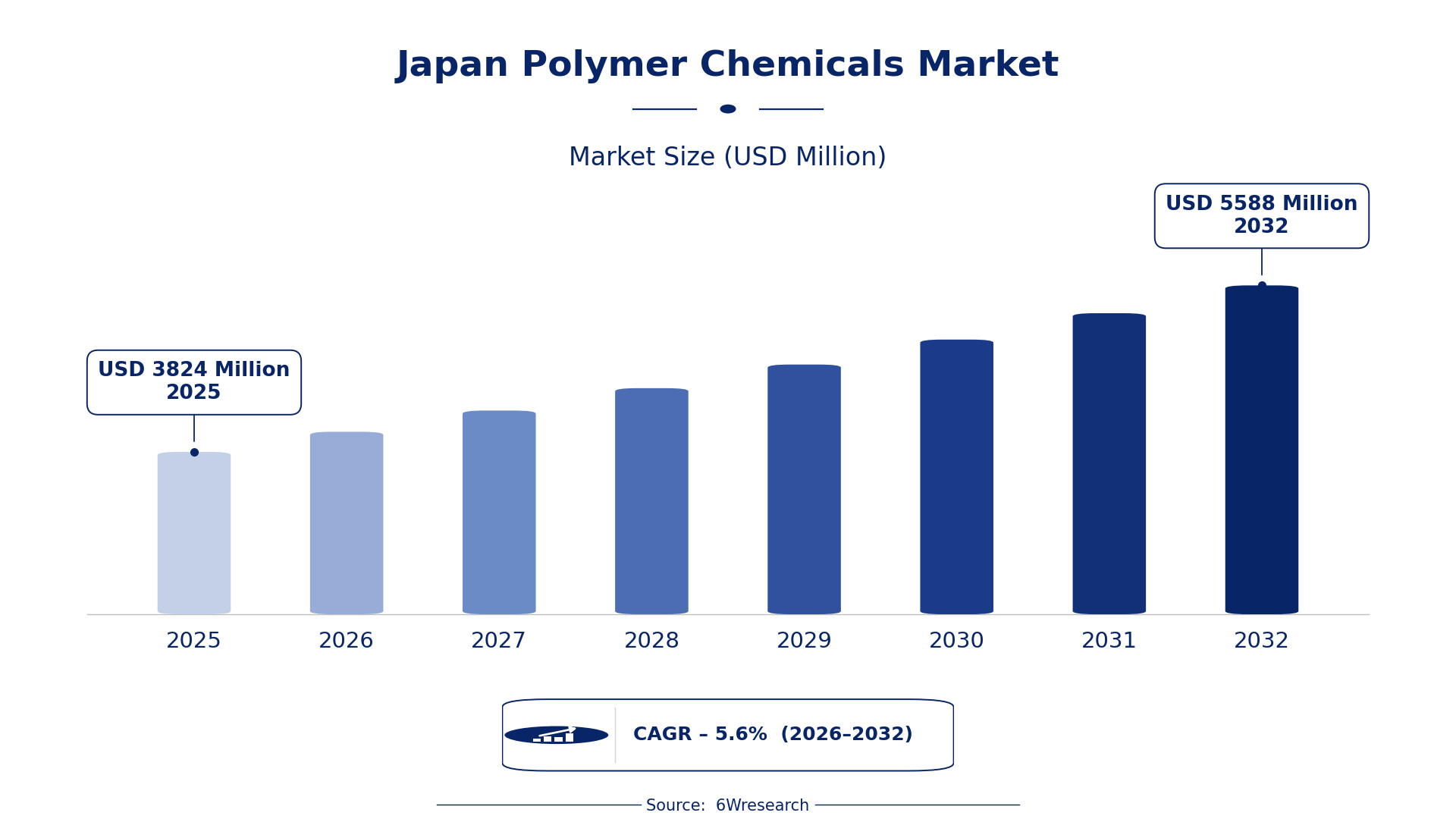
According to 6Wresearch internal database and industry insights, the Japan Polymer Chemicals Market was valued at USD 3,824 Million in 2025 and is projected to reach USD 5,588 Million by 2032, growing at a CAGR of approximately 5.6% during 2026–2032.
Japan Polymer Chemicals Market Highlights
| Report Metric | Details |
| Report Name | Japan Polymer Chemicals Market (2026-2032) |
| Market Size 2025 | USD 3,824 Million |
| Market Size 2032 | USD 5,588 Million |
| Absolute Growth 2025–2032 | USD 1,764 Million |
| CAGR 2026–2032 | 5.6% |
| Peak Annual Growth | 6.7% in 2032 |
| Forecast Period | 2026–2032 |
| Historical Data | 2022–2025 |
| Base Year | 2025 |
| Leading Product Type, 2025 | Monomers (40% share) |
| Leading Application, 2025 | Polymerization (40% share) |
| Leading Distribution Channel, 2025 | Direct Sales (36% share) |
| Leading End User, 2025 | Plastics Industry (42% share) |
| Fastest-Growing Product Type | Catalysts (7.9% CAGR) |
| Fastest-Growing Application | Molecular Weight Control (8.4% CAGR) |
| Fastest-Growing Distribution Channel | Online Platforms (7.5% CAGR) |
| Fastest-Growing End User | Research Institutions (7.3% CAGR) |
| Growing Sector | Molecular Weight Control |
| Key End Users | Polymerization, Polymer Synthesis, Molecular Weight Control, Free Radical Formation |
Japan Polymer Chemicals Market Year-wise Growth Rate and Key Drivers (2022–2032)
This graph illustrates the annual growth rates of the market from 2022 to 2032, highlighting a steady upward trajectory and projected market expansion over the forecast period.
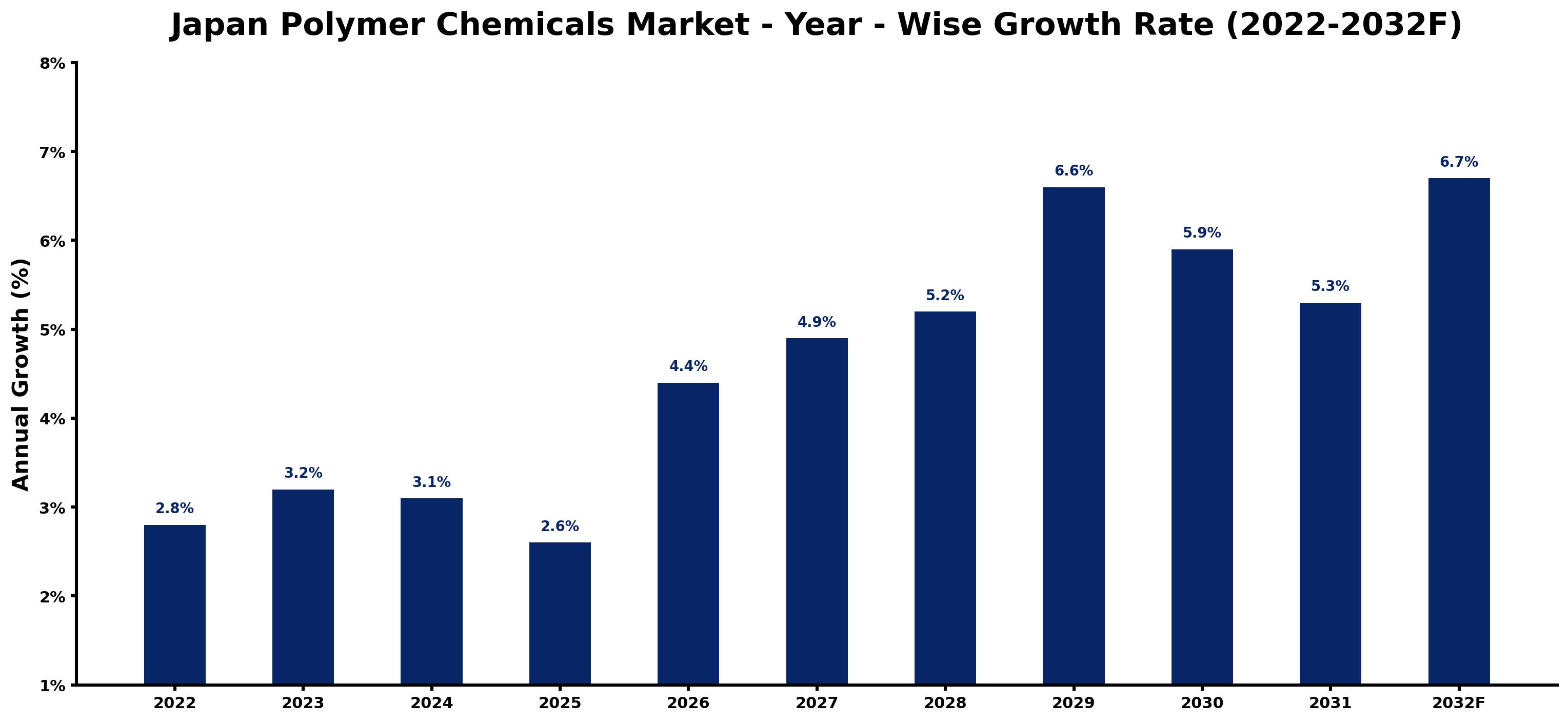
Below, each year's estimated growth is shown next to the factor that most influenced it.
| Year | Estimated Annual Growth (%) | Market Rationale |
| 2022 | 2.8 | The market experienced stable growth, driven by ongoing demand from the plastics industry. |
| 2023 | 3.2 | Growth accelerated as the plastics sector expanded, boosting polymer chemical consumption. |
| 2024 | 3.1 | Growth slowed slightly due to market saturation in certain applications, yet demand remained strong. |
| 2025 | 2.6 | The market continued to grow, albeit at a slower pace, influenced by competitive pressures. |
| 2026 | 4.4 | Demand is expected to surge as investments in sustainable practices gain traction across the industry. |
| 2027 | 4.9 | Growth will continue to rise, supported by increased production capacities in polymer synthesis. |
| 2028 | 5.2 | The market is projected to see further acceleration as technological advancements improve efficiency. |
| 2029 | 6.6 | Demand will peak as the plastics industry ramps up production in response to market needs. |
| 2030 | 5.9 | Growth is expected to moderate slightly as the market stabilises after the previous surge in demand. |
| 2031 | 5.3 | The market will maintain a steady growth rate, reflecting consistent demand from key sectors. |
| 2032 | 6.7 | Growth is projected to accelerate again, driven by rising investments in biodegradable polymer technologies. |
Note: Market size estimations and growth projections presented in this report are based on 6Wresearch's proprietary forecasting methodology, utilizing the latest available industry data, government publications, and primary research inputs.
Japan Polymer Chemicals Market Synopsis
Polymer chemicals are substances used in producing polymers through chemical processes, primarily derived from petrochemical sources. The Tokyo region serves as a key manufacturing hub, while government initiatives promote eco-friendly practices, further stimulating demand.
Market Dynamics Impact Analysis (2026–2032)
| Factor | Type | Impact | Primary Segment Affected |
| Increasing demand for sustainable products drives the need for biodegradable polymers. | Driver | High | Polymerization |
| Rising investments in polymer production facilities enhance capacity. | Driver | High | Polymer Synthesis |
| Growing interest in eco-friendly materials presents opportunities for innovation. | Opportunity | High | Initiators |
| Emerging markets for specialty polymers create new revenue streams. | Opportunity | Medium | Monomers |
| Regulatory compliance costs can burden manufacturers, affecting pricing strategies. | Restraint | High | Catalysts |
| Supply chain disruptions can delay production schedules and increase costs. | Restraint | Medium | Chain Transfer Agents |
| High raw material prices can limit profitability for producers. | Challenge | High | Monomers |
| Capacity constraints may hinder the ability to meet rising demand. | Challenge | Medium | Polymer Synthesis |
Evaluation of Drivers in Japan Polymer Chemicals Market (2026–2032)
The table below links each growth driver to the segment it affects and the evidence for it.
| Drivers | Primary Segment Affected | Why It Matters (Evidence) |
| Increased production of biodegradable polymers results from environmental regulations. | Initiators | Japan's Green Growth Strategy targets JPY 150 trillion for sustainable polymer production, leading to higher demand for initiators. |
| The plastics industry's growth fuels demand for polymerization processes. | Polymerization | The plastics industry employs around 1.5 million people, driving continuous demand for polymer chemicals and related processes. |
| Technological advancements in polymer synthesis improve production efficiency. | Polymer Synthesis | Research institutions in Japan conduct over 200 polymer-related studies annually, leading to better production techniques. |
| Rising demand for catalysts is linked to the expansion of polymer production. | Catalysts | Annual demand for catalysts in polymer production exceeds 30,000 tons, highlighting their critical role in manufacturing processes. |
| Growing interest in specialty polymers opens new markets for chemical companies. | Monomers | Japan's chemical industry, valued at approximately 10 trillion yen, is diversifying into specialty applications, creating new opportunities. |
Orders continue to rise as the plastics industry expands, increasing demand for polymer chemicals. In 2023, the annual demand for catalysts in polymer production surpassed 30,000 tons, reflecting the sector's growth. Research institutions in Japan conduct over 200 polymer-related studies each year, leading to improved production techniques. The market is shifting towards new chemical applications, further boosting demand for polymer chemicals. Increased investments in sustainable practices are expected to support market growth, particularly in biodegradable polymers and specialty applications.
Evaluation of Restraints in Japan Polymer Chemicals Market
The main factors holding the market back are set out below.
| Market Restraint | Primary Segment Affected | Why It Matters (Evidence) |
| Regulatory compliance costs can burden manufacturers, affecting pricing strategies. | Catalysts | Compliance with the PRTR Law requires businesses to report chemical substances, increasing operational costs for manufacturers. |
| Supply chain disruptions can delay production schedules and increase costs. | Chain Transfer Agents | Recent global supply chain issues have impacted the availability of key raw materials, affecting production timelines and increasing expenses. |
| High raw material prices can limit profitability for producers. | Monomers | Fluctuations in petrochemical prices directly impact the cost structure of polymer chemical manufacturers, squeezing margins. |
| Limited availability of skilled workforce can hinder production capacity. | Polymer Synthesis | The chemical industry in Japan faces challenges in attracting and retaining skilled talent, which affects growth and production efficiency. |
| Market saturation in certain applications can restrict growth potential. | Polymerization | In some sectors, demand has plateaued, limiting opportunities for expansion and innovation. |
Japan Polymer Chemicals Market Challenges
Buyers of polymer chemicals are facing rising costs due to a 20% increase in raw material prices over the past year, which compresses their profit margins. Domestic producers encounter fierce competition from imports, risking a potential revenue loss of 15% as they strive to maintain market share. Skills shortages in advanced polymer chemistry hinder innovation, delaying product development timelines by six months for manufacturers. Regulatory changes aimed at reducing plastic waste impose compliance costs averaging 5 million yen annually for smaller firms, further straining their financial resources.
Trends in the Japan Polymer Chemicals Market
Buyers and suppliers in the Japan Polymer Chemicals Market are adjusting to the following trends.
- Transition towards Biodegradable Polymers: Japan launched a strategy in 2023 to reduce plastic waste by promoting biodegradable polymers. This initiative is expected to increase demand for eco-friendly polymer chemicals, aligning with sustainability goals.
- Emergence of Online Sales Platforms: The Tokyo region is experiencing a shift towards online sales platforms for polymer chemicals, with a projected CAGR of 7.5% from 2026 to 2032. This trend facilitates easier access for buyers and broadens market reach.
- Increased Focus on Polymer Research: The National Institute of Advanced Industrial Science and Technology leads over 200 polymer-related studies annually, driving innovation in polymer chemistry and expanding application areas. This focus is important for future market growth.
- Growing Demand from Research Institutions: Research institutions are increasingly adopting advanced polymer chemicals, with a projected CAGR of 7.3% from 2026 to 2032. This trend highlights the need for innovative materials in experimental applications.
Investment Opportunities in the Japan Polymer Chemicals Market
Where to invest in the Japan Polymer Chemicals Market: the main openings are set out below.
- Tokyo as a Hub for Sustainable Innovation: The Tokyo region is becoming a centre for sustainable polymer innovation, with JPY 150 trillion in public and private investments over the next decade. Suppliers can enter this market by partnering with local research institutions.
- Research Institutions Seeking Advanced Materials: Research institutions are actively seeking advanced polymer chemicals to support their studies, creating opportunities for suppliers to provide specialised products. Collaborations with academic labs can improve market access.
- Investment in Biodegradable Polymers: With Japan targeting a 46% cut in greenhouse-gas emissions by 2030, there is a significant opportunity to invest in biodegradable polymer production. This aligns with the needs of the plastics industry, which is adapting to new regulations.
- Gap in Specialty Polymers: The annual demand for specialty polymers is rising, presenting a gap in the market. Suppliers can target this opportunity by developing niche products for specific applications in the chemical sector.
Government Initiatives in the Japan Polymer Chemicals Market
The Plastic Resource Circulation Act, enacted in 2021, promotes the reduction, reuse, and recycling of plastics while supporting alternatives like biodegradable polymers. This law mandates businesses to adopt sustainable practices, influencing polymer chemical producers to innovate and comply with environmental standards. The PRTR Law requires businesses to report chemical releases, ensuring transparency and accountability in the industry, which affects operational costs for manufacturers.
In practice, the Japanese Plastics Industry Federation benefits from government grants aimed at promoting innovation in polymer chemistry. The Tokyo Metropolitan Government supports initiatives that improve research and development, providing funding for projects that enhance sustainability in polymer production. These measures encourage manufacturers to invest in eco-friendly technologies and improve their competitive edge.
Future Insight of the Japan Polymer Chemicals Market
Emerging biodegradable polymer production facilities will come online by 2032, aligning with Japan's ambitious decarbonisation goals. The annual demand for catalysts in polymer production, exceeding 30,000 tons, will compel suppliers to innovate their product lines. Research initiatives will thrive, with over 200 polymer-related studies conducted annually, improving efficiency and product quality. Standards like ISO 9001 will continue to build buyer confidence in domestic products, ensuring reliability and consistency.
Market Segmentation Analysis
Japan Polymer Chemicals Market report covers a detailed analysis of the following market segments:
By Product Type – Monomers Lead, Catalysts Expected to Grow Fastest
According to Navya, Research Analyst at 6Wresearch, the largest product type category in 2025 was Monomers, at 40% of revenue. Monomers are essential for polymer production, acting as the primary components in various formulations. Their widespread use across multiple manufacturing processes solidifies their leading position in Japan's polymer chemicals market. The quickest growth will come from Catalysts, forecast to expand at a CAGR of 7.9% between 2026 and 2032. Catalysts play a crucial role in speeding up chemical reactions during polymer production, which is vital for manufacturers seeking greater efficiency. The annual demand for catalysts exceeding 30,000 tons underscores their rapid growth potential. Suppliers must focus on enhancing their catalyst offerings to meet the rising demand from manufacturers.
By Application – Polymerization Leads, Molecular Weight Control Expected to Grow Fastest
Polymerization accounted for 40% of the market by application in 2025. Polymerization is the core process for creating polymers, making it indispensable in the production of various polymer products. Its fundamental importance ensures that it maintains the largest share within the application segment. Molecular Weight Control is projected to grow fastest, at a CAGR of 8.4% during 2026–2032. Molecular Weight Control is vital for tailoring polymer properties, which is increasingly sought after as manufacturers aim for specific performance characteristics. This growing need for customisation drives the swift expansion of this sub-segment. Buyers will benefit from suppliers that provide advanced solutions for molecular weight control to meet precise product specifications.
By Distribution Channel – Direct Sales Leads, Online Platforms Expected to Grow Fastest
In 2025, Direct Sales led the distribution channel split with a 36% share. Direct Sales is a common method for B2B transactions in the polymer chemicals market, allowing for personalised service and direct engagement between suppliers and buyers. This established practice supports its leading position in the distribution channel segment. Online Platforms are set to record the highest CAGR in this split, 7.5% over 2026–2032. Online Platforms facilitate information and sales, making them an attractive option for buyers seeking convenience and access to a broader range of products. The rise of e-commerce in industrial sectors contributes to the rapid growth of this channel. Suppliers should invest in online sales strategies to capture the growing segment of buyers preferring digital transactions.
By End User – Plastics Industry Leads, Research Institutions Expected to Grow Fastest
Plastics Industry held 42% of the Japan Polymer Chemicals Market by end user in 2025. The Plastics Industry is the largest end user of polymer chemicals, employing around 1.5 million people and generating substantial demand for these substances. Its diverse applications across various sectors reinforce its dominant position in the market. Over 2026–2032, Research Institutions are expected to post the fastest growth, at a CAGR of 7.3%. Research Institutions utilise polymer chemicals for experimental purposes, which leads to increased funding and focus on polymer-related studies. This rising emphasis on research and development accelerates the growth of this segment. Suppliers should engage with research institutions to create partnerships that can foster innovative applications of polymer chemicals.
Key Attractiveness of the Report
- 10 Years of Market Numbers
- Historical Data Starting from 2022 to 2025
- Base Year 2025
- Forecast Data until 2032
- Key Performance Indicators Impacting the Market
- Major Upcoming Developments and Projects
Key Highlights of the Report:
- Japan Polymer Chemicals Market Outlook
- Market Size of Japan Polymer Chemicals Market, 2025
- Forecast of Japan Polymer Chemicals Market, 2032
- Historical Data and Forecast of Japan Polymer Chemicals Revenues & Volume for the Period 2022-2032F
- Japan Polymer Chemicals Market Trend Evolution
- Japan Polymer Chemicals Market Drivers and Challenges
- Japan Polymer Chemicals Price Trends
- Japan Polymer Chemicals Porter's Five Forces
- Japan Polymer Chemicals Industry Life Cycle
- Historical Data and Forecast of Japan Polymer Chemicals Market Revenues & Volume By Product Type for the Period 2022-2032F
- Historical Data and Forecast of Japan Polymer Chemicals Market Revenues & Volume By Monomers for the Period 2022-2032F
- Historical Data and Forecast of Japan Polymer Chemicals Market Revenues & Volume By Catalysts for the Period 2022-2032F
- Historical Data and Forecast of Japan Polymer Chemicals Market Revenues & Volume By Chain Transfer Agents for the Period 2022-2032F
- Historical Data and Forecast of Japan Polymer Chemicals Market Revenues & Volume By Initiators for the Period 2022-2032F
- Historical Data and Forecast of Japan Polymer Chemicals Market Revenues & Volume By Application for the Period 2022-2032F
- Historical Data and Forecast of Japan Polymer Chemicals Market Revenues & Volume By Polymer Synthesis for the Period 2022-2032F
- Historical Data and Forecast of Japan Polymer Chemicals Market Revenues & Volume By Polymerization for the Period 2022-2032F
- Historical Data and Forecast of Japan Polymer Chemicals Market Revenues & Volume By Molecular Weight Control for the Period 2022-2032F
- Historical Data and Forecast of Japan Polymer Chemicals Market Revenues & Volume By Free Radical Formation for the Period 2022-2032F
- Historical Data and Forecast of Japan Polymer Chemicals Market Revenues & Volume By Distribution Channel for the Period 2022-2032F
- Historical Data and Forecast of Japan Polymer Chemicals Market Revenues & Volume By Online Platforms for the Period 2022-2032F
- Historical Data and Forecast of Japan Polymer Chemicals Market Revenues & Volume By Direct Sales for the Period 2022-2032F
- Historical Data and Forecast of Japan Polymer Chemicals Market Revenues & Volume By Distributors for the Period 2022-2032F
- Historical Data and Forecast of Japan Polymer Chemicals Market Revenues & Volume By Specialty Stores for the Period 2022-2032F
- Historical Data and Forecast of Japan Polymer Chemicals Market Revenues & Volume By End User for the Period 2022-2032F
- Historical Data and Forecast of Japan Polymer Chemicals Market Revenues & Volume By Chemical Companies for the Period 2022-2032F
- Historical Data and Forecast of Japan Polymer Chemicals Market Revenues & Volume By Research Institutions for the Period 2022-2032F
- Historical Data and Forecast of Japan Polymer Chemicals Market Revenues & Volume By Plastics Industry for the Period 2022-2032F
- Historical Data and Forecast of Japan Polymer Chemicals Market Revenues & Volume By Academic Labs for the Period 2022-2032F
- Japan Polymer Chemicals Import Export Trade Statistics
- Market Opportunity Assessment By Product Type
- Market Opportunity Assessment By Application
- Market Opportunity Assessment By Distribution Channel
- Market Opportunity Assessment By End User
- Japan Polymer Chemicals Top Companies Market Share
- Japan Polymer Chemicals Competitive Benchmarking By Technical and Operational Parameters
- Japan Polymer Chemicals Company Profiles
- Japan Polymer Chemicals Key Strategic Recommendations
Market Covered
The report covers the following segments.
By Product Type
- Monomers
- Catalysts
- Chain Transfer Agents
- Initiators
By Application
- Polymer Synthesis
- Polymerization
- Molecular Weight Control
- Free Radical Formation
By Distribution Channel
- Online Platforms
- Direct Sales
- Distributors
- Specialty Stores
By End User
- Chemical Companies
- Research Institutions
- Plastics Industry
- Academic Labs































