Japan Post-Emergent Herbicide Adjuvants Market Size & Growth Rate
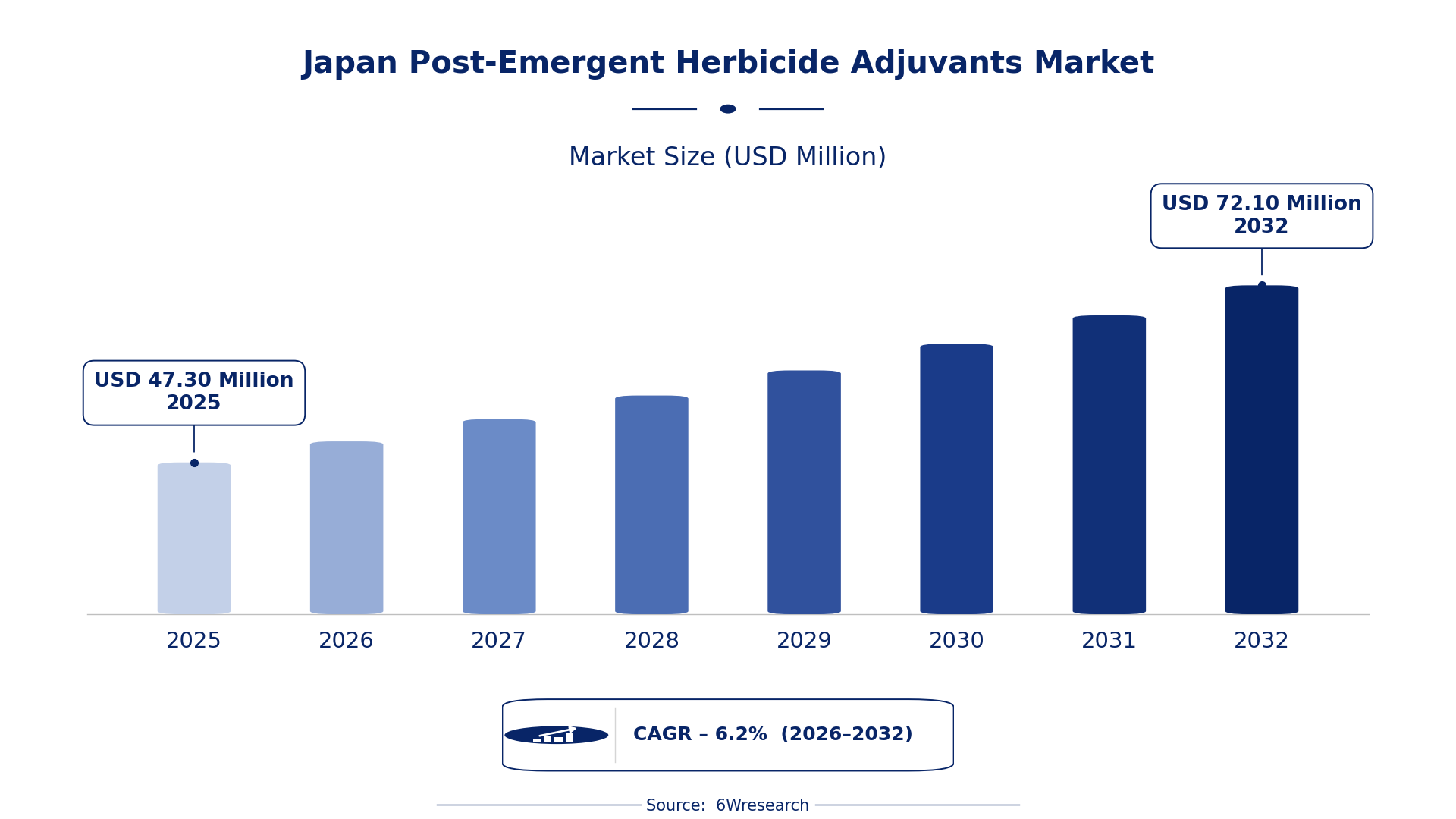
According to 6Wresearch internal database and industry insights, the Japan Post-Emergent Herbicide Adjuvants Market was valued at USD 47.30 Million in 2025 and is projected to reach USD 72.10 Million by 2032, growing at a CAGR of approximately 6.2% during 2026–2032.
Japan Post-Emergent Herbicide Adjuvants Market Highlights
| Report Metric | Details |
| Report Name | Japan Post-Emergent Herbicide Adjuvants Market (2026-2032) |
| Market Size 2025 | USD 47.30 Million |
| Market Size 2032 | USD 72.10 Million |
| Absolute Growth 2025–2032 | USD 24.80 Million |
| CAGR 2026–2032 | 6.2% |
| Peak Annual Growth | 7.1% in 2032 |
| Forecast Period | 2026–2032 |
| Historical Data | 2022–2025 |
| Base Year | 2025 |
| Leading Product Type, 2025 | Surfactants (40% share) |
| Leading Chemical Type, 2025 | Non-Ionic (42% share) |
| Leading Distribution Channel, 2025 | Agricultural Suppliers (46% share) |
| Leading End User, 2025 | Farmers (44% share) |
| Fastest-Growing Product Type | Oils & Esters (8.9% CAGR) |
| Fastest-Growing Chemical Type | Methylated Seed Oils (8.8% CAGR) |
| Fastest-Growing Distribution Channel | Direct Sales (8.3% CAGR) |
| Fastest-Growing End User | Agribusinesses (8.1% CAGR) |
| Growing Sector | Agriculture |
| Key End Users | Farmers, Agribusinesses, Crop Protection Firms |
Japan Post-Emergent Herbicide Adjuvants Market Year-wise Growth Rate and Key Drivers (2022–2032)
This graph illustrates the annual growth rates of the market from 2022 to 2032, highlighting a steady upward trajectory and projected market expansion over the forecast period.
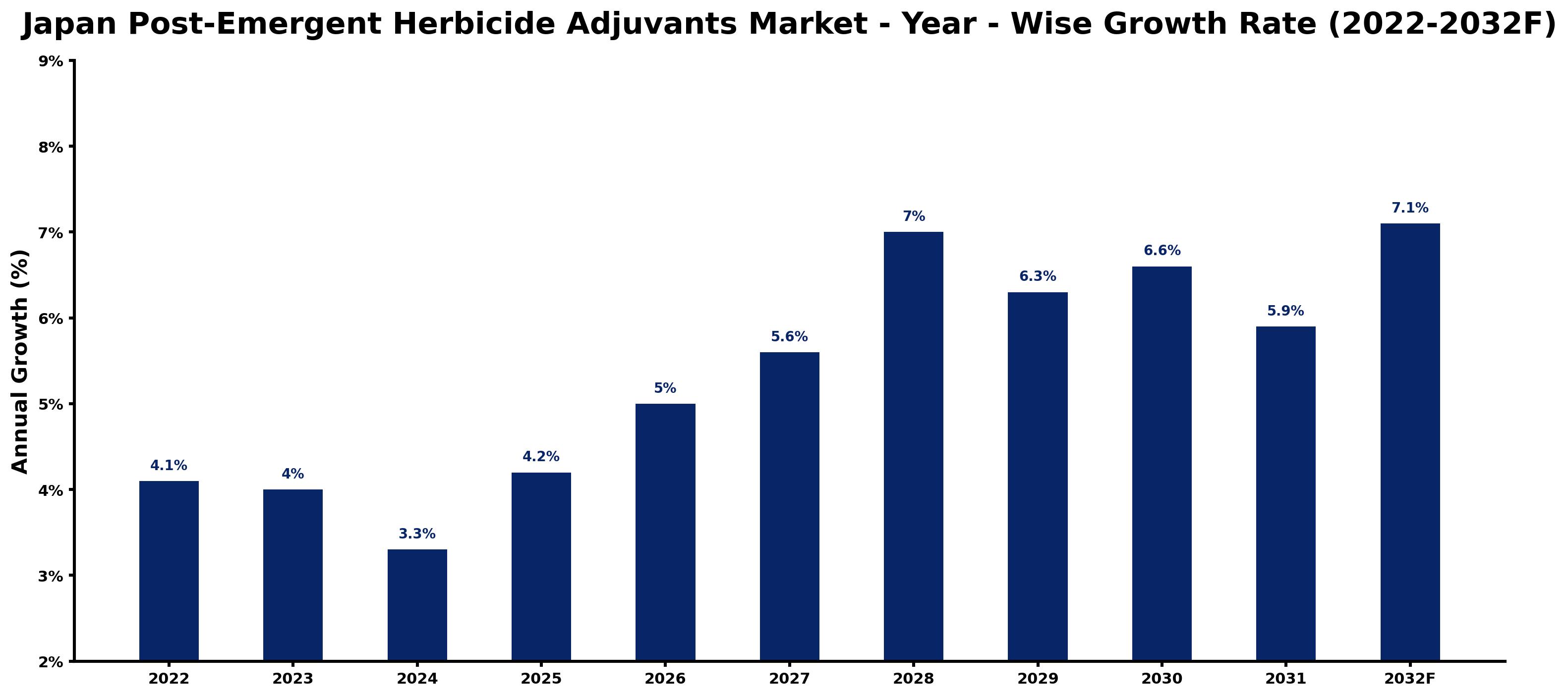
The following figures match every annual growth estimate with the main market development of that year, giving the reasoning behind each rise or slowdown.
| Year | Estimated Annual Growth (%) | Market Rationale |
| 2022 | 4.1 | The market experienced steady growth, driven by ongoing agricultural activities and herbicide usage. |
| 2023 | 4.0 | Growth slowed slightly as farmers adjusted to changing weather patterns affecting crop management. |
| 2024 | 3.3 | The market continued to grow, albeit at a slower rate, due to cautious adoption of new technologies. |
| 2025 | 4.2 | Growth accelerated as farmers embraced new herbicide formulations and adjuvants for improved efficacy. |
| 2026 | 5.0 | Demand is expected to increase as investments in precision agriculture technologies begin to take effect. |
| 2027 | 5.6 | The market is projected to see further growth as farmers seek effective solutions for weed management. |
| 2028 | 7.0 | Demand is anticipated to surge as the adoption of new adjuvants becomes more widespread among farmers. |
| 2029 | 6.3 | Growth is expected to slow as market saturation begins to impact the uptake of new products. |
| 2030 | 6.6 | An increase in herbicide applications will lead to a rise in demand for effective adjuvants. |
| 2031 | 5.9 | Growth is projected to moderate as the market adjusts to previous years' rapid expansion. |
| 2032 | 7.1 | The market is expected to peak as advanced formulations and sustainable practices gain traction. |
Note: Market size estimations and growth projections presented in this report are based on 6Wresearch's proprietary forecasting methodology, utilizing the latest available industry data, government publications, and primary research inputs.
Japan Post-Emergent Herbicide Adjuvants Market Synopsis
Post-Emergent Herbicide Adjuvants are chemical additives that improve the effectiveness of herbicides after application, enhancing absorption, reducing spray drift, and increasing weed control efficacy in various crops. The Japan Post-Emergent Herbicide Adjuvants Market is expanding due to investments in precision agriculture technologies, rising herbicide applications, and the need for effective weed management solutions, with strong demand from farmers and agribusinesses. In 2022, Japan's rice production reached about 7.5 million tons, necessitating effective weed management strategies.
Market Dynamics Impact Analysis (2026–2032)
| Factor | Type | Impact | Primary Segment Affected |
| Growing adoption of precision agriculture technologies | Driver | High | Surfactants |
| Increased herbicide applications for effective weed control | Driver | High | Oils & Esters |
| Emerging demand for sustainable agricultural practices | Opportunity | Medium | Compatibility Agents |
| Rising interest in advanced formulations for better performance | Opportunity | Medium | Spray Drift Reducers |
| Aging farmer population impacting technology adoption | Restraint | High | Non-Ionic |
| Market saturation limiting new product uptake | Restraint | Medium | Methylated Seed Oils |
| High costs associated with new technology adoption | Challenge | High | Blending Agents |
| Regulatory compliance requirements delaying product launches | Challenge | Medium | Polymer-Based |
Evaluation of Drivers in Japan Post-Emergent Herbicide Adjuvants Market (2026–2032)
The factors lifting demand, and the evidence behind each, are summarised below.
| Drivers | Primary Segment Affected | Why It Matters (Evidence) |
| Investment in precision agriculture technologies | Surfactants | This investment increases herbicide effectiveness, prompting farmers to purchase more adjuvants for better crop yields. |
| Rising herbicide applications due to pest pressures | Oils & Esters | Farmers are buying more adjuvants to improve herbicide absorption and efficacy in challenging conditions. |
| Demand for sustainable practices in agriculture | Methylated Seed Oils | Farmers are seeking solutions that ensure safe mixing of chemicals, driving purchases of these adjuvants. |
| Focus on advanced formulations for weed control | Spray Drift Reducers | Farmers are investing in products that minimise herbicide loss, resulting in higher sales of drift reducers. |
| Increase in agricultural area cultivated | Non-Ionic | With approximately 4.5 million hectares under cultivation, demand for effective adjuvants is rising. |
Several shifts outside the market lift sales. Investments in precision agriculture technologies are increasing, with farmers seeking effective solutions for weed management. In 2022, Japan's rice production reached 7.5 million tons, necessitating better herbicide applications. The average age of farmers, over 67 years, is pushing the need for effective adjuvants that improve absorption. The growing focus on sustainable agricultural practices is driving demand for adjuvants that ensure safe chemical mixing. Agricultural suppliers in regions like Hokkaido are responding to these trends by offering products that meet evolving farmer needs.
Evaluation of Restraints in Japan Post-Emergent Herbicide Adjuvants Market
Below are the constraints most often cited by buyers and suppliers, with the segment each affects.
| Market Restraint | Primary Segment Affected | Why It Matters (Evidence) |
| Aging farmer population impacting technology adoption | Non-Ionic | The average age of farmers in Japan exceeds 67 years, leading to slower adoption of new adjuvant technologies. |
| Market saturation limiting new product uptake | Methylated Seed Oils | As the market matures, the introduction of new products faces challenges in gaining traction among established users. |
| High costs associated with new technology adoption | Blending Agents | Farmers hesitate to invest in new adjuvants due to the financial burden of advanced formulations. |
| Regulatory compliance requirements delaying product launches | Polymer-Based | Strict regulations around chemical substances slow down the introduction of new adjuvant products. |
| Limited awareness of benefits among smaller farmers | Compatibility Agents | Smaller farmers may not fully understand the advantages of using compatibility agents, affecting sales. |
Japan Post-Emergent Herbicide Adjuvants Market Challenges
Japan's agricultural sector faces delays due to strict regulations from the Ministry of Agriculture, Forestry and Fisheries, which can extend product approval times by up to six months, impacting suppliers. An ageing farmer population, with over 67% of farmers aged 67 or older, limits technological adoption, causing reluctance to utilise new adjuvant formulations and reducing weed control effectiveness. Buyers confront rising prices as inadequate herbicide management leads to potential crop losses estimated at 1 million tons of rice annually. Skills shortages in modern agricultural practices restrict producers' ability to optimise herbicide use, resulting in inefficient applications and wasted resources.
Trends in the Japan Post-Emergent Herbicide Adjuvants Market
Buyers and suppliers in the Japan Post-Emergent Herbicide Adjuvants Market are adjusting to the following trends.
- Shift towards Precision Agriculture: In 2023, Japan launched a program supporting precision agriculture technologies, resulting in increased adoption of advanced adjuvants. This trend is expected to improve efficiency in weed management, benefiting farmers across the country.
- Transition from Traditional to Advanced Adjuvants: Since 2021, the focus on advanced adjuvants has intensified, with farmers increasingly using non-ionic surfactants. This shift is driven by the need for improved herbicide efficacy, resulting in higher sales of these products.
- Emergence of Sustainable Practices: The Japanese government has allocated funds for sustainable agriculture initiatives, promoting the use of biodegradable adjuvants. This trend is gaining traction among farmers, resulting in a rise in demand for environmentally friendly products.
- Increased Demand for Customised Solutions: Farmers are increasingly seeking customised adjuvant solutions tailored to specific crop needs. This trend is evident in regions like Tohoku, where tailored products are becoming more popular.
Investment Opportunities in the Japan Post-Emergent Herbicide Adjuvants Market
The following opportunities in the Japan Post-Emergent Herbicide Adjuvants Market pair current demand with a clear way in.
- Timing for Sustainable Practices: With the government's push for sustainable agriculture, there is a growing demand for biodegradable adjuvants. This presents an opportunity for suppliers to invest in eco-friendly products, particularly among agribusinesses in Hokkaido.
- Supply of Advanced Adjuvants: The need for advanced adjuvants is rising, especially those that improve herbicide effectiveness. Suppliers can target farmers in Tohoku looking for effective weed management solutions.
- Facility Development for Research: Investment in research facilities for developing new adjuvants is critical. The Crop Protection Association of Japan can facilitate partnerships to explore advanced formulations.
- Market Gap for Compatibility Agents: As the market matures, the demand for compatibility agents is increasing. Suppliers can address this gap by providing tailored solutions to farmers across Japan.
Government Initiatives in the Japan Post-Emergent Herbicide Adjuvants Market
The Waste Management and Public Cleansing Act (1970) regulates the treatment of waste from agricultural chemicals, ensuring safe disposal practices for producers. Compliance with this law requires producers to implement proper waste management protocols, affecting their operational costs and sustainability efforts. In 2022, the Ministry of Agriculture, Forestry and Fisheries allocated funds for agricultural waste management initiatives, supporting sustainable practices in the sector.
The Chemical Substances Control Law (1973) mandates the evaluation of chemical substances used in adjuvants. This regulation impacts producers by requiring thorough testing and reporting, ensuring safety and efficacy for buyers while potentially increasing compliance costs. The Ministry of Health, Labour and Welfare oversees this law, ensuring that producers meet safety standards.
Future Insight of the Japan Post-Emergent Herbicide Adjuvants Market
Investment in precision agriculture technologies will reshape the market by 2032, creating demand for advanced adjuvants that enhance herbicide effectiveness. This shift will necessitate effective weed management solutions for the agricultural area of approximately 4.5 million hectares. Adoption of ISO 9001 standards will elevate quality in adjuvant production, benefiting suppliers. Growing awareness of sustainable practices will motivate buyers to pursue solutions that improve agricultural productivity.
Market Segmentation Analysis
Japan Post-Emergent Herbicide Adjuvants Market report covers a detailed analysis of the following market segments:
By Product Type – Surfactants Lead, Oils & Esters Expected to Grow Fastest
According to Navya, Research Analyst at 6Wresearch, Surfactants accounted for 40% of the market by product type in 2025. Surfactants hold the largest share because they are essential for improving herbicide effectiveness through enhanced coverage and penetration. Their widespread use in rice production, which reached 7.5 million tons in 2022, underscores their critical role in effective weed management. The quickest growth will come from Oils & Esters, forecast to expand at a CAGR of 8.9% between 2026 and 2032. Oils & Esters are experiencing rapid growth as they significantly aid in the absorption of herbicides into plant tissues. This surge is particularly relevant as Japan's agricultural sector aims to optimise crop yields amidst an ageing farmer population. Suppliers should focus on developing Oils & Esters to cater to the increasing market demand.
By Chemical Type – Non-Ionic Leads, Methylated Seed Oils Expected to Grow Fastest
Non-Ionic took 42% of chemical type revenue in 2025, more than any other category. Non-Ionic adjuvants dominate the market due to their prevalent use in enhancing the performance of various herbicides across different crops. Their adherence to agricultural standards set by the Ministry of Agriculture, Forestry and Fisheries ensures their wide acceptance among farmers. Methylated Seed Oils are projected to grow fastest, at a CAGR of 8.8% during 2026–2032. Methylated Seed Oils are growing quickly as they effectively increase herbicide uptake, which is crucial for farmers seeking to improve crop productivity. The current focus on sustainable agriculture initiatives further supports their adoption. Buyers should consider integrating Methylated Seed Oils to improve herbicide efficiency in their farming practices.
By Distribution Channel – Agricultural Suppliers Lead, Direct Sales Expected to Grow Fastest
Agricultural Suppliers held 46% of the Japan Post-Emergent Herbicide Adjuvants Market by distribution channel in 2025. Agricultural Suppliers lead the market as they provide essential products directly to farmers and agribusinesses, ensuring that necessary adjuvants are readily available. Their strong presence in key agricultural regions like Hokkaido and Tohoku highlights their significance in the supply chain. Over 2026–2032, Direct Sales is expected to post the fastest growth, at a CAGR of 8.3%. Direct Sales are growing rapidly as they represent a preferred method for distributing agricultural chemicals, enabling efficient transactions between suppliers and end users. This trend aligns with the increasing demand for precision agriculture technologies. Suppliers should enhance their direct sales strategies to effectively meet the rising need for efficient distribution.
By End User – Farmers Lead, Agribusinesses Expected to Grow Fastest
In 2025, Farmers led the end user split with a 44% share. Farmers are the primary users of adjuvants in crop production, driving the largest share of the market. Their active involvement in agriculture, despite an ageing demographic, underscores the necessity of effective weed control solutions. Agribusinesses are set to record the highest CAGR in this split, 8.1% over 2026–2032. Agribusinesses are experiencing the fastest growth as they utilise adjuvants for large-scale agricultural operations, reflecting the industry's shift towards more efficient farming practices. This trend is supported by government initiatives promoting sustainable agriculture. Suppliers should tailor their offerings to meet the specific needs of agribusinesses to capture this growing segment.
Key Attractiveness of the Report
- 10 Years of Market Numbers
- Historical Data Starting from 2022 to 2025
- Base Year 2025
- Forecast Data until 2032
- Key Performance Indicators Impacting the Market
- Major Upcoming Developments and Projects
Key Highlights of the Report:
- Japan Post-Emergent Herbicide Adjuvants Market Outlook
- Market Size of Japan Post-Emergent Herbicide Adjuvants Market, 2025
- Forecast of Japan Post-Emergent Herbicide Adjuvants Market, 2032
- Historical Data and Forecast of Japan Post-Emergent Herbicide Adjuvants Revenues & Volume for the Period 2022-2032F
- Japan Post-Emergent Herbicide Adjuvants Market Trend Evolution
- Japan Post-Emergent Herbicide Adjuvants Market Drivers and Challenges
- Japan Post-Emergent Herbicide Adjuvants Price Trends
- Japan Post-Emergent Herbicide Adjuvants Porter's Five Forces
- Japan Post-Emergent Herbicide Adjuvants Industry Life Cycle
- Historical Data and Forecast of Japan Post-Emergent Herbicide Adjuvants Market Revenues & Volume By Product Type for the Period 2022-2032F
- Historical Data and Forecast of Japan Post-Emergent Herbicide Adjuvants Market Revenues & Volume By Surfactants for the Period 2022-2032F
- Historical Data and Forecast of Japan Post-Emergent Herbicide Adjuvants Market Revenues & Volume By Oils & Esters for the Period 2022-2032F
- Historical Data and Forecast of Japan Post-Emergent Herbicide Adjuvants Market Revenues & Volume By Compatibility Agents for the Period 2022-2032F
- Historical Data and Forecast of Japan Post-Emergent Herbicide Adjuvants Market Revenues & Volume By Spray Drift Reducers for the Period 2022-2032F
- Historical Data and Forecast of Japan Post-Emergent Herbicide Adjuvants Market Revenues & Volume By Chemical Type for the Period 2022-2032F
- Historical Data and Forecast of Japan Post-Emergent Herbicide Adjuvants Market Revenues & Volume By Non-Ionic for the Period 2022-2032F
- Historical Data and Forecast of Japan Post-Emergent Herbicide Adjuvants Market Revenues & Volume By Methylated Seed Oils for the Period 2022-2032F
- Historical Data and Forecast of Japan Post-Emergent Herbicide Adjuvants Market Revenues & Volume By Blending Agents for the Period 2022-2032F
- Historical Data and Forecast of Japan Post-Emergent Herbicide Adjuvants Market Revenues & Volume By Polymer-Based for the Period 2022-2032F
- Historical Data and Forecast of Japan Post-Emergent Herbicide Adjuvants Market Revenues & Volume By Distribution Channel for the Period 2022-2032F
- Historical Data and Forecast of Japan Post-Emergent Herbicide Adjuvants Market Revenues & Volume By Agricultural Suppliers for the Period 2022-2032F
- Historical Data and Forecast of Japan Post-Emergent Herbicide Adjuvants Market Revenues & Volume By Online Platforms for the Period 2022-2032F
- Historical Data and Forecast of Japan Post-Emergent Herbicide Adjuvants Market Revenues & Volume By Direct Sales for the Period 2022-2032F
- Historical Data and Forecast of Japan Post-Emergent Herbicide Adjuvants Market Revenues & Volume By Specialty Stores for the Period 2022-2032F
- Historical Data and Forecast of Japan Post-Emergent Herbicide Adjuvants Market Revenues & Volume By End User for the Period 2022-2032F
- Historical Data and Forecast of Japan Post-Emergent Herbicide Adjuvants Market Revenues & Volume By Farmers for the Period 2022-2032F
- Historical Data and Forecast of Japan Post-Emergent Herbicide Adjuvants Market Revenues & Volume By Agribusinesses for the Period 2022-2032F
- Historical Data and Forecast of Japan Post-Emergent Herbicide Adjuvants Market Revenues & Volume By Crop Protection Firms for the Period 2022-2032F
- Historical Data and Forecast of Japan Post-Emergent Herbicide Adjuvants Market Revenues & Volume By Horticulture Experts for the Period 2022-2032F
- Japan Post-Emergent Herbicide Adjuvants Import Export Trade Statistics
- Market Opportunity Assessment By Product Type
- Market Opportunity Assessment By Chemical Type
- Market Opportunity Assessment By Distribution Channel
- Market Opportunity Assessment By End User
- Japan Post-Emergent Herbicide Adjuvants Top Companies Market Share
- Japan Post-Emergent Herbicide Adjuvants Competitive Benchmarking By Technical and Operational Parameters
- Japan Post-Emergent Herbicide Adjuvants Company Profiles
- Japan Post-Emergent Herbicide Adjuvants Key Strategic Recommendations
Market Covered
Coverage by segment is as follows.
By Product Type
- Surfactants
- Oils & Esters
- Compatibility Agents
- Spray Drift Reducers
By Chemical Type
- Non-Ionic
- Methylated Seed Oils
- Blending Agents
- Polymer-Based
By Distribution Channel
- Agricultural Suppliers
- Online Platforms
- Direct Sales
- Specialty Stores
By End User
- Farmers
- Agribusinesses
- Crop Protection Firms
- Horticulture Experts






































