Japan Poultry Farm Automation Market Size & Growth Rate
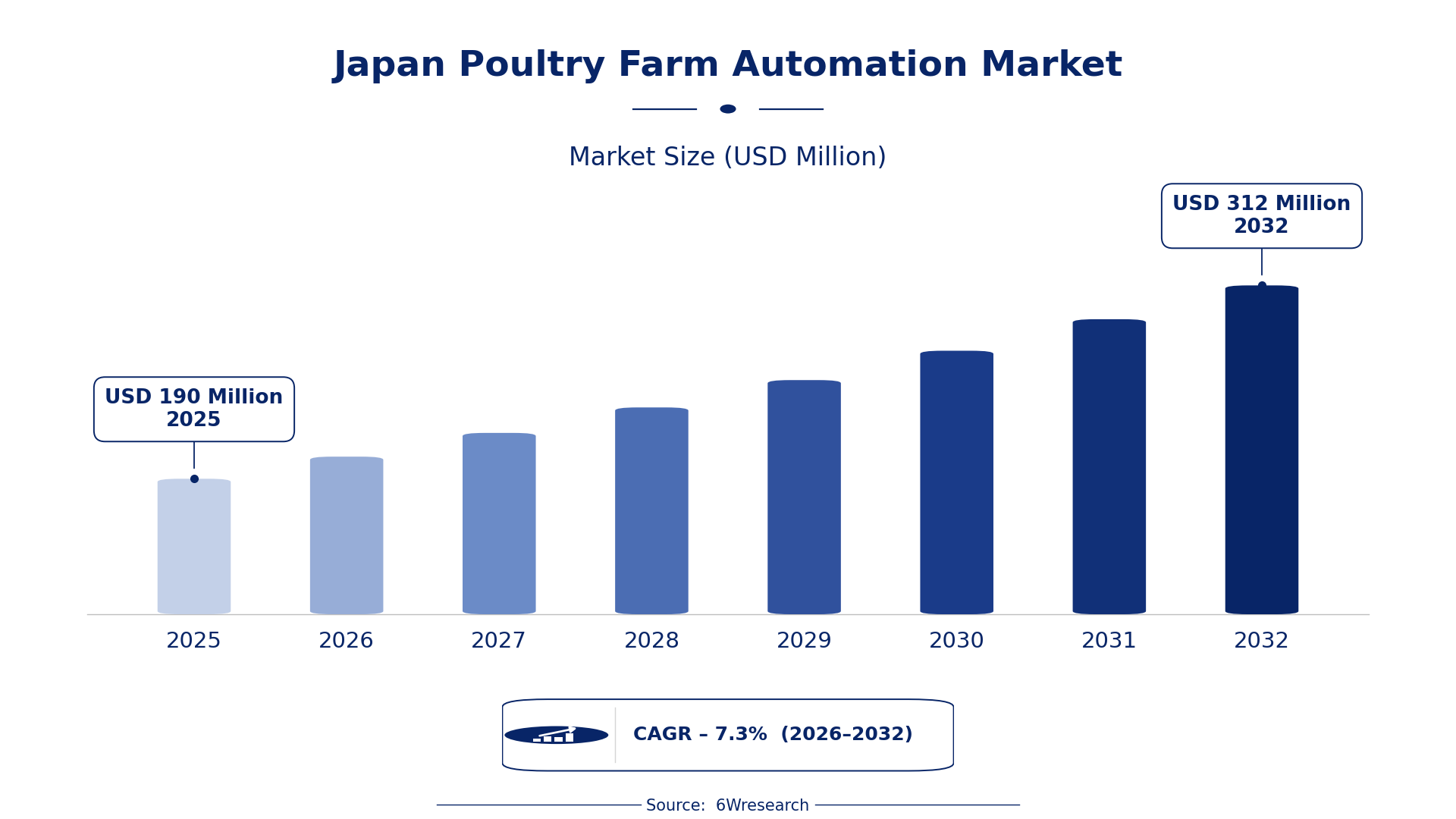
According to 6Wresearch internal database and industry insights, the Japan Poultry Farm Automation Market was valued at USD 190 Million in 2025 and is projected to reach USD 312 Million by 2032, growing at a CAGR of approximately 7.3% during 2026–2032.
Japan Poultry Farm Automation Market Highlights
| Report Metric | Details |
| Report Name | Japan Poultry Farm Automation Market (2026-2032) |
| Market Size 2025 | USD 190 Million |
| Market Size 2032 | USD 312 Million |
| Absolute Growth 2025–2032 | USD 122 Million |
| CAGR 2026–2032 | 7.3% |
| Peak Annual Growth | 8.4% in 2027 |
| Forecast Period | 2026–2032 |
| Historical Data | 2022–2025 |
| Base Year | 2025 |
| Leading Product Type, 2025 | Automated Feeding Systems (37% share) |
| Leading System Type, 2025 | IoT Enabled (34% share) |
| Leading Distribution Channel, 2025 | Direct Sales (42% share) |
| Leading End User, 2025 | Commercial Poultry Farms (52% share) |
| Fastest-Growing Product Type | Smart Lighting Systems (10.4% CAGR) |
| Fastest-Growing Distribution Channel | Online Platforms (9.4% CAGR) |
| Fastest-Growing End User | Hatcheries (9.1% CAGR) |
| Growing Sector | Poultry Farming |
| Key End Users | Commercial Poultry Farms, Hatcheries, Broiler Sheds, Poultry Houses |
Japan Poultry Farm Automation Market Year-wise Growth Rate and Key Drivers (2022–2032)
This graph illustrates the annual growth rates of the market from 2022 to 2032, highlighting a steady upward trajectory and projected market expansion over the forecast period.
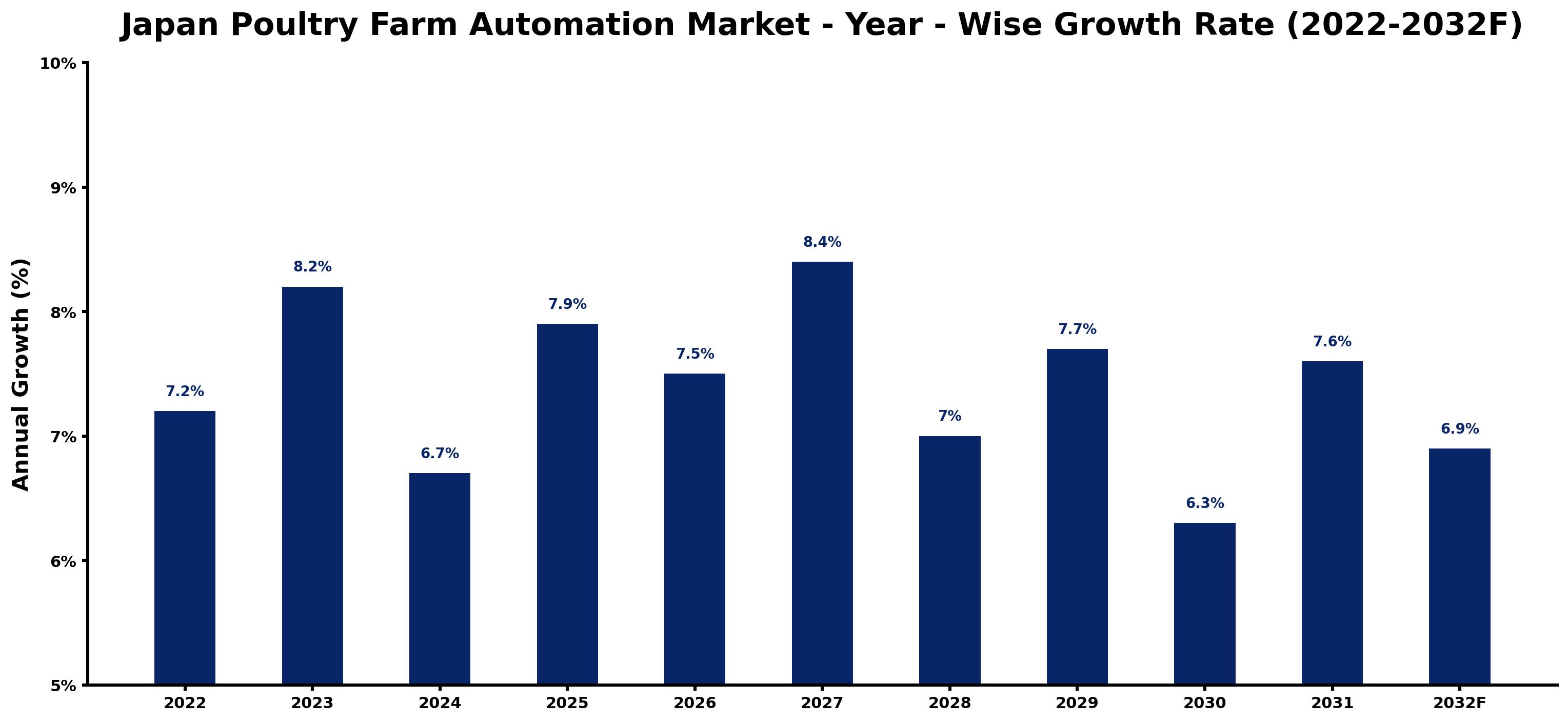
Annual growth estimates for each year appear below with the principal reason behind them, explaining the shifts that set the pace of the market.
| Year | Estimated Annual Growth (%) | Market Rationale |
| 2022 | 7.2 | The market experienced steady growth, reflecting strong poultry production levels. |
| 2023 | 8.2 | Growth accelerated due to increased investments in automation technologies. |
| 2024 | 6.7 | A slight slowdown occurred as some farms delayed automation upgrades. |
| 2025 | 7.9 | Investment in smart farming technologies picked up pace, driving demand. |
| 2026 | 7.5 | Growth is expected to slow as market saturation begins to impact new installations. |
| 2027 | 8.4 | A surge in demand for IoT-enabled systems will lead to faster growth. |
| 2028 | 7.0 | The market is projected to slow as competition intensifies among suppliers. |
| 2029 | 7.7 | Renewed interest in automation technologies will boost market growth again. |
| 2030 | 6.3 | Growth is expected to slow as economic factors influence investment decisions. |
| 2031 | 7.6 | Increased adoption of smart systems will revitalise the market's growth. |
| 2032 | 6.9 | A further slowdown is projected as the market approaches maturity. |
Note: Market size estimations and growth projections presented in this report are based on 6Wresearch's proprietary forecasting methodology, utilizing the latest available industry data, government publications, and primary research inputs.
Japan Poultry Farm Automation Market Synopsis
Poultry Farm Automation involves technologies designed to improve the efficiency of poultry farming operations, including automated feeding, climate control, and egg collection systems. The Japan Poultry Farm Automation Market is expanding, driven by poultry production reaching 1.5 million tons in 2022 and increasing investments in smart farming technologies. Government support for automation initiatives and the growing adoption of IoT-enabled systems are propelling market growth.
Market Dynamics Impact Analysis (2026–2032)
| Factor | Type | Impact | Primary Segment Affected |
| Growing demand for automated feeding systems to enhance feeding efficiency. | Driver | High | Automated Feeding Systems |
| Rising adoption of IoT-enabled systems for monitoring and efficiency. | Driver | High | IoT Enabled |
| Investment in smart farming technologies creates new opportunities. | Opportunity | High | Commercial Poultry Farms |
| Subsidy programs for smart agriculture technologies stimulate market growth. | Opportunity | High | Hatcheries |
| High initial investment costs limit automation adoption for smaller farms. | Restraint | Medium | Broiler Sheds |
| Market saturation in certain regions restricts further growth potential. | Restraint | Medium | Poultry Houses |
| Competition among suppliers can lead to price wars, affecting margins. | Challenge | High | Commercial Poultry Farms |
| Supply chain disruptions can delay equipment availability for buyers. | Challenge | Medium | Hatcheries |
Evaluation of Drivers in Japan Poultry Farm Automation Market (2026–2032)
The factors lifting demand, and the evidence behind each, are summarised below.
| Drivers | Primary Segment Affected | Why It Matters (Evidence) |
| Increased poultry production drives demand for automated feeding systems. | Automated Feeding Systems | Japan's poultry production reached 1.5 million tons in 2022, prompting farms to improve efficiency through automation. |
| The rise of IoT-enabled systems improves farm management capabilities. | IoT Enabled | The adoption rate of automated systems in Japan is around 40%, encouraging further investment in technology. |
| Government initiatives promote smart farming technologies across the sector. | Climate Control Units | Support for automation initiatives boosts demand, aligning with national agricultural goals for modernization. |
| Growing awareness of animal welfare standards increases demand for automation. | Egg Collection Systems | Egg collection systems are used in 70% of hatcheries in Japan, reflecting this trend towards improved welfare. |
| Technological advancements in automation systems improve operational efficiency. | Smart Lighting Systems | The use of smart lighting systems is growing by 15% annually in poultry houses, enhancing growth cycles. |
Buyers are adding capacity as Japan's poultry production reached 1.5 million tons in 2022, prompting farms to improve efficiency through automated systems. The adoption rate of automated systems in Japan is around 40%, reflecting the rise of IoT-enabled technologies that improve farm management capabilities. The increasing use of egg collection systems in hatcheries illustrates the growing awareness of animal welfare standards. The use of smart lighting systems, which is growing by 15% annually, demonstrates technological advancements improving productivity in poultry operations.
Evaluation of Restraints in Japan Poultry Farm Automation Market
The main factors holding the market back are set out below.
| Market Restraint | Primary Segment Affected | Why It Matters (Evidence) |
| High initial investment costs deter smaller farms from adopting automation. | Broiler Sheds | The average investment in poultry automation per farm is around 5 million yen, limiting accessibility for many farmers. |
| Market saturation in key regions restricts further growth potential. | Poultry Houses | Intense competition in Tokyo and Aichi limits opportunities for new entrants in the market. |
| Limited awareness of automation benefits among traditional farmers hinders adoption. | Commercial Poultry Farms | Many traditional farmers remain hesitant to invest in new technologies due to lack of information. |
| Supply chain disruptions can delay equipment availability for buyers. | Hatcheries | Recent global supply chain issues have affected the timely delivery of essential automation components. |
| Regulatory compliance requirements can complicate the implementation of new systems. | Egg Collection Systems | Producers must adhere to the JIS Z 8401 standard, increasing operational complexity and costs. |
Japan Poultry Farm Automation Market Challenges
Producers face high costs from competition with automated farms, which require substantial investments to remain viable. Skills shortages hinder the adoption of advanced technologies, delaying productivity improvements and raising operational costs for farms. Supply chain disruptions lead to shortages of critical components, extending installation timelines for suppliers by up to six months. Compliance with environmental standards, such as the JIS Z 8401, increases operational expenses for producers by around 10%, further straining their financial resources.
Trends in the Japan Poultry Farm Automation Market
Buyers and suppliers in the Japan Poultry Farm Automation Market are adjusting to the following trends.
- Shift from Manual to Automated Systems: The poultry industry is increasingly moving towards automation, with a notable rise in the adoption of automated feeding systems. In 2023, Japan's poultry farms saw an increase in the installed base of these systems, estimated at 50,000 units.
- Transition to IoT-Enabled Technologies: Since 2022, there has been a marked shift towards IoT-enabled systems in poultry farming. The adoption rate of such systems is projected to grow significantly, improving overall farm management capabilities.
- Emergence of Smart Farming Initiatives: The launch of subsidy programs for smart agriculture technologies in 2023 has spurred interest in automation. This initiative aims to increase automation in agriculture by 30% by 2030, encouraging investment in advanced technologies.
- Growing Focus on Automation for Animal Welfare: The poultry sector is prioritising automation technologies that improve animal welfare. With 70% of hatcheries using egg collection systems, this trend reflects a commitment to better conditions for poultry.
Investment Opportunities in the Japan Poultry Farm Automation Market
Investors looking at the Japan Poultry Farm Automation Market should consider the following areas.
- Commercial Poultry Farms Seeking Automation: Commercial poultry farms are increasingly looking for automation solutions to improve productivity. With Japan's poultry production reaching 1.5 million tons in 2022, there is strong demand for advanced technologies to enhance operational efficiency.
- Investment Gap in Smart Farming Technologies: Japan's GX Basic Policy targets about JPY 150 trillion of decarbonisation investment over 10 years, creating a gap for suppliers of smart farming technologies. This presents an opportunity for equipment dealers to enter the market and meet growing demand.
- Hatcheries Adopting Advanced Automation: Hatcheries represent a key area for investment in automation technologies, as 70% already use egg collection systems. The average investment per hatchery is around 5 million yen, indicating a need for modernisation and advanced solutions.
- Urban Areas as Key Markets for Specialty Equipment: Specialty stores for poultry equipment are concentrated in urban areas, creating opportunities for suppliers. With the average lifespan of automated systems around 10 years, there is a consistent need for replacements and upgrades.
Government Initiatives in the Japan Poultry Farm Automation Market
The GX Promotion Act (2023) establishes a framework for promoting green technologies, adding to previous laws like the New Robot Strategy (2015) that aimed to expand robot use in agriculture. This new law supports automation in poultry farming, encouraging producers to adopt modern technologies and improve efficiency.
The Ministry of Agriculture, Forestry and Fisheries oversees the implementation of various subsidy programs for smart agriculture technologies. These programs fund initiatives aimed at increasing automation in agriculture, benefiting producers and enhancing productivity in poultry farming.
Future Insight of the Japan Poultry Farm Automation Market
Farmers will increasingly adopt IoT-enabled systems to enhance productivity, with a projected 30% increase by 2032. The government's subsidy program for smart agriculture technologies will accelerate automation, improving operational efficiency across the sector. Climate control units will become standard in nearly all poultry farms, ensuring optimal conditions for livestock. As the average investment in automation reaches 5 million yen per farm, suppliers will see a surge in demand for advanced solutions that meet evolving industry standards.
Market Segmentation Analysis
Japan Poultry Farm Automation Market report covers a detailed analysis of the following market segments:
By Product Type – Automated Feeding Systems Lead, Smart Lighting Systems Expected to Grow Fastest
According to Navya, Research Analyst at 6Wresearch, the largest product type category in 2025 was Automated Feeding Systems, at 37% of revenue. Automated feeding systems hold the largest share because they are essential for feeding efficiency in poultry farms. With an installed base of approximately 50,000 units, these systems are crucial for maximising productivity in the sector. Over 2026–2032, Smart Lighting Systems are expected to post the fastest growth, at a CAGR of 10.4%. Smart lighting systems are growing rapidly as they play a vital role in influencing the growth cycles of poultry. Their adoption rate is increasing by 15% annually, demonstrating a strong focus on improving animal welfare and overall productivity. Suppliers should focus on developing smart lighting solutions to address the rising demand in the market.
By System Type – IoT Enabled Leads and Records the Fastest Growth
With 34% of system type revenue in 2025, IoT Enabled was the largest category. IoT enabled systems lead the market as they are increasingly popular for monitoring and managing poultry farm operations. Their integration into existing frameworks enhances operational efficiency and data collection, making them indispensable for modern farms. Its lead should widen, with a projected CAGR of 10.3% during 2026–2032, the highest in this split. The growth of IoT enabled systems indicates that their adoption will continue to rise as farms seek to improve automation and efficiency. This trend will further strengthen the segment's leadership as technology becomes more integrated into operations. Buyers should invest in IoT enabled solutions to enhance their competitiveness and improve farm management practices.
By Distribution Channel – Direct Sales Leads, Online Platforms Expected to Grow Fastest
In 2025, Direct Sales led the distribution channel split with a 42% share. Direct sales dominate the market as they represent the most common sales channel for poultry farm automation equipment. This approach allows suppliers to build strong relationships with commercial poultry farms, ensuring tailored solutions that meet specific needs. Online Platforms are projected to grow fastest, at a CAGR of 9.4% during 2026–2032. Online platforms are gaining popularity as buyers increasingly prefer convenience and broader access to products. This shift reflects changing purchasing behaviours in the industry, although direct sales remain the primary channel. Suppliers should enhance their online strategies to attract the growing segment of buyers who prefer digital purchasing options.
By End User – Commercial Poultry Farms Lead, Hatcheries Expected to Grow Fastest
Commercial Poultry Farms held 52% of the Japan Poultry Farm Automation Market by end user in 2025. Commercial poultry farms account for the largest share as they are the primary users of automation technologies designed to improve efficiency. With a poultry farming population of around 1.2 million, these farms are essential for meeting domestic demand. Hatcheries are set to record the highest CAGR in this split, 9.1% over 2026–2032. Hatcheries are experiencing rapid growth due to their critical role in poultry operations, particularly with the increasing automation of egg collection systems. Their importance in the supply chain is driving a surge in adoption rates. Suppliers should tailor their offerings to meet the specific needs of hatcheries to capitalise on this growth opportunity.
Key Attractiveness of the Report
- 10 Years of Market Numbers
- Historical Data Starting from 2022 to 2025
- Base Year 2025
- Forecast Data until 2032
- Key Performance Indicators Impacting the Market
- Major Upcoming Developments and Projects
Key Highlights of the Report:
- Japan Poultry Farm Automation Market Outlook
- Market Size of Japan Poultry Farm Automation Market, 2025
- Forecast of Japan Poultry Farm Automation Market, 2032
- Historical Data and Forecast of Japan Poultry Farm Automation Revenues & Volume for the Period 2022-2032F
- Japan Poultry Farm Automation Market Trend Evolution
- Japan Poultry Farm Automation Market Drivers and Challenges
- Japan Poultry Farm Automation Price Trends
- Japan Poultry Farm Automation Porter's Five Forces
- Japan Poultry Farm Automation Industry Life Cycle
- Historical Data and Forecast of Japan Poultry Farm Automation Market Revenues & Volume By Product Type for the Period 2022-2032F
- Historical Data and Forecast of Japan Poultry Farm Automation Market Revenues & Volume By Automated Feeding Systems for the Period 2022-2032F
- Historical Data and Forecast of Japan Poultry Farm Automation Market Revenues & Volume By Egg Collection Systems for the Period 2022-2032F
- Historical Data and Forecast of Japan Poultry Farm Automation Market Revenues & Volume By Climate Control Units for the Period 2022-2032F
- Historical Data and Forecast of Japan Poultry Farm Automation Market Revenues & Volume By Smart Lighting Systems for the Period 2022-2032F
- Historical Data and Forecast of Japan Poultry Farm Automation Market Revenues & Volume By System Type for the Period 2022-2032F
- Historical Data and Forecast of Japan Poultry Farm Automation Market Revenues & Volume By Conveyor-Based for the Period 2022-2032F
- Historical Data and Forecast of Japan Poultry Farm Automation Market Revenues & Volume By Belt Type for the Period 2022-2032F
- Historical Data and Forecast of Japan Poultry Farm Automation Market Revenues & Volume By IoT Enabled for the Period 2022-2032F
- Historical Data and Forecast of Japan Poultry Farm Automation Market Revenues & Volume By Timed LED for the Period 2022-2032F
- Historical Data and Forecast of Japan Poultry Farm Automation Market Revenues & Volume By Distribution Channel for the Period 2022-2032F
- Historical Data and Forecast of Japan Poultry Farm Automation Market Revenues & Volume By Direct Sales for the Period 2022-2032F
- Historical Data and Forecast of Japan Poultry Farm Automation Market Revenues & Volume By Equipment Dealers for the Period 2022-2032F
- Historical Data and Forecast of Japan Poultry Farm Automation Market Revenues & Volume By Online Platforms for the Period 2022-2032F
- Historical Data and Forecast of Japan Poultry Farm Automation Market Revenues & Volume By Specialty Stores for the Period 2022-2032F
- Historical Data and Forecast of Japan Poultry Farm Automation Market Revenues & Volume By End User for the Period 2022-2032F
- Historical Data and Forecast of Japan Poultry Farm Automation Market Revenues & Volume By Commercial Poultry Farms for the Period 2022-2032F
- Historical Data and Forecast of Japan Poultry Farm Automation Market Revenues & Volume By Hatcheries for the Period 2022-2032F
- Historical Data and Forecast of Japan Poultry Farm Automation Market Revenues & Volume By Broiler Sheds for the Period 2022-2032F
- Historical Data and Forecast of Japan Poultry Farm Automation Market Revenues & Volume By Poultry Houses for the Period 2022-2032F
- Japan Poultry Farm Automation Import Export Trade Statistics
- Market Opportunity Assessment By Product Type
- Market Opportunity Assessment By System Type
- Market Opportunity Assessment By Distribution Channel
- Market Opportunity Assessment By End User
- Japan Poultry Farm Automation Top Companies Market Share
- Japan Poultry Farm Automation Competitive Benchmarking By Technical and Operational Parameters
- Japan Poultry Farm Automation Company Profiles
- Japan Poultry Farm Automation Key Strategic Recommendations
Market Covered
The study includes the following segmentation.
By Product Type
- Automated Feeding Systems
- Egg Collection Systems
- Climate Control Units
- Smart Lighting Systems
By System Type
- Conveyor-Based
- Belt Type
- IoT Enabled
- Timed LED
By Distribution Channel
- Direct Sales
- Equipment Dealers
- Online Platforms
- Specialty Stores
By End User
- Commercial Poultry Farms
- Hatcheries
- Broiler Sheds
- Poultry Houses






































